Domina Conceptos Médicos

Estudia para la escuela de medicina y tus examenes con Lecturio.

Diuréticos Ahorradores de Potasio

Los LOS Neisseria diuréticos ahorradores de potasio son medicamentos que actúan en EN Erythema nodosum is an immune-mediated panniculitis (inflammation of the subcutaneous fat) caused by a type IV (delayed-type) hypersensitivity reaction. It commonly manifests in young women as tender, erythematous nodules on the shins. Erythema Nodosum las células principales de los LOS Neisseria conductos colectores para inducir una diuresis, pero evitando la excreción de potasio. Estos diuréticos incluyen 2 subclases: los LOS Neisseria bloqueadores de los LOS Neisseria canales de sodio y los LOS Neisseria antagonistas de la aldosterona. Debido a que estos agentes actúan tan distalmente en EN Erythema nodosum is an immune-mediated panniculitis (inflammation of the subcutaneous fat) caused by a type IV (delayed-type) hypersensitivity reaction. It commonly manifests in young women as tender, erythematous nodules on the shins. Erythema Nodosum la nefrona, no hay una pérdida significativa de potasio asociada a su uso. Estos agentes se utilizan normalmente en EN Erythema nodosum is an immune-mediated panniculitis (inflammation of the subcutaneous fat) caused by a type IV (delayed-type) hypersensitivity reaction. It commonly manifests in young women as tender, erythematous nodules on the shins. Erythema Nodosum el tratamiento del exceso de mineralocorticoides, que puede ser primario (e.g., el síndrome de Conn) o secundario (e.g., estados de disminución del volumen intravascular, especialmente en EN Erythema nodosum is an immune-mediated panniculitis (inflammation of the subcutaneous fat) caused by a type IV (delayed-type) hypersensitivity reaction. It commonly manifests in young women as tender, erythematous nodules on the shins. Erythema Nodosum pacientes con insuficiencia cardíaca). Además, la espironolactona puede utilizarse por sus propiedades antiandrogénicas en EN Erythema nodosum is an immune-mediated panniculitis (inflammation of the subcutaneous fat) caused by a type IV (delayed-type) hypersensitivity reaction. It commonly manifests in young women as tender, erythematous nodules on the shins. Erythema Nodosum mujeres con exceso de andrógenos (e.g., hirsutismo) y para la supresión de andrógenos en EN Erythema nodosum is an immune-mediated panniculitis (inflammation of the subcutaneous fat) caused by a type IV (delayed-type) hypersensitivity reaction. It commonly manifests in young women as tender, erythematous nodules on the shins. Erythema Nodosum mujeres transgénero (de hombre a mujer). Estos medicamentos están contraindicados en EN Erythema nodosum is an immune-mediated panniculitis (inflammation of the subcutaneous fat) caused by a type IV (delayed-type) hypersensitivity reaction. It commonly manifests in young women as tender, erythematous nodules on the shins. Erythema Nodosum caso de hiperpotasemia.

Last updated: Dec 15, 2025

Editorial responsibility: Stanley Oiseth, Lindsay Jones, Evelin Maza

Descripción General

Definición

Los LOS Neisseria diuréticos ahorradores de potasio son medicamentos que actúan en EN Erythema nodosum is an immune-mediated panniculitis (inflammation of the subcutaneous fat) caused by a type IV (delayed-type) hypersensitivity reaction. It commonly manifests in young women as tender, erythematous nodules on the shins. Erythema Nodosum las células principales de los LOS Neisseria conductos colectores para inducir una diuresis, pero evitando la excreción de potasio.
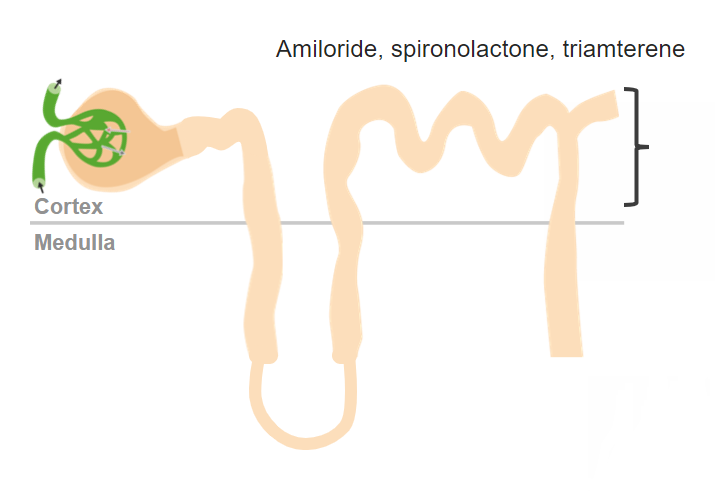
Diuréticos ahorradores de potasio

Los diuréticos ahorradores de potasio actúan en los conductos colectores de la nefrona.

Imagen por Lecturio. Licencia: CC BY-NC-SA 4.0

Descripción general de los LOS Neisseria agentes antihipertensivos

Tabla: Medicamentos utilizados para tratar la hipertensión
Sitio de acción Clase Subclases
Medicamentos renales Medicamentos que afectan al AL Amyloidosis SRAA
  • IECA
  • ARA
  • Inhibidores directos de la renina
Diuréticos
Medicamentos extrarrenales Vasodilatadores directos
  • Bloqueadores de los LOS Neisseria canales de calcio
  • Activadores de los LOS Neisseria canales de potasio
  • Nitrodilatadores
  • Antagonistas de la endotelina
Agentes que actúan a través del sistema nervioso simpático
  • Medicamentos que actúan en EN Erythema nodosum is an immune-mediated panniculitis (inflammation of the subcutaneous fat) caused by a type IV (delayed-type) hypersensitivity reaction. It commonly manifests in young women as tender, erythematous nodules on the shins. Erythema Nodosum la vía eferente simpática del SNC (e.g., clonidina)
  • Medicamentos que actúan en EN Erythema nodosum is an immune-mediated panniculitis (inflammation of the subcutaneous fat) caused by a type IV (delayed-type) hypersensitivity reaction. It commonly manifests in young women as tender, erythematous nodules on the shins. Erythema Nodosum los LOS Neisseria ganglios (e.g., hexametonio)
  • Medicamentos que actúan en EN Erythema nodosum is an immune-mediated panniculitis (inflammation of the subcutaneous fat) caused by a type IV (delayed-type) hypersensitivity reaction. It commonly manifests in young women as tender, erythematous nodules on the shins. Erythema Nodosum las terminales nerviosas (e.g., guanetidina, reserpina)
  • Medicamentos que actúan en EN Erythema nodosum is an immune-mediated panniculitis (inflammation of the subcutaneous fat) caused by a type IV (delayed-type) hypersensitivity reaction. It commonly manifests in young women as tender, erythematous nodules on the shins. Erythema Nodosum los LOS Neisseria receptores α y β

Medicamentos de la clase de los LOS Neisseria diuréticos ahorradores de potasio

Los LOS Neisseria medicamentos de esta clase incluyen:

  • Antagonistas de la aldosterona:
    • Espironolactona
    • Eplerenona
  • Bloqueadores de los LOS Neisseria canales de sodio:
    • Triamtereno
    • Amilorida

Estructura Química y Farmacodinamia

Estructura química

  • Espironolactona y eplerenona: esteroides sintéticos
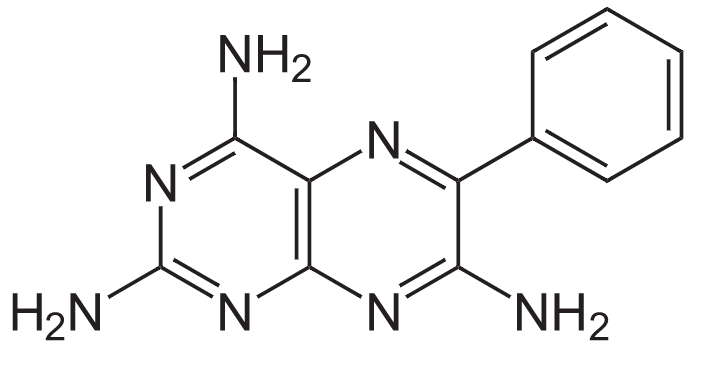
  • Triamtereno: derivado de la pteridina
  • Amilorida: derivado de la pirazina
Estructura del triamtereno

Estructura del triamtereno

Imagen: Estructura del triamtereno por NEUROtiker. Licencia: Dominio Público

Mecanismo de acción y efectos fisiológicos

Antagonistas de la aldosterona (espironolactona, eplerenona):

  • También llamados antagonistas de los LOS Neisseria receptores de mineralocorticoides
  • Mecanismo de acción: Se unen al AL Amyloidosis receptor Receptor Receptors are proteins located either on the surface of or within a cell that can bind to signaling molecules known as ligands (e.g., hormones) and cause some type of response within the cell. Receptors mineralocorticoide basolateral en EN Erythema nodosum is an immune-mediated panniculitis (inflammation of the subcutaneous fat) caused by a type IV (delayed-type) hypersensitivity reaction. It commonly manifests in young women as tender, erythematous nodules on the shins. Erythema Nodosum el conducto colector como antagonista competitivo del receptor Receptor Receptors are proteins located either on the surface of or within a cell that can bind to signaling molecules known as ligands (e.g., hormones) and cause some type of response within the cell. Receptors de aldosterona, bloqueando los LOS Neisseria efectos de la aldosterona.
  • Efectos de la aldosterona:
    • La aldosterona estimula la producción de las siguientes proteínas en EN Erythema nodosum is an immune-mediated panniculitis (inflammation of the subcutaneous fat) caused by a type IV (delayed-type) hypersensitivity reaction. It commonly manifests in young women as tender, erythematous nodules on the shins. Erythema Nodosum las células principales del conducto colector:
      • Na+/K+-ATPasa en EN Erythema nodosum is an immune-mediated panniculitis (inflammation of the subcutaneous fat) caused by a type IV (delayed-type) hypersensitivity reaction. It commonly manifests in young women as tender, erythematous nodules on the shins. Erythema Nodosum la región basolateral
      • ENaC ENaC Sodium channels found on salt-reabsorbing epithelial cells that line the distal nephron; the distal colon; salivary ducts; sweat glands; and the lung. They are amiloride-sensitive and play a critical role in the control of sodium balance, blood volume, and blood pressure. Liddle Syndrome (canal de sodio epitelial) en EN Erythema nodosum is an immune-mediated panniculitis (inflammation of the subcutaneous fat) caused by a type IV (delayed-type) hypersensitivity reaction. It commonly manifests in young women as tender, erythematous nodules on the shins. Erythema Nodosum la región luminal: Permite la reabsorción de Na+ desde el lumen hacia las células principales.
      • Canal medular renal externo de potasio en EN Erythema nodosum is an immune-mediated panniculitis (inflammation of the subcutaneous fat) caused by a type IV (delayed-type) hypersensitivity reaction. It commonly manifests in young women as tender, erythematous nodules on the shins. Erythema Nodosum la porción luminal: Permite la excreción de K+ en EN Erythema nodosum is an immune-mediated panniculitis (inflammation of the subcutaneous fat) caused by a type IV (delayed-type) hypersensitivity reaction. It commonly manifests in young women as tender, erythematous nodules on the shins. Erythema Nodosum la orina.
    • La aldosterona estimula la reabsorción de Na+ en EN Erythema nodosum is an immune-mediated panniculitis (inflammation of the subcutaneous fat) caused by a type IV (delayed-type) hypersensitivity reaction. It commonly manifests in young women as tender, erythematous nodules on the shins. Erythema Nodosum los LOS Neisseria túbulos renales:
      • El agua sigue al AL Amyloidosis Na+.
      • Crea un gradiente eléctrico negativo a través del lumen, promoviendo la secreción de K+ y H+ en EN Erythema nodosum is an immune-mediated panniculitis (inflammation of the subcutaneous fat) caused by a type IV (delayed-type) hypersensitivity reaction. It commonly manifests in young women as tender, erythematous nodules on the shins. Erythema Nodosum la orina.
  • Resultados de los LOS Neisseria antagonistas de la aldosterona:
    • En EN Erythema nodosum is an immune-mediated panniculitis (inflammation of the subcutaneous fat) caused by a type IV (delayed-type) hypersensitivity reaction. It commonly manifests in young women as tender, erythematous nodules on the shins. Erythema Nodosum la reabsorción de Na+ → el agua permanece en EN Erythema nodosum is an immune-mediated panniculitis (inflammation of the subcutaneous fat) caused by a type IV (delayed-type) hypersensitivity reaction. It commonly manifests in young women as tender, erythematous nodules on the shins. Erythema Nodosum el lumen tubular con el Na+ → diuresis.
    • ↓ Excreción de K+ → ahorro de potasio
    • ↓ Excreción de H+ → tendencia a la acidosis Acidosis A pathologic condition of acid accumulation or depletion of base in the body. The two main types are respiratory acidosis and metabolic acidosis, due to metabolic acid build up. Respiratory Acidosis metabólica
  • Efectos antiandrogénicos:
    • Espironolactona (efectos antiandrogénicos significativos):
      • Los LOS Neisseria antagonistas de los LOS Neisseria receptores de mineralocorticoides no selectivos, que también pueden unirse a los LOS Neisseria receptores de estrógeno y progesterona, → pueden ↑ la aromatización de la testosterona a estradiol Estradiol The 17-beta-isomer of estradiol, an aromatized C18 steroid with hydroxyl group at 3-beta- and 17-beta-position. Estradiol-17-beta is the most potent form of mammalian estrogenic steroids. Noncontraceptive Estrogen and Progestins.
      • ↓ Producción de testosterona
      • Se une a los LOS Neisseria receptores de andrógenos e inhibe competitivamente la testosterona y la dihidrotestosterona.
      • Puede ayudar a mejorar el acné, pero también provoca ginecomastia, impotencia, disminución de la libido e irregularidades menstruales.
    • Eplerenona:
      • Más selectiva para el receptor Receptor Receptors are proteins located either on the surface of or within a cell that can bind to signaling molecules known as ligands (e.g., hormones) and cause some type of response within the cell. Receptors mineralocorticoide, con muchos menos efectos antiandrogénicos
      • Es mucho mejor tolerada.
  • Efectos antiinflamatorios ( en EN Erythema nodosum is an immune-mediated panniculitis (inflammation of the subcutaneous fat) caused by a type IV (delayed-type) hypersensitivity reaction. It commonly manifests in young women as tender, erythematous nodules on the shins. Erythema Nodosum dosis bajas de eplerenona):
    • ↓ Defectos de perfusión miocárdica tras un IM → ↓ mortalidad cardíaca
    • Puede frenar la progresión de la albuminuria Albuminuria The presence of albumin in the urine, an indicator of kidney diseases. Kidney Function Tests en EN Erythema nodosum is an immune-mediated panniculitis (inflammation of the subcutaneous fat) caused by a type IV (delayed-type) hypersensitivity reaction. It commonly manifests in young women as tender, erythematous nodules on the shins. Erythema Nodosum pacientes diabéticos.

Bloqueadores de los LOS Neisseria canales de sodio (triamtereno, amilorida):
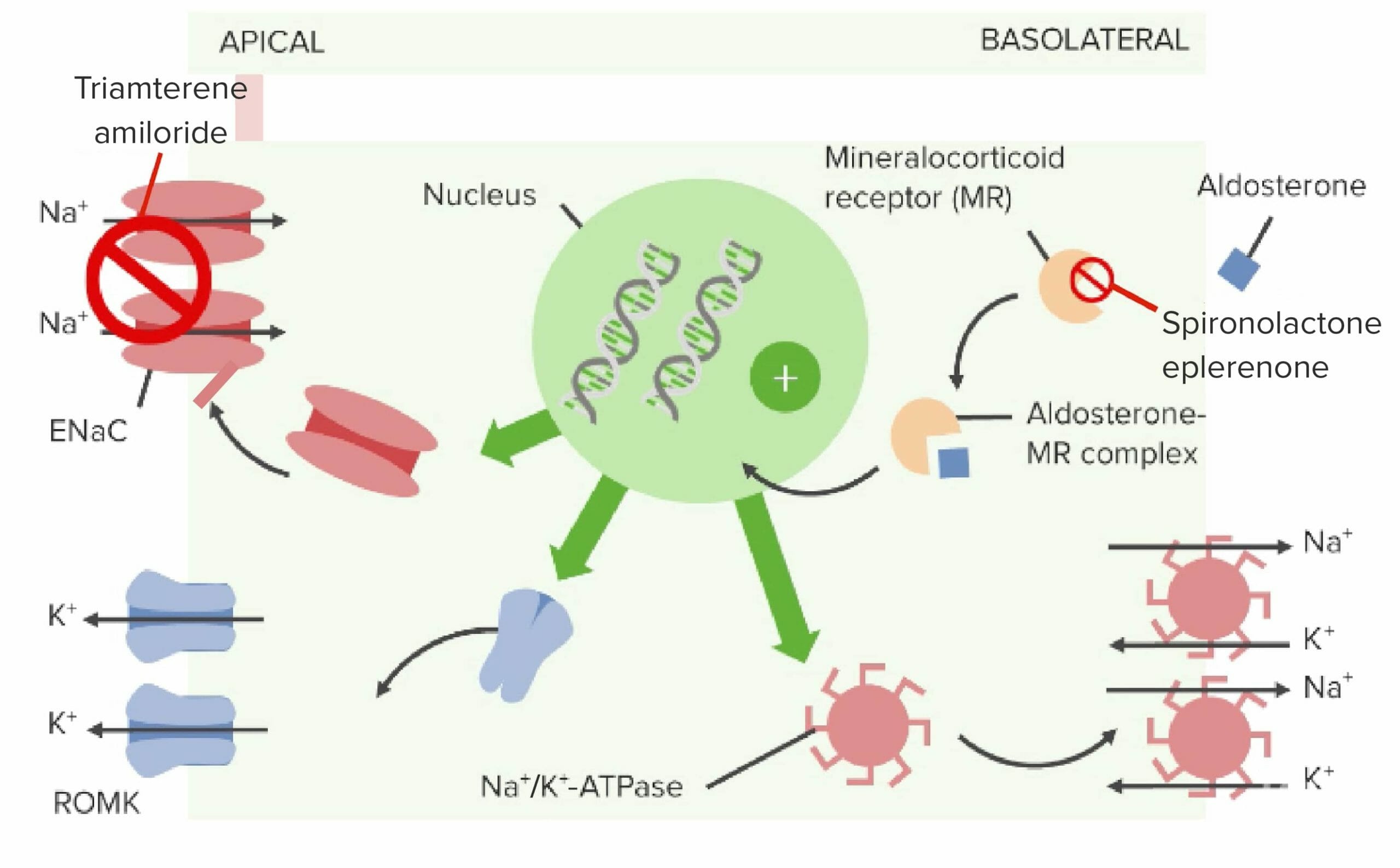
  • Cationes que se unen y bloquean directamente los LOS Neisseria ENaCs en EN Erythema nodosum is an immune-mediated panniculitis (inflammation of the subcutaneous fat) caused by a type IV (delayed-type) hypersensitivity reaction. It commonly manifests in young women as tender, erythematous nodules on the shins. Erythema Nodosum la región apical de las células que recubren los LOS Neisseria túbulos contorneados distales y los LOS Neisseria conductos colectores.
  • Resulta en EN Erythema nodosum is an immune-mediated panniculitis (inflammation of the subcutaneous fat) caused by a type IV (delayed-type) hypersensitivity reaction. It commonly manifests in young women as tender, erythematous nodules on the shins. Erythema Nodosum:
    • ↓ Reabsorción de Na+
    • ↓ Excreción de K+
    • El agua siempre sigue al AL Amyloidosis Na+ → el agua permanece con el Na+ en EN Erythema nodosum is an immune-mediated panniculitis (inflammation of the subcutaneous fat) caused by a type IV (delayed-type) hypersensitivity reaction. It commonly manifests in young women as tender, erythematous nodules on the shins. Erythema Nodosum los LOS Neisseria túbulos ( en EN Erythema nodosum is an immune-mediated panniculitis (inflammation of the subcutaneous fat) caused by a type IV (delayed-type) hypersensitivity reaction. It commonly manifests in young women as tender, erythematous nodules on the shins. Erythema Nodosum lugar de reabsorberse).
  • Efectos fisiológicos:
    • La diuresis es el resultado del efecto osmótico del Na+ en EN Erythema nodosum is an immune-mediated panniculitis (inflammation of the subcutaneous fat) caused by a type IV (delayed-type) hypersensitivity reaction. It commonly manifests in young women as tender, erythematous nodules on the shins. Erythema Nodosum los LOS Neisseria túbulos.
    • No hay pérdida significativa de potasio.
Mechanism of action of aldosterone antagonists and sodium channel blockers

Mecanismo de acción de los antagonistas de la aldosterona y los bloqueadores de los canales de sodio

Imagen por Lecturio.

Farmacocinética

  • Absorción:
    • Todos se absorben bien por vía oral.
    • El efecto máximo se produce a las 2–4 horas aproximadamente.
  • Metabolismo:
    • La espironolactona y el triamtereno se metabolizan en EN Erythema nodosum is an immune-mediated panniculitis (inflammation of the subcutaneous fat) caused by a type IV (delayed-type) hypersensitivity reaction. It commonly manifests in young women as tender, erythematous nodules on the shins. Erythema Nodosum metabolitos activos.
    • La eplerenona se metaboliza en EN Erythema nodosum is an immune-mediated panniculitis (inflammation of the subcutaneous fat) caused by a type IV (delayed-type) hypersensitivity reaction. It commonly manifests in young women as tender, erythematous nodules on the shins. Erythema Nodosum metabolitos inactivos.
    • La amilorida no se metaboliza hepáticamente.
  • Excreción: principalmente por los LOS Neisseria riñones; secundariamente por la bilis/heces
Tabla: Farmacocinética de los LOS Neisseria diuréticos ahorradores de potasio
Medicamento Absorción Distribución Metabolismo Excreción
Espironolactona
  • Biodisponibilidad: aproximadamente el 90% cuando se toma con alimentos
  • Efecto máximo: aproximadamente 2,5–4 horas
Unión a proteínas: > 90% Metabolismo hepático rápido y extenso a metabolitos activos
  • Orina (principalmente en EN Erythema nodosum is an immune-mediated panniculitis (inflammation of the subcutaneous fat) caused by a type IV (delayed-type) hypersensitivity reaction. It commonly manifests in young women as tender, erythematous nodules on the shins. Erythema Nodosum forma de metabolitos)
  • Bilis (secundaria)
Eplerenona
  • Biodisponibilidad: aproximadamente el 70%
  • Efecto máximo: 2 horas
  • VD: 42–90 L
  • Unión a proteínas: 50%
Metabolismo hepático por CYP3A4 CYP3A4 Class 3 Antiarrhythmic Drugs (Potassium Channel Blockers) a metabolitos inactivos
  • Orina (67%)
  • Heces (32%)
  • Vida media: 3–6 horas
Triamtereno
  • Se absorbe rápidamente.
  • Biodisponibilidad: 50%
  • Efecto máximo: 3 horas
VD: 1,5 L/kg Metabolismo hepático por CYP1A2 a metabolitos activos Se excreta por vía renal.
Amilorida
  • Se absorbe rápidamente.
  • Efecto máximo: 3–4 horas
  • VD: 350–380 L
  • Unión a proteínas: mínima
No se metaboliza.
  • Orina (50%)
  • Heces (40%)
  • Vida media: 6–9 horas
VD: volumen de distribución

Indicaciones

Indicaciones generales

Los LOS Neisseria diuréticos ahorradores de potasio son los LOS Neisseria más útiles para tratar el edema Edema Edema is a condition in which excess serous fluid accumulates in the body cavity or interstitial space of connective tissues. Edema is a symptom observed in several medical conditions. It can be categorized into 2 types, namely, peripheral (in the extremities) and internal (in an organ or body cavity). Edema relacionado con estados de exceso de mineralocorticoides, que pueden ser primarios o secundarios. Las indicaciones incluyen:

  • Edema Edema Edema is a condition in which excess serous fluid accumulates in the body cavity or interstitial space of connective tissues. Edema is a symptom observed in several medical conditions. It can be categorized into 2 types, namely, peripheral (in the extremities) and internal (in an organ or body cavity). Edema por causas primarias de exceso de mineralocorticoides:
    • Síndrome de Conn
    • Producción ectópica de la hormona adrenocorticotrópica (ACTH, por sus siglas en EN Erythema nodosum is an immune-mediated panniculitis (inflammation of the subcutaneous fat) caused by a type IV (delayed-type) hypersensitivity reaction. It commonly manifests in young women as tender, erythematous nodules on the shins. Erythema Nodosum inglés)
  • Edemas debidos a estados de disminución del volumen intravascular, que resultan de un exceso secundario de mineralocorticoides:
    • Insuficiencia cardíaca/post-IM (especialmente eplerenona)
    • Cirrosis
    • Síndrome nefrótico
    • Hipertensión resistente (normalmente además de los LOS Neisseria antihipertensivos de 1.ra línea)

Indicaciones únicas de la espironolactona

La espironolactona tiene indicaciones adicionales debido a sus propiedades antiandrogénicas:

  • Estados de hiperandrogenismo en EN Erythema nodosum is an immune-mediated panniculitis (inflammation of the subcutaneous fat) caused by a type IV (delayed-type) hypersensitivity reaction. It commonly manifests in young women as tender, erythematous nodules on the shins. Erythema Nodosum las mujeres, incluyendo:
    • Acné vulgar
    • Hirsutismo
    • Síndrome de ovario poliquístico
    • Hiperplasia suprarrenal congénita
  • Terapia hormonal para mujeres transgénero (hombre a mujer)

Efectos Secundarios y Contraindicaciones

Efectos secundarios de los LOS Neisseria diuréticos ahorradores de potasio

  • Alteraciones en EN Erythema nodosum is an immune-mediated panniculitis (inflammation of the subcutaneous fat) caused by a type IV (delayed-type) hypersensitivity reaction. It commonly manifests in young women as tender, erythematous nodules on the shins. Erythema Nodosum fluidos y electrolitos:
    • Hiperpotasemia (↑ K+)
    • Acidosis Acidosis A pathologic condition of acid accumulation or depletion of base in the body. The two main types are respiratory acidosis and metabolic acidosis, due to metabolic acid build up. Respiratory Acidosis metabólica hiperclorémica
    • Hiponatremia (↓ Na+)
    • Hipomagnesemia (↓ Mg2+)
    • Hipocalcemia (↓ Ca CA Condylomata acuminata are a clinical manifestation of genital HPV infection. Condylomata acuminata are described as raised, pearly, flesh-colored, papular, cauliflower-like lesions seen in the anogenital region that may cause itching, pain, or bleeding. Condylomata Acuminata (Genital Warts)2+)
    • Hipovolemia
  • Síntomas:
    • Mareos
    • Cefalea
    • Calambres musculares
    • Malestar gastrointestinal: cólicos abdominales, náuseas, vómitos, diarrea
    • Fotosensibilidad (triamtereno)
  • Efectos adicionales específicos de la espironolactona (relacionados con sus propiedades antiandrogénicas):
    • Ginecomastia
    • Impotencia y ↓ libido
    • Anomalías menstruales

Contraindicaciones

  • Hiperpotasemia
  • Enfermedad de Addison/insuficiencia suprarrenal
  • Anuria Anuria Absence of urine formation. It is usually associated with complete bilateral ureteral (ureter) obstruction, complete lower urinary tract obstruction, or unilateral ureteral obstruction when a solitary kidney is present. Acute Kidney Injury o ERC severa/progresiva
  • Enfermedad hepática grave
  • Embarazo (especialmente los LOS Neisseria antagonistas de la aldosterona, que pueden causar la feminización del feto masculino)

Precauciones

  • Diabetes Diabetes Diabetes mellitus (DM) is a metabolic disease characterized by hyperglycemia and dysfunction of the regulation of glucose metabolism by insulin. Type 1 DM is diagnosed mostly in children and young adults as the result of autoimmune destruction of β cells in the pancreas and the resulting lack of insulin. Type 2 DM has a significant association with obesity and is characterized by insulin resistance. Diabetes Mellitus (especialmente triamtereno y amilorida)
  • Gota
  • Lactancia

Comparación de Medicamentos

Algunos de los LOS Neisseria otros diuréticos más comunes son los LOS Neisseria diuréticos tiazídicos (e.g., la hidroclorotiazida), los LOS Neisseria diuréticos de asa ASA Anterior Cord Syndrome (e.g., la furosemida), los LOS Neisseria inhibidores de la anhidrasa carbónica (e.g., la acetazolamida) y los LOS Neisseria diuréticos osmóticos (e.g., el manitol).

Tabla: Comparación de los LOS Neisseria diuréticos
Medicamento Mecanismo Efecto fisiológico Indicación
Diurético tiazídico: Hidroclorotiazida ↓ Reabsorción de NaCl en EN Erythema nodosum is an immune-mediated panniculitis (inflammation of the subcutaneous fat) caused by a type IV (delayed-type) hypersensitivity reaction. It commonly manifests in young women as tender, erythematous nodules on the shins. Erythema Nodosum el DCT a través de la inhibición del cotransportador de Na+/Cl
  • ↓ Presión arterial
  • Edema Edema Edema is a condition in which excess serous fluid accumulates in the body cavity or interstitial space of connective tissues. Edema is a symptom observed in several medical conditions. It can be categorized into 2 types, namely, peripheral (in the extremities) and internal (in an organ or body cavity). Edema
  • Hipertensión
  • Edema Edema Edema is a condition in which excess serous fluid accumulates in the body cavity or interstitial space of connective tissues. Edema is a symptom observed in several medical conditions. It can be categorized into 2 types, namely, peripheral (in the extremities) and internal (in an organ or body cavity). Edema
Diurético de asa ASA Anterior Cord Syndrome: Furosemida Inhibe el cotransportador luminal de Na+/K+/Cl en EN Erythema nodosum is an immune-mediated panniculitis (inflammation of the subcutaneous fat) caused by a type IV (delayed-type) hypersensitivity reaction. It commonly manifests in young women as tender, erythematous nodules on the shins. Erythema Nodosum la rama ascendente gruesa del asa ASA Anterior Cord Syndrome de Henle.
  • Edema Edema Edema is a condition in which excess serous fluid accumulates in the body cavity or interstitial space of connective tissues. Edema is a symptom observed in several medical conditions. It can be categorized into 2 types, namely, peripheral (in the extremities) and internal (in an organ or body cavity). Edema
  • ↓ Presión arterial
  • Edema Edema Edema is a condition in which excess serous fluid accumulates in the body cavity or interstitial space of connective tissues. Edema is a symptom observed in several medical conditions. It can be categorized into 2 types, namely, peripheral (in the extremities) and internal (in an organ or body cavity). Edema/ascitis
  • Insuficiencia cardíaca
  • Hipertensión
Diurético ahorrador de potasio: Espironolactona
  • ↓ Reabsorción de Na a través de los LOS Neisseria canales ENaC ENaC Sodium channels found on salt-reabsorbing epithelial cells that line the distal nephron; the distal colon; salivary ducts; sweat glands; and the lung. They are amiloride-sensitive and play a critical role in the control of sodium balance, blood volume, and blood pressure. Liddle Syndrome en EN Erythema nodosum is an immune-mediated panniculitis (inflammation of the subcutaneous fat) caused by a type IV (delayed-type) hypersensitivity reaction. It commonly manifests in young women as tender, erythematous nodules on the shins. Erythema Nodosum el túbulo colector
  • Inhibición de los LOS Neisseria receptores de aldosterona en EN Erythema nodosum is an immune-mediated panniculitis (inflammation of the subcutaneous fat) caused by a type IV (delayed-type) hypersensitivity reaction. It commonly manifests in young women as tender, erythematous nodules on the shins. Erythema Nodosum el túbulo colector
  • ↓ Presión arterial
  • Edema Edema Edema is a condition in which excess serous fluid accumulates in the body cavity or interstitial space of connective tissues. Edema is a symptom observed in several medical conditions. It can be categorized into 2 types, namely, peripheral (in the extremities) and internal (in an organ or body cavity). Edema
  • No causa ↑ excreción de K+.
  • Efectos antiandrogénicos
  • Insuficiencia cardíaca
  • Edema Edema Edema is a condition in which excess serous fluid accumulates in the body cavity or interstitial space of connective tissues. Edema is a symptom observed in several medical conditions. It can be categorized into 2 types, namely, peripheral (in the extremities) and internal (in an organ or body cavity). Edema/ascitis
  • Hipertensión
  • Hirsutismo en EN Erythema nodosum is an immune-mediated panniculitis (inflammation of the subcutaneous fat) caused by a type IV (delayed-type) hypersensitivity reaction. It commonly manifests in young women as tender, erythematous nodules on the shins. Erythema Nodosum las mujeres
  • Hiperaldosteronismo primario
Inhibidor de la anhidrasa carbónica: Acetazolamida Inhibe tanto la hidratación del CO2 en EN Erythema nodosum is an immune-mediated panniculitis (inflammation of the subcutaneous fat) caused by a type IV (delayed-type) hypersensitivity reaction. It commonly manifests in young women as tender, erythematous nodules on the shins. Erythema Nodosum las células epiteliales del PCT como la deshidratación del H2CO3 en EN Erythema nodosum is an immune-mediated panniculitis (inflammation of the subcutaneous fat) caused by a type IV (delayed-type) hypersensitivity reaction. It commonly manifests in young women as tender, erythematous nodules on the shins. Erythema Nodosum el lumen del PCT; provocando una excreción ↑ HCO3y Na+.
  • ↑ Excreción urinaria de HCO3 acidosis Acidosis A pathologic condition of acid accumulation or depletion of base in the body. The two main types are respiratory acidosis and metabolic acidosis, due to metabolic acid build up. Respiratory Acidosis metabólica.
  • ↓ Presión intraocular
  • Edema Edema Edema is a condition in which excess serous fluid accumulates in the body cavity or interstitial space of connective tissues. Edema is a symptom observed in several medical conditions. It can be categorized into 2 types, namely, peripheral (in the extremities) and internal (in an organ or body cavity). Edema en EN Erythema nodosum is an immune-mediated panniculitis (inflammation of the subcutaneous fat) caused by a type IV (delayed-type) hypersensitivity reaction. It commonly manifests in young women as tender, erythematous nodules on the shins. Erythema Nodosum pacientes con alcalosis metabólica
  • Enfermedad de las alturas
  • ↑ Presión intraocular
  • Uso fuera de indicación: hidrocefalia de presión normal
Diuréticos osmóticos: Manitol ↑ Presión osmótica en EN Erythema nodosum is an immune-mediated panniculitis (inflammation of the subcutaneous fat) caused by a type IV (delayed-type) hypersensitivity reaction. It commonly manifests in young women as tender, erythematous nodules on the shins. Erythema Nodosum el filtrado glomerular → ↑ líquido tubular e impide la reabsorción de agua.
  • ↓ Agua libre
  • ↓ Volumen sanguíneo cerebral
  • Aumento de la presión intracraneal
  • Aumento de la presión intraocular
PCT: túbulo contorneado proximal, por sus siglas en inglés
DCT: túbulo contorneado distal, por sus siglas en inglés
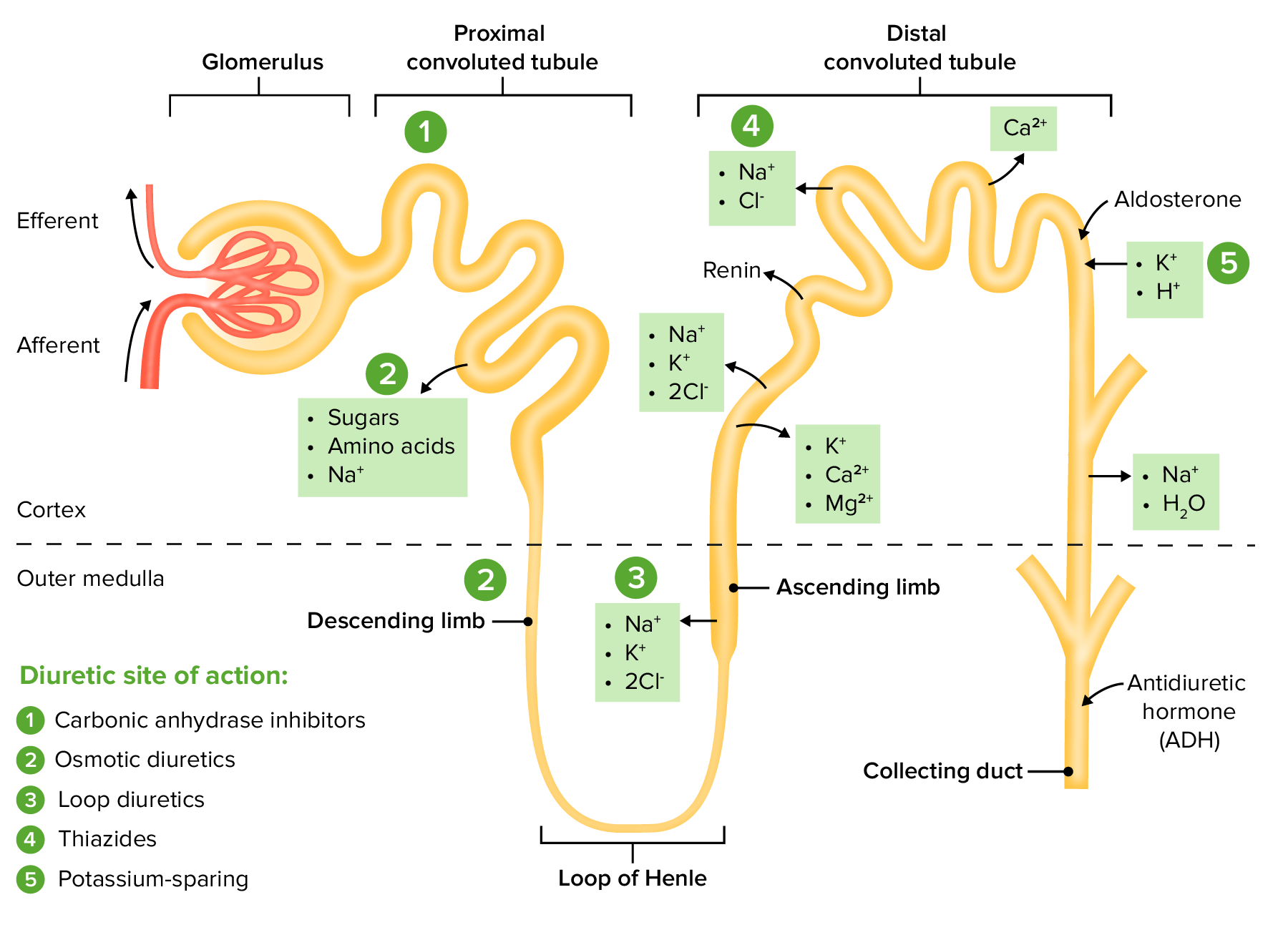
Diuréticos

Sitios de acción, dentro de la nefrona, para las clases de medicamentos diuréticos

Imagen por Lecturio. Licencia: CC BY-NC-SA 4.0

Referencias

  1. Ives, H.E. (2012). Agentes diuréticos. In Katzung, B.G., Masters, S.B., Trevor, A.J. (Eds.), Basic and Clinical Pharmacology, 12th ed. pp. 261–263.
  2. National Center for Biotechnology Information (2021). PubChem compound summary for CID 5546, triamterene. Retrieved June 15, 2021, from https://pubchem.ncbi.nlm.nih.gov/compound/Triamterene.
  3. National Center for Biotechnology Information. (2021). PubChem compound summary for CID 5833, sSpironolactone. Retrieved June 15, 2021, from https://pubchem.ncbi.nlm.nih.gov/compound/Spironolactone.
  4. Pitt, B., et al. (1999). The effect of spironolactone on morbidity and mortality in patients with severe heart failure. Randomized Aldactone Evaluation Study Investigators. New England Journal of Medicine 341:709–717. https://pubmed.ncbi.nlm.nih.gov/10471456/
  5. Yancy, C.W., et al. (2017). ACC/AHA/HFSA focused update of the 2013 ACCF/AHA guideline for the management of heart failure: a report of the American College of Cardiology/American Heart Association Task Force on Clinical Practice Guidelines and the Heart Failure Society of America. Journal of Cardiac Failure 23:628–651. https://pubmed.ncbi.nlm.nih.gov/28461259/
  6. McDiarmid, A.K., et al. (2020). Myocardial Effects of Aldosterone Antagonism in Heart Failure With Preserved Ejection Fraction. Journal of the American Heart Association. 9(1), e011521https://pubmed.ncbi.nlm.nih.gov/31852424/
  7. Agrawal, S., et al. (2015). Heart failure and chronic kidney disease: should we use spironolactone? American Journal of the Medical Sciences 350:147–151. https://pubmed.ncbi.nlm.nih.gov/26086152/
  8. Yang, C.T., et al. (2018). Long-Term Effects of spironolactone on kidney function and hyperkalemia-associated hospitalization in patients with chronic kidney disease. Journal of Clinical Medicine 7:459. https://pubmed.ncbi.nlm.nih.gov/30469400/
  9. Nishizaka, M.K., Zaman, M.A., Calhoun, D.A. (2003). Efficacy of low-dose spironolactone in subjects with resistant hypertension. American Journal of Hypertension 16(11 Pt 1):925–930. https://pubmed.ncbi.nlm.nih.gov/14573330/
  10. Tu, W., et al. (2016). Triamterene enhances the blood pressure lowering effect of hydrochlorothiazide in patients with hypertension. Journal of General Internal Medicine 31:30–36. https://pubmed.ncbi.nlm.nih.gov/26194642/
  11. Hoorn, E.J., Ellison, D.H. (2017). Diuretic resistance. American Journal of Kidney Diseases 69:136–142. https://pubmed.ncbi.nlm.nih.gov/27814935/
  12. Knauf, H., Wais, U., Albiez, G., Lübcke, R. (1976). Inhibition of the exchange of Na for K and and H by triamterene (in epithelia)(author’s transl.). Arzneimittel-Forschung 26:484–486. https://pubmed.ncbi.nlm.nih.gov/133688/
  13. Horisberger, J.D., Giebisch, G. (1987). Potassium-sparing diuretics. Renal Physiology 10:198–220. https://pubmed.ncbi.nlm.nih.gov/2455308/
  14. Ettinger, B., Oldroyd, N.O., Sörgel, F. (1980). Triamterene nephrolithiasis. JAMA 244:2443-2445. https://pubmed.ncbi.nlm.nih.gov/7431573/
  15. Thürmann, P.A. (2016). Influence of drugs on urological diseases. Der Urologe 55:401-409. https://pubmed.ncbi.nlm.nih.gov/26908119/
  16. Nolan, P.J, D’Arcy, G. (1987). Triamterene drug fever and hepatitis. Medical Journal of Australia 147:262. https://pubmed.ncbi.nlm.nih.gov/3670184/
  17. Nasr, S.H., et al. (2014). Triamterene crystalline nephropathy. American Journal of Kidney Diseases 63:148-152. https://pubmed.ncbi.nlm.nih.gov/23958399/
  18. Tetti, M., et al. (2018). Liddle syndrome: review of the literature and description of a new case. Int J Mol Sci 19:812. https://pubmed.ncbi.nlm.nih.gov/29534496/
  19. Viswanathan, V., et al. (2013). Effect of spironolactone and amiloride on thiazolidinedione-induced fluid retention in South Indian patients with type 2 diabetes. Clin J Am Soc Nephrol 8:225-232. https://pubmed.ncbi.nlm.nih.gov/23184569/
  20. Pattanayak, R.D., et al. (2017). Lithium-induced polyuria and amiloride: key issues and considerations. Indian J Psychiatry 59:391-392. https://pubmed.ncbi.nlm.nih.gov/29085107/
  21. Tomkiewicz, R.P., et al. (1993). Amiloride inhalation therapy in cystic fibrosis: influence on ion content, hydration, and rheology of sputum. Am Rev Respir Dis 148(4 Pt 1):1002-1007. https://pubmed.ncbi.nlm.nih.gov/8214916/

¡Crea tu cuenta gratis o inicia una sesión para seguir leyendo!

Regístrate ahora y obtén acceso gratuito a Lecturio con páginas de concepto, videos médicos y cuestionarios para tu educación médica.

User Reviews

Que tengas una sesión de estudio alegre y navideña 🎁 Ahorra 50% en todos los planes >>

Details