


Herpesvírus Humano 8

O herpesvírus humano 8, também conhecido como herpesvírus associado ao sarcoma de Kaposi Kaposi A multicentric, malignant neoplastic vascular proliferation characterized by the development of bluish-red cutaneous nodules, usually on the lower extremities, most often on the toes or feet, and slowly increasing in size and number and spreading to more proximal areas. The tumors have endothelium-lined channels and vascular spaces admixed with variably sized aggregates of spindle-shaped cells, and often remain confined to the skin and subcutaneous tissue, but widespread visceral involvement may occur. Hhv-8 is the suspected cause. There is also a high incidence in AIDS patients. AIDS-defining Conditions, é um vírus de DNA DNA A deoxyribonucleotide polymer that is the primary genetic material of all cells. Eukaryotic and prokaryotic organisms normally contain DNA in a double-stranded state, yet several important biological processes transiently involve single-stranded regions. DNA, which consists of a polysugar-phosphate backbone possessing projections of purines (adenine and guanine) and pyrimidines (thymine and cytosine), forms a double helix that is held together by hydrogen bonds between these purines and pyrimidines (adenine to thymine and guanine to cytosine). DNA Types and Structure de cadeia dupla, pertencente à família Herpesviridae Herpesviridae A family of enveloped, linear, double-stranded DNA viruses infecting a wide variety of animals. Subfamilies, based on biological characteristics, include: alphaherpesvirinae; betaherpesvirinae; and gammaherpesvirinae. Herpes Simplex Virus 1 and 2. Este vírus oncogénico é raro e causa sarcoma de Kaposi Kaposi A multicentric, malignant neoplastic vascular proliferation characterized by the development of bluish-red cutaneous nodules, usually on the lower extremities, most often on the toes or feet, and slowly increasing in size and number and spreading to more proximal areas. The tumors have endothelium-lined channels and vascular spaces admixed with variably sized aggregates of spindle-shaped cells, and often remain confined to the skin and subcutaneous tissue, but widespread visceral involvement may occur. Hhv-8 is the suspected cause. There is also a high incidence in AIDS patients. AIDS-defining Conditions (uma condição definidora de SIDA), linfomas de efusão primária e doença de Castleman multicêntrica, sobretudo em pacientes imunodeprimidos. O processo ocorre através da indução da atividade de crescimento celular e da inibição da apoptose nas células infetadas.

Last updated: Dec 15, 2025
Editorial responsibility: Stanley Oiseth, Lindsay Jones, Evelin Maza

Classificação

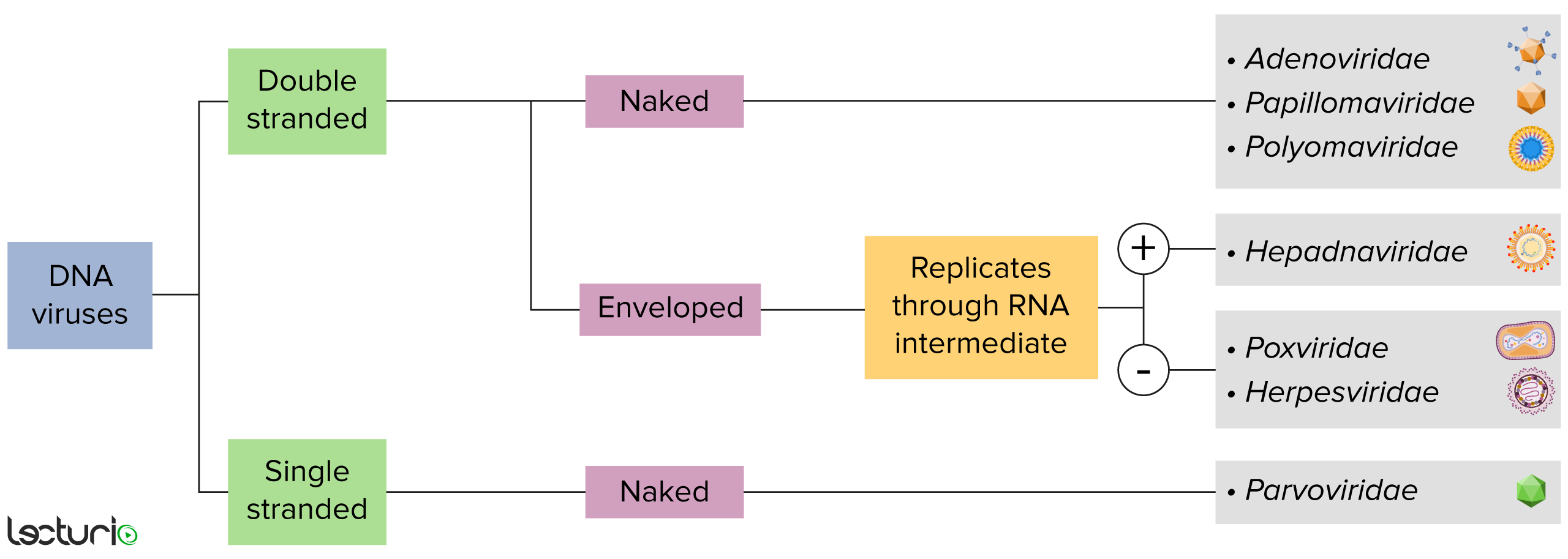
Fluxograma de classificação de vírus de DNA

Identificação de vírus de DNA:
Os vírus podem ser classificados de várias formas. Contudo, a maioria dos vírus possui um genoma formado por DNA ou RNA. Os vírus com genoma de DNA podem ainda ser caracterizados como de cadeia simples ou dupla. Os vírus com envelope são revestidos por uma camada fina de membrana celular, que geralmente é retirada da célula hospedeira. Os vírus sem envelope são apelidados de vírus “nus”. Alguns vírus com envelope traduzem DNA em RNA antes de serem incorporados no genoma da célula hospedeira.

Imagem por Lecturio. Licença: CC BY-NC-SA 4.0

Características Gerais e Epidemiologia

Características gerais do herpesvírus humano 8 (HHV-8)

  • Também conhecido como herpesvírus associado ao sarcoma de Kaposi Kaposi A multicentric, malignant neoplastic vascular proliferation characterized by the development of bluish-red cutaneous nodules, usually on the lower extremities, most often on the toes or feet, and slowly increasing in size and number and spreading to more proximal areas. The tumors have endothelium-lined channels and vascular spaces admixed with variably sized aggregates of spindle-shaped cells, and often remain confined to the skin and subcutaneous tissue, but widespread visceral involvement may occur. Hhv-8 is the suspected cause. There is also a high incidence in AIDS patients. AIDS-defining Conditions
  • Taxonomia:
    • Família: Herpesviridae Herpesviridae A family of enveloped, linear, double-stranded DNA viruses infecting a wide variety of animals. Subfamilies, based on biological characteristics, include: alphaherpesvirinae; betaherpesvirinae; and gammaherpesvirinae. Herpes Simplex Virus 1 and 2
    • Subfamília: Gammaherpesvirinae Gammaherpesvirinae A subfamily of herpesviridae characterized by variable reproductive cycles. The genera include: lymphocryptovirus and rhadinovirus. Epstein-Barr Virus
    • Género: Radinovírus
  • Vírus DNA DNA A deoxyribonucleotide polymer that is the primary genetic material of all cells. Eukaryotic and prokaryotic organisms normally contain DNA in a double-stranded state, yet several important biological processes transiently involve single-stranded regions. DNA, which consists of a polysugar-phosphate backbone possessing projections of purines (adenine and guanine) and pyrimidines (thymine and cytosine), forms a double helix that is held together by hydrogen bonds between these purines and pyrimidines (adenine to thymine and guanine to cytosine). DNA Types and Structure:
    • Cadeia dupla
    • Linear
  • Estrutura:
    • Núcleo de DNA DNA A deoxyribonucleotide polymer that is the primary genetic material of all cells. Eukaryotic and prokaryotic organisms normally contain DNA in a double-stranded state, yet several important biological processes transiently involve single-stranded regions. DNA, which consists of a polysugar-phosphate backbone possessing projections of purines (adenine and guanine) and pyrimidines (thymine and cytosine), forms a double helix that is held together by hydrogen bonds between these purines and pyrimidines (adenine to thymine and guanine to cytosine). DNA Types and Structure
    • Constituído por uma cápside icosaédrica
    • Tegumento
    • Envelope Envelope Bilayer lipid membrane acquired by viral particles during viral morphogenesis. Although the lipids of the viral envelope are host derived, various virus-encoded integral membrane proteins, i.e. Viral envelope proteins are incorporated there. Virology lipídico com glicoproteínas “spike”

Doenças associadas

  • Sarcoma de Kaposi Kaposi A multicentric, malignant neoplastic vascular proliferation characterized by the development of bluish-red cutaneous nodules, usually on the lower extremities, most often on the toes or feet, and slowly increasing in size and number and spreading to more proximal areas. The tumors have endothelium-lined channels and vascular spaces admixed with variably sized aggregates of spindle-shaped cells, and often remain confined to the skin and subcutaneous tissue, but widespread visceral involvement may occur. Hhv-8 is the suspected cause. There is also a high incidence in AIDS patients. AIDS-defining Conditions ( tumor Tumor Inflammation maligno vascular)
  • Doença multicêntrica de Castleman (doença linfoproliferativa de células B)
  • Linfomas primários de efusão (linfoma não Hodgkin)

Epidemiologia

  • Os tumores associados ao HHV-8 representam <1% de todos os cancros a nível mundial.
  • Idade: o risco de sarcoma de Kaposi Kaposi A multicentric, malignant neoplastic vascular proliferation characterized by the development of bluish-red cutaneous nodules, usually on the lower extremities, most often on the toes or feet, and slowly increasing in size and number and spreading to more proximal areas. The tumors have endothelium-lined channels and vascular spaces admixed with variably sized aggregates of spindle-shaped cells, and often remain confined to the skin and subcutaneous tissue, but widespread visceral involvement may occur. Hhv-8 is the suspected cause. There is also a high incidence in AIDS patients. AIDS-defining Conditions aumenta com o declínio da imunidade celular em indivíduos mais MAIS Androgen Insensitivity Syndrome velhos.
  • Mais MAIS Androgen Insensitivity Syndrome comum:
    • Região mediterrânica
    • África Subsariana (endémica)
  • Homens > mulheres, sobretudo em homens que fazem sexo com homens

Patogénese

Reservatório

Os humanos são o único reservatório conhecido.

Transmissão

O mecanismo de transmissão do vírus ainda não está totalmente esclarecido.

  • Segundo a evidência atual ocorre sobretudo através de:
    • Saliva Saliva The clear, viscous fluid secreted by the salivary glands and mucous glands of the mouth. It contains mucins, water, organic salts, and ptyalin. Salivary Glands: Anatomy
    • Contacto sexual
  • Estão descritos alguns casos de transmissão por transplante de sangue e órgãos sólidos.

Fatores de risco do hospedeiro

A infeção pelo herpesvírus humano 8 é maioritariamente assintomática. As manifestações clínicas podem ocorrer em pacientes imunodeprimidos:

  • VIH/SIDA (o sarcoma de Kaposi Kaposi A multicentric, malignant neoplastic vascular proliferation characterized by the development of bluish-red cutaneous nodules, usually on the lower extremities, most often on the toes or feet, and slowly increasing in size and number and spreading to more proximal areas. The tumors have endothelium-lined channels and vascular spaces admixed with variably sized aggregates of spindle-shaped cells, and often remain confined to the skin and subcutaneous tissue, but widespread visceral involvement may occur. Hhv-8 is the suspected cause. There is also a high incidence in AIDS patients. AIDS-defining Conditions é uma condição definidora de SIDA)
  • Pacientes transplantados

Ciclo de replicação viral

  • Processo:
    • O vírus liga-se às células hospedeiras com glicoproteínas de superfície → entrada
    • Pode levar a:
      • Fase de latência → produção de proteínas que promovem a oncogénese
      • Fase de replicação lítica
  • Infeta:
    • Células epiteliais
    • Células endoteliais
    • Linfócitos
  • A latência ocorre em:
    • Linfócitos B
    • Células endoteliais vasculares

Fisiopatologia

  • O vírus é transmitido pela saliva Saliva The clear, viscous fluid secreted by the salivary glands and mucous glands of the mouth. It contains mucins, water, organic salts, and ptyalin. Salivary Glands: Anatomy → replica-se nas células epiteliais da orofaringe
  • Leva à infeção de células B e células endoteliais → pode ocorrer latência viral
  • A infeção é controlada pelo sistema imune.
  • Se o paciente ficar imunodeprimido → reativação do vírus latente → mais MAIS Androgen Insensitivity Syndrome células são infetadas
  • As proteínas virais interagem com as vias celulares, atuando através do/a:
    • ↑ Atividade do fator de crescimento celular → proliferação
    • Inibição de genes Genes A category of nucleic acid sequences that function as units of heredity and which code for the basic instructions for the development, reproduction, and maintenance of organisms. DNA Types and Structure de supressão tumoral → previne a apoptose
  • Isto pode potenciar a:
    • Angiogénese
    • Oncogénese

Doenças Causadas por HHV-8

Tabela: Doenças causadas por HHV-8
Doença Apresentação clínica Diagnóstico Tratamento
Sarcoma de Kaposi Kaposi A multicentric, malignant neoplastic vascular proliferation characterized by the development of bluish-red cutaneous nodules, usually on the lower extremities, most often on the toes or feet, and slowly increasing in size and number and spreading to more proximal areas. The tumors have endothelium-lined channels and vascular spaces admixed with variably sized aggregates of spindle-shaped cells, and often remain confined to the skin and subcutaneous tissue, but widespread visceral involvement may occur. Hhv-8 is the suspected cause. There is also a high incidence in AIDS patients. AIDS-defining Conditions Lesões vasculares malignas da/o:
  • Pele
  • Mucosa
  • Trato GI
  • Trato respiratório
Biópsia das lesões
  • Otimização da terapêutica antirretroviral
  • Quimioterapia intralesional ou sistémica
Doença multicêntrica de Castleman
  • Febre
  • Linfadenopatia generalizada
  • Hepatoesplenomegalia
  • Biópsia do gânglio linfático
  • Coloração imuno-histoquímica
  • PCR PCR Polymerase chain reaction (PCR) is a technique that amplifies DNA fragments exponentially for analysis. The process is highly specific, allowing for the targeting of specific genomic sequences, even with minuscule sample amounts. The PCR cycles multiple times through 3 phases: denaturation of the template DNA, annealing of a specific primer to the individual DNA strands, and synthesis/elongation of new DNA molecules. Polymerase Chain Reaction (PCR) para detetar o DNA DNA A deoxyribonucleotide polymer that is the primary genetic material of all cells. Eukaryotic and prokaryotic organisms normally contain DNA in a double-stranded state, yet several important biological processes transiently involve single-stranded regions. DNA, which consists of a polysugar-phosphate backbone possessing projections of purines (adenine and guanine) and pyrimidines (thymine and cytosine), forms a double helix that is held together by hydrogen bonds between these purines and pyrimidines (adenine to thymine and guanine to cytosine). DNA Types and Structure viral
  • Otimização da terapêutica antirretroviral
  • Quimioterapia
  • Agentes imunológicos
Linfomas primários de efusão As manifestações dependem do local de acumulação de líquido:
  • Derrame pleural
  • Derrame pericárdico
  • Ascite
  • Derrame articular
  • Análise das células malignas do derrame
  • Coloração imuno-histoquímica
  • Otimização da terapêutica antirretroviral
  • Quimioterapia
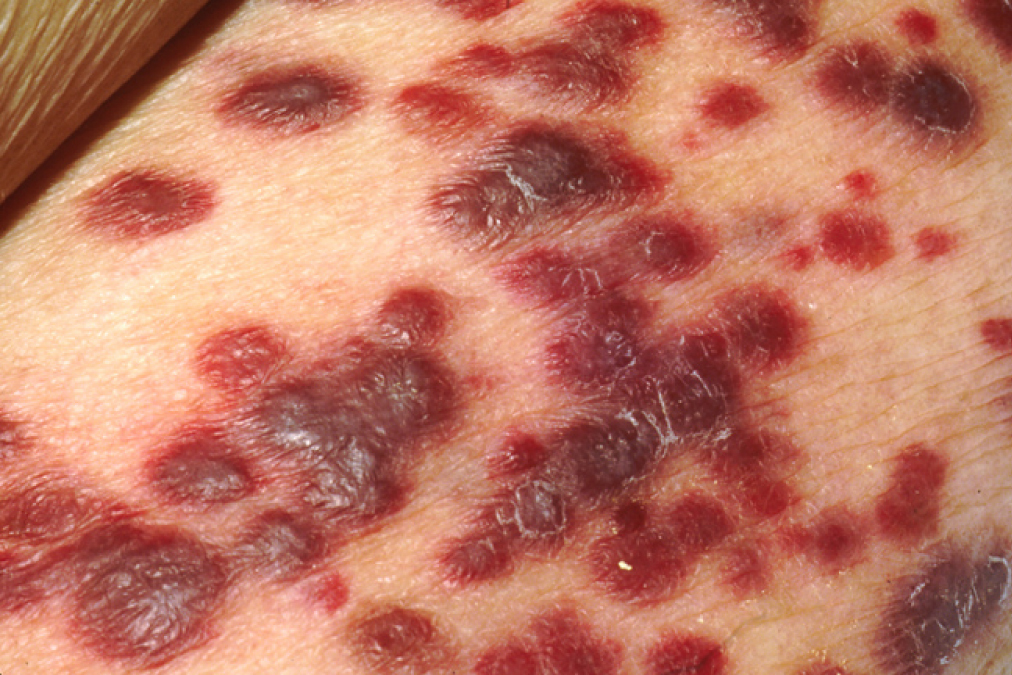
Sarcoma de Kaposi Herpesvírus humano 8

Lesões cutâneas do sarcoma de Kaposi

Imagem: “Kaposi’s sarcoma” por OpenStax College. Licença: CC BY 3.0

Comparação de Herpesvírus

A tabela abaixo compara os 9 herpesvírus considerados endémicos em humanos; existem 115 espécies diferentes de herpesvírus no total, agrupadas em 3 famílias:

  • Alfa (infeta células epiteliais e produz infeção latente em neurónios pós-mitóticos)
  • Beta (infetar e produz infeção latente em vários tipos de células)
  • Gama (produz infeção latente, sobretudo em células linfóides)
Tabela: Comparação dos 9 herpesvírus considerados endémicos em humanos
HHV Nome comum Principais células-alvo Local de latência Apresentação clínica*
1
(grupo alfa)
HSV-1 Células mucoepiteliais Gânglios da raiz dorsal
  • Gengivoestomatite
  • Queratite
  • Panarício herpético
  • Encefalite
  • Hepatite
  • Esofagite
  • Pneumonia Pneumonia Pneumonia or pulmonary inflammation is an acute or chronic inflammation of lung tissue. Causes include infection with bacteria, viruses, or fungi. In more rare cases, pneumonia can also be caused through toxic triggers through inhalation of toxic substances, immunological processes, or in the course of radiotherapy. Pneumonia
2
(grupo alfa)
HSV-2
  • Herpes genital
  • Meningite
  • Proctite
3
(grupo alfa)
VZV
  • Varicela
  • Herpes Zoster Herpes Zoster Varicella-zoster virus (VZV) is a linear, double-stranded DNA virus in the Herpesviridae family. Shingles (also known as herpes zoster) is more common in adults and occurs due to the reactivation of VZV. Varicella-Zoster Virus/Chickenpox (Zona)
4
(grupo gama)
EBV EBV Epstein-barr virus (EBV) is a linear, double-stranded DNA virus belonging to the herpesviridae family. This highly prevalent virus is mostly transmitted through contact with oropharyngeal secretions from an infected individual. The virus can infect epithelial cells and B lymphocytes, where it can undergo lytic replication or latency. Epstein-Barr Virus
  • Células epiteliais
  • Células B
Células B de memória
  • Mononucleose infeciosa
  • Linfoma de Hodgkin
  • Linfoma de Burkitt
  • Leucoplasia pilosa oral
  • Carcinoma gástrico associado ao EBV EBV Epstein-barr virus (EBV) is a linear, double-stranded DNA virus belonging to the herpesviridae family. This highly prevalent virus is mostly transmitted through contact with oropharyngeal secretions from an infected individual. The virus can infect epithelial cells and B lymphocytes, where it can undergo lytic replication or latency. Epstein-Barr Virus
5
(grupo beta)
CMV
  • Monócitos
  • Linfócitos
  • Células epiteliais
Células progenitoras hematopoiéticas da medula óssea
  • Mononucleose por CMV
  • Retinite por CMV
  • Colite por CMV
  • Encefalite por CMV
6A, 6B
(grupo beta)
HHV-6 HHV-6 Human herpesvirus (HHV)-6 and HHV-7 are similar double-stranded DNA viruses belonging to the Herpesviridae family. Human herpesviruses are ubiquitous and infections are commonly contracted during childhood. Human Herpesvirus 6 and 7 células T Monócitos Roséola
7
(grupo beta)
HHV-7 HHV-7 Human herpesvirus (HHV)-6 and HHV-7 are similar double-stranded DNA viruses belonging to the Herpesviridae family. Human herpesviruses are ubiquitous and infections are commonly contracted during childhood. Human Herpesvirus 6 and 7 células T
8
(grupo gama)
Herpesvírus associado ao sarcoma de Kaposi Kaposi A multicentric, malignant neoplastic vascular proliferation characterized by the development of bluish-red cutaneous nodules, usually on the lower extremities, most often on the toes or feet, and slowly increasing in size and number and spreading to more proximal areas. The tumors have endothelium-lined channels and vascular spaces admixed with variably sized aggregates of spindle-shaped cells, and often remain confined to the skin and subcutaneous tissue, but widespread visceral involvement may occur. Hhv-8 is the suspected cause. There is also a high incidence in AIDS patients. AIDS-defining Conditions
  • Linfócitos
  • Células epiteliais
células B Sarcoma de Kaposi Kaposi A multicentric, malignant neoplastic vascular proliferation characterized by the development of bluish-red cutaneous nodules, usually on the lower extremities, most often on the toes or feet, and slowly increasing in size and number and spreading to more proximal areas. The tumors have endothelium-lined channels and vascular spaces admixed with variably sized aggregates of spindle-shaped cells, and often remain confined to the skin and subcutaneous tissue, but widespread visceral involvement may occur. Hhv-8 is the suspected cause. There is also a high incidence in AIDS patients. AIDS-defining Conditions
* Na coluna da “apresentação clínica”, encontram-se a negrito as doenças definidoras de SIDA.

Referências

  1. Mui UN, Haley CT, Tyring SK. (2017). Viral oncology: molecular biology and pathogenesis. J Clin Med 6(12). https://pubmed.ncbi.nlm.nih.gov/29186062/
  2. Cesarman E, Damania B, Krown SE, Martin J, Bower M, Whitby D. (2019). Kaposi sarcoma. Nat Rev Dis Primers 5(1):9. https://pubmed.ncbi.nlm.nih.gov/30705286/
  3. Yan L, Majerciak V, Zheng ZM, Lan K. (2019). Towards better understanding of KSHV life cycle: from transcription and posttranscriptional regulations to pathogenesis. Virol Sin; 34(2):135-161. https://pubmed.ncbi.nlm.nih.gov/31025296/
  4. Dittmer DP, Damania B. (2016). Kaposi sarcoma-associated herpesvirus: immunobiology, oncogenesis, and therapy. J Clin Invest 126:3165–3175. https://pubmed.ncbi.nlm.nih.gov/27584730/
  5. Jha HC, Banerjee S, Robertson ES. (2016). The role of gammaherpesviruses in cancer pathogenesis. Pathogens 5(1). https://pubmed.ncbi.nlm.nih.gov/26861404/
  6. Damania B, Münz C. (2019). Immunodeficiencies that predispose to pathologies by human oncogenic γ-herpesviruses. FEMS Microbiol Rev 43:181–192. https://pubmed.ncbi.nlm.nih.gov/30649299/
  7. Purushothaman P, Uppal T, Sarkar R, Verma SC. (2016). KSHV-mediated angiogenesis in tumor progression. Viruses 8(7). https://pubmed.ncbi.nlm.nih.gov/27447661/
  8. Wen KW, Damania B. (2010). Kaposi sarcoma-associated herpesvirus (KSHV): molecular biology and oncogenesis. Cancer Lett 289(2):140-50. https://pubmed.ncbi.nlm.nih.gov/19651473/
  9. Gonçalves PH, Uldrick TS, Yarchoan R. (2017). HIV-associated Kaposi sarcoma and related diseases. AIDS 31:1903–1916. https://pubmed.ncbi.nlm.nih.gov/28609402/
  10. Schneider JW, Dittmer DP. (2017). Diagnosis and treatment of Kaposi sarcoma. Am J Clin Dermatol 18:529–539. https://pubmed.ncbi.nlm.nih.gov/28324233/
  11. Centers for Disease Control and Prevention. (1981). Follow-up on Kaposi’s sarcoma and pneumocystis pneumonia. MMWR 30:409–410.
  12. Rewane A, Tadi P. (2021). Herpes virus type 8. StatPearls. Retrieved June 24, 2021, from https://www.ncbi.nlm.nih.gov/books/NBK556023/
  13. Polizzotto, M. (2024). Human herpesvirus-8 infection. UpToDate. Retrieved January 20, 2025, from https://www.uptodate.com/contents/human-herpesvirus-8-infection

Crie sua conta gratuita ou faça login para continuar lendo!

Cadastre-se agora e tenha acesso grátis ao Lecturio, com páginas de conceitos, vídeos de medicina e questões para sua educação médica.

Aprende mais com a Lecturio:

Multiple devices displaying human anatomy and health education content.

Complementa o teu estudo da faculdade com o companheiro de estudo tudo-em-um da Lecturio, através de métodos de ensino baseados em evidência.

Estuda onde quiseres

Two iPhones display medical education apps, one showing anatomy, the other Bookmatcher.

A Lecturio Medical complementa o teu estudo através de métodos de ensino baseados em evidência, vídeos de palestras, perguntas e muito mais – tudo combinado num só lugar e fácil de usar.

User Reviews

Have a holly, jolly study session 🎁 Save 50% on all plans now >>

Que tengas una sesión de estudio alegre y navideña 🎁 Ahorra 50% en todos los planes >>

Details