


Fármacos Anti-VIH

A terapêutica antirretroviral (TARV) tem como alvo o ciclo de replicação do vírus da imunodeficiência humana (VIH), sendo classificada com base na enzima ou mecanismo viral que é inibido. O objetivo do tratamento é suprimir a replicação viral de forma a alcançar o resultado de carga viral não detetada. Atualmente, são usados inibidores da transcriptase reversa, protease Protease Enzyme of the human immunodeficiency virus that is required for post-translational cleavage of gag and gag-pol precursor polyproteins into functional products needed for viral assembly. HIV protease is an aspartic protease encoded by the amino terminus of the pol gene. HIV Infection and AIDS, integrase Integrase Enzyme of the human immunodeficiency virus that is required to integrate viral DNA into cellular DNA in the nucleus of a host cell. HIV integrase is a DNA nucleotidyltransferase encoded by the pol gene. HIV Infection and AIDS e inibidores de entrada em regimes combinados de TARV (cTARV). A terapêutica combinada (esquema de 3 fármacos) é utilizada para prevenir a resistência farmacológica e a resistência cruzada, que se desenvolvem através de mutações genéticas.

Last updated: Dec 15, 2025

Editorial responsibility: Stanley Oiseth, Lindsay Jones, Evelin Maza

Descrição Geral

Fármacos antirretrovirais

  • Classificados com base na fase do ciclo de vida do retrovírus que o fármaco inibe
  • Objetivo: suprimir a replicação viral na infeção pelo vírus da imunodeficiência humana (VIH)
  • Procedimento: administração de 3 fármacos simultaneamente

Estrutura do virião do VIH

  • O envelope Envelope Bilayer lipid membrane acquired by viral particles during viral morphogenesis. Although the lipids of the viral envelope are host derived, various virus-encoded integral membrane proteins, i.e. Viral envelope proteins are incorporated there. Virology do virião contém 2 glicoproteínas de membrana:
    • gp41 Gp41 Transmembrane envelope protein of the human immunodeficiency virus which is encoded by the HIV env gene. It has a molecular weight of 41, 000 and is glycosylated. The n-terminal part of gp41 is thought to be involved in cell fusion with the CD4 antigens of T4 lymphocytes, leading to syncytial formation. Gp41 is one of the most common HIV antigens detected by immunoblotting. HIV Infection and AIDS (transmembranar)
    • gp120 Gp120 External envelope protein of the human immunodeficiency virus which is encoded by the HIV env gene. It has a molecular weight of 120 kda and contains numerous glycosylation sites. Gp120 binds to cells expressing CD4 cell-surface antigens, most notably t4-lymphocytes and monocytes/macrophages. Gp120 has been shown to interfere with the normal function of CD4 and is at least partly responsible for the cytopathic effect of HIV. HIV Infection and AIDS (proteína de superfície)
  • Proteína da matriz p17: envolve o núcleo do vírus
  • Núcleo do vírus:
    • Proteína da cápside p24
    • 2 ácidos ribonucleicos ( RNA RNA A polynucleotide consisting essentially of chains with a repeating backbone of phosphate and ribose units to which nitrogenous bases are attached. RNA is unique among biological macromolecules in that it can encode genetic information, serve as an abundant structural component of cells, and also possesses catalytic activity. RNA Types and Structure) de sentido positivo envelopados de cadeia simples revestidos por uma proteína de nucleocápside
    • Enzimas (transcriptase reversa, integrase Integrase Enzyme of the human immunodeficiency virus that is required to integrate viral DNA into cellular DNA in the nucleus of a host cell. HIV integrase is a DNA nucleotidyltransferase encoded by the pol gene. HIV Infection and AIDS, protease Protease Enzyme of the human immunodeficiency virus that is required for post-translational cleavage of gag and gag-pol precursor polyproteins into functional products needed for viral assembly. HIV protease is an aspartic protease encoded by the amino terminus of the pol gene. HIV Infection and AIDS)

Ciclo de replicação do VIH

  • Células-alvo: células T CD4+, macrófagos e células dendríticas
  • Entrada de células VIH:
    • O virião entra primeiro através da rutura na membrana mucosa.
    • O virião atravessa a barreira mucosa e procura células-alvo.
  • Replicação do VIH:
    1. Fusão de membranas e ligação de recetores (entrada): o virião (que transporta RNA RNA A polynucleotide consisting essentially of chains with a repeating backbone of phosphate and ribose units to which nitrogenous bases are attached. RNA is unique among biological macromolecules in that it can encode genetic information, serve as an abundant structural component of cells, and also possesses catalytic activity. RNA Types and Structure viral, transcriptase reversa, integrase Integrase Enzyme of the human immunodeficiency virus that is required to integrate viral DNA into cellular DNA in the nucleus of a host cell. HIV integrase is a DNA nucleotidyltransferase encoded by the pol gene. HIV Infection and AIDS e outras proteínas) entra na célula hospedeira.
      • O virião liga o recetor CD4 a um recetor de quimiocina ( CCR5 CCR5 Ccr receptors with specificity for chemokine ccl3; chemokine ccl4; and chemokine ccl5. They are expressed at high levels in T-lymphocytes; B-lymphocytes; macrophages; mast cells; and nk cells. The ccr5 receptor is used by the human immunodeficiency virus to infect cells. HIV Infection and AIDS em macrófagos, CXCR4 CXCR4 Cxcr receptors with specificity for cxcl12 chemokine. The receptors may play a role in hematopoiesis regulation and can also function as coreceptors for the human immunodeficiency virus. HIV Infection and AIDS em células T).
        • Vírus trópicos de macrófagos: estirpes R5
        • Vírus trópicos de células T: estirpes X4
      • A ligação de gp120 Gp120 External envelope protein of the human immunodeficiency virus which is encoded by the HIV env gene. It has a molecular weight of 120 kda and contains numerous glycosylation sites. Gp120 binds to cells expressing CD4 cell-surface antigens, most notably t4-lymphocytes and monocytes/macrophages. Gp120 has been shown to interfere with the normal function of CD4 and is at least partly responsible for the cytopathic effect of HIV. HIV Infection and AIDS com CD4 e os recetores de quimiocinas leva a uma mudança conformacional, expondo o domínio de fusão na gp41 Gp41 Transmembrane envelope protein of the human immunodeficiency virus which is encoded by the HIV env gene. It has a molecular weight of 41, 000 and is glycosylated. The n-terminal part of gp41 is thought to be involved in cell fusion with the CD4 antigens of T4 lymphocytes, leading to syncytial formation. Gp41 is one of the most common HIV antigens detected by immunoblotting. HIV Infection and AIDS.
      • Este processo resulta na união das membranas viral e celular, fundindo-as.
    2. O invólucro proteico da cápside (que envolve o RNA RNA A polynucleotide consisting essentially of chains with a repeating backbone of phosphate and ribose units to which nitrogenous bases are attached. RNA is unique among biological macromolecules in that it can encode genetic information, serve as an abundant structural component of cells, and also possesses catalytic activity. RNA Types and Structure viral e as proteínas) vai-se separando à medida que a partícula viral atravessa o citoplasma.
    3. Transcrição reversa: ocorre a síntese mediada por transcriptase reversa de ácido desoxirribonucleico próviral ou DNA DNA A deoxyribonucleotide polymer that is the primary genetic material of all cells. Eukaryotic and prokaryotic organisms normally contain DNA in a double-stranded state, yet several important biological processes transiently involve single-stranded regions. DNA, which consists of a polysugar-phosphate backbone possessing projections of purines (adenine and guanine) and pyrimidines (thymine and cytosine), forms a double helix that is held together by hydrogen bonds between these purines and pyrimidines (adenine to thymine and guanine to cytosine). DNA Types and Structure (a partir do RNA RNA A polynucleotide consisting essentially of chains with a repeating backbone of phosphate and ribose units to which nitrogenous bases are attached. RNA is unique among biological macromolecules in that it can encode genetic information, serve as an abundant structural component of cells, and also possesses catalytic activity. RNA Types and Structure viral).
    4. Integração: O DNA DNA A deoxyribonucleotide polymer that is the primary genetic material of all cells. Eukaryotic and prokaryotic organisms normally contain DNA in a double-stranded state, yet several important biological processes transiently involve single-stranded regions. DNA, which consists of a polysugar-phosphate backbone possessing projections of purines (adenine and guanine) and pyrimidines (thymine and cytosine), forms a double helix that is held together by hydrogen bonds between these purines and pyrimidines (adenine to thymine and guanine to cytosine). DNA Types and Structure viral é transportado através do núcleo e integrado no DNA DNA A deoxyribonucleotide polymer that is the primary genetic material of all cells. Eukaryotic and prokaryotic organisms normally contain DNA in a double-stranded state, yet several important biological processes transiently involve single-stranded regions. DNA, which consists of a polysugar-phosphate backbone possessing projections of purines (adenine and guanine) and pyrimidines (thymine and cytosine), forms a double helix that is held together by hydrogen bonds between these purines and pyrimidines (adenine to thymine and guanine to cytosine). DNA Types and Structure do hospedeiro, por intermédio da integrase Integrase Enzyme of the human immunodeficiency virus that is required to integrate viral DNA into cellular DNA in the nucleus of a host cell. HIV integrase is a DNA nucleotidyltransferase encoded by the pol gene. HIV Infection and AIDS.
    5. Replicação: O DNA DNA A deoxyribonucleotide polymer that is the primary genetic material of all cells. Eukaryotic and prokaryotic organisms normally contain DNA in a double-stranded state, yet several important biological processes transiently involve single-stranded regions. DNA, which consists of a polysugar-phosphate backbone possessing projections of purines (adenine and guanine) and pyrimidines (thymine and cytosine), forms a double helix that is held together by hydrogen bonds between these purines and pyrimidines (adenine to thymine and guanine to cytosine). DNA Types and Structure viral é transcrito e formam-se múltiplas cópias do novo RNA RNA A polynucleotide consisting essentially of chains with a repeating backbone of phosphate and ribose units to which nitrogenous bases are attached. RNA is unique among biological macromolecules in that it can encode genetic information, serve as an abundant structural component of cells, and also possesses catalytic activity. RNA Types and Structure do VIH, transportadas para o citoplasma.
      • O novo RNA RNA A polynucleotide consisting essentially of chains with a repeating backbone of phosphate and ribose units to which nitrogenous bases are attached. RNA is unique among biological macromolecules in that it can encode genetic information, serve as an abundant structural component of cells, and also possesses catalytic activity. RNA Types and Structure do VIH torna-se o genoma do novo vírus.
      • As outras cópias do RNA RNA A polynucleotide consisting essentially of chains with a repeating backbone of phosphate and ribose units to which nitrogenous bases are attached. RNA is unique among biological macromolecules in that it can encode genetic information, serve as an abundant structural component of cells, and also possesses catalytic activity. RNA Types and Structure são usadas para produzir novas proteínas do VIH.
    6. Montagem: O novo RNA RNA A polynucleotide consisting essentially of chains with a repeating backbone of phosphate and ribose units to which nitrogenous bases are attached. RNA is unique among biological macromolecules in that it can encode genetic information, serve as an abundant structural component of cells, and also possesses catalytic activity. RNA Types and Structure viral + proteínas + enzimas movem-se para a superfície da célula e formam partículas não infeciosas.
    7. Crescimento e maturação:
      • As partículas ( RNA RNA A polynucleotide consisting essentially of chains with a repeating backbone of phosphate and ribose units to which nitrogenous bases are attached. RNA is unique among biological macromolecules in that it can encode genetic information, serve as an abundant structural component of cells, and also possesses catalytic activity. RNA Types and Structure viral + proteínas) surgem eventualmente da célula hospedeira com o VIH imaturo.
      • A protease Protease Enzyme of the human immunodeficiency virus that is required for post-translational cleavage of gag and gag-pol precursor polyproteins into functional products needed for viral assembly. HIV protease is an aspartic protease encoded by the amino terminus of the pol gene. HIV Infection and AIDS da proteína viral cliva as poliproteínas recém-sintetizadas, originando um VIH maduro.
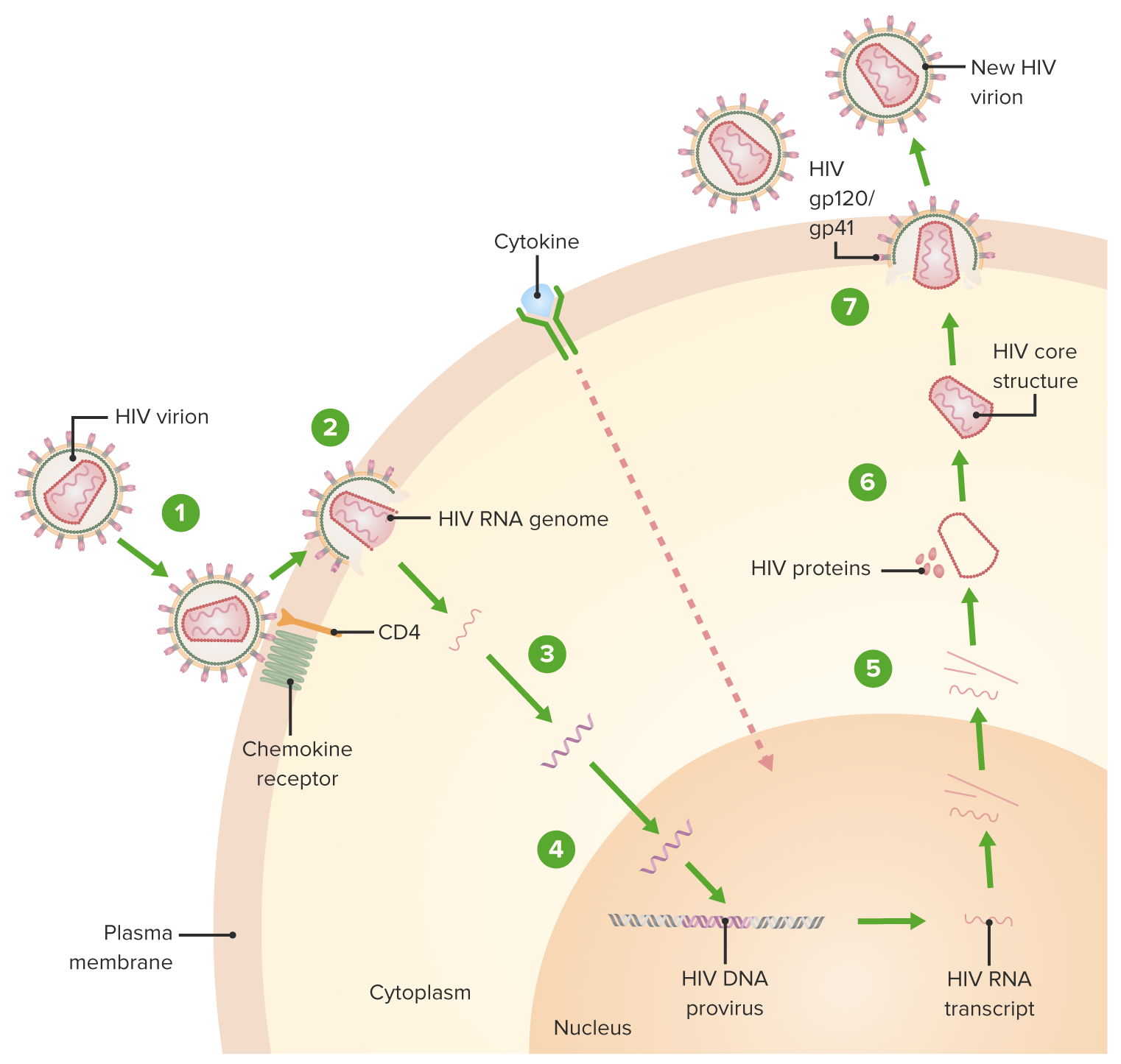
Ciclo de replicação do HIV

Ciclo de replicação do VIH:
1. O virião liga-se a um recetor CD4 e de quimiocina, sofrendo uma mudança conformacional que facilita a sua fusão e da célula hospedeira.
2. O virião vai perdendo o invólucro de proteína da cápside (que envolve o RNA viral e proteínas) à medida que atravessa o citoplasma.
3. Ocorre a síntese de DNA pró-viral mediada por transcriptase reversa.
4. O DNA viral é transportado através do núcleo e integrado no DNA do hospedeiro, sendo o processo facilitado pela integrase.
5. O DNA viral é transcrito, originando múltiplas cópias do novo RNA do VIH que são transportadas para o citoplasma. O novo RNA do VIH torna-se o genoma de um novo vírus. Ocorre ainda a ativação de citocinas da célula.
6. O novo RNA viral + proteínas + enzimas movem-se para a superfície celular e formam uma partícula não infeciosa.
7. A partícula (RNA viral + proteínas) abandona a célula hospedeira com o VIH imaturo. A proteína protease viral (enzima) cliva as poliproteínas recém-sintetizadas produzindo um VIH maduro.

Imagem por Lecturio.

Principais classes de fármacos antirretrovirais

Tabela: Principais classes de fármacos antirretrovirais
Tipo de fármaco Mecanismo de ação
Inibidores da transcriptase reversa
  • NRTIs: inibidores nucleótidos da transcriptase reversa
  • NtRTIs: inibidores nucleótidos da transcriptase reversa
  • NNRTIs: inibidores não nucleótidos da transcriptase reversa
  • Interferem com a tradução de RNA RNA A polynucleotide consisting essentially of chains with a repeating backbone of phosphate and ribose units to which nitrogenous bases are attached. RNA is unique among biological macromolecules in that it can encode genetic information, serve as an abundant structural component of cells, and also possesses catalytic activity. RNA Types and Structure viral em DNA DNA A deoxyribonucleotide polymer that is the primary genetic material of all cells. Eukaryotic and prokaryotic organisms normally contain DNA in a double-stranded state, yet several important biological processes transiently involve single-stranded regions. DNA, which consists of a polysugar-phosphate backbone possessing projections of purines (adenine and guanine) and pyrimidines (thymine and cytosine), forms a double helix that is held together by hydrogen bonds between these purines and pyrimidines (adenine to thymine and guanine to cytosine). DNA Types and Structure
  • Afetam a transcrição reversa
Inibidores da transferência de cadeia da integrase Integrase Enzyme of the human immunodeficiency virus that is required to integrate viral DNA into cellular DNA in the nucleus of a host cell. HIV integrase is a DNA nucleotidyltransferase encoded by the pol gene. HIV Infection and AIDS (INSTIs, pela sigla em inglês)
  • Impedem a inserção do genoma viral no DNA DNA A deoxyribonucleotide polymer that is the primary genetic material of all cells. Eukaryotic and prokaryotic organisms normally contain DNA in a double-stranded state, yet several important biological processes transiently involve single-stranded regions. DNA, which consists of a polysugar-phosphate backbone possessing projections of purines (adenine and guanine) and pyrimidines (thymine and cytosine), forms a double helix that is held together by hydrogen bonds between these purines and pyrimidines (adenine to thymine and guanine to cytosine). DNA Types and Structure do hospedeiro
  • Afetam a integração
Inibidores da protease Protease Enzyme of the human immunodeficiency virus that is required for post-translational cleavage of gag and gag-pol precursor polyproteins into functional products needed for viral assembly. HIV protease is an aspartic protease encoded by the amino terminus of the pol gene. HIV Infection and AIDS (IPs, pela sigla em inglês)
  • Bloqueiam a clivagem de precursores de proteínas (por protease Protease Enzyme of the human immunodeficiency virus that is required for post-translational cleavage of gag and gag-pol precursor polyproteins into functional products needed for viral assembly. HIV protease is an aspartic protease encoded by the amino terminus of the pol gene. HIV Infection and AIDS) necessários para produzir partículas virais infeciosas maduras
  • Afetam o desenvolvimento e maturação
Inibidores de entrada:
  • Antagonistas de CCR5 CCR5 Ccr receptors with specificity for chemokine ccl3; chemokine ccl4; and chemokine ccl5. They are expressed at high levels in T-lymphocytes; B-lymphocytes; macrophages; mast cells; and nk cells. The ccr5 receptor is used by the human immunodeficiency virus to infect cells. HIV Infection and AIDS
  • Inibidores de fusão
  • Inibidores de fixação
  • Inibem a ligação do virião via gp120 Gp120 External envelope protein of the human immunodeficiency virus which is encoded by the HIV env gene. It has a molecular weight of 120 kda and contains numerous glycosylation sites. Gp120 binds to cells expressing CD4 cell-surface antigens, most notably t4-lymphocytes and monocytes/macrophages. Gp120 has been shown to interfere with the normal function of CD4 and is at least partly responsible for the cytopathic effect of HIV. HIV Infection and AIDS (inibidor de fixação) ou do recetor CCR5 CCR5 Ccr receptors with specificity for chemokine ccl3; chemokine ccl4; and chemokine ccl5. They are expressed at high levels in T-lymphocytes; B-lymphocytes; macrophages; mast cells; and nk cells. The ccr5 receptor is used by the human immunodeficiency virus to infect cells. HIV Infection and AIDS (antagonista do CCR5 CCR5 Ccr receptors with specificity for chemokine ccl3; chemokine ccl4; and chemokine ccl5. They are expressed at high levels in T-lymphocytes; B-lymphocytes; macrophages; mast cells; and nk cells. The ccr5 receptor is used by the human immunodeficiency virus to infect cells. HIV Infection and AIDS) e fusão da célula hospedeira do virião (inibidor de fusão)
  • Afetam a entrada viral
Inibidor pós-fixação Liga-se à molécula CD4, bloqueando a entrada viral, mas não a ligação
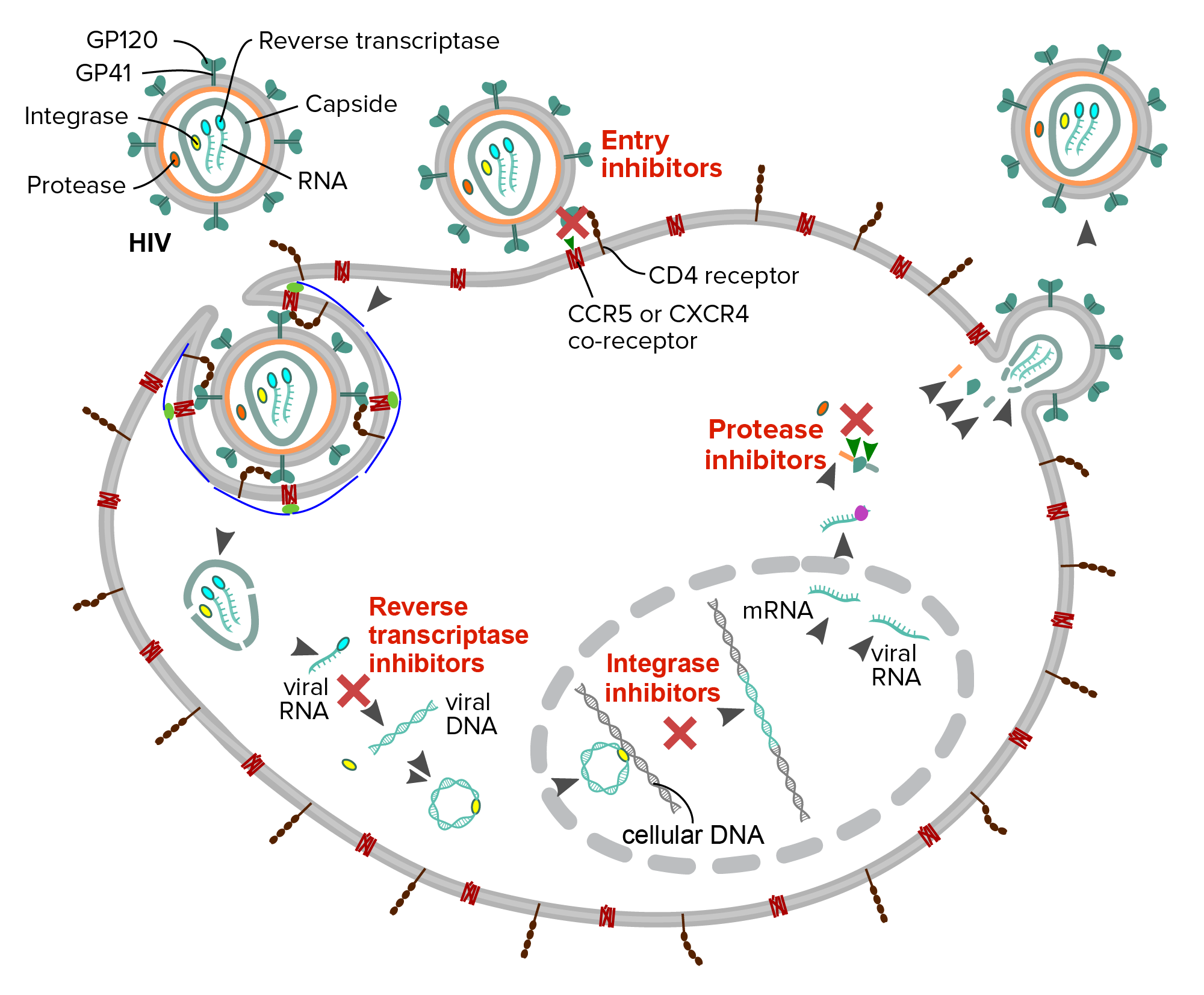
Classes de medicamentos para o HIV

Descrição esquemática do mecanismo das 4 classes de fármacos antirretrovirais contra o VIH:
Inibidores de fusão ou entrada: interferem na ligação, fusão ou entrada do vírus VIH
Inibidores da transcriptase reversa: interferem na tradução do RNA viral em DNA
Inibidores da integrase: impedem a inserção do genoma viral no DNA do hospedeiro
Inibidores da protease: bloqueiam a clivagem dos precursores proteicos necessários para a produção de partículas virais infeciosas

Imagem: “HIV-drug-classes” por Thomas Splettstoesser. Licença: CC BY 3.0, editado por Lecturio.

Falência terapêutica de um esquema antirretroviral

  • Caracteriza-se por níveis plasmáticos de RNA RNA A polynucleotide consisting essentially of chains with a repeating backbone of phosphate and ribose units to which nitrogenous bases are attached. RNA is unique among biological macromolecules in that it can encode genetic information, serve as an abundant structural component of cells, and also possesses catalytic activity. RNA Types and Structure do VIH persistentemente elevados em pacientes com vírus previamente indetetável, mesmo com tratamento continuado.
  • Corresponde à resistência de 1 ou mais MAIS Androgen Insensitivity Syndrome fármacos do esquema terapêutico
  • Requer uma mudança no esquema (necessidade de implementar uma combinação farmacológica completamente nova)

Inibidores Nucleótidos da Transcriptase Reversa

Fármacos

  • NRTIs:
    • Zidovudina (ZDV) ou azidotimidina (AZT): NRTI representativo
    • Lamivudina (3TC)
    • Abacavir Abacavir Anti-HIV Drugs (ABC)
    • Emtricitabina (FTC)
    • Entecavir Entecavir Anti-HIV Drugs (ETV)
    • Truvada Truvada Anti-HIV Drugs (emtricitabina/ tenofovir Tenofovir An adenine analog reverse transcriptase inhibitor with antiviral activity against HIV-1 and hepatitis b. It is used to treat HIV infections and chronic hepatitis b, in combination with other antiviral agents, due to the emergence of antiviral drug resistance when it is used alone. Anti-HIV Drugs)
    • Zalcitabina (ddC): descontinuado
  • NtRTI ( tenofovir Tenofovir An adenine analog reverse transcriptase inhibitor with antiviral activity against HIV-1 and hepatitis b. It is used to treat HIV infections and chronic hepatitis b, in combination with other antiviral agents, due to the emergence of antiviral drug resistance when it is used alone. Anti-HIV Drugs, o único análogo de nucleótido):
    • Tenofovir Tenofovir An adenine analog reverse transcriptase inhibitor with antiviral activity against HIV-1 and hepatitis b. It is used to treat HIV infections and chronic hepatitis b, in combination with other antiviral agents, due to the emergence of antiviral drug resistance when it is used alone. Anti-HIV Drugs alafenamida (TAF)
    • Tenofovir Tenofovir An adenine analog reverse transcriptase inhibitor with antiviral activity against HIV-1 and hepatitis b. It is used to treat HIV infections and chronic hepatitis b, in combination with other antiviral agents, due to the emergence of antiviral drug resistance when it is used alone. Anti-HIV Drugs disoproxil fumarato (TDF)
  • O uso de NRTIs não está recomendado (Departamento de Saúde e Serviços Humanos dos Estados Unidos ( HHS HHS Diabetic ketoacidosis (DKA) and hyperosmolar hyperglycemic state (HHS) are serious, acute complications of diabetes mellitus. Hyperosmolar hyperglycemic state occurs due to a relative deficiency of insulin or insulin resistance, leading to severe hyperglycemia and elevated serum osmolality. Hyperglycemic Crises, pela sigla em inglês), 2019):
    • Didanosina (ddI): acidose láctica, pancreatite
    • Estavudina (d4T): acidose láctica, pancreatite

Mecanismo de ação

  • Atuam como terminadores de cadeia do DNA DNA A deoxyribonucleotide polymer that is the primary genetic material of all cells. Eukaryotic and prokaryotic organisms normally contain DNA in a double-stranded state, yet several important biological processes transiently involve single-stranded regions. DNA, which consists of a polysugar-phosphate backbone possessing projections of purines (adenine and guanine) and pyrimidines (thymine and cytosine), forms a double helix that is held together by hydrogen bonds between these purines and pyrimidines (adenine to thymine and guanine to cytosine). DNA Types and Structure próviral (ausência do grupo 3′-hidroxi, para que outros nucleótidos não possam continuar a ligação)
  • Ligam-se competitivamente ao local de ligação do trifosfato de desoxinucleótido (dNTP, pela sigla em inglês) da transcriptase reversa, terminando a etapa de elongação

Efeitos adversos

  • Toxicidade mitocondrial:
    • Os trifosfatos intracelulares para NRTIs não afetam a DNA DNA A deoxyribonucleotide polymer that is the primary genetic material of all cells. Eukaryotic and prokaryotic organisms normally contain DNA in a double-stranded state, yet several important biological processes transiently involve single-stranded regions. DNA, which consists of a polysugar-phosphate backbone possessing projections of purines (adenine and guanine) and pyrimidines (thymine and cytosine), forms a double helix that is held together by hydrogen bonds between these purines and pyrimidines (adenine to thymine and guanine to cytosine). DNA Types and Structure polimerase α e a polimerase β humana.
    • Alguns trifosfatos intracelulares para NRTIs inibem a DNA DNA A deoxyribonucleotide polymer that is the primary genetic material of all cells. Eukaryotic and prokaryotic organisms normally contain DNA in a double-stranded state, yet several important biological processes transiently involve single-stranded regions. DNA, which consists of a polysugar-phosphate backbone possessing projections of purines (adenine and guanine) and pyrimidines (thymine and cytosine), forms a double helix that is held together by hydrogen bonds between these purines and pyrimidines (adenine to thymine and guanine to cytosine). DNA Types and Structure polimerase γ humana (enzima mitocondrial), resultando em toxicidades associadas à inibição da síntese de DNA DNA A deoxyribonucleotide polymer that is the primary genetic material of all cells. Eukaryotic and prokaryotic organisms normally contain DNA in a double-stranded state, yet several important biological processes transiently involve single-stranded regions. DNA, which consists of a polysugar-phosphate backbone possessing projections of purines (adenine and guanine) and pyrimidines (thymine and cytosine), forms a double helix that is held together by hydrogen bonds between these purines and pyrimidines (adenine to thymine and guanine to cytosine). DNA Types and Structure mitocondrial.
    • Observada como:
      • Lipodistrofia: distribuição anormal de tecido adiposo, “corcunda de búfalo”
      • Esteatose hepática
      • Neuropatia periférica
      • Pancreatite
      • Acidose láctica
    • Didanosina, estavudina: ↑ risco de toxicidade mitocondrial
    • A emtricitabina fosforilada, a lamivudina e o tenofovir Tenofovir An adenine analog reverse transcriptase inhibitor with antiviral activity against HIV-1 and hepatitis b. It is used to treat HIV infections and chronic hepatitis b, in combination with other antiviral agents, due to the emergence of antiviral drug resistance when it is used alone. Anti-HIV Drugs não afetam a DNA DNA A deoxyribonucleotide polymer that is the primary genetic material of all cells. Eukaryotic and prokaryotic organisms normally contain DNA in a double-stranded state, yet several important biological processes transiently involve single-stranded regions. DNA, which consists of a polysugar-phosphate backbone possessing projections of purines (adenine and guanine) and pyrimidines (thymine and cytosine), forms a double helix that is held together by hydrogen bonds between these purines and pyrimidines (adenine to thymine and guanine to cytosine). DNA Types and Structure polimerase γ humana (sem toxicidade mitocondrial).
  • Supressão da medula óssea: anemia Anemia Anemia is a condition in which individuals have low Hb levels, which can arise from various causes. Anemia is accompanied by a reduced number of RBCs and may manifest with fatigue, shortness of breath, pallor, and weakness. Subtypes are classified by the size of RBCs, chronicity, and etiology. Anemia: Overview and Types, neutropenia Neutropenia Neutrophils are an important component of the immune system and play a significant role in the eradication of infections. Low numbers of circulating neutrophils, referred to as neutropenia, predispose the body to recurrent infections or sepsis, though patients can also be asymptomatic. Neutropenia, trombocitopenia
  • Efeitos gastrointestinais (GI): náuseas, vómitos, diarreia, hepatite colestática aguda
  • Agitação motora, cefaleia, mialgias e insónia

Características importantes

  • NRTIs: usados nas infeções por VIH-1 e VIH-2
  • Os NRTIs são pró-fármacos: devem ser trifosforilados para serem ativados
  • NtRTI ( tenofovir Tenofovir An adenine analog reverse transcriptase inhibitor with antiviral activity against HIV-1 and hepatitis b. It is used to treat HIV infections and chronic hepatitis b, in combination with other antiviral agents, due to the emergence of antiviral drug resistance when it is used alone. Anti-HIV Drugs): deve ser difosforilado para atingir a forma ativa
  • Metabolismo e eliminação:
    • Tenofovir Tenofovir An adenine analog reverse transcriptase inhibitor with antiviral activity against HIV-1 and hepatitis b. It is used to treat HIV infections and chronic hepatitis b, in combination with other antiviral agents, due to the emergence of antiviral drug resistance when it is used alone. Anti-HIV Drugs: semi-vida de eliminação longa (17 horas)
    • Emtricitabina, lamivudina, tenofovir Tenofovir An adenine analog reverse transcriptase inhibitor with antiviral activity against HIV-1 and hepatitis b. It is used to treat HIV infections and chronic hepatitis b, in combination with other antiviral agents, due to the emergence of antiviral drug resistance when it is used alone. Anti-HIV Drugs: excreção renal do fármaco original
    • Zidovudina, abacavir Abacavir Anti-HIV Drugs: hepática (glucorunidação)
  • Resistência: rápida, sobretudo se usado em monoterapia

Resumo dos fármacos NRTI e NtRTI

Tabela: NRTIs e NtRTIs
Fármaco Efeitos adversos Interações/contra-indicações
Zidovudina (AZT):
  • Primeiro fármaco ARV para o VIH
  • Atravessa a placenta Placenta A highly vascularized mammalian fetal-maternal organ and major site of transport of oxygen, nutrients, and fetal waste products. It includes a fetal portion (chorionic villi) derived from trophoblasts and a maternal portion (decidua) derived from the uterine endometrium. The placenta produces an array of steroid, protein and peptide hormones (placental hormones). Placenta, Umbilical Cord, and Amniotic Cavity (impede a transmissão de mãe para filho)
  • Acidose láctica, hepatomegalia, esteatose hepática
  • Supressão da medula óssea: anemia Anemia Anemia is a condition in which individuals have low Hb levels, which can arise from various causes. Anemia is accompanied by a reduced number of RBCs and may manifest with fatigue, shortness of breath, pallor, and weakness. Subtypes are classified by the size of RBCs, chronicity, and etiology. Anemia: Overview and Types e neutropenia Neutropenia Neutrophils are an important component of the immune system and play a significant role in the eradication of infections. Low numbers of circulating neutrophils, referred to as neutropenia, predispose the body to recurrent infections or sepsis, though patients can also be asymptomatic. Neutropenia
  • GI: vómitos, diarreia
  • Cefaleia, miopatia, insónia, hiperpigmentação ungueal
  • Diabetes Diabetes Diabetes mellitus (DM) is a metabolic disease characterized by hyperglycemia and dysfunction of the regulation of glucose metabolism by insulin. Type 1 DM is diagnosed mostly in children and young adults as the result of autoimmune destruction of β cells in the pancreas and the resulting lack of insulin. Type 2 DM has a significant association with obesity and is characterized by insulin resistance. Diabetes Mellitus, hepatite colestática aguda
  • Antifúngicos azólicos, ácido valpróico, atovaquona aumentam os níveis plasmáticos
  • Vigiar anemia Anemia Anemia is a condition in which individuals have low Hb levels, which can arise from various causes. Anemia is accompanied by a reduced number of RBCs and may manifest with fatigue, shortness of breath, pallor, and weakness. Subtypes are classified by the size of RBCs, chronicity, and etiology. Anemia: Overview and Types, neutropenia Neutropenia Neutrophils are an important component of the immune system and play a significant role in the eradication of infections. Low numbers of circulating neutrophils, referred to as neutropenia, predispose the body to recurrent infections or sepsis, though patients can also be asymptomatic. Neutropenia e disfunção hepática (requer ajuste de dose)
Emtricitabina: estruturalmente semelhante à lamivudina
  • Toxicidade mínima
  • Hiperpigmentação palmoplantar, cefaleia, diarreia, erupção cutânea
  • Hepatite grave em indivíduos infetados com VHB, se a medicação for descontinuada
Não associar lamivudina (os fármacos competem com a fosforilação intracelular).
Lamivudina: ativo contra o vírus da hepatite B
  • Geralmente bem tolerado
  • Pancreatite em crianças
  • Hepatite grave em indivíduos com VHB, se a medicação for descontinuada
Não associar emtricitabina (os fármacos competem com a fosforilação intracelular).
Abacavir Abacavir Anti-HIV Drugs Reação de hipersensibilidade (potencialmente fatal): febre, erupção cutânea, dor abdominal, vómitos, dispneia
  • Contraindicado em pacientes que são HLAB*5701 positivos (risco de reação de hipersensibilidade)
  • Associado a eventos CV CV Vasculitides
Tenofovir Tenofovir An adenine analog reverse transcriptase inhibitor with antiviral activity against HIV-1 and hepatitis b. It is used to treat HIV infections and chronic hepatitis b, in combination with other antiviral agents, due to the emergence of antiviral drug resistance when it is used alone. Anti-HIV Drugs (NtRTI): TAF e TDF (TAF: ativo contra o vírus da hepatite B)
  • Sintomas gastrointestinais
  • Lesão renal (TDF > TAF), síndrome de Fanconi, perda mineral óssea (TDF > TAF)
  • Hepatite grave em indivíduos com VHB, se a medicação for descontinuada
ARV: antirretroviral
CV: cardiovasculares
GI: gastrointestinais
VHB: vírus da hepatite B
VIH: vírus da imunodeficiência humana
TAF: tenofovir alafenamida
TDF: tenofovir disoproxil fumarato

Inibidores da Transcriptase Reversa Não Nucleótidos

Fármacos

  • 1ª geração:
  • 2ª geração:
    • Etravirina (ETV)
    • Rilpivirina (RPV)
    • Doravirina (DOR)
  • Delavirdina (DLV): atualmente já não está recomendado (Estados Unidos HHS HHS Diabetic ketoacidosis (DKA) and hyperosmolar hyperglycemic state (HHS) are serious, acute complications of diabetes mellitus. Hyperosmolar hyperglycemic state occurs due to a relative deficiency of insulin or insulin resistance, leading to severe hyperglycemia and elevated serum osmolality. Hyperglycemic Crises, 2019)

Mecanismo de ação

Inibidores não competitivos da transcriptase reversa:
  • Ligam-se diretamente à transcriptase reversa e inibem a síntese do DNA DNA A deoxyribonucleotide polymer that is the primary genetic material of all cells. Eukaryotic and prokaryotic organisms normally contain DNA in a double-stranded state, yet several important biological processes transiently involve single-stranded regions. DNA, which consists of a polysugar-phosphate backbone possessing projections of purines (adenine and guanine) and pyrimidines (thymine and cytosine), forms a double helix that is held together by hydrogen bonds between these purines and pyrimidines (adenine to thymine and guanine to cytosine). DNA Types and Structure viral
  • Induzem mudanças conformacionais na estrutura da enzima, tornando-a inativa
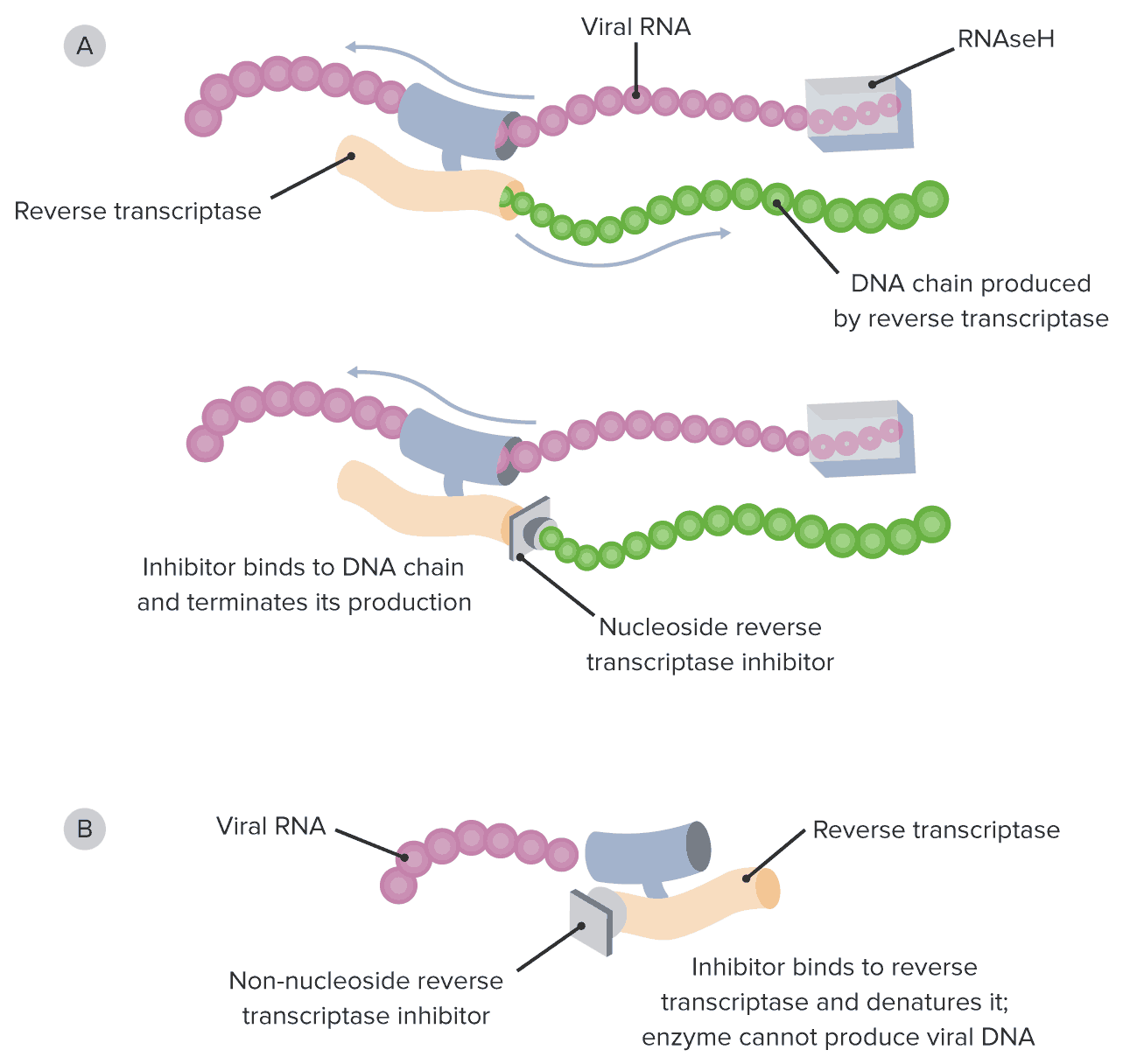
Antivirais Medicamentos anti-HIV

Diagrama do mecanismo de ação dos NRTIs e NNRTIs:
R: Os NRTIs bloqueiam o genoma do DNA viral em crescimento e substituem os nucleótidos naturais, atuando como terminadores de cadeia.
B: Por outro lado, os NNRTIs ligam-se diretamente à enzima transcriptase reversa, impedindo diretamente a síntese de DNA viral.
NRTI: inibidor nucleótido da transcriptase reversa
NNRTI: inibidor não nucleótido da transcriptase reversa
RNAseH: ribonuclease H

Imagem por Lecturio.

Efeitos adversos

  • Erupção cutânea, sintomas gastrointestinais, cefaleia, febre
  • Hepatotoxicidade (aumento das enzimas hepáticas)

Características importantes

  • Usados na infeção por VIH-1
  • Não desencadeiam nenhum efeito na DNA DNA A deoxyribonucleotide polymer that is the primary genetic material of all cells. Eukaryotic and prokaryotic organisms normally contain DNA in a double-stranded state, yet several important biological processes transiently involve single-stranded regions. DNA, which consists of a polysugar-phosphate backbone possessing projections of purines (adenine and guanine) and pyrimidines (thymine and cytosine), forms a double helix that is held together by hydrogen bonds between these purines and pyrimidines (adenine to thymine and guanine to cytosine). DNA Types and Structure polimerase da célula hospedeira
  • Metabolismo: hepático (pelo citocromo P450 (CYP))
  • O uso concomitante de indutores ou inibidores potentes do CYP deve ser evitado.
  • Resistência:
    • Taxa de resistência farmacológica: 2%–8%
    • Os fármacos de 1ª geração possuem perfis de resistência diferentes dos fármacos de 2ª geração.
    • Não usar em regime de monoterapia; deve ser associado a outros agentes para evitar resistências.

Resumo dos fármacos NNRTI

Tabela: fármacos NNRTI
Fármaco Efeitos adversos Interações/contra-indicações
Etravirina: NNRTI mais MAIS Androgen Insensitivity Syndrome usado em casos de VIH resistentes Pode interagir com outros antirretrovirais (por exemplo, a dose de maraviroc Maraviroc A cyclohexane and triazole derivative that acts as an antagonist of the ccr5 receptor. It prevents infection by HIV-1 virus strains which use ccr5 as a co-receptor for membrane fusion and cellular entry. Anti-HIV Drugs deve ser dobrada se usado em combinação)
Efavirenz Efavirenz Anti-HIV Drugs Evitar nos casos com síndrome do QT longo, doença hepática, doença psiquiátrica
Doravirina Efeitos no SNC/psiquiátricos semelhantes ao efavirenz Efavirenz Anti-HIV Drugs (mas muito menos comuns) O uso concomitante com rifampicina está contraindicado (↓ exposição à doravirina)
Rilpivirina
  • A absorção é dependente do pH pH The quantitative measurement of the acidity or basicity of a solution. Acid-Base Balance e, portanto, não deve ser administrado com IBPs e inibidores H2/antiácidos.
  • Evitar nos casos com síndrome do QT longo
Nevirapina: não está indicada no tratamento inicial (↑ toxicidade)
  • Necrose hepática
  • Erupção cutânea, reações cutâneas graves
  • Deve ser evitado em pacientes com doença hepática moderada a grave.
  • Deve ser evitado em mulheres com contagem de CD4 > 250 células/mL ou em homens com contagem de CD4 > 400 células/mL (limiar para hepatotoxicidade).
SNC: sistema nervoso central

Inibidores da Protease

Fármacos

  • Darunavir (DRV)
  • Atazanavir Atazanavir Anti-HIV Drugs (ATV)
  • Ritonavir Ritonavir An HIV protease inhibitor that works by interfering with the reproductive cycle of HIV. It also inhibits cytochrome p-450 cyp3a. Anti-HIV Drugs (RTV)
  • Lopinavir Lopinavir An HIV protease inhibitor used in a fixed-dose combination with ritonavir. It is also an inhibitor of cytochrome p-450 cyp3a. Anti-HIV Drugs (LPV): não está indicado no tratamento inicial do VIH
  • Fosamprenavir Fosamprenavir Anti-HIV Drugs (FPV): não está indicado no tratamento inicial do VIH
  • Tipranavir Tipranavir Anti-HIV Drugs (TPV): não está indicado no tratamento inicial do VIH
  • Atualmente já não está recomendado no tratamento (Estados Unidos HHS HHS Diabetic ketoacidosis (DKA) and hyperosmolar hyperglycemic state (HHS) are serious, acute complications of diabetes mellitus. Hyperosmolar hyperglycemic state occurs due to a relative deficiency of insulin or insulin resistance, leading to severe hyperglycemia and elevated serum osmolality. Hyperglycemic Crises, 2019):
    • Indinavir Indinavir A potent and specific HIV protease inhibitor that appears to have good oral bioavailability. Anti-HIV Drugs (IDV)
    • Nelfinavir Nelfinavir A potent HIV protease inhibitor. It is used in combination with other antiviral drugs in the treatment of HIV in both adults and children. Anti-HIV Drugs (NFV)
    • Saquinavir Saquinavir An HIV protease inhibitor which acts as an analog of an HIV protease cleavage site. It is a highly specific inhibitor of HIV-1 and HIV-2 proteases, and also inhibits cytochrome p-450 cyp3a. Anti-HIV Drugs (SQV): descontinuado nos Estados Unidos

Mecanismo de ação

  • Ligação à enzima aspartil protease Protease Enzyme of the human immunodeficiency virus that is required for post-translational cleavage of gag and gag-pol precursor polyproteins into functional products needed for viral assembly. HIV protease is an aspartic protease encoded by the amino terminus of the pol gene. HIV Infection and AIDS do VIH, impedindo a clivagem das poliproteínas Gag-Pol e, consequentemente, tornando as partículas virais recém-criadas imaturas/não infeciosas
  • Inibidores da protease Protease Enzyme of the human immunodeficiency virus that is required for post-translational cleavage of gag and gag-pol precursor polyproteins into functional products needed for viral assembly. HIV protease is an aspartic protease encoded by the amino terminus of the pol gene. HIV Infection and AIDS (PIs, pela sigla em inglês):
    • Objetivo: inibir a depuração metabólica dos IPs do VIH (de forma a melhorar a biodisponibilidade oral e prolongar a semi-vida de eliminação)
    • Agentes de reforço usados:
      • Ritonavir Ritonavir An HIV protease inhibitor that works by interfering with the reproductive cycle of HIV. It also inhibits cytochrome p-450 cyp3a. Anti-HIV Drugs
      • Cobicistate (análogo do ritonavir Ritonavir An HIV protease inhibitor that works by interfering with the reproductive cycle of HIV. It also inhibits cytochrome p-450 cyp3a. Anti-HIV Drugs): melhor tolerado
    • Efeitos:
      • Permite a redução da dose do fármaco e da frequência de dosagem
      • Aumenta a concentração do fármaco

Efeitos adversos

  • Sintomas gastrointestinais: náuseas, vómitos e diarreia
  • Dislipidemias, deposição de gordura ou síndrome metabólica
  • Lipodistrofia
  • Hepatotoxicidade
  • Hiperglicemia, diabetes Diabetes Diabetes mellitus (DM) is a metabolic disease characterized by hyperglycemia and dysfunction of the regulation of glucose metabolism by insulin. Type 1 DM is diagnosed mostly in children and young adults as the result of autoimmune destruction of β cells in the pancreas and the resulting lack of insulin. Type 2 DM has a significant association with obesity and is characterized by insulin resistance. Diabetes Mellitus
  • Nefrolitíase
  • Hemorragia nos casos de hemofilia
  • Prolongamento do intervalo PR

Características importantes

  • Ativos contra:
    • VIH-1 e VIH-2
    • Hepatite C
  • Metabolismo:
    • Extensamente metabolizado pelo CYP 3A4 (exceto nelfinavir Nelfinavir A potent HIV protease inhibitor. It is used in combination with other antiviral drugs in the treatment of HIV in both adults and children. Anti-HIV Drugs: CYP 2C19)
    • Deve ser evitada a administração concomitante de outros indutores ou inibidores potentes do CYP.
  • As resistência são raras

Resumo dos inibidores da protease Protease Enzyme of the human immunodeficiency virus that is required for post-translational cleavage of gag and gag-pol precursor polyproteins into functional products needed for viral assembly. HIV protease is an aspartic protease encoded by the amino terminus of the pol gene. HIV Infection and AIDS

Tabela: Inibidores de protease Protease Enzyme of the human immunodeficiency virus that is required for post-translational cleavage of gag and gag-pol precursor polyproteins into functional products needed for viral assembly. HIV protease is an aspartic protease encoded by the amino terminus of the pol gene. HIV Infection and AIDS
Fármaco Efeitos adversos Interações/contra-indicações
Atazanavir Atazanavir Anti-HIV Drugs
  • Hiperbilirrubinemia (indireta), colestase/colecistite, testes Testes Gonadal Hormones da função hepática anormais
  • ↑ Risco de litíase renal
  • Menor risco de dislipidemia, comparativamente a outros inibidores de protease Protease Enzyme of the human immunodeficiency virus that is required for post-translational cleavage of gag and gag-pol precursor polyproteins into functional products needed for viral assembly. HIV protease is an aspartic protease encoded by the amino terminus of the pol gene. HIV Infection and AIDS
  • Os alimentos aumentam a absorção e a biodisponibilidade.
  • Evitar o uso concomitante de IBPs, antiácidos (reduzem a concentração de atazanavir Atazanavir Anti-HIV Drugs)
Darunavir
  • Administrado com ritonavir Ritonavir An HIV protease inhibitor that works by interfering with the reproductive cycle of HIV. It also inhibits cytochrome p-450 cyp3a. Anti-HIV Drugs/cobicistate em dose baixa; associação aumenta os níveis de maraviroc Maraviroc A cyclohexane and triazole derivative that acts as an antagonist of the ccr5 receptor. It prevents infection by HIV-1 virus strains which use ccr5 as a co-receptor for membrane fusion and cellular entry. Anti-HIV Drugs (cuja dose precisa de ser reduzida)
  • Evitar nos casos de doença hepática grave
Ritonavir Ritonavir An HIV protease inhibitor that works by interfering with the reproductive cycle of HIV. It also inhibits cytochrome p-450 cyp3a. Anti-HIV Drugs: reforço
  • Sintomas gastrointestinais
  • Parestesias
  • Alteração do perfil lipídico
Um dos inibidores mais MAIS Androgen Insensitivity Syndrome potentes do CYP3A4 CYP3A4 Class 3 Antiarrhythmic Drugs (Potassium Channel Blockers); evitar tomar fármacos com índice terapêutico estreito.
Lopinavir Lopinavir An HIV protease inhibitor used in a fixed-dose combination with ritonavir. It is also an inhibitor of cytochrome p-450 cyp3a. Anti-HIV Drugs: coformulado com ritonavir Ritonavir An HIV protease inhibitor that works by interfering with the reproductive cycle of HIV. It also inhibits cytochrome p-450 cyp3a. Anti-HIV Drugs
  • Sintomas gastrointestinais
  • Alteração do perfil lipídico
Não está indicado no tratamento inicial (devido à sua potência e toxicidade)
CYP: citocromo P450
GI: gastrointestinais
LFTs: testes de função hepática
IBPs: inibidores da bomba de protões

 Inibidores da Transferência de Cadeia da Integrase

Fármacos

Mecanismo de ação

  • Ligam-se à enzima integrase Integrase Enzyme of the human immunodeficiency virus that is required to integrate viral DNA into cellular DNA in the nucleus of a host cell. HIV integrase is a DNA nucleotidyltransferase encoded by the pol gene. HIV Infection and AIDS do vírus, responsável pela integração do DNA DNA A deoxyribonucleotide polymer that is the primary genetic material of all cells. Eukaryotic and prokaryotic organisms normally contain DNA in a double-stranded state, yet several important biological processes transiently involve single-stranded regions. DNA, which consists of a polysugar-phosphate backbone possessing projections of purines (adenine and guanine) and pyrimidines (thymine and cytosine), forms a double helix that is held together by hydrogen bonds between these purines and pyrimidines (adenine to thymine and guanine to cytosine). DNA Types and Structure viral no DNA DNA A deoxyribonucleotide polymer that is the primary genetic material of all cells. Eukaryotic and prokaryotic organisms normally contain DNA in a double-stranded state, yet several important biological processes transiently involve single-stranded regions. DNA, which consists of a polysugar-phosphate backbone possessing projections of purines (adenine and guanine) and pyrimidines (thymine and cytosine), forms a double helix that is held together by hydrogen bonds between these purines and pyrimidines (adenine to thymine and guanine to cytosine). DNA Types and Structure do hospedeiro da célula infetada
  • Inibem a ligação do complexo de pré-integração

Efeitos adversos

  • Geralmente bem tolerados
  • Aumento de peso
  • Sintomas gastrointestinais, tonturas, fadiga
  • Aumento da creatina quinase (potencial miopatia ou rabdomiólise)
  • Depressão (ideações suicidas)

Características importantes

Resumo dos inibidores da transferência de cadeia da  integrase Integrase Enzyme of the human immunodeficiency virus that is required to integrate viral DNA into cellular DNA in the nucleus of a host cell. HIV integrase is a DNA nucleotidyltransferase encoded by the pol gene. HIV Infection and AIDS

Tabela: Inibidores da transferência de cadeia da  integrase Integrase Enzyme of the human immunodeficiency virus that is required to integrate viral DNA into cellular DNA in the nucleus of a host cell. HIV integrase is a DNA nucleotidyltransferase encoded by the pol gene. HIV Infection and AIDS
Fármaco Efeitos adversos Interações/contra-indicações
Raltegravir Raltegravir Anti-HIV Drugs Os indutores enzimáticos (por exemplo, a rifampicina) aumentam o seu metabolismo, induzindo a UDP-glucuronosiltransferase.
Dolutegravir Dolutegravir Anti-HIV Drugs Aumento ligeiro e reversível da creatinina (inibe o transportador renal, OCT2)
  • Contraindicado em pacientes com mutação Q148
  • Os indutores enzimáticos (por exemplo, rifampicina) aumentam o seu metabolismo, induzindo a UDP-glucuronosiltransferase.
Elvitegravir Elvitegravir Anti-HIV Drugs: administrado com cobicistate ou ritonavir Ritonavir An HIV protease inhibitor that works by interfering with the reproductive cycle of HIV. It also inhibits cytochrome p-450 cyp3a. Anti-HIV Drugs Sintomas gastrointestinais Atualmente disponível apenas numa combinação de dose fixa com tenofovir Tenofovir An adenine analog reverse transcriptase inhibitor with antiviral activity against HIV-1 and hepatitis b. It is used to treat HIV infections and chronic hepatitis b, in combination with other antiviral agents, due to the emergence of antiviral drug resistance when it is used alone. Anti-HIV Drugs, emtricitabina e cobicistate (que ↑ interações medicamentosas)
Bictegravir Bictegravir Anti-HIV Drugs: coformulado com emtricitabina e TAF
  • Diarreia
  • Cefaleia
  • Aumento de peso
A ingestão com rifampicina ou dofetilida está contraindicada
GI: gastrointestinais
OCT2: transportador de catiões orgânicos-2
TAF: tenofovir alafenamida
UDP: uridina-5′-difosfo

Inibidores de Entrada e Inibidores de Pós-fixação

Inibidores de entrada

  • Antagonista de CCR5 CCR5 Ccr receptors with specificity for chemokine ccl3; chemokine ccl4; and chemokine ccl5. They are expressed at high levels in T-lymphocytes; B-lymphocytes; macrophages; mast cells; and nk cells. The ccr5 receptor is used by the human immunodeficiency virus to infect cells. HIV Infection and AIDS: maraviroc Maraviroc A cyclohexane and triazole derivative that acts as an antagonist of the ccr5 receptor. It prevents infection by HIV-1 virus strains which use ccr5 as a co-receptor for membrane fusion and cellular entry. Anti-HIV Drugs (MVC)
    • Mecanismo de ação: bloqueia o correcetor CCR5 CCR5 Ccr receptors with specificity for chemokine ccl3; chemokine ccl4; and chemokine ccl5. They are expressed at high levels in T-lymphocytes; B-lymphocytes; macrophages; mast cells; and nk cells. The ccr5 receptor is used by the human immunodeficiency virus to infect cells. HIV Infection and AIDS, interferindo na entrada do VIH
    • Efeitos adversos:
      • Hepatotoxicidade
      • Erupção cutânea ou reações alérgicas sistémicas
      • Tosse, infeções respiratórias superiores
      • Artralgias
    • Características importantes:
      • Usados predominantemente no vírus CCR5-trópico (VIH-1)
      • Metabolismo: renal e hepático
      • Em todos os regimes de terapêutica combinada com maraviroc Maraviroc A cyclohexane and triazole derivative that acts as an antagonist of the ccr5 receptor. It prevents infection by HIV-1 virus strains which use ccr5 as a co-receptor for membrane fusion and cellular entry. Anti-HIV Drugs é necessário ajuste de dose.
      • Quando combinado com inibidores do CYP3A → a dose de maraviroc Maraviroc A cyclohexane and triazole derivative that acts as an antagonist of the ccr5 receptor. It prevents infection by HIV-1 virus strains which use ccr5 as a co-receptor for membrane fusion and cellular entry. Anti-HIV Drugs é menor; com indutores de CYP3A → a dose de maraviroc Maraviroc A cyclohexane and triazole derivative that acts as an antagonist of the ccr5 receptor. It prevents infection by HIV-1 virus strains which use ccr5 as a co-receptor for membrane fusion and cellular entry. Anti-HIV Drugs é maior
      • A resistência desenvolve-se quando ocorre a troca de correcetor (mudança no tropismo).
  • Inibidor de fusão: enfuvirtida (INN)
    • Mecanismo de ação: liga-se à gp41 Gp41 Transmembrane envelope protein of the human immunodeficiency virus which is encoded by the HIV env gene. It has a molecular weight of 41, 000 and is glycosylated. The n-terminal part of gp41 is thought to be involved in cell fusion with the CD4 antigens of T4 lymphocytes, leading to syncytial formation. Gp41 is one of the most common HIV antigens detected by immunoblotting. HIV Infection and AIDS do VIH, impedindo a fusão com a célula T CD4
    • Efeitos adversos:
      • Complicações no local da injeção (dor, eritema, endurecimento e nódulos)
      • Aumento da incidência de pneumonia Pneumonia Pneumonia or pulmonary inflammation is an acute or chronic inflammation of lung tissue. Causes include infection with bacteria, viruses, or fungi. In more rare cases, pneumonia can also be caused through toxic triggers through inhalation of toxic substances, immunological processes, or in the course of radiotherapy. Pneumonia
    • Características importantes:
      • Usado na infeção por VIH-1
      • Administrado como injeção subcutânea
      • Não inibe o CYP nem afeta os substratos do CYP
  • Inibidor de fixação: fostemsavir Fostemsavir Anti-HIV Drugs (FTR)
    • Mecanismo de ação:
      • Fostemsavir Fostemsavir Anti-HIV Drugs: pró-fármaco que é convertido em temsavir
      • O temsavir liga-se à gp120 Gp120 External envelope protein of the human immunodeficiency virus which is encoded by the HIV env gene. It has a molecular weight of 120 kda and contains numerous glycosylation sites. Gp120 binds to cells expressing CD4 cell-surface antigens, most notably t4-lymphocytes and monocytes/macrophages. Gp120 has been shown to interfere with the normal function of CD4 and is at least partly responsible for the cytopathic effect of HIV. HIV Infection and AIDS, inibindo a ligação do virião à célula T hospedeira.
    • Efeitos adversos:
      • Náuseas
      • Prolongamento do intervalo QT
      • Pode aumentar as enzimas hepáticas em pacientes com hepatite B/C
    • Características importantes:
      • Usado na infeção por VIH-1
      • Potente indutor de CYP3A que diminui os níveis dos fármacos
Entrada do HIV em uma célula hospedeira

Diagrama esquemático da entrada viral e etapas inibidas por enfuvirtida e maraviroc:
A subunidade trimérica gp120 do complexo de glicoproteínas do envelope viral liga-se ao CD4 na superfície da célula alvo, desencadeando uma mudança conformacional que promove interações com recetores de quimiocinas (neste caso, CCR5). A subunidade transmembranar trimérica gp41 é ativada para mediar a fusão da membrana, de forma a que o conteúdo viral possa entrar na célula. O maraviroc bloqueia o correcetor CCR5. A enfuvirtida liga-se à gp41, impedindo a fusão.

Imagem: “HIV entry into a host cell” por Laboratório de Virologia Experimental, Departamento de Microbiologia Médica, Centro de Infeção e Imunidade de Amsterdão (CINIMA, pela sigla em inglês), Centro Médico Académico, Universidade de Amsterdão, 1105 AZ Amsterdão, Holanda. Licença: CC BY 2.0

Inibidor pós-fixação

  • Fármaco: Ibalizumabe
  • Mecanismo de ação:
    • Anticorpo monoclonal
    • Liga-se à molécula CD4 e bloqueia a entrada da partícula viral
  • Efeitos adversos:
  • Características importantes:
    • Usado na infeção por VIH-1
    • Para pacientes com multirresistências
    • Administrado por via intravenosa (após a dose inicial, administrada a cada 14 dias)

Regimes de Terapêutica Antirretroviral Combinada (cTARV, pela sigla em inglês)

Guidelines antirretrovirais para adultos e adolescentes ( HHS HHS Diabetic ketoacidosis (DKA) and hyperosmolar hyperglycemic state (HHS) are serious, acute complications of diabetes mellitus. Hyperosmolar hyperglycemic state occurs due to a relative deficiency of insulin or insulin resistance, leading to severe hyperglycemia and elevated serum osmolality. Hyperglycemic Crises, 2022)

  • A terapêutica antirretroviral (TARV) está recomendada para:
    • Reduzir a morbimortalidade
    • Reduzir a transmissão do VIH
  • A TARV deve ser iniciada imediatamente após o diagnóstico de VIH.
  • Regimes iniciais recomendados:
    • Bictegravir Bictegravir Anti-HIV Drugs + tenofovir Tenofovir An adenine analog reverse transcriptase inhibitor with antiviral activity against HIV-1 and hepatitis b. It is used to treat HIV infections and chronic hepatitis b, in combination with other antiviral agents, due to the emergence of antiviral drug resistance when it is used alone. Anti-HIV Drugs alafenamida + emtricitabina
    • Dolutegravir Dolutegravir Anti-HIV Drugs + tenofovir Tenofovir An adenine analog reverse transcriptase inhibitor with antiviral activity against HIV-1 and hepatitis b. It is used to treat HIV infections and chronic hepatitis b, in combination with other antiviral agents, due to the emergence of antiviral drug resistance when it is used alone. Anti-HIV Drugs disoproxil/alafenamida fumarato + emtricitabina ou lamivudina
  • Regimes iniciais específicos, dependentes de determinados critérios:
    • Dolutegravir Dolutegravir Anti-HIV Drugs + abacavir Abacavir Anti-HIV Drugs + lamivudina: apenas em indivíduos HLA-B HLA-B Class I human histocompatibility (HLA) surface antigens encoded by more than 30 detectable alleles on locus B of the HLA complex, the most polymorphic of all the HLA specificities. Several of these antigens (e.g., hla-b27, -b7, -b8) are strongly associated with predisposition to rheumatoid and other autoimmune disorders. Like other class I HLA determinants, they are involved in the cellular immune reactivity of cytolytic T lymphocytes. Organ Transplantation*5701 negativos e sem hepatite B crónica
    • Dolutegravir Dolutegravir Anti-HIV Drugs + lamivudina, exceto:
      • Indivíduos com RNA RNA A polynucleotide consisting essentially of chains with a repeating backbone of phosphate and ribose units to which nitrogenous bases are attached. RNA is unique among biological macromolecules in that it can encode genetic information, serve as an abundant structural component of cells, and also possesses catalytic activity. RNA Types and Structure do VIH > 500.000 cópias/mL
      • Indivíduos com coinfeção pelo vírus da hepatite B (VHB)
      • Indivíduos nos quais a TAR deve ser iniciada antes de obter os resultados do teste de resistência genotípica ao VIH para transcriptase reversa ou teste de VHB

Tratamento antirretroviral das grávidas

  • A TARV está recomendada nas mulheres grávidas.
  • O esquema consiste em:
    • 2 fármacos da classe terapêutica NRTI
    • 3º fármaco (inibidor da integrase Integrase Enzyme of the human immunodeficiency virus that is required to integrate viral DNA into cellular DNA in the nucleus of a host cell. HIV integrase is a DNA nucleotidyltransferase encoded by the pol gene. HIV Infection and AIDS ou inibidor da protease Protease Enzyme of the human immunodeficiency virus that is required for post-translational cleavage of gag and gag-pol precursor polyproteins into functional products needed for viral assembly. HIV protease is an aspartic protease encoded by the amino terminus of the pol gene. HIV Infection and AIDS)
  • Regime:
    • Opções de dupla terapêutica NRTI:
      • Abacavir Abacavir Anti-HIV Drugs + lamivudina (O abacavir Abacavir Anti-HIV Drugs não deve ser usado em pacientes positivos para HLA-B HLA-B Class I human histocompatibility (HLA) surface antigens encoded by more than 30 detectable alleles on locus B of the HLA complex, the most polymorphic of all the HLA specificities. Several of these antigens (e.g., hla-b27, -b7, -b8) are strongly associated with predisposition to rheumatoid and other autoimmune disorders. Like other class I HLA determinants, they are involved in the cellular immune reactivity of cytolytic T lymphocytes. Organ Transplantation*5701; não está recomendado se o RNA RNA A polynucleotide consisting essentially of chains with a repeating backbone of phosphate and ribose units to which nitrogenous bases are attached. RNA is unique among biological macromolecules in that it can encode genetic information, serve as an abundant structural component of cells, and also possesses catalytic activity. RNA Types and Structure do VIH pré-tratamento for> 100.000 cópias/mL)
      • Tenofovir Tenofovir An adenine analog reverse transcriptase inhibitor with antiviral activity against HIV-1 and hepatitis b. It is used to treat HIV infections and chronic hepatitis b, in combination with other antiviral agents, due to the emergence of antiviral drug resistance when it is used alone. Anti-HIV Drugs (disoproxilo fumarato ou alafenamida) + emtricitabina
      • Tenofovir Tenofovir An adenine analog reverse transcriptase inhibitor with antiviral activity against HIV-1 and hepatitis b. It is used to treat HIV infections and chronic hepatitis b, in combination with other antiviral agents, due to the emergence of antiviral drug resistance when it is used alone. Anti-HIV Drugs (disoproxilo fumarato ou alafenamida) + lamivudina
    • 3ª opções farmacológicas:

Tratamento antirretroviral de recém-nascidos

  • Baixo risco de transmissão perinatal do VIH:
    • Considerado em:
      • Mães sob TARV durante a gravidez, que são aderentes
      • Nível de RNA RNA A polynucleotide consisting essentially of chains with a repeating backbone of phosphate and ribose units to which nitrogenous bases are attached. RNA is unique among biological macromolecules in that it can encode genetic information, serve as an abundant structural component of cells, and also possesses catalytic activity. RNA Types and Structure do VIH confirmado < 50 cópias/mL (supressão viral) próximo ao parto
    • Medicação neonatal: zidovudina durante 4 semanas
  • Alto risco de transmissão perinatal do VIH:
    • Considerado em:
      • Mães sem TARV pré-parto/intraparto ou apenas TARV intraparto
      • Mães sem supressão viral
      • Mães com VIH agudo durante a gravidez ou amamentação
    • Intraparto: zidovudina intravenosa se RNA RNA A polynucleotide consisting essentially of chains with a repeating backbone of phosphate and ribose units to which nitrogenous bases are attached. RNA is unique among biological macromolecules in that it can encode genetic information, serve as an abundant structural component of cells, and also possesses catalytic activity. RNA Types and Structure do VIH > 1.000 cópias/mL
    • Nascimento até 6 semanas (tratamento presuntivo de VIH em recém-nascidos):
  • Recém-nascido exposto:
    • Considerado em:
      • Mães que têm pelo menos 1 teste de VIH positivo no parto ou pós-parto
      • Mães cujos recém-nascidos têm um teste de anticorpos VIH positivo
    • Assume-se tratamento presuntivo do VIH em recém-nascidos
  • Recém-nascidos com VIH (teste virológico confirmado para VIH): TARV com associação de 3 fármacos (nas doses adequadas)

Referências

  1. Fletcher, C., Bartlett, J., Mitty, J. (2020) Overview of antiretroviral agents used to treat HIV. Retrieved 11 Jan 2021, from https://www.uptodate.com/contents/overview-of-antiretroviral-agents-used-to-treat-hiv
  2. Flexner C.W. (2017). Antiretroviral agents and treatment of HIV infection. Brunton L.L., & Hilal-Dandan R, & Knollmann B.C.(Eds.), Goodman & Gilman’s: The Pharmacological Basis of Therapeutics, 13e. McGraw-Hill.
  3. Panel on Antiretroviral Guidelines for Adults and Adolescents. Guidelines for the Use of Antiretroviral Agents in Adults and Adolescents with HIV. Department of Health and Human Services. Retrieved 11 Jan 2021, from https://clinicalinfo.hiv.gov/en/guidelines/hiv-clinical-guidelines-adult-and-adolescent-arv/whats-new-guidelines
  4. Panel on Antiretroviral Therapy and Medical Management of Children Living with HIV. Guidelines for the Use of Antiretroviral Agents in Pediatric HIV Infection. Retrieved 13 Jan 2021, from https://clinicalinfo.hiv.gov/en/guidelines/pediatric-arv/whats-new-guidelines
  5. Panel on Treatment of Pregnant Women with HIV Infection and Prevention of Perinatal Transmission. Recommendations for the Use of Antiretroviral Drugs in Pregnant Women with HIV Infection and Interventions to Reduce Perinatal HIV Transmission in the United States. Retrieved 13 Jan 2021, from https://clinicalinfo.hiv.gov/en/guidelines/perinatal/whats-new-guidelines
  6. Safrin, Sharon (2021) “Antiviral Agents.” Basic & Clinical Pharmacology, 15e Eds. Bertram G. Katzung, and Todd W. Vanderah. McGraw-Hill.

Crie sua conta gratuita ou faça login para continuar lendo!

Cadastre-se agora e tenha acesso grátis ao Lecturio, com páginas de conceitos, vídeos de medicina e questões para sua educação médica.

Aprende mais com a Lecturio:

Multiple devices displaying human anatomy and health education content.

Complementa o teu estudo da faculdade com o companheiro de estudo tudo-em-um da Lecturio, através de métodos de ensino baseados em evidência.

Estuda onde quiseres

Two iPhones display medical education apps, one showing anatomy, the other Bookmatcher.

A Lecturio Medical complementa o teu estudo através de métodos de ensino baseados em evidência, vídeos de palestras, perguntas e muito mais – tudo combinado num só lugar e fácil de usar.

User Reviews

Have a holly, jolly study session 🎁 Save 50% on all plans now >>

Que tengas una sesión de estudio alegre y navideña 🎁 Ahorra 50% en todos los planes >>

Details