


Catarata em Adultos

A catarata corresponde a uma opacificação indolor do cristalino. Provoca défice visual, uma vez que o cristalino é responsável por uma parte do poder de refração do olho. Embora todas as faixas etárias possam ser afetadas, a catarata senil (ou relacionada com a idade) é a mais MAIS Androgen Insensitivity Syndrome comum. Para além da idade, existem vários fatores de risco, nomeadamente doenças sistémicas, fármacos ou trauma. Os doentes apresentam visão turva, sensibilidade ao brilho e alteração da visão de cores. à inspeção no exame oftalmológico geralmente observa-se uma diminuição ou opacificação do reflexo vermelho. O exame na lâmpada de fenda revela a extensão e a localização da catarata. O tratamento é a cirurgia, que está indicada quando a perda da função visual interfere na vida diária.

Last updated: Jul 6, 2022

Editorial responsibility: Stanley Oiseth, Lindsay Jones, Evelin Maza

Descrição Geral

Definição

A catarata corresponde a uma opacificação indolor do cristalino e resulta em visão turva, ao interferir com a projeção de luz na retina Retina The ten-layered nervous tissue membrane of the eye. It is continuous with the optic nerve and receives images of external objects and transmits visual impulses to the brain. Its outer surface is in contact with the choroid and the inner surface with the vitreous body. The outermost layer is pigmented, whereas the inner nine layers are transparent. Eye: Anatomy. Pode causar cegueira parcial ou total.
Epidemiologia

Anatomia

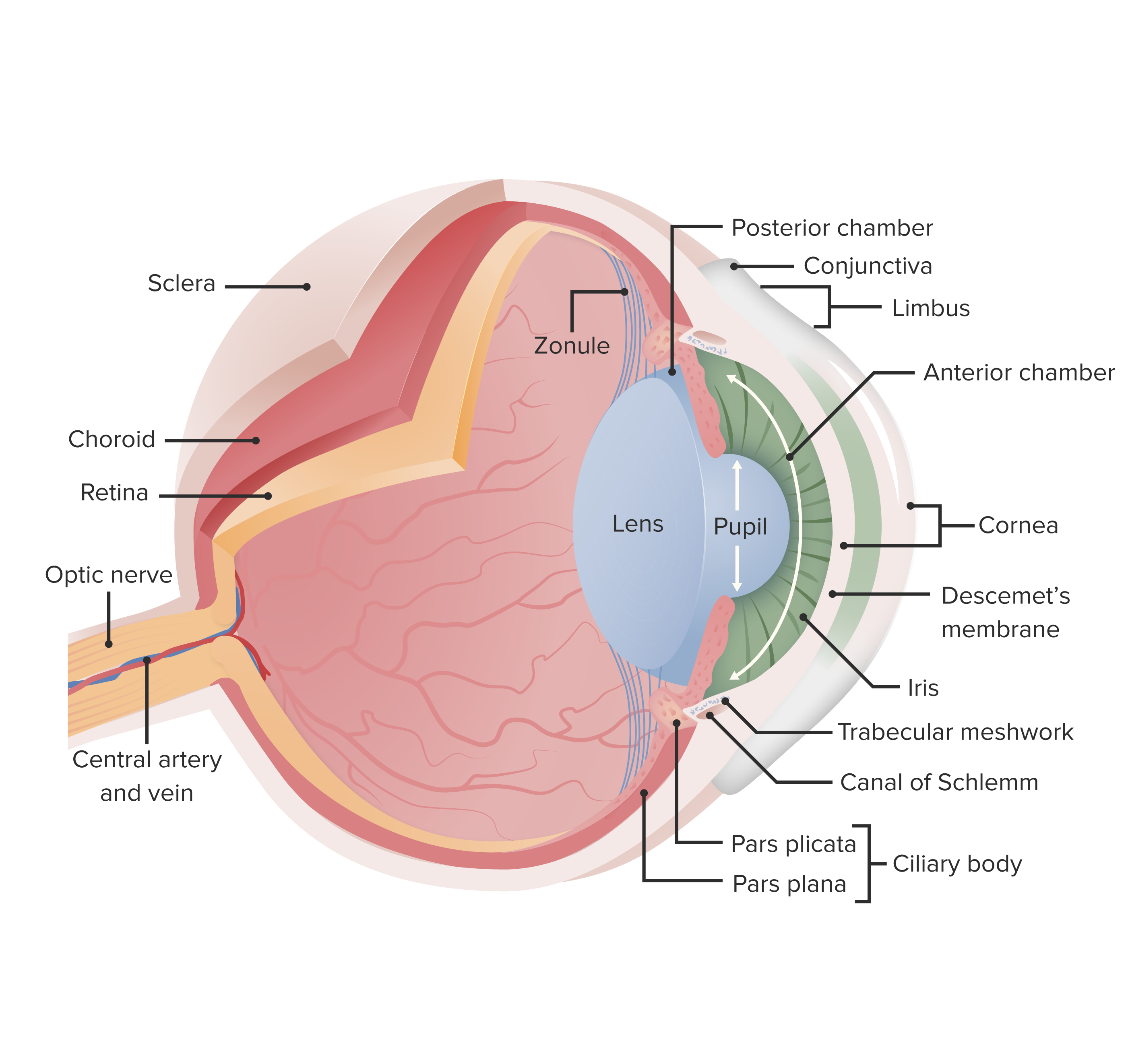
Anatomia essencial do diagrama de olho

Esta imagem representa a anatomia do olho. Na catarata, existe opacificação do cristalino, que interfere com a projeção da luz sobre a retina; isto provoca diminuição da acuidade visual, sobretudo à noite quando os níveis de luz são mais baixos.

Image by Lecturio.

Related videos

Etiologia e Fisiopatologia

  • Idade:
    • O principal fator de risco
    • O envelhecimento aumenta a espessura do cristalino.
    • São adicionadas camadas corticais → as células ficam comprimidas no centro → perda de transparência + endurecimento do cristalino
    • As transformações sofridas pelas células epiteliais levam a alterações na formação e homeostase das fibras do cristalino → afetação do transporte de nutrientes e antioxidantes
    • O dano oxidativo contribui para a formação de catarata.
  • Outros fatores de risco:
    • Toxinas
      • Tabagismo
      • Uso excessivo de álcool
    • Exposição à luz ultravioleta
    • Radiação infravermelha (especialmente comum em trabalhadores de vidro)
    • Choque elétrico (exposição a correntes de alta voltagem)
    • Trauma
      • Perfuração do globo ocular
      • Trauma fechado (impacto direto sobre o olho)
    • Fármacos:
      • Corticóides
      • Mióticos (inibidores da colinesterase)
    • Outras condições médicas:
      • Infeções do olho
      • Diálise crónica em doentes com insuficiência renal
      • Doença de Wilson
        • Alterações no metabolismo do cobre que provocam a sua acumulação na córnea
        • Catarata “sunflower” (tipo girassol): disco central esverdeado com opacidades radiais em cunha
      • Diabetes Diabetes Diabetes mellitus (DM) is a metabolic disease characterized by hyperglycemia and dysfunction of the regulation of glucose metabolism by insulin. Type 1 DM is diagnosed mostly in children and young adults as the result of autoimmune destruction of β cells in the pancreas and the resulting lack of insulin. Type 2 DM has a significant association with obesity and is characterized by insulin resistance. Diabetes Mellitus
        • No cristalino, a glucose Glucose A primary source of energy for living organisms. It is naturally occurring and is found in fruits and other parts of plants in its free state. It is used therapeutically in fluid and nutrient replacement. Lactose Intolerance é convertida em sorbitol Sorbitol A polyhydric alcohol with about half the sweetness of sucrose. Sorbitol occurs naturally and is also produced synthetically from glucose. It was formerly used as a diuretic and may still be used as a laxative and in irrigating solutions for some surgical procedures. It is also used in many manufacturing processes, as a pharmaceutical aid, and in several research applications. Laxatives pela aldolase Aldolase Becker Muscular Dystrophy redutase
        • glucose Glucose A primary source of energy for living organisms. It is naturally occurring and is found in fruits and other parts of plants in its free state. It is used therapeutically in fluid and nutrient replacement. Lactose Intolerance → ↑ sorbitol Sorbitol A polyhydric alcohol with about half the sweetness of sucrose. Sorbitol occurs naturally and is also produced synthetically from glucose. It was formerly used as a diuretic and may still be used as a laxative and in irrigating solutions for some surgical procedures. It is also used in many manufacturing processes, as a pharmaceutical aid, and in several research applications. Laxatives → ↑ osmolaridade e acumulação de fluido no cristalino → catarata
      • VIH/SIDA: os doentes são submetidos a cirurgia de catarata mais MAIS Androgen Insensitivity Syndrome cedo do que o habitual

Apresentação Clínica

Sintomas

  • Diminuição da visão ou visão turva:
    • Pode ser unilateral ou bilateral
    • Muitas vezes gradual e indolor
  • Diplopia Diplopia A visual symptom in which a single object is perceived by the visual cortex as two objects rather than one. Disorders associated with this condition include refractive errors; strabismus; oculomotor nerve diseases; trochlear nerve diseases; abducens nerve diseases; and diseases of the brain stem and occipital lobe. Myasthenia Gravis ou poliopia: a catarata cria múltiplas refrações (através de áreas claras e opacidades).
  • Sensibilidade ao brilho: à luz do sol ou faróis (à noite)
  • Alteração da visão de cores: desbotamento de objetos
  • Halos coloridos à volta da luz: dispersão da luz pela presença de gotas de água no cristalino
  • Alterações nos óculos refrativos
    • Mudança míope temporária: aumento da visão de perto
    • Mudanças frequentes na visão de perto e/ou distante

Sinais

  • Acuidade visual diminuída unilateral ou bilateralmente
  • Exame fundoscópico não dilatado
    • Escurecimento do reflexo vermelho
    • Opacidades dentro do reflexo vermelho
    • Fundo obscuro

Diagnóstico

Exame oftalmológico

  • Exame com lâmpada de fenda: permite examinar a extensão e o tipo de opacificação do cristalino, assim como avaliar outras estruturas oculares
  • Exame fundoscópico dilatado: permite examinar o pólo posterior, para descartar a presença de outras patologias

Classificação dos achados diagnósticos

  • Tipos de catarata com base na sua maturidade
    • Imatura:
      • Quantidade variável de opacificação
      • Ainda permite a visualização da retina Retina The ten-layered nervous tissue membrane of the eye. It is continuous with the optic nerve and receives images of external objects and transmits visual impulses to the brain. Its outer surface is in contact with the choroid and the inner surface with the vitreous body. The outermost layer is pigmented, whereas the inner nine layers are transparent. Eye: Anatomy e tem reflexo vermelho
    • Madura: a catarata é opaca e não há reflexo vermelho
    • Hipermatura:
      • A opacidade é densa e obscurece o reflexo vermelho, com liquefação do córtex
      • Catarata Morgagniana: catarata hipermadura com núcleo afundando inferiormente
  • Tipos de catarata com base na porção do cristalino afetada (muitas vezes sobrepõem-se)
    • Subcapsular posterior
      • Parte posterior do cristalino
      • Mais MAIS Androgen Insensitivity Syndrome comum em distúrbios metabólicos ( diabetes Diabetes Diabetes mellitus (DM) is a metabolic disease characterized by hyperglycemia and dysfunction of the regulation of glucose metabolism by insulin. Type 1 DM is diagnosed mostly in children and young adults as the result of autoimmune destruction of β cells in the pancreas and the resulting lack of insulin. Type 2 DM has a significant association with obesity and is characterized by insulin resistance. Diabetes Mellitus e galactosemia Galactosemia Galactosemia is a disorder caused by defects in galactose metabolism. Galactosemia is an inherited, autosomal-recessive condition, which results in inadequate galactose processing and high blood levels of monosaccharide. The rare disorder often presents in infants with symptoms of lethargy, nausea, vomiting, diarrhea, and jaundice. Galactosemia)
    • Nuclear
      • Núcleo ou porção central do cristalino
    • Cortical
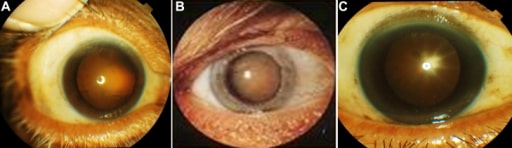
Catarata subcapsular posterior Catarata nuclear Catarata cortical
Causas
  • Envelhecimento
  • Esteróides
    • Altas doses
    • Uso crónico
  • Inflamação intraocular crónica
  • Trauma (exposição UV)
  • Doenças metabólicas
    • Diabetes Diabetes Diabetes mellitus (DM) is a metabolic disease characterized by hyperglycemia and dysfunction of the regulation of glucose metabolism by insulin. Type 1 DM is diagnosed mostly in children and young adults as the result of autoimmune destruction of β cells in the pancreas and the resulting lack of insulin. Type 2 DM has a significant association with obesity and is characterized by insulin resistance. Diabetes Mellitus
    • Galactosemia Galactosemia Galactosemia is a disorder caused by defects in galactose metabolism. Galactosemia is an inherited, autosomal-recessive condition, which results in inadequate galactose processing and high blood levels of monosaccharide. The rare disorder often presents in infants with symptoms of lethargy, nausea, vomiting, diarrhea, and jaundice. Galactosemia
Envelhecimento
  • Envelhecimento: tipo mais MAIS Androgen Insensitivity Syndrome comum de catarata senil
  • Diabetes Diabetes Diabetes mellitus (DM) is a metabolic disease characterized by hyperglycemia and dysfunction of the regulation of glucose metabolism by insulin. Type 1 DM is diagnosed mostly in children and young adults as the result of autoimmune destruction of β cells in the pancreas and the resulting lack of insulin. Type 2 DM has a significant association with obesity and is characterized by insulin resistance. Diabetes Mellitus
Sintomas
  • Início insidioso
  • Diminuição da visão à distância
  • Cores menos vibrantes
  • Início variável
  • Brilho ( mais MAIS Androgen Insensitivity Syndrome comum)
  • Diminuição da visão de perto e de longe
  • Cegueira noturna
  • Dificuldades na perceção de profundidade
  • Diplopia Diplopia A visual symptom in which a single object is perceived by the visual cortex as two objects rather than one. Disorders associated with this condition include refractive errors; strabismus; oculomotor nerve diseases; trochlear nerve diseases; abducens nerve diseases; and diseases of the brain stem and occipital lobe. Myasthenia Gravis
Diagnóstico Opacidade granular no pólo posterior do córtex adjacente à cápsula posterior
  • Opacificação do núcleo central
  • Esclerose e amarelecimento do núcleo do cristalino
  • Opacidades na camada cortical
  • Opacidades periféricas em forma de raio progredindo circunferencialmente
Cataract examples

Aparência do cristalino em 3 doentes.
A: Catarata cortical
B: Catarata nuclear
C: Catarata subcapsular posterior
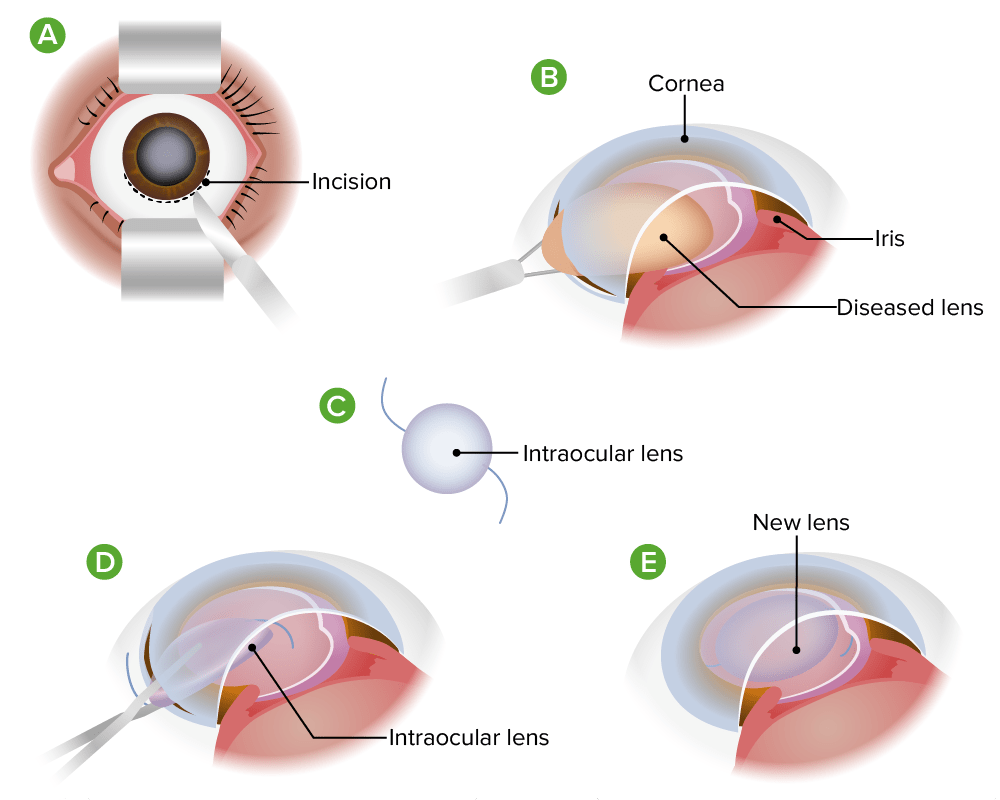
Imagem: “Appearance of lenses in patients” por Department of Biochemistry, Jawaharlal Nehru Medical College, Maharashtra, India. Licença: CC BY 3.0

Tratamento

  • Cirurgia:
    • Indicada quando existe perturbação visual grave com impacto na vida diária
    • Procedimento realizado em regime ambulatório, muitas vezes sob anestesia local
  • Técnicas cirúrgicas:
    • Extração de catarata extracapsular standard:
      • Para remoção de catarata avançada
      • Remoção do núcleo do cristalino em bloco único, deixando a cápsula
      • Lente intraocular (LIO) colocada no saco capsular
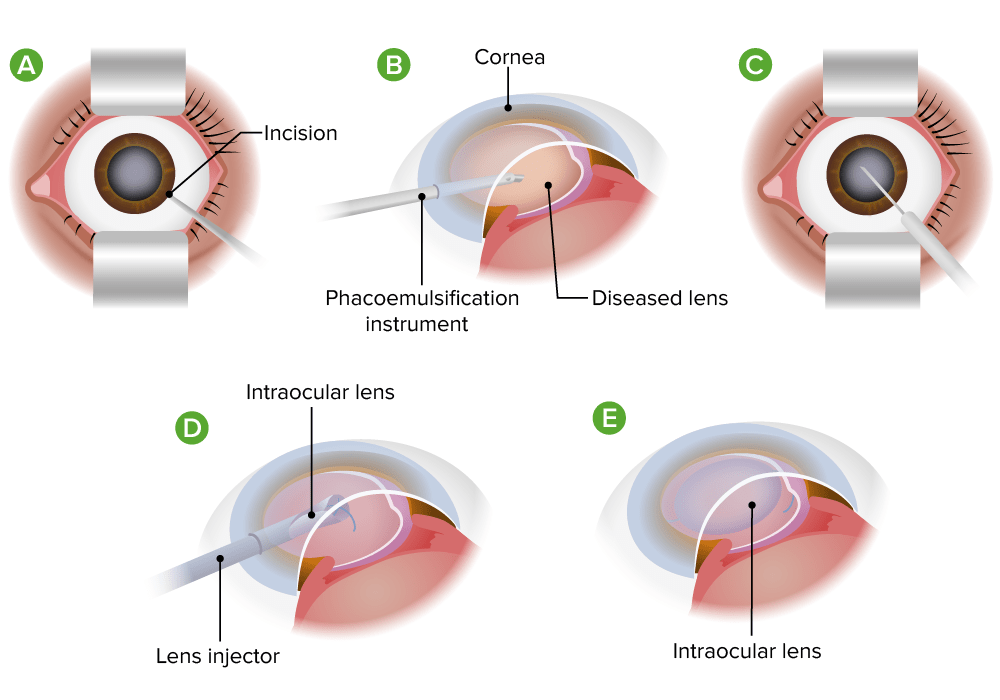
    • Facoemulsificação:
      • Cirurgia mais MAIS Androgen Insensitivity Syndrome comum nos países desenvolvidos
      • Cirurgia de pequena incisão
      • A sonda de faco fragmenta a parte central dura do cristalino (com energia ultrassónica)
      • LIO colocada na cápsula da lente
    • Extração de catarata intracapsular
  • Complicações:
    • Endoftalmite (infeção dentro do olho)
    • Mau posicionamento intraocular
    • Descolamento da retina Retina The ten-layered nervous tissue membrane of the eye. It is continuous with the optic nerve and receives images of external objects and transmits visual impulses to the brain. Its outer surface is in contact with the choroid and the inner surface with the vitreous body. The outermost layer is pigmented, whereas the inner nine layers are transparent. Eye: Anatomy
    • Degenerescência macular

Diagnóstico Diferencial

  • Diabetes Diabetes Diabetes mellitus (DM) is a metabolic disease characterized by hyperglycemia and dysfunction of the regulation of glucose metabolism by insulin. Type 1 DM is diagnosed mostly in children and young adults as the result of autoimmune destruction of β cells in the pancreas and the resulting lack of insulin. Type 2 DM has a significant association with obesity and is characterized by insulin resistance. Diabetes Mellitus mellitus: um grupo heterogéneo de doenças metabólicas caracterizadas por hiperglicemia que se deve à resistência periférica ou deficiência de insulina. A diabetes Diabetes Diabetes mellitus (DM) is a metabolic disease characterized by hyperglycemia and dysfunction of the regulation of glucose metabolism by insulin. Type 1 DM is diagnosed mostly in children and young adults as the result of autoimmune destruction of β cells in the pancreas and the resulting lack of insulin. Type 2 DM has a significant association with obesity and is characterized by insulin resistance. Diabetes Mellitus mellitus pode resultar numa série de complicações, incluindo erros transitórios de refração (associados aos níveis flutuantes de glicose) e retinopatia crónica, que se manifesta com miodesópsias e visão turva.
  • Glaucoma Glaucoma Glaucoma is an optic neuropathy characterized by typical visual field defects and optic nerve atrophy seen as optic disc cupping on examination. The acute form of glaucoma is a medical emergency. Glaucoma is often, but not always, caused by increased intraocular pressure (IOP). Glaucoma: uma neuropatia ótica com alterações no disco ótico e defeito no campo visual. O glaucoma Glaucoma Glaucoma is an optic neuropathy characterized by typical visual field defects and optic nerve atrophy seen as optic disc cupping on examination. The acute form of glaucoma is a medical emergency. Glaucoma is often, but not always, caused by increased intraocular pressure (IOP). Glaucoma está frequentemente associado ao aumento da pressão intraocular (geralmente dentro das câmaras anterior e posterior), o que resulta numa perda gradual da visão. Essa perda de visão pode ocorrer de forma aguda devido ao bloqueio da drenagem do humor Humor Defense Mechanisms aquoso ( glaucoma Glaucoma Glaucoma is an optic neuropathy characterized by typical visual field defects and optic nerve atrophy seen as optic disc cupping on examination. The acute form of glaucoma is a medical emergency. Glaucoma is often, but not always, caused by increased intraocular pressure (IOP). Glaucoma agudo de ângulo fechado), que é uma emergência médica. A maioria dos casos deve-se a glaucoma Glaucoma Glaucoma is an optic neuropathy characterized by typical visual field defects and optic nerve atrophy seen as optic disc cupping on examination. The acute form of glaucoma is a medical emergency. Glaucoma is often, but not always, caused by increased intraocular pressure (IOP). Glaucoma de ângulo aberto.
  • Degenerescência macular: distúrbio degenerativo da porção central da retina Retina The ten-layered nervous tissue membrane of the eye. It is continuous with the optic nerve and receives images of external objects and transmits visual impulses to the brain. Its outer surface is in contact with the choroid and the inner surface with the vitreous body. The outermost layer is pigmented, whereas the inner nine layers are transparent. Eye: Anatomy. Apresenta-se principalmente com perda da visão central. Os doentes raramente perdem a visão periférica. O diagnóstico é feito através de achados característicos no exame com lâmpada de fenda (drusas, hemorragia sub-retiniana).
  • Erros de refração: Ocorrem quando o olho não consegue focalizar a luz na retina Retina The ten-layered nervous tissue membrane of the eye. It is continuous with the optic nerve and receives images of external objects and transmits visual impulses to the brain. Its outer surface is in contact with the choroid and the inner surface with the vitreous body. The outermost layer is pigmented, whereas the inner nine layers are transparent. Eye: Anatomy. Afetados por fatores como o tamanho do olho (comprimento axial Axial Computed Tomography (CT)) e a forma da córnea. Os principais tipos de erros de refração são a miopia, a hipermetropia e o astigmatismo.
  • Uveíte: inflamação aguda da úvea (camada intermédia do globo ocular) e do corpo ciliar. A uveíte pode ser causada por infeções (herpes, sífilis) ou pode estar relacionada com doenças inflamatórias sistémicas (doença inflamatória intestinal, artrite reumatoide). Os sintomas incluem visão turva, olho vermelho com dor (uveíte anterior) ou sem dor (uveíte intermediária e posterior) e miodesópsias (uveíte intermediária).

Referências

  1. Folberg, R.(2020). The Eye  in Kumar, V., Abbas, A., Aster, J. (Eds.), Robbins and Cotran Pathologic Basis of Disease (10th ed., pp. 1305-1328). Elsevier, Inc.
  2. Jacobs, D., Gardiner, M.; Givens, J. (2020). Cataract in adults. UpToDate. Retrieved September 12, 2020, from https://www.uptodate.com/contents/cataract-in-adults
  3. Nizami, A., Gulani, A. (2020) Cataract. Retrieved September 12, 2020, from https://www.ncbi.nlm.nih.gov/books/NBK539699/
  4. Ocampo, V., Foster, C.S., Dahl, A. (Ed.). (2018).Senile cataract. Medscape. Retrieved September 12, 2020, from https://emedicine.medscape.com/article/1210914-overview
  5. Pollreisz, A., Schmidth-Erfurth, U. (2010). Diabetic Cataract-Pathogenesis, Epidemiology and Treatment. J Ophthalmol. https://pubmed.ncbi.nlm.nih.gov/20634936/ 

Crie sua conta gratuita ou faça login para continuar lendo!

Cadastre-se agora e tenha acesso grátis ao Lecturio, com páginas de conceitos, vídeos de medicina e questões para sua educação médica.

Aprende mais com a Lecturio:

Multiple devices displaying human anatomy and health education content.

Complementa o teu estudo da faculdade com o companheiro de estudo tudo-em-um da Lecturio, através de métodos de ensino baseados em evidência.

Estuda onde quiseres

Two iPhones display medical education apps, one showing anatomy, the other Bookmatcher.

A Lecturio Medical complementa o teu estudo através de métodos de ensino baseados em evidência, vídeos de palestras, perguntas e muito mais – tudo combinado num só lugar e fácil de usar.

User Reviews

Have a holly, jolly study session 🎁 Save 50% on all plans now >>

Que tengas una sesión de estudio alegre y navideña 🎁 Ahorra 50% en todos los planes >>

Details