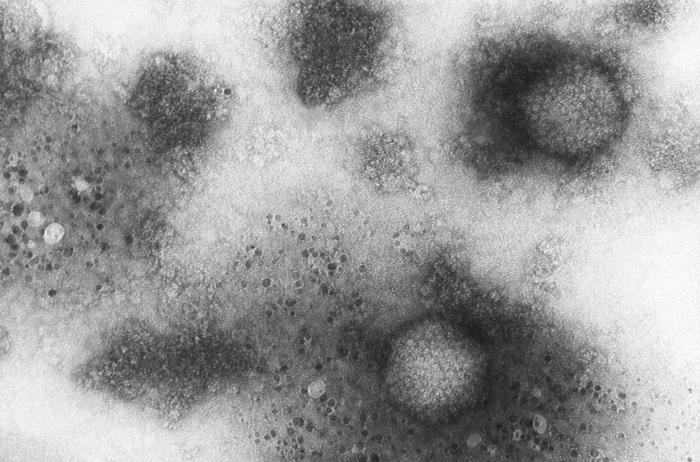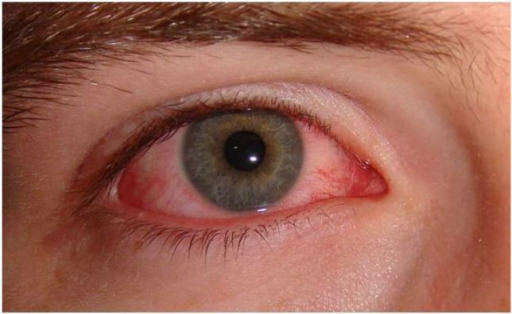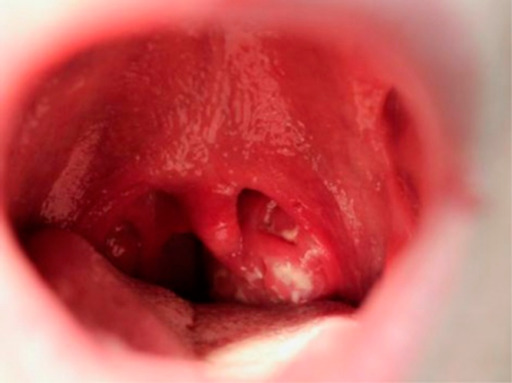



Adenovírus

O adenovírus (membro da família Adenoviridae Adenoviridae A family of non-enveloped viruses infecting mammals (mastadenovirus) and birds (aviadenovirus) or both (atadenovirus). Infections may be asymptomatic or result in a variety of diseases. Adenovirus) é um vírus de DNA DNA A deoxyribonucleotide polymer that is the primary genetic material of all cells. Eukaryotic and prokaryotic organisms normally contain DNA in a double-stranded state, yet several important biological processes transiently involve single-stranded regions. DNA, which consists of a polysugar-phosphate backbone possessing projections of purines (adenine and guanine) and pyrimidines (thymine and cytosine), forms a double helix that is held together by hydrogen bonds between these purines and pyrimidines (adenine to thymine and guanine to cytosine). DNA Types and Structure de cadeia dupla não envelopado. O adenovírus pode ser transmitido de várias maneiras e manifesta-se clinicamente dependendo do local de entrada. A apresentação pode incluir faringite febril, conjuntivite, doença respiratória aguda, pneumonia Pneumonia Pneumonia or pulmonary inflammation is an acute or chronic inflammation of lung tissue. Causes include infection with bacteria, viruses, or fungi. In more rare cases, pneumonia can also be caused through toxic triggers through inhalation of toxic substances, immunological processes, or in the course of radiotherapy. Pneumonia atípica e gastroenterite. As manifestações mais MAIS Androgen Insensitivity Syndrome graves são cistite hemorrágica aguda, hepatite, miocardite e infeção disseminada. O diagnóstico é confirmado por PCR PCR Polymerase chain reaction (PCR) is a technique that amplifies DNA fragments exponentially for analysis. The process is highly specific, allowing for the targeting of specific genomic sequences, even with minuscule sample amounts. The PCR cycles multiple times through 3 phases: denaturation of the template DNA, annealing of a specific primer to the individual DNA strands, and synthesis/elongation of new DNA molecules. Polymerase Chain Reaction (PCR) e teste de antigénio. A maioria das infeções é autolimitada, sendo o tratamento de suporte. A terapêutica antiviral Antiviral Antivirals for Hepatitis B está reservada para pacientes imunodeprimidos e infeções graves.

Last updated: Dec 15, 2025
Editorial responsibility: Stanley Oiseth, Lindsay Jones, Evelin Maza

Classificação

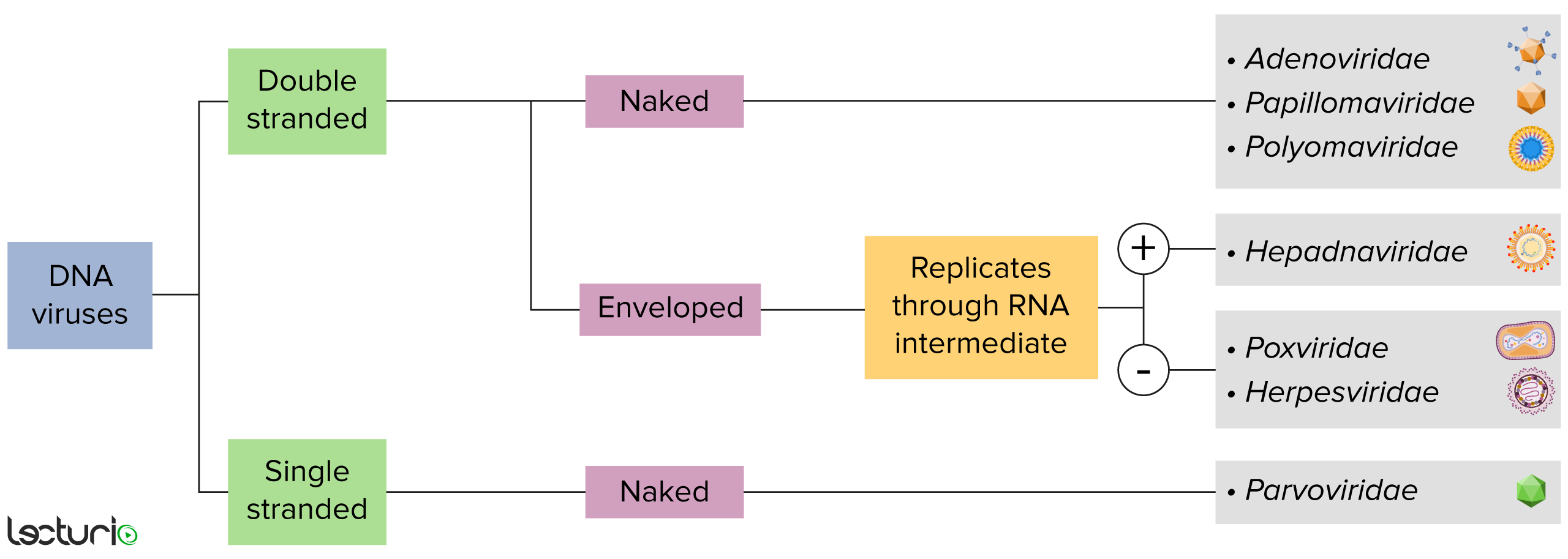
Fluxograma de classificação de vírus de DNA

Identificação de vírus de DNA:
Os vírus podem ser classificados de várias formas. Contudo, a maioria dos vírus possui um genoma formado por DNA ou RNA. Os vírus com genoma de DNA podem ainda ser caracterizados como de cadeia simples ou dupla. Os vírus com envelope são revestidos por uma camada fina de membrana celular, que geralmente é retirada da célula hospedeira. Os vírus sem envelope são apelidados de vírus “nus”. Alguns vírus com envelope traduzem DNA em RNA antes de serem incorporados no genoma da célula hospedeira.
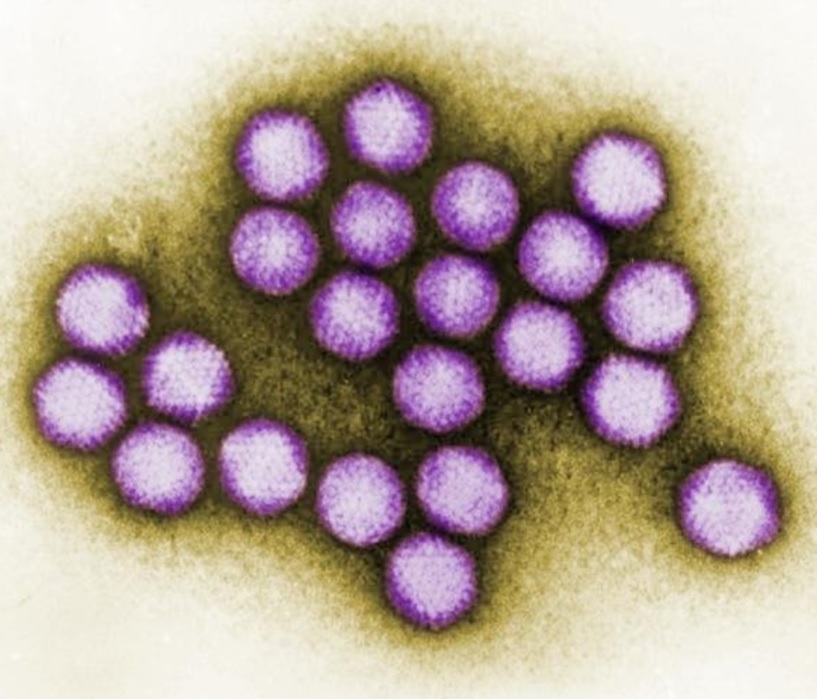
Imagem por Lecturio. Licença: CC BY-NC-SA 4.0

Características Gerais e Epidemiologia

Características básicas do adenovírus

  • Taxonomia:
    • Família: Adenoviridae Adenoviridae A family of non-enveloped viruses infecting mammals (mastadenovirus) and birds (aviadenovirus) or both (atadenovirus). Infections may be asymptomatic or result in a variety of diseases. Adenovirus
    • Género: Mastadenovirus Mastadenovirus A genus of adenoviridae that infects mammals including humans and causes a wide range of diseases. The type species is human adenovirus c. Adenovirus
  • Vírus DNA DNA A deoxyribonucleotide polymer that is the primary genetic material of all cells. Eukaryotic and prokaryotic organisms normally contain DNA in a double-stranded state, yet several important biological processes transiently involve single-stranded regions. DNA, which consists of a polysugar-phosphate backbone possessing projections of purines (adenine and guanine) and pyrimidines (thymine and cytosine), forms a double helix that is held together by hydrogen bonds between these purines and pyrimidines (adenine to thymine and guanine to cytosine). DNA Types and Structure:
    • Cadeia dupla
    • Linear
  • Estrutura
    • Vírus sem envelope Envelope Bilayer lipid membrane acquired by viral particles during viral morphogenesis. Although the lipids of the viral envelope are host derived, various virus-encoded integral membrane proteins, i.e. Viral envelope proteins are incorporated there. Virology
    • Cápside icosaédrica
    • Projeções semelhantes a fibras nos vértices
  • Resistente a:
    • Ácido
    • Detergente
    • Ambiente seco
  • Desativado por:

Espécies clinicamente relevantes

  • 7 espécies de adenovírus humanos (grupos A–G)
  • > 60 serotipos

Epidemiologia

  • Mais MAIS Androgen Insensitivity Syndrome comum em bebés e crianças (causa até 10% das doenças febris neste grupo)
  • Sem predileção por raça
  • Maior incidência na primavera e no inverno

Related videos

Patogénese

Reservatório

  • Humanos
  • Mamíferos

Transmissão

  • Contacto com secreções de uma pessoa infetada (recém-nascidos podem ser infetados por secreções cervicais)
  • Fómitos
  • Através da água (piscinas inadequadamente cloradas)
  • Aerossóis
  • Fecal-oral

Fatores de risco do hospedeiro

O vírus é mais MAIS Androgen Insensitivity Syndrome prevalente em:

  • Crianças pequenas
  • Creches
  • Militares

Ciclo de replicação viral

  • As fibras da cápside viral ligam-se aos recetores celulares ou células epiteliais → endocitose
  • Sai do endossoma → o DNA DNA A deoxyribonucleotide polymer that is the primary genetic material of all cells. Eukaryotic and prokaryotic organisms normally contain DNA in a double-stranded state, yet several important biological processes transiently involve single-stranded regions. DNA, which consists of a polysugar-phosphate backbone possessing projections of purines (adenine and guanine) and pyrimidines (thymine and cytosine), forms a double helix that is held together by hydrogen bonds between these purines and pyrimidines (adenine to thymine and guanine to cytosine). DNA Types and Structure viral entra no núcleo da célula → transcrição e replicação
  • A tradução e a síntese de proteínas estruturais virais ocorrem no citoplasma
  • Empacotamento viral → são libertados novos viriões da célula hospedeira
  • Durante o processo de replicação, o vírus inibe a supressão do crescimento celular.

Fisiopatologia

O local de entrada por norma determina o tipo de infeção; podem ocorrer 2 processos:
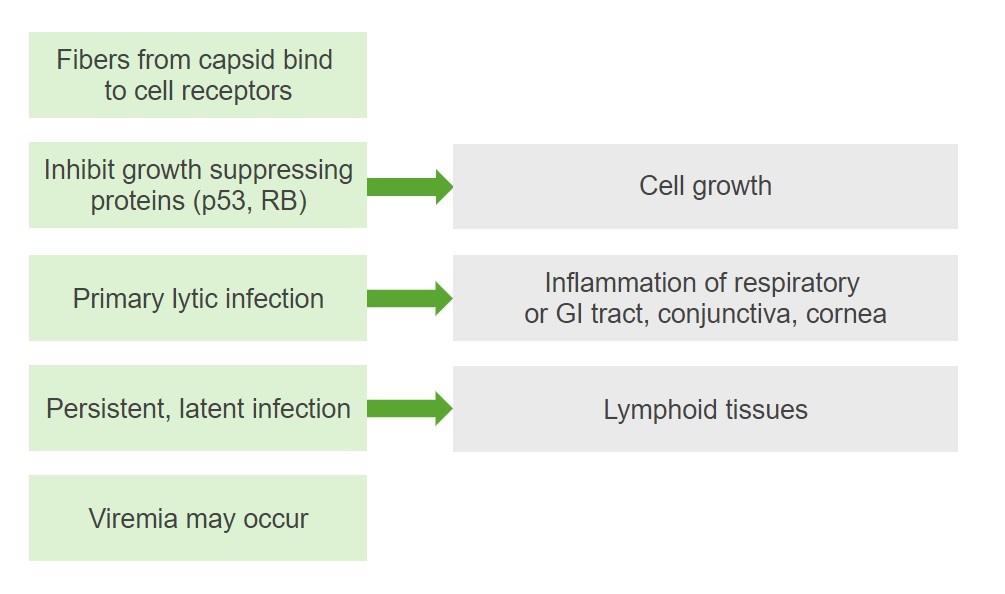
  • Infeção lítica:
    • O vírus replica-se nas células epiteliais do hospedeiro → lise celular
    • Resposta inflamatória → manifestações clínicas
  • Infeção latente:
    • O mecanismo fisiopatológico ainda não está totalmente compreendido
    • O vírus infeta o tecido linfoide (por exemplo, amígdalas) → assintomático (a excreção do vírus demora até 18 meses mas sem doença)
    • Pode ser reativado (por exemplo, em estados imunodeprimidos) → viremia Viremia The presence of viruses in the blood. Erythema Infectiosum → infeção sistémica
Esquema de patogênese da infecção por adenovírus

Diagrama resumido da patogénese da infeção por adenovírus
RB: retinoblastoma

Imagem por Lecturio. Licença: CC BY-NC-SA 4.0

Apresentação Clínica

A maioria das infeções por adenovírus é assintomática. As infeções com doença clinicamente aparente podem apresentar as seguintes condições:

Tabela: Infeções sintomáticas por adenovírus
Doença Incubação População de risco Apresentação Clínica
Faringite febril 4-9 dias Crianças (<< 3 anos)
  • Febre
  • Odinofagia
  • Tosse
  • Rinorreia
  • Mimetiza uma infeção estreptocócica
  • A otite média é frequente.
Doença respiratória aguda Militares
  • Febre
  • Tosse
  • Odinofagia
  • Rinorreia
  • Adenite cervical
Conjuntivite Crianças mais MAIS Androgen Insensitivity Syndrome velhas e adultos (especialmente exposição em piscinas e lagos)
  • Sintomas de faringite
  • Hiperémia conjuntival
  • Secreções mucosas escassas
  • Linfadenopatia pré-auricular
  • Queratite em adultos
Pneumonia Pneumonia Pneumonia or pulmonary inflammation is an acute or chronic inflammation of lung tissue. Causes include infection with bacteria, viruses, or fungi. In more rare cases, pneumonia can also be caused through toxic triggers through inhalation of toxic substances, immunological processes, or in the course of radiotherapy. Pneumonia atípica 10-14 dias Crianças e adultos
  • Febre
  • Tosse não produtiva
  • Dispneia
  • Inflamação irregular difusa ( pneumonia Pneumonia Pneumonia or pulmonary inflammation is an acute or chronic inflammation of lung tissue. Causes include infection with bacteria, viruses, or fungi. In more rare cases, pneumonia can also be caused through toxic triggers through inhalation of toxic substances, immunological processes, or in the course of radiotherapy. Pneumonia intersticial)
  • Envolve ≥ 1 lobo (muitas vezes difuso)
Gastroenterite 3-10 dias Bebés e crianças pequenas
  • Diarreia aquosa
  • Vómitos
  • Pode causar intussusceção
Apendicite <10 dias Crianças A hiperplasia linfóide compromete o aporte sanguíneo → inflamação

Manifestações raras

  • Hepatite
  • Cistite hemorrágica aguda
  • Meningite e encefalite
  • Miocardite
  • Doença disseminada (associada a ↑↑ mortalidade)

Diagnóstico e Tratamento

Diagnóstico

Os seguintes exames podem ser utilizados para confirmar o diagnóstico:

  • PCR PCR Polymerase chain reaction (PCR) is a technique that amplifies DNA fragments exponentially for analysis. The process is highly specific, allowing for the targeting of specific genomic sequences, even with minuscule sample amounts. The PCR cycles multiple times through 3 phases: denaturation of the template DNA, annealing of a specific primer to the individual DNA strands, and synthesis/elongation of new DNA molecules. Polymerase Chain Reaction (PCR) para detetar o ADN do adenovírus
    • Sensível e específico
    • Pode ser realizado em diversas estirpes
  • Teste de antigénio
    • Rápido
    • Menos sensível
    • Opções:
      • Imunofluorescência
      • Imunoensaio enzimático
  • Cultura viral
  • Serologia

Tratamento

As infeções por adenovírus são habitualmente autolimitadas, portanto, na maioria dos casos, o tratamento é de suporte.

  • Hidratação
  • Repouso
  • Terapêutica antiviral Antiviral Antivirals for Hepatitis B (eficácia variável)
    • Indicações:
      • Doentes imunodeprimidos
      • Infeção grave
    • Opções:
      • Cidofovir Cidofovir An acyclic nucleoside phosphonate that acts as a competitive inhibitor of viral DNA polymerases. It is used in the treatment of retinitis caused by cytomegalovirus infections and may also be useful for treating herpesvirus infections. Antivirals for Herpes Virus
      • Ribavirina (eficácia inconsistente)
      • Imunoglobulina intravenosa (tratamento adjuvante para os imunocomprometidos)

Prevenção

  • Evitar indivíduos infetados.
  • Lavar as mãos
  • Superfícies limpas.
  • Cloração de piscinas
  • Administração de vacina oral viva:
    • Tem como alvo os adenovírus tipos 4 e 7
    • Reservada apenas para militares

Comparações de Vírus Clinicamente Semelhantes

A tabela abaixo compara vírus com apresentações clínicas semelhantes:

Tabela: Comparação de adenovírus, rinovírus e vírus sincicial respiratório
Vírus Adenovírus Rinovírus Vírus sincicial respiratório
Família Adenoviridae Adenoviridae A family of non-enveloped viruses infecting mammals (mastadenovirus) and birds (aviadenovirus) or both (atadenovirus). Infections may be asymptomatic or result in a variety of diseases. Adenovirus Picornaviridae Picornaviridae A family of small RNA viruses comprising some important pathogens of humans and animals. Transmission usually occurs mechanically. There are nine genera: aphthovirus; cardiovirus; enterovirus; erbovirus; hepatovirus; kobuvirus; parechovirus; rhinovirus; and teschovirus. Coxsackievirus Paramyxoviridae Paramyxoviridae A family of spherical viruses, of the order mononegavirales, somewhat larger than the orthomyxoviruses, and containing single-stranded RNA. Subfamilies include paramyxoviridae and pneumovirinae. Respiratory Syncytial Virus
Características
  • Cadeia dupla
  • Vírus de DNA DNA A deoxyribonucleotide polymer that is the primary genetic material of all cells. Eukaryotic and prokaryotic organisms normally contain DNA in a double-stranded state, yet several important biological processes transiently involve single-stranded regions. DNA, which consists of a polysugar-phosphate backbone possessing projections of purines (adenine and guanine) and pyrimidines (thymine and cytosine), forms a double helix that is held together by hydrogen bonds between these purines and pyrimidines (adenine to thymine and guanine to cytosine). DNA Types and Structure
  • Sem envelope Envelope Bilayer lipid membrane acquired by viral particles during viral morphogenesis. Although the lipids of the viral envelope are host derived, various virus-encoded integral membrane proteins, i.e. Viral envelope proteins are incorporated there. Virology
  • Cápside icosaédrica
  • Cadeia simples, sentido positivo
  • Vírus de RNA RNA A polynucleotide consisting essentially of chains with a repeating backbone of phosphate and ribose units to which nitrogenous bases are attached. RNA is unique among biological macromolecules in that it can encode genetic information, serve as an abundant structural component of cells, and also possesses catalytic activity. RNA Types and Structure
  • Sem envelope Envelope Bilayer lipid membrane acquired by viral particles during viral morphogenesis. Although the lipids of the viral envelope are host derived, various virus-encoded integral membrane proteins, i.e. Viral envelope proteins are incorporated there. Virology
  • Cápside icosaédrica
  • Cadeia simples
  • Sentido negativo
  • Vírus de RNA RNA A polynucleotide consisting essentially of chains with a repeating backbone of phosphate and ribose units to which nitrogenous bases are attached. RNA is unique among biological macromolecules in that it can encode genetic information, serve as an abundant structural component of cells, and also possesses catalytic activity. RNA Types and Structure
  • Com envelope Envelope Bilayer lipid membrane acquired by viral particles during viral morphogenesis. Although the lipids of the viral envelope are host derived, various virus-encoded integral membrane proteins, i.e. Viral envelope proteins are incorporated there. Virology
  • Cápside helicoidal
Transmissão
  • Aerossóis
  • Contacto direto
  • Fómites
  • Aerossóis
  • Contacto direto
  • Fómites
  • Aerossóis
  • Contacto direto
Clínica
  • Infeções respiratórias superiores e inferiores
  • Otite média
  • Conjuntivite
  • Gastroenterite
  • Infeções respiratórias superiores e inferiores
  • Otite média
  • Infeções do trato respiratório superior e inferior
  • Otite média
Diagnóstico
  • Clínico
  • PCR PCR Polymerase chain reaction (PCR) is a technique that amplifies DNA fragments exponentially for analysis. The process is highly specific, allowing for the targeting of specific genomic sequences, even with minuscule sample amounts. The PCR cycles multiple times through 3 phases: denaturation of the template DNA, annealing of a specific primer to the individual DNA strands, and synthesis/elongation of new DNA molecules. Polymerase Chain Reaction (PCR) – reação em cadeia da polimerase
  • Teste de antigénio
  • Clínico
  • PCR PCR Polymerase chain reaction (PCR) is a technique that amplifies DNA fragments exponentially for analysis. The process is highly specific, allowing for the targeting of specific genomic sequences, even with minuscule sample amounts. The PCR cycles multiple times through 3 phases: denaturation of the template DNA, annealing of a specific primer to the individual DNA strands, and synthesis/elongation of new DNA molecules. Polymerase Chain Reaction (PCR) – reação em cadeia da polimerase
  • Clínico
  • PCR PCR Polymerase chain reaction (PCR) is a technique that amplifies DNA fragments exponentially for analysis. The process is highly specific, allowing for the targeting of specific genomic sequences, even with minuscule sample amounts. The PCR cycles multiple times through 3 phases: denaturation of the template DNA, annealing of a specific primer to the individual DNA strands, and synthesis/elongation of new DNA molecules. Polymerase Chain Reaction (PCR) – reação em cadeia da polimerase
  • Teste de antigénio
Tratamento De suporte
Prevenção
  • Evitar indivíduos afetados.
  • Lavar as mãos
  • Vacina oral viva
  • Evitar indivíduos afetados.
  • Lavar as mãos
  • Evitar indivíduos infetados.
  • Lavar as mãos
  • Palivizumab Palivizumab A humanized monoclonal antibody and antiviral agent that is used to prevent respiratory syncytial virus infections in high risk pediatric patients. Respiratory Syncytial Virus para bebés de alto risco

Diagnósticos Diferenciais

  • Faringite bacteriana: infeção da faringe. Os pacientes apresentam frequentemente odinofagia e febre. O diagnóstico etiológico pode incluir teste rápido para a deteção de Streptococcus Streptococcus Streptococcus is one of the two medically important genera of gram-positive cocci, the other being Staphylococcus. Streptococci are identified as different species on blood agar on the basis of their hemolytic pattern and sensitivity to optochin and bacitracin. There are many pathogenic species of streptococci, including S. pyogenes, S. agalactiae, S. pneumoniae, and the viridans streptococci. Streptococcus do grupo A e culturas bacterianas. O tratamento inclui antibioterapia com penicilina ou amoxicilina.
  • Pneumonia Pneumonia Pneumonia or pulmonary inflammation is an acute or chronic inflammation of lung tissue. Causes include infection with bacteria, viruses, or fungi. In more rare cases, pneumonia can also be caused through toxic triggers through inhalation of toxic substances, immunological processes, or in the course of radiotherapy. Pneumonia bacteriana: infeção do parênquima pulmonar. Os pacientes apresentam febre, dispneia e tosse produtiva. A consolidação lobar na radiografia do tórax é um dos achados mais MAIS Androgen Insensitivity Syndrome frequentes; em alguns casos podem ser visualizados infiltrados multifocais. O tratamento geralmente envolve antibioterapia empírica, que pode ser dirigida se o microorganismo etiológico for identificado.
  • Tosse convulsa: doença infeciosa causada por Bordetella pertussis Bordetella pertussis A species of gram-negative, aerobic bacteria that is the causative agent of whooping cough. Its cells are minute coccobacilli that are surrounded by a slime sheath. Bordetella. Os pacientes inicialmente apresentam tosse ligeira, febre, rinorreia, espirros e conjuntivite. Posteriormente ocorre progressão para tosse intensa e característica, associada de um som agudo na inspiração. O diagnóstico é confirmado por PCR PCR Polymerase chain reaction (PCR) is a technique that amplifies DNA fragments exponentially for analysis. The process is highly specific, allowing for the targeting of specific genomic sequences, even with minuscule sample amounts. The PCR cycles multiple times through 3 phases: denaturation of the template DNA, annealing of a specific primer to the individual DNA strands, and synthesis/elongation of new DNA molecules. Polymerase Chain Reaction (PCR) ou cultura. O tratamento engloba antibioterapia com macrólidos.

Referências

  1. Siu, W., Killikelly, A., Salvadori, M. I., & Abrams, E. M. (2024). Approach to prevention of respiratory syncytial virus disease in infants by passive immunization. Canadian Family Physician, 70(11-12), 697–700.  10.46747/cfp.701112697
  2. Vora GJ, Lin B, Gratwick K, et al. (2006). Co-infections of adenovirus species in previously vaccinated patients. Emerg Infect Dis 12:921–930.
  3. Echavarría M. (2008). Adenoviruses in immunocompromised hosts. Clin Microbiol Rev 21:704–715. https://www.ncbi.nlm.nih.gov/pmc/articles/PMC2570151/
  4. Ghebremedhin B. (2014). Human adenovirus: viral pathogen with increasing importance. Eur J Microbiol Immunol (Bp), 4(1):26–33. https://www.ncbi.nlm.nih.gov/pmc/articles/PMC3955829/
  5. Zhao S, Wan C, Ke C, et al. (2014). Re-emergent human adenovirus genome type 7d caused an acute respiratory disease outbreak in Southern China after a twenty-one-year absence. Sci Rep 4(4):7365. https://www.ncbi.nlm.nih.gov/pmc/articles/PMC4258649/
  6. Kajon AE, Lu X, Erdman DD, et al. (2010). Molecular epidemiology and a brief history of emerging adenovirus 14-associated respiratory disease in the United States. J Infect Dis 202(1):93–103. https://pubmed.ncbi.nlm.nih.gov/20500088/
  7. Flomenberg, P., & Kojaoghlanian, T. (2025, June 27). Pathogenesis, epidemiology, and clinical manifestations of adenovirus infections. In T. M. File Jr. & S. L. Kaplan (Eds.), UpToDate. Retrieved October 16, 2025, from https://www.uptodate.com/contents/pathogenesis-epidemiology-and-clinical-manifestations-of-adenovirus-infections
  8. Munoz, F.M., and Flomenberg, P. (2025). Diagnosis, treatment, and prevention of adenovirus infection. UpToDate. Retrieved October 16, 2025, from https://www.uptodate.com/contents/diagnosis-treatment-and-prevention-of-adenovirus-infection
  9. Tesini, B.L. (2024). Adenovirus infection. MSD Manual Professional Version. Retrieved October 16, 2025, from https://www.msdmanuals.com/professional/infectious-diseases/respiratory-viruses/adenovirus-infections
  10. Gompf, S.G., Cornelius, T. (2024). Adenovirus. Medscape. Retrieved October 16, 2025, from https://emedicine.medscape.com/article/211738-overview

Crie sua conta gratuita ou faça login para continuar lendo!

Cadastre-se agora e tenha acesso grátis ao Lecturio, com páginas de conceitos, vídeos de medicina e questões para sua educação médica.

Aprende mais com a Lecturio:

Multiple devices displaying human anatomy and health education content.

Complementa o teu estudo da faculdade com o companheiro de estudo tudo-em-um da Lecturio, através de métodos de ensino baseados em evidência.

Estuda onde quiseres

Two iPhones display medical education apps, one showing anatomy, the other Bookmatcher.

A Lecturio Medical complementa o teu estudo através de métodos de ensino baseados em evidência, vídeos de palestras, perguntas e muito mais – tudo combinado num só lugar e fácil de usar.

User Reviews

Have a holly, jolly study session 🎁 Save 50% on all plans now >>

Que tengas una sesión de estudio alegre y navideña 🎁 Ahorra 50% en todos los planes >>

Details