Domina Conceptos Médicos

Estudia para la escuela de medicina y tus examenes con Lecturio.

Traumatismo Genitourinario

Las lesiones traumáticas del tracto genitourinario incluyen lesiones en EN Erythema nodosum is an immune-mediated panniculitis (inflammation of the subcutaneous fat) caused by a type IV (delayed-type) hypersensitivity reaction. It commonly manifests in young women as tender, erythematous nodules on the shins. Erythema Nodosum los LOS Neisseria riñones, el uréter, la vejiga, la uretra o los LOS Neisseria genitales. Por lo general, las lesiones del tracto genitourinario por sí solas no son mortales, pero pueden estar asociadas con otras lesiones potencialmente más significativas. El sistema genitourinario se divide en EN Erythema nodosum is an immune-mediated panniculitis (inflammation of the subcutaneous fat) caused by a type IV (delayed-type) hypersensitivity reaction. It commonly manifests in young women as tender, erythematous nodules on the shins. Erythema Nodosum el tracto genitourinario superior (riñones y uréteres) e inferior (vejiga, uretra y genitales externos). Los LOS Neisseria mecanismos incluyen lesiones contusas y penetrantes. El diagnóstico se basa en EN Erythema nodosum is an immune-mediated panniculitis (inflammation of the subcutaneous fat) caused by a type IV (delayed-type) hypersensitivity reaction. It commonly manifests in young women as tender, erythematous nodules on the shins. Erythema Nodosum un examen físico completo y en EN Erythema nodosum is an immune-mediated panniculitis (inflammation of the subcutaneous fat) caused by a type IV (delayed-type) hypersensitivity reaction. It commonly manifests in young women as tender, erythematous nodules on the shins. Erythema Nodosum imagenología. El tratamiento depende de la gravedad de la lesión y va VA Ventilation: Mechanics of Breathing desde la simple observación y medidas de soporte hasta intervenciones quirúrgicas mayores. El diagnóstico y la intervención oportuna son cruciales para prevenir complicaciones y garantizar resultados óptimos.

Last updated: Dec 15, 2025

Editorial responsibility: Stanley Oiseth, Lindsay Jones, Evelin Maza

Descripción General

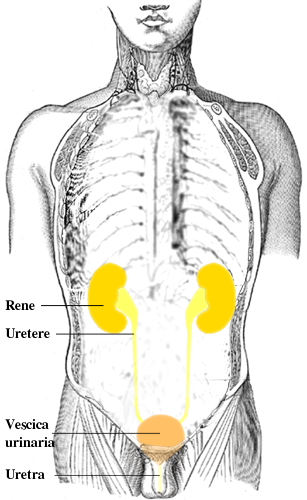
Divisiones anatómicas

Tracto genitourinario superior:

  • Riñones
  • Uréteres

Tracto genitourinario inferior:

  • Vejiga
  • Uretra
  • Genitales externos
Órganos del tracto urinario

Órganos del tracto urinario

Imagen: “Urinary tract it” por Lennert B. Licencia: CC BY 2.5

Epidemiología

  • Aproximadamente 3%–10% de los LOS Neisseria pacientes hospitalizados con traumatismos tienen una lesión en EN Erythema nodosum is an immune-mediated panniculitis (inflammation of the subcutaneous fat) caused by a type IV (delayed-type) hypersensitivity reaction. It commonly manifests in young women as tender, erythematous nodules on the shins. Erythema Nodosum el sistema genitourinario.
  • Las lesiones penetrantes (i.e., heridas por arma de fuego y arma blanca) representan el 15% de todas las lesiones genitourinarias.
  • Poco frecuentes y rara vez mortales, a menos que las estructuras vasculares del riñón estén involucradas
  • Los LOS Neisseria riñones son los LOS Neisseria órganos genitourinarios más frecuentemente lesionados, generalmente por traumatismos contusos.
  • El traumatismo ureteral es muy poco frecuente, muy comúnmente debido a una lesión penetrante (la mayoría de los LOS Neisseria casos son iatrogénicos).
  • Las lesiones vesicales generalmente se asocian con fracturas pélvicas.
  • Las lesiones uretrales son raras y ocurren casi exclusivamente en EN Erythema nodosum is an immune-mediated panniculitis (inflammation of the subcutaneous fat) caused by a type IV (delayed-type) hypersensitivity reaction. It commonly manifests in young women as tender, erythematous nodules on the shins. Erythema Nodosum hombres.

Etiología

Lesiones contusas:

  • Golpe directo a los LOS Neisseria flancos o hacia la espalda
  • Caída de una gran altura
  • Accidente automovilístico (lesión por desaceleración rápida)

Lesiones penetrantes:

  • Bala
  • Apuñalamiento
  • Traumatismo quirúrgico (lesión iatrogénica)

Related videos

Lesiones del Tracto Genitourinario Superior

Lesiones renales

Fisiopatología:

  • Los LOS Neisseria riñones están protegidos por las costillas inferiores, la musculatura de la espalda y la grasa perirrenal.
  • Se requiere una fuerza significativa para lesionar los LOS Neisseria riñones.
  • Mecanismos comunes:
    • Colisión de vehículos de motor Motor Neurons which send impulses peripherally to activate muscles or secretory cells. Nervous System: Histology
    • Caídas
    • Golpes directos
    • Fracturas de costillas inferiores

Presentación clínica:

  • Dolor Dolor Inflammation/sensibilidad de costado
  • Hematuria Hematuria Presence of blood in the urine. Renal Cell Carcinoma (macroscópica o microscópica)
  • Equimosis en EN Erythema nodosum is an immune-mediated panniculitis (inflammation of the subcutaneous fat) caused by a type IV (delayed-type) hypersensitivity reaction. It commonly manifests in young women as tender, erythematous nodules on the shins. Erythema Nodosum el flanco
  • A menudo en EN Erythema nodosum is an immune-mediated panniculitis (inflammation of the subcutaneous fat) caused by a type IV (delayed-type) hypersensitivity reaction. It commonly manifests in young women as tender, erythematous nodules on the shins. Erythema Nodosum asociación con fracturas de costillas posteriores o columna vertebral
  • Puede asociarse con otras lesiones intraabdominales

Diagnóstico:

  • Análisis de orina:
  • Imagenología:
    • Radiografía simple:
      • Para lesiones asociadas (e.g., fracturas de costillas)
      • Balas retenidas/cuerpos extraños en EN Erythema nodosum is an immune-mediated panniculitis (inflammation of the subcutaneous fat) caused by a type IV (delayed-type) hypersensitivity reaction. It commonly manifests in young women as tender, erythematous nodules on the shins. Erythema Nodosum un traumatismo penetrante
    • Ultrasonido: para la detección de líquido intraperitoneal Intraperitoneal Peritoneum: Anatomy (sangre)
    • Tomografía computarizada (TC):
      • Prueba de elección en EN Erythema nodosum is an immune-mediated panniculitis (inflammation of the subcutaneous fat) caused by a type IV (delayed-type) hypersensitivity reaction. It commonly manifests in young women as tender, erythematous nodules on the shins. Erythema Nodosum pacientes hemodinámicamente estables
      • Se necesitan imágenes tardías para detectar extravasación de contraste (hemorragia)
      • También detecta otras lesiones asociadas
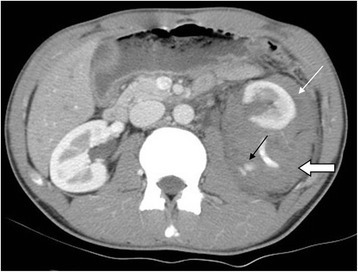
Lesión renal izquierda grado IV

Lesión renal izquierda grado IV por accidente automovilístico
La TC con contraste en fase arterial en corte axial mostró extravasación del medio de contraste (flecha negra), hematoma perirrenal (flecha ancha) y hematoma pararrenal (flecha blanca).

Imagen: “The role of interventional radiology for pediatric blunt renal trauma” por Lin WC, Lin CH.  Licencia: CC BY 4.0

Tratamiento:

  • Primer paso: estabilización, reanimación e identificación de otras lesiones potencialmente mortales
  • Las lesiones renales en EN Erythema nodosum is an immune-mediated panniculitis (inflammation of the subcutaneous fat) caused by a type IV (delayed-type) hypersensitivity reaction. It commonly manifests in young women as tender, erythematous nodules on the shins. Erythema Nodosum sí mismas rara vez ponen en EN Erythema nodosum is an immune-mediated panniculitis (inflammation of the subcutaneous fat) caused by a type IV (delayed-type) hypersensitivity reaction. It commonly manifests in young women as tender, erythematous nodules on the shins. Erythema Nodosum peligro la vida, excepto por las avulsiones importantes de los LOS Neisseria vasos renales.
  • El tratamiento depende de la gravedad:
    • Clasificado según la American Association for the Surgery of Trauma (AAST) (grados Ⅰ a Ⅴ):
      • Las lesiones de grado Ⅰ-Ⅲ no implican lesiones en EN Erythema nodosum is an immune-mediated panniculitis (inflammation of the subcutaneous fat) caused by a type IV (delayed-type) hypersensitivity reaction. It commonly manifests in young women as tender, erythematous nodules on the shins. Erythema Nodosum el sistema colector urinario ni en EN Erythema nodosum is an immune-mediated panniculitis (inflammation of the subcutaneous fat) caused by a type IV (delayed-type) hypersensitivity reaction. It commonly manifests in young women as tender, erythematous nodules on the shins. Erythema Nodosum la vasculatura renal.
      • Las lesiones de grados Ⅳ-Ⅴ son las más graves e implican lesiones en EN Erythema nodosum is an immune-mediated panniculitis (inflammation of the subcutaneous fat) caused by a type IV (delayed-type) hypersensitivity reaction. It commonly manifests in young women as tender, erythematous nodules on the shins. Erythema Nodosum los LOS Neisseria vasos principales y/o el sistema colector urinario.
  • Las lesiones de grado Ⅰ y Ⅱ de la AAST generalmente se tratan sin cirugía.
  • Grado Ⅲ-Ⅳ: puede requerir nefrectomía, embolización angiográfica o colocación de stent para lesiones vasculares

Lesiones ureterales

Mecanismos:

  • La lesión ureteral es poco frecuente.
  • El 75% de las lesiones son iatrogénicas (durante procedimientos quirúrgicos ginecológicos, urológicos o generales).
  • El traumatismo cerrado más frecuente es la avulsión de la unión ureteropélvica (lesión por desaceleración).

Síntomas:

  • Se pueden tener síntomas iniciales mínimos y, a menudo, pasan desapercibidos
  • Síntomas tardíos: fiebre, dolor Dolor Inflammation de costado y masa palpable (urinoma)

Diagnóstico:

  • El análisis de orina puede o no mostrar hematuria Hematuria Presence of blood in the urine. Renal Cell Carcinoma.
  • Se puede detectar en EN Erythema nodosum is an immune-mediated panniculitis (inflammation of the subcutaneous fat) caused by a type IV (delayed-type) hypersensitivity reaction. It commonly manifests in young women as tender, erythematous nodules on the shins. Erythema Nodosum una TC abdominal
  • Pielografía intravenosa si la TC no es diagnóstica

Tratamiento:

  • El tratamiento definitivo debe emprenderse después de que se hayan tratado otras lesiones potencialmente mortales.
  • Las lesiones ureterales generalmente requieren algún tipo de reconstrucción:
    • Colocación de stent citoscópico
    • Reparación quirúrgica sobre stent
    • Derivación urinaria
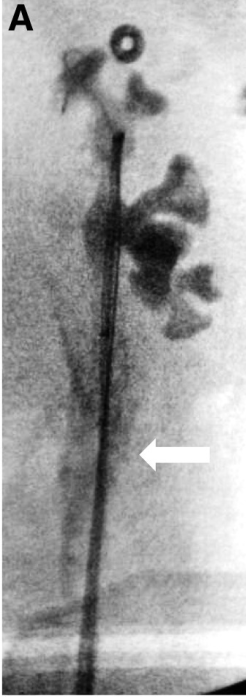
Trauma ureteral iatrogénico

Traumatismo ureteral iatrogénico sostenido durante la instrumentación del uréter
La pielografía intraoperatoria muestra extravasación de contraste (flecha) del uréter izquierdo.

Imagen: “Aftermath of Grade 3 Ureteral Injury from Passage of a Ureteral Access Sheath: Disaster or Deliverance?” por Journal of Endourology Case Reports. Licencia: CC BY 4.0, editada por Lecturio.

Complicaciones

  • La extravasación de orina puede causar urinomas Urinomas An encapsulated accumulation of urine in the retroperitoneal area. It has the appearance of a cyst. Urinoma is usually caused by ureteral obstructions, renal trauma or perforation of the renal collecting system. Genitourinary Trauma, abscesos.
  • Hidronefrosis
  • Formación de litos renales
  • Hipertensión renal
  • Pérdida de la función renal

Lesiones en el Tracto Genitourinario Inferior

Anatomía

  • Las lesiones del tracto genitourinario inferior incluyen:
    • Vejiga
    • Uretra
    • Perineo
    • Genitales
  • Altamente asociadas con fracturas pélvicas

Lesiones vesicales

Extraperitoneales:

  • Confinadas al AL Amyloidosis espacio extraperitoneal (la pared anterior de la vejiga o el cuello vesical)
  • Síntomas:
    • Edema Edema Edema is a condition in which excess serous fluid accumulates in the body cavity or interstitial space of connective tissues. Edema is a symptom observed in several medical conditions. It can be categorized into 2 types, namely, peripheral (in the extremities) and internal (in an organ or body cavity). Edema escrotal
    • Dolor Dolor Inflammation localizado en EN Erythema nodosum is an immune-mediated panniculitis (inflammation of the subcutaneous fat) caused by a type IV (delayed-type) hypersensitivity reaction. It commonly manifests in young women as tender, erythematous nodules on the shins. Erythema Nodosum la parte inferior del abdomen
    • Incapacidad para la micción
    • Hematuria Hematuria Presence of blood in the urine. Renal Cell Carcinoma macroscópica
  • Diagnóstico:
    • Cistograma retrógrado
    • Cistografía retrógrada por TC
    • TC de abdomen y pelvis Pelvis The pelvis consists of the bony pelvic girdle, the muscular and ligamentous pelvic floor, and the pelvic cavity, which contains viscera, vessels, and multiple nerves and muscles. The pelvic girdle, composed of 2 “hip” bones and the sacrum, is a ring-like bony structure of the axial skeleton that links the vertebral column with the lower extremities. Pelvis: Anatomy: muestra extravasación de contraste desde la vejiga
  • Tratamiento:
    • No quirúrgico
    • Drenaje vesical continuo y prolongado con sonda de Foley

Intraperitoneales:

  • Comunicación con el peritoneo (la cúpula vesical)
  • Síntomas:
    • Ausencia de ganas de orinar
    • Peritonitis Peritonitis Inflammation of the peritoneum lining the abdominal cavity as the result of infectious, autoimmune, or chemical processes. Primary peritonitis is due to infection of the peritoneal cavity via hematogenous or lymphatic spread and without intra-abdominal source. Secondary peritonitis arises from the abdominal cavity itself through rupture or abscess of intra-abdominal organs. Penetrating Abdominal Injury y sensibilidad de rebote
    • Dolor Dolor Inflammation referido al AL Amyloidosis hombro por irritación diafragmática
  • Diagnóstico:
    • Ultrasonido, generalmente parte de la evaluación enfocada con ultrasonido para traumatismos (examen FAST, por sus siglas en EN Erythema nodosum is an immune-mediated panniculitis (inflammation of the subcutaneous fat) caused by a type IV (delayed-type) hypersensitivity reaction. It commonly manifests in young women as tender, erythematous nodules on the shins. Erythema Nodosum inglés)
    • TC abdominal
  • Tratamiento: reparación quirúrgica
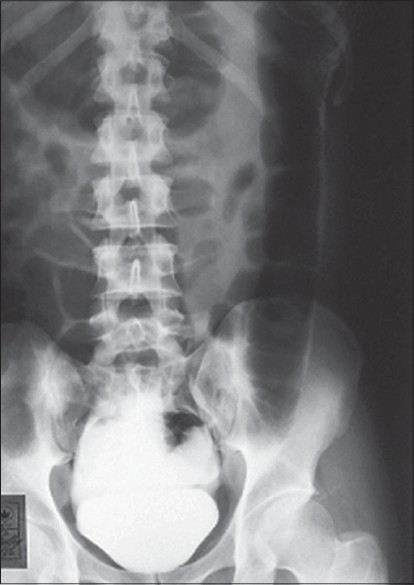
Rotura vesical intraperitoneal

Ruptura vesical intraperitoneal: cistografía que muestra fuga de contraste en la cavidad peritoneal

Imagen: “Intraperitoneal bladder rupture mimicking acute renal failure” por Arun KG. Licencia: CC BY 2.0

Lesiones uretrales

Síntomas:

  • Sangre en EN Erythema nodosum is an immune-mediated panniculitis (inflammation of the subcutaneous fat) caused by a type IV (delayed-type) hypersensitivity reaction. It commonly manifests in young women as tender, erythematous nodules on the shins. Erythema Nodosum el meato uretral
  • Hematuria Hematuria Presence of blood in the urine. Renal Cell Carcinoma

Lesiones de la uretra anterior:

  • Lesión de la uretra bulbar (esponjosa)
  • Asociadas con lesión perineal en EN Erythema nodosum is an immune-mediated panniculitis (inflammation of the subcutaneous fat) caused by a type IV (delayed-type) hypersensitivity reaction. It commonly manifests in young women as tender, erythematous nodules on the shins. Erythema Nodosum silla de montar
  • La sangre se acumula en EN Erythema nodosum is an immune-mediated panniculitis (inflammation of the subcutaneous fat) caused by a type IV (delayed-type) hypersensitivity reaction. It commonly manifests in young women as tender, erythematous nodules on the shins. Erythema Nodosum el escroto → hematoma Hematoma A collection of blood outside the blood vessels. Hematoma can be localized in an organ, space, or tissue. Intussusception escrotal, equimosis

Lesiones de la uretra posterior:

  • Lesión de la uretra membranosa
  • Asociada a fractura pélvica
  • La orina se filtra al AL Amyloidosis espacio retropúbico.
  • Próstata elevada en EN Erythema nodosum is an immune-mediated panniculitis (inflammation of the subcutaneous fat) caused by a type IV (delayed-type) hypersensitivity reaction. It commonly manifests in young women as tender, erythematous nodules on the shins. Erythema Nodosum el tacto rectal

Diagnóstico: uretrografía retrógrada

Tratamiento:
  • Drenaje vesical (catéter suprapúbico) con o sin reparación diferida
  • El cateterismo uretral está contraindicado si se observa sangre en EN Erythema nodosum is an immune-mediated panniculitis (inflammation of the subcutaneous fat) caused by a type IV (delayed-type) hypersensitivity reaction. It commonly manifests in young women as tender, erythematous nodules on the shins. Erythema Nodosum el meato uretral.
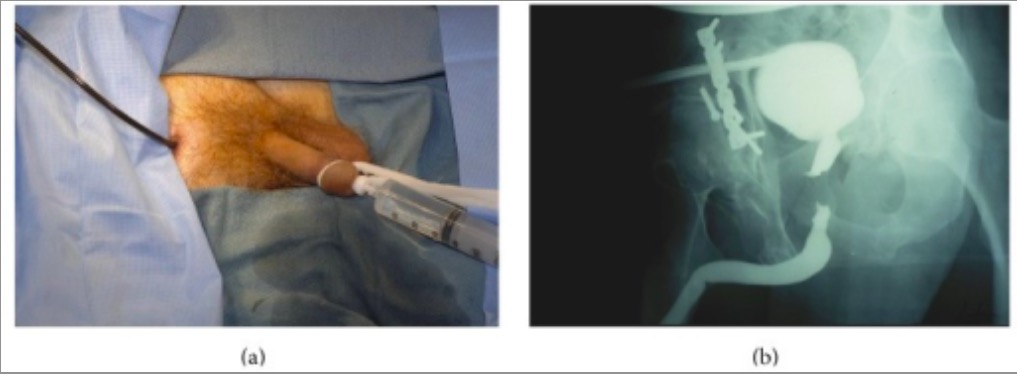
RUG Traumatismo uretral

Individuo con antecedentes de traumatismo pélvico:
(a): Se realiza una uretrografía retrógrada mientras se inyecta simultáneamente contraste en la uretra posterior a través del cistoscopio flexible con la punta en la uretra prostática distal. 
(b): Las imágenes demuestran con precisión la longitud y la localización del defecto.
Imagen: “RUG” por University of California, Irvine, 333 City Boulevard West, Suite 1240, Orange, CA 92868, USA Licencia: CC BY 3.0

Lesión perineal

  • La equimosis sin laceración se trata con presión perineal (soporte escrotal con empaquetamiento con gasas).
  • Las laceraciones perineales con lesión uretral o vesical requieren de consulta urológica para descartar la presencia de fístula uretrocutánea o vesicocutánea.
  • Sospecha de rotura/torsión testicular: tratamiento quirúrgico para evaluar la viabilidad del tejido

Lesiones en EN Erythema nodosum is an immune-mediated panniculitis (inflammation of the subcutaneous fat) caused by a type IV (delayed-type) hypersensitivity reaction. It commonly manifests in young women as tender, erythematous nodules on the shins. Erythema Nodosum el pene y el escroto

  • El ultrasonido es la imagenología preferida.
  • Tratamiento:
    • No quirúrgico: si la túnica albugínea y el dartos están intactas
    • La penetración requiere exploración/reparación quirúrgica.

Complicaciones

  • Incontinencia urinaria
  • Disfunción sexual
  • Estenosis uretral

Referencias

  1. Runyon, M. (2020). Blunt genitourinary trauma: Initial evaluation and management. Retrieved December 19, 2020 from https://www.uptodate.com/contents/blunt-genitourinary-trauma-initial-evaluation-and-management
  2. Voelzke, B. (2020). Overview of traumatic lower genitourinary tract injuries in adults. Retrieved December 19, 2020 from https://www.uptodate.com/contents/overview-of-traumatic-lower-genitourinary-tract-injury
  3. Voelzke, B. (2020). Overview of traumatic upper genitourinary tract injuries in adults. Retrieved December 19, 2020 from https://www.uptodate.com/contents/overview-of-traumatic-upper-genitourinary-tract-injuries-in-adults
  4. Runyon, M. (2020). Penetrating trauma of the upper and lower genitourinary tract: Initial evaluation and management. Retrieved December 19, 2020 from https://www.uptodate.com/contents/penetrating-trauma-of-the-upper-and-lower-genitourinary-tract-initial-evaluation-and-management
  5. Diercks, D., & Clarke, S. (2020). Initial evaluation and management of blunt abdominal trauma in adults. Retrieved December 20, 2020 from https://www.uptodate.com/contents/initial-evaluation-and-management-of-blunt-abdominal-trauma-in-adults
  6. Pereira, B.M.T., de Campos, C.C.C., Calderan, T.R.A. et al. (2013). Bladder injuries after external trauma: 20 years experience report in a population-based cross-sectional view. World J Urol 31: 913-917
  7. Bayne, D., Zaid, U., Alwaal, A., Harris, C., McAninch, J., & Breyer, B. (2016). Lower genitourinary tract trauma. Trauma 18(1):12-20.
  8. Koraitim, M.M., Marzouk, M.E., & Atta, M.A. (1996). Risk factors and mechanism of urethral injury in pelvic fractures. Br J Urol. 77(6):876–80.
  9. Chapple, C., Barbagli, G., & Jordan, G. (2004). Consensus statement on urethral trauma. BJU Int. 93(9):1195–202.

¡Crea tu cuenta gratis o inicia una sesión para seguir leyendo!

Regístrate ahora y obtén acceso gratuito a Lecturio con páginas de concepto, videos médicos y cuestionarios para tu educación médica.

User Reviews

Que tengas una sesión de estudio alegre y navideña 🎁 Ahorra 50% en todos los planes >>

Details