
Domina Conceptos Médicos

Estudia para la escuela de medicina y tus examenes con Lecturio.

Síndrome Neuroléptico Maligno

El síndrome neuroléptico maligno es una reacción rara, idiosincrásica y potencialmente mortal, a los LOS Neisseria medicamentos antipsicóticos. El síndrome neuroléptico maligno se presenta con ≥ 2 de los LOS Neisseria siguientes síntomas cardinales: fiebre, estado mental alterado, rigidez muscular y disfunción autonómica. Es importante identificar rápidamente esta afección debido a sus altas tasas de morbilidad y mortalidad. El diagnóstico se basa en EN Erythema nodosum is an immune-mediated panniculitis (inflammation of the subcutaneous fat) caused by a type IV (delayed-type) hypersensitivity reaction. It commonly manifests in young women as tender, erythematous nodules on the shins. Erythema Nodosum hallazgos clínicos y de laboratorio positivos, junto con la exclusión de otras posibles causas. El tratamiento implica suspender los LOS Neisseria medicamentos antipsicóticos, la terapia de soporte y las opciones farmacológicas.

Last updated: Dec 15, 2025

Editorial responsibility: Stanley Oiseth, Lindsay Jones, Evelin Maza

Descripción General

Definición

El síndrome neuroléptico maligno es un trastorno neurológico potencialmente mortal asociado con el uso de antipsicóticos que se presenta como una tétrada clásica:

  • Fiebre
  • Estado mental alterado
  • Inestabilidad autonómica
  • Rigidez muscular

Epidemiología

  • Incidencia 0.01%-3% de personas que toman antipsicóticos
  • Tasa de mortalidad del 10%-20% si no se trata
  • Si hay insuficiencia renal, la tasa de mortalidad aumenta al AL Amyloidosis 50%.

Etiología

  • El síndrome neuroléptico maligno es una reacción idiosincrásica a los LOS Neisseria medicamentos neurolépticos (antipsicóticos).
  • Los LOS Neisseria antipsicóticos modulan principalmente la vía de la dopamina (D2).
  • Los LOS Neisseria antipsicóticos típicos tienen una mayor probabilidad de producir el síndrome neuroléptico maligno que los LOS Neisseria antipsicóticos atípicos:
    • Antipsicóticos “típicos” comunes de 1ra generación:
      • Haloperidol Haloperidol A phenyl-piperidinyl-butyrophenone that is used primarily to treat schizophrenia and other psychoses. It is also used in schizoaffective disorder, delusional disorders, ballism, and tourette syndrome (a drug of choice) and occasionally as adjunctive therapy in intellectual disability and the chorea of huntington disease. It is a potent antiemetic and is used in the treatment of intractable hiccups. First-Generation Antipsychotics (Haldol)
      • Droperidol
      • Clorpromazina (Torazina)
    • Antipsicóticos “atípicos” comunes de 2da generación:
      • Risperidona (Risperdal)
      • Olanzapina (Zyprexa)
      • Quetiapina (Seroquel)
      • Clozapina (Clozaril)
      • Ziprasidona (Geodon)
      • Aripiprazol (Abilify)
  • Otros medicamentos que pueden desencadenar el síndrome neuroléptico maligno:
    • Amoxapina, dosulepina (antidepresivos tricíclicos)
    • Droperidol, metoclopramida (antieméticos)
    • Prometazina (antihistamínico)
    • Tetrabenazina (tratamiento de los LOS Neisseria trastornos del movimiento hipercinético)
    • Litio
    • Fenelzina (inhibidor de la monoaminooxidasa)
    • Suspensión repentina de medicamentos dopaminérgicos (medicamentos antiparkinsonianos como levodopa Levodopa The naturally occurring form of dihydroxyphenylalanine and the immediate precursor of dopamine. Unlike dopamine itself, it can be taken orally and crosses the blood-brain barrier. It is rapidly taken up by dopaminergic neurons and converted to dopamine. It is used for the treatment of parkinsonian disorders and is usually given with agents that inhibit its conversion to dopamine outside of the central nervous system. Parkinson’s Disease Drugs)

Fisiopatología y Presentación Clínica

Fisiopatología

  • El mecanismo subyacente exacto sigue sin estar claro.
  • Disminución repentina de la actividad dopaminérgica central:
    • Bloqueo significativo del receptor Receptor Receptors are proteins located either on the surface of or within a cell that can bind to signaling molecules known as ligands (e.g., hormones) and cause some type of response within the cell. Receptors D2
    • Retirada abrupta del agonista del receptor Receptor Receptors are proteins located either on the surface of or within a cell that can bind to signaling molecules known as ligands (e.g., hormones) and cause some type of response within the cell. Receptors D2
  • El bloqueo D2 en EN Erythema nodosum is an immune-mediated panniculitis (inflammation of the subcutaneous fat) caused by a type IV (delayed-type) hypersensitivity reaction. It commonly manifests in young women as tender, erythematous nodules on the shins. Erythema Nodosum varias estructuras del sistema nervioso causa los LOS Neisseria síntomas característicos:
    • Hipotálamo → fiebre
    • Vías nigroestriatales → rigidez
    • Médula espinal → rigidez y temblor

Presentación clínica

Las características cardinales del síndrome neuroléptico maligno incluyen:

  • Fiebre (> 40°C)
  • Alteración en EN Erythema nodosum is an immune-mediated panniculitis (inflammation of the subcutaneous fat) caused by a type IV (delayed-type) hypersensitivity reaction. It commonly manifests in young women as tender, erythematous nodules on the shins. Erythema Nodosum el nivel de conciencia:
    • Encefalopatía
    • Delirio
    • Estupor
    • Coma Coma Coma is defined as a deep state of unarousable unresponsiveness, characterized by a score of 3 points on the GCS. A comatose state can be caused by a multitude of conditions, making the precise epidemiology and prognosis of coma difficult to determine. Coma
  • Desregulación autonómica:
    • Diaforesis (sudoración excesiva)
    • Taquicardia, taquipnea o hipertensión.
    • Sialorrea (salivación excesiva)
    • Hipoxemia
  • Rigidez muscular severa, también conocida como “rigidez en EN Erythema nodosum is an immune-mediated panniculitis (inflammation of the subcutaneous fat) caused by a type IV (delayed-type) hypersensitivity reaction. It commonly manifests in young women as tender, erythematous nodules on the shins. Erythema Nodosum tubo de plomo”

Otros signos y síntomas son los LOS Neisseria siguientes:
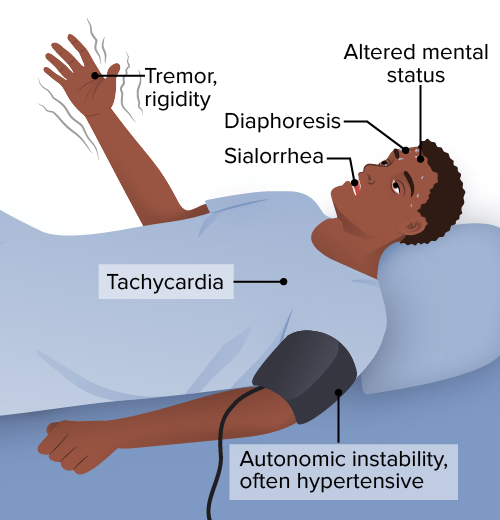
  • Disfagia (dificultad para deglutir)
  • Disnea
  • Síntomas de la enfermedad de Parkinson (e.g., temblores, bradicinesia, rigidez)
  • Sensación sostenida de movimiento/inquietud
  • Movimientos de contorsión incontrolables, repetitivos y estereotipados, generalmente de la lengua
  • Incontinencia urinaria
Symptoms of neuroleptic malignant syndrome

Image by Lecturio.

Diagnóstico y Tratamiento

Hallazgos de laboratorio en EN Erythema nodosum is an immune-mediated panniculitis (inflammation of the subcutaneous fat) caused by a type IV (delayed-type) hypersensitivity reaction. It commonly manifests in young women as tender, erythematous nodules on the shins. Erythema Nodosum el síndrome neuroléptico maligno

El diagnóstico del síndrome neuroléptico maligno es principalmente clínico. Las investigaciones de laboratorio se realizan para descartar otras afecciones o complicaciones.

Hallazgos de laboratorio asociados:

  • Leucocitosis (aumento de leucocitos)
  • Creatinquinasa elevada, debido a la rigidez muscular severa
  • Potasio elevado
  • Función hepática anormal
  • Mioglobinuria

Tratamiento

El síndrome neuroléptico maligno es una emergencia médica aguda y debe tratarse como tal TAL Renal Sodium and Water Regulation.

El 1er paso debe ser detener el agente antipsicótico o reiniciar el agente dopaminérgico.

  • Control de la fiebre:
    • Antipiréticos
    • Mantas de enfriamiento
    • Compresas de hielo
  • Tratamiento médico:
    • Benzodiazepinas: 1ra línea para la agitación y las convulsiones
    • Dantroleno:
      • Trata la rigidez muscular
      • Inhibe el receptor Receptor Receptors are proteins located either on the surface of or within a cell that can bind to signaling molecules known as ligands (e.g., hormones) and cause some type of response within the cell. Receptors de rianodina
      • Evita la liberación de Ca CA Condylomata acuminata are a clinical manifestation of genital HPV infection. Condylomata acuminata are described as raised, pearly, flesh-colored, papular, cauliflower-like lesions seen in the anogenital region that may cause itching, pain, or bleeding. Condylomata Acuminata (Genital Warts)2+ del retículo sarcoplásmico del músculo esquelético
      • Conduce a la relajación muscular
    • Agonistas de la dopamina (bromocriptina, amantadina)
  • Terapia de soporte, como ingresar al AL Amyloidosis paciente en EN Erythema nodosum is an immune-mediated panniculitis (inflammation of the subcutaneous fat) caused by a type IV (delayed-type) hypersensitivity reaction. It commonly manifests in young women as tender, erythematous nodules on the shins. Erythema Nodosum la unidad de cuidados intensivos (UCI)
  • Los LOS Neisseria síntomas deben comenzar a remitir inmediatamente después de suspender el agente causal y desaparecen en EN Erythema nodosum is an immune-mediated panniculitis (inflammation of the subcutaneous fat) caused by a type IV (delayed-type) hypersensitivity reaction. It commonly manifests in young women as tender, erythematous nodules on the shins. Erythema Nodosum 10 días.
  • En EN Erythema nodosum is an immune-mediated panniculitis (inflammation of the subcutaneous fat) caused by a type IV (delayed-type) hypersensitivity reaction. It commonly manifests in young women as tender, erythematous nodules on the shins. Erythema Nodosum la mayoría de los LOS Neisseria casos, se pueden volver a administrar diferentes antipsicóticos de forma segura después de 2 semanas.

Diagnóstico Diferencial

Los LOS Neisseria diagnósticos diferenciales más relevantes para el síndrome neuroléptico maligno son el síndrome serotoninérgico y la hipertermia maligna, es importante distinguirlos.

  • Síndrome serotoninérgico: caracterizado por fiebre, disfunción autonómica y rigidez/espasticidad relacionada con sobredosis por inhibidores selectivos de la recaptura de serotonina (ISRS) o algún otro antidepresivo. El síndrome serotoninérgico se presenta con más síntomas gastrointestinales (e.g., náusea, vómitos). El tratamiento es casi el mismo que el del síndrome neuroléptico maligno.
  • Hipertermia maligna: complicación rara provocada por ciertos anestésicos inhalados o succinilcolina. Sospechar en EN Erythema nodosum is an immune-mediated panniculitis (inflammation of the subcutaneous fat) caused by a type IV (delayed-type) hypersensitivity reaction. It commonly manifests in young women as tender, erythematous nodules on the shins. Erythema Nodosum el quirófano o durante el procedimiento de anestesia. El tratamiento es casi el mismo que el del síndrome neuroléptico maligno y es clínicamente indistinguible, excepto por los LOS Neisseria medicamentos específicos que desencadenan el síndrome.

Otras afecciones que se presentan con estado mental alterado, disfunción autonómica y fiebre:

  • Meningitis Meningitis Meningitis is inflammation of the meninges, the protective membranes of the brain, and spinal cord. The causes of meningitis are varied, with the most common being bacterial or viral infection. The classic presentation of meningitis is a triad of fever, altered mental status, and nuchal rigidity. Meningitis: infección de las meninges Meninges The brain and the spinal cord are enveloped by 3 overlapping layers of connective tissue called the meninges. The layers are, from the most external layer to the most internal layer, the dura mater, arachnoid mater, and pia mater. Between these layers are 3 potential spaces called the epidural, subdural, and subarachnoid spaces. Meninges: Anatomy, las membranas protectoras alrededor del cerebro, causada con mayor frecuencia por Streptococcus Streptococcus Streptococcus is one of the two medically important genera of gram-positive cocci, the other being Staphylococcus. Streptococci are identified as different species on blood agar on the basis of their hemolytic pattern and sensitivity to optochin and bacitracin. There are many pathogenic species of streptococci, including S. pyogenes, S. agalactiae, S. pneumoniae, and the viridans streptococci. Streptococcus pneumoniae o Haemophilus influenzae Haemophilus Influenzae A species of Haemophilus found on the mucous membranes of humans and a variety of animals. The species is further divided into biotypes I through viii. Haemophilus. La meningitis Meningitis Meningitis is inflammation of the meninges, the protective membranes of the brain, and spinal cord. The causes of meningitis are varied, with the most common being bacterial or viral infection. The classic presentation of meningitis is a triad of fever, altered mental status, and nuchal rigidity. Meningitis se presenta con fiebre, rigidez nucal y cefalea. El diagnóstico se realiza mediante punción lumbar para la evaluación del líquido cefalorraquídeo (LCR). El tratamiento consiste en EN Erythema nodosum is an immune-mediated panniculitis (inflammation of the subcutaneous fat) caused by a type IV (delayed-type) hypersensitivity reaction. It commonly manifests in young women as tender, erythematous nodules on the shins. Erythema Nodosum la administración rápida de antibióticos.
  • Encefalitis: inflamación del cerebro, generalmente causada por agentes virales. A menudo se presenta con signos y síntomas leves similares a los LOS Neisseria de la gripe, como fiebre, cefalea o ningún síntoma en EN Erythema nodosum is an immune-mediated panniculitis (inflammation of the subcutaneous fat) caused by a type IV (delayed-type) hypersensitivity reaction. It commonly manifests in young women as tender, erythematous nodules on the shins. Erythema Nodosum absoluto. El diagnóstico se realiza mediante punción lumbar e imagenología cerebral. El tratamiento consiste en EN Erythema nodosum is an immune-mediated panniculitis (inflammation of the subcutaneous fat) caused by a type IV (delayed-type) hypersensitivity reaction. It commonly manifests in young women as tender, erythematous nodules on the shins. Erythema Nodosum medicamentos antivirales y terapia de soporte, como reposo en EN Erythema nodosum is an immune-mediated panniculitis (inflammation of the subcutaneous fat) caused by a type IV (delayed-type) hypersensitivity reaction. It commonly manifests in young women as tender, erythematous nodules on the shins. Erythema Nodosum cama, fluidoterapia y medicamentos antiinflamatorios.
  • Encefalopatía tóxica: trastorno neurológico causado por la exposición a disolventes orgánicos neurotóxicos, como metales pesados, medicamentos neurotóxicos o cianotoxinas. La presentación clínica es variada e incluye estado mental alterado, pérdida de memoria y problemas visuales. El diagnóstico se realiza por exclusión y el tratamiento es principalmente de soporte.
  • Golpe de calor Calor Inflammation: elevación de la temperatura corporal central por encima del rango diurno normal de 36ºC – 37,5ºC debido a la falla de la termorregulación. El golpe de calor Calor Inflammation se presenta como disfunción neurológica grave, temperatura central marcadamente elevada, sudoración ausente, piel caliente y enrojecida, taquicardia, hipotensión, taquipnea y náuseas. El tratamiento implica reanimación de volumen y enfriamiento rápido del paciente.
  • Estado epiléptico: emergencia médica caracterizada por una única convulsión que dura > 5 minutos o ≥ 2 convulsiones en EN Erythema nodosum is an immune-mediated panniculitis (inflammation of the subcutaneous fat) caused by a type IV (delayed-type) hypersensitivity reaction. It commonly manifests in young women as tender, erythematous nodules on the shins. Erythema Nodosum un período de 5 minutos sin volver a un estado lúcido normal. El electroencefalograma ( EEG EEG Seizures) respalda el diagnóstico y el tratamiento incluye medicamentos anticonvulsivantes (e.g., diazepam Diazepam A benzodiazepine with anticonvulsant, anxiolytic, sedative, muscle relaxant, and amnesic properties and a long duration of action. Its actions are mediated by enhancement of gamma-aminobutyric acid activity. Benzodiazepines, lorazepam Lorazepam A benzodiazepine used as an anti-anxiety agent with few side effects. It also has hypnotic, anticonvulsant, and considerable sedative properties and has been proposed as a preanesthetic agent. Benzodiazepines, fenitoína).
  • Tirotoxicosis: manifestaciones fisiológicas clásicas del exceso de hormonas tiroideas. La tirotoxicosis se presenta como signos de un aumento de la tasa metabólica e hiperactividad del sistema nervioso simpático. El diagnóstico se realiza midiendo los LOS Neisseria niveles de hormona estimulante de la tiroides (TSH, por sus siglas en EN Erythema nodosum is an immune-mediated panniculitis (inflammation of the subcutaneous fat) caused by a type IV (delayed-type) hypersensitivity reaction. It commonly manifests in young women as tender, erythematous nodules on the shins. Erythema Nodosum inglés) y tiroxina libre (T4) y triyodotironina (T3). El tratamiento depende de la causa, pero puede ser farmacológico, quirúrgico o con yodo radiactivo.

Referencias

  1. Berman BD. (2011). Neuroleptic malignant syndrome: a review for neurohospitalists. The Neurohospitalist 1(1):41–47. https://doi.org/10.1177/1941875210386491
  2. Simon LV, Hashmi MF, Callahan AL. (2023). Neuroleptic malignant syndrome. StatPearls. Retrieved on June 13, 2025, from https://www.ncbi.nlm.nih.gov/books/NBK482282/
  3. Wijdicks EFM. (2025). Neuroleptic malignant syndrome. UpToDate. Retrieved on June 13, 2025, from https://www.uptodate.com/contents/neuroleptic-malignant-syndrome

¡Crea tu cuenta gratis o inicia una sesión para seguir leyendo!

Regístrate ahora y obtén acceso gratuito a Lecturio con páginas de concepto, videos médicos y cuestionarios para tu educación médica.

User Reviews

Que tengas una sesión de estudio alegre y navideña 🎁 Ahorra 50% en todos los planes >>

Details