Domina Conceptos Médicos

Estudia para la escuela de medicina y tus examenes con Lecturio.

Pólipos Colorrectales

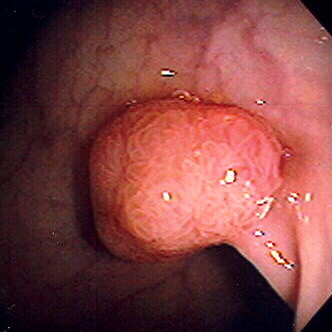
Los LOS Neisseria pólipos colorrectales son crecimientos de tejido mucoso en EN Erythema nodosum is an immune-mediated panniculitis (inflammation of the subcutaneous fat) caused by a type IV (delayed-type) hypersensitivity reaction. It commonly manifests in young women as tender, erythematous nodules on the shins. Erythema Nodosum el colon Colon The large intestines constitute the last portion of the digestive system. The large intestine consists of the cecum, appendix, colon (with ascending, transverse, descending, and sigmoid segments), rectum, and anal canal. The primary function of the colon is to remove water and compact the stool prior to expulsion from the body via the rectum and anal canal. Colon, Cecum, and Appendix: Anatomy, el lugar más común de los LOS Neisseria pólipos en EN Erythema nodosum is an immune-mediated panniculitis (inflammation of the subcutaneous fat) caused by a type IV (delayed-type) hypersensitivity reaction. It commonly manifests in young women as tender, erythematous nodules on the shins. Erythema Nodosum el tracto gastrointestinal. Los LOS Neisseria pólipos pueden clasificarse como neoplásicos o no neoplásicos y pueden estar asociados a síndromes genéticos. Los LOS Neisseria pólipos hiperplásicos no son neoplásicos y son el tipo más común en EN Erythema nodosum is an immune-mediated panniculitis (inflammation of the subcutaneous fat) caused by a type IV (delayed-type) hypersensitivity reaction. It commonly manifests in young women as tender, erythematous nodules on the shins. Erythema Nodosum general, mientras que los LOS Neisseria adenomas son el tipo más común de pólipo neoplásico y tienen el potencial de progresar a cáncer. Para la mayoría de las personas sin síndromes hereditarios, el tamizaje del cáncer de colon Colon The large intestines constitute the last portion of the digestive system. The large intestine consists of the cecum, appendix, colon (with ascending, transverse, descending, and sigmoid segments), rectum, and anal canal. The primary function of the colon is to remove water and compact the stool prior to expulsion from the body via the rectum and anal canal. Colon, Cecum, and Appendix: Anatomy debe comenzar a los LOS Neisseria 45 años y en EN Erythema nodosum is an immune-mediated panniculitis (inflammation of the subcutaneous fat) caused by a type IV (delayed-type) hypersensitivity reaction. It commonly manifests in young women as tender, erythematous nodules on the shins. Erythema Nodosum la adolescencia en EN Erythema nodosum is an immune-mediated panniculitis (inflammation of the subcutaneous fat) caused by a type IV (delayed-type) hypersensitivity reaction. It commonly manifests in young women as tender, erythematous nodules on the shins. Erythema Nodosum el caso de las personas con el raro síndrome de poliposis adenomatosa familiar. El diagnóstico se realiza mediante biopsia y el tratamiento incluye la vigilancia frecuente en EN Erythema nodosum is an immune-mediated panniculitis (inflammation of the subcutaneous fat) caused by a type IV (delayed-type) hypersensitivity reaction. It commonly manifests in young women as tender, erythematous nodules on the shins. Erythema Nodosum personas con pólipos adenomatosos o el tamizaje cada 10 años en EN Erythema nodosum is an immune-mediated panniculitis (inflammation of the subcutaneous fat) caused by a type IV (delayed-type) hypersensitivity reaction. It commonly manifests in young women as tender, erythematous nodules on the shins. Erythema Nodosum la población general hasta los LOS Neisseria 75 años.

Last updated: Dec 15, 2025

Editorial responsibility: Stanley Oiseth, Lindsay Jones, Evelin Maza

Descripción General

Tipos de pólipos colorrectales

  • Benignos:
    • Hiperplásico: sin potencial neoplásico
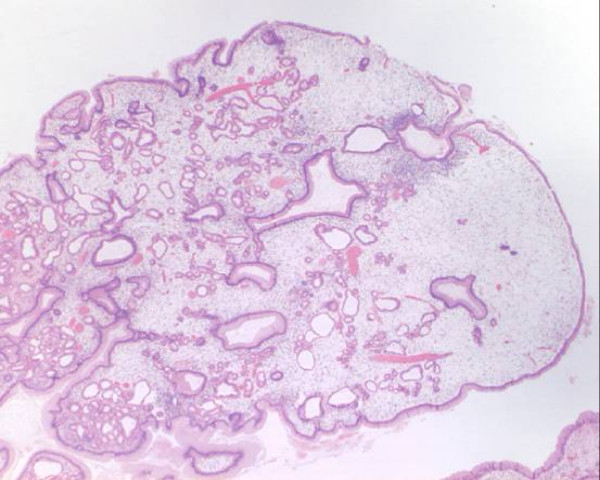
    • Hamartomatoso: mezcla de tejidos normales, pero que crecen en EN Erythema nodosum is an immune-mediated panniculitis (inflammation of the subcutaneous fat) caused by a type IV (delayed-type) hypersensitivity reaction. It commonly manifests in young women as tender, erythematous nodules on the shins. Erythema Nodosum una masa desorganizada
      • Juvenil: suele ser solitario, puede verse en EN Erythema nodosum is an immune-mediated panniculitis (inflammation of the subcutaneous fat) caused by a type IV (delayed-type) hypersensitivity reaction. It commonly manifests in young women as tender, erythematous nodules on the shins. Erythema Nodosum niños, no se asocia a un mayor riesgo de cáncer colorrectal
      • Síndrome de tumor Tumor Inflammation de hamartoma Hamartoma A focal malformation resembling a neoplasm, composed of an overgrowth of mature cells and tissues that normally occur in the affected area. Colorectal Cancer: compuesto por los LOS Neisseria síndromes de Cowden y Bannayan-Riley-Ruvalcaba
      • Pólipos de Peutz-Jeghers: generalmente asociados al AL Amyloidosis síndrome de Peutz-Jeghers
    • Inflamatorio: común en EN Erythema nodosum is an immune-mediated panniculitis (inflammation of the subcutaneous fat) caused by a type IV (delayed-type) hypersensitivity reaction. It commonly manifests in young women as tender, erythematous nodules on the shins. Erythema Nodosum la colitis Colitis Inflammation of the colon section of the large intestine, usually with symptoms such as diarrhea (often with blood and mucus), abdominal pain, and fever. Pseudomembranous Colitis ulcerosa
  • Neoplásico:
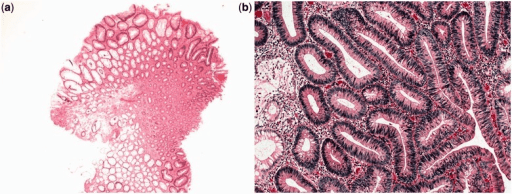
    • Adenoma tubular
    • Adenoma velloso
    • Mixto tubulovelloso
    • Serrado sésil

Prevalencia de pólipos colorrectales

  • Los LOS Neisseria pólipos colorrectales se encuentran en EN Erythema nodosum is an immune-mediated panniculitis (inflammation of the subcutaneous fat) caused by a type IV (delayed-type) hypersensitivity reaction. It commonly manifests in young women as tender, erythematous nodules on the shins. Erythema Nodosum el 15%–40% de los LOS Neisseria adultos.
  • La mayoría de los LOS Neisseria pólipos neoplásicos de colon Colon The large intestines constitute the last portion of the digestive system. The large intestine consists of the cecum, appendix, colon (with ascending, transverse, descending, and sigmoid segments), rectum, and anal canal. The primary function of the colon is to remove water and compact the stool prior to expulsion from the body via the rectum and anal canal. Colon, Cecum, and Appendix: Anatomy son adenomas (aproximadamente ⅔):
    • 30%–50% de los LOS Neisseria individuos con 1 adenoma ≥ 1 otro adenoma.
    • Menos común en EN Erythema nodosum is an immune-mediated panniculitis (inflammation of the subcutaneous fat) caused by a type IV (delayed-type) hypersensitivity reaction. It commonly manifests in young women as tender, erythematous nodules on the shins. Erythema Nodosum Asia ASIA Spinal Cord Injuries, pero en EN Erythema nodosum is an immune-mediated panniculitis (inflammation of the subcutaneous fat) caused by a type IV (delayed-type) hypersensitivity reaction. It commonly manifests in young women as tender, erythematous nodules on the shins. Erythema Nodosum incremento a medida que se adoptan las dietas occidentales.
  • La mayoría de los LOS Neisseria cánceres colorrectales surgen de pólipos adenomatosos esporádicos:
    • La detección precoz de pólipos adenomatosos mediante el tamizaje disminuye el riesgo de cáncer colorrectal.
    • Incidencia a lo largo de la vida ( en EN Erythema nodosum is an immune-mediated panniculitis (inflammation of the subcutaneous fat) caused by a type IV (delayed-type) hypersensitivity reaction. It commonly manifests in young women as tender, erythematous nodules on the shins. Erythema Nodosum individuos con riesgo medio) de cáncer colorrectal en EN Erythema nodosum is an immune-mediated panniculitis (inflammation of the subcutaneous fat) caused by a type IV (delayed-type) hypersensitivity reaction. It commonly manifests in young women as tender, erythematous nodules on the shins. Erythema Nodosum Estados Unidos: alrededor del 4%.

Factores de riesgo

  • El aumento de la edad es un factor de riesgo para desarrollar adenomas.
  • Dieta: alta en EN Erythema nodosum is an immune-mediated panniculitis (inflammation of the subcutaneous fat) caused by a type IV (delayed-type) hypersensitivity reaction. It commonly manifests in young women as tender, erythematous nodules on the shins. Erythema Nodosum carnes rojas y grasas, baja en EN Erythema nodosum is an immune-mediated panniculitis (inflammation of the subcutaneous fat) caused by a type IV (delayed-type) hypersensitivity reaction. It commonly manifests in young women as tender, erythematous nodules on the shins. Erythema Nodosum fibra
  • Enfermedad inflamatoria intestinal:
    • Colitis Colitis Inflammation of the colon section of the large intestine, usually with symptoms such as diarrhea (often with blood and mucus), abdominal pain, and fever. Pseudomembranous Colitis ulcerosa
    • Enfermedad de Crohn
  • Antecedente familiar
  • Consumo de tabaco y alcohol
  • Obesidad
  • Ascendencia africana
  • Diabetes Diabetes Diabetes mellitus (DM) is a metabolic disease characterized by hyperglycemia and dysfunction of the regulation of glucose metabolism by insulin. Type 1 DM is diagnosed mostly in children and young adults as the result of autoimmune destruction of β cells in the pancreas and the resulting lack of insulin. Type 2 DM has a significant association with obesity and is characterized by insulin resistance. Diabetes Mellitus tipo 2 no controlada

Síndromes de poliposis hereditaria

Cada síndrome se presenta en EN Erythema nodosum is an immune-mediated panniculitis (inflammation of the subcutaneous fat) caused by a type IV (delayed-type) hypersensitivity reaction. It commonly manifests in young women as tender, erythematous nodules on the shins. Erythema Nodosum <1% de la población y representa el 5%–10% de los LOS Neisseria cánceres colorrectales.
  • Cáncer colorrectal hereditario no polipósico (síndrome de Lynch):
    • La causa hereditaria más común del cáncer
    • Representa 2%–4% de los LOS Neisseria cánceres colorrectales
    • Herencia autosómica dominante
    • Prevalencia: 1 de cada 279 personas
    • Mutaciones en EN Erythema nodosum is an immune-mediated panniculitis (inflammation of the subcutaneous fat) caused by a type IV (delayed-type) hypersensitivity reaction. It commonly manifests in young women as tender, erythematous nodules on the shins. Erythema Nodosum el gen de reparación de desajustes de ADN
    • El cáncer se produce en EN Erythema nodosum is an immune-mediated panniculitis (inflammation of the subcutaneous fat) caused by a type IV (delayed-type) hypersensitivity reaction. It commonly manifests in young women as tender, erythematous nodules on the shins. Erythema Nodosum múltiples sitios
    • Número de pólipos neoplásicos ligeramente superior al AL Amyloidosis normal; también, mayor tasa de progresión a cáncer colorrectal
    • Cánceres asociados en EN Erythema nodosum is an immune-mediated panniculitis (inflammation of the subcutaneous fat) caused by a type IV (delayed-type) hypersensitivity reaction. It commonly manifests in young women as tender, erythematous nodules on the shins. Erythema Nodosum individuos con cáncer colorrectal hereditario no polipósico y/o en EN Erythema nodosum is an immune-mediated panniculitis (inflammation of the subcutaneous fat) caused by a type IV (delayed-type) hypersensitivity reaction. It commonly manifests in young women as tender, erythematous nodules on the shins. Erythema Nodosum familiares de 1er grado, especialmente de endometrio, ovario
  • Síndrome de poliposis adenomatosa familiar y variantes:
    • Herencia autosómica dominante o mutaciones esporádicas
    • Gen afectado: APC APC A polyposis syndrome due to an autosomal dominant mutation of the apc genes on chromosome 5. The syndrome is characterized by the development of hundreds of adenomatous polyps in the colon and rectum of affected individuals by early adulthood. Familial Adenomatous Polyposis
    • Poliposis adenomatosa familiar clásica: prevalencia 1 de cada 7 000 personas; cada una tiene ≥ 100 pólipos.
    • Poliposis adenomatosa familiar atenuada: una forma leve de poliposis adenomatosa familiar (10–99 pólipos)
  • Síndrome de poliposis juvenil:
    • Los LOS Neisseria primeros pólipos aparecen a < 5 años de edad
    • Autosómico dominante
  • Síndrome de Peutz-Jeghers:
    • Presentes en EN Erythema nodosum is an immune-mediated panniculitis (inflammation of the subcutaneous fat) caused by a type IV (delayed-type) hypersensitivity reaction. It commonly manifests in young women as tender, erythematous nodules on the shins. Erythema Nodosum la infancia
    • Autosómico dominante
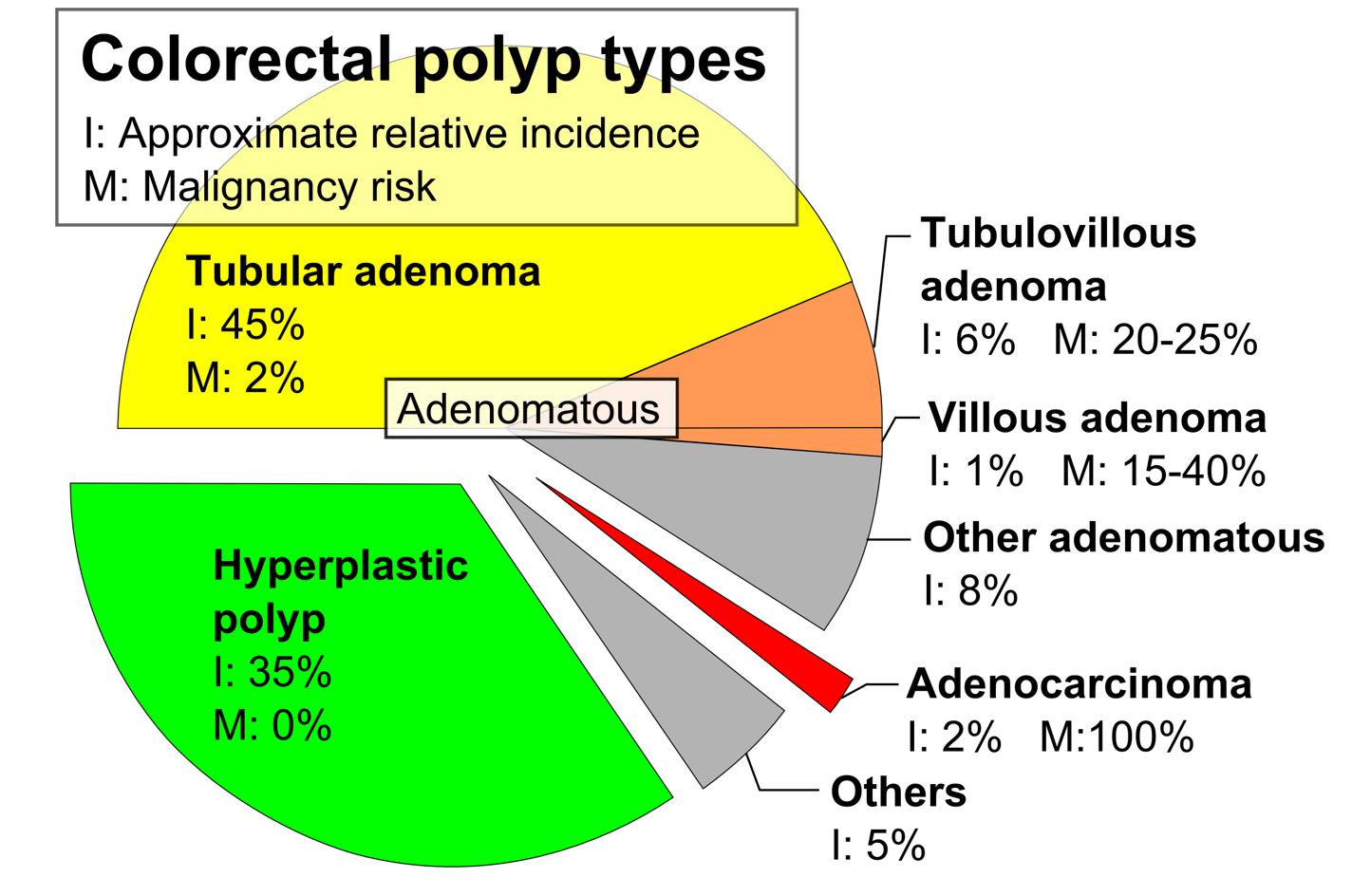
Tipos de pólipos colorrectales

Tipos de pólipos colorrectales, incidencia relativa aproximada (I) y riesgo de malignidad (M) (2019)

Imagen: “Pie chart of colorectal polyp etiologies” por Mikael Häggström. Licencia: CC0 1.0
Fisiopatología

Pólipos benignos

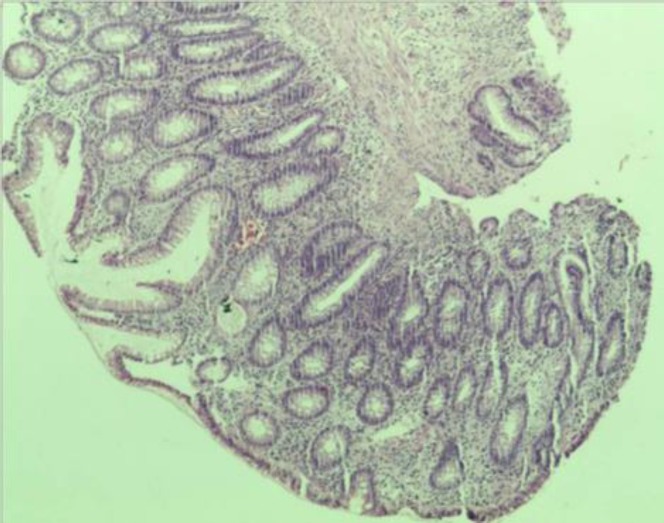
  • Pólipos hiperplásicos: proliferación epitelial reactiva benigna
  • Pólipos hamartomatosos: pueden aparecer esporádicamente o estar determinados genéticamente
    • Tienen diferentes proporciones y ubicación de los LOS Neisseria tejidos colónicos normales
    • Síndrome de Cowden: mayoritariamente en EN Erythema nodosum is an immune-mediated panniculitis (inflammation of the subcutaneous fat) caused by a type IV (delayed-type) hypersensitivity reaction. It commonly manifests in young women as tender, erythematous nodules on the shins. Erythema Nodosum el grupo del síndrome del hamartoma Hamartoma A focal malformation resembling a neoplasm, composed of an overgrowth of mature cells and tissues that normally occur in the affected area. Colorectal Cancer PTEN
    • Síndrome de Cronkhite-Canada: no hereditario; causa desconocida
    • Esclerosis tuberosa: TSC1 (hamartina, TSC TSC Tuberous sclerosis or tuberous sclerosis complex (TSC) is an autosomal dominant disorder with mainly neurocutaneous symptoms. Mutation in the tsc genes causes excessive tumor-like growths in the brain, eyes, heart, kidney, and lungs. Cutaneous manifestations include hypopigmentation (i.e., ash leaf spots, confetti lesions) or excessive growth (i.e., angiofibroma, shagreen patch). Tuberous Sclerosis (tuberina), vía mTOR mTOR Peutz-Jeghers Syndrome)
    • Poliposis juvenil: esporádica o autosómica dominante, con mutaciones en EN Erythema nodosum is an immune-mediated panniculitis (inflammation of the subcutaneous fat) caused by a type IV (delayed-type) hypersensitivity reaction. It commonly manifests in young women as tender, erythematous nodules on the shins. Erythema Nodosum SMAD4, BMPR1A BMPR1A A subtype of bone morphogenetic protein receptors with high affinity for bone morphogenetic proteins. They can interact with and undergo phosphorylation by type II bone morphogenetic protein receptors. They signal primarily through receptor-regulated SMAD proteins. Familial Juvenile Polyposis; factor de crecimiento transformante β
    • Síndrome de Peutz-Jeghers: autosómico dominante
  • Pólipos inflamatorios: debidos a ciclos crónicos de lesión y curación (e.g., enfermedad inflamatoria intestinal)

Pólipos neoplásicos

  • Pólipo adenomatoso: displasia de bajo grado
    • Puede transformarse en EN Erythema nodosum is an immune-mediated panniculitis (inflammation of the subcutaneous fat) caused by a type IV (delayed-type) hypersensitivity reaction. It commonly manifests in young women as tender, erythematous nodules on the shins. Erythema Nodosum displasia de alto grado/carcinoma in situ (a lo largo de varios años o décadas) y, finalmente, en EN Erythema nodosum is an immune-mediated panniculitis (inflammation of the subcutaneous fat) caused by a type IV (delayed-type) hypersensitivity reaction. It commonly manifests in young women as tender, erythematous nodules on the shins. Erythema Nodosum cáncer de colon Colon The large intestines constitute the last portion of the digestive system. The large intestine consists of the cecum, appendix, colon (with ascending, transverse, descending, and sigmoid segments), rectum, and anal canal. The primary function of the colon is to remove water and compact the stool prior to expulsion from the body via the rectum and anal canal. Colon, Cecum, and Appendix: Anatomy a medida que acumula más mutaciones
    • Precursores de la mayoría de los LOS Neisseria cánceres de colon Colon The large intestines constitute the last portion of the digestive system. The large intestine consists of the cecum, appendix, colon (with ascending, transverse, descending, and sigmoid segments), rectum, and anal canal. The primary function of the colon is to remove water and compact the stool prior to expulsion from the body via the rectum and anal canal. Colon, Cecum, and Appendix: Anatomy
    • Suelen seguir la vía de la inestabilidad cromosómica (mutación APC APC A polyposis syndrome due to an autosomal dominant mutation of the apc genes on chromosome 5. The syndrome is characterized by the development of hundreds of adenomatous polyps in the colon and rectum of affected individuals by early adulthood. Familial Adenomatous Polyposis)
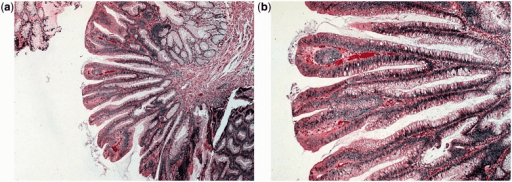
    • Puede tener una arquitectura tubular, vellosa o tubulovellosa
    • La correlación con el cáncer colorrectal invasivo aumenta con:
      • Tamaño (factor más importante): raro si el adenoma < 1 cm; 40% de > 4 cm contiene focos de cáncer invasivo.
      • Displasia de alto grado
      • Arquitectura vellosa
    • Evento de mutación inicial que causa adenoma/displasia: más común en EN Erythema nodosum is an immune-mediated panniculitis (inflammation of the subcutaneous fat) caused by a type IV (delayed-type) hypersensitivity reaction. It commonly manifests in young women as tender, erythematous nodules on the shins. Erythema Nodosum el epitelio en EN Erythema nodosum is an immune-mediated panniculitis (inflammation of the subcutaneous fat) caused by a type IV (delayed-type) hypersensitivity reaction. It commonly manifests in young women as tender, erythematous nodules on the shins. Erythema Nodosum regeneración (e.g., enfermedad intestinal inflamatoria)
  • Adenomas serrados sésiles:
    • 15% de los LOS Neisseria cánceres colorrectales esporádicos
    • Sin características citológicas de displasia como en EN Erythema nodosum is an immune-mediated panniculitis (inflammation of the subcutaneous fat) caused by a type IV (delayed-type) hypersensitivity reaction. It commonly manifests in young women as tender, erythematous nodules on the shins. Erythema Nodosum otros adenomas, pero con un potencial maligno similar
  • Síndromes de poliposis hereditaria con pólipos neoplásicos:
    • Síndrome de Lynch: mutaciones en EN Erythema nodosum is an immune-mediated panniculitis (inflammation of the subcutaneous fat) caused by a type IV (delayed-type) hypersensitivity reaction. It commonly manifests in young women as tender, erythematous nodules on the shins. Erythema Nodosum los LOS Neisseria genes Genes A category of nucleic acid sequences that function as units of heredity and which code for the basic instructions for the development, reproduction, and maintenance of organisms. DNA Types and Structure de reparación de desajustes de ADN
    • Poliposis adenomatosa familiar y variantes: mutación inicial en EN Erythema nodosum is an immune-mediated panniculitis (inflammation of the subcutaneous fat) caused by a type IV (delayed-type) hypersensitivity reaction. It commonly manifests in young women as tender, erythematous nodules on the shins. Erythema Nodosum el gen APC APC A polyposis syndrome due to an autosomal dominant mutation of the apc genes on chromosome 5. The syndrome is characterized by the development of hundreds of adenomatous polyps in the colon and rectum of affected individuals by early adulthood. Familial Adenomatous Polyposis
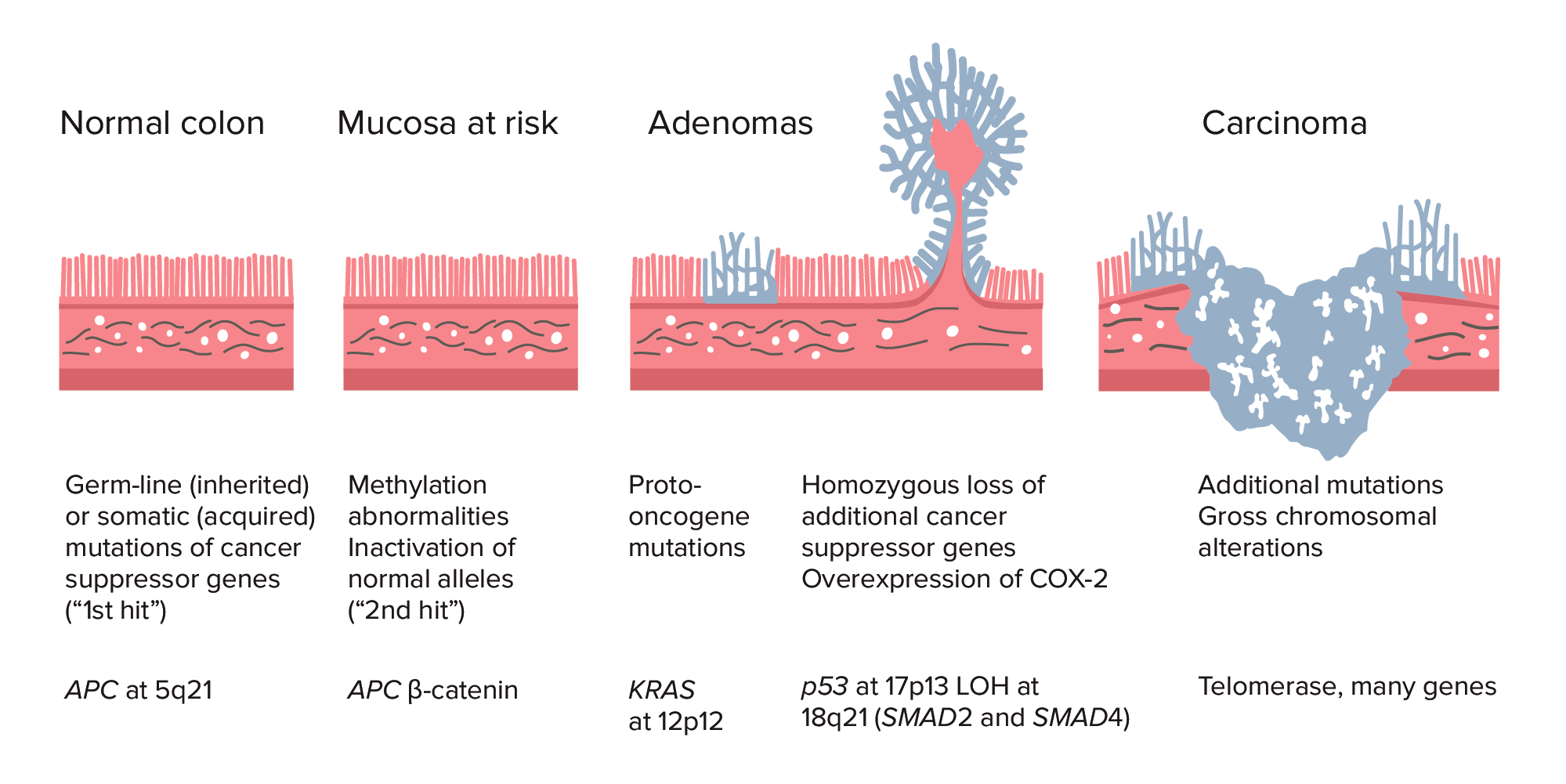
Secuencia adenoma-carcinoma

Secuencia adenoma–carcinoma de colon normal a carcinoma:
La formación del cáncer colorrectal comienza con la mutación del gen APC (heredada o adquirida) y las anomalías de metilación. Otros cambios pueden incluir la mutación del gen KRAS. En una fase avanzada del proceso, la deleción de p53, la pérdida de heterocigosidad (LOH) en 18q21 (que implica a SMAD2 y SMAD4), con la sobreexpresión de COX-2 pueden contribuir a un mayor crecimiento y a la progresión del cáncer. La acumulación de mutaciones, más que el momento en que se producen, es lo más crucial en la carcinogénesis.

Imagen por Lecturio. Licencia: CC BY-NC-SA 4.0

Presentación Clínica

La mayoría de los LOS Neisseria pólipos colorrectales son asintomáticos y se descubren en EN Erythema nodosum is an immune-mediated panniculitis (inflammation of the subcutaneous fat) caused by a type IV (delayed-type) hypersensitivity reaction. It commonly manifests in young women as tender, erythematous nodules on the shins. Erythema Nodosum el tamizaje rutinario para cáncer de colon Colon The large intestines constitute the last portion of the digestive system. The large intestine consists of the cecum, appendix, colon (with ascending, transverse, descending, and sigmoid segments), rectum, and anal canal. The primary function of the colon is to remove water and compact the stool prior to expulsion from the body via the rectum and anal canal. Colon, Cecum, and Appendix: Anatomy.

  • Los LOS Neisseria pólipos sintomáticos pueden presentarse con:
    • Sangre o mucosidad en EN Erythema nodosum is an immune-mediated panniculitis (inflammation of the subcutaneous fat) caused by a type IV (delayed-type) hypersensitivity reaction. It commonly manifests in young women as tender, erythematous nodules on the shins. Erythema Nodosum las heces
    • Cambio en EN Erythema nodosum is an immune-mediated panniculitis (inflammation of the subcutaneous fat) caused by a type IV (delayed-type) hypersensitivity reaction. It commonly manifests in young women as tender, erythematous nodules on the shins. Erythema Nodosum los LOS Neisseria hábitos intestinales:
      • Estreñimiento
      • Diarrea
    • Obstrucción o intususcepción si el pólipo es lo suficientemente grande
  • Síndromes hereditarios:
    • Síndrome de Lynch:
      • Presentan un mayor número de pólipos que la población general
      • El cáncer colorrectal puede desarrollarse sin formar primero un pólipo precursor visible.
      • Típicamente, tienen adenomas serrados sésiles en EN Erythema nodosum is an immune-mediated panniculitis (inflammation of the subcutaneous fat) caused by a type IV (delayed-type) hypersensitivity reaction. It commonly manifests in young women as tender, erythematous nodules on the shins. Erythema Nodosum el colon Colon The large intestines constitute the last portion of the digestive system. The large intestine consists of the cecum, appendix, colon (with ascending, transverse, descending, and sigmoid segments), rectum, and anal canal. The primary function of the colon is to remove water and compact the stool prior to expulsion from the body via the rectum and anal canal. Colon, Cecum, and Appendix: Anatomy derecho
    • Poliposis adenomatosa familiar:
      • Antecedentes familiares positivos de la enfermedad
      • Presentan el cáncer colorrectal de forma precoz, entre los LOS Neisseria 20–50 años de edad (edad media: 39 años)
      • Tener ≥ 100 (o > 1 000) pólipos colorrectales
    • Síndrome de Peutz-Jeghers:
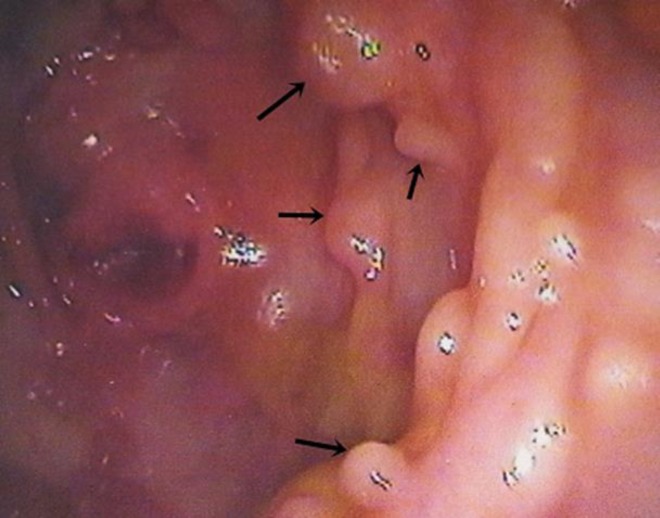
      • Puede presentarse con pólipos hamartomatosos en EN Erythema nodosum is an immune-mediated panniculitis (inflammation of the subcutaneous fat) caused by a type IV (delayed-type) hypersensitivity reaction. It commonly manifests in young women as tender, erythematous nodules on the shins. Erythema Nodosum otros lugares (estómago e intestino delgado)
      • Lesiones cutáneas pigmentadas: máculas melanóticas de la piel y las mucosas
    • Síndrome de Cowden:
      • Presenta múltiples hamartomas en EN Erythema nodosum is an immune-mediated panniculitis (inflammation of the subcutaneous fat) caused by a type IV (delayed-type) hypersensitivity reaction. It commonly manifests in young women as tender, erythematous nodules on the shins. Erythema Nodosum el colon Colon The large intestines constitute the last portion of the digestive system. The large intestine consists of the cecum, appendix, colon (with ascending, transverse, descending, and sigmoid segments), rectum, and anal canal. The primary function of the colon is to remove water and compact the stool prior to expulsion from the body via the rectum and anal canal. Colon, Cecum, and Appendix: Anatomy
      • Lesiones mucocutáneas faciales

Diagnóstico y Tratamiento

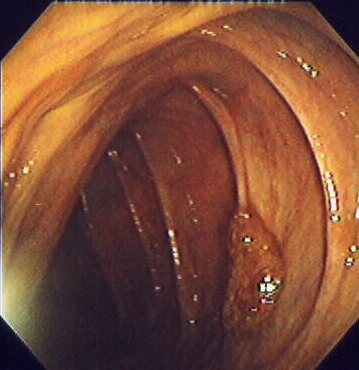
El diagnóstico y el tratamiento definitivo de los LOS Neisseria pólipos colorrectales se consiguen mediante la extirpación endoscópica de todo el pólipo.
Diagnóstico

  • Colonoscopia de tamizaje u otras formas de tamizaje de cáncer de colon Colon The large intestines constitute the last portion of the digestive system. The large intestine consists of the cecum, appendix, colon (with ascending, transverse, descending, and sigmoid segments), rectum, and anal canal. The primary function of the colon is to remove water and compact the stool prior to expulsion from the body via the rectum and anal canal. Colon, Cecum, and Appendix: Anatomy para detectar los LOS Neisseria pólipos de forma temprana:
    • Empezando a partir de los LOS Neisseria 45 años en EN Erythema nodosum is an immune-mediated panniculitis (inflammation of the subcutaneous fat) caused by a type IV (delayed-type) hypersensitivity reaction. It commonly manifests in young women as tender, erythematous nodules on the shins. Erythema Nodosum personas de riesgo promedio (antes si un familiar de 1er grado tiene cáncer colorrectal a una edad < 60 años)
    • Más temprano y más frecuentemente en EN Erythema nodosum is an immune-mediated panniculitis (inflammation of the subcutaneous fat) caused by a type IV (delayed-type) hypersensitivity reaction. It commonly manifests in young women as tender, erythematous nodules on the shins. Erythema Nodosum los LOS Neisseria individuos de mayor riesgo:
      • Enfermedad inflamatoria intestinal
      • Síndromes hereditarios de riesgo
  • La colonoscopia es necesaria para la extirpación de los LOS Neisseria pólipos si son detectados por otros estudios:
    • Colonografía por TC
    • Sigmoidoscopia
    • Prueba de heces positiva para sangre oculta y mutaciones de ADN
  • Resultados de la colonoscopia de referencia:
    • Sin adenomas: 3,3%.
    • 1–2 adenomas < 10 mm: 4,9%
    • Adenoma de alto riesgo: 17,3%
  • Pruebas moleculares indicadas en EN Erythema nodosum is an immune-mediated panniculitis (inflammation of the subcutaneous fat) caused by a type IV (delayed-type) hypersensitivity reaction. It commonly manifests in young women as tender, erythematous nodules on the shins. Erythema Nodosum la sospecha de poliposis hereditaria o síndromes de cáncer colorrectal

Tratamiento

Pautas de seguimiento después de la colonoscopia y la polipectomía (basadas en EN Erythema nodosum is an immune-mediated panniculitis (inflammation of the subcutaneous fat) caused by a type IV (delayed-type) hypersensitivity reaction. It commonly manifests in young women as tender, erythematous nodules on the shins. Erythema Nodosum la Actualización del Consenso 2020 por la U.S. Multi-Society Task Force sobre el Cáncer Colorrectal):
  • Basado en EN Erythema nodosum is an immune-mediated panniculitis (inflammation of the subcutaneous fat) caused by a type IV (delayed-type) hypersensitivity reaction. It commonly manifests in young women as tender, erythematous nodules on the shins. Erythema Nodosum los LOS Neisseria hallazgos de la 1ra colonoscopia:
    • Riesgo de cáncer colorrectal en EN Erythema nodosum is an immune-mediated panniculitis (inflammation of the subcutaneous fat) caused by a type IV (delayed-type) hypersensitivity reaction. It commonly manifests in young women as tender, erythematous nodules on the shins. Erythema Nodosum los LOS Neisseria 10 años siguientes a una colonoscopia normal: < 0,5%, basado en EN Erythema nodosum is an immune-mediated panniculitis (inflammation of the subcutaneous fat) caused by a type IV (delayed-type) hypersensitivity reaction. It commonly manifests in young women as tender, erythematous nodules on the shins. Erythema Nodosum los LOS Neisseria resultados de 4,3 millones de personas
    • Suposiciones de calidad:
      • Examen completo hasta el ciego
      • Preparación adecuada
      • Colonoscopista experto con una tasa de detección de adenomas adecuada
  • Colonoscopia normal → repetir en EN Erythema nodosum is an immune-mediated panniculitis (inflammation of the subcutaneous fat) caused by a type IV (delayed-type) hypersensitivity reaction. It commonly manifests in young women as tender, erythematous nodules on the shins. Erythema Nodosum 10 años
    • No hay pólipos adenomatosos
    • Pólipos hiperplásicos < 10 mm
  • Adenomas de bajo riesgo → repetir en EN Erythema nodosum is an immune-mediated panniculitis (inflammation of the subcutaneous fat) caused by a type IV (delayed-type) hypersensitivity reaction. It commonly manifests in young women as tender, erythematous nodules on the shins. Erythema Nodosum 7–10 años
    • Número: solo se han encontrado 1 o 2
    • Tamaño: < 10 mm
    • Histología: displasia de bajo grado
  • Pólipos serrados sésiles → se repiten en EN Erythema nodosum is an immune-mediated panniculitis (inflammation of the subcutaneous fat) caused by a type IV (delayed-type) hypersensitivity reaction. It commonly manifests in young women as tender, erythematous nodules on the shins. Erythema Nodosum 5–10 años
    • 1–2 pólipos serrados sésiles
    • Tamaño: < 10 mm
  • Hallazgos anormales por debajo de → repetir en EN Erythema nodosum is an immune-mediated panniculitis (inflammation of the subcutaneous fat) caused by a type IV (delayed-type) hypersensitivity reaction. It commonly manifests in young women as tender, erythematous nodules on the shins. Erythema Nodosum 3–5 años
    • > 3 pólipos adenomatosos < 10 mm
    • 3-4 pólipos serrados sésiles < 10 mm
    • Pólipo hiperplásico > 10 mm
  • Neoplasia avanzada o adenomas de alto riesgo → repetir en EN Erythema nodosum is an immune-mediated panniculitis (inflammation of the subcutaneous fat) caused by a type IV (delayed-type) hypersensitivity reaction. It commonly manifests in young women as tender, erythematous nodules on the shins. Erythema Nodosum 3 años
    • 5–10 adenomas
    • 5–10 pólipos serrados sésiles
    • Adenoma o pólipo serrado sésil > 10 mm
    • Histología:
      • Tubulovelloso o velloso
      • Displasia de alto grado
  • > 10 adenomas → repetir en EN Erythema nodosum is an immune-mediated panniculitis (inflammation of the subcutaneous fat) caused by a type IV (delayed-type) hypersensitivity reaction. It commonly manifests in young women as tender, erythematous nodules on the shins. Erythema Nodosum 1 año
  • Resección colónica segmentaria para pólipos grandes (> 2 cm) o invasión linfovascular
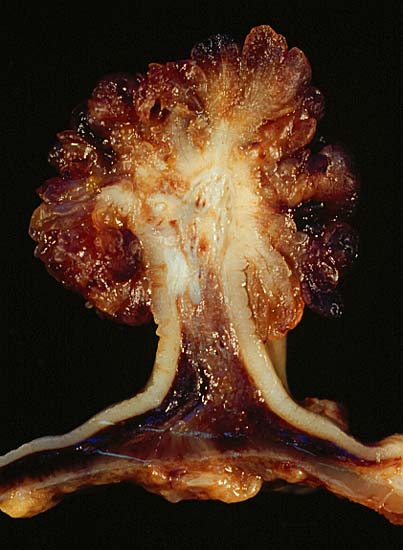
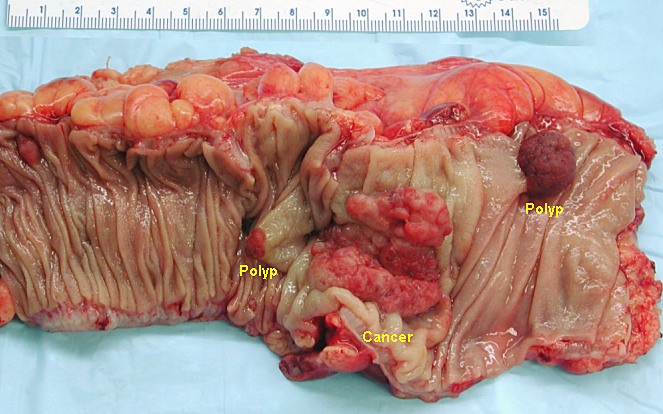
Segmento de colon resecado en estado no fijado que contiene un carcinoma colorrectal invasivo y dos pólipos adenomatosos

Segmento de colon resecado en estado no fijado que contiene un carcinoma colorrectal invasivo y 2 pólipos adenomatosos

Imagen: “Colon cancer” por Emmanuelm. Licencia: CC BY 3.0

Referencias

  1. Kumar, V., Abbas, A. K., Aster, J.C. (Eds.). (2020). The gastrointestinal tract. In: Robbins & Cotran Pathologic Basis of Disease, 10th ed. Elsevier, pp. 807–812.
  2. Nguyen, L. H., Goel, A., Chung, D. C. (2020). Pathways of colorectal carcinogenesis. Gastroenterology 158:291–302. https://doi.org/10.1053/j.gastro.2019.08.059
  3. Grover, S., Stoffel, E. (2020). MUTYH-associated polyposis. UpToDate. Retrieved November 12, 2020, from https://www.uptodate.com/contents/mutyh-associated-polyposis
  4. Macrae, F.A. (2021). Overview of colon polyps. UpToDate. Retrieved July 20, 2021,from https://www.uptodate.com/contents/overview-of-colon-polyps
  5. Peltomäki, P., Olkinuora, A., Nieminen, T. T. (2020). Updates in the field of hereditary nonpolyposis colorectal cancer. Expert Review of Gastroenterology & Hepatology 14:707–720. https://doi.org/10.1080/17474124.2020.1782187
  6. Gupta, S., et al. (2020). Recommendations for follow-up after colonoscopy and polypectomy: a consensus update by the US multi-society task force on colorectal cancer. Retrieved July 20, 2021, from https://www.asge.org/docs/default-source/guidelines/recommendations-for-follow-up-after-colonoscopy-and-polypectomy-a-consensus-update-by-the-us-multi-society-task-force-on-colorectal-cancer

¡Crea tu cuenta gratis o inicia una sesión para seguir leyendo!

Regístrate ahora y obtén acceso gratuito a Lecturio con páginas de concepto, videos médicos y cuestionarios para tu educación médica.

User Reviews

Que tengas una sesión de estudio alegre y navideña 🎁 Ahorra 50% en todos los planes >>

Details