
Domina Conceptos Médicos

Estudia para la escuela de medicina y tus examenes con Lecturio.

Metabolismo del Etanol

El etanol es un compuesto químico que se produce en EN Erythema nodosum is an immune-mediated panniculitis (inflammation of the subcutaneous fat) caused by a type IV (delayed-type) hypersensitivity reaction. It commonly manifests in young women as tender, erythematous nodules on the shins. Erythema Nodosum pequeñas cantidades en EN Erythema nodosum is an immune-mediated panniculitis (inflammation of the subcutaneous fat) caused by a type IV (delayed-type) hypersensitivity reaction. It commonly manifests in young women as tender, erythematous nodules on the shins. Erythema Nodosum el intestino delgado y también se ingiere a partir de bebidas alcohólicas. La digestión del etanol implica una vía catabólica compleja que tiene lugar principalmente en EN Erythema nodosum is an immune-mediated panniculitis (inflammation of the subcutaneous fat) caused by a type IV (delayed-type) hypersensitivity reaction. It commonly manifests in young women as tender, erythematous nodules on the shins. Erythema Nodosum el hígado. El etanol se convierte en EN Erythema nodosum is an immune-mediated panniculitis (inflammation of the subcutaneous fat) caused by a type IV (delayed-type) hypersensitivity reaction. It commonly manifests in young women as tender, erythematous nodules on the shins. Erythema Nodosum acetaldehído, luego en EN Erythema nodosum is an immune-mediated panniculitis (inflammation of the subcutaneous fat) caused by a type IV (delayed-type) hypersensitivity reaction. It commonly manifests in young women as tender, erythematous nodules on the shins. Erythema Nodosum acetato y finalmente en EN Erythema nodosum is an immune-mediated panniculitis (inflammation of the subcutaneous fat) caused by a type IV (delayed-type) hypersensitivity reaction. It commonly manifests in young women as tender, erythematous nodules on the shins. Erythema Nodosum acetil-CoA, que se convierte en EN Erythema nodosum is an immune-mediated panniculitis (inflammation of the subcutaneous fat) caused by a type IV (delayed-type) hypersensitivity reaction. It commonly manifests in young women as tender, erythematous nodules on the shins. Erythema Nodosum un sustrato para el ciclo del ácido cítrico y finalmente producir energía. El consumo excesivo de etanol puede tener consecuencias metabólicas patológicas, como alcoholismo, enfermedad hepática y cáncer.

Last updated: Apr 17, 2025
Editorial responsibility: Stanley Oiseth, Lindsay Jones, Evelin Maza

Descripción General

Características químicas

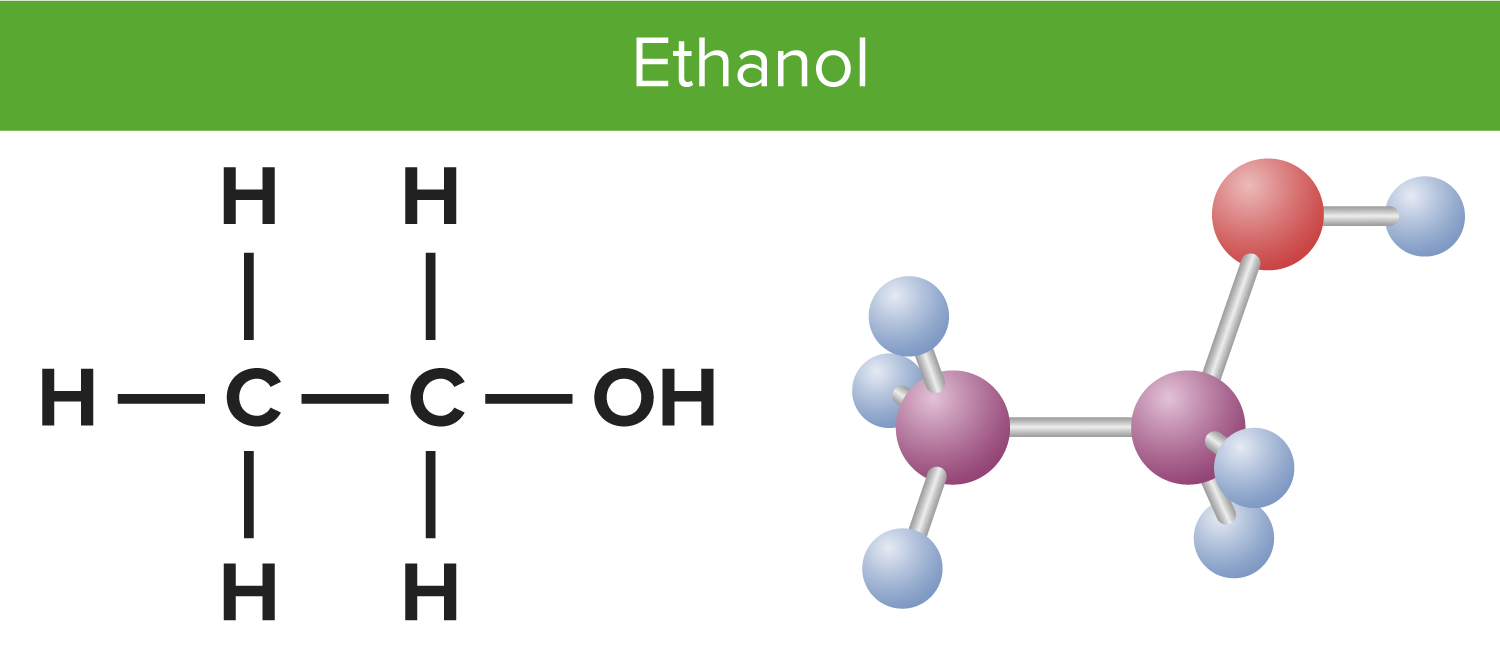
  • El etanol es un alcohol de 2 carbonos.
  • Soluble en EN Erythema nodosum is an immune-mediated panniculitis (inflammation of the subcutaneous fat) caused by a type IV (delayed-type) hypersensitivity reaction. It commonly manifests in young women as tender, erythematous nodules on the shins. Erythema Nodosum ambientes acuosos y lipídicos debido a su pequeño tamaño (cadena carbonada corta) y grupo hidroxilo (-OH)
  • Fórmula molecular: CH3 CH2OH
  • Líquido incoloro, volátil con un ligero olor.
Estructura del etanol

Estructura de la molécula de etanol

Imagen por Lecturio.

Producción y absorción

  • El etanol es producido por el tracto gastrointestinal en EN Erythema nodosum is an immune-mediated panniculitis (inflammation of the subcutaneous fat) caused by a type IV (delayed-type) hypersensitivity reaction. It commonly manifests in young women as tender, erythematous nodules on the shins. Erythema Nodosum cantidades mínimas a través de la fermentación del contenido intestinal (aproximadamente 3 g de etanol/día).
  • El alcohol también se produce mínimamente por varias vías metabólicas, que incluyen:
    • Síntesis de ácidos grasos
    • Metabolismo de los LOS Neisseria glicerolípidos
    • Vías de biosíntesis de los LOS Neisseria ácidos biliares
  • También ingresa al cuerpo a través del consumo de alcohol:
    1. El alcohol se consume → ingresa al AL Amyloidosis estómago y al AL Amyloidosis intestino delgado → se absorbe en EN Erythema nodosum is an immune-mediated panniculitis (inflammation of the subcutaneous fat) caused by a type IV (delayed-type) hypersensitivity reaction. It commonly manifests in young women as tender, erythematous nodules on the shins. Erythema Nodosum el torrente sanguíneo (debido a la solubilidad en EN Erythema nodosum is an immune-mediated panniculitis (inflammation of the subcutaneous fat) caused by a type IV (delayed-type) hypersensitivity reaction. It commonly manifests in young women as tender, erythematous nodules on the shins. Erythema Nodosum agua)
    2. Se propaga a los LOS Neisseria espacios intracelulares y extracelulares, incluido el tejido adiposo.
      • Las mujeres suelen tener un nivel de alcohol en EN Erythema nodosum is an immune-mediated panniculitis (inflammation of the subcutaneous fat) caused by a type IV (delayed-type) hypersensitivity reaction. It commonly manifests in young women as tender, erythematous nodules on the shins. Erythema Nodosum la sangre más alto que los LOS Neisseria hombres debido a un mayor porcentaje de grasa corporal.
    3. A través del sistema portal → llega al AL Amyloidosis hígado, responsable de la mayor parte de su metabolismo

Metabolismo del Etanol

El sitio principal del catabolismo del alcohol es el hígado.
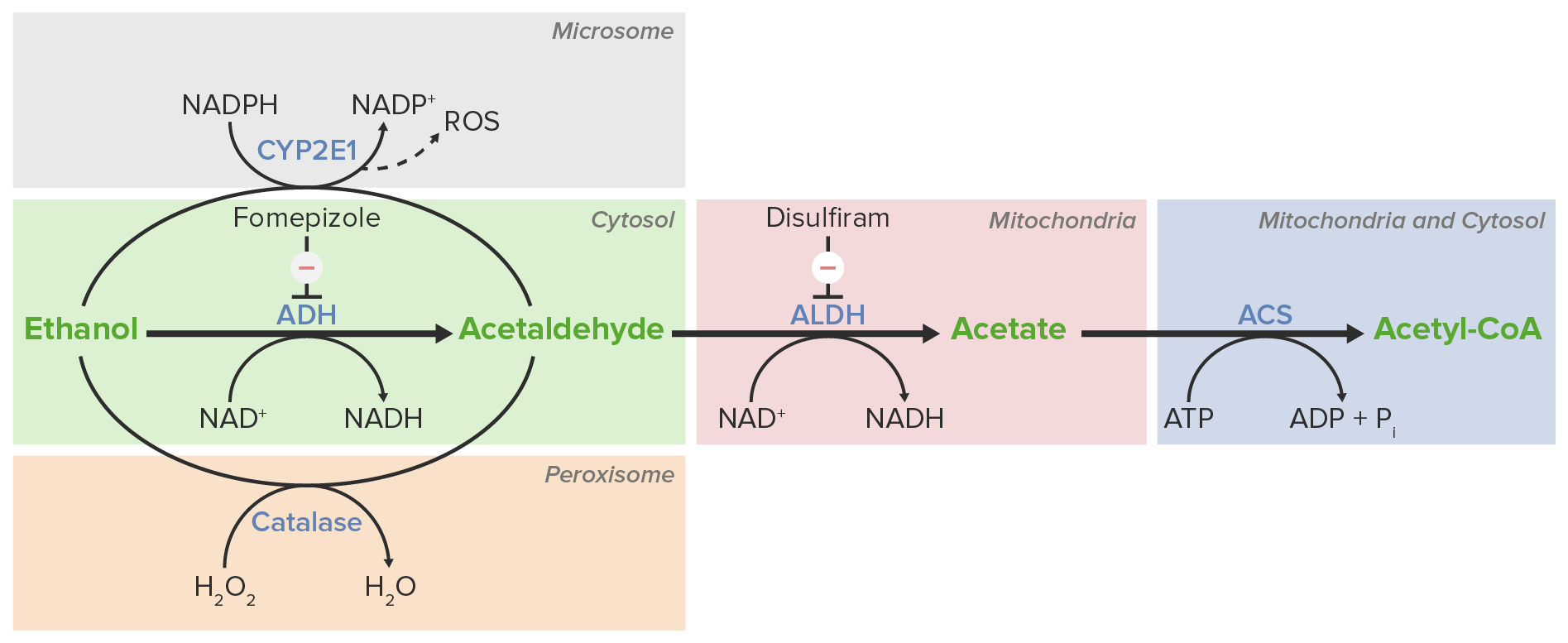
  1. Etanolacetaldehído
    • Ocurre en EN Erythema nodosum is an immune-mediated panniculitis (inflammation of the subcutaneous fat) caused by a type IV (delayed-type) hypersensitivity reaction. It commonly manifests in young women as tender, erythematous nodules on the shins. Erythema Nodosum el citoplasma
    • Enzima hepática: alcohol deshidrogenasa (ADH)
      • Responsable de la mayor parte de la descomposición del etanol en EN Erythema nodosum is an immune-mediated panniculitis (inflammation of the subcutaneous fat) caused by a type IV (delayed-type) hypersensitivity reaction. It commonly manifests in young women as tender, erythematous nodules on the shins. Erythema Nodosum acetaldehído
      • Se encuentra en EN Erythema nodosum is an immune-mediated panniculitis (inflammation of the subcutaneous fat) caused by a type IV (delayed-type) hypersensitivity reaction. It commonly manifests in young women as tender, erythematous nodules on the shins. Erythema Nodosum el citoplasma
      • Requiere NAD NAD+ A coenzyme composed of ribosylnicotinamide 5′-diphosphate coupled to adenosine 5′-phosphate by pyrophosphate linkage. It is found widely in nature and is involved in numerous enzymatic reactions in which it serves as an electron carrier by being alternately oxidized (NAD+) and reduced (NADH). Pentose Phosphate Pathway+
    • Citocromo hepático: enzima P450 CYP2E1 CYP2E1 An ethanol-inducible cytochrome p450 enzyme that metabolizes several precarcinogens, drugs, and solvents to reactive metabolites. Substrates include ethanol; inhalation anesthetics; benzene; acetaminophen and other low molecular weight compounds. Cyp2e1 has been used as an enzyme marker in the study of alcohol abuse. Ethanol Metabolism (también llamado sistema oxidante de etanol microsomal)
      • Inducido durante el consumo crónico de alcohol
      • Se encuentra en EN Erythema nodosum is an immune-mediated panniculitis (inflammation of the subcutaneous fat) caused by a type IV (delayed-type) hypersensitivity reaction. It commonly manifests in young women as tender, erythematous nodules on the shins. Erythema Nodosum los LOS Neisseria microsomas
      • Requiere de nicotinamida adenina dinucleótido fosfato ( NADPH NADPH Nicotinamide adenine dinucleotide phosphate. A coenzyme composed of ribosylnicotinamide 5′-phosphate (nmn) coupled by pyrophosphate linkage to the 5′-phosphate adenosine 2. Pentose Phosphate Pathway)
      • Libera especies reactivas de oxígeno → daño hepático alcohólico
    • Éster etílico de ácido graso sintasa (FAEE)
      • Cataliza la reacción reversible del éster etílico de ácido graso de cadena larga y H 2 O ↔ ácidos grasos de cadena larga y etanol
      • Se encuentra en EN Erythema nodosum is an immune-mediated panniculitis (inflammation of the subcutaneous fat) caused by a type IV (delayed-type) hypersensitivity reaction. It commonly manifests in young women as tender, erythematous nodules on the shins. Erythema Nodosum el hígado y el páncreas.
  2. Acetaldehído → acetato: catalizado por la enzima acetaldehído deshidrogenasa (ALDH)
    • La ALDH se encuentra principalmente en EN Erythema nodosum is an immune-mediated panniculitis (inflammation of the subcutaneous fat) caused by a type IV (delayed-type) hypersensitivity reaction. It commonly manifests in young women as tender, erythematous nodules on the shins. Erythema Nodosum las mitocondrias hepáticas y en EN Erythema nodosum is an immune-mediated panniculitis (inflammation of the subcutaneous fat) caused by a type IV (delayed-type) hypersensitivity reaction. It commonly manifests in young women as tender, erythematous nodules on the shins. Erythema Nodosum menor cantidad en EN Erythema nodosum is an immune-mediated panniculitis (inflammation of the subcutaneous fat) caused by a type IV (delayed-type) hypersensitivity reaction. It commonly manifests in young women as tender, erythematous nodules on the shins. Erythema Nodosum el citoplasma
    • Requiere NAD NAD+ A coenzyme composed of ribosylnicotinamide 5′-diphosphate coupled to adenosine 5′-phosphate by pyrophosphate linkage. It is found widely in nature and is involved in numerous enzymatic reactions in which it serves as an electron carrier by being alternately oxidized (NAD+) and reduced (NADH). Pentose Phosphate Pathway+
  3. Acetato → acetil-CoA: catalizado por la acetil-CoA sintetasa (ACS) dependiente de ATP
    • ACS se encuentra en EN Erythema nodosum is an immune-mediated panniculitis (inflammation of the subcutaneous fat) caused by a type IV (delayed-type) hypersensitivity reaction. It commonly manifests in young women as tender, erythematous nodules on the shins. Erythema Nodosum las mitocondrias y el citoplasma
    • Requiere coenzima A y ATP
  4. Acetil-CoA → varias vías metabólicas:
    • Ciclo del ácido cítrico
    • Síntesis de ácidos grasos
    • Síntesis de cuerpos cetónicos o cetogénesis
    • Vía del mevalonato
    • Síntesis de acetilcolina
    • Síntesis de melatonina
Diagrama esquemático de los pasos del metabolismo del etanol.

Diagrama esquemático de los pasos del metabolismo del etanol.

Imagen por Lecturio.

Medicamentos que afectan el metabolismo del etanol.

Muchos medicamentos comunes pueden inhibir las enzimas involucradas en EN Erythema nodosum is an immune-mediated panniculitis (inflammation of the subcutaneous fat) caused by a type IV (delayed-type) hypersensitivity reaction. It commonly manifests in young women as tender, erythematous nodules on the shins. Erythema Nodosum el metabolismo del etanol, lo que lleva a la acumulación de sus productos tóxicos (e.g., acetaldehído):

Medicamento Enzima inhibida Efectos
Fomepizol Alcohol deshidrogenasa (ADH)
  • Previene la formación de acetaldehído
  • Se utiliza como tratamiento para el envenenamiento por metanol o etilenglicol
Disulfiram Acetaldehído deshidrogenasa (ALDH) Causa acumulación de acetaldehído → síntomas de resaca
    • Náuseas
    • Vómitos
    • Enrojecimiento
    • Mareo
    • Cefalea
    • Malestar abdominal
  • Se utiliza como tratamiento para el trastorno por consumo de alcohol
  • Carbimida de calcio
  • Cianamida de hidrógeno
  • Cefalosporinas
  • Cloranfenicol
  • Ketoconazol
  • Metronidazol
  • Nitratos
  • Nitroimidazoles Nitroimidazoles Nitroimidazoles are prodrugs composed of an imidazole ring with an attached nitro group. Nitroimidazoles are reduced within susceptible microorganisms, leading to free radical formation and disruption of DNA integrity. Nitroimidazoles
  • Sulfonamida
  • Provocan un “efecto disulfiram”
  • Se utilizan como tratamiento para diversas enfermedades (no para el trastorno por consumo de alcohol)
  • No se recomienda su uso concomitante de alcohol y estos medicamentos.

Consumo Excesivo de Etanol

El consumo excesivo de etanol, como en EN Erythema nodosum is an immune-mediated panniculitis (inflammation of the subcutaneous fat) caused by a type IV (delayed-type) hypersensitivity reaction. It commonly manifests in young women as tender, erythematous nodules on the shins. Erythema Nodosum el trastorno por consumo de alcohol, conduce a la saturación de la vía metabólica del etanol y la consiguiente acumulación de metabolitos tóxicos, así como a la alteración de otras vías metabólicas.
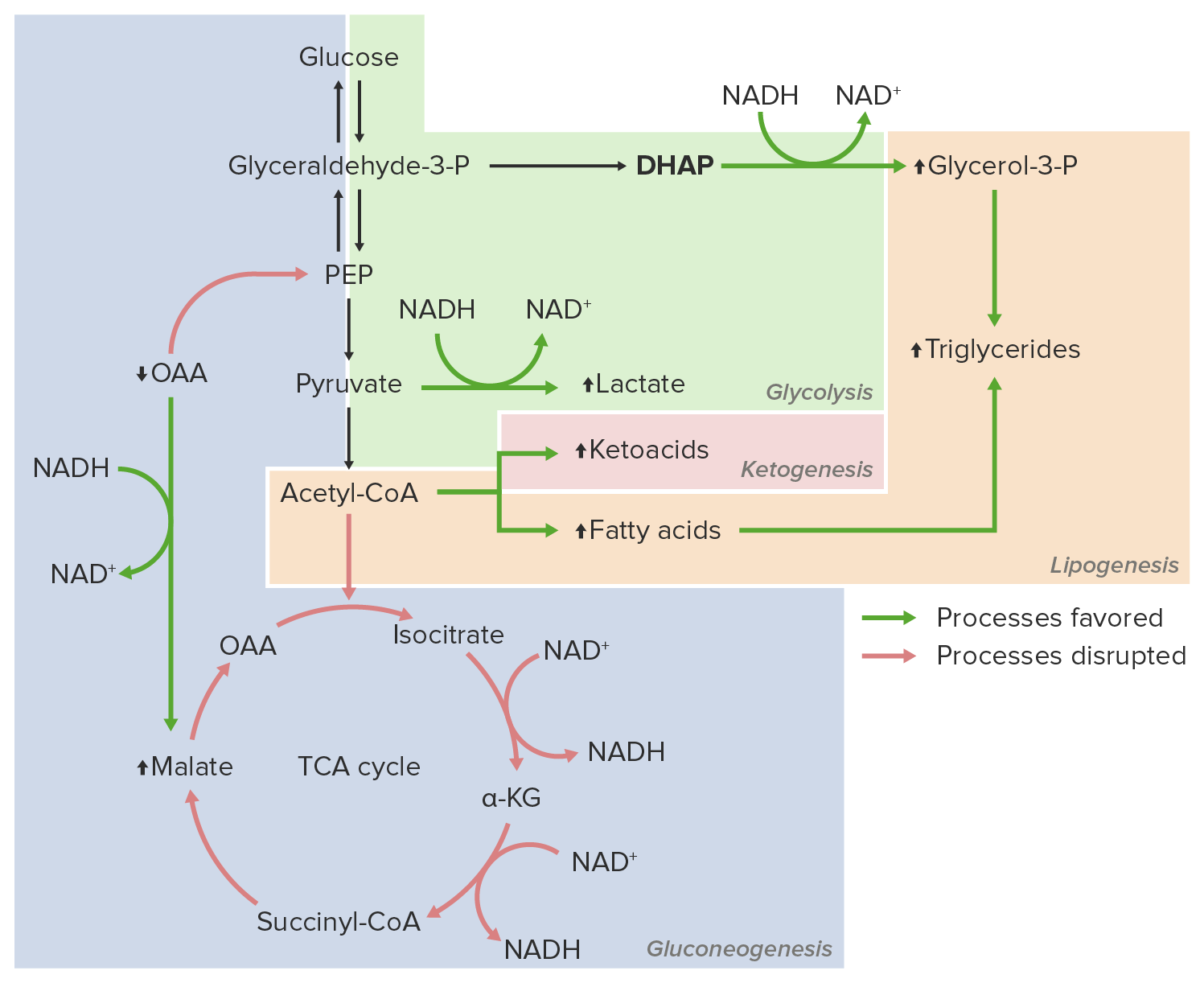
  • Los LOS Neisseria niveles de acetaldehído exceden la capacidad de la acetaldehído deshidrogenasa → acumulación de acetaldehído (tóxico) → síntomas de resaca
    • Enrojecimiento relacionado con el alcohol
    • Cefaleas
    • Náuseas y/o vómitos
    • Aumento de la frecuencia cardíaca
  • Aumento de la relación NADH/ NAD NAD+ A coenzyme composed of ribosylnicotinamide 5′-diphosphate coupled to adenosine 5′-phosphate by pyrophosphate linkage. It is found widely in nature and is involved in numerous enzymatic reactions in which it serves as an electron carrier by being alternately oxidized (NAD+) and reduced (NADH). Pentose Phosphate Pathway +exceso de NADH
    • Inhibe el ciclo del ácido cítrico + aumenta la conversión de acetato a acetil-CoA → aumenta la acetil-CoA → estimula la síntesis de ácidos grasos + inhibe la beta oxidación → enfermedad del hígado graso
    • Desvía el piruvato de la glucólisis al AL Amyloidosis lactato + inhibe la gluconeogénesis → hipoglucemia grave
    • Acidosis Acidosis A pathologic condition of acid accumulation or depletion of base in the body. The two main types are respiratory acidosis and metabolic acidosis, due to metabolic acid build up. Respiratory Acidosis metabólica:
      • Aumento de la conversión de piruvato en EN Erythema nodosum is an immune-mediated panniculitis (inflammation of the subcutaneous fat) caused by a type IV (delayed-type) hypersensitivity reaction. It commonly manifests in young women as tender, erythematous nodules on the shins. Erythema Nodosum lactato → acidosis Acidosis A pathologic condition of acid accumulation or depletion of base in the body. The two main types are respiratory acidosis and metabolic acidosis, due to metabolic acid build up. Respiratory Acidosis láctica
      • Aumento de acetil-CoA → aumento de cetogénesis → cetoacidosis
Consumo excesivo de etanol

Consumo excesivo de etanol

Imagen por Lecturio.

Relevancia Clínica

Las siguientes condiciones clínicas están asociadas con el consumo excesivo de etanol:

  • Trastorno por consumo de alcohol: un nivel de consumo de alcohol que excede el estándar sociocultural. Marcado por la adicción mental y física asociada con un deseo irresistible por la sustancia y la tolerancia a la sustancia que conduce a aumentos en EN Erythema nodosum is an immune-mediated panniculitis (inflammation of the subcutaneous fat) caused by a type IV (delayed-type) hypersensitivity reaction. It commonly manifests in young women as tender, erythematous nodules on the shins. Erythema Nodosum la dosis y síntomas de abstinencia durante ese mismo periodo.
  • Enfermedad hepática alcohólica: una variedad de afecciones hepáticas progresivas causadas por el consumo crónico y excesivo de alcohol. Por lo general, implica inflamación y agrandamiento del hígado y termina en EN Erythema nodosum is an immune-mediated panniculitis (inflammation of the subcutaneous fat) caused by a type IV (delayed-type) hypersensitivity reaction. It commonly manifests in young women as tender, erythematous nodules on the shins. Erythema Nodosum cirrosis. Los LOS Neisseria síntomas incluyen ictericia (color amarillo de la piel), sangrado intestinal, debilidad, ascitis ( edema Edema Edema is a condition in which excess serous fluid accumulates in the body cavity or interstitial space of connective tissues. Edema is a symptom observed in several medical conditions. It can be categorized into 2 types, namely, peripheral (in the extremities) and internal (in an organ or body cavity). Edema abdominal) y pérdida de peso.
  • Enfermedad del hígado graso: acumulación de triglicéridos y otros lípidos en EN Erythema nodosum is an immune-mediated panniculitis (inflammation of the subcutaneous fat) caused by a type IV (delayed-type) hypersensitivity reaction. It commonly manifests in young women as tender, erythematous nodules on the shins. Erythema Nodosum los LOS Neisseria hepatocitos, lo que conduce a cambios lipídicos microvesiculares y macrovesiculares que se observan en EN Erythema nodosum is an immune-mediated panniculitis (inflammation of the subcutaneous fat) caused by a type IV (delayed-type) hypersensitivity reaction. It commonly manifests in young women as tender, erythematous nodules on the shins. Erythema Nodosum la biopsia hepática. Las etiologías incluyen la hepatopatía alcohólica, la dieta y los LOS Neisseria cambios inducidos por medicamentos.
  • Cirrosis: una afección en EN Erythema nodosum is an immune-mediated panniculitis (inflammation of the subcutaneous fat) caused by a type IV (delayed-type) hypersensitivity reaction. It commonly manifests in young women as tender, erythematous nodules on the shins. Erythema Nodosum etapa tardía causada por daño crónico al AL Amyloidosis hígado, caracterizada por necrosis Necrosis The death of cells in an organ or tissue due to disease, injury or failure of the blood supply. Ischemic Cell Damage del parénquima hepático, fibrosis Fibrosis Any pathological condition where fibrous connective tissue invades any organ, usually as a consequence of inflammation or other injury. Bronchiolitis Obliterans del tejido hepático y una respuesta inflamatoria a la etiología subyacente, como el alcoholismo crónico. Los LOS Neisseria síntomas incluyen prurito en EN Erythema nodosum is an immune-mediated panniculitis (inflammation of the subcutaneous fat) caused by a type IV (delayed-type) hypersensitivity reaction. It commonly manifests in young women as tender, erythematous nodules on the shins. Erythema Nodosum la piel, ictericia, ascitis y cáncer.
  • Hipoglucemia: un nivel anormalmente bajo de glucosa en EN Erythema nodosum is an immune-mediated panniculitis (inflammation of the subcutaneous fat) caused by a type IV (delayed-type) hypersensitivity reaction. It commonly manifests in young women as tender, erythematous nodules on the shins. Erythema Nodosum la sangre (< 70–110 mg/dL). Los LOS Neisseria síntomas incluyen sudoración, temblores, mareos, incapacidad para concentrarse y náuseas. La hipoglucemia grave puede provocar confusión, convulsiones, coma Coma Coma is defined as a deep state of unarousable unresponsiveness, characterized by a score of 3 points on the GCS. A comatose state can be caused by a multitude of conditions, making the precise epidemiology and prognosis of coma difficult to determine. Coma y la muerte.
  • Acidosis Acidosis A pathologic condition of acid accumulation or depletion of base in the body. The two main types are respiratory acidosis and metabolic acidosis, due to metabolic acid build up. Respiratory Acidosis metabólica o cetoacidosis alcohólica: una reducción en EN Erythema nodosum is an immune-mediated panniculitis (inflammation of the subcutaneous fat) caused by a type IV (delayed-type) hypersensitivity reaction. It commonly manifests in young women as tender, erythematous nodules on the shins. Erythema Nodosum la concentración de iones bicarbonato (HCO 3 -) que resulta en EN Erythema nodosum is an immune-mediated panniculitis (inflammation of the subcutaneous fat) caused by a type IV (delayed-type) hypersensitivity reaction. It commonly manifests in young women as tender, erythematous nodules on the shins. Erythema Nodosum un pH pH The quantitative measurement of the acidity or basicity of a solution. Acid-Base Balance sanguíneo < 7.35. Puede ocurrir debido a un exceso de iones de hidrógeno o pérdida de bicarbonato. Esto conduce a una respiración anormal, “aliento afrutado”, dolor Dolor Inflammation abdominal, vómitos y, posiblemente, la muerte.

Referencias

  1. Chen, N., Zhang, Q., Wu, Y., & Li, X. (2024). Lysine β-hydroxybutyrylation promotes lipid accumulation in alcoholic liver disease. Biochemical Pharmacology, 228, 115936. https://doi.org/10.1016/j.bcp.2023.115936
  2. Lamb, R. J., Huang, J., Patel, N., & Shen, J. (2024). ALDH2 polymorphism and myocardial infarction: From alcohol metabolism to redox regulation. Pharmacology & Therapeutics, 259, 108666. https://doi.org/10.1016/j.pharmthera.2024.108666
  3. LeFort, K. R., Nguyen, H., Kumar, A., & Weller, C. M. (2024). Contributing roles of mitochondrial dysfunction and hepatocyte apoptosis in liver diseases through oxidative stress, post-translational modifications, inflammation, and intestinal barrier dysfunction. Cellular and Molecular Life Sciences, 81(1), Article 34. https://doi.org/10.1007/s00018-023-05061-7
  4. Lehner, T., Simms, L., Adams, K. M., & Waterson, M. J. (2024). Alcohol metabolism in alcohol use disorder: A potential therapeutic target. Alcohol and Alcoholism, 59(1), agad077. https://doi.org/10.1093/alcalc/agad077
  5. Lu, Y., & George, J. (2024). Interaction between fatty acid oxidation and ethanol metabolism in liver. American Journal of Physiology-Gastrointestinal and Liver Physiology, 326(5), G483–G494. https://doi.org/10.1152/ajpgi.00281.2023
  6. Mackowiak, B., Hines, I. N., & Wheeler, M. D. (2024). Alcohol-associated liver disease. The Journal of Clinical Investigation, 134(3). https://doi.org/10.1172/JCI176345
  7. Meijnikman, A. S., Holleboom, A. G., & Nieuwdorp, M. (2024). Endogenous ethanol production in health and disease. Nature Reviews Gastroenterology & Hepatology, 21(8), 556–571. https://doi.org/10.1038/s41575-024-00937-w
  8. Tonetti, F. R., Oliveira, L. M., Pinto, T. P., & Dias, A. A. (2024). Gut-liver axis: Recent concepts in pathophysiology in alcohol-associated liver disease. Hepatology, 80(6), 1342–1371. https://doi.org/10.1097/HEP.0000000000000924

¡Crea tu cuenta gratis o inicia una sesión para seguir leyendo!

Regístrate ahora y obtén acceso gratuito a Lecturio con páginas de concepto, videos médicos y cuestionarios para tu educación médica.

User Reviews

Que tengas una sesión de estudio alegre y navideña 🎁 Ahorra 50% en todos los planes >>

Details