Domina Conceptos Médicos

Estudia para la escuela de medicina y tus examenes con Lecturio.

Insuficiencia Venosa Crónica

La enfermedad venosa crónica es un espectro de trastornos caracterizados por la dilatación venosa y/o la función anormal de las venas en las extremidades inferiores como consecuencia de la hipertensión venosa. La "Insuficiencia venosa crónica" se refiere a las formas más graves de la enfermedad venosa crónica. Los LOS Neisseria cambios cutáneos suelen distinguir la insuficiencia venosa crónica de las formas más leves de enfermedad venosa (como las venas varicosas) e incluyen la pigmentación de la piel, la dermatitis Dermatitis Any inflammation of the skin. Atopic Dermatitis (Eczema) por estasis, la lipodermatoesclerosis y finalmente, el desarrollo de úlceras. El diagnóstico generalmente se basa únicamente en EN Erythema nodosum is an immune-mediated panniculitis (inflammation of the subcutaneous fat) caused by a type IV (delayed-type) hypersensitivity reaction. It commonly manifests in young women as tender, erythematous nodules on the shins. Erythema Nodosum los LOS Neisseria hallazgos de la exploración física, aunque el ultrasonido doppler Doppler Ultrasonography applying the doppler effect, with frequency-shifted ultrasound reflections produced by moving targets (usually red blood cells) in the bloodstream along the ultrasound axis in direct proportion to the velocity of movement of the targets, to determine both direction and velocity of blood flow. Ultrasound (Sonography) venoso puede proporcionar información adicional sobre la etiología, la localización y la extensión de la enfermedad. El pilar del tratamiento es la terapia de compresión. La base del tratamiento es la terapia de compresión. También existen diversas opciones quirúrgicas para los LOS Neisseria pacientes sintomáticos, como la ablación, la escleroterapia y la reparación valvular.

Last updated: Jan 21, 2023

Editorial responsibility: Stanley Oiseth, Lindsay Jones, Evelin Maza

Descripción General

Definición

La enfermedad venosa crónica es un espectro de trastornos caracterizados por la dilatación venosa y/o la función anormal de las venas en EN Erythema nodosum is an immune-mediated panniculitis (inflammation of the subcutaneous fat) caused by a type IV (delayed-type) hypersensitivity reaction. It commonly manifests in young women as tender, erythematous nodules on the shins. Erythema Nodosum las extremidades inferiores como consecuencia de la hipertensión venosa.
Epidemiología

  • Mujeres > hombres
  • Incidencia de la enfermedad venosa crónica a lo largo de la vida: hasta el 50% de los LOS Neisseria individuos
  • Incidencia de la insuficiencia venosa crónica a lo largo de la vida:
    • Hasta el 40% de las mujeres
    • Hasta el 17% de los LOS Neisseria hombres
    • Incidencia ↑ con la edad

Etiología

  • Hipertensión venosa crónica
  • Causas de hipertensión venosa:
    • Obstrucción: generalmente trombosis venosa profunda (TVP)
    • Reflujo (flujo sanguíneo venoso retrógrado):
      • Generalmente debido a incompetencia valvular
      • La incompetencia valvular puede desarrollarse después de la obstrucción.
  • Enfermedad primaria: presentación sintomática sin evento precipitante (70%)
  • Enfermedad secundaria: se desarrolla después de una obstrucción debida a una TVP (30%)
  • Factores de riesgo para desarrollar insuficiencia venosa crónica:
    • ↑ Edad
    • ↑ IMC
    • Antecedentes familiares de enfermedades venosas
    • Laxitud de los LOS Neisseria ligamentos (hernias, pies planos)
    • Estar de pie durante mucho tiempo
    • Tabaquismo
    • TVP previa
    • Síndrome de Klippel-Trenaunay
    • ↑ Estados estrogénicos, incluido el embarazo

Fisiopatología

Hipertensión venosa

  • La TVP (obstrucción) y/o la incompetencia valvular primaria (reflujo) pueden causar:
    • ↑ presión en EN Erythema nodosum is an immune-mediated panniculitis (inflammation of the subcutaneous fat) caused by a type IV (delayed-type) hypersensitivity reaction. It commonly manifests in young women as tender, erythematous nodules on the shins. Erythema Nodosum las venas profundas
    • ↑ presión en EN Erythema nodosum is an immune-mediated panniculitis (inflammation of the subcutaneous fat) caused by a type IV (delayed-type) hypersensitivity reaction. It commonly manifests in young women as tender, erythematous nodules on the shins. Erythema Nodosum las venas perforantes
    • ↑ presión en EN Erythema nodosum is an immune-mediated panniculitis (inflammation of the subcutaneous fat) caused by a type IV (delayed-type) hypersensitivity reaction. It commonly manifests in young women as tender, erythematous nodules on the shins. Erythema Nodosum las venas superficiales
  • La disfunción endotelial de las paredes de las venas se debe a la TVP.
  • La inflamación crónica de las paredes de las venas conduce a una eventual remodelación de las mismas:
    • ↑ Colágeno tipo 1
    • ↓ Colágeno tipo 3
    • ↓ Células musculares lisas
    • Degradación de la matriz extracelular
    • ↑ Las proteinasas conduce a una mayor permeabilidad.
  • La disfunción severa de la pared de los LOS Neisseria vasos aumenta el riesgo de TVP debido a:
    • Incapacidad de hacer avanzar la sangre adecuadamente (estasis venosa)
    • Inflamación crónica/daño endotelial
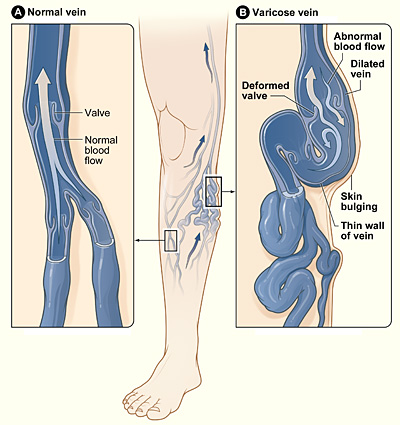
Venas varicosas (várices)

Venas varicosas

Imagen: “Varicose veins” por el National Heart Lung and Blood Institute. Licencia: Dominio Público
Cambios en EN Erythema nodosum is an immune-mediated panniculitis (inflammation of the subcutaneous fat) caused by a type IV (delayed-type) hypersensitivity reaction. It commonly manifests in young women as tender, erythematous nodules on the shins. Erythema Nodosum la piel y los LOS Neisseria tejidos blandos

  • El aumento de la hipertensión venosa se combina con el aumento de la permeabilidad de los LOS Neisseria vasos.
  • Esto favorece la salida de componentes sanguíneos al AL Amyloidosis espacio subcutáneo:
    • Líquido → edema Edema Edema is a condition in which excess serous fluid accumulates in the body cavity or interstitial space of connective tissues. Edema is a symptom observed in several medical conditions. It can be categorized into 2 types, namely, peripheral (in the extremities) and internal (in an organ or body cavity). Edema → ↑ presión en EN Erythema nodosum is an immune-mediated panniculitis (inflammation of the subcutaneous fat) caused by a type IV (delayed-type) hypersensitivity reaction. It commonly manifests in young women as tender, erythematous nodules on the shins. Erythema Nodosum la extremidad, que puede provocar:
      • Necrosis Necrosis The death of cells in an organ or tissue due to disease, injury or failure of the blood supply. Ischemic Cell Damage
      • Deterioro del drenaje linfático → mayor acumulación de líquidos y eliminación deficiente de desechos.
    • Eritrocitos (que se descomponen) → depósitos de hemosiderina → pigmentación de la piel
    • Proteinasas → úlceras cutáneas
    • Leucocitos → liberación de citoquinas → fibrosis Fibrosis Any pathological condition where fibrous connective tissue invades any organ, usually as a consequence of inflammation or other injury. Bronchiolitis Obliterans subcutánea (lipodermatoesclerosis) → ↓ capilares en EN Erythema nodosum is an immune-mediated panniculitis (inflammation of the subcutaneous fat) caused by a type IV (delayed-type) hypersensitivity reaction. It commonly manifests in young women as tender, erythematous nodules on the shins. Erythema Nodosum estas zonas:
      • Placas blancas (atrofia blanca)
      • ↓ Flujo sanguíneo → mala cicatrización e isquemia/ necrosis Necrosis The death of cells in an organ or tissue due to disease, injury or failure of the blood supply. Ischemic Cell Damage.

Presentación Clínica

Espectro de la enfermedad venosa crónica

  • Dilatación venosa asintomática
  • Enfermedad leve:
    • Telangiectasias Telangiectasias Ataxia-telangiectasia
    • Venas reticulares
    • Venas varicosas
    • Leve edema Edema Edema is a condition in which excess serous fluid accumulates in the body cavity or interstitial space of connective tissues. Edema is a symptom observed in several medical conditions. It can be categorized into 2 types, namely, peripheral (in the extremities) and internal (in an organ or body cavity). Edema de tobillo
  • Enfermedad grave (insuficiencia venosa crónica):
    • Edema Edema Edema is a condition in which excess serous fluid accumulates in the body cavity or interstitial space of connective tissues. Edema is a symptom observed in several medical conditions. It can be categorized into 2 types, namely, peripheral (in the extremities) and internal (in an organ or body cavity). Edema significativo
    • Cambios en EN Erythema nodosum is an immune-mediated panniculitis (inflammation of the subcutaneous fat) caused by a type IV (delayed-type) hypersensitivity reaction. It commonly manifests in young women as tender, erythematous nodules on the shins. Erythema Nodosum la piel
    • Úlceras

Síntomas presentes

  • Edema Edema Edema is a condition in which excess serous fluid accumulates in the body cavity or interstitial space of connective tissues. Edema is a symptom observed in several medical conditions. It can be categorized into 2 types, namely, peripheral (in the extremities) and internal (in an organ or body cavity). Edema con fóvea
  • Dolor Dolor Inflammation o molestias en EN Erythema nodosum is an immune-mediated panniculitis (inflammation of the subcutaneous fat) caused by a type IV (delayed-type) hypersensitivity reaction. It commonly manifests in young women as tender, erythematous nodules on the shins. Erythema Nodosum las extremidades inferiores:
    • A menudo se describe como “piernas pesadas”, palpitantes, dolorosas o con calambres
    • Empeora al AL Amyloidosis estar de pie
    • A diferencia de la enfermedad arterial periférica (EAP), el dolor Dolor Inflammation mejora con:
      • Elevación de la pierna
      • Caminar
  • Adormecimiento u hormigueo
  • Prurito
  • Venas tortuosas visibles:
    • Telangiectasias Telangiectasias Ataxia-telangiectasia: vénulas intradérmicas dilatadas < 1 mm
    • Venas reticulares: venas subdérmicas dilatadas, de 1 – 3 mm de diámetro
    • Venas varicosas: venas subcutáneas dilatadas > 3 mm de diámetro
  • Cambios en EN Erythema nodosum is an immune-mediated panniculitis (inflammation of the subcutaneous fat) caused by a type IV (delayed-type) hypersensitivity reaction. It commonly manifests in young women as tender, erythematous nodules on the shins. Erythema Nodosum la piel:
    • Coloración marrón o gris-azulada de la piel por los LOS Neisseria depósitos de hemosiderina
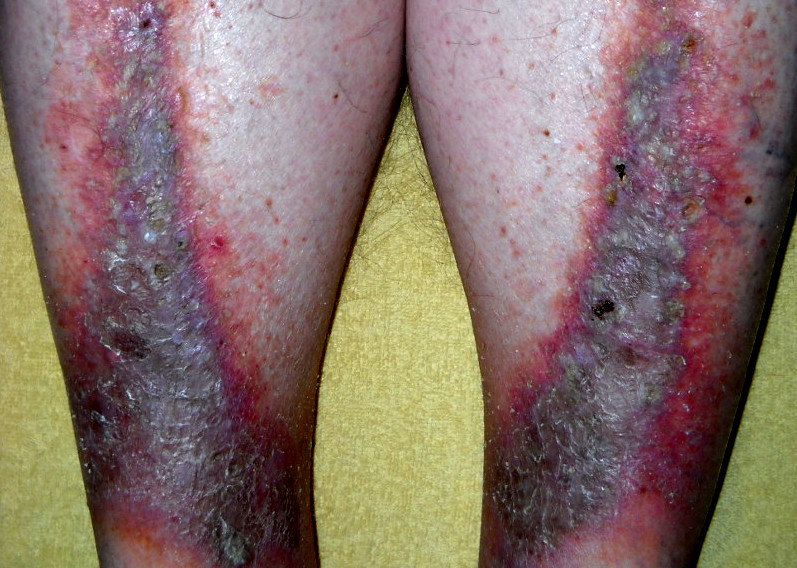
    • Dermatitis Dermatitis Any inflammation of the skin. Atopic Dermatitis (Eczema) por estasis (erupción eczematosa) caracterizada por:
      • Eritema
      • Descamación
      • Supuración
      • Erosiones
      • Costras
    • Lipodermatoesclerosis:
      • Zonas firmes e induradas
      • La piel se adhiere al AL Amyloidosis tejido subcutáneo ( fibrosis Fibrosis Any pathological condition where fibrous connective tissue invades any organ, usually as a consequence of inflammation or other injury. Bronchiolitis Obliterans subcutánea).
      • Más común en EN Erythema nodosum is an immune-mediated panniculitis (inflammation of the subcutaneous fat) caused by a type IV (delayed-type) hypersensitivity reaction. It commonly manifests in young women as tender, erythematous nodules on the shins. Erythema Nodosum la parte medial del tobillo
      • Puede formar una banda constrictiva alrededor de la extremidad
    • Atrofia blanca:
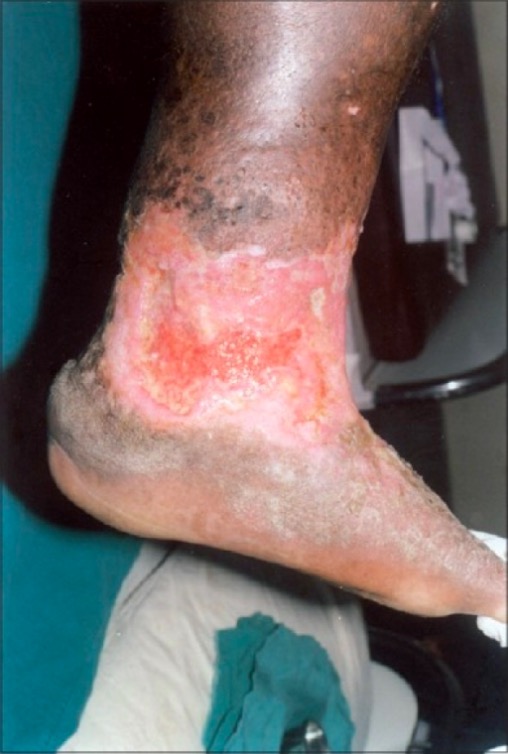
    • Úlceras: comúnmente sobre el maléolo medial

Diagnóstico y Clasificación

Examen físico

Aspecto de las extremidades inferiores:

  • Edema Edema Edema is a condition in which excess serous fluid accumulates in the body cavity or interstitial space of connective tissues. Edema is a symptom observed in several medical conditions. It can be categorized into 2 types, namely, peripheral (in the extremities) and internal (in an organ or body cavity). Edema
  • Venas superficiales tortuosas visibles o palpables
  • Cambios característicos en EN Erythema nodosum is an immune-mediated panniculitis (inflammation of the subcutaneous fat) caused by a type IV (delayed-type) hypersensitivity reaction. It commonly manifests in young women as tender, erythematous nodules on the shins. Erythema Nodosum la piel
  • +/- Úlceras

Tiempo de llenado venoso:

  • Observe el tiempo que tardan las venas visibles en EN Erythema nodosum is an immune-mediated panniculitis (inflammation of the subcutaneous fat) caused by a type IV (delayed-type) hypersensitivity reaction. It commonly manifests in young women as tender, erythematous nodules on the shins. Erythema Nodosum distenderse después de que el paciente se ponga de pie desde una posición sentada.
  • El tiempo de llenado normal es > 20 segundos.
  • Un tiempo de llenado < 20 segundos indica reflujo valvular.

Índice tobillo-brazo:

  • Índice tobillo-brazo = relación entre la presión arterial del tobillo y la del brazo
  • Índice tobillo-brazo ≤ 0,9 → EAP
  • Importante: La terapia de compresión (estándar en EN Erythema nodosum is an immune-mediated panniculitis (inflammation of the subcutaneous fat) caused by a type IV (delayed-type) hypersensitivity reaction. It commonly manifests in young women as tender, erythematous nodules on the shins. Erythema Nodosum la insuficiencia venosa) está contraindicada en EN Erythema nodosum is an immune-mediated panniculitis (inflammation of the subcutaneous fat) caused by a type IV (delayed-type) hypersensitivity reaction. It commonly manifests in young women as tender, erythematous nodules on the shins. Erythema Nodosum la EAP.

Imagenología

Ultrasonido doppler Doppler Ultrasonography applying the doppler effect, with frequency-shifted ultrasound reflections produced by moving targets (usually red blood cells) in the bloodstream along the ultrasound axis in direct proportion to the velocity of movement of the targets, to determine both direction and velocity of blood flow. Ultrasound (Sonography):

  • Prueba de primera línea para:
    • Confirmar el diagnóstico (si está en EN Erythema nodosum is an immune-mediated panniculitis (inflammation of the subcutaneous fat) caused by a type IV (delayed-type) hypersensitivity reaction. It commonly manifests in young women as tender, erythematous nodules on the shins. Erythema Nodosum duda)
    • Determinar la etiología
    • Descartar una TVP
    • Evaluar la gravedad de la enfermedad venosa profunda
    • Localizar la anatomía afectada
  • Combina:
    • Imágenes en EN Erythema nodosum is an immune-mediated panniculitis (inflammation of the subcutaneous fat) caused by a type IV (delayed-type) hypersensitivity reaction. It commonly manifests in young women as tender, erythematous nodules on the shins. Erythema Nodosum modo B de las venas profundas y superficiales
    • Evaluación del flujo sanguíneo mediante Doppler Doppler Ultrasonography applying the doppler effect, with frequency-shifted ultrasound reflections produced by moving targets (usually red blood cells) in the bloodstream along the ultrasound axis in direct proportion to the velocity of movement of the targets, to determine both direction and velocity of blood flow. Ultrasound (Sonography)
  • La obstrucción se distingue por:
    • Ausencia de flujo sanguíneo
    • Venas no comprimibles
  • El reflujo se diagnóstica por:
    • Inversión del flujo sanguíneo
    • > 0,5 segundos en EN Erythema nodosum is an immune-mediated panniculitis (inflammation of the subcutaneous fat) caused by a type IV (delayed-type) hypersensitivity reaction. It commonly manifests in young women as tender, erythematous nodules on the shins. Erythema Nodosum las venas superficiales y perforantes
    • > 1 segundo en EN Erythema nodosum is an immune-mediated panniculitis (inflammation of the subcutaneous fat) caused by a type IV (delayed-type) hypersensitivity reaction. It commonly manifests in young women as tender, erythematous nodules on the shins. Erythema Nodosum venas profundas

Venografía transversal con TC o RM:

  • Se utiliza para evaluar el sistema venoso profundo poco accesible por ultrasonido (e.g., la zona infrainguinal)
  • Considerar en EN Erythema nodosum is an immune-mediated panniculitis (inflammation of the subcutaneous fat) caused by a type IV (delayed-type) hypersensitivity reaction. It commonly manifests in young women as tender, erythematous nodules on the shins. Erythema Nodosum pacientes con ultrasonido normal o equívoco

Venografía con catéter (invasiva):

  • Estándar de oro
  • Rara vez se necesita para hacer el diagnóstico
  • Se utiliza antes de una intervención más invasiva

Clasificación clínica, etiológica, anatómica y fisiopatológica de la enfermedad venosa crónica

  • Signos clínicos:
    • C0: sin enfermedad visible o palpable
    • C1: telangiectasias Telangiectasias Ataxia-telangiectasia y venas reticulares
    • C2: venas varicosas
    • C3: edema Edema Edema is a condition in which excess serous fluid accumulates in the body cavity or interstitial space of connective tissues. Edema is a symptom observed in several medical conditions. It can be categorized into 2 types, namely, peripheral (in the extremities) and internal (in an organ or body cavity). Edema
    • C4: cambios en EN Erythema nodosum is an immune-mediated panniculitis (inflammation of the subcutaneous fat) caused by a type IV (delayed-type) hypersensitivity reaction. It commonly manifests in young women as tender, erythematous nodules on the shins. Erythema Nodosum la piel
    • C5: úlcera cicatrizada
    • C6: úlcera activa
    • C6R: úlcera activa recurrente
  • Signos etiológicos:
    • Ep EP Ectopic pregnancy refers to the implantation of a fertilized egg (embryo) outside the uterine cavity. The main cause is disruption of the normal anatomy of the fallopian tube. Ectopic Pregnancy: causas primarias, generalmente degeneración de las válvulas que conduce al AL Amyloidosis reflujo
    • Es: causas secundarias, generalmente TVP o traumatismos
    • Ec: causas congénitas
  • Signos anatómicos:
    • As: venas superficiales (dentro del tejido subcutáneo)
    • Ad AD The term advance directive (AD) refers to treatment preferences and/or the designation of a surrogate decision-maker in the event that a person becomes unable to make medical decisions on their own behalf. Advance directives represent the ethical principle of autonomy and may take the form of a living will, health care proxy, durable power of attorney for health care, and/or a physician’s order for life-sustaining treatment. Advance Directives: venas profundas (dentro de los LOS Neisseria compartimentos musculares unidos por la fascia Fascia Layers of connective tissue of variable thickness. The superficial fascia is found immediately below the skin; the deep fascia invests muscles, nerves, and other organs. Cellulitis)
    • Ap: venas perforantes (venas que conectan las venas superficiales con las profundas atravesando la fascia Fascia Layers of connective tissue of variable thickness. The superficial fascia is found immediately below the skin; the deep fascia invests muscles, nerves, and other organs. Cellulitis muscular)
  • Signos fisiopatológicos:
    • Pr: reflujo venoso (flujo retrógrado)
    • Po: obstrucción venosa (trombosis)
    • Pr,o: tanto el reflujo como la obstrucción
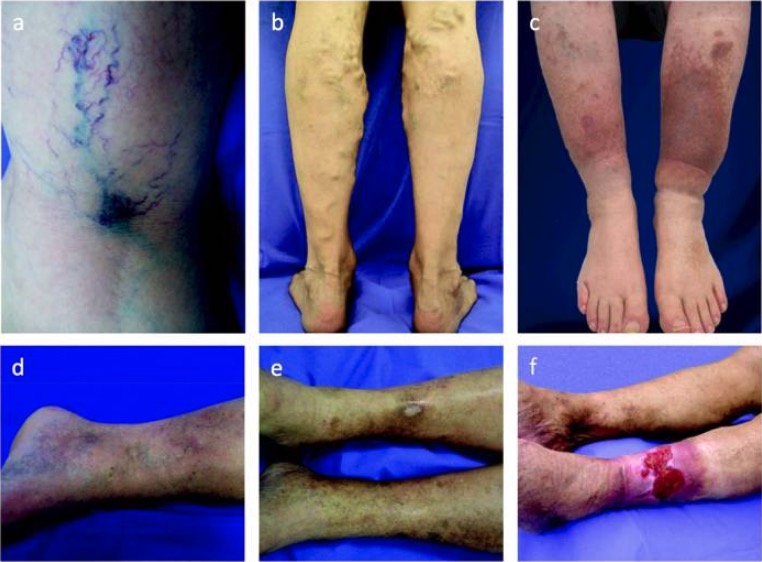
Fotografías del espectro de manifestaciones clínicas de la enfermedad venosa crónica

Espectro de enfermedad venosa crónica:
La extensión de la enfermedad puede clasificarse de C1 a C6 basándose en las siguientes manifestaciones:
a: telangiectasias y venas reticulares (C1)
b: venas varicosas (C2)
c: edema y pigmentación de la piel (C4)
d: lipodermatoesclerosis (C4)
e: úlcera cicatrizada (C5)
f: úlcera venosa activa (C6)

Imagen: “Spectrum of chronic venous disease” por Eva Ellinghaus et al. Licencia: CC BY 4.0

Tratamiento

Objetivos

  • Reducir el edema Edema Edema is a condition in which excess serous fluid accumulates in the body cavity or interstitial space of connective tissues. Edema is a symptom observed in several medical conditions. It can be categorized into 2 types, namely, peripheral (in the extremities) and internal (in an organ or body cavity). Edema.
  • Reducir las molestias.
  • Prevenir y tratar las manifestaciones cutáneas.
  • Curar las úlceras.
  • Mejorar los LOS Neisseria factores de riesgo modificables.

Tratamiento conservador (no quirúrgico)

  • Elevación frecuente de las piernas (30 minutos, 3-4 veces al AL Amyloidosis día) → mejora el drenaje venoso
  • Ejercicio → mejora la bomba muscular de la pantorrilla
  • Pérdida de peso → ↓ presión
  • Cuidado de la piel:
    • Limpieza
    • Emolientes:
      • Para mantener la barrera cutánea
      • Previene la resequedad y la formación de fisuras
      • ↓ Rascado (lo que puede provocar úlceras)
  • Terapia de compresión (medias):
    • Técnica de manejo inicial
    • Contraindicado con EAP coexistente
    • Se requiere una adherencia a largo plazo
  • Sustancias venoactivas para ↑ el tono venoso:
    • Utilizado en EN Erythema nodosum is an immune-mediated panniculitis (inflammation of the subcutaneous fat) caused by a type IV (delayed-type) hypersensitivity reaction. It commonly manifests in young women as tender, erythematous nodules on the shins. Erythema Nodosum pacientes con:
      • Edema Edema Edema is a condition in which excess serous fluid accumulates in the body cavity or interstitial space of connective tissues. Edema is a symptom observed in several medical conditions. It can be categorized into 2 types, namely, peripheral (in the extremities) and internal (in an organ or body cavity). Edema persistente a pesar de la terapia de compresión
      • Contraindicación para uso de la terapia de compresión
    • Beneficioso para el tratamiento del edema Edema Edema is a condition in which excess serous fluid accumulates in the body cavity or interstitial space of connective tissues. Edema is a symptom observed in several medical conditions. It can be categorized into 2 types, namely, peripheral (in the extremities) and internal (in an organ or body cavity). Edema, pero no para la cicatrización de la úlcera
    • Opciones disponibles en EN Erythema nodosum is an immune-mediated panniculitis (inflammation of the subcutaneous fat) caused by a type IV (delayed-type) hypersensitivity reaction. It commonly manifests in young women as tender, erythematous nodules on the shins. Erythema Nodosum Estados Unidos:
      • Escina (extracto de semillas de castaño de Indias)
      • Fracción de flavonoides purificada y micronizada

Cuidado de las úlceras

  • Desbridamiento:
    • Elimina el tejido necrótico circundante
    • Promueve el tejido de granulación saludable
    • Mejora la reepitelización
    • ↓ Riesgo de infección
    • Puede realizarse mediante métodos quirúrgicos, enzimáticos o biológicos
  • Agentes tópicos (la mayoría no mejoran las tasas de curación):
    • Yodo cadexómero
    • Sulfadiazina de plata
    • Evitar los LOS Neisseria antisépticos tópicos.
  • Antibióticos sistémicos: sólo en EN Erythema nodosum is an immune-mediated panniculitis (inflammation of the subcutaneous fat) caused by a type IV (delayed-type) hypersensitivity reaction. It commonly manifests in young women as tender, erythematous nodules on the shins. Erythema Nodosum pacientes con celulitis aguda o úlcera clínicamente infectada
  • Apósitos
  • Opciones médicas para el tratamiento de las úlceras resistentes:
    • Estanozolol: un esteroide anabólico que estimula la fibrinólisis
    • Pentoxifilina: ↑ microcirculación y oxigenación tisular

Tratamiento quirúrgico

Objetivos:

  • Ocluir (o eliminar) los LOS Neisseria vasos dañados y restablecer el flujo sanguíneo adecuado
  • Disminuir la hipertensión venosa para reducir el edema Edema Edema is a condition in which excess serous fluid accumulates in the body cavity or interstitial space of connective tissues. Edema is a symptom observed in several medical conditions. It can be categorized into 2 types, namely, peripheral (in the extremities) and internal (in an organ or body cavity). Edema y los LOS Neisseria efectos en EN Erythema nodosum is an immune-mediated panniculitis (inflammation of the subcutaneous fat) caused by a type IV (delayed-type) hypersensitivity reaction. It commonly manifests in young women as tender, erythematous nodules on the shins. Erythema Nodosum la piel

Las alternativas incluyen:

  • Ablación venosa superficial (destrucción térmica)
  • Escleroterapia (inyección de sustancias tóxicas que provocan fibrosis Fibrosis Any pathological condition where fibrous connective tissue invades any organ, usually as a consequence of inflammation or other injury. Bronchiolitis Obliterans y oclusión)
  • Flebectomía (escisión venosa)
  • Angioplastia y stent (aliviar las obstrucciones en EN Erythema nodosum is an immune-mediated panniculitis (inflammation of the subcutaneous fat) caused by a type IV (delayed-type) hypersensitivity reaction. It commonly manifests in young women as tender, erythematous nodules on the shins. Erythema Nodosum las venas profundas)
  • Reparación de válvulas (venas profundas)

Complicaciones

  • Sangrado por várices
  • TVP
  • Tromboflebitis superficial:
    • Inflamación dentro de las paredes de las venas → trombosis
    • Tratamiento:
      • AINEs
      • Terapia de compresión
  • Celulitis o úlceras infectadas:
    • Requiere tratamiento con antibióticos sistémicos y desbridamiento
    • Puede llevar a la amputación

Diagnóstico Diferencial

  • Insuficiencia cardíaca: síndrome clínico resultante de una disfunción de la bomba cardíaca que provoca una baja perfusión tisular y una congestión del sistema venoso: La insuficiencia cardíaca puede distinguirse de la insuficiencia venosa crónica por la presencia de disnea, distensión venosa yugular y un sonido cardíaco S3 S3 Heart Sounds. El diagnóstico se realiza a partir de una combinación de hallazgos clínicos, de laboratorio y de imagen, y el tratamiento se dirige a la optimización médica de la bomba cardíaca.
  • Cirrosis: fibrosis Fibrosis Any pathological condition where fibrous connective tissue invades any organ, usually as a consequence of inflammation or other injury. Bronchiolitis Obliterans progresiva e insuficiencia hepática, que conduce a la hipertensión portal: La hipertensión portal puede causar congestión venosa a nivel distal, lo que provoca ascitis, várices gástricas y esofágicas y edema Edema Edema is a condition in which excess serous fluid accumulates in the body cavity or interstitial space of connective tissues. Edema is a symptom observed in several medical conditions. It can be categorized into 2 types, namely, peripheral (in the extremities) and internal (in an organ or body cavity). Edema periférico. También son posibles las telangiectasias Telangiectasias Ataxia-telangiectasia. Los LOS Neisseria síntomas también incluyen ictericia, hemorragia gastrointestinal, síntomas neurológicos y trastornos de la coagulación. El tratamiento es principalmente de soporte, con el objetivo de reducir las complicaciones.
  • Síndrome nefrótico: Los LOS Neisseria podocitos renales dañados conducen a una proteinuria Proteinuria The presence of proteins in the urine, an indicator of kidney diseases. Nephrotic Syndrome in Children masiva, que en EN Erythema nodosum is an immune-mediated panniculitis (inflammation of the subcutaneous fat) caused by a type IV (delayed-type) hypersensitivity reaction. It commonly manifests in young women as tender, erythematous nodules on the shins. Erythema Nodosum última instancia puede dar lugar a un edema Edema Edema is a condition in which excess serous fluid accumulates in the body cavity or interstitial space of connective tissues. Edema is a symptom observed in several medical conditions. It can be categorized into 2 types, namely, peripheral (in the extremities) and internal (in an organ or body cavity). Edema periférico significativo similar a la enfermedad venosa crónica. También se asocia a un estado de hipercoagulabilidad debido a la pérdida de antitrombina III por la orina, por lo que puede desarrollarse TVP. La biopsia renal dará un diagnóstico definitivo. El tratamiento es en EN Erythema nodosum is an immune-mediated panniculitis (inflammation of the subcutaneous fat) caused by a type IV (delayed-type) hypersensitivity reaction. It commonly manifests in young women as tender, erythematous nodules on the shins. Erythema Nodosum gran medida de soporte y dirigido a la causa subyacente.
  • EAP: aterosclerosis que provoca una disminución del flujo sanguíneo en EN Erythema nodosum is an immune-mediated panniculitis (inflammation of the subcutaneous fat) caused by a type IV (delayed-type) hypersensitivity reaction. It commonly manifests in young women as tender, erythematous nodules on the shins. Erythema Nodosum las arterias periféricas, comúnmente en EN Erythema nodosum is an immune-mediated panniculitis (inflammation of the subcutaneous fat) caused by a type IV (delayed-type) hypersensitivity reaction. It commonly manifests in young women as tender, erythematous nodules on the shins. Erythema Nodosum las extremidades inferiores: La aterosclerosis provoca claudicación ( dolor Dolor Inflammation inducido por el ejercicio y que se alivia con el reposo). La disminución del flujo sanguíneo arterial en EN Erythema nodosum is an immune-mediated panniculitis (inflammation of the subcutaneous fat) caused by a type IV (delayed-type) hypersensitivity reaction. It commonly manifests in young women as tender, erythematous nodules on the shins. Erythema Nodosum la EAP también puede dar lugar a úlceras secundarias a la isquemia. El diagnóstico se establece clínicamente y se apoya en EN Erythema nodosum is an immune-mediated panniculitis (inflammation of the subcutaneous fat) caused by a type IV (delayed-type) hypersensitivity reaction. It commonly manifests in young women as tender, erythematous nodules on the shins. Erythema Nodosum las imágenes vasculares. El tratamiento incluye medicamentos y revascularización quirúrgica.
  • Carcinoma de células escamosas (CCE): tumor Tumor Inflammation maligno que surge de los LOS Neisseria queratinocitos epidérmicos, generalmente en EN Erythema nodosum is an immune-mediated panniculitis (inflammation of the subcutaneous fat) caused by a type IV (delayed-type) hypersensitivity reaction. It commonly manifests in young women as tender, erythematous nodules on the shins. Erythema Nodosum zonas expuestas al AL Amyloidosis sol: los LOS Neisseria CCE pueden formar placas rosadas bien delimitadas y con descamación que pueden parecerse a los LOS Neisseria cambios inflamatorios de la piel presentes en EN Erythema nodosum is an immune-mediated panniculitis (inflammation of the subcutaneous fat) caused by a type IV (delayed-type) hypersensitivity reaction. It commonly manifests in young women as tender, erythematous nodules on the shins. Erythema Nodosum la enfermedad venosa periférica. El diagnóstico se establece con una biopsia. El CCE también puede surgir en EN Erythema nodosum is an immune-mediated panniculitis (inflammation of the subcutaneous fat) caused by a type IV (delayed-type) hypersensitivity reaction. It commonly manifests in young women as tender, erythematous nodules on the shins. Erythema Nodosum úlceras venosas crónicas. La base del tratamiento es la escisión quirúrgica.

Referencias

  1. Creager, M. A., Loscalzo, J. (2008). Vascular disorders of the extremities. In Fauci, A. S., Braunwald, E., Kasper, D.L., et al. (Eds.) Harrison’s Internal Medicine (17th ed., p. 1574).
  2. Kabnick, L. S., Scovell, S. (2025). Overview of lower extremity chronic venous disease. In Collins, K. A. (Eds.) UpToDate. Retrieved on August 8, 2025, from https://www.uptodate.com/contents/overview-of-lower-extremity-chronic-venous-disease
  3. Mathes, B. M., & Kabnick, L. S. (2024). Clinical manifestations of lower extremity chronic venous disorders. UpToDate. Retrieved on August 8, 2025, from https://www.uptodate.com/contents/clinical-manifestations-of-lower-extremity-chronic-venous-disorders
  4. Moneta, G. (2025). Classification of lower extremity chronic venous disease. In Collins, K. A. (Ed.) UpToDate. Retrieved on August 8, 2025, from https://www.uptodate.com/contents/classification-of-lower-extremity-chronic-venous-disorders
  5. Mathes, B. M., & Fukaya, E. (2023). Diagnostic evaluation of lower extremity chronic venous disease. UpToDate. Retrieved on August 8, 2025, from https://www.uptodate.com/contents/diagnostic-evaluation-of-lower-extremity-chronic-venous-disease
  6. Kabnick, L. S., & Scovell, S. (2025). Overview of lower extremity chronic venous disease. In D. M. Gloviczki (Ed.), UpToDate. Wolters Kluwer. Retrieved on August 8, 2025, from https://www.uptodate.com/contents/overview-of-lower-extremity-chronic-venous-disease
  7. Patel, S. (2024). Venous insufficiency. In Surowiec S. (Ed.) StatPearls. Retrieved on August 8, 2025, from https://www.statpearls.com/articlelibrary/viewarticle/31060/
  8. Piazza, G. (2014). Varicose veins. Circulation, 130(7), e271–e273. https://doi.org/10.1161/CIRCULATIONAHA.113.008331 

¡Crea tu cuenta gratis o inicia una sesión para seguir leyendo!

Regístrate ahora y obtén acceso gratuito a Lecturio con páginas de concepto, videos médicos y cuestionarios para tu educación médica.

User Reviews

Que tengas una sesión de estudio alegre y navideña 🎁 Ahorra 50% en todos los planes >>

Details