Domina Conceptos Médicos

Estudia para la escuela de medicina y tus examenes con Lecturio.

Inmunidad Adaptativa Humoral

La inmunidad adaptativa humoral es una parte integral del sistema inmunitario adaptativo, que monta una defensa muy específica contra los LOS Neisseria patógenos pero tarda más tiempo en EN Erythema nodosum is an immune-mediated panniculitis (inflammation of the subcutaneous fat) caused by a type IV (delayed-type) hypersensitivity reaction. It commonly manifests in young women as tender, erythematous nodules on the shins. Erythema Nodosum responder ( en EN Erythema nodosum is an immune-mediated panniculitis (inflammation of the subcutaneous fat) caused by a type IV (delayed-type) hypersensitivity reaction. It commonly manifests in young women as tender, erythematous nodules on the shins. Erythema Nodosum comparación con el sistema inmunitario innato). La inmunidad humoral es el brazo del sistema inmunitario que protege los LOS Neisseria fluidos extracelulares de los LOS Neisseria linfáticos (linfa), el intersticio y el sistema circulatorio ( plasma Plasma The residual portion of blood that is left after removal of blood cells by centrifugation without prior blood coagulation. Transfusion Products) de la contaminación microbiana mediada por moléculas solubles. Las células B juegan un papel importante, produciendo anticuerpos o inmunoglobulinas. Surgidos de la médula ósea, los LOS Neisseria linfocitos B se originan a partir del progenitor linfoide común y pasan por etapas para ensamblar el receptor Receptor Receptors are proteins located either on the surface of or within a cell that can bind to signaling molecules known as ligands (e.g., hormones) and cause some type of response within the cell. Receptors de linfocitos B. Para volverse completamente funcional, sigue la activación, y esto puede ser dependiente de células T (que produce células de memoria) o independiente de células T (que produce una respuesta de corta duración). Cuando se activan, las células B pasan por procesos que mejoran la afinidad por el antígeno, el cambio de clase y la diferenciación a células plasmáticas y células de memoria. Las células plasmáticas producen los LOS Neisseria anticuerpos, mientras que las células B de memoria responden a la reinfección. Existen diferentes isotipos de inmunoglobulinas, generalmente proporcionando protección inmunológica a través de la activación del complemento, opsonización, neutralización de toxinas o virus Virus Viruses are infectious, obligate intracellular parasites composed of a nucleic acid core surrounded by a protein capsid. Viruses can be either naked (non-enveloped) or enveloped. The classification of viruses is complex and based on many factors, including type and structure of the nucleoid and capsid, the presence of an envelope, the replication cycle, and the host range. Virology e inducción de lisis celular.

Last updated: Dec 15, 2025

Editorial responsibility: Stanley Oiseth, Lindsay Jones, Evelin Maza

Descripción General

Sistema inmunológico: definición

El sistema inmunitario proporciona defensa (inmunidad) contra patógenos invasores que van desde virus Virus Viruses are infectious, obligate intracellular parasites composed of a nucleic acid core surrounded by a protein capsid. Viruses can be either naked (non-enveloped) or enveloped. The classification of viruses is complex and based on many factors, including type and structure of the nucleoid and capsid, the presence of an envelope, the replication cycle, and the host range. Virology hasta parásitos. Los LOS Neisseria componentes del sistema están interconectados por la circulación sanguínea y linfática.

2 líneas de defensa (que se superponen):

  • Inmunidad innata (que no es específica)
  • Inmunidad adaptativa (basada en EN Erythema nodosum is an immune-mediated panniculitis (inflammation of the subcutaneous fat) caused by a type IV (delayed-type) hypersensitivity reaction. It commonly manifests in young women as tender, erythematous nodules on the shins. Erythema Nodosum el reconocimiento de antígenos específicos):
    • Inmunidad mediada por células: respuesta adaptativa en EN Erythema nodosum is an immune-mediated panniculitis (inflammation of the subcutaneous fat) caused by a type IV (delayed-type) hypersensitivity reaction. It commonly manifests in young women as tender, erythematous nodules on the shins. Erythema Nodosum las células/tejidos que involucran a las células T
    • Inmunidad humoral: respuesta adaptativa en EN Erythema nodosum is an immune-mediated panniculitis (inflammation of the subcutaneous fat) caused by a type IV (delayed-type) hypersensitivity reaction. It commonly manifests in young women as tender, erythematous nodules on the shins. Erythema Nodosum los LOS Neisseria fluidos (humores) que involucra células B e inmunoglobulinas

Inmunidad innata vs adaptativa

Tabla: Inmunidad innata versus adaptativa
Inmunidad innata Inmunidad adaptativa
Genética línea germinal codificada Reordenamientos genéticos implicados en EN Erythema nodosum is an immune-mediated panniculitis (inflammation of the subcutaneous fat) caused by a type IV (delayed-type) hypersensitivity reaction. It commonly manifests in young women as tender, erythematous nodules on the shins. Erythema Nodosum el desarrollo de linfocitos
Respuesta inmune No específica Altamente específico
Tiempo de respuesta Inmediato (minutos a horas) Se desarrolla durante un período de tiempo más largo.
Respuesta de memoria Sin respuesta de memoria Con respuesta de memoria, que responde rápidamente al AL Amyloidosis reconocimiento del antígeno
Reconocimiento del patógeno Los LOS Neisseria receptores de reconocimiento de patrones (PRR), como los LOS Neisseria TLR, reconocen patrones moleculares asociados a patógenos (PAMP).
  • Células de memoria (células T y B)
  • Células B activadas
Componentes
  • Barreras químicas y biológicas (p. ej., ácido gástrico, flora vaginal)
  • Barreras anatómicas (p. ej., piel)
  • Células (p. ej., granulocitos)
  • Proteínas secretadas:
    • Enzimas (p. ej., lisozima)
    • Otros PRR (p. ej., péptidos antimicrobianos [AMP])
    • Citocinas*
    • Sistema complementario
  • Inmunidad mediada por células: células T
  • Inmunidad humoral: células B, inmunoglobulinas
*Estos mediadores también tienen funciones en la inmunidad adaptativa.

Componentes del Sistema Inmune Adaptativo

Responder a los LOS Neisseria invasores microbianos es responsabilidad del sistema inmunitario. A menudo, el sistema inmunológico innato tiene la capacidad de contener los LOS Neisseria patógenos, pero los LOS Neisseria invasores han desarrollado medios para evadir la inmunidad innata. La siguiente línea de defensa es el sistema inmunológico adaptativo.

Sistema inmune adaptativo: definición

  • Compuesto por linfocitos (células T auxiliares, células T citotóxicas) y proteínas secretadas (anticuerpos producidos por las células B)
  • La funcionalidad lleva días, pero una vez activados, los LOS Neisseria encuentros repetidos con el agente infractor provocan una respuesta más rápida.
  • Los LOS Neisseria componentes, células B y T, tienen:
    • Diversidad: responder a millones de antígenos
    • Especificidad: respuesta inmunitaria adaptada al AL Amyloidosis antígeno específico
    • Memoria: puede responder muchos años después

Inmunidad mediada por células

  • Efectores primarios: células T
    • Células T CD4+ (auxiliares): diferentes subconjuntos realizan múltiples funciones (incluida la producción de citoquinas, la activación de macrófagos).
    • Células T CD8+ (citotóxicas): defienden contra patógenos intracelulares (especialmente virus Virus Viruses are infectious, obligate intracellular parasites composed of a nucleic acid core surrounded by a protein capsid. Viruses can be either naked (non-enveloped) or enveloped. The classification of viruses is complex and based on many factors, including type and structure of the nucleoid and capsid, the presence of an envelope, the replication cycle, and the host range. Virology) mediante la destrucción de las células infectadas.
    • Células T de memoria: responden a la reexposición al AL Amyloidosis antígeno
  • Otros componentes:
    • Las células T dependen de las citocinas (proteínas solubles liberadas por diferentes células, que desempeñan funciones superpuestas tanto en EN Erythema nodosum is an immune-mediated panniculitis (inflammation of the subcutaneous fat) caused by a type IV (delayed-type) hypersensitivity reaction. It commonly manifests in young women as tender, erythematous nodules on the shins. Erythema Nodosum la inmunidad innata como en EN Erythema nodosum is an immune-mediated panniculitis (inflammation of the subcutaneous fat) caused by a type IV (delayed-type) hypersensitivity reaction. It commonly manifests in young women as tender, erythematous nodules on the shins. Erythema Nodosum la adaptativa).
    • Varias células (células dendríticas, macrófagos) del sistema inmunitario innato presentan antígenos a las células T.
Cell-mediated immunity

Inmunidad mediada por células:
La activación de los linfocitos T auxiliares da lugar a la liberación de citoquinas, activando así los linfocitos T citotóxicos y los fagocitos (como los macrófagos).
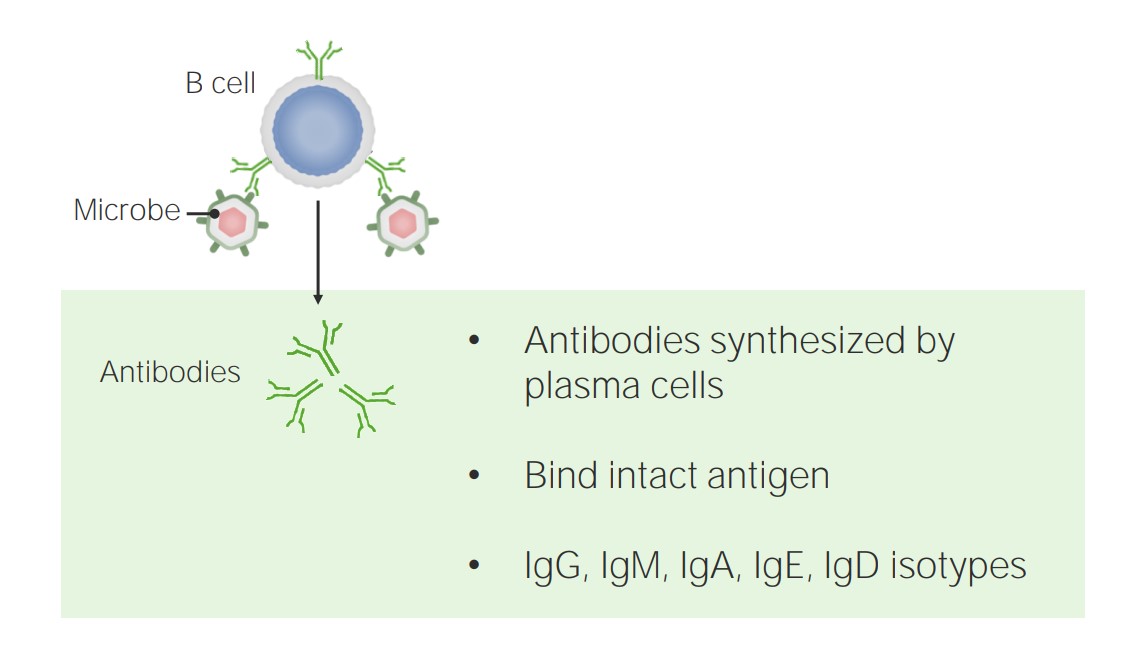
Imagen por Lecturio.

Inmunidad adaptativa humoral

  • Inmunidad mediada por anticuerpos
  • Células B:
    • Diferenciarse en EN Erythema nodosum is an immune-mediated panniculitis (inflammation of the subcutaneous fat) caused by a type IV (delayed-type) hypersensitivity reaction. It commonly manifests in young women as tender, erythematous nodules on the shins. Erythema Nodosum células plasmáticas, produciendo anticuerpos (con la ayuda de las células T)
    • Se diferencian en EN Erythema nodosum is an immune-mediated panniculitis (inflammation of the subcutaneous fat) caused by a type IV (delayed-type) hypersensitivity reaction. It commonly manifests in young women as tender, erythematous nodules on the shins. Erythema Nodosum células de memoria, respondiendo rápidamente a la reinfección.
    • Actuar como células presentadoras de antígenos a las células T (expresando CMH II)
  • Los LOS Neisseria anticuerpos, junto con el complemento, ayudan a las células del sistema innato contra las bacterias encapsuladas extracelulares.
  • Los LOS Neisseria anticuerpos pueden neutralizar toxinas, como la toxina tetánica y los LOS Neisseria virus Virus Viruses are infectious, obligate intracellular parasites composed of a nucleic acid core surrounded by a protein capsid. Viruses can be either naked (non-enveloped) or enveloped. The classification of viruses is complex and based on many factors, including type and structure of the nucleoid and capsid, the presence of an envelope, the replication cycle, and the host range. Virology.
Humoral immunity

La inmunidad humoral está mediada por las células B y los anticuerpos.

Imagen por Lecturio.
Desarrollo de Células B

Células B

  • Surgen del progenitor linfoide común
  • En EN Erythema nodosum is an immune-mediated panniculitis (inflammation of the subcutaneous fat) caused by a type IV (delayed-type) hypersensitivity reaction. It commonly manifests in young women as tender, erythematous nodules on the shins. Erythema Nodosum etapas, las células B se desarrollan en EN Erythema nodosum is an immune-mediated panniculitis (inflammation of the subcutaneous fat) caused by a type IV (delayed-type) hypersensitivity reaction. It commonly manifests in young women as tender, erythematous nodules on the shins. Erythema Nodosum la médula ósea:
  • Una célula B ingenua madura con un BCR BCR Lymphocytes: Histology:
    • Sale de la médula ósea y migra a los LOS Neisseria órganos linfoides secundarios.
    • Expresa IgM IgM A class of immunoglobulin bearing mu chains (immunoglobulin mu-chains). Igm can fix complement. The name comes from its high molecular weight and originally being called a macroglobulin. Immunoglobulins: Types and Functions e IgD IgD An immunoglobulin which accounts for less than 1% of plasma immunoglobulin. It is found on the membrane of many circulating B lymphocytes. Immunoglobulins: Types and Functions una vez dentro de los LOS Neisseria tejidos linfoides secundarios

Receptor Receptor Receptors are proteins located either on the surface of or within a cell that can bind to signaling molecules known as ligands (e.g., hormones) and cause some type of response within the cell. Receptors de células B ( BCR BCR Lymphocytes: Histology)

  • Consiste en EN Erythema nodosum is an immune-mediated panniculitis (inflammation of the subcutaneous fat) caused by a type IV (delayed-type) hypersensitivity reaction. It commonly manifests in young women as tender, erythematous nodules on the shins. Erythema Nodosum la molécula de Ig Ig X-linked Agammaglobulinemia y una molécula de señalización.
  • La molécula de Ig Ig X-linked Agammaglobulinemia está anclada a la superficie celular:
    • Tiene cadenas pesadas (μ, δ, γ, α o ε) unidas por disulfuro a cadenas ligeras (κ o λ)
    • Tiene una región constante y variable Variable Variables represent information about something that can change. The design of the measurement scales, or of the methods for obtaining information, will determine the data gathered and the characteristics of that data. As a result, a variable can be qualitative or quantitative, and may be further classified into subgroups. Types of Variables (donde se une el antígeno)
  • Se necesitan reordenamientos de genes Genes A category of nucleic acid sequences that function as units of heredity and which code for the basic instructions for the development, reproduction, and maintenance of organisms. DNA Types and Structure (que unen diferentes segmentos de genes Genes A category of nucleic acid sequences that function as units of heredity and which code for the basic instructions for the development, reproduction, and maintenance of organisms. DNA Types and Structure) dentro de las células B para ensamblar la molécula de Ig Ig X-linked Agammaglobulinemia.
  • Este proceso también produce un repertorio de diversas células B y crea protección contra diferentes tipos de infecciones.
Receptor de células B (BCR)

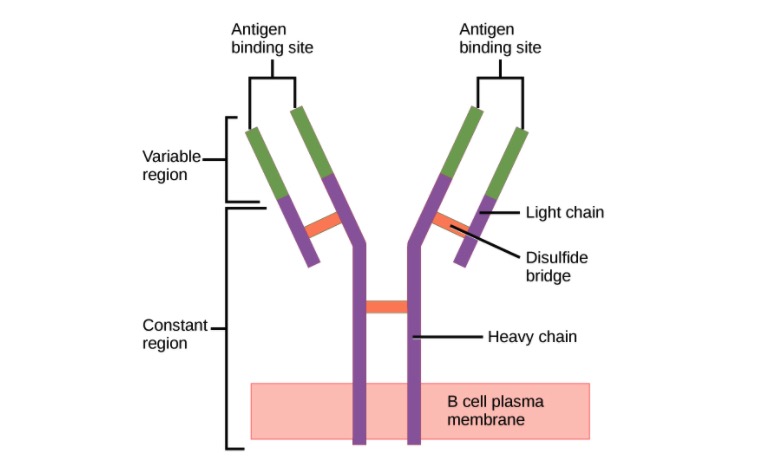
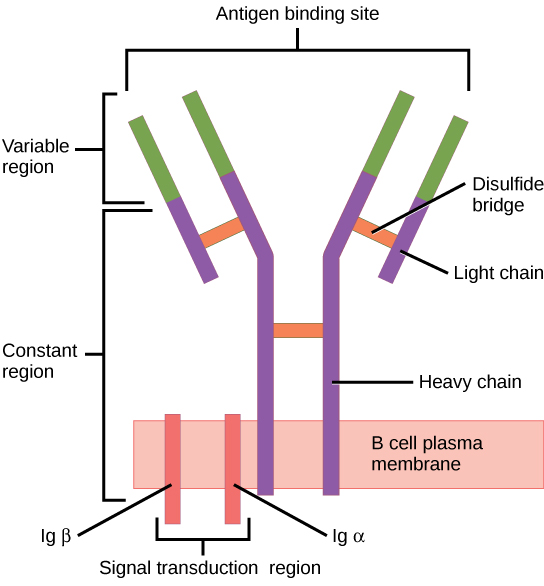
El receptor de células B (BCR) consiste en la molécula de Ig y la molécula de señalización:
Ig contiene 2 cadenas pesadas idénticas y 2 cadenas ligeras idénticas unidas por un puente disulfuro. La Ig unida a la membrana está anclada a la superficie celular.

Imagen: “Figure 42 02 06” por OpenStax. Licencia: CC BY 4.0

Activación de células B

Pasos necesarios para que la célula B funcione:
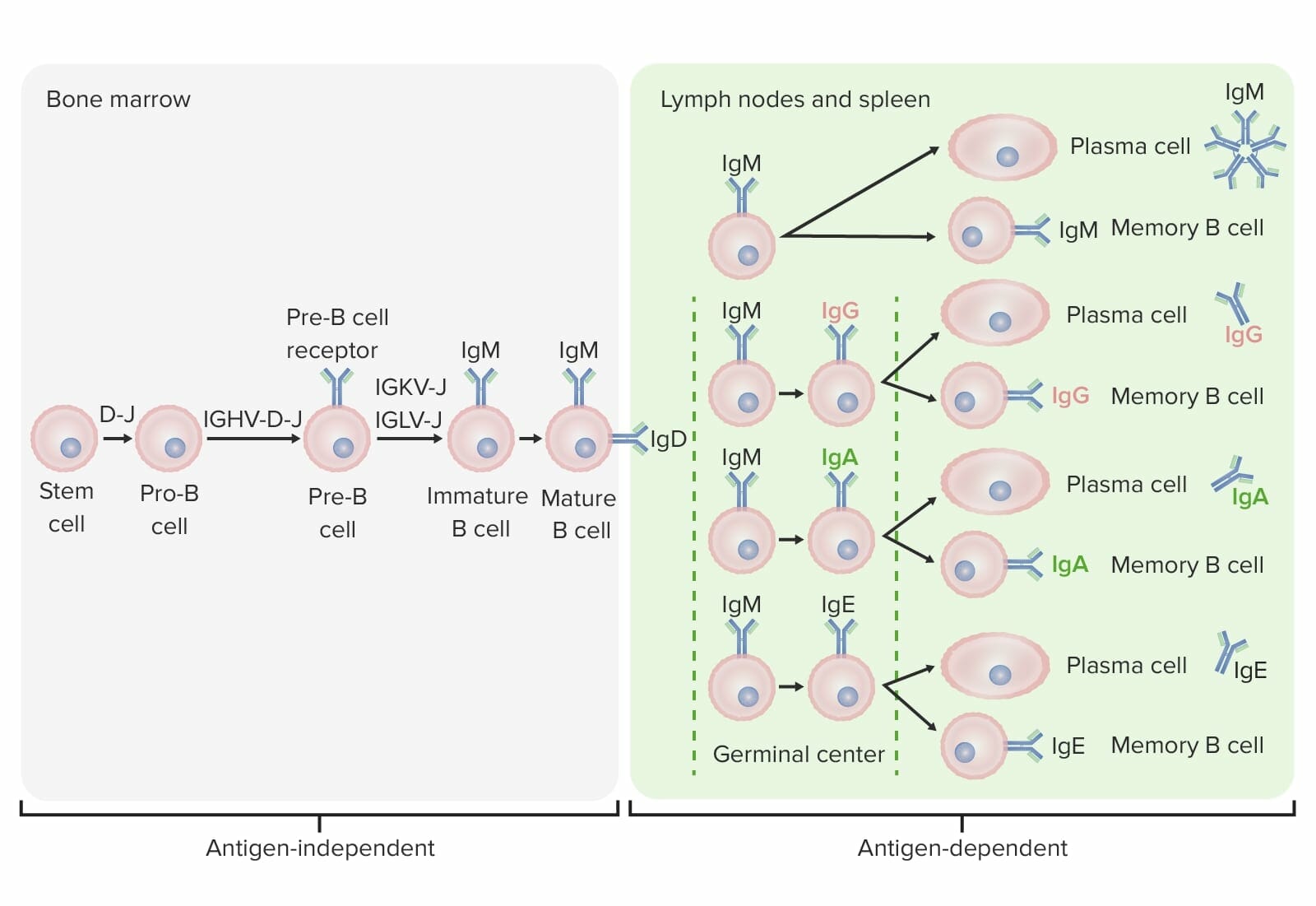
  • Se necesitan 2 señales:
    • Señal 1: antígeno al AL Amyloidosis BCR BCR Lymphocytes: Histology (cuantos más BCR BCR Lymphocytes: Histology entrecrucen con el antígeno, más fuerte es la señal)
    • Señal 2:
      • Las fuentes o antígenos inflamatorios presentan una amenaza para el huésped.
      • Sin la señal 2, las células B no se activan (esto evita la activación involuntaria por parte de antígenos inofensivos).
  • Activación dependiente de células T :
    • El antígeno se une a BCR BCR Lymphocytes: Histology → endocitosado y degradado
    • El antígeno degradado se une a las moléculas del CHM II de la superficie.
    • La célula B circula a través de los LOS Neisseria ganglios linfáticos → se encuentra con las células auxiliares foliculares (Tfh) CD4+ T activadas
    • El complejo antígeno- CHM II es reconocido por las células Tfh → se activa la célula B → proliferación de células B
  • Activación independiente de células T :
    • La activación no siempre necesita la ayuda de las células T.
    • Algunos antígenos, como los LOS Neisseria polisacáridos de una célula bacteriana (p. ej., Streptococcus Streptococcus Streptococcus is one of the two medically important genera of gram-positive cocci, the other being Staphylococcus. Streptococci are identified as different species on blood agar on the basis of their hemolytic pattern and sensitivity to optochin and bacitracin. There are many pathogenic species of streptococci, including S. pyogenes, S. agalactiae, S. pneumoniae, and the viridans streptococci. Streptococcus pneumoniae y Haemophilus influenzae Haemophilus Influenzae A species of Haemophilus found on the mucous membranes of humans and a variety of animals. The species is further divided into biotypes I through viii. Haemophilus ), pueden estimular directamente las células B.
    • Respuestas de corta duración, principalmente con producción de IgM IgM A class of immunoglobulin bearing mu chains (immunoglobulin mu-chains). Igm can fix complement. The name comes from its high molecular weight and originally being called a macroglobulin. Immunoglobulins: Types and Functions (sin memoria)
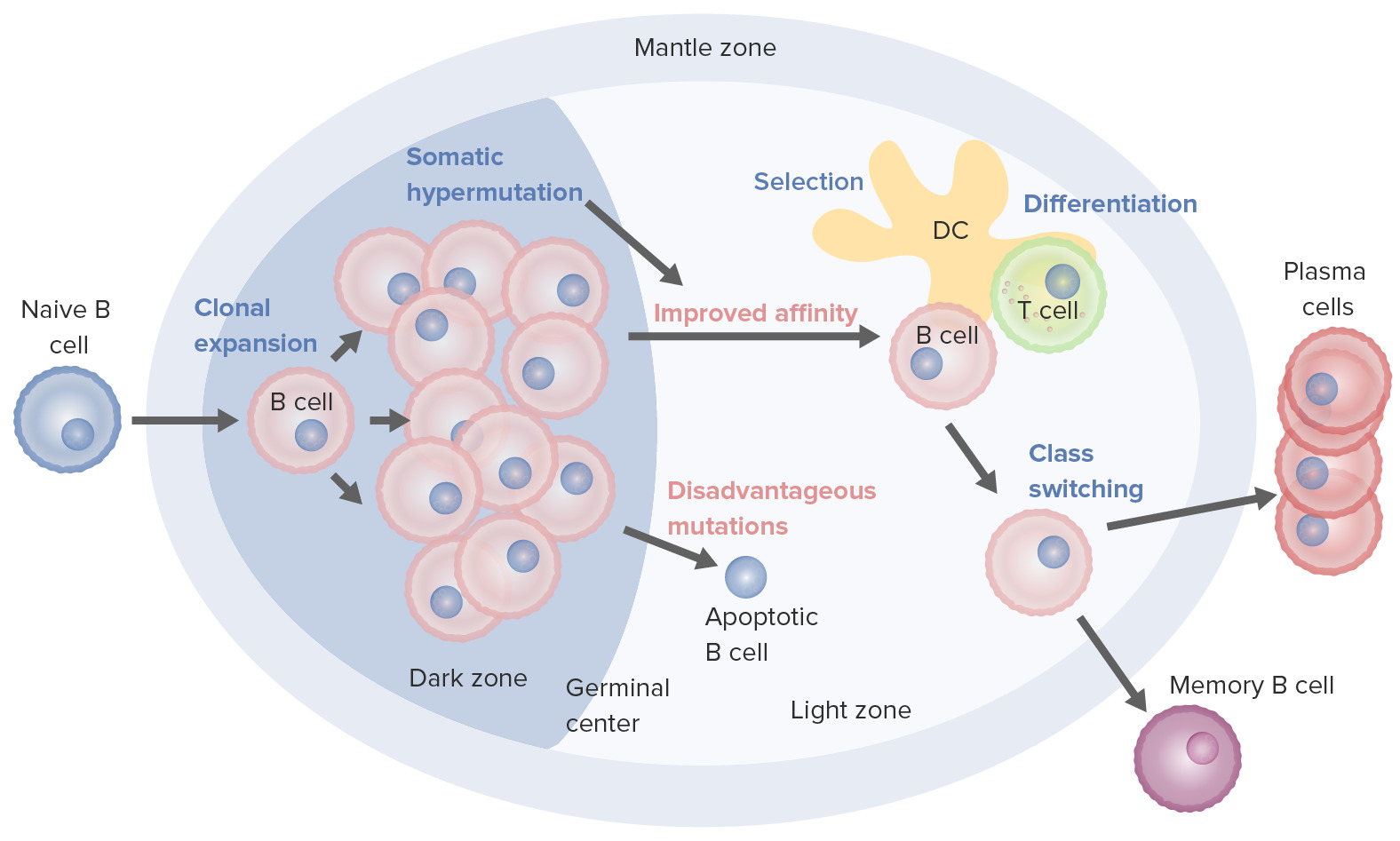
  • Para producir una célula B diferenciada funcional después de la activación por un antígeno, los LOS Neisseria procesos que tienen lugar incluyen:
    • Proliferación
    • Maduración de la afinidad:
      • Ajuste fino de la afinidad del anticuerpo por el antígeno
      • Logrado por hipermutación somática (mutación programada que involucra genes Genes A category of nucleic acid sequences that function as units of heredity and which code for the basic instructions for the development, reproduction, and maintenance of organisms. DNA Types and Structure de cadena ligera y pesada de Ig Ig X-linked Agammaglobulinemia)
      • Produce BCR BCR Lymphocytes: Histology con capacidad mejorada para reconocer y unirse al AL Amyloidosis antígeno
    • Cambio de clase:
      • La cadena pesada determina la clase de Ig Ig X-linked Agammaglobulinemia ( IgM IgM A class of immunoglobulin bearing mu chains (immunoglobulin mu-chains). Igm can fix complement. The name comes from its high molecular weight and originally being called a macroglobulin. Immunoglobulins: Types and Functions, IgG IgG The major immunoglobulin isotype class in normal human serum. There are several isotype subclasses of igg, for example, igg1, igg2a, and igg2b. Hypersensitivity Pneumonitis, IgE IgE An immunoglobulin associated with mast cells. Overexpression has been associated with allergic hypersensitivity. Immunoglobulins: Types and Functions, IgA IgA Represents 15-20% of the human serum immunoglobulins, mostly as the 4-chain polymer in humans or dimer in other mammals. Secretory iga is the main immunoglobulin in secretions. Immunoglobulins: Types and Functions, IgD IgD An immunoglobulin which accounts for less than 1% of plasma immunoglobulin. It is found on the membrane of many circulating B lymphocytes. Immunoglobulins: Types and Functions).
      • Influenciado por citoquinas
    • Diferenciación en EN Erythema nodosum is an immune-mediated panniculitis (inflammation of the subcutaneous fat) caused by a type IV (delayed-type) hypersensitivity reaction. It commonly manifests in young women as tender, erythematous nodules on the shins. Erythema Nodosum plasma Plasma The residual portion of blood that is left after removal of blood cells by centrifugation without prior blood coagulation. Transfusion Products o célula de memoria.
Differentiation stages of the B cell

Etapas de diferenciación de la célula B:
En las etapas independientes del antígeno, la producción de células B comienza con la célula madre hematopoyética, que se convierte en un progenitor linfoide común, y luego en una célula pre-pro-B o en una célula progenitora B. Los siguientes pasos incluyen el reordenamiento de los genes para ensamblar la molécula de inmunoglobulina (Ig). Las cadenas pesadas de inmunoglobulina comienzan con el reordenamiento del segmento de diversidad y de unión para formar la célula pro-B. En el siguiente paso (célula pre-B), se completa la recombinación de la cadena pesada de Ig (variable, diversidad, unión) y se forma el receptor de la célula pre-B. Se produce un reordenamiento de la cadena ligera (kappa (κ) o lambda (λ)) que da lugar a la expresión de una molécula completa de anticuerpos IgM por parte de una célula B inmadura. A continuación se produce la formación de la célula B madura (virgen) con IgM e IgD.
Las etapas dependientes del antígeno tienen lugar en los tejidos linfoides secundarios. Una vez que la célula B madura produce IgM e IgD, puede producirse un cambio de clase para fabricar IgE, IgG e IgA. Las células B se activan y se convierten en células plasmáticas o células de memoria.
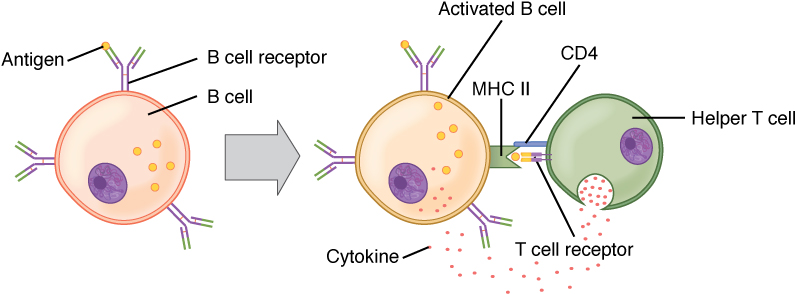
Imagen por Lecturio.

Células B en el Sistema Inmune

Células B activadas

  • diferenciar en EN Erythema nodosum is an immune-mediated panniculitis (inflammation of the subcutaneous fat) caused by a type IV (delayed-type) hypersensitivity reaction. It commonly manifests in young women as tender, erythematous nodules on the shins. Erythema Nodosum:
    • Células de plasma Plasma The residual portion of blood that is left after removal of blood cells by centrifugation without prior blood coagulation. Transfusion Products:
      • Producir miles de anticuerpos
      • Migrar a la médula ósea
    • Células de memoria:
      • Reaccionar a la estimulación antigénica ( en EN Erythema nodosum is an immune-mediated panniculitis (inflammation of the subcutaneous fat) caused by a type IV (delayed-type) hypersensitivity reaction. It commonly manifests in young women as tender, erythematous nodules on the shins. Erythema Nodosum respuesta a la reinfección)
      • Generar células plasmáticas que tienen anticuerpos de alta afinidad en EN Erythema nodosum is an immune-mediated panniculitis (inflammation of the subcutaneous fat) caused by a type IV (delayed-type) hypersensitivity reaction. It commonly manifests in young women as tender, erythematous nodules on the shins. Erythema Nodosum respuestas inmunitarias secundarias
  • Marcadores de superficie celular:
    • Yo G
    • CD19, CD20, CD21 CD21 Molecular sites on or in B-lymphocytes, follicular dendritic cells, lymphoid cells, and epithelial cells that recognize and combine with complement C3D. Human complement receptor 2 (CR2) serves as a receptor for both C3dg and the gp350/220 glycoprotein of Human Herpesvirus 4 and binds the monoclonal antibody OKB7, which blocks binding of both ligands to the receptor. Epstein-Barr Virus ( receptor Receptor Receptors are proteins located either on the surface of or within a cell that can bind to signaling molecules known as ligands (e.g., hormones) and cause some type of response within the cell. Receptors importante para el virus Virus Viruses are infectious, obligate intracellular parasites composed of a nucleic acid core surrounded by a protein capsid. Viruses can be either naked (non-enveloped) or enveloped. The classification of viruses is complex and based on many factors, including type and structure of the nucleoid and capsid, the presence of an envelope, the replication cycle, and the host range. Virology de Epstein-Barr), CD40 CD40 Members of the tumor necrosis factor receptor superfamily with specificity for CD40 ligand. They are found on mature B-lymphocytes, some epithelial cells; and lymphoid dendritic cells. Evidence suggests that CD40-dependent activation of B-cells is important for generation of memory B-cells within the germinal centers. Mutations in the CD40 antigen gene result in hyper-igm immunodeficiency syndrome, type 3. Signaling of the receptor occurs through its association with tnf receptor-associated factors. Hyper-IgM Syndrome
    • B7

Respuestas inmunes

  • Respuesta inmune primaria:
    • Primer encuentro del huésped con el antígeno, con células B activadas y, finalmente, células plasmáticas que producen anticuerpos.
    • Los LOS Neisseria anticuerpos se detectan en EN Erythema nodosum is an immune-mediated panniculitis (inflammation of the subcutaneous fat) caused by a type IV (delayed-type) hypersensitivity reaction. It commonly manifests in young women as tender, erythematous nodules on the shins. Erythema Nodosum el suero dentro de los LOS Neisseria 7 a 10 días.
      • IgM IgM A class of immunoglobulin bearing mu chains (immunoglobulin mu-chains). Igm can fix complement. The name comes from its high molecular weight and originally being called a macroglobulin. Immunoglobulins: Types and Functions: aparecen los LOS Neisseria primeros anticuerpos, luego se nota una disminución
      • Seguido por otros anticuerpos (p. ej., IgG IgG The major immunoglobulin isotype class in normal human serum. There are several isotype subclasses of igg, for example, igg1, igg2a, and igg2b. Hypersensitivity Pneumonitis, IgA IgA Represents 15-20% of the human serum immunoglobulins, mostly as the 4-chain polymer in humans or dimer in other mammals. Secretory iga is the main immunoglobulin in secretions. Immunoglobulins: Types and Functions) a medida que se produce el cambio de clase
    • La protección contra patógenos invasivos es lenta y parcialmente eficiente.
  • Respuesta inmune secundaria:
    • Sigue a la activación de las células B de memoria
    • Más rápido y más efectivo para suprimir el progreso de la infección.
    • Las células B de memoria, que han experimentado una maduración de afinidad en EN Erythema nodosum is an immune-mediated panniculitis (inflammation of the subcutaneous fat) caused by a type IV (delayed-type) hypersensitivity reaction. It commonly manifests in young women as tender, erythematous nodules on the shins. Erythema Nodosum la respuesta primaria, producen abundantes anticuerpos con afinidades de unión a antígeno aumentadas.
    • IgM IgM A class of immunoglobulin bearing mu chains (immunoglobulin mu-chains). Igm can fix complement. The name comes from its high molecular weight and originally being called a macroglobulin. Immunoglobulins: Types and Functions e IgG IgG The major immunoglobulin isotype class in normal human serum. There are several isotype subclasses of igg, for example, igg1, igg2a, and igg2b. Hypersensitivity Pneumonitis aparecen en EN Erythema nodosum is an immune-mediated panniculitis (inflammation of the subcutaneous fat) caused by a type IV (delayed-type) hypersensitivity reaction. It commonly manifests in young women as tender, erythematous nodules on the shins. Erythema Nodosum menos tiempo, con un aumento de IgG IgG The major immunoglobulin isotype class in normal human serum. There are several isotype subclasses of igg, for example, igg1, igg2a, and igg2b. Hypersensitivity Pneumonitis más rápido y en EN Erythema nodosum is an immune-mediated panniculitis (inflammation of the subcutaneous fat) caused by a type IV (delayed-type) hypersensitivity reaction. It commonly manifests in young women as tender, erythematous nodules on the shins. Erythema Nodosum mayores cantidades que en EN Erythema nodosum is an immune-mediated panniculitis (inflammation of the subcutaneous fat) caused by a type IV (delayed-type) hypersensitivity reaction. It commonly manifests in young women as tender, erythematous nodules on the shins. Erythema Nodosum la respuesta inmune primaria.
Las respuestas inmunitarias primaria y secundaria.

Respuesta inmune primaria y secundaria:
En una respuesta inmunitaria primaria, las células B vírgenes son estimuladas por el antígeno. Se produce la activación de las células B y luego la diferenciación en células secretoras de anticuerpos. Los anticuerpos son específicos para el antígeno desencadenante. La producción de IgM es seguida por IgG. Si bien hay una respuesta inmune, la producción es de bajo nivel. En la respuesta inmunitaria secundaria, el mismo antígeno estimula las células B de memoria, lo que conduce a la producción de mayores cantidades de anticuerpos específicos que se producen en la respuesta primaria. La producción y liberación de IgG también ocurren antes.
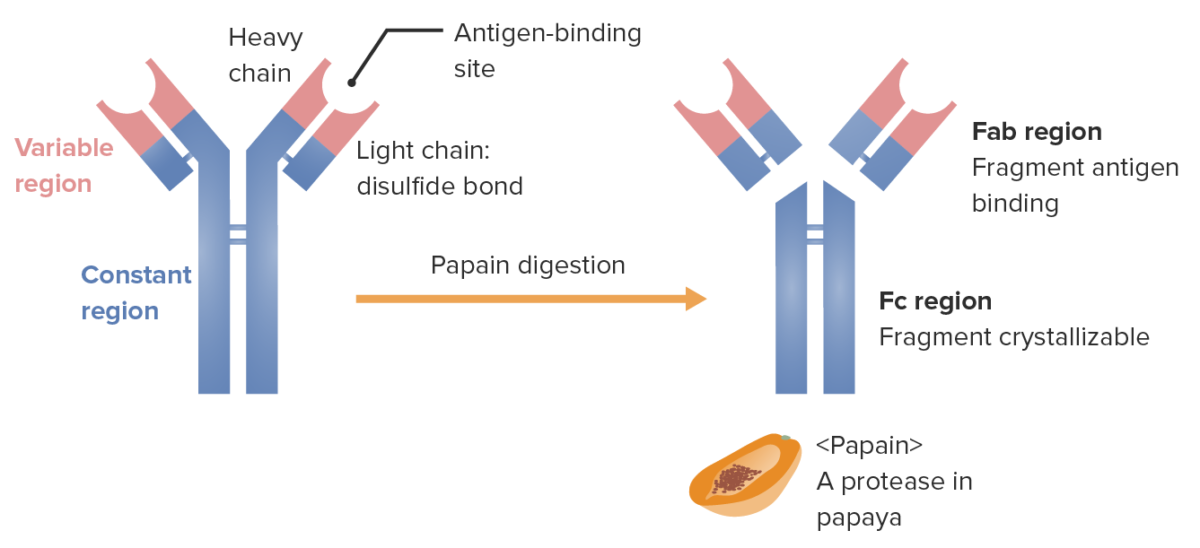
Imagen por Lecturio.

Anticuerpos

Inmunoglobulina ( Ig Ig X-linked Agammaglobulinemia)

  • Moléculas de glicoproteínas producidas por las células plasmáticas que actúan en EN Erythema nodosum is an immune-mediated panniculitis (inflammation of the subcutaneous fat) caused by a type IV (delayed-type) hypersensitivity reaction. It commonly manifests in young women as tender, erythematous nodules on the shins. Erythema Nodosum las respuestas inmunitarias al AL Amyloidosis reconocer y unirse a antígenos particulares
  • Componentes generales:
    • 2 cadenas pesadas idénticas y 2 cadenas ligeras idénticas (referidas a su peso molecular)
    • Los LOS Neisseria enlaces disulfuro unen las cadenas pesadas con las cadenas ligeras (formando una molécula en EN Erythema nodosum is an immune-mediated panniculitis (inflammation of the subcutaneous fat) caused by a type IV (delayed-type) hypersensitivity reaction. It commonly manifests in young women as tender, erythematous nodules on the shins. Erythema Nodosum forma de Y)
    • Región bisagra (confiere flexibilidad)
    • Restos de carbohidratos (generalmente asociados con la región constante)
  • Las cadenas pesadas (μ, δ, γ, α o ε) están unidas por disulfuro a las cadenas ligeras (κ o λ).
  • Regiones:
    • Región variable Variable Variables represent information about something that can change. The design of the measurement scales, or of the methods for obtaining information, will determine the data gathered and the characteristics of that data. As a result, a variable can be qualitative or quantitative, and may be further classified into subgroups. Types of Variables (unión de antígeno)
      • La secuencia de aminoácidos en las puntas de la “Y”, que incluye los LOS Neisseria extremos de las cadenas ligera y pesada.
      • Tiene región hipervariable o región determinante de complementariedad (CDR) en EN Erythema nodosum is an immune-mediated panniculitis (inflammation of the subcutaneous fat) caused by a type IV (delayed-type) hypersensitivity reaction. It commonly manifests in young women as tender, erythematous nodules on the shins. Erythema Nodosum cada terminal amino
      • La CDR proporciona especificidad de antígeno, ya que tiene una estructura complementaria al AL Amyloidosis determinante antigénico (epítopo).
    • Región constante (funciones efectoras)
      • Constituye el polipéptido restante.
      • Se une a los LOS Neisseria receptores Fc Fc Crystallizable fragments composed of the carboxy-terminal halves of both immunoglobulin heavy chains linked to each other by disulfide bonds. Fc fragments contain the carboxy-terminal parts of the heavy chain constant regions that are responsible for the effector functions of an immunoglobulin (complement fixation, binding to the cell membrane via fc receptors, and placental transport). This fragment can be obtained by digestion of immunoglobulins with the proteolytic enzyme papain. Immunoglobulins: Types and Functions y al AL Amyloidosis complemento.
  • Fragmentos (determinados por el lugar donde la enzima papaína divide la Ig Ig X-linked Agammaglobulinemia):
    • Fab Fab Univalent antigen-binding fragments composed of one entire immunoglobulin light chain and the amino terminal end of one of the immunoglobulin heavy chains from the hinge region, linked to each other by disulfide bonds. Fab contains the immunoglobulin variable regions, which are part of the antigen-binding site, and the first immunoglobulin constant regions. This fragment can be obtained by digestion of immunoglobulins with the proteolytic enzyme papain. Immunoglobulins: Types and Functions (fragmento de unión a antígeno):
      • Contiene las regiones variables y partes de la región constante de cadenas pesadas y ligeras.
      • Interactúa con el antígeno.
    • Fc Fc Crystallizable fragments composed of the carboxy-terminal halves of both immunoglobulin heavy chains linked to each other by disulfide bonds. Fc fragments contain the carboxy-terminal parts of the heavy chain constant regions that are responsible for the effector functions of an immunoglobulin (complement fixation, binding to the cell membrane via fc receptors, and placental transport). This fragment can be obtained by digestion of immunoglobulins with the proteolytic enzyme papain. Immunoglobulins: Types and Functions (fragmento cristalizable):
      • La parte restante (cola) del anticuerpo (solo cadena pesada)
      • Región constante, fracciones de carbohidratos
      • Enlace de complemento
      • Confiere isotipo Ig Ig X-linked Agammaglobulinemia (p. ej., IgM IgM A class of immunoglobulin bearing mu chains (immunoglobulin mu-chains). Igm can fix complement. The name comes from its high molecular weight and originally being called a macroglobulin. Immunoglobulins: Types and Functions, IgA IgA Represents 15-20% of the human serum immunoglobulins, mostly as the 4-chain polymer in humans or dimer in other mammals. Secretory iga is the main immunoglobulin in secretions. Immunoglobulins: Types and Functions)
  • La composición de la cadena pesada (región constante y Fc Fc Crystallizable fragments composed of the carboxy-terminal halves of both immunoglobulin heavy chains linked to each other by disulfide bonds. Fc fragments contain the carboxy-terminal parts of the heavy chain constant regions that are responsible for the effector functions of an immunoglobulin (complement fixation, binding to the cell membrane via fc receptors, and placental transport). This fragment can be obtained by digestion of immunoglobulins with the proteolytic enzyme papain. Immunoglobulins: Types and Functions) determina la clase/isotipo de Ig Ig X-linked Agammaglobulinemia:
    • µ: IgM IgM A class of immunoglobulin bearing mu chains (immunoglobulin mu-chains). Igm can fix complement. The name comes from its high molecular weight and originally being called a macroglobulin. Immunoglobulins: Types and Functions
    • δ: IgD IgD An immunoglobulin which accounts for less than 1% of plasma immunoglobulin. It is found on the membrane of many circulating B lymphocytes. Immunoglobulins: Types and Functions
    • γ: IgG IgG The major immunoglobulin isotype class in normal human serum. There are several isotype subclasses of igg, for example, igg1, igg2a, and igg2b. Hypersensitivity Pneumonitis
    • α: IgA IgA Represents 15-20% of the human serum immunoglobulins, mostly as the 4-chain polymer in humans or dimer in other mammals. Secretory iga is the main immunoglobulin in secretions. Immunoglobulins: Types and Functions
    • ε: IgE IgE An immunoglobulin associated with mast cells. Overexpression has been associated with allergic hypersensitivity. Immunoglobulins: Types and Functions

Propiedades

  • Diversidad de anticuerpos lograda por:
    • Múltiples segmentos de cadenas pesadas y ligeras
    • Reordenamientos de los LOS Neisseria segmentos génicos de las cadenas.
    • Diversidad de unión (adición o eliminación de nucleótidos)
    • Diversidad combinatoria (combinación aleatoria de cadenas pesadas y ligeras)
    • Hipermutación somática
  • Especificidad lograda por:
    • Hipermutación somática → maduración de afinidad (región variable Variable Variables represent information about something that can change. The design of the measurement scales, or of the methods for obtaining information, will determine the data gathered and the characteristics of that data. As a result, a variable can be qualitative or quantitative, and may be further classified into subgroups. Types of Variables)
    • Cambio de clase (región constante)

Funciones

Protección contra agentes infecciosos y sus productos mediante:
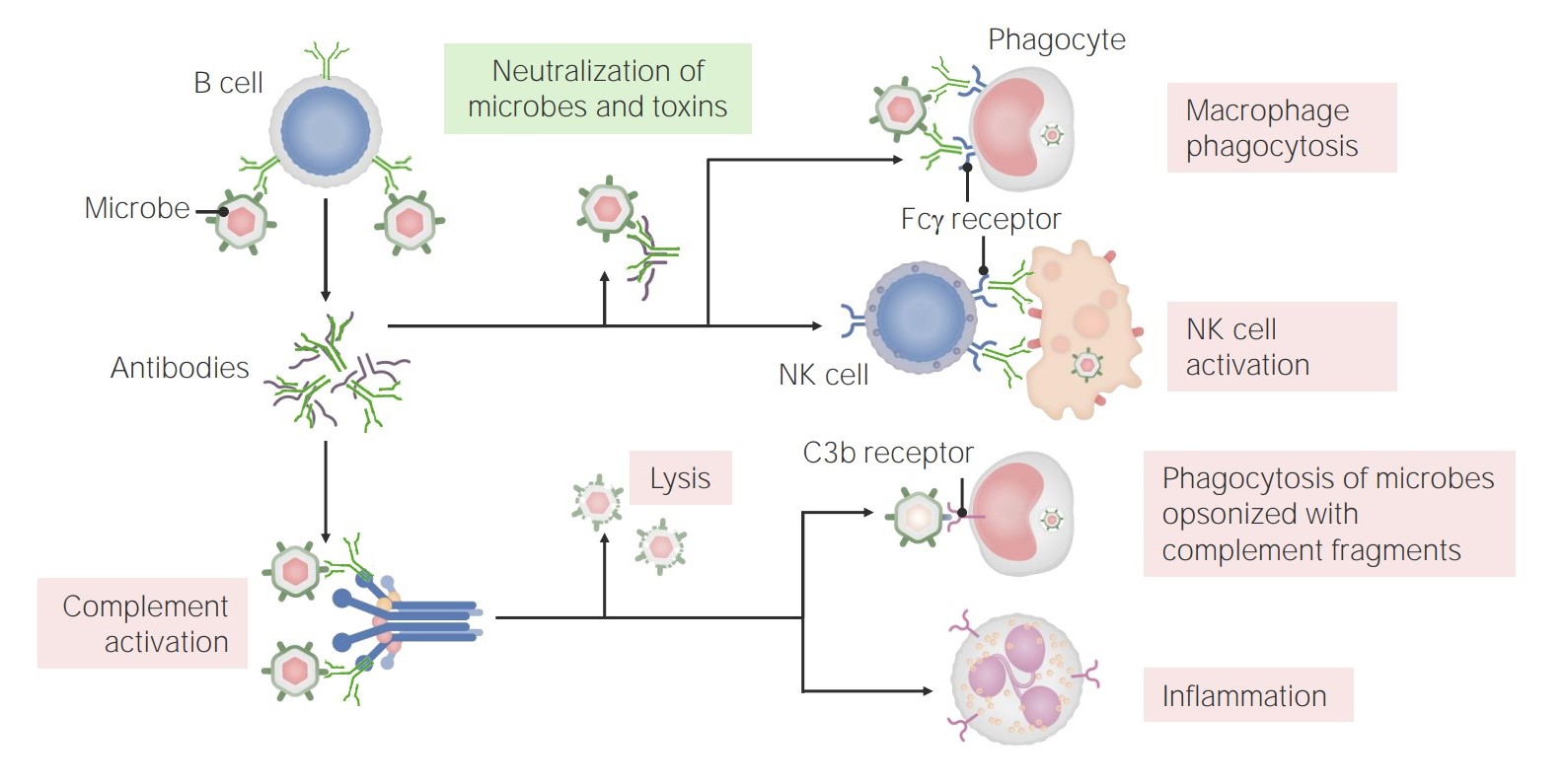
  • Neutralización de toxinas y la infectividad de los LOS Neisseria patógenos:
    • Utiliza el Fab Fab Univalent antigen-binding fragments composed of one entire immunoglobulin light chain and the amino terminal end of one of the immunoglobulin heavy chains from the hinge region, linked to each other by disulfide bonds. Fab contains the immunoglobulin variable regions, which are part of the antigen-binding site, and the first immunoglobulin constant regions. This fragment can be obtained by digestion of immunoglobulins with the proteolytic enzyme papain. Immunoglobulins: Types and Functions del anticuerpo, que forma una unión altamente específica al AL Amyloidosis objetivo.
    • La unión previene la adherencia de patógenos.
  • Activación del complemento que causa lisis celular e inflamación.
  • Opsonización (con o sin complemento), favoreciendo la fagocitosis
  • Citotoxicidad mediada por células dependiente de anticuerpos ( ADCC ADCC The phenomenon of antibody-mediated target cell destruction by non-sensitized effector cells. The identity of the target cell varies, but it must possess surface immunoglobulin G whose Fc portion is intact. The effector cell is a ‘killer’ cell possessing Fc receptors. It may be a lymphocyte lacking conventional B- or T-cell markers, or a monocyte, macrophage, or polynuclear leukocyte, depending on the identity of the target cell. The reaction is complement-independent. Humoral Adaptive Immunity): las células inmunitarias se estimulan a través de los LOS Neisseria receptores Fc Fc Crystallizable fragments composed of the carboxy-terminal halves of both immunoglobulin heavy chains linked to each other by disulfide bonds. Fc fragments contain the carboxy-terminal parts of the heavy chain constant regions that are responsible for the effector functions of an immunoglobulin (complement fixation, binding to the cell membrane via fc receptors, and placental transport). This fragment can be obtained by digestion of immunoglobulins with the proteolytic enzyme papain. Immunoglobulins: Types and Functions, lo que provoca la lisis de las células diana.
  • Aclaramiento de inmunocomplejos:
    • Los LOS Neisseria complejos antígeno/anticuerpo activan el sistema del complemento (las regiones Fc Fc Crystallizable fragments composed of the carboxy-terminal halves of both immunoglobulin heavy chains linked to each other by disulfide bonds. Fc fragments contain the carboxy-terminal parts of the heavy chain constant regions that are responsible for the effector functions of an immunoglobulin (complement fixation, binding to the cell membrane via fc receptors, and placental transport). This fragment can be obtained by digestion of immunoglobulins with the proteolytic enzyme papain. Immunoglobulins: Types and Functions del anticuerpo en EN Erythema nodosum is an immune-mediated panniculitis (inflammation of the subcutaneous fat) caused by a type IV (delayed-type) hypersensitivity reaction. It commonly manifests in young women as tender, erythematous nodules on the shins. Erythema Nodosum IgM IgM A class of immunoglobulin bearing mu chains (immunoglobulin mu-chains). Igm can fix complement. The name comes from its high molecular weight and originally being called a macroglobulin. Immunoglobulins: Types and Functions e IgG IgG The major immunoglobulin isotype class in normal human serum. There are several isotype subclasses of igg, for example, igg1, igg2a, and igg2b. Hypersensitivity Pneumonitis se unen a C1q).
    • Los LOS Neisseria glóbulos rojos reconocen estos complejos y los LOS Neisseria transportan al AL Amyloidosis hígado y al AL Amyloidosis bazo para la fagocitosis.
The functions of antibodies

Las funciones de los anticuerpos:
Los anticuerpos tienen múltiples funciones en la inmunidad, incluyendo la neutralización (de microbios y toxinas), la promoción de la fagocitosis y la activación de las células NK. Además, los anticuerpos tienen un papel en la activación del complemento, que puede conducir a la lisis directa de los microbios, la opsonización y la fagocitosis, y el reclutamiento/activación de los neutrófilos.

Imagen por Lecturio.

Relevancia Clínica

  • Agammaglobulinemia ligada al AL Amyloidosis cromosoma X: resulta de mutaciones en EN Erythema nodosum is an immune-mediated panniculitis (inflammation of the subcutaneous fat) caused by a type IV (delayed-type) hypersensitivity reaction. It commonly manifests in young women as tender, erythematous nodules on the shins. Erythema Nodosum el gen del cromosoma X que codifica para la tirosina quinasa de Bruton (BTK), que es esencial para el desarrollo y la maduración de las células B. La enfermedad se caracteriza por una ausencia de células B que conduce a infecciones recurrentes, principalmente por bacterias y virus Virus Viruses are infectious, obligate intracellular parasites composed of a nucleic acid core surrounded by a protein capsid. Viruses can be either naked (non-enveloped) or enveloped. The classification of viruses is complex and based on many factors, including type and structure of the nucleoid and capsid, the presence of an envelope, the replication cycle, and the host range. Virology encapsulados, que afectan los LOS Neisseria pulmones, los LOS Neisseria senos paranasales y la piel, así como el SNC. El tratamiento consiste en EN Erythema nodosum is an immune-mediated panniculitis (inflammation of the subcutaneous fat) caused by a type IV (delayed-type) hypersensitivity reaction. It commonly manifests in young women as tender, erythematous nodules on the shins. Erythema Nodosum la administración de inmunoglobulina.
  • Inmunodeficiencia común variable Variable Variables represent information about something that can change. The design of the measurement scales, or of the methods for obtaining information, will determine the data gathered and the characteristics of that data. As a result, a variable can be qualitative or quantitative, and may be further classified into subgroups. Types of Variables ( CVID CVID Common variable immune deficiency (CVID), also known as humoral immunodeficiency, is a disorder of the immune system characterized by reduced serum levels of immunoglobulins g, a, and m. Common Variable Immunodeficiency (CVID)): caracterizada por células B fenotípicamente normales que no pueden producir anticuerpos. La inmunodeficiencia común variable Variable Variables represent information about something that can change. The design of the measurement scales, or of the methods for obtaining information, will determine the data gathered and the characteristics of that data. As a result, a variable can be qualitative or quantitative, and may be further classified into subgroups. Types of Variables puede estar asociada con varios defectos moleculares que afectan la producción de anticuerpos. La enfermedad se manifiesta en EN Erythema nodosum is an immune-mediated panniculitis (inflammation of the subcutaneous fat) caused by a type IV (delayed-type) hypersensitivity reaction. It commonly manifests in young women as tender, erythematous nodules on the shins. Erythema Nodosum adultos con infecciones sinopulmonares recurrentes. El tratamiento es la terapia de reemplazo de inmunoglobulina.
  • Síndrome de hiper-IgM: un grupo heterogéneo de condiciones que pueden ser de herencia autosómica recesiva o ligada al AL Amyloidosis cromosoma X. Las formas ligadas al AL Amyloidosis cromosoma X se caracterizan por células T auxiliares defectuosas que no pueden activar las células B para efectuar la recombinación de cambio de clase. Como resultado, las células B producen solo IgM IgM A class of immunoglobulin bearing mu chains (immunoglobulin mu-chains). Igm can fix complement. The name comes from its high molecular weight and originally being called a macroglobulin. Immunoglobulins: Types and Functions, mientras que otras inmunoglobulinas, como IgG IgG The major immunoglobulin isotype class in normal human serum. There are several isotype subclasses of igg, for example, igg1, igg2a, and igg2b. Hypersensitivity Pneumonitis, IgA IgA Represents 15-20% of the human serum immunoglobulins, mostly as the 4-chain polymer in humans or dimer in other mammals. Secretory iga is the main immunoglobulin in secretions. Immunoglobulins: Types and Functions e IgE IgE An immunoglobulin associated with mast cells. Overexpression has been associated with allergic hypersensitivity. Immunoglobulins: Types and Functions, son deficientes. Los LOS Neisseria pacientes presentan neutropenia Neutropenia Neutrophils are an important component of the immune system and play a significant role in the eradication of infections. Low numbers of circulating neutrophils, referred to as neutropenia, predispose the body to recurrent infections or sepsis, though patients can also be asymptomatic. Neutropenia e infecciones sinopulmonares recurrentes desde la infancia, y son susceptibles a neumonía por Pneumocystis jiroveci Pneumocystis jiroveci Pneumocystis jiroveci is a yeast-like fungus causing pneumocystis pneumonia (PCP) in immunocompromised patients. Pneumocystis pneumonia is spread through airborne transmission and classically affects patients with AIDS, functioning as an AIDS-defining illness. Patients may present with insidious onset of fever, chills, dry cough, chest pain, and shortness of breath. Pneumocystis jirovecii/Pneumocystis Pneumonia (PCP) e infecciones por Cryptosporidium Cryptosporidium A genus of coccidian parasites of the family cryptosporidiidae, found in the intestinal epithelium of many vertebrates including humans. Hyper-IgM Syndrome . Las formas recesivas autosómicas se caracterizan por niveles de IgM IgM A class of immunoglobulin bearing mu chains (immunoglobulin mu-chains). Igm can fix complement. The name comes from its high molecular weight and originally being called a macroglobulin. Immunoglobulins: Types and Functions mucho más altos. Existe una propensión a la autoinmunidad y al AL Amyloidosis desarrollo de linfomas de células B. El síndrome de hiper-IgM también puede ser secundario al AL Amyloidosis síndrome de rubéola congénita y medicamentos como la fenitoína. El tratamiento incluye terapia de reemplazo de inmunoglobulina y antibióticos profilácticos.
  • Síndrome de hiper-IgD (HIDS): trastorno autosómico recesivo asociado con mutaciones en EN Erythema nodosum is an immune-mediated panniculitis (inflammation of the subcutaneous fat) caused by a type IV (delayed-type) hypersensitivity reaction. It commonly manifests in young women as tender, erythematous nodules on the shins. Erythema Nodosum el gen que codifica la mevalonato quinasa, una enzima que participa en EN Erythema nodosum is an immune-mediated panniculitis (inflammation of the subcutaneous fat) caused by a type IV (delayed-type) hypersensitivity reaction. It commonly manifests in young women as tender, erythematous nodules on the shins. Erythema Nodosum la síntesis del colesterol. La enfermedad se manifiesta en EN Erythema nodosum is an immune-mediated panniculitis (inflammation of the subcutaneous fat) caused by a type IV (delayed-type) hypersensitivity reaction. It commonly manifests in young women as tender, erythematous nodules on the shins. Erythema Nodosum la infancia con episodios recurrentes de escalofríos y fiebre, dolor Dolor Inflammation abdominal, vómitos o diarrea, dolor Dolor Inflammation de cabeza y artralgias. Los LOS Neisseria signos físicos incluyen linfadenopatía cervical, esplenomegalia, artritis, lesiones cutáneas y úlceras aftosas orogenitales. Los LOS Neisseria niveles séricos de IgD IgD An immunoglobulin which accounts for less than 1% of plasma immunoglobulin. It is found on the membrane of many circulating B lymphocytes. Immunoglobulins: Types and Functions suelen ser muy altos, aunque ocasionalmente pueden estar dentro de los LOS Neisseria límites normales. Los LOS Neisseria antagonistas del receptor Receptor Receptors are proteins located either on the surface of or within a cell that can bind to signaling molecules known as ligands (e.g., hormones) and cause some type of response within the cell. Receptors de interleucina-1 (IL-1R), los LOS Neisseria AINE y los LOS Neisseria corticosteroides se usan terapéuticamente. Los LOS Neisseria episodios febriles tienden a ser menos frecuentes en EN Erythema nodosum is an immune-mediated panniculitis (inflammation of the subcutaneous fat) caused by a type IV (delayed-type) hypersensitivity reaction. It commonly manifests in young women as tender, erythematous nodules on the shins. Erythema Nodosum la edad adulta.

Referencias

  1. Ballas, Z. (2024). Structure of immunoglobulins. UpToDate. Retrieved October 28, 2025, from https://www.uptodate.com/contents/structure-of-immunoglobulins
  2. Carroll, M. C., & Isenman, D. E. (2012). Regulation of humoral immunity by complement. Immunity, 37(2):199-207. https://pubmed.ncbi.nlm.nih.gov/22921118/
  3. Fernandez J. (2024). Hyper-IgM syndrome. MSD Manual. Merck & Co., Inc., Kenilworth, NJ, USA. Retrieved October 28, 2025, from https://www.merckmanuals.com/professional/immunology-allergic-disorders/immunodeficiency-disorders/hyper-igm-syndrome
  4. Kontzias, A. (2023). Hyper-IgD syndrome. MSD Manual. Merck & Co., Inc., Kenilworth, NJ, USA. Retrieved October 28, 2025, from https://www.merckmanuals.com/professional/pediatrics/hereditary-periodic-fever-syndromes/hyper-igd-syndrome
  5. Notarangelo, LD. (2025). Hyperimmunoglobulin M syndromes. UptoDate. Retrieved October 28, 2025, from https://www.uptodate.com/contents/hyperimmunoglobulin-m-syndromes
  6. Romberg, N. (2024). The adaptive humoral immune response. UptoDate. Retrieved October 28, 2025, from https://www.uptodate.com/contents/the-adaptive-humoral-immune-response
  7. Schroeder, HW, Jr, & Cavacini, L. (2010). Structure and function of immunoglobulins. J Allergy Clin Immunol, 125(2 Suppl 2):S41-52. https://pubmed.ncbi.nlm.nih.gov/20176268/

¡Crea tu cuenta gratis o inicia una sesión para seguir leyendo!

Regístrate ahora y obtén acceso gratuito a Lecturio con páginas de concepto, videos médicos y cuestionarios para tu educación médica.

User Reviews

Que tengas una sesión de estudio alegre y navideña 🎁 Ahorra 50% en todos los planes >>

Details