Domina Conceptos Médicos

Estudia para la escuela de medicina y tus examenes con Lecturio.

Estenosis Mitral

La estenosis mitral (EM) es el estrechamiento del orificio de la válvula mitral (VM), lo que condiciona a una obstrucción del flujo sanguíneo desde la aurícula izquierda (AI) al AL Amyloidosis ventrículo izquierdo (VI). La estenosis mitral se debe con mayor frecuencia a la cardiopatía reumática. La estenosis mitral conduce a una alteración del llenado diastólico del VI, a un aumento de la presión de la AI y a una dilatación de la misma, lo que puede provocar fibrilación auricular, congestión pulmonar, hipertensión pulmonar e insuficiencia cardíaca derecha. Los LOS Neisseria síntomas incluyen disnea de esfuerzo, ortopnea, palpitaciones, fatiga y disfonía. A la exploración física se podrá auscultar un chasquido de apertura, seguido de un soplo diastólico retumbante. Para el diagnóstico se utiliza un ecocardiograma. El tratamiento incluye restricción de sodio, diuréticos, manejo de la fibrilación auricular, posible anticoagulación y comisurotomía percutánea o cirugía.

Last updated: Dec 15, 2025

Editorial responsibility: Stanley Oiseth, Lindsay Jones, Evelin Maza

Descripción General

Definición

La estenosis mitral (EM) es el estrechamiento del orificio de la válvula mitral (VM), que impide el flujo de sangre desde la aurícula izquierda (AI) hacia el ventrículo izquierdo (VI) durante la diástole.
Epidemiología

  • La prevalencia ha HA Hemolytic anemia (HA) is the term given to a large group of anemias that are caused by the premature destruction/hemolysis of circulating red blood cells (RBCs). Hemolysis can occur within (intravascular hemolysis) or outside the blood vessels (extravascular hemolysis). Hemolytic Anemia disminuido en EN Erythema nodosum is an immune-mediated panniculitis (inflammation of the subcutaneous fat) caused by a type IV (delayed-type) hypersensitivity reaction. It commonly manifests in young women as tender, erythematous nodules on the shins. Erythema Nodosum los LOS Neisseria países desarrollados.
  • Incidencia:
    • 1 de cada 100 000 en EN Erythema nodosum is an immune-mediated panniculitis (inflammation of the subcutaneous fat) caused by a type IV (delayed-type) hypersensitivity reaction. It commonly manifests in young women as tender, erythematous nodules on the shins. Erythema Nodosum Estados Unidos
    • Es mayor en EN Erythema nodosum is an immune-mediated panniculitis (inflammation of the subcutaneous fat) caused by a type IV (delayed-type) hypersensitivity reaction. It commonly manifests in young women as tender, erythematous nodules on the shins. Erythema Nodosum los LOS Neisseria países en EN Erythema nodosum is an immune-mediated panniculitis (inflammation of the subcutaneous fat) caused by a type IV (delayed-type) hypersensitivity reaction. It commonly manifests in young women as tender, erythematous nodules on the shins. Erythema Nodosum desarrollo, donde la cardiopatía reumática es más frecuente
  • Mujeres > hombres
  • La aparición suele ser en EN Erythema nodosum is an immune-mediated panniculitis (inflammation of the subcutaneous fat) caused by a type IV (delayed-type) hypersensitivity reaction. It commonly manifests in young women as tender, erythematous nodules on the shins. Erythema Nodosum la 3ra y 4ta década de la vida.

Etiología

  • Cardiopatía reumática (más común)
  • Congénita
  • Calcificación del anillo mitral
  • Inducida por la radiación
  • Enfermedad de Fabry
  • Enfermedad de Whipple
  • Lupus eritematoso sistémico
  • Artritis reumatoide
  • Enfermedad carcinoide
  • Condiciones que imitan los LOS Neisseria cambios hemodinámicos de la EM:
    • Mixoma de aurícula izquierda
    • Endocarditis Endocarditis Endocarditis is an inflammatory disease involving the inner lining (endometrium) of the heart, most commonly affecting the cardiac valves. Both infectious and noninfectious etiologies lead to vegetations on the valve leaflets. Patients may present with nonspecific symptoms such as fever and fatigue. Endocarditis infecciosas extensas
    • Válvula mitral bioprotésica degenerada

Fisiopatología

  • Cardiopatía reumática: mimetismo molecular mostrado por Streptococcus Streptococcus Streptococcus is one of the two medically important genera of gram-positive cocci, the other being Staphylococcus. Streptococci are identified as different species on blood agar on the basis of their hemolytic pattern and sensitivity to optochin and bacitracin. There are many pathogenic species of streptococci, including S. pyogenes, S. agalactiae, S. pneumoniae, and the viridans streptococci. Streptococcus hemolíticos del grupo A posterior a una infección faríngea → pancarditis aguda → inflamación valvular crónica →
    • Fibrosis Fibrosis Any pathological condition where fibrous connective tissue invades any organ, usually as a consequence of inflammation or other injury. Bronchiolitis Obliterans y engrosamiento de las valvas y fusión de las comisuras mitrales
    • Calcificación y estenosis mitral con estrechamiento del orificio valvular
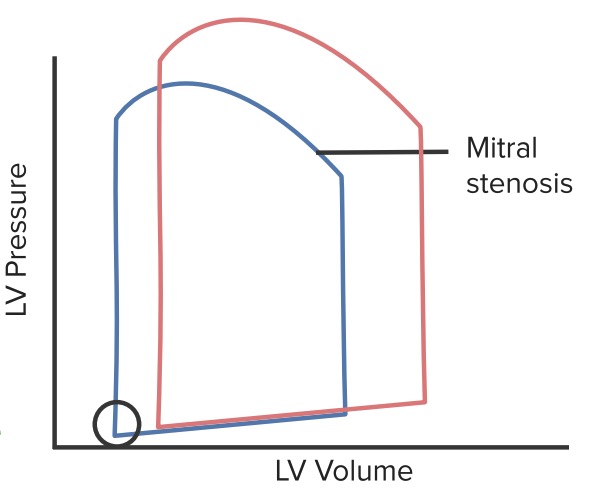
  • Orificio estrecho de la VM → llenado restringido del VI → se requiere mayor presión de la AI para impulsar la sangre →
    • Dilatación de la AI → fibrilación auricular, trombosis de la AI
    • ↑ Presión capilar pulmonar → hipertensión pulmonar → insuficiencia cardíaca derecha.
    • ↓ Volumen sistólico → ↓ gasto cardíaco → insuficiencia cardíaca izquierda.
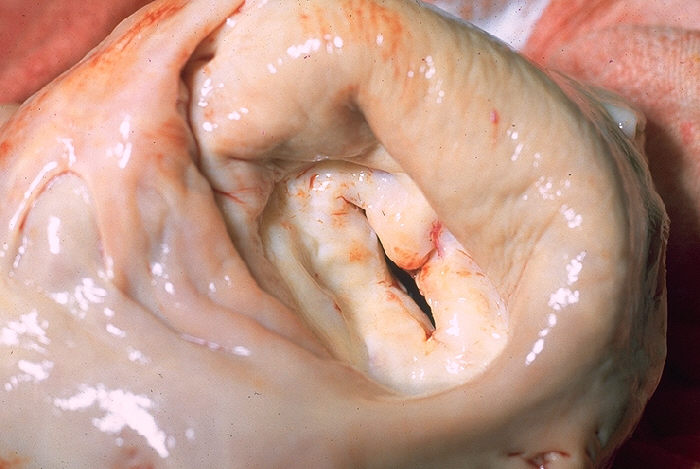
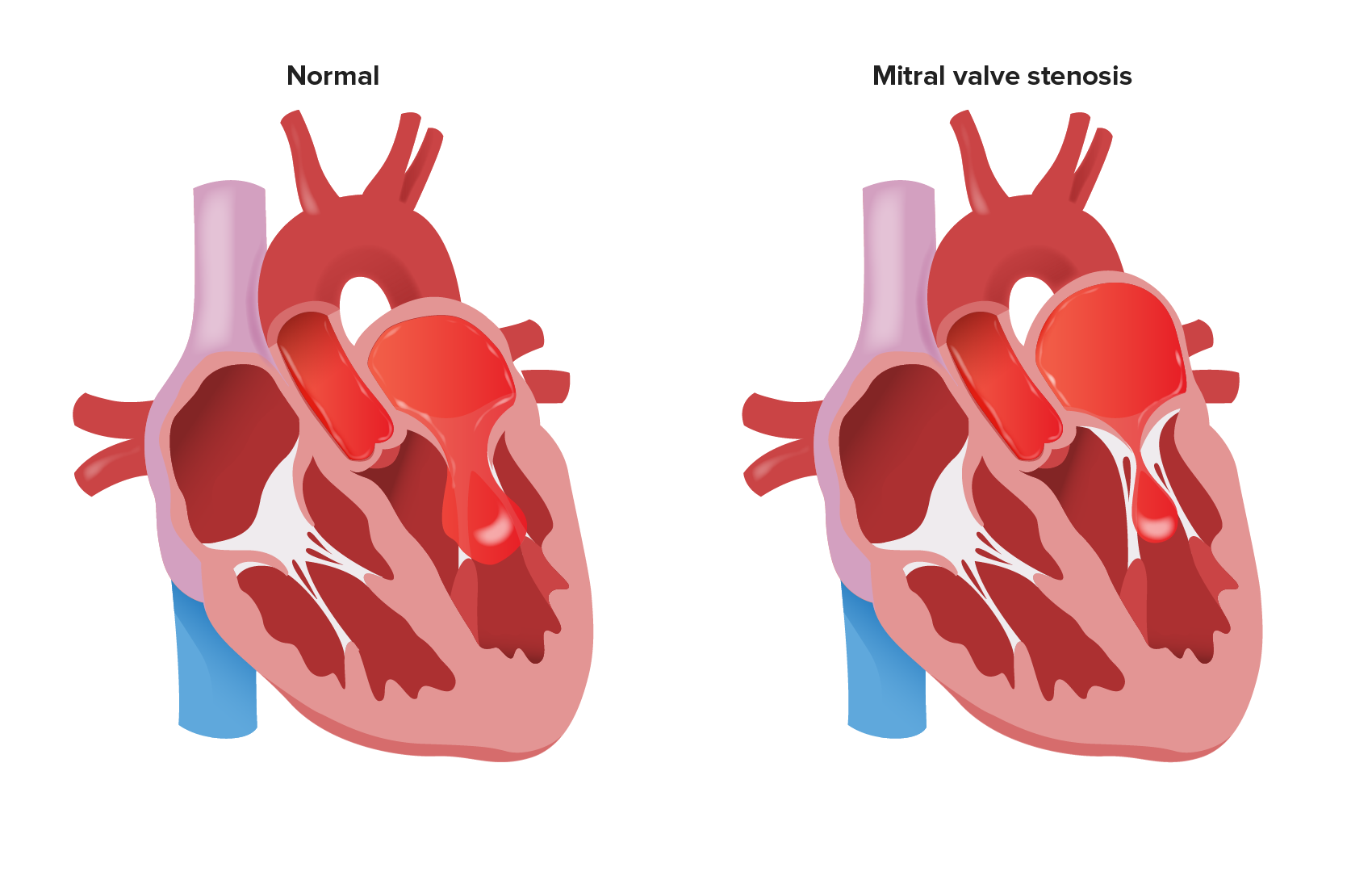
Estenosis de la válvula mitral

Obstrucción del flujo sanguíneo de la AI al VI durante la diástole debido a una VM estenótica

Imagen por Lecturio.
Presentación Clínica

Manifestaciones clínicas

  • Asintomática en EN Erythema nodosum is an immune-mediated panniculitis (inflammation of the subcutaneous fat) caused by a type IV (delayed-type) hypersensitivity reaction. It commonly manifests in young women as tender, erythematous nodules on the shins. Erythema Nodosum las primeras etapas
  • Síntomas de insuficiencia cardíaca:
    • Disnea de esfuerzo de forma progresiva
    • Fatiga
    • Ortopnea
    • Disnea paroxística nocturna
    • Edema Edema Edema is a condition in which excess serous fluid accumulates in the body cavity or interstitial space of connective tissues. Edema is a symptom observed in several medical conditions. It can be categorized into 2 types, namely, peripheral (in the extremities) and internal (in an organ or body cavity). Edema pulmonar → rotura de pequeños vasos pulmonares → hemoptisis
  • Síntomas de fibrilación auricular:
    • Palpitaciones
    • Secuelas de la tromboembolia
  • Compresión del nervio laríngeo recurrente izquierdo debido a una AI aumentada de tamaño. → disfonía (síndrome de Ortner)
  • Compresión de los LOS Neisseria bronquios por una AI agrandada → tos TOS Thoracic outlet syndrome (TOS) is a broad term used for a spectrum of syndromes related to the general region of the thoracic outlet, which involves the compression or irritation of elements of the brachial plexus, subclavian artery, or subclavian vein. Thoracic Outlet Syndrome
  • Compresión del esófago por una AI agrandada → disfagia

Examen físico

  • S1 S1 Heart Sounds fuerte → cierre brusco de las valvas estenóticas de la VM ( S1 S1 Heart Sounds puede estar ausente si las valvas están muy calcificadas.)
  • Desdoblamiento normal de S2 S2 Heart Sounds con un P2 exagerado → hipertensión pulmonar.
  • Chasquido de apertura diastólica temprana después de S2 S2 Heart Sounds, seguido de un soplo retumbante de tono bajo, decrescendo-crescendo:
    • Se escucha mejor en EN Erythema nodosum is an immune-mediated panniculitis (inflammation of the subcutaneous fat) caused by a type IV (delayed-type) hypersensitivity reaction. It commonly manifests in young women as tender, erythematous nodules on the shins. Erythema Nodosum el vértice
    • ↑ Soplo en EN Erythema nodosum is an immune-mediated panniculitis (inflammation of the subcutaneous fat) caused by a type IV (delayed-type) hypersensitivity reaction. It commonly manifests in young women as tender, erythematous nodules on the shins. Erythema Nodosum cuclillas, maniobra de handgrip (↑ poscarga).
    • ↓ Soplo con disminución del flujo sanguíneo a través de la válvula (taquicardia, hipertensión pulmonar)
    • El chasquido de apertura se acerca más a S2 S2 Heart Sounds a medida que la estenosis es más severa.
    • El chasquido puede estar ausente si la válvula está muy calcificada.
  • P2 palpable y elevación del ventrículo derecho (elevación paraesternal)
  • El punto de máximo impulso es normal o ↓, debido a ↓ llenado del VI.
  • Signos de insuficiencia cardíaca (generalmente del lado derecho):
    • Ingurgitación yugular
    • Crepitantes
    • Hepatomegalia
    • Edema Edema Edema is a condition in which excess serous fluid accumulates in the body cavity or interstitial space of connective tissues. Edema is a symptom observed in several medical conditions. It can be categorized into 2 types, namely, peripheral (in the extremities) and internal (in an organ or body cavity). Edema periférico
  • Rubor malar (“facies mitral”) → vasodilatación cutánea e hipoxemia → bajo gasto cardíaco e hipertensión pulmonar severa.
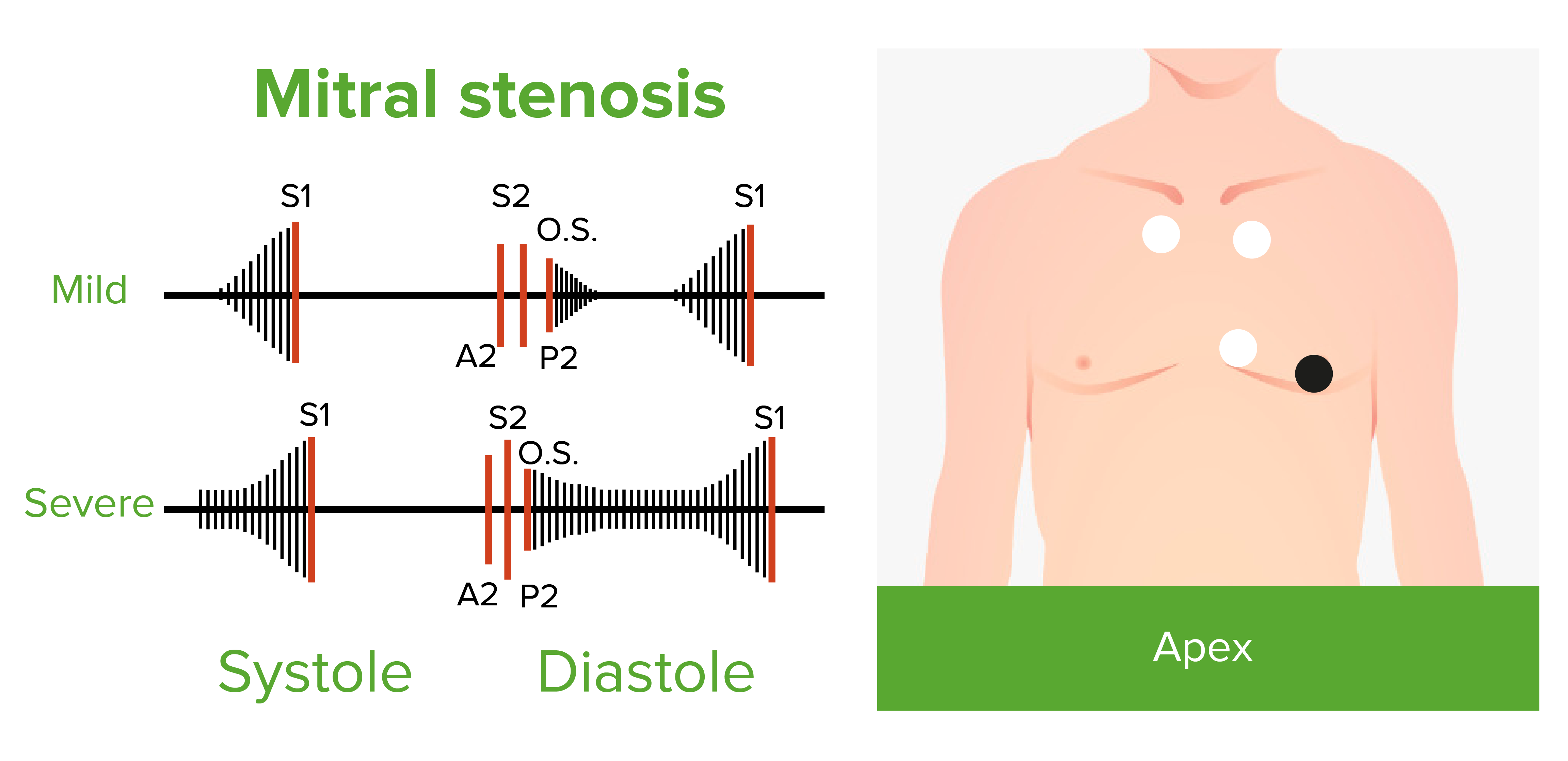
Fonocardiograma de estenosis mitral

Llenado diastólico y soplo retumbante en estenosis mitral leve y severa
El soplo mesodiastólico comienza después del chasquido de apertura. El soplo presistólico se debe a la contracción auricular (y está ausente en la fibrilación auricular).
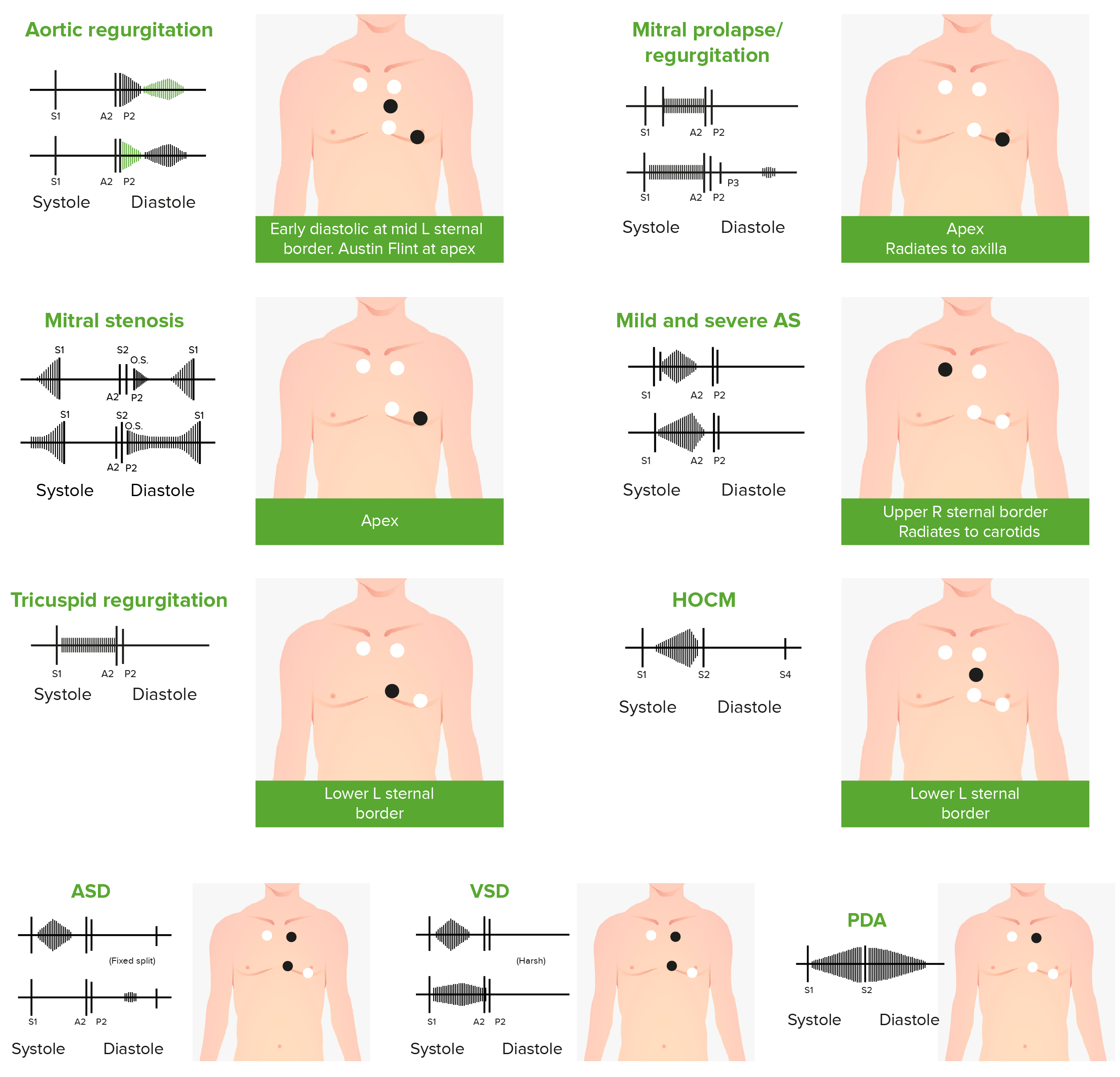
Imagen por Lecturio.

Diagnóstico

Ecocardiografía

  • Ecocardiografía transtorácica (ETT):
    • Modalidad diagnóstica de elección
    • Hallazgos:
      • VM estenótica
      • Engrosamiento y calcificación de las válvulas
      • Fusión comisural
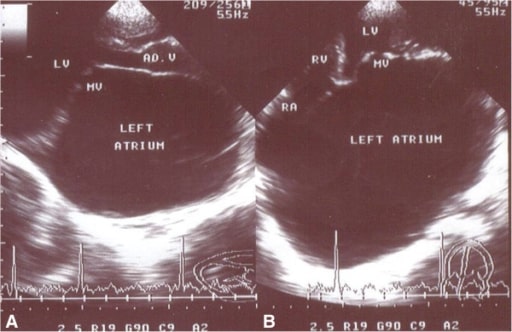
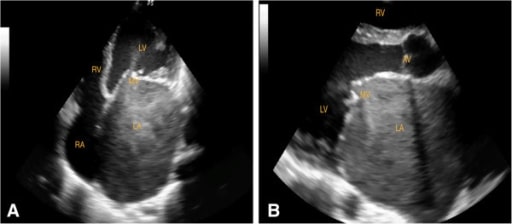
      • Dilatación de la AI
      • Evaluación de la función del VI y VD
    • El Doppler Doppler Ultrasonography applying the doppler effect, with frequency-shifted ultrasound reflections produced by moving targets (usually red blood cells) in the bloodstream along the ultrasound axis in direct proportion to the velocity of movement of the targets, to determine both direction and velocity of blood flow. Ultrasound (Sonography) se utiliza para evaluar:
      • El gradiente transvalvular
      • Área de la válvula mitral (AVM):
        • EM moderada: 1,5–2,5 cm2
        • EM severa: < 1,5 cm2
        • EM muy severa: < 1 cm2
      • Presión de la arteria pulmonar
      • Valvulopatía asociada (regurgitación mitral)
  • Ecocardiografía transesofágica (ETE):
    • Se utiliza para descartar trombo de la AI previo a la realización de valvuloplastia percutánea con balón
    • También puede evaluar la presencia de mixomas de la AI o de grandes vegetaciones que pueden simular una EM

Evaluación adicional

  • Electrocardiografía ( ECG ECG An electrocardiogram (ECG) is a graphic representation of the electrical activity of the heart plotted against time. Adhesive electrodes are affixed to the skin surface allowing measurement of cardiac impulses from many angles. The ECG provides 3-dimensional information about the conduction system of the heart, the myocardium, and other cardiac structures. Electrocardiogram (ECG)):
    • Los LOS Neisseria hallazgos son inespecíficos.
    • Signos de agrandamiento de la AI:
      • Ondas P de “doble pico” (P mitral)
      • Solo se ve VE Ventilation: Mechanics of Breathing cuando está en EN Erythema nodosum is an immune-mediated panniculitis (inflammation of the subcutaneous fat) caused by a type IV (delayed-type) hypersensitivity reaction. It commonly manifests in young women as tender, erythematous nodules on the shins. Erythema Nodosum ritmo sinusal
    • Fibrilación auricular
    • Con hipertensión pulmonar severa:
      • Desviación del eje hacia la derecha
      • Ondas P “altas”
  • Radiografía de tórax:
    • Enderezamiento del borde superior izquierdo de la silueta cardíaca → Agrandamiento de la AI
    • Hipertensión pulmonar → ggrandamiento de la arteria pulmonar
    • Congestión vascular pulmonar:
      • Cefalización del flujo sanguíneo (de zonas pulmonares inferiores a superiores)
      • Líneas B de Kerley
  • Imagenología por resonancia magnética cardíaca:
    • Se utiliza cuando un ecocardiograma no es satisfactorio o existe una discrepancia entre los LOS Neisseria hallazgos y el cuadro clínico
    • Puede proporcionar información sobre la anatomía de las válvulas
    • Permite evaluar la severidad de la EM
  • Cateterismo cardíaco:
    • Parte de la evaluación preoperatoria
    • Evalúa concomitancia de coronariopatía antes de la cirugía
    • Puede confirmar ↑ presiones de la AI y la arteria pulmonar, área de la válvula mitral

Tratamiento

  • Monitoreo periódico de los LOS Neisseria pacientes asintomáticos
  • Prevención secundaria de la fiebre reumática en EN Erythema nodosum is an immune-mediated panniculitis (inflammation of the subcutaneous fat) caused by a type IV (delayed-type) hypersensitivity reaction. It commonly manifests in young women as tender, erythematous nodules on the shins. Erythema Nodosum pacientes con EM reumática:
    • Penicilina G
    • La duración de la terapia depende del número de episodios previos y del lapso transcurrido desde el último episodio.
  • Anticoagulación para la EM moderada a severa:
    • Si hay fibrilación auricular
    • Si el paciente presentó un evento embólico previo
    • Si hay un trombo en EN Erythema nodosum is an immune-mediated panniculitis (inflammation of the subcutaneous fat) caused by a type IV (delayed-type) hypersensitivity reaction. It commonly manifests in young women as tender, erythematous nodules on the shins. Erythema Nodosum la AI
    • Considerar la anticoagulación en EN Erythema nodosum is an immune-mediated panniculitis (inflammation of the subcutaneous fat) caused by a type IV (delayed-type) hypersensitivity reaction. It commonly manifests in young women as tender, erythematous nodules on the shins. Erythema Nodosum caso de agrandamiento severo de AI.
    • Nota: Normalmente, se utiliza la warfarina porque los LOS Neisseria nuevos anticoagulantes no han sido evaluados en EN Erythema nodosum is an immune-mediated panniculitis (inflammation of the subcutaneous fat) caused by a type IV (delayed-type) hypersensitivity reaction. It commonly manifests in young women as tender, erythematous nodules on the shins. Erythema Nodosum cardiopatía valvular.
  • Tratamiento de la fibrilación auricular:
    • Cardioversión en EN Erythema nodosum is an immune-mediated panniculitis (inflammation of the subcutaneous fat) caused by a type IV (delayed-type) hypersensitivity reaction. It commonly manifests in young women as tender, erythematous nodules on the shins. Erythema Nodosum pacientes inestables
    • Betabloqueadores y bloqueadores de los LOS Neisseria canales de calcio en EN Erythema nodosum is an immune-mediated panniculitis (inflammation of the subcutaneous fat) caused by a type IV (delayed-type) hypersensitivity reaction. It commonly manifests in young women as tender, erythematous nodules on the shins. Erythema Nodosum pacientes estables
  • Tratamiento de la insuficiencia cardíaca:
    • Diuréticos
    • Los LOS Neisseria betabloqueadores se emplean con precaución (↓ frecuencia cardíaca puede ↓ gasto cardíaco).
    • Restricción de sal
  • Comisurotomía mitral percutánea con balón (CMPB):
    • De 1ra línea
    • Se utiliza en EN Erythema nodosum is an immune-mediated panniculitis (inflammation of the subcutaneous fat) caused by a type IV (delayed-type) hypersensitivity reaction. It commonly manifests in young women as tender, erythematous nodules on the shins. Erythema Nodosum la EM severa o sintomática
    • Requiere una morfología valvular favorable con poca o ninguna regurgitación mitral y sin trombos en EN Erythema nodosum is an immune-mediated panniculitis (inflammation of the subcutaneous fat) caused by a type IV (delayed-type) hypersensitivity reaction. It commonly manifests in young women as tender, erythematous nodules on the shins. Erythema Nodosum la AI
    • Puede retrasar el reemplazo valvular
  • Reemplazo quirúrgico de la VM:
    • Se realiza si la CMPB está contraindicada
    • Se requiere anticoagulación:
      • 3–6 meses para válvula bioprotésica
      • De por vida para válvula mecánica
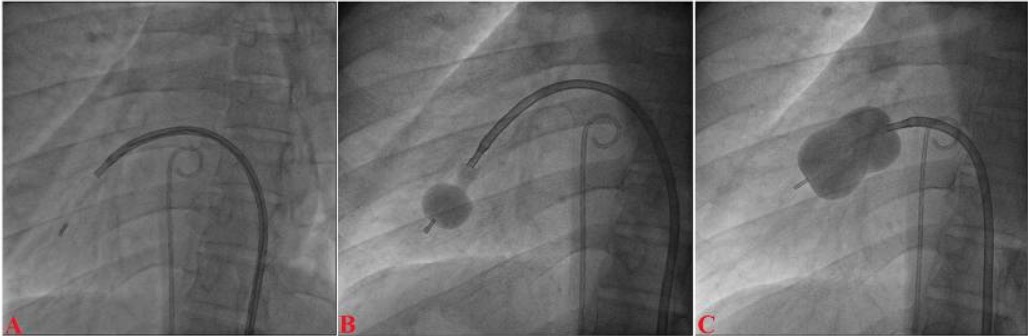
Balón Accura para estenosis mitral

Valvulotomía mitral percutánea en un caso de situs inversus totalis y EM reumática juvenil crítica. A: entrada del balón Accura en el VI; B: inflado distal del balón; C: dilatación de la válvula mitral.

Imagen: “Accura balloon” por Department of Cardiology, LPS Institute of Cardiology, G.S.V.M. Medical College, Kanpur, Uttar Pradesh 208002, India. Licencia: CC BY 2.0.

Diagnóstico Diferencial

  • Regurgitación mitral (RM): trastorno valvular en EN Erythema nodosum is an immune-mediated panniculitis (inflammation of the subcutaneous fat) caused by a type IV (delayed-type) hypersensitivity reaction. It commonly manifests in young women as tender, erythematous nodules on the shins. Erythema Nodosum el que la sangre regresa del VI a la AI durante la sístole. El prolapso de la válvula mitral (PVM) es la etiología más común. Los LOS Neisseria signos y síntomas se basan en EN Erythema nodosum is an immune-mediated panniculitis (inflammation of the subcutaneous fat) caused by a type IV (delayed-type) hypersensitivity reaction. It commonly manifests in young women as tender, erythematous nodules on the shins. Erythema Nodosum la severidad y pueden incluir disnea de esfuerzo, fatiga o edema Edema Edema is a condition in which excess serous fluid accumulates in the body cavity or interstitial space of connective tissues. Edema is a symptom observed in several medical conditions. It can be categorized into 2 types, namely, peripheral (in the extremities) and internal (in an organ or body cavity). Edema. En EN Erythema nodosum is an immune-mediated panniculitis (inflammation of the subcutaneous fat) caused by a type IV (delayed-type) hypersensitivity reaction. It commonly manifests in young women as tender, erythematous nodules on the shins. Erythema Nodosum el examen físico se destaca un soplo sistólico en EN Erythema nodosum is an immune-mediated panniculitis (inflammation of the subcutaneous fat) caused by a type IV (delayed-type) hypersensitivity reaction. It commonly manifests in young women as tender, erythematous nodules on the shins. Erythema Nodosum la punta cardíaca y un ecocardiograma puede establecer el diagnóstico y diferenciar la RM de la EM. El tratamiento incluye la restricción de sodio, los LOS Neisseria diuréticos y la cirugía para los LOS Neisseria casos severos.
  • PVM: defecto valvular cardíaco más frecuente, caracterizado por el abombamiento de las valvas de la VM hacia la AI durante la sístole. La auscultación revela característicamente un clic mesosistólico seguido de un posible soplo regurgitante. Los LOS Neisseria pacientes suelen estar asintomáticos. Sin embargo, el PVM puede evolucionar a RM en EN Erythema nodosum is an immune-mediated panniculitis (inflammation of the subcutaneous fat) caused by a type IV (delayed-type) hypersensitivity reaction. It commonly manifests in young women as tender, erythematous nodules on the shins. Erythema Nodosum algunos pacientes. La ecocardiografía establecerá el diagnóstico y diferenciará el PVM de la EM. La mayoría de los LOS Neisseria pacientes no requieren tratamiento.
  • Regurgitación aórtica severa: trastorno valvular en EN Erythema nodosum is an immune-mediated panniculitis (inflammation of the subcutaneous fat) caused by a type IV (delayed-type) hypersensitivity reaction. It commonly manifests in young women as tender, erythematous nodules on the shins. Erythema Nodosum el que la sangre retorna hacia el ventrículo desde la aorta Aorta The main trunk of the systemic arteries. Mediastinum and Great Vessels: Anatomy durante la diástole. Los LOS Neisseria pacientes pueden presentar disnea de esfuerzo, ortopnea, palpitaciones y dolor Dolor Inflammation torácico. El examen físico evidenciará un soplo diastólico temprano decrescendo en EN Erythema nodosum is an immune-mediated panniculitis (inflammation of the subcutaneous fat) caused by a type IV (delayed-type) hypersensitivity reaction. It commonly manifests in young women as tender, erythematous nodules on the shins. Erythema Nodosum el 3er espacio intercostal izquierdo. La ecocardiografía establecerá el diagnóstico y diferenciará la regurgitación aórtica severa de la EM. El tratamiento consiste en EN Erythema nodosum is an immune-mediated panniculitis (inflammation of the subcutaneous fat) caused by a type IV (delayed-type) hypersensitivity reaction. It commonly manifests in young women as tender, erythematous nodules on the shins. Erythema Nodosum la reparación o reemplazo quirúrgico.
  • Estenosis tricuspídea: estrechamiento de la válvula tricuspídea que impide el flujo sanguíneo normal de la AD AD The term advance directive (AD) refers to treatment preferences and/or the designation of a surrogate decision-maker in the event that a person becomes unable to make medical decisions on their own behalf. Advance directives represent the ethical principle of autonomy and may take the form of a living will, health care proxy, durable power of attorney for health care, and/or a physician’s order for life-sustaining treatment. Advance Directives al AL Amyloidosis VD. Los LOS Neisseria pacientes pueden estar asintomáticos o presentar signos y síntomas de congestión venosa sistémica. Un soplo mesodiastólico en EN Erythema nodosum is an immune-mediated panniculitis (inflammation of the subcutaneous fat) caused by a type IV (delayed-type) hypersensitivity reaction. It commonly manifests in young women as tender, erythematous nodules on the shins. Erythema Nodosum el borde esternal inferior izquierdo distingue la estenosis tricuspídea de la EM. Un ecocardiograma establecerá el diagnóstico. El tratamiento incluye la restricción de sodio, los LOS Neisseria diuréticos y la cirugía para los LOS Neisseria casos severos.
  • Regurgitación tricuspídea: trastorno valvular que permite el reflujo de sangre hacia la AD AD The term advance directive (AD) refers to treatment preferences and/or the designation of a surrogate decision-maker in the event that a person becomes unable to make medical decisions on their own behalf. Advance directives represent the ethical principle of autonomy and may take the form of a living will, health care proxy, durable power of attorney for health care, and/or a physician’s order for life-sustaining treatment. Advance Directives desde el VD durante la sístole. Los LOS Neisseria pacientes pueden estar asintomáticos o presentar signos y síntomas de congestión venosa sistémica. Un soplo holosistólico en EN Erythema nodosum is an immune-mediated panniculitis (inflammation of the subcutaneous fat) caused by a type IV (delayed-type) hypersensitivity reaction. It commonly manifests in young women as tender, erythematous nodules on the shins. Erythema Nodosum el borde esternal inferior izquierdo distingue la regurgitación tricuspídea de la EM. Un ecocardiograma establecerá el diagnóstico. El manejo implica el tratamiento de la causa subyacente, la restricción de sodio, los LOS Neisseria diuréticos y la cirugía para los LOS Neisseria casos severos.
  • Comunicación interauricular: solución de continuidad en EN Erythema nodosum is an immune-mediated panniculitis (inflammation of the subcutaneous fat) caused by a type IV (delayed-type) hypersensitivity reaction. It commonly manifests in young women as tender, erythematous nodules on the shins. Erythema Nodosum el tabique interauricular que permite el desplazamiento de la sangre de izquierda a derecha. Las complicaciones son hipertensión pulmonar, insuficiencia cardíaca y fibrilación auricular. Los LOS Neisseria adultos pueden presentar disnea, fatiga y palpitaciones. Puede escucharse un soplo mesosistólico con un S2 S2 Heart Sounds fijo y ampliamente desdoblado en EN Erythema nodosum is an immune-mediated panniculitis (inflammation of the subcutaneous fat) caused by a type IV (delayed-type) hypersensitivity reaction. It commonly manifests in young women as tender, erythematous nodules on the shins. Erythema Nodosum el borde esternal izquierdo, que difiere de la EM. El diagnóstico se realiza con un ecocardiograma. Como tratamiento se realiza el cierre quirúrgico o transcatéter.
  • Mixoma de la AI: tumor cardíaco primario benigno que puede causar obstrucción del tracto de salida de la VM durante la diástole si se localiza en la AI. Los pacientes presentan signos y síntomas de insuficiencia cardíaca. El soplo puede imitar a la EM. También se oye un “ruido apagado del tumor” cuando el mixoma cae en EN Erythema nodosum is an immune-mediated panniculitis (inflammation of the subcutaneous fat) caused by a type IV (delayed-type) hypersensitivity reaction. It commonly manifests in young women as tender, erythematous nodules on the shins. Erythema Nodosum el orificio mitral. El diagnóstico se realiza con un ecocardiograma y una RM cardíaca, que diferenciará el mixoma de la AI de la EM. El tratamiento incluye la resección quirúrgica.

Referencias

  1. Armstrong, G.P. (2020). Mitral stenosis. [online] MSD Manual Professional Version. https://www.msdmanuals.com/professional/cardiovascular-disorders/valvular-disorders/mitral-stenosis
  2. Dima, C. (2018). Mitral stenosis. In O’Brien, T.X. (Ed.), Medscape. Retrieved November 23, 2020, from https://emedicine.medscape.com/article/155724-overview
  3. Meyer, T.E., & Gaasch, W.H. (2019). Pathophysiology and natural history of mitral stenosis. In Yeon, S.B. (Ed.), Uptodate. Retrieved November 23, 2020, from https://www.uptodate.com/contents/pathophysiology-and-natural-history-of-mitral-stenosis
  4. Otto, C.M. (2020). Clinical manifestations and diagnosis of rheumatic mitral stenosis. In Yeon, S.B. (Ed.), Uptodate. Retrieved November 23, 2020, from https://www.uptodate.com/contents/clinical-manifestations-and-diagnosis-of-rheumatic-mitral-stenosis
  5. Gaasch, W.H. (2020). Overview of the management of mitral stenosis. In Yeon, S.B. (Ed.), Uptodate. Retrieved November 23, 2020, from https://www.uptodate.com/contents/overview-of-the-management-of-mitral-stenosis

¡Crea tu cuenta gratis o inicia una sesión para seguir leyendo!

Regístrate ahora y obtén acceso gratuito a Lecturio con páginas de concepto, videos médicos y cuestionarios para tu educación médica.

User Reviews

Que tengas una sesión de estudio alegre y navideña 🎁 Ahorra 50% en todos los planes >>

Details