
Domina Conceptos Médicos

Estudia para la escuela de medicina y tus examenes con Lecturio.

Autoinmunidad

La autoinmunidad es una respuesta inmunitaria patológica hacia los LOS Neisseria autoantígenos, que resulta de una combinación de factores: inmunológicos, genéticos y ambientales. El sistema inmunitario está equipado con autotolerancia, lo que permite que las células inmunitarias, como las células T y las células B, reconozcan los LOS Neisseria autoantígenos y no generen una reacción contra ellos. Los LOS Neisseria defectos en EN Erythema nodosum is an immune-mediated panniculitis (inflammation of the subcutaneous fat) caused by a type IV (delayed-type) hypersensitivity reaction. It commonly manifests in young women as tender, erythematous nodules on the shins. Erythema Nodosum este mecanismo, junto con los LOS Neisseria desencadenantes ambientales (como las infecciones) y los LOS Neisseria factores de susceptibilidad genética ( los LOS Neisseria más notables son los LOS Neisseria genes Genes A category of nucleic acid sequences that function as units of heredity and which code for the basic instructions for the development, reproduction, and maintenance of organisms. DNA Types and Structure del antígeno leucocitario humano (HLA)) pueden conducir a enfermedades autoinmunes. Estas condiciones son más comunes en EN Erythema nodosum is an immune-mediated panniculitis (inflammation of the subcutaneous fat) caused by a type IV (delayed-type) hypersensitivity reaction. It commonly manifests in young women as tender, erythematous nodules on the shins. Erythema Nodosum las mujeres. Las enfermedades autoinmunes son crónicas, con manifestaciones clínicas consistentes con la respuesta inmune asociada. Entre estas condiciones se encuentran la enfermedad de Graves (autoanticuerpos contra los LOS Neisseria receptores de la hormona tiroidea), la miastenia gravis (anticuerpos contra los LOS Neisseria receptores de la acetilcolina), la diabetes Diabetes Diabetes mellitus (DM) is a metabolic disease characterized by hyperglycemia and dysfunction of the regulation of glucose metabolism by insulin. Type 1 DM is diagnosed mostly in children and young adults as the result of autoimmune destruction of β cells in the pancreas and the resulting lack of insulin. Type 2 DM has a significant association with obesity and is characterized by insulin resistance. Diabetes Mellitus tipo 1 (destrucción de las células β pancreáticas por parte de las células inmunitarias) y el lupus eritematoso sistémico (daño multiorgánico provocado por inmunocomplejos y autoanticuerpos).

Last updated: Dec 15, 2025

Editorial responsibility: Stanley Oiseth, Lindsay Jones, Evelin Maza

Descripción General

Definición

La autoinmunidad es la respuesta inmunitaria patológica a uno mismo, o contra las propias células, que produce inflamación, daño celular o disfunción de tejidos/órganos.

Epidemiología

  • La mayoría de las enfermedades autoinmunes son más comunes en EN Erythema nodosum is an immune-mediated panniculitis (inflammation of the subcutaneous fat) caused by a type IV (delayed-type) hypersensitivity reaction. It commonly manifests in young women as tender, erythematous nodules on the shins. Erythema Nodosum mujeres que en EN Erythema nodosum is an immune-mediated panniculitis (inflammation of the subcutaneous fat) caused by a type IV (delayed-type) hypersensitivity reaction. It commonly manifests in young women as tender, erythematous nodules on the shins. Erythema Nodosum hombres (2:1).
  • Los LOS Neisseria factores de estrés como el embarazo o los LOS Neisseria trastornos hormonales pueden aumentar la posibilidad de que ocurra.
  • Afecta alrededor del 5%–10% de la población de EE. UU.
  • La edad de inicio depende de la enfermedad, como se ve VE Ventilation: Mechanics of Breathing a continuación:
    • Síndrome de Sjögren: alrededor de los LOS Neisseria 40–60 años de edad
    • Lupus eritematoso sistémico (LES): generalmente se observa entre los LOS Neisseria 15–55 años de edad (aparición más temprana → forma más grave de LES)
    • Esclerosis sistémica: generalmente se observa entre los LOS Neisseria 20–50 años de edad.
    • Artritis reumatoide: diagnosticada entre los LOS Neisseria 30–60 años
  • El inicio también se ve VE Ventilation: Mechanics of Breathing afectado por signos y síntomas sutiles que podrían pasarse por alto, retrasando así el diagnóstico.

Tolerancia Inmunológica

El sistema inmunitario utiliza la activación de los LOS Neisseria linfocitos para la defensa contra los LOS Neisseria patógenos, pero al AL Amyloidosis mismo tiempo mantiene la autotolerancia, que es la ausencia de respuesta a los LOS Neisseria antígenos propios. La tolerancia inmunológica es protectora y tiene diferentes mecanismos (cuya falla es un factor en EN Erythema nodosum is an immune-mediated panniculitis (inflammation of the subcutaneous fat) caused by a type IV (delayed-type) hypersensitivity reaction. It commonly manifests in young women as tender, erythematous nodules on the shins. Erythema Nodosum la autoinmunidad).

Tolerancia central

  • Deleción clonal (selección negativa):
    • Este mecanismo (ocurre en EN Erythema nodosum is an immune-mediated panniculitis (inflammation of the subcutaneous fat) caused by a type IV (delayed-type) hypersensitivity reaction. It commonly manifests in young women as tender, erythematous nodules on the shins. Erythema Nodosum el timo) es donde las células T que reaccionan fuertemente a los LOS Neisseria autoantígenos identificados se eliminan (por apoptosis Apoptosis A regulated cell death mechanism characterized by distinctive morphologic changes in the nucleus and cytoplasm, including the endonucleolytic cleavage of genomic DNA, at regularly spaced, internucleosomal sites, I.e., DNA fragmentation. It is genetically-programmed and serves as a balance to mitosis in regulating the size of animal tissues and in mediating pathologic processes associated with tumor growth. Ischemic Cell Damage).
    • Previene la liberación de linfocitos T disfuncionales (que reconocen autoantígenos y pueden activar autoinmunidad)
    • Facilitada por la proteína reguladora autoinmune
  • Edición de receptores:
    • Las células B experimentan reordenamientos del gen del receptor Receptor Receptors are proteins located either on the surface of or within a cell that can bind to signaling molecules known as ligands (e.g., hormones) and cause some type of response within the cell. Receptors, expresando receptores de antígenos no específicos para los LOS Neisseria antígenos propios.
    • Si no se produce la edición del receptor Receptor Receptors are proteins located either on the surface of or within a cell that can bind to signaling molecules known as ligands (e.g., hormones) and cause some type of response within the cell. Receptors, las células B sufren apoptosis Apoptosis A regulated cell death mechanism characterized by distinctive morphologic changes in the nucleus and cytoplasm, including the endonucleolytic cleavage of genomic DNA, at regularly spaced, internucleosomal sites, I.e., DNA fragmentation. It is genetically-programmed and serves as a balance to mitosis in regulating the size of animal tissues and in mediating pathologic processes associated with tumor growth. Ischemic Cell Damage.

Tolerancia periférica

  • Anergia clonal:
    • Cuando se reconocen los LOS Neisseria autoantígenos, los LOS Neisseria linfocitos dejan de responder funcionalmente.
    • Células T:
      • Requieren 2 señales, el antígeno y una molécula coestimuladora, para la activación
      • Sin las 2 señales, las células son anérgicas (vivas pero incapaces de responder o funcionalmente inactivadas).
      • La coestimulación ayuda a evitar la activación de linfocitos T por antígenos benignos.
    • Las células B se vuelven incapaces de responder cuando se encuentran autoantígenos en EN Erythema nodosum is an immune-mediated panniculitis (inflammation of the subcutaneous fat) caused by a type IV (delayed-type) hypersensitivity reaction. It commonly manifests in young women as tender, erythematous nodules on the shins. Erythema Nodosum los LOS Neisseria tejidos periféricos.
  • Ignorancia inmunológica: la célula T, que es viable y capaz de responder, no se da cuenta o no se ve VE Ventilation: Mechanics of Breathing afectada por el antígeno.
  • Células T reguladoras:
    • Células T colaboradoras, que expresan CD25 y FOXP3
    • Prevenir la inflamación excesiva y el daño tisular
    • Regulan a la baja la actividad de muchas células inmunitarias
  • Apoptosis Apoptosis A regulated cell death mechanism characterized by distinctive morphologic changes in the nucleus and cytoplasm, including the endonucleolytic cleavage of genomic DNA, at regularly spaced, internucleosomal sites, I.e., DNA fragmentation. It is genetically-programmed and serves as a balance to mitosis in regulating the size of animal tissues and in mediating pathologic processes associated with tumor growth. Ischemic Cell Damage (deleción clonal): las células T que reaccionan a los LOS Neisseria antígenos propios reciben señales para proceder con la muerte celular:
    • Las células expresan BIM, una proteína/iniciador proapoptótico de la familia BCL2 → apoptosis Apoptosis A regulated cell death mechanism characterized by distinctive morphologic changes in the nucleus and cytoplasm, including the endonucleolytic cleavage of genomic DNA, at regularly spaced, internucleosomal sites, I.e., DNA fragmentation. It is genetically-programmed and serves as a balance to mitosis in regulating the size of animal tissues and in mediating pathologic processes associated with tumor growth. Ischemic Cell Damage.
    • Las células expresan Fas ( receptor Receptor Receptors are proteins located either on the surface of or within a cell that can bind to signaling molecules known as ligands (e.g., hormones) and cause some type of response within the cell. Receptors de muerte), un miembro de la familia de receptores del factor de necrosis Necrosis The death of cells in an organ or tissue due to disease, injury or failure of the blood supply. Ischemic Cell Damage tumoral ( TNF TNF Tumor necrosis factor (TNF) is a major cytokine, released primarily by macrophages in response to stimuli. The presence of microbial products and dead cells and injury are among the stimulating factors. This protein belongs to the TNF superfamily, a group of ligands and receptors performing functions in inflammatory response, morphogenesis, and cell proliferation. Tumor Necrosis Factor (TNF)) → apoptosis Apoptosis A regulated cell death mechanism characterized by distinctive morphologic changes in the nucleus and cytoplasm, including the endonucleolytic cleavage of genomic DNA, at regularly spaced, internucleosomal sites, I.e., DNA fragmentation. It is genetically-programmed and serves as a balance to mitosis in regulating the size of animal tissues and in mediating pathologic processes associated with tumor growth. Ischemic Cell Damage

Fisiopatología

Características de la autoinmunidad

La aparición de trastornos autoinmunitarios implica la interacción de diferentes factores (genéticos, ambientales e inmunológicos) que conducen a una respuesta inmunitaria activada, con manifestaciones.
  • Autorreactividad:
    • Reacción inmunitaria (autoanticuerpos y/o respuestas excesivas de células T) específica para el autoantígeno o el propio tejido:
      • Tener en EN Erythema nodosum is an immune-mediated panniculitis (inflammation of the subcutaneous fat) caused by a type IV (delayed-type) hypersensitivity reaction. It commonly manifests in young women as tender, erythematous nodules on the shins. Erythema Nodosum cuenta que los LOS Neisseria autoanticuerpos se pueden encontrar tanto en EN Erythema nodosum is an immune-mediated panniculitis (inflammation of the subcutaneous fat) caused by a type IV (delayed-type) hypersensitivity reaction. It commonly manifests in young women as tender, erythematous nodules on the shins. Erythema Nodosum individuos sanos como en EN Erythema nodosum is an immune-mediated panniculitis (inflammation of the subcutaneous fat) caused by a type IV (delayed-type) hypersensitivity reaction. It commonly manifests in young women as tender, erythematous nodules on the shins. Erythema Nodosum lesiones, cáncer o infecciones.
      • Los LOS Neisseria autoanticuerpos no indican automáticamente la enfermedad (las manifestaciones deben ser evidentes).
    • Puede desencadenarse por infecciones:
      • Los LOS Neisseria virus Virus Viruses are infectious, obligate intracellular parasites composed of a nucleic acid core surrounded by a protein capsid. Viruses can be either naked (non-enveloped) or enveloped. The classification of viruses is complex and based on many factors, including type and structure of the nucleoid and capsid, the presence of an envelope, the replication cycle, and the host range. Virology como el VIH y el EBV EBV Epstein-barr virus (EBV) is a linear, double-stranded DNA virus belonging to the herpesviridae family. This highly prevalent virus is mostly transmitted through contact with oropharyngeal secretions from an infected individual. The virus can infect epithelial cells and B lymphocytes, where it can undergo lytic replication or latency. Epstein-Barr Virus (por sus siglas en EN Erythema nodosum is an immune-mediated panniculitis (inflammation of the subcutaneous fat) caused by a type IV (delayed-type) hypersensitivity reaction. It commonly manifests in young women as tender, erythematous nodules on the shins. Erythema Nodosum inglés) provocan la activación de células B policlonales → autoanticuerpos
      • Mimetismo molecular: las proteínas estreptocócicas tienen secuencias similares a las de la miosina cardíaca → ↑ anticuerpos → cardiopatía reumática
      • Las infecciones pueden modificar los LOS Neisseria autoantígenos a través de una lesión, creando neoantígenos → activan las células T
      • Los LOS Neisseria microbios pueden inducir coestimuladores en EN Erythema nodosum is an immune-mediated panniculitis (inflammation of the subcutaneous fat) caused by a type IV (delayed-type) hypersensitivity reaction. It commonly manifests in young women as tender, erythematous nodules on the shins. Erythema Nodosum las células presentadoras de antígenos: si se presentan antígenos propios, se activan las células T autorreactivas.
    • Otros factores:
      • La radiación ultravioleta conduce a la muerte celular → antígenos nucleares expuestos → respuesta inmune
      • Lesión tisular → liberación de autoantígenos → respuesta inmunitaria
  • Autoinmunidad clínica:
    • Se reconocen signos y síntomas.
    • En EN Erythema nodosum is an immune-mediated panniculitis (inflammation of the subcutaneous fat) caused by a type IV (delayed-type) hypersensitivity reaction. It commonly manifests in young women as tender, erythematous nodules on the shins. Erythema Nodosum muchos casos, los LOS Neisseria hallazgos serológicos son positivos antes de que ocurran las manifestaciones.
  • Componente genético:
    • La mayoría de las enfermedades autoinmunes son trastornos multigénicos:
      • Los LOS Neisseria polimorfismos genéticos afectan la respuesta de las células inmunitarias.
      • Pero generalmente se necesitan varios polimorfismos genéticos para afectar la autorreactividad.
    • Genes Genes A category of nucleic acid sequences that function as units of heredity and which code for the basic instructions for the development, reproduction, and maintenance of organisms. DNA Types and Structure del complejo mayor de histocompatibilidad (CMH) o antígeno leucocitario humano (HLA): factor de susceptibilidad genética más destacado
    • Ejemplos de genes Genes A category of nucleic acid sequences that function as units of heredity and which code for the basic instructions for the development, reproduction, and maintenance of organisms. DNA Types and Structure no HLA: polimorfismos en EN Erythema nodosum is an immune-mediated panniculitis (inflammation of the subcutaneous fat) caused by a type IV (delayed-type) hypersensitivity reaction. It commonly manifests in young women as tender, erythematous nodules on the shins. Erythema Nodosum el gen no receptor Receptor Receptors are proteins located either on the surface of or within a cell that can bind to signaling molecules known as ligands (e.g., hormones) and cause some type of response within the cell. Receptors 22 de la proteína tirosina fosfatasa (PTPN22) (relacionado con la artritis reumatoide, diabetes Diabetes Diabetes mellitus (DM) is a metabolic disease characterized by hyperglycemia and dysfunction of the regulation of glucose metabolism by insulin. Type 1 DM is diagnosed mostly in children and young adults as the result of autoimmune destruction of β cells in the pancreas and the resulting lack of insulin. Type 2 DM has a significant association with obesity and is characterized by insulin resistance. Diabetes Mellitus tipo 1), NOD2 (enfermedad de Crohn)
El desarrollo de enfermedades autoinmunes.

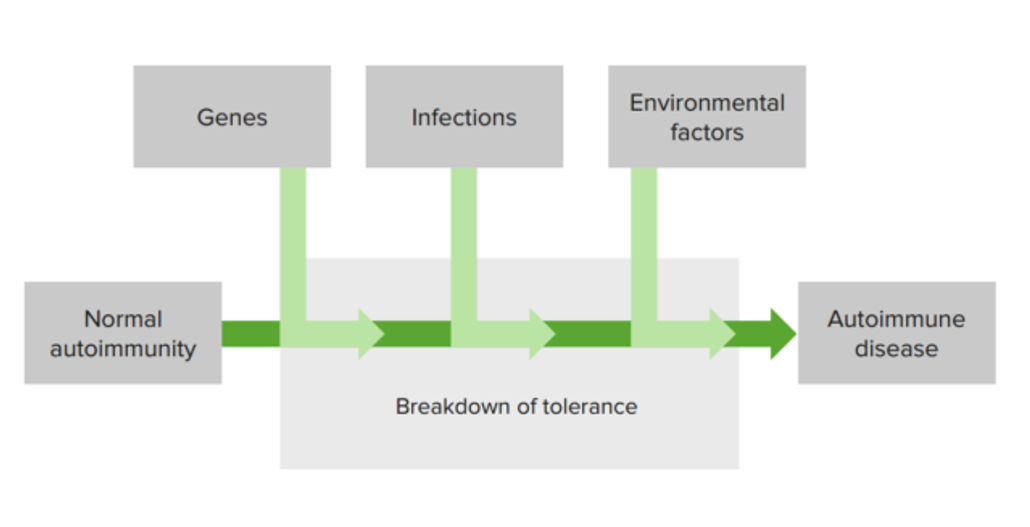
Múltiples factores afectan el desarrollo de la enfermedad autoinmune:
La combinación de factores de susceptibilidad genética, el medioambiente y un defecto en la tolerancia inmunológica conducen a la activación de linfocitos autorreactivos y al desarrollo de trastornos autoinmunitarios.

Imagen por Lecturio.

Genes Genes A category of nucleic acid sequences that function as units of heredity and which code for the basic instructions for the development, reproduction, and maintenance of organisms. DNA Types and Structure seleccionados asociados con enfermedades autoinmunes

Tabla: Genes Genes A category of nucleic acid sequences that function as units of heredity and which code for the basic instructions for the development, reproduction, and maintenance of organisms. DNA Types and Structure seleccionados asociados con enfermedades autoinmunes
Genes Genes A category of nucleic acid sequences that function as units of heredity and which code for the basic instructions for the development, reproduction, and maintenance of organisms. DNA Types and Structure Enfermedad autoinmune asociada
CMH/HLA La mayoría de las enfermedades autoinmunes
PTPN22
  • Diabetes Diabetes Diabetes mellitus (DM) is a metabolic disease characterized by hyperglycemia and dysfunction of the regulation of glucose metabolism by insulin. Type 1 DM is diagnosed mostly in children and young adults as the result of autoimmune destruction of β cells in the pancreas and the resulting lack of insulin. Type 2 DM has a significant association with obesity and is characterized by insulin resistance. Diabetes Mellitus tipo 1
  • Artritis reumatoide
  • Enfermedades autoinmunes de la tiroides
  • Enfermedad inflamatoria intestinal
CTLA4
  • Diabetes Diabetes Diabetes mellitus (DM) is a metabolic disease characterized by hyperglycemia and dysfunction of the regulation of glucose metabolism by insulin. Type 1 DM is diagnosed mostly in children and young adults as the result of autoimmune destruction of β cells in the pancreas and the resulting lack of insulin. Type 2 DM has a significant association with obesity and is characterized by insulin resistance. Diabetes Mellitus tipo 1
  • Artritis reumatoide
  • Enfermedad autoinmune de la tiroides
IL2RA
  • Diabetes Diabetes Diabetes mellitus (DM) is a metabolic disease characterized by hyperglycemia and dysfunction of the regulation of glucose metabolism by insulin. Type 1 DM is diagnosed mostly in children and young adults as the result of autoimmune destruction of β cells in the pancreas and the resulting lack of insulin. Type 2 DM has a significant association with obesity and is characterized by insulin resistance. Diabetes Mellitus tipo 1
  • Esclerosis múltiple
IL2/IL21
  • Diabetes Diabetes Diabetes mellitus (DM) is a metabolic disease characterized by hyperglycemia and dysfunction of the regulation of glucose metabolism by insulin. Type 1 DM is diagnosed mostly in children and young adults as the result of autoimmune destruction of β cells in the pancreas and the resulting lack of insulin. Type 2 DM has a significant association with obesity and is characterized by insulin resistance. Diabetes Mellitus tipo 1
  • Artritis reumatoide
  • Enfermedad inflamatoria intestinal
BLK
  • Artritis reumatoide
  • LES

Mecanismos patogénicos

  • Defecto en EN Erythema nodosum is an immune-mediated panniculitis (inflammation of the subcutaneous fat) caused by a type IV (delayed-type) hypersensitivity reaction. It commonly manifests in young women as tender, erythematous nodules on the shins. Erythema Nodosum la tolerancia inmune:
    • Puede afectar la tolerancia central o periférica.
    • Mutación que involucra a la proteína reguladora autoinmune → candidiasis Candidiasis Candida is a genus of dimorphic, opportunistic fungi. Candida albicans is part of the normal human flora and is the most common cause of candidiasis. The clinical presentation varies and can include localized mucocutaneous infections (e.g., oropharyngeal, esophageal, intertriginous, and vulvovaginal candidiasis) and invasive disease (e.g., candidemia, intraabdominal abscess, pericarditis, and meningitis). Candida/Candidiasis mucocutánea crónica (síndrome autoinmune con infecciones crónicas no invasivas por Candida Candida Candida is a genus of dimorphic, opportunistic fungi. Candida albicans is part of the normal human flora and is the most common cause of candidiasis. The clinical presentation varies and can include localized mucocutaneous infections (e.g., oropharyngeal, esophageal, intertriginous, and vulvovaginal candidiasis) and invasive disease (e.g., candidemia, intraabdominal abscess, pericarditis, and meningitis). Candida/Candidiasis)
    • La ignorancia inmunológica puede superarse mediante una mayor disponibilidad de antígenos.
  • Defecto en EN Erythema nodosum is an immune-mediated panniculitis (inflammation of the subcutaneous fat) caused by a type IV (delayed-type) hypersensitivity reaction. It commonly manifests in young women as tender, erythematous nodules on the shins. Erythema Nodosum la regulación activa:
    • Las células T reguladoras expresan FOXP3.
    • Mutaciones que involucran FOXP3 → síndrome de inmunodisregulación poliendocrinopatía enteropatía ligada al AL Amyloidosis cromosoma X
  • Defecto en EN Erythema nodosum is an immune-mediated panniculitis (inflammation of the subcutaneous fat) caused by a type IV (delayed-type) hypersensitivity reaction. It commonly manifests in young women as tender, erythematous nodules on the shins. Erythema Nodosum la regulación central y periférica de las células B:
    • Las células B autorreactivas se eliminan a través de varios mecanismos o puntos de control (deleción, anergia y edición del receptor Receptor Receptors are proteins located either on the surface of or within a cell that can bind to signaling molecules known as ligands (e.g., hormones) and cause some type of response within the cell. Receptors).
    • En EN Erythema nodosum is an immune-mediated panniculitis (inflammation of the subcutaneous fat) caused by a type IV (delayed-type) hypersensitivity reaction. It commonly manifests in young women as tender, erythematous nodules on the shins. Erythema Nodosum LES, se han observado puntos de control aberrantes y aumento de células B autorreactivas.
  • Superficie celular y antígenos solubles atacados:
    • Los LOS Neisseria antígenos en EN Erythema nodosum is an immune-mediated panniculitis (inflammation of the subcutaneous fat) caused by a type IV (delayed-type) hypersensitivity reaction. It commonly manifests in young women as tender, erythematous nodules on the shins. Erythema Nodosum las superficies celulares pueden ser atacados por autoanticuerpos.
    • Ejemplos:
      • Célula tiroidea con receptores superficiales de hormona estimulante de la tiroides (TSH, por sus siglas en EN Erythema nodosum is an immune-mediated panniculitis (inflammation of the subcutaneous fat) caused by a type IV (delayed-type) hypersensitivity reaction. It commonly manifests in young women as tender, erythematous nodules on the shins. Erythema Nodosum inglés) → estimulación del receptor Receptor Receptors are proteins located either on the surface of or within a cell that can bind to signaling molecules known as ligands (e.g., hormones) and cause some type of response within the cell. Receptors (enfermedad de Graves)
      • Uniones neuromusculares con receptores de acetilcolina → bloqueo (miastenia gravis)
  • Inmunidad innata:
    • Los LOS Neisseria receptores de reconocimiento de patrones son proteínas (esenciales para la inmunidad innata) que distinguen el material extraño (e.g., microbios) del propio.
    • La variante de proteínas repetidas ricas en EN Erythema nodosum is an immune-mediated panniculitis (inflammation of the subcutaneous fat) caused by a type IV (delayed-type) hypersensitivity reaction. It commonly manifests in young women as tender, erythematous nodules on the shins. Erythema Nodosum leucina (NALP) NACHT (NAIP, CIITA, HET-E y TP1), un PRR, está asociada con afecciones autoinmunes con vitíligo.
  • Lesión mediada por células T:
    • Se genera una respuesta de células T citotóxicas.
    • PTPN22 : afecta a la enzima que altera la señalización en EN Erythema nodosum is an immune-mediated panniculitis (inflammation of the subcutaneous fat) caused by a type IV (delayed-type) hypersensitivity reaction. It commonly manifests in young women as tender, erythematous nodules on the shins. Erythema Nodosum los LOS Neisseria linfocitos (hiperreactividad de las células T)
  • Formación de inmunocomplejos:
    • Los LOS Neisseria inmunocomplejos resultan de una reacción entre anticuerpos y antígenos presentes en EN Erythema nodosum is an immune-mediated panniculitis (inflammation of the subcutaneous fat) caused by a type IV (delayed-type) hypersensitivity reaction. It commonly manifests in young women as tender, erythematous nodules on the shins. Erythema Nodosum las superficies celulares o en EN Erythema nodosum is an immune-mediated panniculitis (inflammation of the subcutaneous fat) caused by a type IV (delayed-type) hypersensitivity reaction. It commonly manifests in young women as tender, erythematous nodules on the shins. Erythema Nodosum la circulación.
    • Depósito en EN Erythema nodosum is an immune-mediated panniculitis (inflammation of the subcutaneous fat) caused by a type IV (delayed-type) hypersensitivity reaction. It commonly manifests in young women as tender, erythematous nodules on the shins. Erythema Nodosum órganos → respuesta inmune contra los LOS Neisseria depósitos de inmunocomplejos → enfermedad autoinmune

Principales Enfermedades Autoinmunes

Enfermedad de Graves

  • Descripción: presencia de anticuerpos circulantes contra los LOS Neisseria receptores de TSH, lo que conduce a un aumento de la función tiroidea
  • Mecanismo autoinmune:
    • Se producen autoanticuerpos, sobre todo anticuerpos contra el receptor Receptor Receptors are proteins located either on the surface of or within a cell that can bind to signaling molecules known as ligands (e.g., hormones) and cause some type of response within the cell. Receptors de tirotropina.
    • En EN Erythema nodosum is an immune-mediated panniculitis (inflammation of the subcutaneous fat) caused by a type IV (delayed-type) hypersensitivity reaction. It commonly manifests in young women as tender, erythematous nodules on the shins. Erythema Nodosum el 90% de los LOS Neisseria casos, se observan inmunoglobulinas estimulantes de la tiroides.
    • Inmunoglobulinas estimulantes de la tiroides → estimulan el receptor Receptor Receptors are proteins located either on the surface of or within a cell that can bind to signaling molecules known as ligands (e.g., hormones) and cause some type of response within the cell. Receptors de TSH → liberación de hormonas tiroideas
  • Efecto: hiperfunción de la glándula tiroides (hipertiroidismo)

Artritis reumatoide

  • Descripción: enfermedad crónica, progresiva, autoinmune con poliartritis inflamatoria simétrica
  • Mecanismo autoinmune:
    • Células T colaboradoras activadas → mediadores inflamatorios que causan lesión tisular:
      • Interferones e interleucinas
      • TNF TNF Tumor necrosis factor (TNF) is a major cytokine, released primarily by macrophages in response to stimuli. The presence of microbial products and dead cells and injury are among the stimulating factors. This protein belongs to the TNF superfamily, a group of ligands and receptors performing functions in inflammatory response, morphogenesis, and cell proliferation. Tumor Necrosis Factor (TNF) (el más implicado, por lo tanto, los LOS Neisseria productos biológicos anti-TNF se usan para el tratamiento)
    • Los LOS Neisseria linfocitos B producen anticuerpos contra las proteínas citrulinadas (anticuerpos antipéptido citrulinado, a menudo analizados como péptido anticíclico citrulinado).
  • Efectos:
    • Inflamación de la articulación
    • Daños estructurales en EN Erythema nodosum is an immune-mediated panniculitis (inflammation of the subcutaneous fat) caused by a type IV (delayed-type) hypersensitivity reaction. It commonly manifests in young women as tender, erythematous nodules on the shins. Erythema Nodosum los LOS Neisseria sitios afectados

Enfermedad de Hashimoto

  • Descripción: enfermedad autoinmune con destrucción de las células tiroideas e insuficiencia tiroidea
  • Mecanismo autoinmune:
    • Desglose de la tolerancia inmunológica a los LOS Neisseria autoantígenos tiroideos (que incluyen peroxidasa tiroidea, tiroglobulina y receptor Receptor Receptors are proteins located either on the surface of or within a cell that can bind to signaling molecules known as ligands (e.g., hormones) and cause some type of response within the cell. Receptors de TSH)
    • Las células T citotóxicas y las citoquinas destruyen las células tiroideas.
    • Anticuerpos contra tiroglobulina y peroxidasa tiroidea: papel secundario en EN Erythema nodosum is an immune-mediated panniculitis (inflammation of the subcutaneous fat) caused by a type IV (delayed-type) hypersensitivity reaction. It commonly manifests in young women as tender, erythematous nodules on the shins. Erythema Nodosum la muerte de las células tiroideas, pero son marcadores de autoinmunidad tiroidea
    • También se encuentran anticuerpos para el receptor Receptor Receptors are proteins located either on the surface of or within a cell that can bind to signaling molecules known as ligands (e.g., hormones) and cause some type of response within the cell. Receptors de TSH de tipo bloqueador
  • Efectos:
    • Infiltración linfocítica de la tiroides (tiroiditis linfocítica crónica)
    • Destrucción del tejido tiroideo → hipotiroidismo

Síndrome de Sjögren

  • Descripción: infiltración de tejidos glandulares, como las glándulas salivales y lagrimales, por linfocitos
  • Mecanismo autoinmune:
    • El desencadenante puede ser una infección viral → muerte celular y liberación de antígenos tisulares
    • Los LOS Neisseria linfocitos aberrantes (generalmente células T CD4+ y células B) se infiltran en EN Erythema nodosum is an immune-mediated panniculitis (inflammation of the subcutaneous fat) caused by a type IV (delayed-type) hypersensitivity reaction. It commonly manifests in young women as tender, erythematous nodules on the shins. Erythema Nodosum las glándulas.
    • Citoquinas y autoanticuerpos → dañan y atrofian las glándulas → ↓ producción exocrina
    • Los LOS Neisseria anticuerpos contra 2 ribonucleoproteínas están presentes en EN Erythema nodosum is an immune-mediated panniculitis (inflammation of the subcutaneous fat) caused by a type IV (delayed-type) hypersensitivity reaction. It commonly manifests in young women as tender, erythematous nodules on the shins. Erythema Nodosum el 60%–70% de los LOS Neisseria casos:
      • Anticuerpos anti-SSA/Ro
      • Anticuerpos anti-SSB/La
  • Efectos:
    • Infiltración linfocítica de las glándulas lagrimales y salivales → ↓ función de las glándulas secretoras
    • Otras glándulas exocrinas pueden estar involucradas.

Esclerosis múltiple

  • Descripción: enfermedad autoinmune inflamatoria crónica que conduce a la desmielinización del SNC
  • Mecanismo autoinmune:
    • Mecanismo exacto desconocido
    • Las células T colaboradoras 1 y T colaboradora 17 reaccionan contra los LOS Neisseria antígenos de mielina → ↑ citoquinas, macrófagos y otros leucocitos → daño y muerte celular
  • Efectos:
    • Desmielinización → déficits neurológicos
    • Sitios más probablemente afectados:
      • Sustancia blanca periventricular
      • Nervio óptico
      • Tronco encefálico
      • Pedúnculos cerebelosos
      • Cuerpo calloso
      • Médula espinal

Espondilitis anquilosante

  • Descripción:
    • Inflamación crónica del esqueleto axial Axial Computed Tomography (CT), con enfermedad grave que lleva a la fusión y rigidez de la columna vertebral
    • Fuertemente asociado con HLA-B27
  • Mecanismo autoinmune:
    • Se activa la inmunidad innata.
    • Los LOS Neisseria microbios gastrointestinales posiblemente invaden la circulación sistémica (debido a la alteración de la barrera de la mucosa intestinal).
    • Se liberan células, citoquinas e IL → las células inmunitarias similares a las innatas van a las articulaciones y entesis.
  • Efectos:
    • Entesitis (inflamación en EN Erythema nodosum is an immune-mediated panniculitis (inflammation of the subcutaneous fat) caused by a type IV (delayed-type) hypersensitivity reaction. It commonly manifests in young women as tender, erythematous nodules on the shins. Erythema Nodosum el sitio de inserción del ligamento o tendón en EN Erythema nodosum is an immune-mediated panniculitis (inflammation of the subcutaneous fat) caused by a type IV (delayed-type) hypersensitivity reaction. It commonly manifests in young women as tender, erythematous nodules on the shins. Erythema Nodosum el hueso)
    • Inflamación crónica → formación de sindesmofitos → fusión vertebral

Diabetes Diabetes Diabetes mellitus (DM) is a metabolic disease characterized by hyperglycemia and dysfunction of the regulation of glucose metabolism by insulin. Type 1 DM is diagnosed mostly in children and young adults as the result of autoimmune destruction of β cells in the pancreas and the resulting lack of insulin. Type 2 DM has a significant association with obesity and is characterized by insulin resistance. Diabetes Mellitus tipo 1

  • Descripción: trastorno metabólico con hiperglucemia, debido a deficiencia de insulina
  • Mecanismo autoinmune:
    • Como con cualquier enfermedad autoinmune, la genética y el medio ambiente juegan un papel.
    • La tolerancia inmunológica de las células T (específicas para los LOS Neisseria antígenos de los LOS Neisseria islotes) falla.
    • Puede ser un defecto en EN Erythema nodosum is an immune-mediated panniculitis (inflammation of the subcutaneous fat) caused by a type IV (delayed-type) hypersensitivity reaction. It commonly manifests in young women as tender, erythematous nodules on the shins. Erythema Nodosum las células T reguladoras o una deleción clonal
  • Efectos:
    • Destrucción de células β pancreáticas
    • Deficiencia de insulina → ↑ glucosa

Lupus eritematoso sistémico

  • Descripción: condición inflamatoria autoinmune que causa el depósito de inmunocomplejos en EN Erythema nodosum is an immune-mediated panniculitis (inflammation of the subcutaneous fat) caused by a type IV (delayed-type) hypersensitivity reaction. It commonly manifests in young women as tender, erythematous nodules on the shins. Erythema Nodosum los LOS Neisseria órganos, lo que resulta en EN Erythema nodosum is an immune-mediated panniculitis (inflammation of the subcutaneous fat) caused by a type IV (delayed-type) hypersensitivity reaction. It commonly manifests in young women as tender, erythematous nodules on the shins. Erythema Nodosum manifestaciones sistémicas.
  • Mecanismo autoinmune:
    • El daño celular se produce por desencadenantes multifactoriales → ↑ exposición a antígenos nucleares (ADN y ARN)
    • Las células T y B autorreactivas se activan → producción de autoanticuerpos:
      • Anticuerpos antinucleares (ANA, por sus siglas en EN Erythema nodosum is an immune-mediated panniculitis (inflammation of the subcutaneous fat) caused by a type IV (delayed-type) hypersensitivity reaction. It commonly manifests in young women as tender, erythematous nodules on the shins. Erythema Nodosum inglés)
      • Anticuerpos anti-ADN de doble cadena (anti-dsDNA)
      • Anticuerpos anti-Smith (anti-Sm)
      • Anticuerpos anti-histona
      • Anticuerpos anti-Ro y anti-La
      • Anticuerpos anti-ribonucleoproteína
      • Anticuerpos antifosfolípidos
    • La activación permanente de las células T y B da como resultado una ↑ producción de anticuerpos persistente → daño de órganos por:
      • Depósito de inmunocomplejos (órganos y vasculatura)
      • Interacción directa con antígenos nucleares → complemento activador → lesión celular y apoptosis Apoptosis A regulated cell death mechanism characterized by distinctive morphologic changes in the nucleus and cytoplasm, including the endonucleolytic cleavage of genomic DNA, at regularly spaced, internucleosomal sites, I.e., DNA fragmentation. It is genetically-programmed and serves as a balance to mitosis in regulating the size of animal tissues and in mediating pathologic processes associated with tumor growth. Ischemic Cell Damage
  • Efectos:
    • Los LOS Neisseria cambios inflamatorios, notables en EN Erythema nodosum is an immune-mediated panniculitis (inflammation of the subcutaneous fat) caused by a type IV (delayed-type) hypersensitivity reaction. It commonly manifests in young women as tender, erythematous nodules on the shins. Erythema Nodosum los LOS Neisseria vasos sanguíneos, los LOS Neisseria riñones, el tejido conectivo y la piel, conducen al AL Amyloidosis daño y la disfunción de los LOS Neisseria órganos.
    • La afectación multisistémica provoca una presentación clínica variable Variable Variables represent information about something that can change. The design of the measurement scales, or of the methods for obtaining information, will determine the data gathered and the characteristics of that data. As a result, a variable can be qualitative or quantitative, and may be further classified into subgroups. Types of Variables.

Miastenia gravis

  • Descripción: debilidad y fatigabilidad de los LOS Neisseria músculos esqueléticos, generalmente asociada con disfunción/destrucción de los LOS Neisseria receptores de acetilcolina (AchR)
  • Mecanismo autoinmune:
    • Anticuerpos contra AchR (observados en EN Erythema nodosum is an immune-mediated panniculitis (inflammation of the subcutaneous fat) caused by a type IV (delayed-type) hypersensitivity reaction. It commonly manifests in young women as tender, erythematous nodules on the shins. Erythema Nodosum el 85 %) en EN Erythema nodosum is an immune-mediated panniculitis (inflammation of the subcutaneous fat) caused by a type IV (delayed-type) hypersensitivity reaction. It commonly manifests in young women as tender, erythematous nodules on the shins. Erythema Nodosum la unión neuromuscular:
      • Bloquea la unión de acetilcolina o destruye los LOS Neisseria sitios receptores
      • Bloquea la acción de la tirosina quinasa específica del músculo (MuSK), que es un componente transmembrana de la unión neuromuscular
    • Algunos pacientes tienen timomas asociados (10%), que pueden presentarse como un síndrome paraneoplásico secundario a timomas.
    • Algunos no tienen anticuerpos contra AchR o MuSK (miastenia grave con anticuerpos negativos):
      • Están presentes anticuerpos contra la proteína 4 relacionada con el receptor Receptor Receptors are proteins located either on the surface of or within a cell that can bind to signaling molecules known as ligands (e.g., hormones) and cause some type of response within the cell. Receptors de lipoproteínas.
      • La proteína 4 relacionada con el receptor Receptor Receptors are proteins located either on the surface of or within a cell that can bind to signaling molecules known as ligands (e.g., hormones) and cause some type of response within the cell. Receptors de lipoproteínas está presente en EN Erythema nodosum is an immune-mediated panniculitis (inflammation of the subcutaneous fat) caused by a type IV (delayed-type) hypersensitivity reaction. It commonly manifests in young women as tender, erythematous nodules on the shins. Erythema Nodosum la membrana postsináptica e induce la agrupación de AChR.
  • Efectos:
    • Agotamiento de AchR
    • Limitación de las miofibras para responder a la acetilcolina
    • Debilidad fluctuante o fatigabilidad que empeora con el esfuerzo a lo largo del día

Tratamiento

Los LOS Neisseria enfoques utilizados en EN Erythema nodosum is an immune-mediated panniculitis (inflammation of the subcutaneous fat) caused by a type IV (delayed-type) hypersensitivity reaction. It commonly manifests in young women as tender, erythematous nodules on the shins. Erythema Nodosum el tratamiento de enfermedades autoinmunes son:

  • Reemplazar el componente faltante:
    • Cuando la respuesta inflamatoria es extensa y el daño es irreversible
    • Observado en EN Erythema nodosum is an immune-mediated panniculitis (inflammation of the subcutaneous fat) caused by a type IV (delayed-type) hypersensitivity reaction. It commonly manifests in young women as tender, erythematous nodules on the shins. Erythema Nodosum:
      • Diabetes Diabetes Diabetes mellitus (DM) is a metabolic disease characterized by hyperglycemia and dysfunction of the regulation of glucose metabolism by insulin. Type 1 DM is diagnosed mostly in children and young adults as the result of autoimmune destruction of β cells in the pancreas and the resulting lack of insulin. Type 2 DM has a significant association with obesity and is characterized by insulin resistance. Diabetes Mellitus tipo 1: insulina
      • Tiroiditis de Hashimoto que causa hipotiroidismo: terapia con hormona tiroidea
  • Inhibición de la función, como en EN Erythema nodosum is an immune-mediated panniculitis (inflammation of the subcutaneous fat) caused by a type IV (delayed-type) hypersensitivity reaction. It commonly manifests in young women as tender, erythematous nodules on the shins. Erythema Nodosum:
    • Enfermedad de Graves: tiroidectomía, tratamiento antitiroideo o ablación con yodo radiactivo
    • Miastenia grave: timectomía, inhibidores de la anticolinesterasa
  • Centrarse en EN Erythema nodosum is an immune-mediated panniculitis (inflammation of the subcutaneous fat) caused by a type IV (delayed-type) hypersensitivity reaction. It commonly manifests in young women as tender, erythematous nodules on the shins. Erythema Nodosum prevenir las acciones de los LOS Neisseria componentes inmunitarios (e.g., células, citoquinas): inmunosupresores (e.g., corticosteroides, agentes biológicos)

Referencias

  1. Angum, F., Khan, T., Kaler, J., et al. (2020). The prevalence of autoimmune disorders in women: a narrative review. Cureus 12(5):e8094. https://doi.org/10.7759/cureus.8094
  2. Kumar, V., Abbas, A., Aster, J. (Eds.) (2021). Diseases of the immune system. In: Robbins and Cotran Pathologic Basis of Disease, 10th ed. Elsevier, pp. 215–234.
  3. Pisetsky, D. (2025). Overview of autoimmunity. UpToDate. Retrieved October 28, 2025, from https://www.uptodate.com/contents/overview-of-autoimmunity
  4. Rosenblum, M. D., Remedios, K. A., Abbas, A. K. (2015). Mechanisms of human autoimmunity. Journal of Clinical Investigation 125:2228–2233. https://doi.org/10.1172/JCI78088
  5. Smith, D.A., Germolec, D.R. (1999). Introduction to immunology and autoimmunity. Environ Health Perspect 107(Suppl 5):661–665. Retrieved October 28, 2025, from https://pubmed.ncbi.nlm.nih.gov/10502528/
  6. Zenewicz, L., Abraham, C., Flavell, R., Cho, J. (2010). Unravelling the genetics of autoimmunity. Cell 140:791–797. https://doi.org/10.1016/j.cell.2010.03.003

¡Crea tu cuenta gratis o inicia una sesión para seguir leyendo!

Regístrate ahora y obtén acceso gratuito a Lecturio con páginas de concepto, videos médicos y cuestionarios para tu educación médica.

User Reviews

Que tengas una sesión de estudio alegre y navideña 🎁 Ahorra 50% en todos los planes >>

Details