


Trocas Gasosas

Uma vez que as células humanas dependem principalmente do metabolismo aeróbico, é de vital importância obter eficientemente oxigénio do ambiente e trazê-lo para os tecidos enquanto se excreta o subproduto da respiração celular (CO2). A respiração envolve os sistemas respiratório e circulatório. Existem 4 processos que fornecem O2 ao corpo e eliminam o CO2. O sistema respiratório está envolvido na ventilação pulmonar e na respiração externa, enquanto o sistema circulatório é responsável pelo transporte e respiração interna. A ventilação pulmonar (respiração) representa o movimento do ar AR Aortic regurgitation (AR) is a cardiac condition characterized by the backflow of blood from the aorta to the left ventricle during diastole. Aortic regurgitation is associated with an abnormal aortic valve and/or aortic root stemming from multiple causes, commonly rheumatic heart disease as well as congenital and degenerative valvular disorders. Aortic Regurgitation para dentro e para fora dos pulmões. A respiração externa, ou trocas gasosas, é representada pela troca de O2 e CO2 entre os pulmões e o sangue.

Last updated: Dec 15, 2025

Editorial responsibility: Stanley Oiseth, Lindsay Jones, Evelin Maza

Anatomia do Sistema Respiratório Envolvido nas Trocas Gasosas

As trocas gasosas ocorrem ao nível dos alvéolos nos pulmões e nos capilares da circulação pulmonar.
  • Unidade respiratória:
    • Menor unidade funcional nos pulmões
    • Composto por um bronquíolo respiratório, ductos alveolares, átrios e alvéolos.
  • Leitos vasculares:
    • Os capilares preenchem o espaço entre os alvéolos.
    • Muito pouca distância entre o sangue nos capilares e o ar AR Aortic regurgitation (AR) is a cardiac condition characterized by the backflow of blood from the aorta to the left ventricle during diastole. Aortic regurgitation is associated with an abnormal aortic valve and/or aortic root stemming from multiple causes, commonly rheumatic heart disease as well as congenital and degenerative valvular disorders. Aortic Regurgitation nos alvéolos
  • Membrana pulmonar:
    • Área de interface entre os capilares e os alvéolos
    • Média de 0,6 micrómetros de espessura
    • Camadas da membrana pulmonar (dentro dos alvéolos → capilares):
      • Revestimento de camada fluida dentro do alvéolo (contém surfactante para quebrar a tensão superficial)
      • Epitélio alveolar
      • Membrana basal epitelial
      • Interstício
      • Membrana basal capilar
      • Membrana endotelial capilar
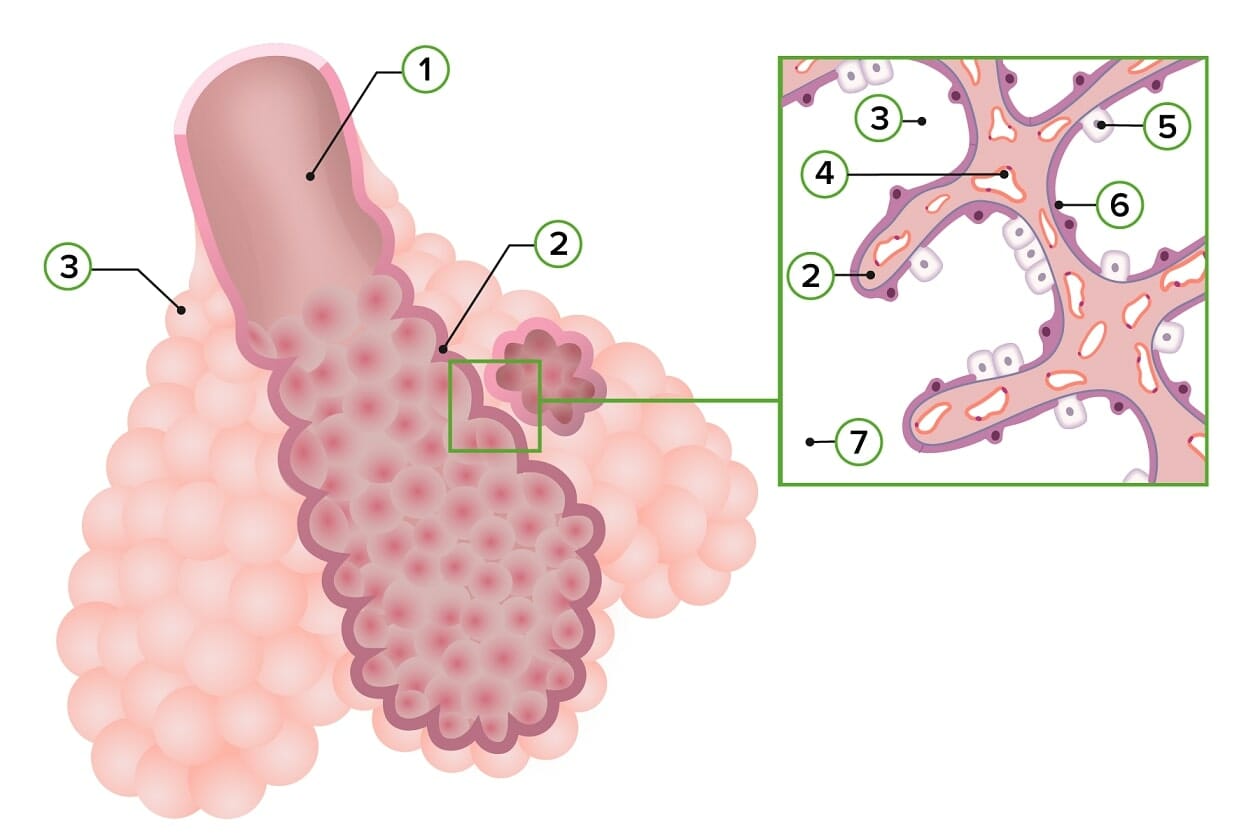
Schematic diagram of the structure of the respiratory zone of the lower respiratory tract

Diagrama esquemático da estrutura da zona respiratória do trato respiratório inferior:
Observar a composição da parede alveolar:
1) Bronquíolo respiratório
2) Septo interalveolar primário
3) Saco alveolar
4) Capilares
5) Pneumócito tipo II
6) Pneumócito tipo I
7) Ducto alveolar

Imagem por Lecturio.

Física das Trocas Gasosas

Propriedades físicas dos gases

Durante as trocas gasosas, O₂ e CO₂ devem atravessar a membrana pulmonar. Este processo é impulsionado por múltiplas forças complexas determinadas pelas propriedades físicas desses gases.

  • Concentração : O₂ e CO₂ fluirão das áreas de alta concentração para as de baixa concentração.
  • Diferença na pressão parcial do gás no ar AR Aortic regurgitation (AR) is a cardiac condition characterized by the backflow of blood from the aorta to the left ventricle during diastole. Aortic regurgitation is associated with an abnormal aortic valve and/or aortic root stemming from multiple causes, commonly rheumatic heart disease as well as congenital and degenerative valvular disorders. Aortic Regurgitation nos alvéolos e do gás dissolvido no sangue:
    • Pressão parcial do gás nos alvéolos:
      • A pressão do ar AR Aortic regurgitation (AR) is a cardiac condition characterized by the backflow of blood from the aorta to the left ventricle during diastole. Aortic regurgitation is associated with an abnormal aortic valve and/or aortic root stemming from multiple causes, commonly rheumatic heart disease as well as congenital and degenerative valvular disorders. Aortic Regurgitation num recipiente fixo é proporcional à concentração de moléculas de ar AR Aortic regurgitation (AR) is a cardiac condition characterized by the backflow of blood from the aorta to the left ventricle during diastole. Aortic regurgitation is associated with an abnormal aortic valve and/or aortic root stemming from multiple causes, commonly rheumatic heart disease as well as congenital and degenerative valvular disorders. Aortic Regurgitation forçadas para dentro desse recipiente.
      • O ar AR Aortic regurgitation (AR) is a cardiac condition characterized by the backflow of blood from the aorta to the left ventricle during diastole. Aortic regurgitation is associated with an abnormal aortic valve and/or aortic root stemming from multiple causes, commonly rheumatic heart disease as well as congenital and degenerative valvular disorders. Aortic Regurgitation atmosférico é composto por O₂, nitrogénio e dióxido de carbono. A taxa de difusão de cada gás é proporcional à pressão exercida por esse gás sozinho, chamada de pressão parcial.
      • Exemplo: O ar AR Aortic regurgitation (AR) is a cardiac condition characterized by the backflow of blood from the aorta to the left ventricle during diastole. Aortic regurgitation is associated with an abnormal aortic valve and/or aortic root stemming from multiple causes, commonly rheumatic heart disease as well as congenital and degenerative valvular disorders. Aortic Regurgitation atmosférico tem 760 mmHg e é 21% O₂. A pressão parcial de O₂ (PO₂) nos alvéolos é 760 x 0,21 = 160 mmHg.
    • Pressão parcial do gás dissolvido no sangue:
      • O gás dissolvido no líquido exerce pressão parcial determinada tanto pela sua concentração quanto por uma constante conhecida como coeficiente de solubilidade.
      • Exemplo: pressão parcial de O₂ dissolvido no sangue = concentração O₂/coeficiente de solubilidade de O₂ = 0,025 mmHg
    • O gás flui de áreas de alta pressão parcial para áreas de baixa pressão parcial.

Forças que impulsionam a taxa de troca de O₂ e CO₂

A taxa de troca gasosa é determinada pela eficiência da troca através da membrana pulmonar e pela velocidade com que ela pode ser trazida do ar AR Aortic regurgitation (AR) is a cardiac condition characterized by the backflow of blood from the aorta to the left ventricle during diastole. Aortic regurgitation is associated with an abnormal aortic valve and/or aortic root stemming from multiple causes, commonly rheumatic heart disease as well as congenital and degenerative valvular disorders. Aortic Regurgitation (para O₂) ou do corpo (para CO₂).

  • O₂:
    • A difusão de O₂ no sangue dos alvéolos é extremamente eficiente.
    • Mesmo ↑ a velocidade na qual o O₂ é levado aos alvéolos (ventilação) não pode melhorar a difusão do O₂ através da membrana pulmonar
    • O único fator que pode afetar a difusão é a modificação da pressão parcial de O₂ no ar AR Aortic regurgitation (AR) is a cardiac condition characterized by the backflow of blood from the aorta to the left ventricle during diastole. Aortic regurgitation is associated with an abnormal aortic valve and/or aortic root stemming from multiple causes, commonly rheumatic heart disease as well as congenital and degenerative valvular disorders. Aortic Regurgitation respirado (por exemplo, respirar O₂ puro ou respirar em altitudes elevadas).
  • CO₂:
    • A difusão é mais MAIS Androgen Insensitivity Syndrome lenta.
    • A velocidade de ventilação é diretamente proporcional à velocidade de difusão através da membrana pulmonar e da remoção do corpo.
  • Correlação clínica:
    • A saturação de O₂ do sangue é determinada pela pressão parcial de O₂ respirada pelo paciente.
    • A saturação de CO₂ do sangue é determinada pela velocidade da ventilação (respiração).

Transporte de Gás

O₂ e CO₂ devem ser transportados pela corrente sanguínea para alcançar os locais de troca gasosa.
Transporte de O₂

  • Há:
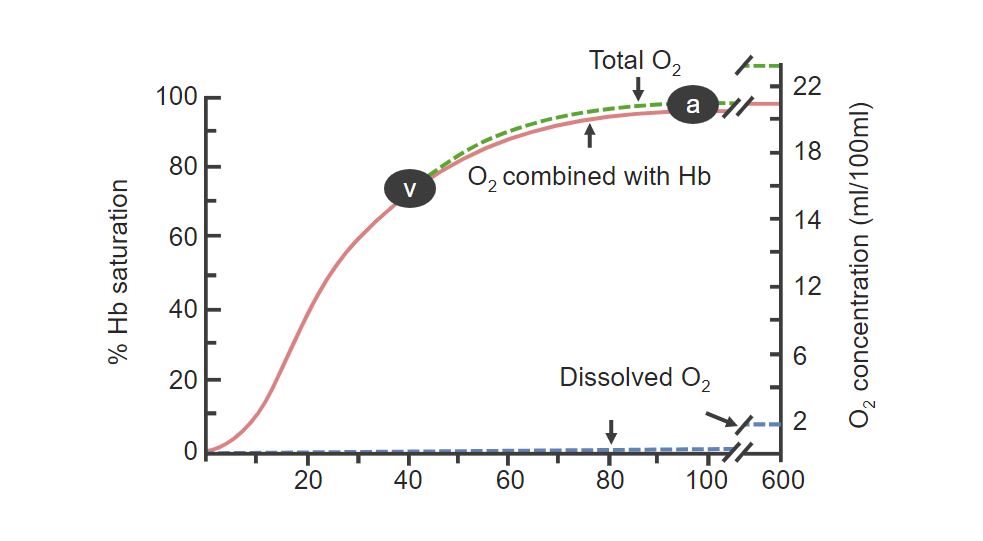
    • 0,295 mL de O₂ por dL de sangue arterial
    • 0,124 mL de O₂ por dL de sangue venoso
  • 1,5% de O₂: dissolvido no plasma Plasma The residual portion of blood that is left after removal of blood cells by centrifugation without prior blood coagulation. Transfusion Products.
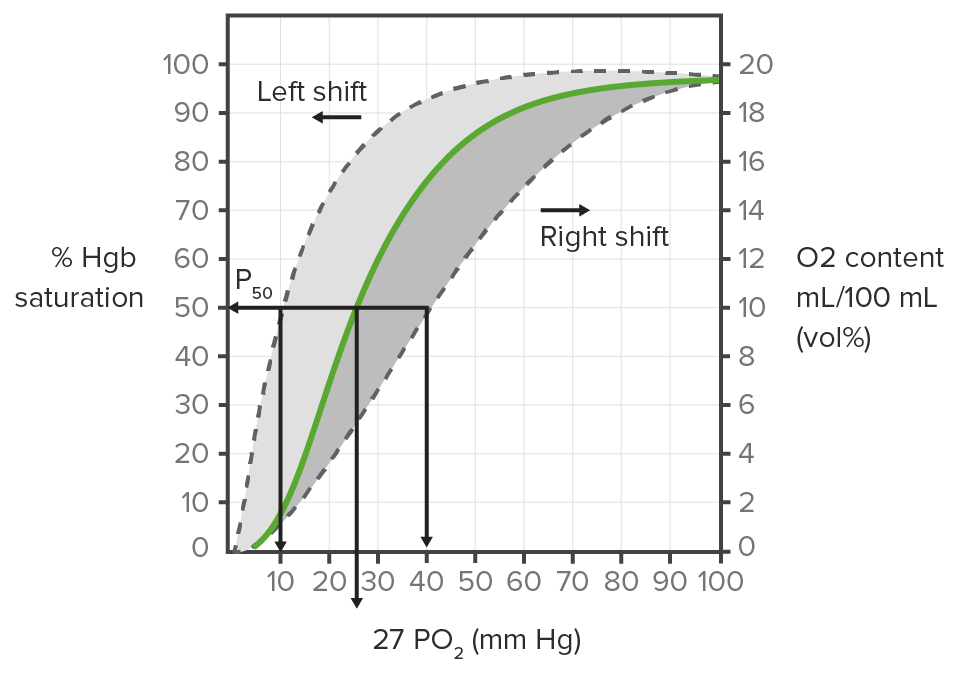
  • 98,5% de O₂: fracamente ligado a cada átomo de ferro da Hb Hb The oxygen-carrying proteins of erythrocytes. They are found in all vertebrates and some invertebrates. The number of globin subunits in the hemoglobin quaternary structure differs between species. Structures range from monomeric to a variety of multimeric arrangements. Gas Exchange nas hemácias.
  • Hb Hb The oxygen-carrying proteins of erythrocytes. They are found in all vertebrates and some invertebrates. The number of globin subunits in the hemoglobin quaternary structure differs between species. Structures range from monomeric to a variety of multimeric arrangements. Gas Exchange:
    • Possui 4 sítios de ligação para O
    • Afinidade da Hb Hb The oxygen-carrying proteins of erythrocytes. They are found in all vertebrates and some invertebrates. The number of globin subunits in the hemoglobin quaternary structure differs between species. Structures range from monomeric to a variety of multimeric arrangements. Gas Exchange para O₂ ↑ com a quantidade de O ligada a ela
  • Saturação de O :
    • Percentagem de Hb Hb The oxygen-carrying proteins of erythrocytes. They are found in all vertebrates and some invertebrates. The number of globin subunits in the hemoglobin quaternary structure differs between species. Structures range from monomeric to a variety of multimeric arrangements. Gas Exchange ligada a O₂:
      • No sangue arterial, a Hb Hb The oxygen-carrying proteins of erythrocytes. They are found in all vertebrates and some invertebrates. The number of globin subunits in the hemoglobin quaternary structure differs between species. Structures range from monomeric to a variety of multimeric arrangements. Gas Exchange tem uma saturação de O₂ próxima de 99%.
      • No sangue venoso, a Hb Hb The oxygen-carrying proteins of erythrocytes. They are found in all vertebrates and some invertebrates. The number of globin subunits in the hemoglobin quaternary structure differs between species. Structures range from monomeric to a variety of multimeric arrangements. Gas Exchange tem uma saturação de O₂ à volta de 75%.
      • Permite que a reserva de O₂ seja preservada no sangue
  • Carga e descarga de Hb Hb The oxygen-carrying proteins of erythrocytes. They are found in all vertebrates and some invertebrates. The number of globin subunits in the hemoglobin quaternary structure differs between species. Structures range from monomeric to a variety of multimeric arrangements. Gas Exchange:
    • A carga e descarga de O₂ são facilitadas por mudanças na forma da Hb Hb The oxygen-carrying proteins of erythrocytes. They are found in all vertebrates and some invertebrates. The number of globin subunits in the hemoglobin quaternary structure differs between species. Structures range from monomeric to a variety of multimeric arrangements. Gas Exchange.
      • À medida que o O₂ se liga, a afinidade da Hb Hb The oxygen-carrying proteins of erythrocytes. They are found in all vertebrates and some invertebrates. The number of globin subunits in the hemoglobin quaternary structure differs between species. Structures range from monomeric to a variety of multimeric arrangements. Gas Exchange pelo O₂ ↑
      • À medida que o O₂ é libertado, a afinidade da Hb Hb The oxygen-carrying proteins of erythrocytes. They are found in all vertebrates and some invertebrates. The number of globin subunits in the hemoglobin quaternary structure differs between species. Structures range from monomeric to a variety of multimeric arrangements. Gas Exchange pelo O₂ ↓
    • A taxa de carga e descarga de O₂ é regulada por:
      • PO₂ (↓ dos níveis de O₂ permitem que o O₂ se dissocie da Hb Hb The oxygen-carrying proteins of erythrocytes. They are found in all vertebrates and some invertebrates. The number of globin subunits in the hemoglobin quaternary structure differs between species. Structures range from monomeric to a variety of multimeric arrangements. Gas Exchange mais MAIS Androgen Insensitivity Syndrome facilmente)
      • ↑ da temperatura ↓ a afinidade da Hb Hb The oxygen-carrying proteins of erythrocytes. They are found in all vertebrates and some invertebrates. The number of globin subunits in the hemoglobin quaternary structure differs between species. Structures range from monomeric to a variety of multimeric arrangements. Gas Exchange para o O₂
      • pH pH The quantitative measurement of the acidity or basicity of a solution. Acid-Base Balance sanguíneo ↓ a afinidade da Hb Hb The oxygen-carrying proteins of erythrocytes. They are found in all vertebrates and some invertebrates. The number of globin subunits in the hemoglobin quaternary structure differs between species. Structures range from monomeric to a variety of multimeric arrangements. Gas Exchange para o O₂
      • ↑ PCO₂ ↓ afinidade da Hb Hb The oxygen-carrying proteins of erythrocytes. They are found in all vertebrates and some invertebrates. The number of globin subunits in the hemoglobin quaternary structure differs between species. Structures range from monomeric to a variety of multimeric arrangements. Gas Exchange para o O₂
      • ↑ da concentração de bifosfoglicerato (BPG) ↓ afinidade da Hb Hb The oxygen-carrying proteins of erythrocytes. They are found in all vertebrates and some invertebrates. The number of globin subunits in the hemoglobin quaternary structure differs between species. Structures range from monomeric to a variety of multimeric arrangements. Gas Exchange para o O₂

Transporte de CO₂

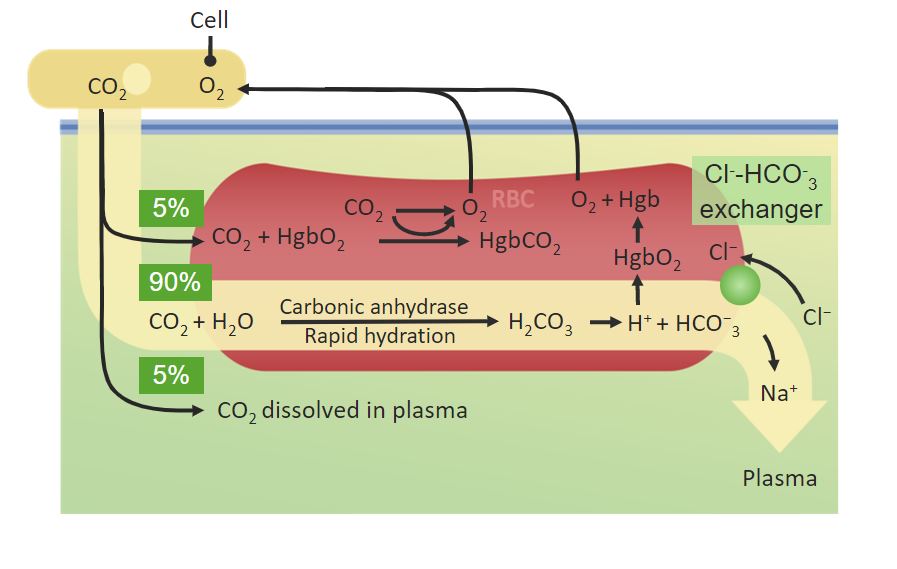
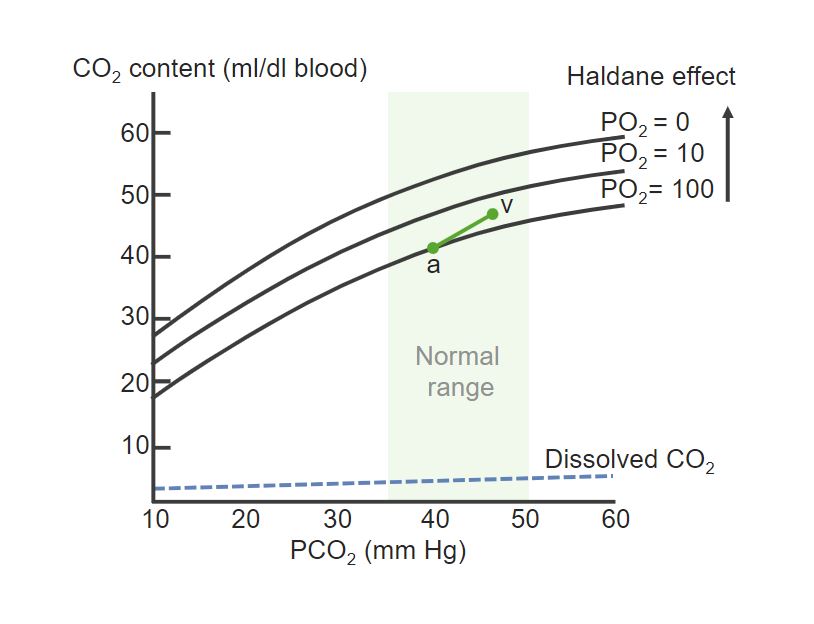
  • 7%–10% de CO₂: dissolvido no plasma Plasma The residual portion of blood that is left after removal of blood cells by centrifugation without prior blood coagulation. Transfusion Products
  • 20% de CO₂: ligado à Hb Hb The oxygen-carrying proteins of erythrocytes. They are found in all vertebrates and some invertebrates. The number of globin subunits in the hemoglobin quaternary structure differs between species. Structures range from monomeric to a variety of multimeric arrangements. Gas Exchange (carbaminohemoglobina)
  • Os 70% restantes são bicarbonato (HCO3); O CO₂ é convertido em HCO3 pela anidrase carbónica dentro das hemácias.

Acoplamento Ventilação/Perfusão (V/Q)

Ventilação e perfusão são os mecanismos que transportam O₂ e CO₂ entre a membrana pulmonar e os tecidos do corpo.

  • Para que as trocas gasosas sejam eficientes, a ventilação e a perfusão devem ser perfeitamente compatíveis.
  • Mudanças nas necessidades metabólicas ou estados de doença podem afetar a ventilação ou a perfusão de forma independente.
  • Existem mecanismos para manter a ventilação e a perfusão equilibradas.

Perfusão

Perfusão é o fluxo de sangue para a vasculatura pulmonar.
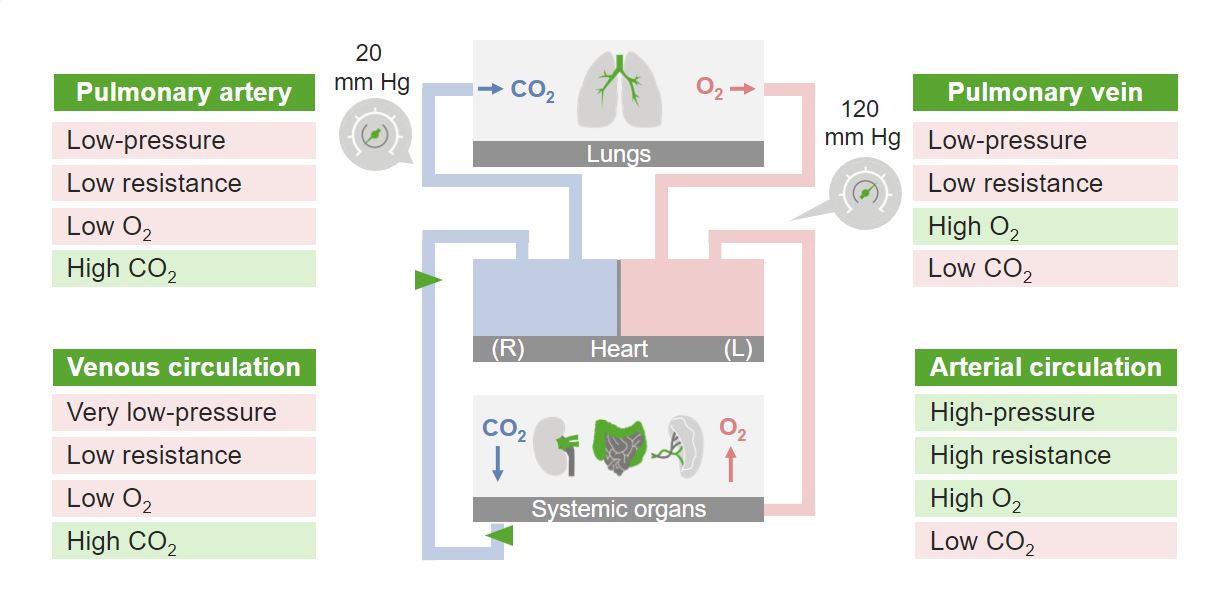
  • Perfusão pulmonar = débito cardíaco
  • Durante o exercício pesado, a necessidade metabólica de O₂↑ e mais MAIS Androgen Insensitivity Syndrome CO₂ deve ser removido
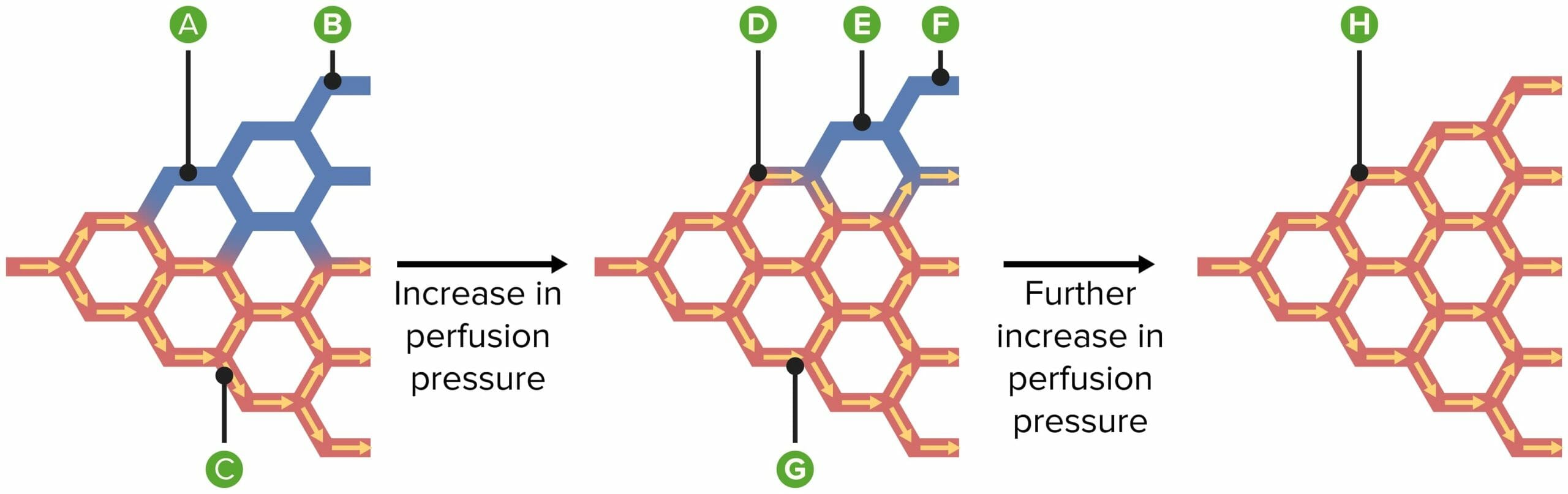
  • Débito cardíaco e fluxo sanguíneo pulmonar ↑ para satisfazer as necessidades através de 2 mecanismos:
    • Recrutamento: quando a pressão arterial pulmonar ↑, vasos colapsados abrem
    • Distensão: quando a pressão arterial pulmonar ↑, os vasos arteriais que conduziam sangue em plena capacidade alargam
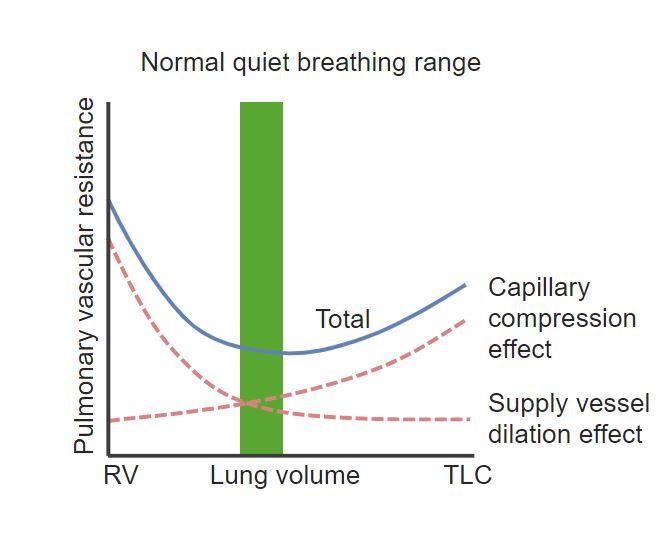
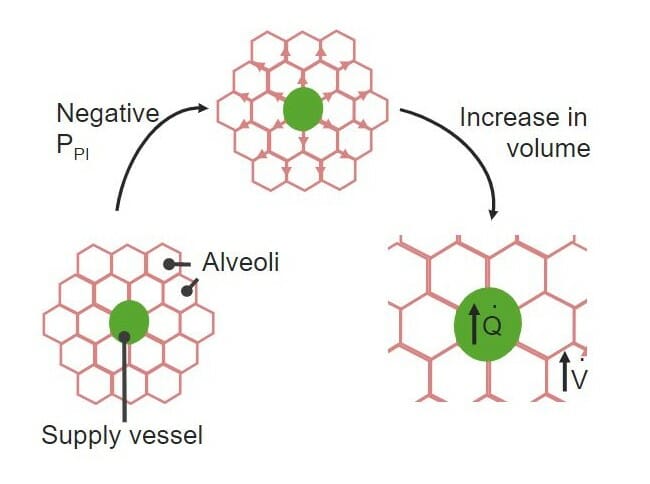
  • Volume pulmonar e fluxo sanguíneo:
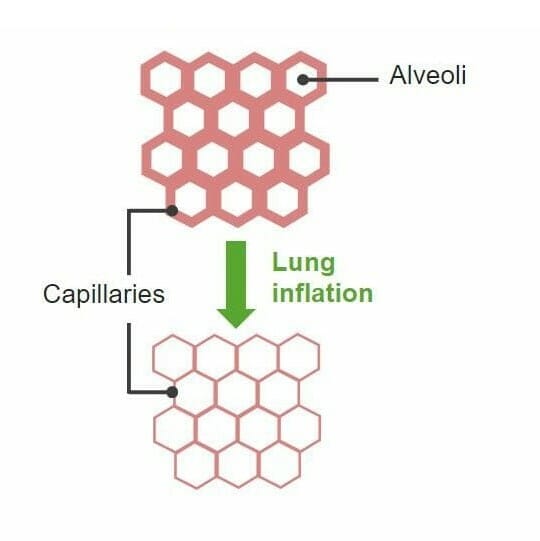
    • Em ↑ volumes pulmonares, os capilares são comprimidos, produzindo ↑ resistência vascular (efeito de compressão)
    • Em ↓ volumes pulmonares, os capilares também são comprimidos, ↑ resistência vascular
    • Efeito da vasodilatação no fluxo sanguíneo: A pressão pleural negativa exercida nos alvéolos sendo transferidos para os vasos sanguíneos causa vasodilatação.

Ventilação

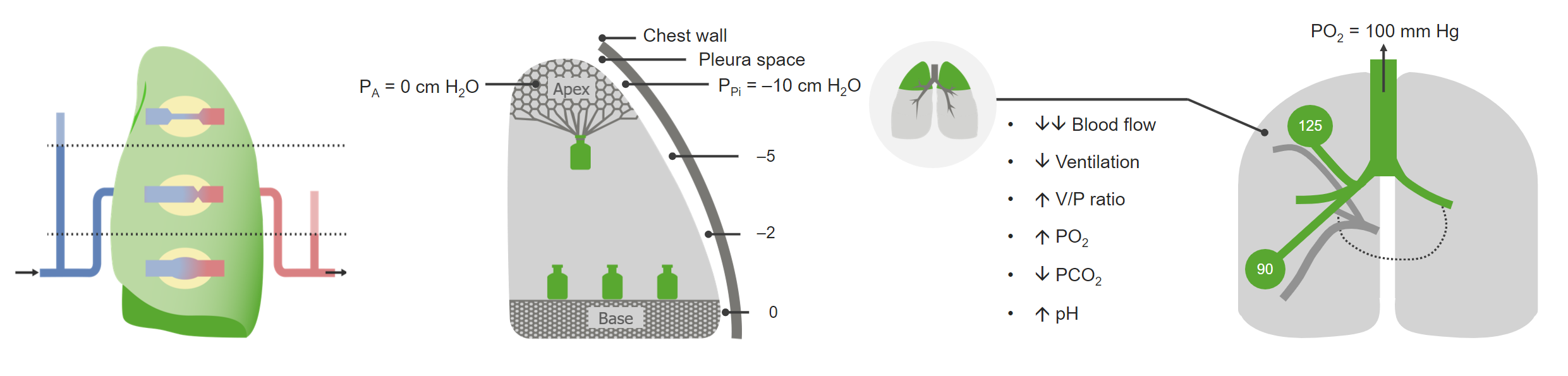
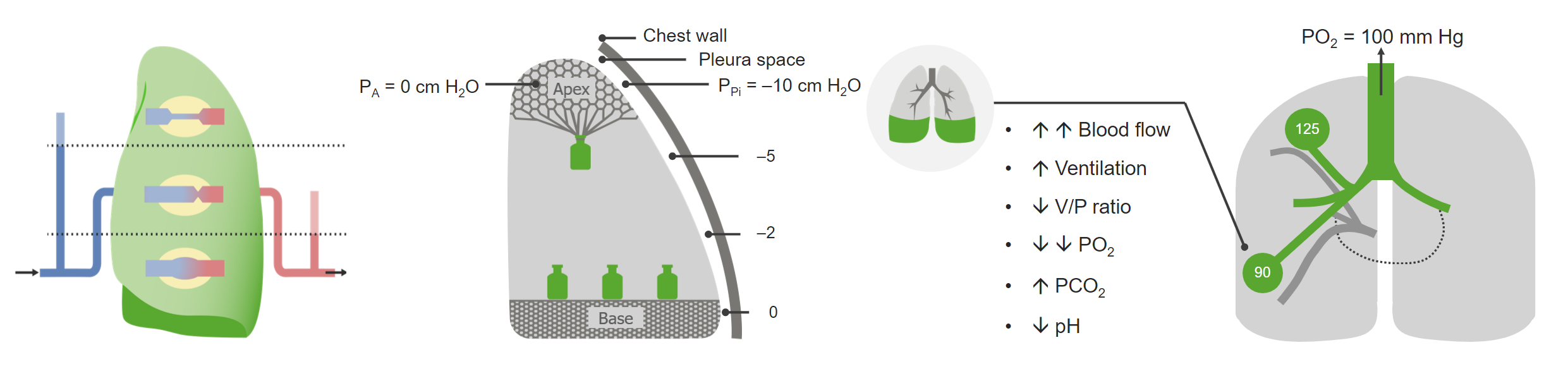
  • Alterações na PO₂ nos alvéolos → alterações no diâmetro das arteríolas que afetam a perfusão:
    • PO₂ induz vasoconstrição
    • PO₂ induz vasodilatação
    • Promove a redistribuição do fluxo sanguíneo para os alvéolos com maior PO₂
  • Quando PO₂ ↓ em todos os alvéolos, há vasoconstrição quimiorreflexa
  • Alterações na PCO₂ → alterações nos diâmetros dos bronquíolos:
    • Se o CO₂ alveolar for ↑, os bronquíolos dilatam
    • Se o CO₂ alveolar for ↓, os bronquíolos contraem
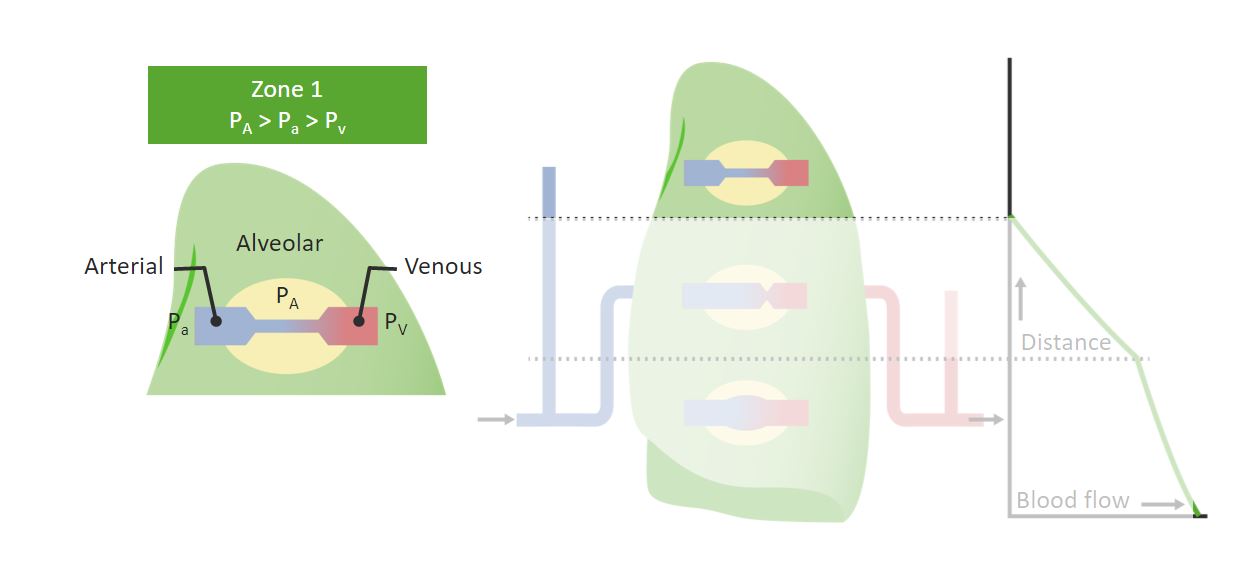
  • Gravidade e fluxo sanguíneo:
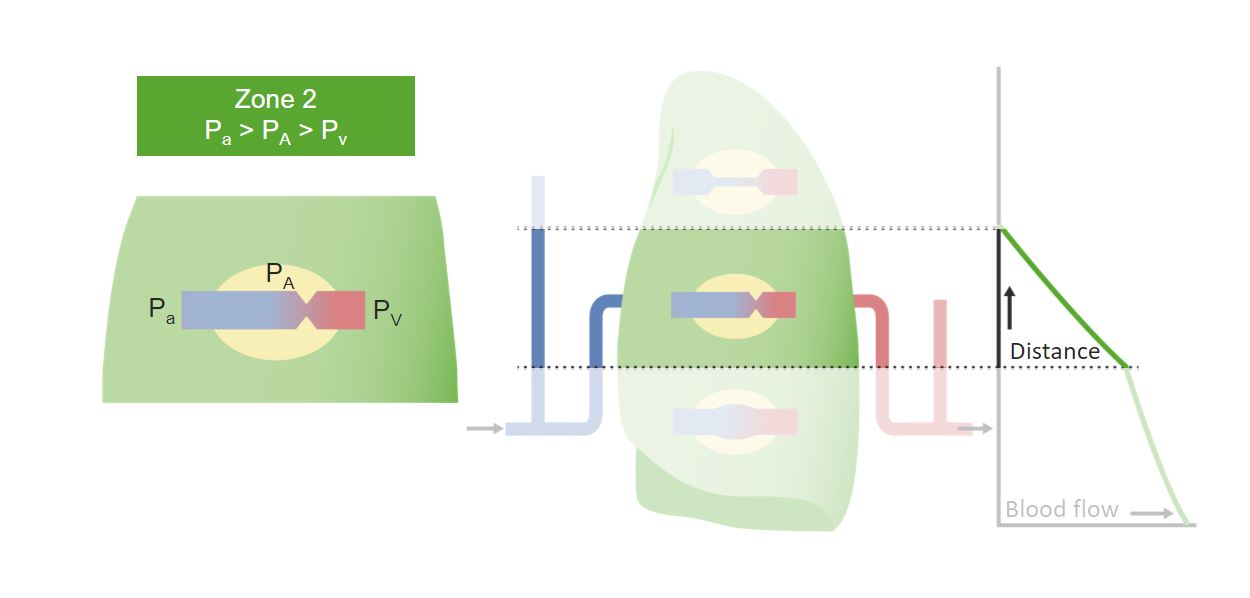
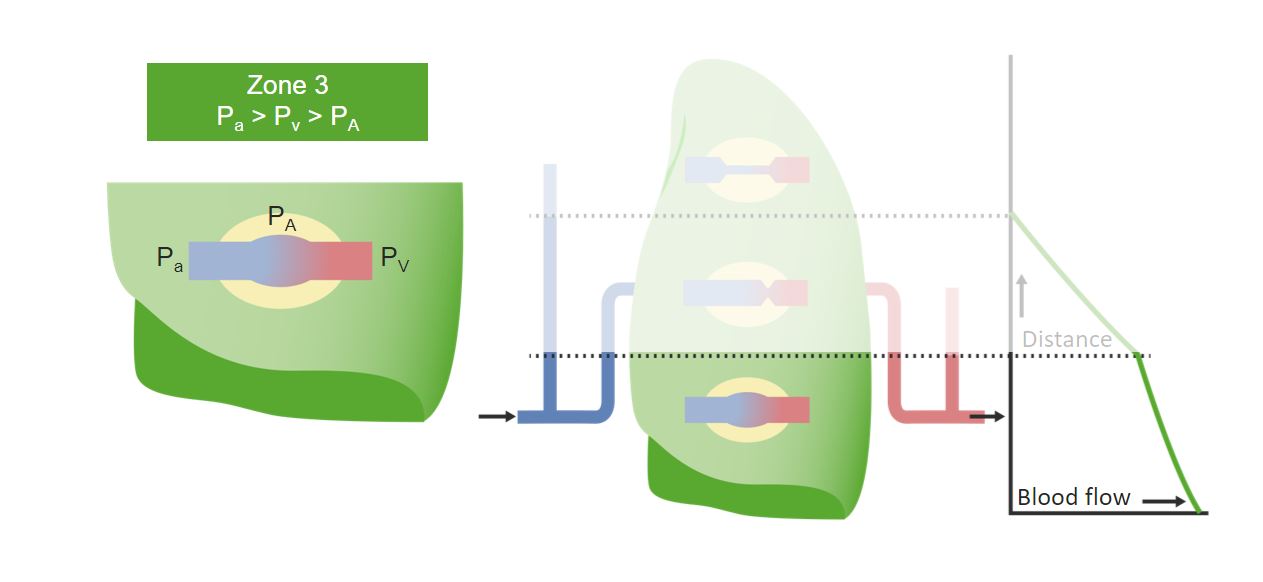
    • Gravidade ↓ fluxo de sangue em direção ao ápice e ↑ em direção à base

Hipoxemia e Hipercapnia

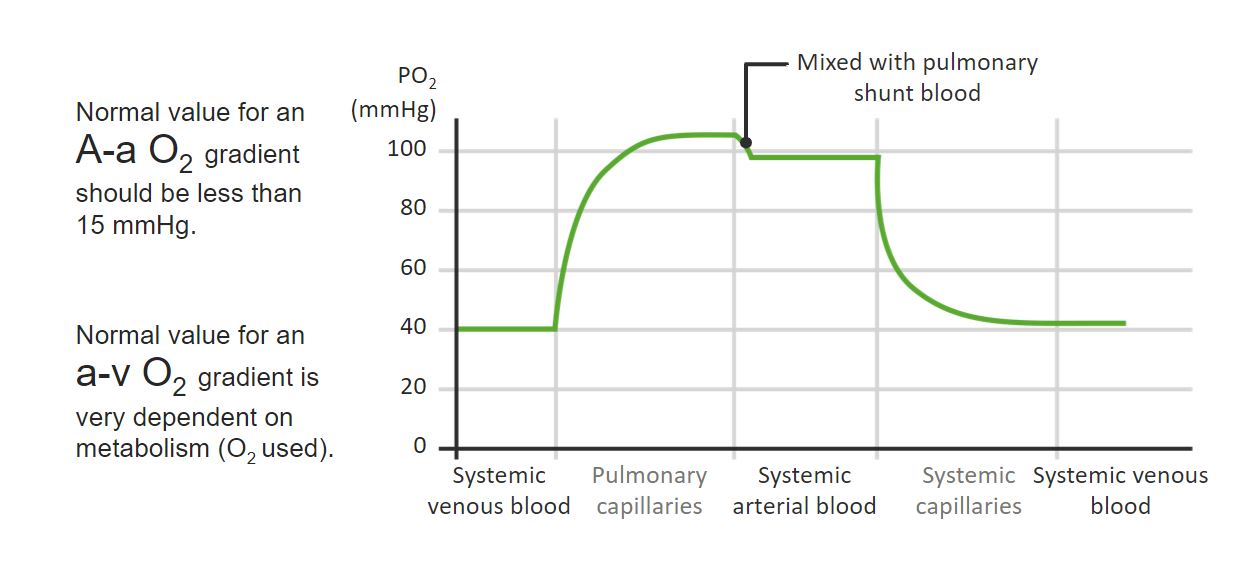
Existem 2 diferenças importantes de PO₂ (gradientes):

  • Alvéolo-arterial ( Aa AA Amyloidosis): diferença na PO₂ entre os alvéolos e o sangue arterial sistémico
  • Arteriovenosa (AV): diferença na PO₂ entre o sangue venoso e arterial
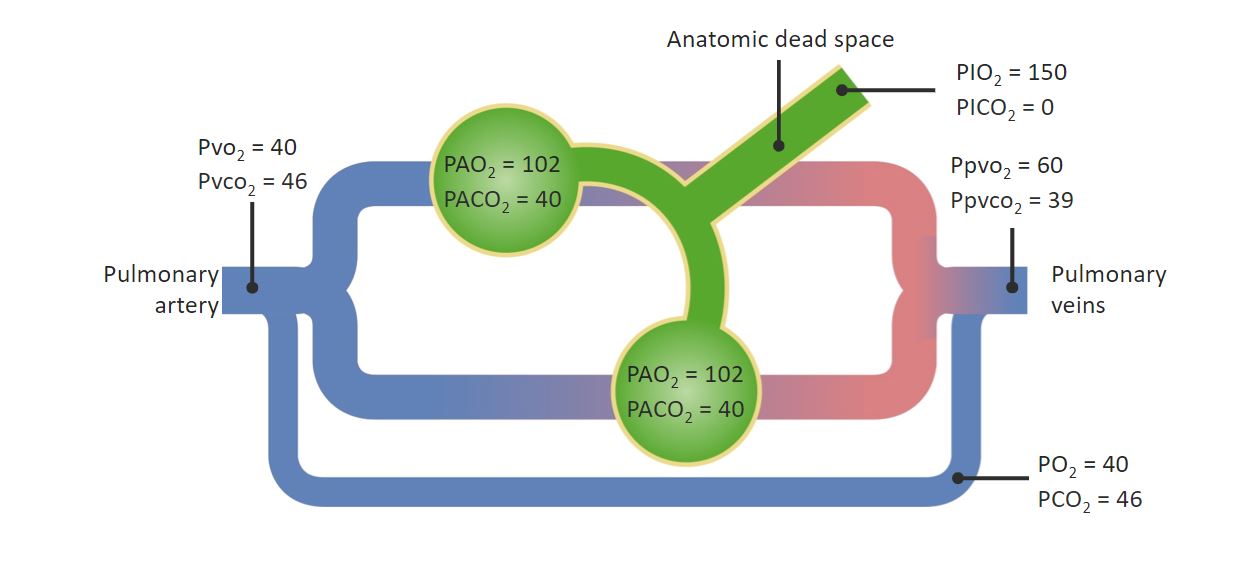
Pressões de O₂ e CO₂ Trocas gasosas respiratórias

Diferença arteriovenosa (av) na PO 2 entre sangue venoso e arterial:
Pressões de O2 e CO2 nos alvéolos e na circulação sistémica antes e após as trocas gasosas.

Imagem por Lecturio. Licença: CC BY-NC-SA 4.0
Hipóxia tecidual

  • Baixa disponibilidade de O para os tecidos
  • A hipóxia é sentida pelos rins, estimulando a síntese de eritrócitos através da liberação de EPO EPO Glycoprotein hormone, secreted chiefly by the kidney in the adult and the liver in the fetus, that acts on erythroid stem cells of the bone marrow to stimulate proliferation and differentiation. Erythrocytes: Histology.

Hipoxemia

  • PO₂ baixo no sangue
  • Pode ser causada por:
    • Hipoventilação
    • Fração inspirada de O₂ reduzida (< 21%)
    • Comprometimento da difusão: difusão inadequada de gases nos capilares
    • Shunt da direita para a esquerda: comunicação entre as circulações arterial e venosa pulmonar , permitindo que o sangue desoxigenado não faça parcialmente as trocas gasosas
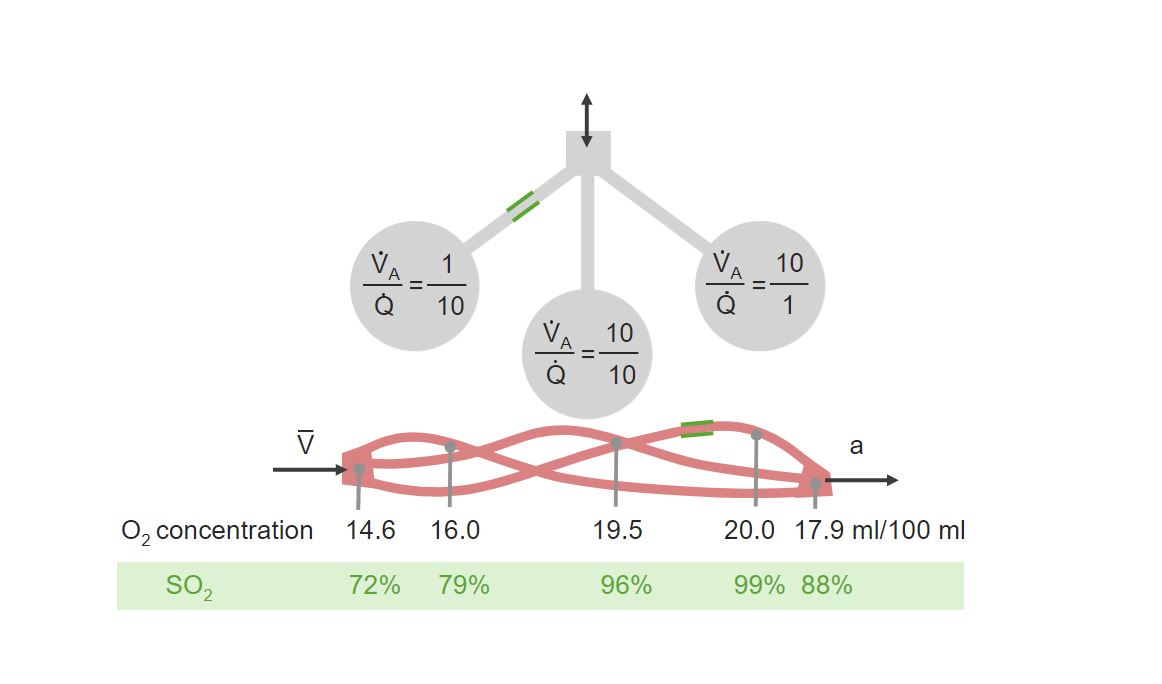
    • Desigualdade V/Q
Diagrama Hipoxemia Respiratória Troca gasosa

Diagrama de uma derivação DIREITA PARA ESQUERDA:
Veja a comunicação que permite ao sangue não fazer as trocas gasosas e diminuir a pressão arterial de O2.

Imagem por Lecturio. Licença: CC BY-NC-SA 4.0
Hipercapnia

  • PCO₂ arterial maior que 40mmHg
  • Este processo pode ocorrer devido a:
    • Ventilação alveolar diminuída
    • Desigualdade V/Q grave
    • Aumento da produção de CO₂ sem compensação ventilatória
  • A ventilação alveolar e a PaCO₂ estão inversamente relacionadas.

Correlação Clínica

  • Anemia Anemia Anemia is a condition in which individuals have low Hb levels, which can arise from various causes. Anemia is accompanied by a reduced number of RBCs and may manifest with fatigue, shortness of breath, pallor, and weakness. Subtypes are classified by the size of RBCs, chronicity, and etiology. Anemia: Overview and Types: diminuição das hemácias em circulação. A anemia Anemia Anemia is a condition in which individuals have low Hb levels, which can arise from various causes. Anemia is accompanied by a reduced number of RBCs and may manifest with fatigue, shortness of breath, pallor, and weakness. Subtypes are classified by the size of RBCs, chronicity, and etiology. Anemia: Overview and Types causa uma diminuição na quantidade de O disponível à medida que a quantidade total de Hb Hb The oxygen-carrying proteins of erythrocytes. They are found in all vertebrates and some invertebrates. The number of globin subunits in the hemoglobin quaternary structure differs between species. Structures range from monomeric to a variety of multimeric arrangements. Gas Exchange diminui. As etiologias podem ser agrupadas com aquelas que apresentam falha na produção de eritrócitos suficientes (deficiência de ferro, displasia da medula óssea e neoplasia) e aquelas que apresentam destruição aumentada de eritrócitos (autoimune, infeciosa, genética). Os sintomas comuns de anemia Anemia Anemia is a condition in which individuals have low Hb levels, which can arise from various causes. Anemia is accompanied by a reduced number of RBCs and may manifest with fatigue, shortness of breath, pallor, and weakness. Subtypes are classified by the size of RBCs, chronicity, and etiology. Anemia: Overview and Types incluem palidez das membranas mucosas e fadiga fácil. A oximetria de pulso permanece normal, pois a percentagem de saturação de cada molécula de hemoglobina não varia. O diagnóstico de anemia Anemia Anemia is a condition in which individuals have low Hb levels, which can arise from various causes. Anemia is accompanied by a reduced number of RBCs and may manifest with fatigue, shortness of breath, pallor, and weakness. Subtypes are classified by the size of RBCs, chronicity, and etiology. Anemia: Overview and Types é confirmado com exames de sangue que indicam uma diminuição dos glóbulos vermelhos. O tratamento é direcionado à correção da patologia subjacente que causa a anemia Anemia Anemia is a condition in which individuals have low Hb levels, which can arise from various causes. Anemia is accompanied by a reduced number of RBCs and may manifest with fatigue, shortness of breath, pallor, and weakness. Subtypes are classified by the size of RBCs, chronicity, and etiology. Anemia: Overview and Types.
  • Policitemia: aumento das hemácias em circulação. A policitemia causa um aumento na quantidade de O₂ disponível à medida que a quantidade total de Hb Hb The oxygen-carrying proteins of erythrocytes. They are found in all vertebrates and some invertebrates. The number of globin subunits in the hemoglobin quaternary structure differs between species. Structures range from monomeric to a variety of multimeric arrangements. Gas Exchange aumenta. As etiologias variam de não patológicas (habitação em grandes altitudes, período de adaptação perinatal) a processos patológicos graves (neoplasia, policitemia vera). Os pacientes com policitemia geralmente têm uma tez avermelhada e podem apresentar coagulação excessiva e as suas consequências. O diagnóstico é confirmado pela contagem de células sanguíneas e o tratamento varia de acordo com a etiologia.
  • Intoxicação por monóxido de carbono (CO): respirar CO diminui a quantidade de O₂ disponível na circulação de um paciente, ocupando os locais de ligação da Hb Hb The oxygen-carrying proteins of erythrocytes. They are found in all vertebrates and some invertebrates. The number of globin subunits in the hemoglobin quaternary structure differs between species. Structures range from monomeric to a variety of multimeric arrangements. Gas Exchange destinados ao O₂ com maior afinidade. A oximetria de pulso geralmente relata saturações normais e até elevadas, pois todos os locais de ligação da hemoglobina estão ocupados. Os pacientes geralmente relatam dor de cabeça e diminuição do nível de consciência. A intoxicação por monóxido de carbono pode ser letal se o paciente não for removido da fonte de CO.
  • Edema Edema Edema is a condition in which excess serous fluid accumulates in the body cavity or interstitial space of connective tissues. Edema is a symptom observed in several medical conditions. It can be categorized into 2 types, namely, peripheral (in the extremities) and internal (in an organ or body cavity). Edema pulmonar: presença de líquido em vez de ar AR Aortic regurgitation (AR) is a cardiac condition characterized by the backflow of blood from the aorta to the left ventricle during diastole. Aortic regurgitation is associated with an abnormal aortic valve and/or aortic root stemming from multiple causes, commonly rheumatic heart disease as well as congenital and degenerative valvular disorders. Aortic Regurgitation nos alvéolos. A presença de fluido adicional impede as trocas gasosas adequadas, diminuindo bastante a área de superfície disponível. O edema Edema Edema is a condition in which excess serous fluid accumulates in the body cavity or interstitial space of connective tissues. Edema is a symptom observed in several medical conditions. It can be categorized into 2 types, namely, peripheral (in the extremities) and internal (in an organ or body cavity). Edema pulmonar tem várias etiologias, incluindo insuficiência cardíaca e sépsis. Os pacientes apresentam falta de ar AR Aortic regurgitation (AR) is a cardiac condition characterized by the backflow of blood from the aorta to the left ventricle during diastole. Aortic regurgitation is associated with an abnormal aortic valve and/or aortic root stemming from multiple causes, commonly rheumatic heart disease as well as congenital and degenerative valvular disorders. Aortic Regurgitation e muitas vezes têm crepitações audíveis no exame objetivo. A oximetria de pulso geralmente é baixa nesses pacientes. O tratamento visa remover as causas da acumulação excessiva de líquido.

Referências

  1. Hall, JE, & Hall, ME. (2021). Guyton and Hall textbook of medical physiology (14th ed.). Elsevier.
  2. Powers KA, Dhamoon AS. (2021). Physiology, pulmonary ventilation, and perfusion. StatPearls. Treasure Island (FL): StatPearls Publishing.
  3.  Biga, LM, Dawson, S, Harwell A, Hopkins, R, et al. Anatomy and physiology. Retrieved April 26, 2021, from https://openstax.org/details/books/anatomy-and-physiology

Crie sua conta gratuita ou faça login para continuar lendo!

Cadastre-se agora e tenha acesso grátis ao Lecturio, com páginas de conceitos, vídeos de medicina e questões para sua educação médica.

Aprende mais com a Lecturio:

Multiple devices displaying human anatomy and health education content.

Complementa o teu estudo da faculdade com o companheiro de estudo tudo-em-um da Lecturio, através de métodos de ensino baseados em evidência.

Estuda onde quiseres

Two iPhones display medical education apps, one showing anatomy, the other Bookmatcher.

A Lecturio Medical complementa o teu estudo através de métodos de ensino baseados em evidência, vídeos de palestras, perguntas e muito mais – tudo combinado num só lugar e fácil de usar.

User Reviews

Have a holly, jolly study session 🎁 Save 50% on all plans now >>

Que tengas una sesión de estudio alegre y navideña 🎁 Ahorra 50% en todos los planes >>

Details