



Reoviridae: Rotavírus

O rotavírus pertence à família Reoviridae Reoviridae A family of non enveloped RNA viruses with cubic symmetry. The twelve genera include orthoreovirus; orbivirus; coltivirus; rotavirus; aquareovirus, cypovirus, phytoreovirus, fijivirus, seadornavirus, idnoreovirus, mycoreovirus, and oryzavirus. Rotavirus e é um vírus de RNA RNA A polynucleotide consisting essentially of chains with a repeating backbone of phosphate and ribose units to which nitrogenous bases are attached. RNA is unique among biological macromolecules in that it can encode genetic information, serve as an abundant structural component of cells, and also possesses catalytic activity. RNA Types and Structure de cadeia dupla, sem envelope Envelope Bilayer lipid membrane acquired by viral particles during viral morphogenesis. Although the lipids of the viral envelope are host derived, various virus-encoded integral membrane proteins, i.e. Viral envelope proteins are incorporated there. Virology. A transmissão ocorre pela via fecal-oral. O rotavírus é uma causa comum de gastroenterite grave em crianças. Infeções graves podem resultar em desidratação e morte. Geralmente não é necessário um teste de diagnóstico, mas o vírus pode ser detetado em amostras de fezes através de ELISA ELISA An immunoassay utilizing an antibody labeled with an enzyme marker such as horseradish peroxidase. While either the enzyme or the antibody is bound to an immunosorbent substrate, they both retain their biologic activity; the change in enzyme activity as a result of the enzyme-antibody-antigen reaction is proportional to the concentration of the antigen and can be measured spectrophotometrically or with the naked eye. Many variations of the method have been developed. St. Louis Encephalitis Virus ou PCR PCR Polymerase chain reaction (PCR) is a technique that amplifies DNA fragments exponentially for analysis. The process is highly specific, allowing for the targeting of specific genomic sequences, even with minuscule sample amounts. The PCR cycles multiple times through 3 phases: denaturation of the template DNA, annealing of a specific primer to the individual DNA strands, and synthesis/elongation of new DNA molecules. Polymerase Chain Reaction (PCR). A base do tratamento é a terapia de reidratação oral. Está disponível uma vacina viva atenuada para prevenção de infeções por rotavírus.

Last updated: Feb 18, 2025
Editorial responsibility: Stanley Oiseth, Lindsay Jones, Evelin Maza

Classificação

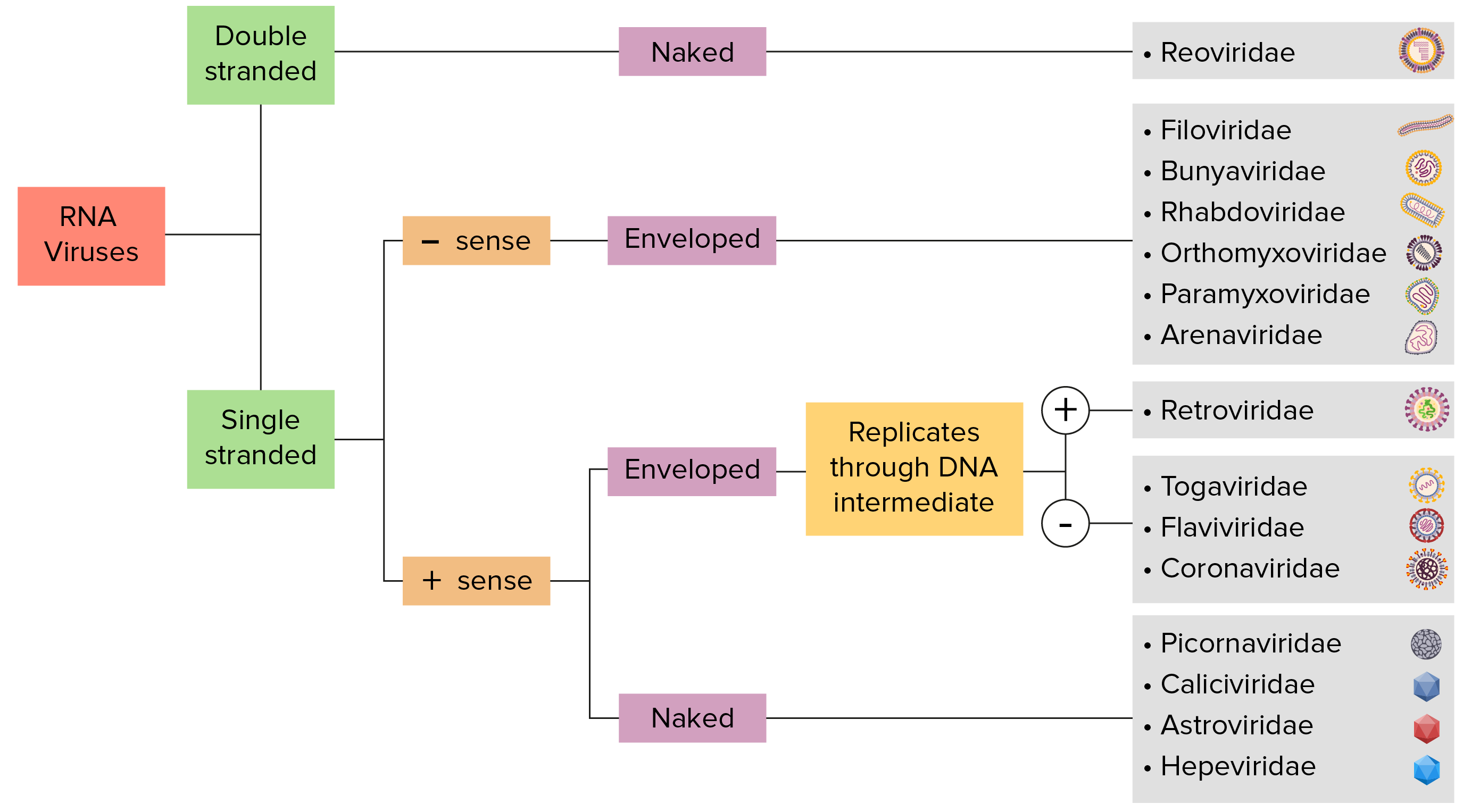
Classificação do fluxograma de vírus de RNA

Identificação do vírus RNA:
Os vírus podem ser classificados de várias maneiras. A maioria dos vírus, no entanto, terá um genoma formado por DNA ou RNA. Os vírus de genoma de RNA podem ser ainda caracterizados por um RNA de cadeia simples ou dupla. Os vírus “envelopados” são cobertos por uma fina camada de membrana celular (geralmente retirada da célula hospedeira). Se a camada estiver ausente, os vírus são chamados de vírus “nus”. Os vírus com genomas de cadeia simples são vírus de “sentido positivo” se o genoma for usado diretamente como RNA mensageiro (mRNA), que é traduzido em proteínas. Os vírus de “sentido negativo” usam a RNA polimerase dependente de RNA, uma enzima viral, para transcrever o seu genoma em RNA mensageiro.
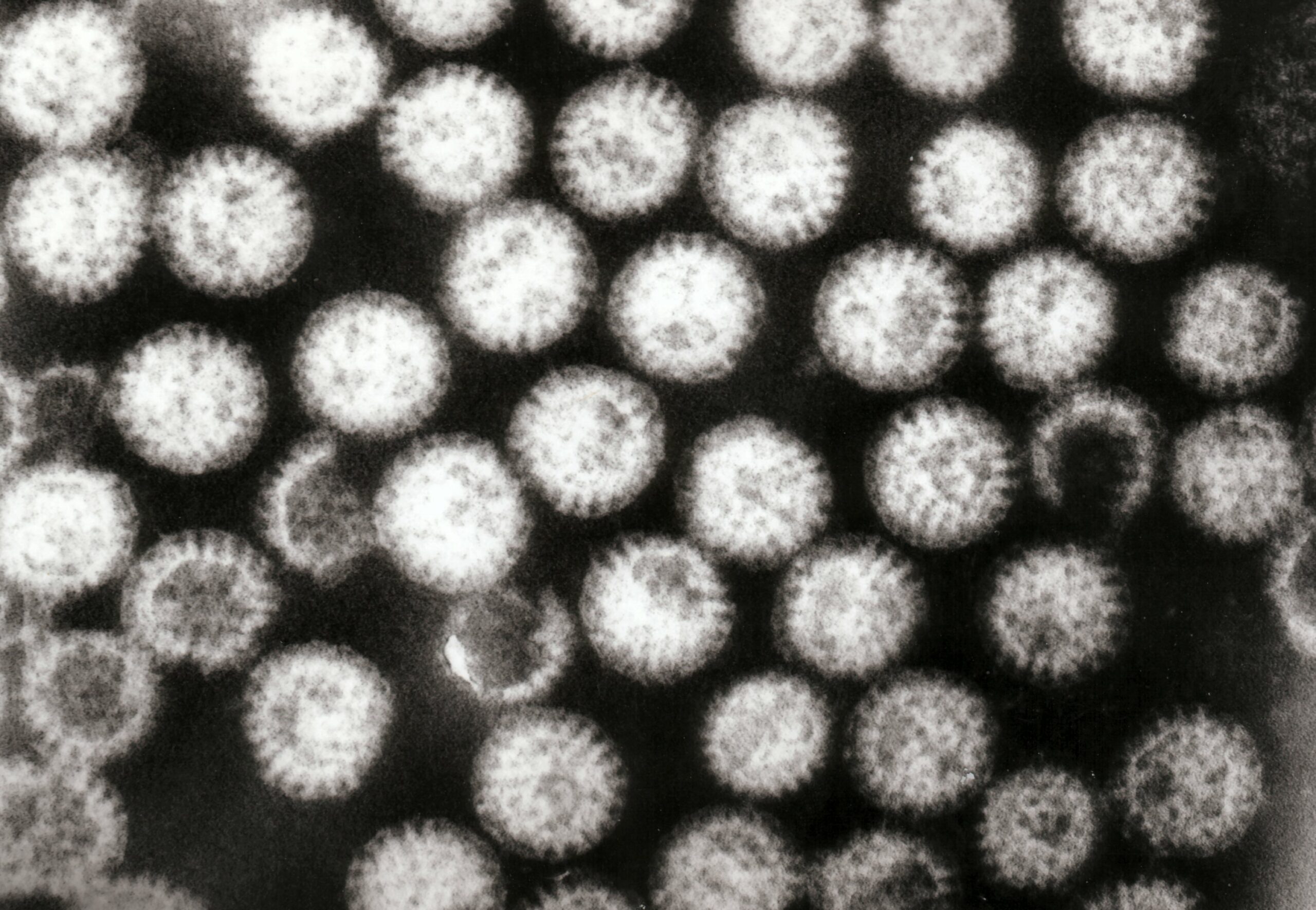
Imagem por Lecturio. Licença: CC BY-NC-SA 4.0

Características Gerais e Epidemiologia

Características básicas do Rotavírus

  • Taxonomia:
    • Família: Reoviridae Reoviridae A family of non enveloped RNA viruses with cubic symmetry. The twelve genera include orthoreovirus; orbivirus; coltivirus; rotavirus; aquareovirus, cypovirus, phytoreovirus, fijivirus, seadornavirus, idnoreovirus, mycoreovirus, and oryzavirus. Rotavirus
    • Género: Rotavírus
  • Vírus RNA RNA A polynucleotide consisting essentially of chains with a repeating backbone of phosphate and ribose units to which nitrogenous bases are attached. RNA is unique among biological macromolecules in that it can encode genetic information, serve as an abundant structural component of cells, and also possesses catalytic activity. RNA Types and Structure:
    • Cadeia dupla
    • Cadeias de sentido positivo e negativo
    • Linear
    • Segmentado (11 segmentos)
  • Estrutura:
    • “Wheel like”
    • Vírus sem envelope Envelope Bilayer lipid membrane acquired by viral particles during viral morphogenesis. Although the lipids of the viral envelope are host derived, various virus-encoded integral membrane proteins, i.e. Viral envelope proteins are incorporated there. Virology
    • Capsídeo icosaédrico de 3 camadas
    • Picos de proteína
  • Pode permanecer viável por semanas a meses no ambiente
Micrografia eletrônica de transmissão de vários vírions de rotavírus

Micrografia eletrónica de transmissão que mostra vários vírions do rotavírus

Imagem: “Transmission electron micrograph of multiple rotavirus particles” por Dr Graham Beards. Licença: CC BY 3.0

Doenças associadas

Os rotavírus causam gastroenterite.

Epidemiologia

  • Principal causa de gastroenterite aguda em crianças < 5 anos
  • Distribuição mundial
  • As crianças têm doença clinicamente mais MAIS Androgen Insensitivity Syndrome aparente do que os adultos.
  • Mais MAIS Androgen Insensitivity Syndrome comum durante o inverno em climas temperados
  • Causa cerca de 39% das mortes globais por diarreia, principalmente em países com acesso limitado a cuidados de saúde
  • Frequentemente leva a hospitalizações prolongadas (> 7 dias), especialmente em bebés com menos de 6 meses, representando grandes desafios para os cuidados de saúde

Patogénese

Reservatório

Os seres humanos são o reservatório primário.

Transmissão

A transmissão ocorre por via fecal-oral:

  • Ingestão de alimentos ou água contaminados
  • Contacto com superfícies/ fomites Fomites Inanimate objects that carry pathogenic microorganisms and thus can serve as the source of infection. Microorganisms typically survive on fomites for minutes or hours. Common fomites include clothing, tissue paper, hairbrushes, and cooking and eating utensils. Adenovirus contaminados

Fatores de risco do hospedeiro

  • Crianças pequenas
  • Indivíduos que não foram imunizados
  • Indivíduos imunocomprometidos
  • Indivíduos que residem em instituições

Fisiopatologia

  • Os vírions penetram nas células das vilosidades do intestino delgado.
  • Produção de proteína semelhante à toxina da cólera → destruição e apagamento das microvilosidades → interrupção na absorção de eletrólitos e água
  • ↓ Atividade da dissacaridase → má absorção de lactose e D-xilose → influxo osmótico para o intestino
  • Secreção ativa de água e diminuição da absorção → diarreia aquosa
  • Os vírions são eliminados nas fezes → permite a transmissão
fluxograma de patogênese da infecção por rotavírus

Fluxograma com resumo da patogénese da infeção por rotavírus

Imagem por Lecturio. Licença: CC BY-NC-SA 4.0

Apresentação Clínica

Linha temporal:

  • Período de incubação < 48 horas
  • Duração: 4-5 dias

Sintomas:

  • Febre
  • Mal-estar
  • Dor abdominal
  • Vómitos
  • Diarreia
    • Aquosa
    • Não inflamatória
    • Não sanguinolenta
    • Pode ser severa e levar à desidratação grave

Sinais de desidratação:

  • Taquicardia
  • Mucosas desidratadas
  • ↓ Débito urinário
  • ↓ Turgor da pele
  • Olhos encovados

Diagnóstico e Tratamento

Diagnóstico

As infeções por rotavírus são difíceis de distinguir de outras doenças diarreicas com base apenas no exame clínico.

  • Geralmente não são necessárias análises laboratoriais.
  • A deteção de rotavírus nas fezes pode ser realizada (se necessária):
    • ELISA ELISA An immunoassay utilizing an antibody labeled with an enzyme marker such as horseradish peroxidase. While either the enzyme or the antibody is bound to an immunosorbent substrate, they both retain their biologic activity; the change in enzyme activity as a result of the enzyme-antibody-antigen reaction is proportional to the concentration of the antigen and can be measured spectrophotometrically or with the naked eye. Many variations of the method have been developed. St. Louis Encephalitis Virus
    • PCR PCR Polymerase chain reaction (PCR) is a technique that amplifies DNA fragments exponentially for analysis. The process is highly specific, allowing for the targeting of specific genomic sequences, even with minuscule sample amounts. The PCR cycles multiple times through 3 phases: denaturation of the template DNA, annealing of a specific primer to the individual DNA strands, and synthesis/elongation of new DNA molecules. Polymerase Chain Reaction (PCR)

Tratamento

  • A doença é autolimitada.
  • Terapia sintomática
  • Reidratação oral
  • Fluidos IV em doentes com desidratação grave

Prevenção

As vacinas vivas atenuadas foram desenvolvidas para prevenir infeções por rotavírus:

  • Dadas a todas as crianças antes dos 8 meses de idade
  • Contraindicações:
    • SCID SCID Severe combined immunodeficiency (SCID), also called “bubble boy disease,” is a rare genetic disorder in which the development of functional B and T cells is disturbed due to several genetic mutations that result in reduced or absent immune function. Severe Combined Immunodeficiency (SCID) (Severe Combined Immunodeficiency Immunodeficiency Chédiak-Higashi Syndrome)
    • História de invaginação intestinal
    • Alergia aos componentes da vacina

Diagnóstico Diferencial

  • Norovírus: vírus RNA RNA A polynucleotide consisting essentially of chains with a repeating backbone of phosphate and ribose units to which nitrogenous bases are attached. RNA is unique among biological macromolecules in that it can encode genetic information, serve as an abundant structural component of cells, and also possesses catalytic activity. RNA Types and Structure de cadeia simples, sem envelope Envelope Bilayer lipid membrane acquired by viral particles during viral morphogenesis. Although the lipids of the viral envelope are host derived, various virus-encoded integral membrane proteins, i.e. Viral envelope proteins are incorporated there. Virology, de sentido positivo, pertencente à família Caliciviridae Caliciviridae A family of RNA viruses infecting a broad range of animals. Most individual species are restricted to their natural hosts. They possess a characteristic six-pointed starlike shape whose surfaces have cup-shaped (chalice) indentions. Transmission is by contaminated food, water, fomites, and occasionally aerosolization of secretions. Genera include lagovirus; norwalk-like viruses; sapporo-like viruses; and vesivirus. Norovirus. O norovírus é uma causa comum de diarreia aguda em todo o mundo. A transmissão é por via fecal-oral. Doentes com infeções por norovírus apresentam náuseas, vómitos e diarreia. O diagnóstico é geralmente baseado na suspeita clínica. O tratamento é sintomático.
  • Campylobacter jejuni Campylobacter jejuni A species of bacteria that resemble small tightly coiled spirals. Its organisms are known to cause abortion in sheep and fever and enteritis in man and may be associated with enteric diseases of calves, lambs, and other animals. Campylobacter: bacilos gram-negativos curvados. Os sintomas comuns de infeção são febre, cefaleia, dor abdominal intensa, mialgias e diarreia, que, por vezes, é sanguinolenta. Raramente, os doentes podem apresentar artrite, endocardite ou meningite. O diagnóstico pode ser feito com uma cultura de fezes. O tratamento inclui terapia de reidratação e antibióticos (por exemplo, macrólidos ou fluoroquinolonas).
  • Shigelose: infeção bacteriana aguda do trato GI causada pela espécie gram-negativa de Shigella Shigella Shigella is a genus of gram-negative, non-lactose-fermenting facultative intracellular bacilli. Infection spreads most commonly via person-to-person contact or through contaminated food and water. Humans are the only known reservoir. Shigella. Os doentes desenvolvem sintomas de febre, tenesmo e diarreia sanguinolenta. A shigelose é diagnosticada clinicamente e confirmada por cultura de fezes. O tratamento pode incluir terapia de reidratação e antibióticos (em casos graves ou em doentes de alto risco).
  • Salmonella Salmonella Salmonellae are gram-negative bacilli of the family Enterobacteriaceae. Salmonellae are flagellated, non-lactose-fermenting, and hydrogen sulfide-producing microbes. Salmonella enterica, the most common disease-causing species in humans, is further classified based on serotype as typhoidal (S. typhi and paratyphi) and nontyphoidal (S. enteritidis and typhimurium). Salmonella não tifoide: infeção causada pelos bacilos gram-negativos, S. enteritidis S. enteritidis A serotype of Salmonella enterica which is an etiologic agent of gastroenteritis in man and other animals. Salmonella ou S. typhimurium S. typhimurium A serotype of Salmonella enterica that is a frequent agent of Salmonella gastroenteritis in humans. It also causes paratyphoid fever. Salmonella. Podem estar presentes vómitos, cólicas abdominais, febre e diarreia inflamatória. As culturas de fezes podem fornecer o diagnóstico. O tratamento é de suporte e os antibióticos são usados apenas para manifestações sistémicas ou diarreia grave.
  • Giardíase: infeção do trato intestinal, causada por Giardia Giardia A genus of flagellate intestinal eukaryotes parasitic in various vertebrates, including humans. Characteristics include the presence of four pairs of flagella arising from a complicated system of axonemes and cysts that are ellipsoidal to ovoidal in shape. Nitroimidazoles lamblia, um protozoário flagelado. O sintoma característico da giardíase é a esteatorreia fétida. Os doentes que desenvolvem infeções crónicas podem apresentar perda de peso, má progressão estatuto-ponderal e défices vitamínicos resultantes da má absorção. O diagnóstico é feito através da deteção de organismos Giardia Giardia A genus of flagellate intestinal eukaryotes parasitic in various vertebrates, including humans. Characteristics include the presence of four pairs of flagella arising from a complicated system of axonemes and cysts that are ellipsoidal to ovoidal in shape. Nitroimidazoles, antigénios ou DNA DNA A deoxyribonucleotide polymer that is the primary genetic material of all cells. Eukaryotic and prokaryotic organisms normally contain DNA in a double-stranded state, yet several important biological processes transiently involve single-stranded regions. DNA, which consists of a polysugar-phosphate backbone possessing projections of purines (adenine and guanine) and pyrimidines (thymine and cytosine), forms a double helix that is held together by hydrogen bonds between these purines and pyrimidines (adenine to thymine and guanine to cytosine). DNA Types and Structure nas fezes. O tratamento inclui terapia de suporte e terapia antimicrobiana com metronidazol, tinidazol ou nitazoxanida.

Referências:

  1. Hallowell, B.D., Parashar, U.D., Curns, A., DeGroote, N.P., Tate, J.E. (2019). Trends in the Laboratory Detection of Rotavirus Before and After Implementation of Routine Rotavirus Vaccination. MMWR, 68(24), 539–543. https://www.cdc.gov/mmwr/volumes/68/wr/mm6824a2.htm?s_cid=mm6824a2_w
  2. Dennehy, P.H. (2015). Rotavirus Infection: A Disease of the Past? Infectious Disease Clinics of North America. 29(4):617–635. https://pubmed.ncbi.nlm.nih.gov/26337738
  3. Burke, R.M., Tate, J.E., Barin, N., et al. (2018). Three Rotavirus Outbreaks in the Post Vaccine Era. MMWR 67:470–472.
  4. Grimwood, K., Lambert, S.B. (2009). Rotavirus Vaccines: Opportunities and Challenges. Human Vaccines. 5(2):57–69.
  5. Tate, J.E., Burton, A.H., Boschi-Pinto, C., Parashar, U.D. (2016). Global, Regional, and National Estimates of Rotavirus Mortality in Children < 5 Years of Age, 2000–2013. https://doi.org/10.1093%2Fcid%2Fciv1013
  6. Aliabadi, N., Tate, J.E., Haynes, A.K., Parashar, U.D. (2015). Sustained Decrease in Laboratory Detection of Rotavirus After Implementation of Routine Vaccination-United States, 2000–2014. MMWR, 64(13):337–342. https://www.ncbi.nlm.nih.gov/pubmed/25856253
  7. Centers for Disease Control and Prevention. (2011). Rotavirus surveillance—Worldwide, 2009. MMWR, 60(16):514-516. https://www.cdc.gov/mmwr/preview/mmwrhtml/mm6016a5.htm
  8. Crotese, M.M., Parashar, U. (2009). Prevention of Rotavirus Gastroenteritis Among Infants and Children: Recommendations of the Advisory Committee on Immunization Practices (ACIP). MMWR, 64(13):337–342. https://www.cdc.gov/mmwr/preview/mmwrhtml/rr5802a1.htm
  9. Payne, D.C., Englund, J.A., Weinberg, G.A., et al. (2019). Association of Rotavirus Vaccination With Inpatient and Emergency Department Visits Among Children Seeking Care for Acute Gastroenteritis, 2010–2016. https://jamanetwork.com/journals/jamanetworkopen/fullarticle/2752101
  10. Cortese, M.M., et al. (2013). Effectiveness of Monovalent and Pentavalent Rotavirus Vaccine. Pediatrics, 132(1):e25–33. https://www.ncbi.nlm.nih.gov/pubmed/23776114
  11. Bishop, R. (2009). Discovery of Rotavirus: Implications for Child Health. Journal of Gastroenterology and Hepatology. 24 (Suppl 3): S81–S85. https://doi.org/10.1111%2Fj.1440-1746.2009.06076.x
  12. Ruiz-Palacios, G., et al. (2006). Safety and Efficacy of an Attenuated Vaccine Against Severe Rotavirus Gastroenteritis. The New England Journal of Medicine. 354(1):11–22. http://www.nejm.org/doi/full/10.1056/NEJMoa052434
  13. Vesikari, T., et al. (2006). Safety and Efficacy of a Pentavalent Human-Bovine (WC3) Reassortant Rotavirus Vaccine. The New England Journal of Medicine. 354(1):23–33. http://www.nejm.org/doi/full/10.1056/NEJMoa052664
  14. O’Ryan, M.G. (2025). Clinical Manifestations and Diagnosis of Rotavirus Infection. UpToDate. Retrieved February 18, 2025, from https://www.uptodate.com/contents/clinical-manifestations-and-diagnosis-of-rotavirus-infection
  15. LeClair, C.E., and Budh, D.P. (2023). Rotavirus. StatPearls. Retrieved February 18, 2025, from https://www.ncbi.nlm.nih.gov/books/NBK558951/
  16. Nguyen, D.D., Henin, S.S., and King, B.R. (2023). Rotavirus. Medscape. Retrieved February 18, 2025, from https://emedicine.medscape.com/article/803885-overview
  17. Centers for Disease Control and Prevention. (2024). Rotavirus. Retrieved February 18, 2025, from https://www.cdc.gov/rotavirus/index.html
  18. Verma, S. K., Soni, S., Sharma, S., & Gupta, P. (2024). Epidemiology & genotyping of rotavirus gastroenteritis and rotavirus-associated intussusception in preschool children in central Uttar Pradesh. Clinical Epidemiology and Global Health, 31, 101900. Retrieved June 24, 2025, from https://www.ceghonline.com/article/S2213-3984(24)00397-X/fulltext

Crie sua conta gratuita ou faça login para continuar lendo!

Cadastre-se agora e tenha acesso grátis ao Lecturio, com páginas de conceitos, vídeos de medicina e questões para sua educação médica.

Aprende mais com a Lecturio:

Multiple devices displaying human anatomy and health education content.

Complementa o teu estudo da faculdade com o companheiro de estudo tudo-em-um da Lecturio, através de métodos de ensino baseados em evidência.

Estuda onde quiseres

Two iPhones display medical education apps, one showing anatomy, the other Bookmatcher.

A Lecturio Medical complementa o teu estudo através de métodos de ensino baseados em evidência, vídeos de palestras, perguntas e muito mais – tudo combinado num só lugar e fácil de usar.

User Reviews

Have a holly, jolly study session 🎁 Save 50% on all plans now >>

Que tengas una sesión de estudio alegre y navideña 🎁 Ahorra 50% en todos los planes >>

Details