


Doenças da Úvea

A uveíte é uma inflamação da úvea, a camada média pigmentada do olho, que consiste na íris, corpo ciliar e coróide. Esta patologia é caracterizada com base no local afetado; a uveíte anterior é a mais MAIS Androgen Insensitivity Syndrome comum. A uveíte pode ser causada por uma infeção ou doença sistémica, no entanto, em alguns casos, a causa é idiopática. Os pacientes apresentam visão turva, hiperemia ocular e dor (frequentemente na uveíte anterior) ou diminuição da visão e moscas volantes (na uveíte intermédia e posterior). O diagnóstico é realizado através de fundoscopia e exame com lâmpada de fenda. O tratamento para a uveíte anterior é realizado com corticóides tópicos, enquanto a uveíte em locais mais MAIS Androgen Insensitivity Syndrome profundos necessita de injeção. A uveíte por infeções ou doenças sistémicas requer tratamento dirigido à causa.

Last updated: Dec 15, 2025

Editorial responsibility: Stanley Oiseth, Lindsay Jones, Evelin Maza

Descrição Geral

Definição

A uveíte é uma inflamação da úvea, a camada média do olho, constituída pela íris, corpo ciliar e coróide.
Anatomia

  • Úvea anterior
    • Parte anterior do corpo ciliar (pars plicata):
      • Controla a acomodação através da modificação da forma do cristalino
      • O epitélio produz o humor Humor Defense Mechanisms aquoso.
    • Íris: diafragma pigmentado que controla a quantidade de luz que entra no olho através de midríase ou miose
  • Úvea intermédia
  • Úvea posterior
    • Coróide:
      • Estrutura vascular que fornece suporte e nutrição à retina Retina The ten-layered nervous tissue membrane of the eye. It is continuous with the optic nerve and receives images of external objects and transmits visual impulses to the brain. Its outer surface is in contact with the choroid and the inner surface with the vitreous body. The outermost layer is pigmented, whereas the inner nine layers are transparent. Eye: Anatomy
      • Continua anteriormente com o corpo ciliar
    • Retina Retina The ten-layered nervous tissue membrane of the eye. It is continuous with the optic nerve and receives images of external objects and transmits visual impulses to the brain. Its outer surface is in contact with the choroid and the inner surface with the vitreous body. The outermost layer is pigmented, whereas the inner nine layers are transparent. Eye: Anatomy:
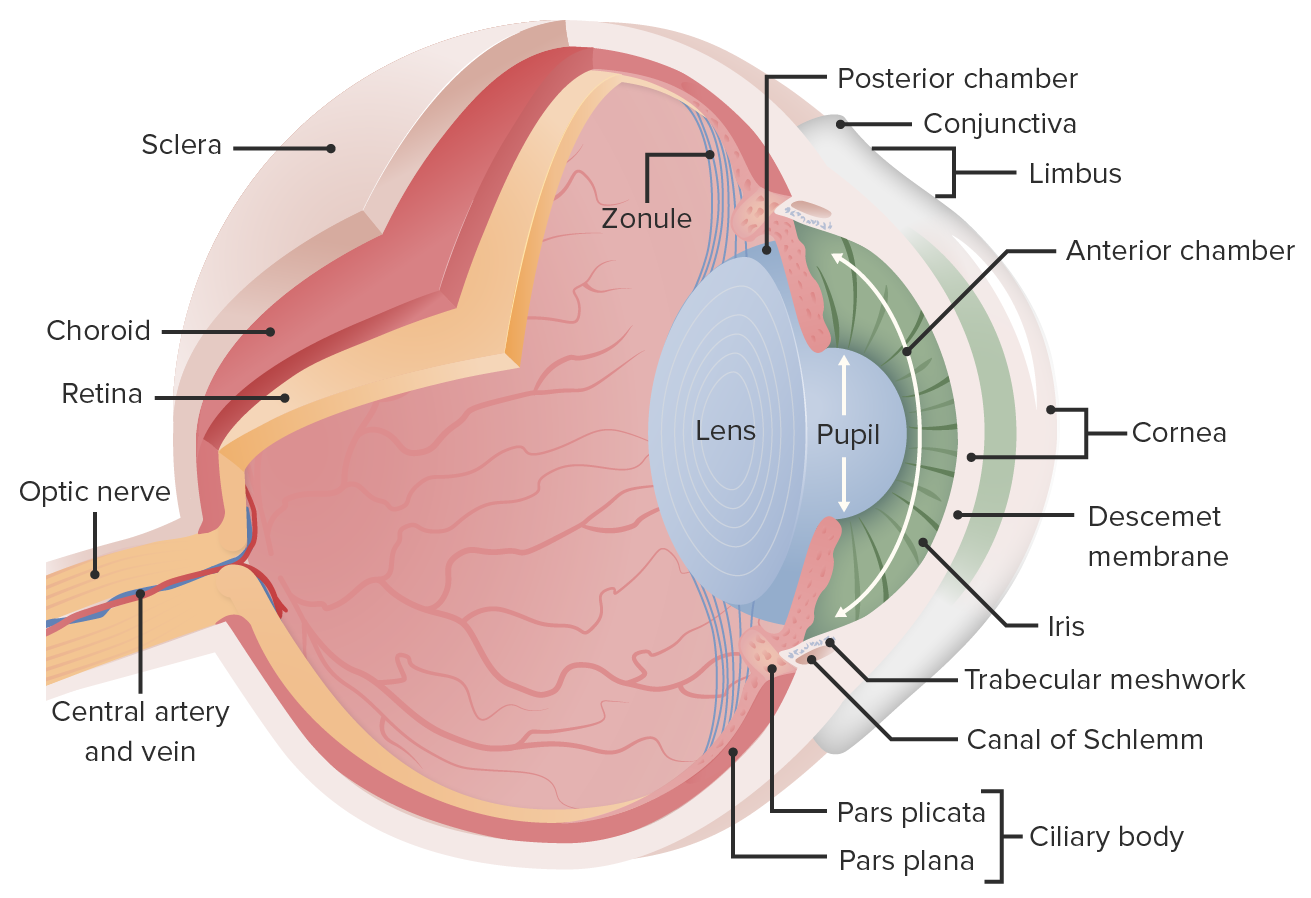
Representação da anatomia do olho

Esta imagem representa a anatomia do olho. Na catarata, existe turvação do cristalino, que opacifica a luz quando esta se projeta na retina; assim, quando os níveis de luz se encontram reduzidos, essencialmente à noite, existe diminuição da visão.

Imagem por Lecturio.
Tipos

  • Uveíte anterior
  • Uveíte intermédia
    • Pars planitis Pars Planitis Form of granulomatous uveitis occurring in the region of the pars plana. This disorder is a common condition with no detectable focal pathology. It causes fibrovascular proliferation at the inferior ora serrata. Diseases of the Uvea: pars plana
    • Vitreíte/hialite: humor Humor Defense Mechanisms vítreo
  • Uveíte posterior
    • Coroidite: coróide
    • Corioretinite/retinocoroidite: coróide e retina Retina The ten-layered nervous tissue membrane of the eye. It is continuous with the optic nerve and receives images of external objects and transmits visual impulses to the brain. Its outer surface is in contact with the choroid and the inner surface with the vitreous body. The outermost layer is pigmented, whereas the inner nine layers are transparent. Eye: Anatomy
    • Retinite: retina Retina The ten-layered nervous tissue membrane of the eye. It is continuous with the optic nerve and receives images of external objects and transmits visual impulses to the brain. Its outer surface is in contact with the choroid and the inner surface with the vitreous body. The outermost layer is pigmented, whereas the inner nine layers are transparent. Eye: Anatomy
    • Neurorretinite: retina Retina The ten-layered nervous tissue membrane of the eye. It is continuous with the optic nerve and receives images of external objects and transmits visual impulses to the brain. Its outer surface is in contact with the choroid and the inner surface with the vitreous body. The outermost layer is pigmented, whereas the inner nine layers are transparent. Eye: Anatomy e nervo ótico
  • Panuveíte
    • Inflamação de todas as camadas
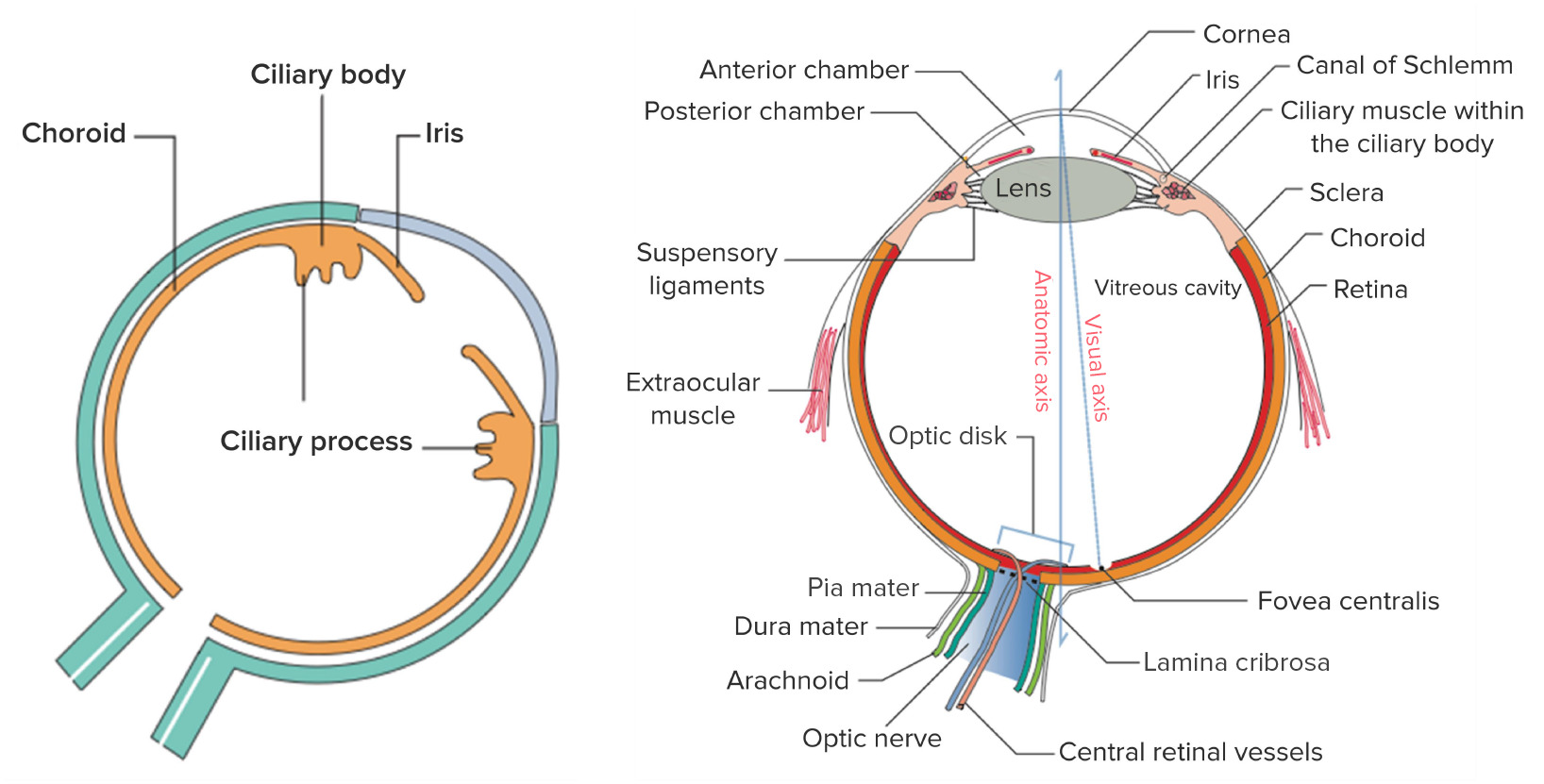
Componentes da úvea

Esquerda: os componentes da úvea, a camada média vascular do olho
Direita: estrutura geral do olho
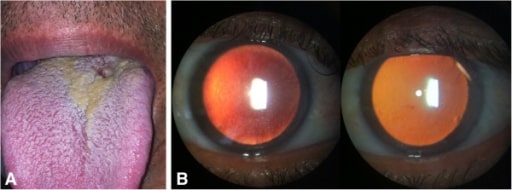
Imagem por Lecturio.

Epidemiologia e Etiologia

Epidemiologia

  • Incidência: 25 casos por 100.000 indivíduos
  • A uveíte anterior, o tipo mais MAIS Androgen Insensitivity Syndrome prevalente, é responsável por 50% dos casos.
  • A patologia sistémica subjacente afeta a predisposição racial:
    • Afro-americanos: sarcoidose, lúpus eritematoso sistémico
    • Asiáticos: doença de Behçet
    • Caucasianos: espondilartropatia antigénio leucocitário humano B27 (HLA-B27), esclerose múltipla
    • Descendência do médio oriente: doença de Behçet

Etiologia

  • Infeções víricas:
    • Vírus herpes simplex Herpes Simplex A group of acute infections caused by herpes simplex virus type 1 or type 2 that is characterized by the development of one or more small fluid-filled vesicles with a raised erythematous base on the skin or mucous membrane. It occurs as a primary infection or recurs due to a reactivation of a latent infection. Congenital TORCH Infections (VHS) 1 e 2
    • Citomegalovírus (CMV): em pacientes imunodeprimidos (VIH com baixa contagem de CD4)
    • Vírus varicela zoster (VVZ)
  • Infeções bacterianas:
    • Sífilis
    • Tuberculose ( TB TB Tuberculosis (TB) is an infectious disease caused by Mycobacterium tuberculosis complex bacteria. The bacteria usually attack the lungs but can also damage other parts of the body. Approximately 30% of people around the world are infected with this pathogen, with the majority harboring a latent infection. Tuberculosis spreads through the air when a person with active pulmonary infection coughs or sneezes. Tuberculosis)
    • Bartonella henselae Bartonella henselae A species of gram-negative bacteria that is the etiologic agent of bacillary angiomatosis. This organism can also be a cause of cat-scratch disease in immunocompetent patients. Bartonella (doença da arranhadura do gato)
  • Infeções fúngicas:
    • Histoplasmose
    • Blastomicose
    • Candidíase
  • Infeções parasitárias:
    • Toxoplasmose
    • Cisticercose
    • Oncocercose
  • Causas sistémicas imunomediadas:
    • Sarcoidose
    • Doenças associadas ao HLA-B27
      • Uveíte unilateral: espondilite anquilosante, artrite reativa
      • Uveíte bilateral: artrite psoriática, doença de Crohn, colite ulcerosa
    • Artrite idiopática juvenil
    • Nefrite túbulo-intersticial e uveíte (TINU)
    • Doença de Behçet: frequentemente com panuveíte recorrente
    • Esclerose múltipla
    • Lúpus eritematoso sistémico
    • Síndrome de Vogt-Koyanagi-Harada
  • Fármacos:
    • Rifabutina
    • Fluoroquinolonas: moxifloxacina, ciprofloxacina
    • Fármacos intravítreos: cidofovir Cidofovir An acyclic nucleoside phosphonate that acts as a competitive inhibitor of viral DNA polymerases. It is used in the treatment of retinitis caused by cytomegalovirus infections and may also be useful for treating herpesvirus infections. Antivirals for Herpes Virus, vancomicina
    • Inibidores da quinase BRAF: dabrafenibe, vemurafenibe, trametinibe
  • Sem envolvimento extraocular:
    • Pars planitis Pars Planitis Form of granulomatous uveitis occurring in the region of the pars plana. This disorder is a common condition with no detectable focal pathology. It causes fibrovascular proliferation at the inferior ora serrata. Diseases of the Uvea: uveíte intermédia que afeta a pars plana
    • Oftalmia simpática: inflamação ocular após trauma penetrante no olho contralateral
    • Coriorretinopatia/uveíte de Birdshot: atinge a úvea posterior e apresenta associação com HLA-A29
    • Trauma: cirurgias intraoculares podem provocar uveítes autolimitadas
  • Idiopática
Uveíte anterior bilateral não granulomatosa

Uveíte anterior bilateral não granulomatosa associada à sífilis. (A): Lesão compatível com cancro sifilítico na base da língua; (B): Exame com lâmpada de fenda: pequenos precipitados queráticos (direita) e depósitos de fibrina a cobrir o endotélio corneano (esquerda) na retroiluminação

Imagem: “initial presentation of syphilis” por Hospital de Olhos Santa Luzia, Estrada do Encanamento 909, CEP 52070-000, Recife-Pernambuco, Brazil. Licença: CC BY 2.0
Fisiopatologia

  • Fatores de risco que promovem uveíte:
    • Doença inflamatória sistémica, especialmente síndromes HLA-B27
    • Imunodepressão
    • Tabagismo
  • Mecanismos propostos:
    • Contaminação microbiana: em casos de trauma, lesão direta e necrose é desencadeada uma resposta inflamatória local.
    • Mimetismo molecular: antigénios de agentes infeciosos ou agentes estranhos desencadeiam reação cruzada com autoantigénios oculares.
    • Efeito indireto da infeção: antigénios de agentes infeciosos permanecem não detetados nos tecidos oculares e conduzem a danos imunomediados recorrentes no tecido.

Apresentação Clínica e Diagnóstico

Apresentação clínica

  • Uveíte anterior:
    • Unilateral ou bilateral
    • Dor, fotofobia, hiperemia, lacrimejo excessivo e diminuição da acuidade visual
    • Pupila contraída ou irregular: pela sinéquia posterior (aderências da íris ao cristalino anterior)
  • Uveíte intermédia e posterior:
    • Geralmente sem dor ou hiperemia
    • Diminuição da acuidade visual, moscas volantes, defeitos de campo visual
  • Panuveíte: apresenta-se com qualquer um dos sintomas supramencionados
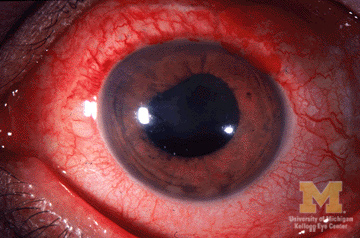
Uveíte anterior

Imagem representativa de uveíte anterior, com hiperemia conjuntival e pupila irregular

Imagem: “Anterior-uveitis” por Jonathan Trobe, M.D. Licença: CC BY 3.0

Diagnóstico

O diagnóstico é realizado através de fundoscopia e exame com lâmpada de fenda. A depressão escleral é uma manobra adicional utilizada para visualizar estruturas posteriores ao cristalino.

Achados

  • Uveíte anterior:
    • Leucócitos na câmara anterior
    • “Flare”: acumulação de proteínas no humor Humor Defense Mechanisms aquoso através de alterações vasculares
    • Precipitados queráticos: característicos da irite
    • Rubor Rubor Inflammation ciliar: hiperemia difusa no limbo
    • Hipópion: camadas de leucócitos na câmara anterior do olho
    • Achados que indicam complicações:
      • Catarata
      • Glaucoma Glaucoma Glaucoma is an optic neuropathy characterized by typical visual field defects and optic nerve atrophy seen as optic disc cupping on examination. The acute form of glaucoma is a medical emergency. Glaucoma is often, but not always, caused by increased intraocular pressure (IOP). Glaucoma
      • Queratopatia em banda: depósitos de cálcio na córnea
      • Formação de sinéquias
  • Uveíte intermédia:
    • Vitrite: células inflamatórias e proteínas no humor Humor Defense Mechanisms vítreo
    • “Bolas de neve”: inflamação exuberante no humor Humor Defense Mechanisms vítreo
    • “Banco de neve”: exsudados na pars plana
    • Edema Edema Edema is a condition in which excess serous fluid accumulates in the body cavity or interstitial space of connective tissues. Edema is a symptom observed in several medical conditions. It can be categorized into 2 types, namely, peripheral (in the extremities) and internal (in an organ or body cavity). Edema macular quistóide: áreas semelhantes a quistos com fluido na mácula
  • Uveíte posterior:
    • Manchas coriorretinianas focais
    • Branqueamento da retina Retina The ten-layered nervous tissue membrane of the eye. It is continuous with the optic nerve and receives images of external objects and transmits visual impulses to the brain. Its outer surface is in contact with the choroid and the inner surface with the vitreous body. The outermost layer is pigmented, whereas the inner nine layers are transparent. Eye: Anatomy
    • Descolamento da retina Retina The ten-layered nervous tissue membrane of the eye. It is continuous with the optic nerve and receives images of external objects and transmits visual impulses to the brain. Its outer surface is in contact with the choroid and the inner surface with the vitreous body. The outermost layer is pigmented, whereas the inner nine layers are transparent. Eye: Anatomy
    • Edema Edema Edema is a condition in which excess serous fluid accumulates in the body cavity or interstitial space of connective tissues. Edema is a symptom observed in several medical conditions. It can be categorized into 2 types, namely, peripheral (in the extremities) and internal (in an organ or body cavity). Edema do nervo ótico

Exames laboratoriais e exames de imagem adicionais estão indicados quando existem sinais e sintomas extraoculares que podem ser atribuídos a uma doença específica (e.g., sarcoidose, sífilis).
Tratamento

Uveíte infeciosa

  • Tratamento dirigido ao agente causal
  • Antibióticos (i.e., trimetoprim/sulfametoxazol para a coriorretinite por toxoplasmose) ou antivíricos (i.e., aciclovir para a uveíte herpética)

Uveíte não infeciosa

  • Uveíte anterior:
    • Corticóides tópicos: dose depende da gravidade da doença
    • Agente cicloplégico (ciclopentolato):
      • Alivia a dor ao evitar o espasmo dos músculos pupilares
      • Impede a formação de sinéquias
  • Uveíte intermédia ou posterior:
    • Não responsiva à medicação tópica
    • Injeção periocular ou intraocular de glucocorticóides
  • Tratamento sistémico ou imunossupressores
    • Para os casos que não conseguem ser tratados com injeção local ou apresentem resistência à terapêutica inicial
    • Glucocorticóides orais
    • Antimetabolitos (metotrexato, azatioprina, micofenolato)
    • Anti fator de necrose tumoral-alfa (TNF-alfa) (adalimumabe)
  • Implante intraocular com libertação de glucocorticóide
    • Para a uveíte posterior resistente
    • Efeito de longa duração, até 3 anos
    • Complicações: endoftalmite, formação de catarata, hipertensão ocular

Diagnóstico Diferencial

  • Conjuntivite: inflamação da conjuntiva, a camada externa do olho. A etiologia pode ser infeciosa ou não infeciosa. Os pacientes apresentam hiperemia e secreção ocular em um ou ambos os olhos. A conjuntivite bacteriana geralmente apresenta-se com secreção purulenta, enquanto as causas víricas apresentam-se com secreção aquosa.
  • Hemorragia subconjuntival: aparecimento de áreas com extravasamento de sangue imediatamente abaixo da superfície ocular. Normalmente é assintomática e pode ocorrer espontaneamente ou com mecanismos associados à manobra de Valsalva (e.g., tosse, espirro ou vómito). O diagnóstico é confirmado pela ausência de secreção, fotofobia ou sensação de corpo estranho, assim como uma acuidade visual normal. A hemorragia subconjuntival geralmente resolve em 1–2 semanas.
  • Descolamento da retina Retina The ten-layered nervous tissue membrane of the eye. It is continuous with the optic nerve and receives images of external objects and transmits visual impulses to the brain. Its outer surface is in contact with the choroid and the inner surface with the vitreous body. The outermost layer is pigmented, whereas the inner nine layers are transparent. Eye: Anatomy: separação da retina Retina The ten-layered nervous tissue membrane of the eye. It is continuous with the optic nerve and receives images of external objects and transmits visual impulses to the brain. Its outer surface is in contact with the choroid and the inner surface with the vitreous body. The outermost layer is pigmented, whereas the inner nine layers are transparent. Eye: Anatomy do epitélio pigmentar da retina Retina The ten-layered nervous tissue membrane of the eye. It is continuous with the optic nerve and receives images of external objects and transmits visual impulses to the brain. Its outer surface is in contact with the choroid and the inner surface with the vitreous body. The outermost layer is pigmented, whereas the inner nine layers are transparent. Eye: Anatomy, resultando num rápido dano aos fotorrecetores. Os sintomas incluem alterações indolores da visão, como “flashes” luminosos súbitos, moscas volantes, alteração da visão periférica ou aparecimento de sombras no campo visual. O descolamento de retina Retina The ten-layered nervous tissue membrane of the eye. It is continuous with the optic nerve and receives images of external objects and transmits visual impulses to the brain. Its outer surface is in contact with the choroid and the inner surface with the vitreous body. The outermost layer is pigmented, whereas the inner nine layers are transparent. Eye: Anatomy é uma emergência que requer cirurgia de correção.
  • Linfoma vítreo-retiniano: é o distúrbio linfoproliferativo intraocular mais MAIS Androgen Insensitivity Syndrome comum e uma síndrome mascarada que representa um verdadeiro dilema diagnóstico. Os pacientes apresentam défice visual gradual com moscas volantes. O gold standard de diagnóstico é o exame citopatológico do fluido ocular ou a biópsia coriorretiniana.

Referências

  1. Duplechain, A., Conrady, C., Patel, B. (2023). Uveitis. Retrieved on August 11, 2025, from www.ncbi.nlm.nih.gov/books/NBK540993
  2. Forrester, J., Kuffova, L., Dick, A. (2018) Autoimmunity, Autoinflammation, and Infection in Uveitis. American Journal of Ophthalmology 189: 77–85. https://www.ajo.com/article/S0002-9394(18)30094-1/pdf
  3. Gonzalez, M., Solano, M., Porco, T., Oldenburg, C., Acharya, N., Lin, S., Chan, M. (2018). Epidemiology of Uveitis in a US population-based study. J Ophthalmic Inflamm Infect. 8:6. https://www.ncbi.nlm.nih.gov/pmc/articles/PMC5904090/
  4. Muchatuta, M., Shlamovitz, G. (2024). Iritis and Uveitis. Medscape. Retrieved on August 11, 2025, from https://emedicine.medscape.com/article/798323-overview
  5. Rosenbaum, J., Thorne, J., Romain, P. (2025) Uveitis: Etiology, Clinical Manifestations and Diagnosis. UpToDate. Retrieved on August 11, 2025, from https://www.uptodate.com/contents/uveitis-etiology-clinical-manifestations-and-diagnosis
  6. Rosenbaum, J., Trobe, J., Romain, P. (2025) Uveitis: Treatment. UpToDate. Retrieved on August 11, 2025, from https://www.uptodate.com/contents/uveitis-treatment

Crie sua conta gratuita ou faça login para continuar lendo!

Cadastre-se agora e tenha acesso grátis ao Lecturio, com páginas de conceitos, vídeos de medicina e questões para sua educação médica.

Aprende mais com a Lecturio:

Multiple devices displaying human anatomy and health education content.

Complementa o teu estudo da faculdade com o companheiro de estudo tudo-em-um da Lecturio, através de métodos de ensino baseados em evidência.

Estuda onde quiseres

Two iPhones display medical education apps, one showing anatomy, the other Bookmatcher.

A Lecturio Medical complementa o teu estudo através de métodos de ensino baseados em evidência, vídeos de palestras, perguntas e muito mais – tudo combinado num só lugar e fácil de usar.

User Reviews

Have a holly, jolly study session 🎁 Save 50% on all plans now >>

Que tengas una sesión de estudio alegre y navideña 🎁 Ahorra 50% en todos los planes >>

Details