


Bouba, Bejel e Pinta

Bouba, bejel Bejel Yaws, bejel, and pinta are endemic, nonvenereal treponematoses. The causative organisms are Treponema pallidum pertenue (yaws), T. pallidum endemicum (bejel), and T. carateum (pinta). These treponematoses are generally transmitted by direct skin-to-skin contact with infected skin lesions. Yaws, Bejel, and Pinta e pinta Pinta An infectious disease of the skin caused by treponema carateum that occurs only in the Western hemisphere. Age of onset is between 10 and 20 years of age. This condition is characterized by marked changes in the skin color and is believed to be transmitted by direct person-to-person contact. Yaws, Bejel, and Pinta são treponematoses endémicas e não venéreas. Os organismos causadores são subespécies de Treponema pallidum Treponema pallidum The causative agent of venereal and non-venereal syphilis as well as yaws. Treponema pertenue (bouba), T. pallidum endemicum T. pallidum endemicum Treponema ( bejel Bejel Yaws, bejel, and pinta are endemic, nonvenereal treponematoses. The causative organisms are Treponema pallidum pertenue (yaws), T. pallidum endemicum (bejel), and T. carateum (pinta). These treponematoses are generally transmitted by direct skin-to-skin contact with infected skin lesions. Yaws, Bejel, and Pinta) e T. carateum T. carateum Treponema ( pinta Pinta An infectious disease of the skin caused by treponema carateum that occurs only in the Western hemisphere. Age of onset is between 10 and 20 years of age. This condition is characterized by marked changes in the skin color and is believed to be transmitted by direct person-to-person contact. Yaws, Bejel, and Pinta). Estas treponematoses são geralmente transmitidas pelo contacto direto pele a pele com lesões cutâneas infetadas. A bouba e o bejel Bejel Yaws, bejel, and pinta are endemic, nonvenereal treponematoses. The causative organisms are Treponema pallidum pertenue (yaws), T. pallidum endemicum (bejel), and T. carateum (pinta). These treponematoses are generally transmitted by direct skin-to-skin contact with infected skin lesions. Yaws, Bejel, and Pinta afetam a pele e os ossos, resultando em placas e nódulos cutâneos e lesões ósseas destrutivas. Pinta Pinta An infectious disease of the skin caused by treponema carateum that occurs only in the Western hemisphere. Age of onset is between 10 and 20 years of age. This condition is characterized by marked changes in the skin color and is believed to be transmitted by direct person-to-person contact. Yaws, Bejel, and Pinta envolve apenas a pele. O diagnóstico é feito com uma combinação de serologia, características clínicas, demografia e distribuição geográfica. O tratamento inclui penicilina G benzatina intramuscular ou azitromicina oral.

Last updated: Dec 15, 2025

Editorial responsibility: Stanley Oiseth, Lindsay Jones, Evelin Maza

Epidemiologia e Etiologia

Epidemiologia

Bouba ( mais MAIS Androgen Insensitivity Syndrome comum):

  • Prevalente em áreas quentes e húmidas de:
    • Sudeste Asiático
    • Indonésia
    • Ilhas do Pacífico
    • África
    • América do Sul
  • Crianças > adultos

Bejel Bejel Yaws, bejel, and pinta are endemic, nonvenereal treponematoses. The causative organisms are Treponema pallidum pertenue (yaws), T. pallidum endemicum (bejel), and T. carateum (pinta). These treponematoses are generally transmitted by direct skin-to-skin contact with infected skin lesions. Yaws, Bejel, and Pinta:

  • Prevalente em regiões áridas de:
    • Médio Oriente
    • África Central e do Sul
  • Crianças > adultos

Pinta Pinta An infectious disease of the skin caused by treponema carateum that occurs only in the Western hemisphere. Age of onset is between 10 and 20 years of age. This condition is characterized by marked changes in the skin color and is believed to be transmitted by direct person-to-person contact. Yaws, Bejel, and Pinta:

  • Muito rara
  • A ocorrência diminuiu.
  • Ainda pode ser endémica em:
    • América do Sul
    • América Central
  • Adolescentes e adultos > crianças

Etiologia

  • Organismos causadores:
    • Subespécies de Treponema Treponema Treponema is a gram-negative, microaerophilic spirochete. Owing to its very thin structure, it is not easily seen on Gram stain, but can be visualized using dark-field microscopy. This spirochete contains endoflagella, which allow for a characteristic corkscrew movement. Treponemapallidum:
      • Bouba: T. pallidum pertenue T. pallidum pertenue Treponema
      • Bejel Bejel Yaws, bejel, and pinta are endemic, nonvenereal treponematoses. The causative organisms are Treponema pallidum pertenue (yaws), T. pallidum endemicum (bejel), and T. carateum (pinta). These treponematoses are generally transmitted by direct skin-to-skin contact with infected skin lesions. Yaws, Bejel, and Pinta: T. pallidum endemicum T. pallidum endemicum Treponema
    • Pinta Pinta An infectious disease of the skin caused by treponema carateum that occurs only in the Western hemisphere. Age of onset is between 10 and 20 years of age. This condition is characterized by marked changes in the skin color and is believed to be transmitted by direct person-to-person contact. Yaws, Bejel, and Pinta: T. carateum T. carateum Treponema
  • Características básicas do Treponema Treponema Treponema is a gram-negative, microaerophilic spirochete. Owing to its very thin structure, it is not easily seen on Gram stain, but can be visualized using dark-field microscopy. This spirochete contains endoflagella, which allow for a characteristic corkscrew movement. Treponema:
    • Espiroqueta (em forma de espiral)
    • Gram negativo
    • Comprimento médio: 6-15μm; Largura média: 0.1-0.2μm

Related videos

Patogénese

Reservatório

Os humanos são o único reservatório.

Transmissão

  • Bouba: contacto pele a pele com lesões
  • Bejel Bejel Yaws, bejel, and pinta are endemic, nonvenereal treponematoses. The causative organisms are Treponema pallidum pertenue (yaws), T. pallidum endemicum (bejel), and T. carateum (pinta). These treponematoses are generally transmitted by direct skin-to-skin contact with infected skin lesions. Yaws, Bejel, and Pinta:
    • Contacto pele a pele com lesões
    • Contacto boca a boca com lesões orais
    • Fómites (por exemplo, utensílios para comer e beber)
  • Pinta Pinta An infectious disease of the skin caused by treponema carateum that occurs only in the Western hemisphere. Age of onset is between 10 and 20 years of age. This condition is characterized by marked changes in the skin color and is believed to be transmitted by direct person-to-person contact. Yaws, Bejel, and Pinta: contacto pele a pele com lesões

Fisiopatologia

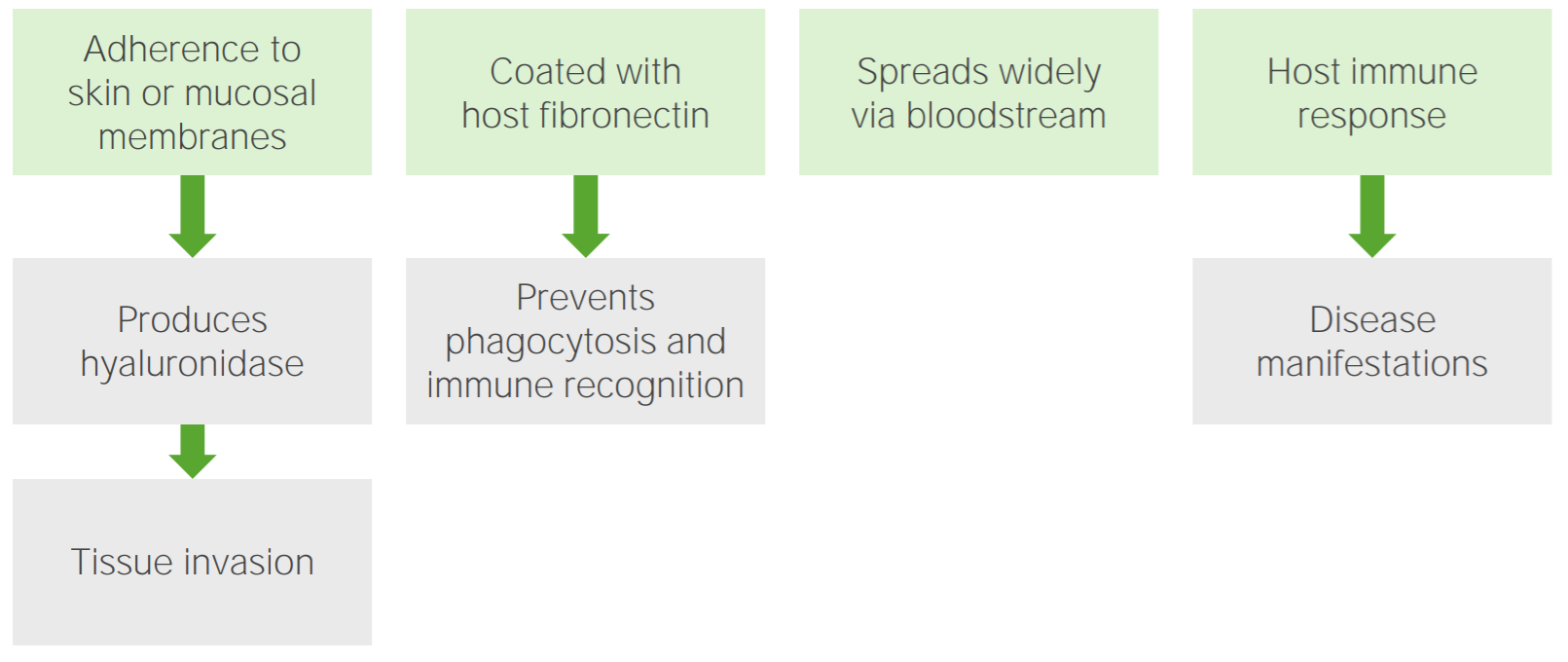
  • Contacto da pele com uma lesão infetada → a espiroqueta adere à pele ou às membranas mucosas
  • Produção de hialuronidase → permite a invasão tecidual
  • Os organismos revestem-se de fibronectina do hospedeiro → previne a fagocitose e o reconhecimento pelo sistema imunológico
  • Viagem para os linfonodos → disseminação pela corrente sanguínea
  • Resposta imune do hospedeiro → manifestações da doença
Patogênese das infecções por Treponema

Patogénese das infeções por Treponema:
O patogénio adere à pele ou membranas mucosas, levando à produção de hialuronidase, que permite a invasão tecidual. O patogénio reveste-se de fibronectina do hospedeiro, o que impede a sua fagocitose e o reconhecimento pelo sistema imunológico. Consequentemente, o patogénio dissemina-se pela corrente sanguínea. Em última análise, ocorre uma resposta imune do hospedeiro, que causa manifestações da doença.

Imagem por Lecturio.

Apresentação Clínica

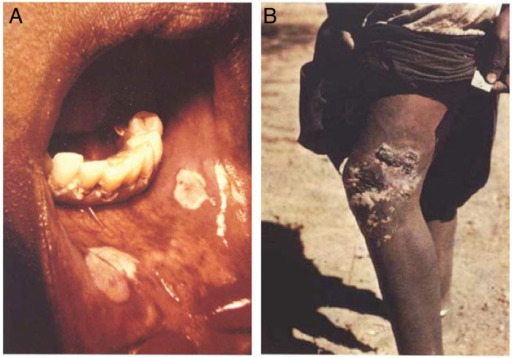
Bouba

Fase primária:

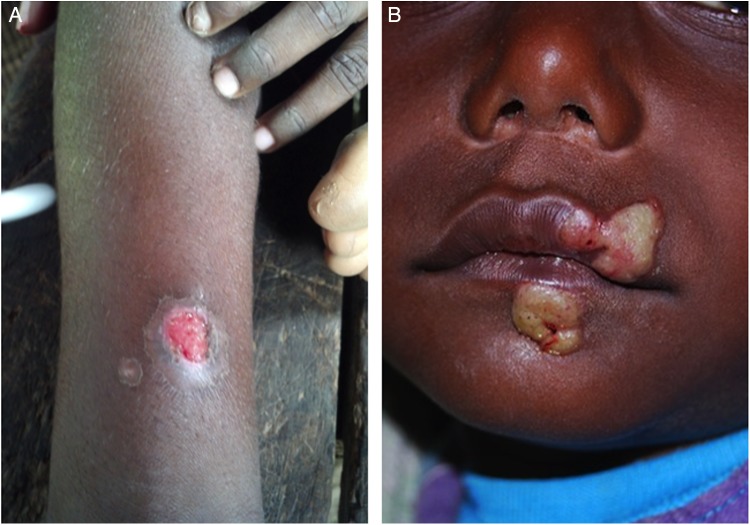
  • Pápula localizada no local da inoculação (“mãe bouba”):
  • Evolução:
    • Progride para um nódulo grande e amarelo
    • Possível ulceração com tecido de granulação vermelho na base da úlcera
    • Regride espontaneamente para uma cicatriz hiperpigmentada

Fase secundária:

  • Lesões secundárias:
    • Após a disseminação linfática da bactéria
    • Surge semanas a 2 anos após a fase primária
  • Morfologia
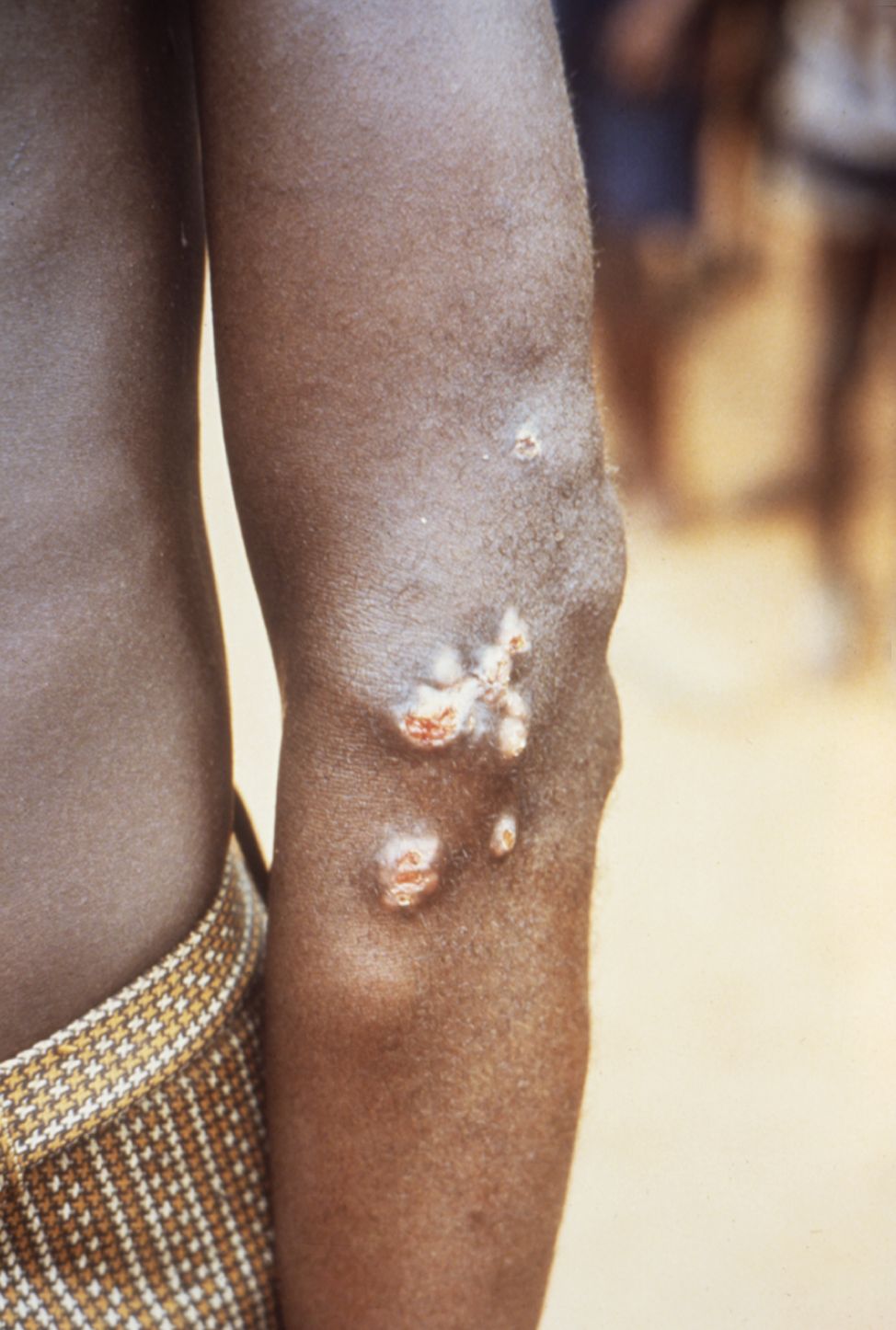
    • Nódulos solitários e ulcerados que se assemelham a bouba primária
    • Vários nódulos menores
  • Papiloma palmar e plantar doloroso ou placas
  • Artralgias
  • Osteoperiostite:
    • Dor óssea noturna
    • Dactilite

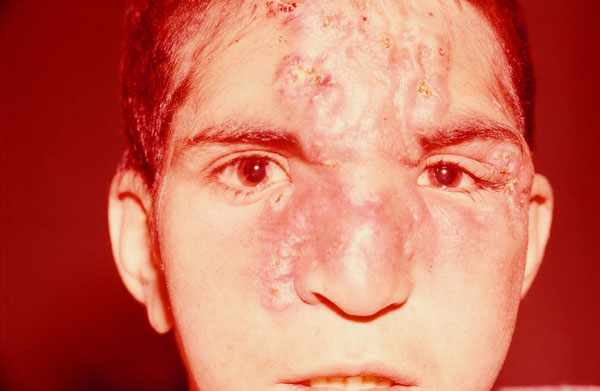
Fase terciária:

  • Rara
  • Lesões tardias que se formam  ≥ 5 anos após a infeção inicial
  • Lesões gomosas (lesões destrutivas, granulomatosas) de:
    • Pele
    • Ossos
  • Lesões destrutivas e mutilantes podem levar a:
    • Malformações de ossos longos (por exemplo, tíbia arqueada)
    • Lesões cutâneas ou subcutâneas justaarticulares
    • Ulcerações da nasofaringe e palato (“rinofaringite mutilante”)
    • Exostose da porção nasal da maxila (“goundou”)

Bejel Bejel Yaws, bejel, and pinta are endemic, nonvenereal treponematoses. The causative organisms are Treponema pallidum pertenue (yaws), T. pallidum endemicum (bejel), and T. carateum (pinta). These treponematoses are generally transmitted by direct skin-to-skin contact with infected skin lesions. Yaws, Bejel, and Pinta

Fase primária:

  • Pequena pápula primária, mancha ou úlcera na mucosa oral
  • Não é comummente visto devido ao tamanho pequeno
  • Resolve espontaneamente

Fase Secundária:

  • Úlceras ou manchas indolores:
    • Podem afetar:
      • Membranas mucosas
      • Pele (particularmente regiões quentes e húmidas)
    • Torna-se condilomatoso antes de eventualmente curar
  • Periostite → dor óssea
  • Laringite → rouquidão
  • Úlceras nasofaríngeas
  • Possível úlcera genital semelhante à observada na sífilis

Fase terciária:

  • Lesões gomosas de:
    • Pele
    • Ossos
  • Lesões destrutivas resultam em:
    • Deformidades ósseas
    • Destruição nasofaríngea
    • Nódulos justa-articulares

Pinta Pinta An infectious disease of the skin caused by treponema carateum that occurs only in the Western hemisphere. Age of onset is between 10 and 20 years of age. This condition is characterized by marked changes in the skin color and is believed to be transmitted by direct person-to-person contact. Yaws, Bejel, and Pinta

Fase primária:

  • Pápula ou placa vermelha inicial:
    • Pruriginoso
    • Semelhante a escamas
    • ≥ 10 cm de diâmetro
    • Comummente nas extremidades inferiores
    • Podem estar presentes lesões satélite.
  • Linfadenopatia regional

Fase secundária:

  • Pintídeos
    • Surgem meses após a fase primária
    • Múltiplas placas pruriginosas
    • Sofrem mudanças de cor de vermelho para cinza e preto.
  • Semelhante à lesão cutânea inicial da fase primária

Fase terciária ou tardia:

  • Descoloração e despigmentação da pele
  • Atrofia
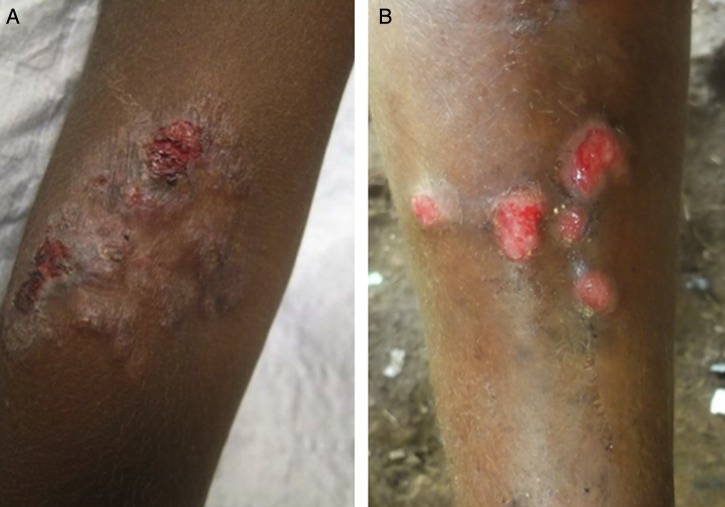
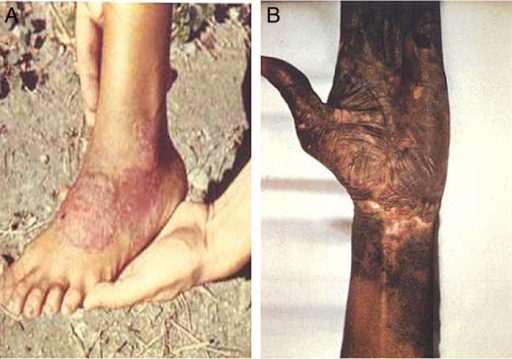
Lesões cutâneas de pinta

Lesões cutâneas de pinta (infeção por Treponema carateum)
A: placa eritematosa de pinta precoce
B: descoloração da pele da pinta tardia

Imagem : “Endemic treponemal diseases” por Marks M, Solomon AW, Mabey DC. Licença: CC BY 4.0

Diagnóstico e Tratamento

Diagnóstico

Como estas espécies treponémicas são morfologicamente indistinguíveis, o diagnóstico é baseado na combinação de dados demográficos, região geográfica, apresentação clínica e achados laboratoriais.

Serologia:

  • Testes Testes Gonadal Hormones não treponémicos:
    • Opções:
    • Os títulos devem diminuir após o tratamento.
  • Testes Testes Gonadal Hormones treponémicos:
    • Opções:
      • Teste de absorção de anticorpos treponémicos fluorescentes (FTA-ABS)
      • Teste de microhemaglutinação para anticorpos para T. pallidum ( MHA-TP MHA-TP Treponema)
      • Teste de aglutinação de partículas de T. pallidum
      • Ensaio enzimático de T. pallidum
      • Imunoensaio de quimioluminescência
    • Não é possível diferenciar entre infeção atual e anterior (os títulos permanecem positivos após o tratamento)

Métodos diretos:

  • Reação em cadeia da polimerase ( PCR PCR Polymerase chain reaction (PCR) is a technique that amplifies DNA fragments exponentially for analysis. The process is highly specific, allowing for the targeting of specific genomic sequences, even with minuscule sample amounts. The PCR cycles multiple times through 3 phases: denaturation of the template DNA, annealing of a specific primer to the individual DNA strands, and synthesis/elongation of new DNA molecules. Polymerase Chain Reaction (PCR), pela sigla em inglês):
    • Detectar DNA DNA A deoxyribonucleotide polymer that is the primary genetic material of all cells. Eukaryotic and prokaryotic organisms normally contain DNA in a double-stranded state, yet several important biological processes transiently involve single-stranded regions. DNA, which consists of a polysugar-phosphate backbone possessing projections of purines (adenine and guanine) and pyrimidines (thymine and cytosine), forms a double helix that is held together by hydrogen bonds between these purines and pyrimidines (adenine to thymine and guanine to cytosine). DNA Types and Structure de Treponema Treponema Treponema is a gram-negative, microaerophilic spirochete. Owing to its very thin structure, it is not easily seen on Gram stain, but can be visualized using dark-field microscopy. This spirochete contains endoflagella, which allow for a characteristic corkscrew movement. Treponema
    • Amostra: zaragatoas de uma úlcera
  • Microscopia de campo escuro:
    • Uma técnica de microscopia que ilumina as amostras contra um fundo escuro
    • Serão vistas espiroquetas móveis.

Tratamento

O tratamento é o mesmo para todas estas infeções. As opções incluem:

  • Penicilina G benzatina intramuscular (preferida com bejel Bejel Yaws, bejel, and pinta are endemic, nonvenereal treponematoses. The causative organisms are Treponema pallidum pertenue (yaws), T. pallidum endemicum (bejel), and T. carateum (pinta). These treponematoses are generally transmitted by direct skin-to-skin contact with infected skin lesions. Yaws, Bejel, and Pinta e pinta Pinta An infectious disease of the skin caused by treponema carateum that occurs only in the Western hemisphere. Age of onset is between 10 and 20 years of age. This condition is characterized by marked changes in the skin color and is believed to be transmitted by direct person-to-person contact. Yaws, Bejel, and Pinta)
  • Azitromicina oral

Diagnóstico Diferencial

  • Sífilis: uma infeção bacteriana sexualmente transmissível causada por subespécies T. pallidum pallidum . A sífilis tem 3 fases. A sífilis primária apresenta-se com uma úlcera genital indolor chamada “chancre”. A sífilis secundária apresenta uma erupção cutânea difusa, condiloma lata e sintomas semelhantes aos da gripe. A sífilis terciária apresenta-se com envolvimento neurológico e cardíaco. O diagnóstico é feito com testes Testes Gonadal Hormones serológicos não treponémicos e treponémicos. A base do tratamento é a penicilina G benzatina intramuscular.
  • Cancróide: uma infeção sexualmente transmissível causada por Haemophilus ducreyi Haemophilus ducreyi A species of Haemophilus that appears to be the pathogen or causative agent of the sexually transmitted disease, chancroid. Haemophilus. Cancróide apresenta úlceras genitais dolorosas e linfadenopatia inguinal supurativa (bubões). O diagnóstico geralmente é clínico, embora PCR PCR Polymerase chain reaction (PCR) is a technique that amplifies DNA fragments exponentially for analysis. The process is highly specific, allowing for the targeting of specific genomic sequences, even with minuscule sample amounts. The PCR cycles multiple times through 3 phases: denaturation of the template DNA, annealing of a specific primer to the individual DNA strands, and synthesis/elongation of new DNA molecules. Polymerase Chain Reaction (PCR) e culturas possam ajudar (se disponíveis). O tratamento é feito com antibióticos macrolídeos.
  • Leishmaniose: infeção causada por espécies de Leishmania Leishmania Leishmania species are obligate intracellular parasites that are transmitted by an infected sandfly. The disease is endemic to Asia, the Middle East, Africa, the Mediterranean, and South and Central America. Clinical presentation varies, dependent on the pathogenicity of the species and the host’s immune response. Leishmania/Leishmaniasis , que são parasitas intracelulares obrigatórios transmitidos pelo flebotomíneo. A forma mais MAIS Androgen Insensitivity Syndrome leve é a leishmaniose cutânea, caracterizada por úlceras cutâneas indolores. O tipo mucocutâneo envolve mais MAIS Androgen Insensitivity Syndrome destruição tecidual e deformidades. A leishmaniose visceral (LV) apresenta hepatoesplenomegalia, anemia Anemia Anemia is a condition in which individuals have low Hb levels, which can arise from various causes. Anemia is accompanied by a reduced number of RBCs and may manifest with fatigue, shortness of breath, pallor, and weakness. Subtypes are classified by the size of RBCs, chronicity, and etiology. Anemia: Overview and Types, trombocitopenia e febre. O tratamento é baseado na gravidade clínica. O tratamento sistémico (anfotericina B) é necessário para a LV.
  • Hanseníase: infeção bacteriana crónica causada pelo complexo Mycobacterium leprae Mycobacterium leprae A species of gram-positive, aerobic bacteria that causes leprosy in man. Its organisms are generally arranged in clumps, rounded masses, or in groups of bacilli side by side. Mycobacterium. Os sintomas afetam principalmente a pele e os nervos periféricos, resultando em manifestações cutâneas (por exemplo, máculas hipopigmentadas) e manifestações neurológicas (por exemplo, perda de sensibilidade). O diagnóstico é estabelecido clinicamente e apoiado com biópsia de pele. O traatamento inclui combinações de antibióticos de longo prazo.

Referências

  1. Mitjà, O., Mabey, D. (2025). Yaws, bejel, and pinta. UpToDate. Retrieved February 25, 2025, from https://www.uptodate.com/contents/yaws-bejel-and-pinta
  2. Galadari, H. (2017). Yaws: Background, etiology and pathophysiology, epidemiology. Medscape. Retrieved February 25, 2025, from https://emedicine.medscape.com/article/1053612-overview
  3. Fine, S.M. (2017). Treponematosis (Endemic syphilis, yaws, and pinta): Background, pathophysiology, epidemiology. Medscape. Retrieved February 25, 2025, from https://emedicine.medscape.com/article/230403-overview
  4.  Maxfield, L., Corley, J. E., & Crane, J. S. (2025). Yaws. In StatPearls (Internet). StatPearls Publishing. Retrieved February 25, 2025, from https://pubmed.ncbi.nlm.nih.gov/30252269/
  5. Torok, E. (2009). Oxford Handbook of Infectious Diseases and Microbiology (1st ed.). Oxford University Press. p. 388. ISBN 978-0-19-856925-1
  6. Bush, L.M., Vazquez-Pertejo, M.T. (2025). Bejel, pinta, and yaws. MSD Manual Professional Version. Retrieved February 25, 2025, from https://www.msdmanuals.com/professional/infectious-diseases/spirochetes/bejel,-pinta,-and-yaws

Crie sua conta gratuita ou faça login para continuar lendo!

Cadastre-se agora e tenha acesso grátis ao Lecturio, com páginas de conceitos, vídeos de medicina e questões para sua educação médica.

Aprende mais com a Lecturio:

Multiple devices displaying human anatomy and health education content.

Complementa o teu estudo da faculdade com o companheiro de estudo tudo-em-um da Lecturio, através de métodos de ensino baseados em evidência.

Estuda onde quiseres

Two iPhones display medical education apps, one showing anatomy, the other Bookmatcher.

A Lecturio Medical complementa o teu estudo através de métodos de ensino baseados em evidência, vídeos de palestras, perguntas e muito mais – tudo combinado num só lugar e fácil de usar.

User Reviews

Have a holly, jolly study session 🎁 Save 50% on all plans now >>

Que tengas una sesión de estudio alegre y navideña 🎁 Ahorra 50% en todos los planes >>

Details