



Amenorreia Secundária

A amenorreia secundária corresponde à ausência de menstruação durante 3 meses numa mulher com ciclos menstruais previamente regulares, ou por 6 meses numa mulher com ciclos irregulares. As etiologias incluem alterações do eixo hipotálamo-hipófise-ovário (HPO, pela sigla em inglês), bem como obstruções adquiridas no útero ou no trato de saída. A causa mais MAIS Androgen Insensitivity Syndrome comum de amenorreia secundária é a gravidez. As causas patológicas mais MAIS Androgen Insensitivity Syndrome comuns incluem a amenorreia hipotalâmica funcional, síndrome do ovário poliquístico, hiperprolactinemia, insuficiência ovárica prematura e síndrome de Asherman. O diagnóstico é feito com base numa história clínica e exame objetivo cuidadosos, medição dos níveis hormonais, teste de gravidez e ecografia pélvica. Uma prova terapêutica com progesterona e/ou estroprogestativo combinado pode ajudar a identificar a localização da alteração. O tratamento depende da etiologia subjacente, apresentação clínica e o desejo da doente em manter a fertilidade. O tratamento pode incluir alterações de estilo de vida, bem como opções médicas e cirúrgicas.

Last updated: Dec 15, 2025

Editorial responsibility: Stanley Oiseth, Lindsay Jones, Evelin Maza

Descrição Geral

Definição

A amenorreia secundária é definida como:

  • Ausência de menstruação durante 3 meses numa mulher que tinha previamente ciclos menstruais regulares
  • Ausência de menstruação durante 6 meses numa mulher que tinha previamente ciclos menstruais irregulares
  • Ausência de menstruação por uma duração de 3 ciclos (para mulheres com ciclos mais MAIS Androgen Insensitivity Syndrome longos)

Fisiologia normal

Para que a menstruação ocorra regularmente é necessário que as hormonas do eixo hipotálamo-hipófise-ovário (HPO, pela sigla em inglês) e a anatomia relevante estejam presentes e funcionantes.
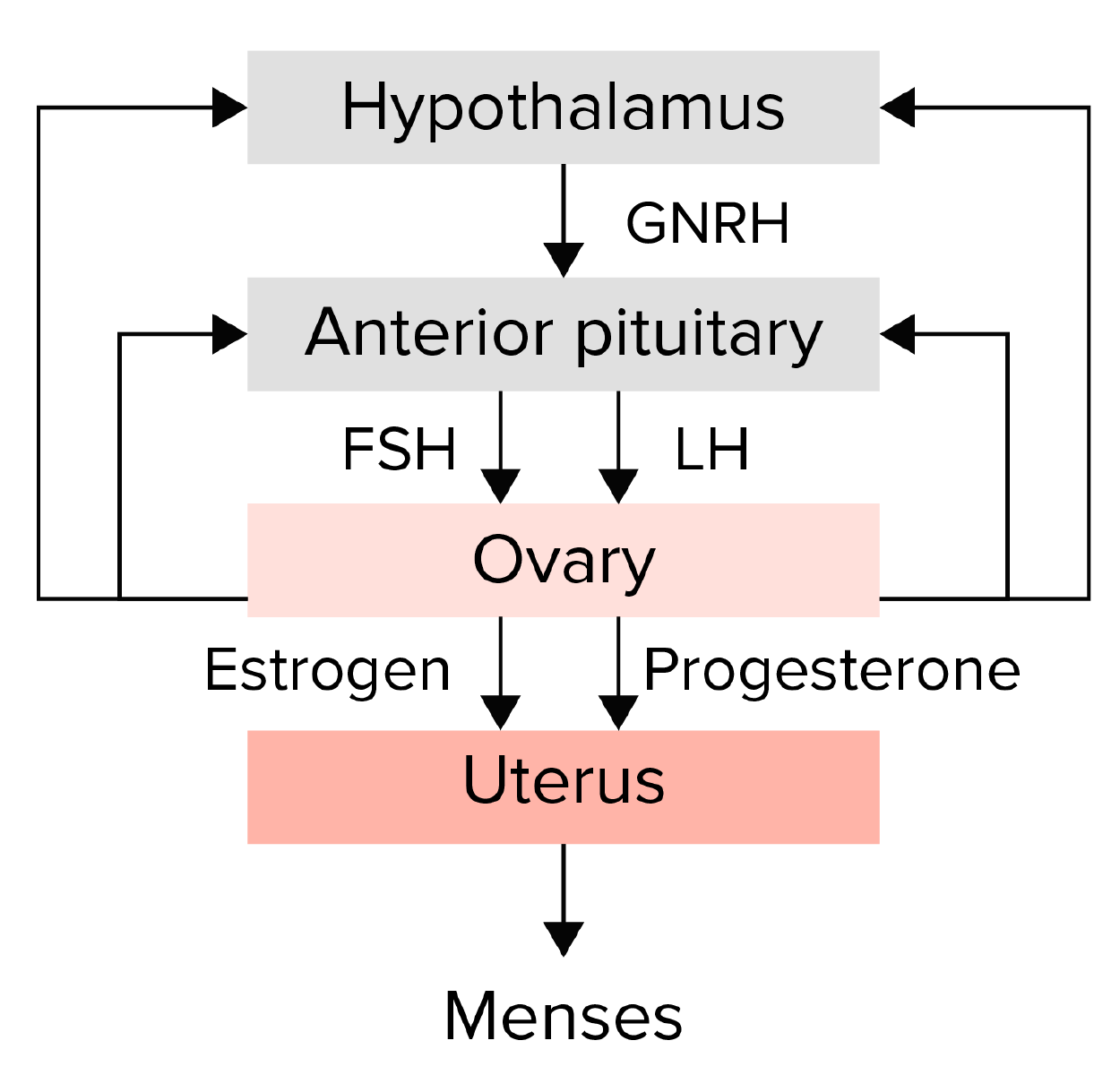
Summary of hypothalamic–pituitary–ovarian axis

Resumo do eixo hipotálamo-hipófise-ovário:
O hipotálamo secreta a hormona libertadora de gonadotrofinas (GNRH, pela sigla em inglês), que estimula a hipófise anterior a libertar as gonadotrofinas: hormona folículo-estimulante (FSH, pela sigla em inglês) e a hormona luteinizante (LH, pela sigla em inglês) As gonadotrofinas estimulam o ovário a produzir estrogénio e progesterona, que, por sua vez, levam ao crescimento e maturação endometrial. Qualquer alteração neste eixo pode levar a amenorreia.
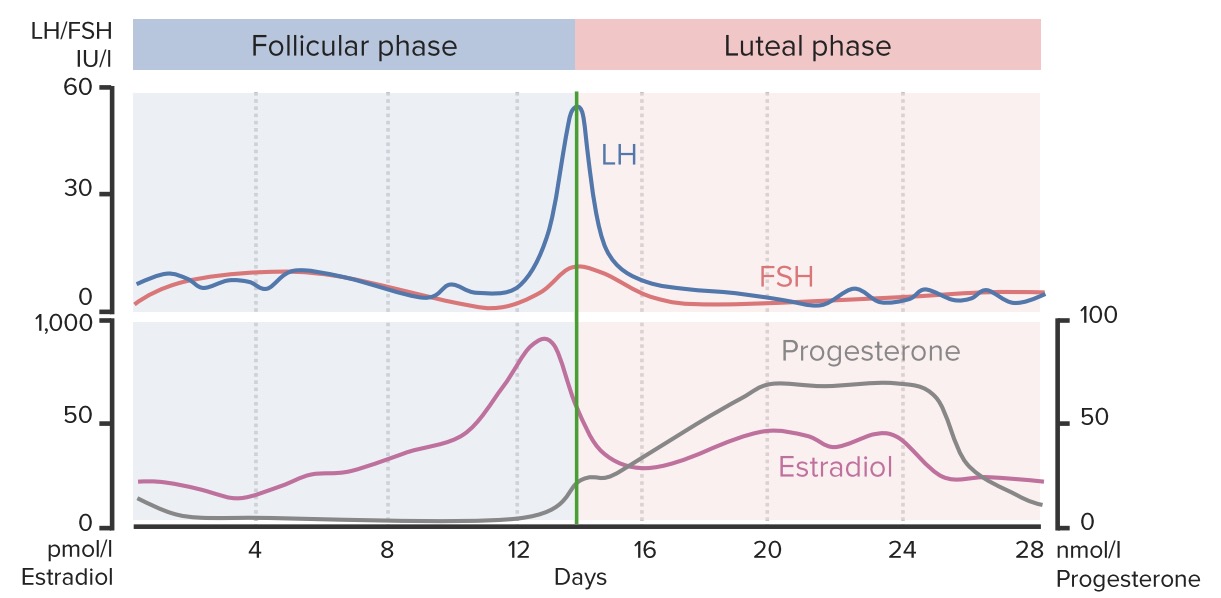
Imagem por Lecturio.
  • Eixo HPO:
    • Hipotálamo → hormona libertadora de gonadotrofinas (GNRH, pela sigla em inglês)
    • Hipófise → hormona folículo-estimulante ( FSH FSH A major gonadotropin secreted by the adenohypophysis. Follicle-stimulating hormone stimulates gametogenesis and the supporting cells such as the ovarian granulosa cells, the testicular sertoli cells, and leydig cells. Fsh consists of two noncovalently linked subunits, alpha and beta. Within a species, the alpha subunit is common in the three pituitary glycoprotein hormones (TSH, LH, and FSH), but the beta subunit is unique and confers its biological specificity. Menstrual Cycle, pela sigla em inglês) e a hormona luteinizante ( LH LH A major gonadotropin secreted by the adenohypophysis. Luteinizing hormone regulates steroid production by the interstitial cells of the testis and the ovary. The preovulatory luteinizing hormone surge in females induces ovulation, and subsequent luteinization of the follicle. Luteinizing hormone consists of two noncovalently linked subunits, alpha and beta. Within a species, the alpha subunit is common in the three pituitary glycoprotein hormones (TSH, LH, and FSH), but the beta subunit is unique and confers its biological specificity. Menstrual Cycle, pela sigla em inglês)
    • Ovário → estrogénio e progesterona
    • Geral: GNRH → FSH FSH A major gonadotropin secreted by the adenohypophysis. Follicle-stimulating hormone stimulates gametogenesis and the supporting cells such as the ovarian granulosa cells, the testicular sertoli cells, and leydig cells. Fsh consists of two noncovalently linked subunits, alpha and beta. Within a species, the alpha subunit is common in the three pituitary glycoprotein hormones (TSH, LH, and FSH), but the beta subunit is unique and confers its biological specificity. Menstrual Cycle e LH LH A major gonadotropin secreted by the adenohypophysis. Luteinizing hormone regulates steroid production by the interstitial cells of the testis and the ovary. The preovulatory luteinizing hormone surge in females induces ovulation, and subsequent luteinization of the follicle. Luteinizing hormone consists of two noncovalently linked subunits, alpha and beta. Within a species, the alpha subunit is common in the three pituitary glycoprotein hormones (TSH, LH, and FSH), but the beta subunit is unique and confers its biological specificity. Menstrual Cycle → estrogénio e progesterona
  • Fase folicular/proliferativa:
    • A secreção pulsátil de GNRH estimula a libertação de FSH FSH A major gonadotropin secreted by the adenohypophysis. Follicle-stimulating hormone stimulates gametogenesis and the supporting cells such as the ovarian granulosa cells, the testicular sertoli cells, and leydig cells. Fsh consists of two noncovalently linked subunits, alpha and beta. Within a species, the alpha subunit is common in the three pituitary glycoprotein hormones (TSH, LH, and FSH), but the beta subunit is unique and confers its biological specificity. Menstrual Cycle.
    • A FSH FSH A major gonadotropin secreted by the adenohypophysis. Follicle-stimulating hormone stimulates gametogenesis and the supporting cells such as the ovarian granulosa cells, the testicular sertoli cells, and leydig cells. Fsh consists of two noncovalently linked subunits, alpha and beta. Within a species, the alpha subunit is common in the three pituitary glycoprotein hormones (TSH, LH, and FSH), but the beta subunit is unique and confers its biological specificity. Menstrual Cycle estimula o desenvolvimento folicular nos ovários.
    • Os folículos em desenvolvimento produzem estrogénio, especificamente o estradiol Estradiol The 17-beta-isomer of estradiol, an aromatized C18 steroid with hydroxyl group at 3-beta- and 17-beta-position. Estradiol-17-beta is the most potent form of mammalian estrogenic steroids. Noncontraceptive Estrogen and Progestins.
    • Estrogénio:
      • Estimula a proliferação endometrial
      • Inibe a secreção de FSH FSH A major gonadotropin secreted by the adenohypophysis. Follicle-stimulating hormone stimulates gametogenesis and the supporting cells such as the ovarian granulosa cells, the testicular sertoli cells, and leydig cells. Fsh consists of two noncovalently linked subunits, alpha and beta. Within a species, the alpha subunit is common in the three pituitary glycoprotein hormones (TSH, LH, and FSH), but the beta subunit is unique and confers its biological specificity. Menstrual Cycle (feedback negativo)
  • Ovulação: desencadeada por um pico de LH LH A major gonadotropin secreted by the adenohypophysis. Luteinizing hormone regulates steroid production by the interstitial cells of the testis and the ovary. The preovulatory luteinizing hormone surge in females induces ovulation, and subsequent luteinization of the follicle. Luteinizing hormone consists of two noncovalently linked subunits, alpha and beta. Within a species, the alpha subunit is common in the three pituitary glycoprotein hormones (TSH, LH, and FSH), but the beta subunit is unique and confers its biological specificity. Menstrual Cycle
  • Fase lútea/secretora:
    • O folículo ovulado passa a denominar-se corpo lúteo.
    • O corpo lúteo produz estradiol Estradiol The 17-beta-isomer of estradiol, an aromatized C18 steroid with hydroxyl group at 3-beta- and 17-beta-position. Estradiol-17-beta is the most potent form of mammalian estrogenic steroids. Noncontraceptive Estrogen and Progestins e progesterona.
    • Progesterona:
      • Estabiliza o endométrio
      • Provoca a maturação do endométrio num endométrio secretor, capaz de sustentar uma gravidez
      • Dica de estudo: progesterona = “hormona progestacional” → produzida somente após a ovulação, quando a gestação é possível
    • O estradiol Estradiol The 17-beta-isomer of estradiol, an aromatized C18 steroid with hydroxyl group at 3-beta- and 17-beta-position. Estradiol-17-beta is the most potent form of mammalian estrogenic steroids. Noncontraceptive Estrogen and Progestins e a progesterona são secretados durante 14 dias após a ovulação (o tempo suficiente para que um embrião fertilizado se implante).
    • Se grávida: o corpo lúteo mantém a produção de progesterona até que a placenta Placenta A highly vascularized mammalian fetal-maternal organ and major site of transport of oxygen, nutrients, and fetal waste products. It includes a fetal portion (chorionic villi) derived from trophoblasts and a maternal portion (decidua) derived from the uterine endometrium. The placenta produces an array of steroid, protein and peptide hormones (placental hormones). Placenta, Umbilical Cord, and Amniotic Cavity seja capaz de o fazer sozinha.
    • Na ausência de gravidez: Involução do corpo lúteo → queda nos níveis de estradiol Estradiol The 17-beta-isomer of estradiol, an aromatized C18 steroid with hydroxyl group at 3-beta- and 17-beta-position. Estradiol-17-beta is the most potent form of mammalian estrogenic steroids. Noncontraceptive Estrogen and Progestins e de progesterona
  • Fase menstrual:
    • A perda das hormonas estabilizadoras (particularmente a progesterona) desencadeia o colapso do endométrio → menstruação
    • Ponto-chave: a queda da progesterona desencadeia a hemorragia.
      • Ausência de ovulação → ausência de progesterona
      • Ausência de progesterona → ausência de uma menstruação regular Regular Insulin (embora possa ocorrer uma hemorragia uterina anómala)
      • Muitas das causas de amenorreia secundária envolvem a alteração da ovulação.
Ciclo ovárico

Alterações hormonais ao longo do ciclo menstrual:
Neste gráfico observa-se a variação das concentrações de FSH, LH, estradiol e progesterona ao longo do ciclo menstrual. É de notar o aumento repentino de estradiol, LH e FSH por volta do dia 14 (linha verde) durante a ovulação e o aumento da progesterona durante a fase lútea, como uma antecipação à fertilização e implantação do óvulo. Alterações no processo de ovulação podem causar amenorreia.

Imagem por Lecturio.

Etiologia e Fisiopatologia

Causas obstétricas

A gravidez é a causa mais MAIS Androgen Insensitivity Syndrome comum de amenorreia secundária. Deve ser sempre excluída em primeiro lugar!

Causas hipotalâmicas e hipofisárias

  • Fisiopatologia:
    • Se a GNRH não estiver a ser libertada ou estiver disfuncional, existe:
      • Ausência de libertação de FSH FSH A major gonadotropin secreted by the adenohypophysis. Follicle-stimulating hormone stimulates gametogenesis and the supporting cells such as the ovarian granulosa cells, the testicular sertoli cells, and leydig cells. Fsh consists of two noncovalently linked subunits, alpha and beta. Within a species, the alpha subunit is common in the three pituitary glycoprotein hormones (TSH, LH, and FSH), but the beta subunit is unique and confers its biological specificity. Menstrual Cycle/ LH LH A major gonadotropin secreted by the adenohypophysis. Luteinizing hormone regulates steroid production by the interstitial cells of the testis and the ovary. The preovulatory luteinizing hormone surge in females induces ovulation, and subsequent luteinization of the follicle. Luteinizing hormone consists of two noncovalently linked subunits, alpha and beta. Within a species, the alpha subunit is common in the three pituitary glycoprotein hormones (TSH, LH, and FSH), but the beta subunit is unique and confers its biological specificity. Menstrual Cycle pela hipófise
      • Ausência de estimulação ovárica
      • Ausência de produção de estrogénio
      • Ausência de proliferação endometrial
      • Ausência de menstruação
  • Amenorreia hipotalâmica funcional:
    • A causa mais MAIS Androgen Insensitivity Syndrome comum de amenorreia secundária não relacionada com a gravidez
    • Corresponde à forma como o corpo previne a reprodução durante períodos de stress intenso, físico ou psicológico:
      • Stress (↑ cortisol Cortisol Glucocorticoids)
      • Desnutrição ou perda de peso (distúrbios alimentares ou fome)
      • Exercício excessivo (comum em atletas do sexo feminino)
    • Tríade das atletas do sexo feminino:
      • Disfunção menstrual
      • ↓ Energia (com ou sem uma perturbação alimentar)
      • ↓ Densidade óssea
  • Hiperprolactinemia:
    • ↑ Prolactina → ↓ GNRH
    • Muitos medicamentos podem ↑ prolactina:
      • Antipsicóticos
      • Antidepressivos tricíclicos
      • Metoclopramida
    • Frequentemente causada por adenomas hipofisários
    • O hipotiroidismo primário ou central pode ter um mecanismo semelhante: ↑ hormona libertadora da tireotrofina → ↑ libertação de prolactina
  • Doença sistémica:
    • Doenças graves podem ↓ GNRH.
    • Exemplos comuns incluem:
      • Diabetes Diabetes Diabetes mellitus (DM) is a metabolic disease characterized by hyperglycemia and dysfunction of the regulation of glucose metabolism by insulin. Type 1 DM is diagnosed mostly in children and young adults as the result of autoimmune destruction of β cells in the pancreas and the resulting lack of insulin. Type 2 DM has a significant association with obesity and is characterized by insulin resistance. Diabetes Mellitus mellitus tipo 1
      • Doença celíaca
      • Doença inflamatória intestinal (DII)
  • Doenças infiltrativas:
    • Sarcoidose
    • Hemocromatose
  • Neoplasia/massa selar:
    • Craniofaringioma
    • Linfoma
    • Histiocitose de células de Langerhans
  • Síndrome da sela turca vazia
  • Síndrome de Sheehan:
    • Hemorragia pós-parto grave → enfarte isquémico da hipófise → hipopituitarismo
    • Pode causar amenorreia, ↓ prolactina, hipotiroidismo e insuficiência da suprarrenal

Causas ováricas

  • Fisiopatologia:
    • Os ovários ou os oócitos são anormais.
    • Ausência de oócitos saudáveis → ausência de estrogénio ou progesterona → ausência de estimulação endometrial → ausência de menstruação
    • A FSH FSH A major gonadotropin secreted by the adenohypophysis. Follicle-stimulating hormone stimulates gametogenesis and the supporting cells such as the ovarian granulosa cells, the testicular sertoli cells, and leydig cells. Fsh consists of two noncovalently linked subunits, alpha and beta. Within a species, the alpha subunit is common in the three pituitary glycoprotein hormones (TSH, LH, and FSH), but the beta subunit is unique and confers its biological specificity. Menstrual Cycle está ↑ porque os ovários não respondem adequadamente
  • Insuficiência ovárica prematura (IOP):
    • Ocorre pela depleção de oócitos com menopausa clínica em mulheres com < 40 anos
    • Causas de IOP:
      • Pré-mutação FMR1 (o gene Gene A category of nucleic acid sequences that function as units of heredity and which code for the basic instructions for the development, reproduction, and maintenance of organisms. Basic Terms of Genetics que causa a síndrome do X frágil)
      • Síndrome de Turner
      • Quimioterapia ou radiação
      • Idiopática

Outras causas de disfunção ovulatória ou anovulação crónica

  • Fisiopatologia:
    • Interferência hormonal no eixo HPO
    • O desenvolvimento folicular é anormal → os oócitos não são ovulatórios → a progesterona não é produzida → não ocorre menstruação
    • O mecanismo de doença não é completamente compreendido.
    • Pode incluir:
      • ↑ Androgénios
      • Perturbações da FSH FSH A major gonadotropin secreted by the adenohypophysis. Follicle-stimulating hormone stimulates gametogenesis and the supporting cells such as the ovarian granulosa cells, the testicular sertoli cells, and leydig cells. Fsh consists of two noncovalently linked subunits, alpha and beta. Within a species, the alpha subunit is common in the three pituitary glycoprotein hormones (TSH, LH, and FSH), but the beta subunit is unique and confers its biological specificity. Menstrual Cycle ou LH LH A major gonadotropin secreted by the adenohypophysis. Luteinizing hormone regulates steroid production by the interstitial cells of the testis and the ovary. The preovulatory luteinizing hormone surge in females induces ovulation, and subsequent luteinization of the follicle. Luteinizing hormone consists of two noncovalently linked subunits, alpha and beta. Within a species, the alpha subunit is common in the three pituitary glycoprotein hormones (TSH, LH, and FSH), but the beta subunit is unique and confers its biological specificity. Menstrual Cycle
      • Excesso de exposição ao estrogénio → feedback negativo na hipófise → ↓ FSH FSH A major gonadotropin secreted by the adenohypophysis. Follicle-stimulating hormone stimulates gametogenesis and the supporting cells such as the ovarian granulosa cells, the testicular sertoli cells, and leydig cells. Fsh consists of two noncovalently linked subunits, alpha and beta. Within a species, the alpha subunit is common in the three pituitary glycoprotein hormones (TSH, LH, and FSH), but the beta subunit is unique and confers its biological specificity. Menstrual Cycle
      • ↑ Hormona adrenocorticotrópica (ACTH, pela sigla em inglês), cortisol Cortisol Glucocorticoids ou outros glucocorticoides (endógenos ou exógenos)
  • Síndrome do ovário poliquístico (SOP) :
    • Oligomenorreia/amenorreia com níveis de androgénios ↑
    • Ovários de aparência poliquística podem ou não estar presentes.
    • Esta perturbação apresenta anovulação crónica
    • Associada à síndrome metabólica:
      • Resistência a insulina
      • Dislipidemia
      • Hipertensão arterial
      • Associação com obesidade
  • Hiperplasia congénita da suprarrenal não clássica ( NC-CAH NC-CAH Secondary Amenorrhea, pela sigla em inglês):
    • Deficiência congénita da 21-hidroxilase → ↑ dos níveis de androgénio
    • Clinicamente indistinguível da SOP, exceto pela avaliação laboratorial
  • Tumores secretores de androgénio (ovárico ou suprarrenal)
  • Tumores secretores de estrogénio (ovárico)
  • Hipertiroidismo
  • Síndrome de Cushing: ↑ cortisol Cortisol Glucocorticoids ou glucocorticóides (endógenos ou exógenos) → alteração do eixo HPO (↓ FSH FSH A major gonadotropin secreted by the adenohypophysis. Follicle-stimulating hormone stimulates gametogenesis and the supporting cells such as the ovarian granulosa cells, the testicular sertoli cells, and leydig cells. Fsh consists of two noncovalently linked subunits, alpha and beta. Within a species, the alpha subunit is common in the three pituitary glycoprotein hormones (TSH, LH, and FSH), but the beta subunit is unique and confers its biological specificity. Menstrual Cycle)
  • Insuficiência da suprarrenal: ↓ produção de cortisol Cortisol Glucocorticoids → ↑ ACTH → alteração do eixo HPO (↓ FSH FSH A major gonadotropin secreted by the adenohypophysis. Follicle-stimulating hormone stimulates gametogenesis and the supporting cells such as the ovarian granulosa cells, the testicular sertoli cells, and leydig cells. Fsh consists of two noncovalently linked subunits, alpha and beta. Within a species, the alpha subunit is common in the three pituitary glycoprotein hormones (TSH, LH, and FSH), but the beta subunit is unique and confers its biological specificity. Menstrual Cycle)

Causas anatómicas

  • Fisiopatologia:
    • Obstrução física à saída de fluxo
    • Por definição, há uma história de menstruações prévias → a anatomia uterina e vaginal eram normais ao nascimento
    • Quaisquer defeitos são adquiridos.
  • Síndrome de Asherman:
    • Aderências uterinas
    • Podem resultar de:
      • Cirurgias uterinas (por exemplo, dilatação e curetagem)
      • Infeções (por exemplo, doença inflamatória pélvica)
  • Estenose cervical:

Resumo das causas mais MAIS Androgen Insensitivity Syndrome comuns

As causas mais MAIS Androgen Insensitivity Syndrome comuns de amenorreia secundária e a respetiva frequência
Causa de amenorreia secundária Frequência aproximada
Amenorreia hipotalâmica funcional 35%
SOP 30%
Hyperprolactinemia Hyperprolactinemia Hyperprolactinemia is defined as a condition of elevated levels of prolactin (PRL) hormone in the blood. The PRL hormone is secreted by the anterior pituitary gland and is responsible for breast development and lactation. The most common cause is PRL-secreting pituitary adenomas (prolactinomas). Hyperprolactinemia 13%
IOP 10%
Síndrome de Asherman 5%
Outras 7%

Apresentação Clínica

Mulher em idade fértil sem menstruação por:

  • 3 meses com uma história de ciclos menstruais previamente regulares
  • 6 meses com uma história de ciclos menstruais previamente irregulares
  • Duração de 3 ciclos (para mulheres com ciclos de duração mais MAIS Androgen Insensitivity Syndrome longa)

A clínica depende da etiologia subjacente, mas pode incluir:

  • Sinais de gravidez:
    • Fadiga
    • Náuseas
    • Aumento de volume do útero
  • Sinais da amenorreia hipotalâmica funcional:
    • Baixo peso ou perda de peso recente
    • História de uma perturbação alimentar
    • Atleta do sexo feminino ou antecedentes de exercício físico excessivo
    • Fratura osteoporótica
  • Sinais de hiperprolactinemia:
    • Galactorreia
    • Ingurgitamento mamário
  • Sinais de hipotiroidismo
  • Sinais de hiperandrogenismo (considerar SOP, CAH CAH Congenital adrenal hyperplasia (CAH) consists of a group of autosomal recessive disorders that cause a deficiency of an enzyme needed in cortisol, aldosterone, and androgen synthesis. The most common subform of cah is 21-hydroxylase deficiency, followed by 11β-hydroxylase deficiency. Congenital Adrenal Hyperplasia e tumores secretores de androgénio):
    • Hirsutismo (crescimento de pelos faciais e no corpo)
    • Acne quística
    • Queda de cabelo num padrão masculino
    • Virilização (ocorre apenas quando os androgénios estão ↑↑)
  • Sinais da menopausa/IOP:

Diagnóstico

Avaliação laboratorial

Exames iniciais:

  • Teste de gravidez na urina ou da hCG qualitativo positivo → grávida
  • ↑ Prolactina → hiperprolactinemia
  • Avaliação da função tiroideia:
    • TSH ↓ ou normal com T4 ↓ → hipotiroidismo central
    • ↑ TSH com ↓ T4 → hipotiroidismo primário
    • ↓ TSH com ↑ T4 → hipertiroidismo
  • FSH FSH A major gonadotropin secreted by the adenohypophysis. Follicle-stimulating hormone stimulates gametogenesis and the supporting cells such as the ovarian granulosa cells, the testicular sertoli cells, and leydig cells. Fsh consists of two noncovalently linked subunits, alpha and beta. Within a species, the alpha subunit is common in the three pituitary glycoprotein hormones (TSH, LH, and FSH), but the beta subunit is unique and confers its biological specificity. Menstrual Cycle e estrogénio:
    • FSH FSH A major gonadotropin secreted by the adenohypophysis. Follicle-stimulating hormone stimulates gametogenesis and the supporting cells such as the ovarian granulosa cells, the testicular sertoli cells, and leydig cells. Fsh consists of two noncovalently linked subunits, alpha and beta. Within a species, the alpha subunit is common in the three pituitary glycoprotein hormones (TSH, LH, and FSH), but the beta subunit is unique and confers its biological specificity. Menstrual Cycle e ↓ estradiol Estradiol The 17-beta-isomer of estradiol, an aromatized C18 steroid with hydroxyl group at 3-beta- and 17-beta-position. Estradiol-17-beta is the most potent form of mammalian estrogenic steroids. Noncontraceptive Estrogen and Progestins: IOP
    • FSH FSH A major gonadotropin secreted by the adenohypophysis. Follicle-stimulating hormone stimulates gametogenesis and the supporting cells such as the ovarian granulosa cells, the testicular sertoli cells, and leydig cells. Fsh consists of two noncovalently linked subunits, alpha and beta. Within a species, the alpha subunit is common in the three pituitary glycoprotein hormones (TSH, LH, and FSH), but the beta subunit is unique and confers its biological specificity. Menstrual Cycle e ↓ estradiol Estradiol The 17-beta-isomer of estradiol, an aromatized C18 steroid with hydroxyl group at 3-beta- and 17-beta-position. Estradiol-17-beta is the most potent form of mammalian estrogenic steroids. Noncontraceptive Estrogen and Progestins: hipogonadismo hipotalâmico → amenorreia hipotalâmica funcional, doença sistémica, doença infiltrativa, neoplasias cerebrais
    • FSH FSH A major gonadotropin secreted by the adenohypophysis. Follicle-stimulating hormone stimulates gametogenesis and the supporting cells such as the ovarian granulosa cells, the testicular sertoli cells, and leydig cells. Fsh consists of two noncovalently linked subunits, alpha and beta. Within a species, the alpha subunit is common in the three pituitary glycoprotein hormones (TSH, LH, and FSH), but the beta subunit is unique and confers its biological specificity. Menstrual Cycle e ↑ estradiol Estradiol The 17-beta-isomer of estradiol, an aromatized C18 steroid with hydroxyl group at 3-beta- and 17-beta-position. Estradiol-17-beta is the most potent form of mammalian estrogenic steroids. Noncontraceptive Estrogen and Progestins: o estrogénio está a suprimir a FSH FSH A major gonadotropin secreted by the adenohypophysis. Follicle-stimulating hormone stimulates gametogenesis and the supporting cells such as the ovarian granulosa cells, the testicular sertoli cells, and leydig cells. Fsh consists of two noncovalently linked subunits, alpha and beta. Within a species, the alpha subunit is common in the three pituitary glycoprotein hormones (TSH, LH, and FSH), but the beta subunit is unique and confers its biological specificity. Menstrual Cycle → medir a testosterona
  • Testosterona:
    • ↑ Testosterona e ↑ estradiol Estradiol The 17-beta-isomer of estradiol, an aromatized C18 steroid with hydroxyl group at 3-beta- and 17-beta-position. Estradiol-17-beta is the most potent form of mammalian estrogenic steroids. Noncontraceptive Estrogen and Progestins: SOP
    • ↓ Testosterona e ↑ estradiol Estradiol The 17-beta-isomer of estradiol, an aromatized C18 steroid with hydroxyl group at 3-beta- and 17-beta-position. Estradiol-17-beta is the most potent form of mammalian estrogenic steroids. Noncontraceptive Estrogen and Progestins: tumor Tumor Inflammation ovárico secretor de estrogénio
    • ↑ Testosterona e ↓ estradiol Estradiol The 17-beta-isomer of estradiol, an aromatized C18 steroid with hydroxyl group at 3-beta- and 17-beta-position. Estradiol-17-beta is the most potent form of mammalian estrogenic steroids. Noncontraceptive Estrogen and Progestins: tumor Tumor Inflammation ovárico secretor de testosterona

Se houver sinais de que os androgénios estão ↑, mas a testosterona estiver normal:
  • Sulfato de desidroepiandrosterona (DHEA-S, pela sigla em inglês):
    • Corresponde a um androgénio da suprarrenal que pode causar irregularidades menstruais quando ↑
    • Pode estar ↑ na presença de tumores da suprarrenal
  • 17-hidroxiprogesterona:
  • SOP:
    • Prova de tolerância à glicose às 2 horas
    • Medição dos lipídios em jejum

Imagiologia

  • Ecografia pélvica:
    • SOP: ovários de aparência poliquística e espessamento do endométrio (devido à exposição ao estrogénio sem progesterona pós-ovulatória)
    • IOP: endométrio fino (dado que não há exposição ao estrogénio)
    • Tumores ováricos secretores de hormonas: massa ovárica sólida
  • RMN cerebral:
    • Realizar na suspeita de uma causa hipotalâmica (ou hipofisária), que não a amenorreia hipotalâmica funcional ou uma doença sistémica
    • Hiperprolactinemia: provavelmente secundária a um adenoma hipofisário
    • Doenças infiltrativas
    • Massas ou tumores
  • DEXA DEXA Osteoporosis scan:
    • Utilizada nos doentes com hipogonadismo hipotalâmico para avaliar a densidade mineral óssea
    • Especialmente importante nas perturbações do comportamento alimentar e em atletas em risco para a tríade das atletas do sexo feminino

Prova terapêutica com progesterona

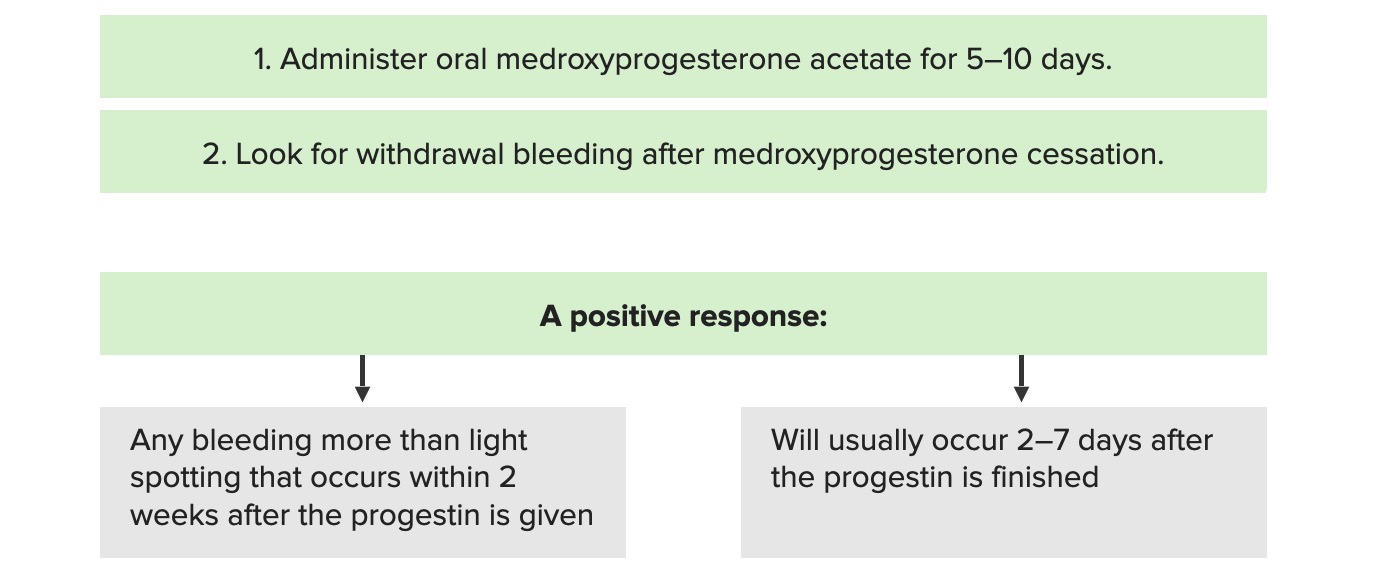
  • Avaliar a presença de hemorragia após um ciclo de 10 dias de progesterona.
  • Se houver hemorragia de privação:
    • Comprova que a doente menstrua na presença de uma exposição hormonal adequada
    • Sugere anovulação → estrogénio sem progesterona
    • Considerar a SOP ou outras patologias com ação estrogénica sem oposição.
  • Se não houver hemorragia de privação:
    • Suspeitar de uma patologia do eixo HPO ou obstrução ao trato de saída.
    • Fazer uma prova terapêutica com estroprogesterona
Algoritmo da prova terapêutica com progesterona

Prova terapêutica com progesterona

Imagem por Lecturio.

Prova terapêutica com estroprogesterona

  • Administrar estrogénio para estimular o endométrio e, em seguida, realizar um ciclo curto de progesterona → avaliar a presença de hemorragia
  • Se houver hemorragia de privação:
    • Comprova que a doente consegue menstruar perante uma exposição hormonal adequada
    • Sugestivo de que não há produção de qualquer hormona pelo ovário → nem estrogénio, nem progesterona
    • Considerar causas hipotalâmicas e IOP.
  • Se não houver hemorragia de privação:
    • Comprova que o problema se localiza no útero ou no trato de saída
    • Considerar a síndrome de Asherman (perante uma história de doença inflamatória pélvica (DIP) ou cirurgia uterina prévia) ou estenose cervical (perante uma história de procedimentos cervicais).

Tratamento

O tratamento depende da etiologia.

Tratar outras patologias médicas:

  • Cuidados obstétricos, se grávida
  • Tratamento do hipotiroidismo ou hipertiroidismo
  • Doença sistémica

Modificação do estilo de vida:

  • Amenorreia hipotalâmica funcional:
    • Aumento de peso (para um IMC > 19)
    • ↓ Intensidade do exercício
    • Psicoterapia
    • Gestão de stress
  • SOP: perda de peso, se estiver com excesso de peso

Tratamento médico:

  • Certificar que a doente está exposta ao estrogénio e progesterona através de:
    • Retoma da ovulação normal
    • Pílulas anticoncecionais orais (OCPs, pela sigla em inglês)
    • Terapêutica de reposição hormonal (TRH)
  • Hiperprolactinemia:
    • Agonistas da dopamina → ↓ prolactina → restauração da função do eixo HPO
    • Opções: cabergolina, bromocriptina
  • Hiperandrogenismo/SOP:
    • Pílulas anticoncecionais orais
    • Espironolactona
    • Agentes sensibilizadores de insulina (metformina)

Tratamento cirúrgico:

  • Corrigir obstruções anatómicas.
  • Excisão de tumores.

Tratamento de fertilidade, se desejado:
  • Indução da ovulação
  • Fertilização in vitro

Referências

  1. Welt CK, Barbieri RL. (2023). Epidemiology and causes of secondary amenorrhea. In Martin KA (Ed.), UpToDate. Retrieved August 19, 2025, from https://www.uptodate.com/contents/epidemiology-and-causes-of-secondary-amenorrhea
  2. Welt CK, Barbieri RL. (2024). Evaluation and management of secondary amenorrhea. In Martin KA (Ed.), UpToDate. Retrieved August 19, 2025, from https://www.uptodate.com/contents/evaluation-and-management-of-secondary-amenorrhea
  3. Welt CK, Barbieri RL. (2025). Clinical manifestations of polycystic ovary syndrome in adults. In Martin KA (Ed.), UpToDate. Retrieved August 19, 2025, from https://www.uptodate.com/contents/clinical-manifestations-of-polycystic-ovary-syndrome-in-adults
  4. Schorge JO, Schaffer JI, et al. (2008). Williams Gynecology (pp. 365-382).
  5. Pinkerton JV. (2023). Amenorrhea. Merck Manual Professional Version. Retrieved August 19, 2025, from https://www.merckmanuals.com/professional/gynecology-and-obstetrics/menstrual-abnormalities/amenorrhea
  6. Tough DeSapri KA. (2024). Amenorrhea. In Lucidi RS (Ed.), Medscape. Retrieved August 19, 2025, from https://emedicine.medscape.com/article/252928-overview

Crie sua conta gratuita ou faça login para continuar lendo!

Cadastre-se agora e tenha acesso grátis ao Lecturio, com páginas de conceitos, vídeos de medicina e questões para sua educação médica.

Aprende mais com a Lecturio:

Multiple devices displaying human anatomy and health education content.

Complementa o teu estudo da faculdade com o companheiro de estudo tudo-em-um da Lecturio, através de métodos de ensino baseados em evidência.

Estuda onde quiseres

Two iPhones display medical education apps, one showing anatomy, the other Bookmatcher.

A Lecturio Medical complementa o teu estudo através de métodos de ensino baseados em evidência, vídeos de palestras, perguntas e muito mais – tudo combinado num só lugar e fácil de usar.

User Reviews

Have a holly, jolly study session 🎁 Save 50% on all plans now >>

Que tengas una sesión de estudio alegre y navideña 🎁 Ahorra 50% en todos los planes >>

Details