Domina Conceptos Médicos

Estudia para la escuela de medicina y tus examenes con Lecturio.

Trastorno por Consumo de Alcohol

El alcohol es una de las sustancias adictivas más utilizadas en EN Erythema nodosum is an immune-mediated panniculitis (inflammation of the subcutaneous fat) caused by a type IV (delayed-type) hypersensitivity reaction. It commonly manifests in young women as tender, erythematous nodules on the shins. Erythema Nodosum el mundo. El trastorno por consumo de alcohol se define como el consumo patológico de alcohol que conduce a un deterioro del funcionamiento diario. La intoxicación aguda por alcohol se presenta con deterioro de las funciones motoras y del habla y puede tratarse en EN Erythema nodosum is an immune-mediated panniculitis (inflammation of the subcutaneous fat) caused by a type IV (delayed-type) hypersensitivity reaction. It commonly manifests in young women as tender, erythematous nodules on the shins. Erythema Nodosum la mayoría de los LOS Neisseria casos con cuidados de soporte. La abstinencia del consumo crónico de alcohol puede tener consecuencias fatales, como delirio y convulsiones y se trata con benzodiacepinas. El trastorno por consumo de alcohol crónico afecta a casi todas las partes del cuerpo humano y tiene un impacto grave en EN Erythema nodosum is an immune-mediated panniculitis (inflammation of the subcutaneous fat) caused by a type IV (delayed-type) hypersensitivity reaction. It commonly manifests in young women as tender, erythematous nodules on the shins. Erythema Nodosum la salud mental y física de una persona. El trastorno por consumo de alcohol se puede controlar con psicoterapia y medicamentos; sin embargo, el pronóstico suele ser malo, con altas tasas de recaída y complicaciones.

Last updated: Dec 15, 2025

Editorial responsibility: Stanley Oiseth, Lindsay Jones, Evelin Maza

Descripción General

Definición

El trastorno por consumo de alcohol es un patrón crónico (> 12 meses) problemático de consumo de alcohol que causa una angustia significativa.

Clasificación

Existen diversas definiciones de diferentes organizaciones para la clasificación del consumo de alcohol.

  • Intoxicación:
    • Antecedente de consumo reciente
    • Síntomas como estupor, marcha inestable y dificultad para hablar
  • Abstinencia:
    • Desarrollo de un síndrome específico de la sustancia debido al AL Amyloidosis cese (o reducción) de la sustancia después del consumo intenso y prolongado
    • Los LOS Neisseria individuos experimentan síntomas físicos (náuseas, diarrea, escalofríos y dolores corporales) y/o psicológicos (necesidad compulsiva o percibida de consumir la sustancia).
  • Tolerancia:
    • Necesidad de aumentar la dosis de la sustancia para lograr el mismo efecto deseado (efecto disminuido mientras se consume la misma cantidad de la sustancia)
  • Consumo moderado y excesivo de alcohol:
    • 1 bebida estándar contiene aproximadamente 14 g de alcohol puro.
      • 350 ml (12 oz) de cerveza normal
      • 150 ml (5 onzas) de vino
      • 45 ml (1,5 oz) de licores destilados
    • Consumo moderado:
      • Mujeres: ≤ 3 tragos en EN Erythema nodosum is an immune-mediated panniculitis (inflammation of the subcutaneous fat) caused by a type IV (delayed-type) hypersensitivity reaction. It commonly manifests in young women as tender, erythematous nodules on the shins. Erythema Nodosum un solo día y no más de 7 tragos por semana
      • Hombres: ≤ 4 tragos en EN Erythema nodosum is an immune-mediated panniculitis (inflammation of the subcutaneous fat) caused by a type IV (delayed-type) hypersensitivity reaction. It commonly manifests in young women as tender, erythematous nodules on the shins. Erythema Nodosum un solo día y no más de 14 tragos por semana
    • Consumo excesivo:
      • Excede los LOS Neisseria límites moderados de ingesta pero sin efectos nocivos físicos/psicológicos del trastorno por consumo de alcohol
      • Incluye episodios intensos de consumo de alcohol (borrachera) o consumo de > 60 g de alcohol en EN Erythema nodosum is an immune-mediated panniculitis (inflammation of the subcutaneous fat) caused by a type IV (delayed-type) hypersensitivity reaction. It commonly manifests in young women as tender, erythematous nodules on the shins. Erythema Nodosum una sola ocasión al AL Amyloidosis menos una vez al AL Amyloidosis mes

Epidemiología

  • Prevalencia: el 7% de los LOS Neisseria adultos en EN Erythema nodosum is an immune-mediated panniculitis (inflammation of the subcutaneous fat) caused by a type IV (delayed-type) hypersensitivity reaction. It commonly manifests in young women as tender, erythematous nodules on the shins. Erythema Nodosum los LOS Neisseria Estados Unidos tienen trastorno por consumo de alcohol.
  • Prevalencia de por vida: 10% en EN Erythema nodosum is an immune-mediated panniculitis (inflammation of the subcutaneous fat) caused by a type IV (delayed-type) hypersensitivity reaction. It commonly manifests in young women as tender, erythematous nodules on the shins. Erythema Nodosum hombres, 3%–5% en EN Erythema nodosum is an immune-mediated panniculitis (inflammation of the subcutaneous fat) caused by a type IV (delayed-type) hypersensitivity reaction. It commonly manifests in young women as tender, erythematous nodules on the shins. Erythema Nodosum mujeres
  • Los LOS Neisseria caucásicos tienen las tasas más altas de consumo de alcohol.
  • Solo el 8% de los LOS Neisseria que cumplen los LOS Neisseria criterios para trastorno por consumo de alcohol buscan tratamiento
  • 3ra causa principal de muerte prevenible en EN Erythema nodosum is an immune-mediated panniculitis (inflammation of the subcutaneous fat) caused by a type IV (delayed-type) hypersensitivity reaction. It commonly manifests in young women as tender, erythematous nodules on the shins. Erythema Nodosum los LOS Neisseria Estados Unidos
  • Factores de riesgo: los LOS Neisseria estudios sugieren una fuerte predisposición genética al AL Amyloidosis trastorno por consumo de alcohol.
  • Inicio temprano del trastorno por consumo de alcohol asociado con un mayor riesgo de desarrollar futuras complicaciones
  • Población de edad avanzada con el trastorno por consumo de alcohol con mayor riesgo de consecuencias graves de la intoxicación por alcohol

Farmacología

Bioquímica del metabolismo del etanol

  • Aproximadamente el 90% del alcohol se metaboliza mediante un proceso oxidativo en EN Erythema nodosum is an immune-mediated panniculitis (inflammation of the subcutaneous fat) caused by a type IV (delayed-type) hypersensitivity reaction. It commonly manifests in young women as tender, erythematous nodules on the shins. Erythema Nodosum el hígado; el resto se excreta sin cambios a través de los LOS Neisseria pulmones y los LOS Neisseria riñones.
  • El etanol se metaboliza en EN Erythema nodosum is an immune-mediated panniculitis (inflammation of the subcutaneous fat) caused by a type IV (delayed-type) hypersensitivity reaction. It commonly manifests in young women as tender, erythematous nodules on the shins. Erythema Nodosum acetaldehído (enzima: alcohol deshidrogenasa).
  • El acetaldehído se metaboliza en EN Erythema nodosum is an immune-mediated panniculitis (inflammation of the subcutaneous fat) caused by a type IV (delayed-type) hypersensitivity reaction. It commonly manifests in young women as tender, erythematous nodules on the shins. Erythema Nodosum acetato (enzima: acetaldehído deshidrogenasa).
  • En EN Erythema nodosum is an immune-mediated panniculitis (inflammation of the subcutaneous fat) caused by a type IV (delayed-type) hypersensitivity reaction. It commonly manifests in young women as tender, erythematous nodules on the shins. Erythema Nodosum los LOS Neisseria consumidores crónicos de alcohol, las enzimas se regulan al AL Amyloidosis alza.
  • Las personas de etnia asiática tienen menos aldehído deshidrogenasa (variación genética) → acumulación de acetaldehído → sofocos y náuseas → menor probabilidades de desarrollar trastorno por consumo de alcohol
  • Medicamentos que inhiben el metabolismo del etanol:
    • Fomepizol (antídoto para sobredosis por metanol o etilenglicol) → inhibe la alcohol deshidrogenasa
    • Disulfiram → inhibe la acetaldehído deshidrogenasa

Otros tipos de alcohol

  • Envenenamiento por metanol:
    • Algunas personas pueden beber metanol como alternativa al AL Amyloidosis etanol.
    • Intoxicación:
      • Visión borrosa
      • Escotoma central
      • Defecto pupilar aferente
      • Cefaleas
      • Cambios del estado mental
      • Náuseas
      • Vómitos
      • Acidosis Acidosis A pathologic condition of acid accumulation or depletion of base in the body. The two main types are respiratory acidosis and metabolic acidosis, due to metabolic acid build up. Respiratory Acidosis metabólica con desequilibrio aniónico
    • Complicaciones más peligrosas: pérdida de la visión y coma Coma Coma is defined as a deep state of unarousable unresponsiveness, characterized by a score of 3 points on the GCS. A comatose state can be caused by a multitude of conditions, making the precise epidemiology and prognosis of coma difficult to determine. Coma
  • Envenenamiento por etilenglicol:
    • Algunas personas pueden beber etilenglicol como alternativa al AL Amyloidosis etanol.
    • Intoxicación:
      • Dolor Dolor Inflammation de costado
      • Hematuria Hematuria Presence of blood in the urine. Renal Cell Carcinoma
      • Oliguria Oliguria Decreased urine output that is below the normal range. Oliguria can be defined as urine output of less than or equal to 0. 5 or 1 ml/kg/hr depending on the age. Renal Potassium Regulation
      • Acidosis Acidosis A pathologic condition of acid accumulation or depletion of base in the body. The two main types are respiratory acidosis and metabolic acidosis, due to metabolic acid build up. Respiratory Acidosis metabólica con desequilibrio aniónico
      • Cristales de oxalato de calcio en EN Erythema nodosum is an immune-mediated panniculitis (inflammation of the subcutaneous fat) caused by a type IV (delayed-type) hypersensitivity reaction. It commonly manifests in young women as tender, erythematous nodules on the shins. Erythema Nodosum la orina
      • Daño renal

Efectos en EN Erythema nodosum is an immune-mediated panniculitis (inflammation of the subcutaneous fat) caused by a type IV (delayed-type) hypersensitivity reaction. It commonly manifests in young women as tender, erythematous nodules on the shins. Erythema Nodosum el cuerpo

  • El alcohol es un potente depresor del sistema nervioso central (SNC):
    • Activación de receptores inhibitorios (ácido gamma aminobutirico, dopamina, serotonina)
    • Inhibición de receptores excitadores (glutamato, canales de calcio dependientes de voltaje)
  • Abstinencia alcohólica
    • Con el consumo crónico de alcohol, el cuerpo aumenta la actividad de los LOS Neisseria receptores excitadores (e.g., glutamato) mientras disminuye la activación de los LOS Neisseria receptores inhibidores (e.g., ácido gamma aminobutirico).
    • El cese del consumo de alcohol conduce a la activación descontrolada del glutamato, que se presenta como abstinencia.

Presentación Clínica y Diagnóstico

Intoxicación alcohólica

Los LOS Neisseria signos y síntomas de la intoxicación aguda por alcohol difieren según el nivel de alcohol en EN Erythema nodosum is an immune-mediated panniculitis (inflammation of the subcutaneous fat) caused by a type IV (delayed-type) hypersensitivity reaction. It commonly manifests in young women as tender, erythematous nodules on the shins. Erythema Nodosum la sangre.

Intoxicación leve:

  • Extroversión
  • Sensación de tranquilidad y relajación
  • Sensaciones leves de sedación
  • Deterioro en EN Erythema nodosum is an immune-mediated panniculitis (inflammation of the subcutaneous fat) caused by a type IV (delayed-type) hypersensitivity reaction. It commonly manifests in young women as tender, erythematous nodules on the shins. Erythema Nodosum tareas que requieren habilidad y/o coordinación motora fina

Intoxicación moderada:

  • Movimientos oculares descontrolados
  • Torpeza y marcha inestable (prueba positiva de sobriedad)
  • Tiempo de reacción lenta
  • Dificultad para hablar
  • Alteración de juicio
  • Percepción alterada del entorno
  • Cambios en EN Erythema nodosum is an immune-mediated panniculitis (inflammation of the subcutaneous fat) caused by a type IV (delayed-type) hypersensitivity reaction. It commonly manifests in young women as tender, erythematous nodules on the shins. Erythema Nodosum el estado de ánimo, comportamiento y personalidad

Intoxicación severa:

  • Náuseas y vómitos
  • Mareo
  • Problemas para hablar y articular las palabras
  • Diplopía
  • Amnesia
  • Delirio
  • Hipotermia o sensación de mucho frío
  • Letargo
  • Depresión respiratoria
  • Convulsiones
  • Coma Coma Coma is defined as a deep state of unarousable unresponsiveness, characterized by a score of 3 points on the GCS. A comatose state can be caused by a multitude of conditions, making the precise epidemiology and prognosis of coma difficult to determine. Coma
  • Muerte

Diagnóstico:

  • Si es posible, obtener los LOS Neisseria antecedentes del consumo de alcohol.
  • Test de alcoholemia con alcoholímetro
  • Aumento del nivel de alcohol en EN Erythema nodosum is an immune-mediated panniculitis (inflammation of the subcutaneous fat) caused by a type IV (delayed-type) hypersensitivity reaction. It commonly manifests in young women as tender, erythematous nodules on the shins. Erythema Nodosum sangre
  • Pruebas de función hepática:
    • Aspartato aminotransferasa ( AST AST Enzymes of the transferase class that catalyze the conversion of l-aspartate and 2-ketoglutarate to oxaloacetate and l-glutamate. Liver Function Tests) esta 2 × más elevada que la alanina aminotransferasa ( ALT ALT An enzyme that catalyzes the conversion of l-alanine and 2-oxoglutarate to pyruvate and l-glutamate. Liver Function Tests). Mnemotecnia, en EN Erythema nodosum is an immune-mediated panniculitis (inflammation of the subcutaneous fat) caused by a type IV (delayed-type) hypersensitivity reaction. It commonly manifests in young women as tender, erythematous nodules on the shins. Erythema Nodosum inglés: “take A ShoT for me”, tomate un trago por mí
    • La elevación de AST AST Enzymes of the transferase class that catalyze the conversion of l-aspartate and 2-ketoglutarate to oxaloacetate and l-glutamate. Liver Function Tests y ALT ALT An enzyme that catalyzes the conversion of l-alanine and 2-oxoglutarate to pyruvate and l-glutamate. Liver Function Tests es < 500 U/L.
    • La gamma glutamil transpeptidasa ( GGT GGT An enzyme, sometimes called ggt, with a key role in the synthesis and degradation of glutathione; (gsh, a tripeptide that protects cells from many toxins). It catalyzes the transfer of the gamma-glutamyl moiety to an acceptor amino acid. Alcoholic Liver Disease) puede estar elevada y es específica para un consumo reciente.
  • Monitoreo de los LOS Neisseria gases arteriales y la brecha aniónica.
  • Obtener niveles de amilasa/lipasa para descartar pancreatitis Pancreatitis Inflammation of the pancreas. Pancreatitis is classified as acute unless there are computed tomographic or endoscopic retrograde cholangiopancreatographic findings of chronic pancreatitis. The two most common forms of acute pancreatitis are alcoholic pancreatitis and gallstone pancreatitis. Acute Pancreatitis alcohólica: se considera positivo si la lipasa sérica es > 3 × los LOS Neisseria límites normales

Abstinencia alcohólica

Evaluación del Clinical Institute Withdrawal Assessment for Alcohol (CIWA-A):

  • Ayuda a determinar la gravedad de la abstinencia
  • Puntuación máxima: 67
  • Las personas que obtienen una puntuación < 10 por lo general no necesitan medicación adicional para la abstinencia.
  • Evalúa los LOS Neisseria siguientes síntomas, la mayoría de los LOS Neisseria cuales tienen una puntuación máxima de 7 puntos:
    • Náuseas y vómitos
    • Perturbaciones táctiles
    • Temblores
    • Alteraciones auditivas
    • Sudoración paroxística
    • Alteraciones visuales
    • Ansiedad
    • Cefalea, sensación de presión en EN Erythema nodosum is an immune-mediated panniculitis (inflammation of the subcutaneous fat) caused by a type IV (delayed-type) hypersensitivity reaction. It commonly manifests in young women as tender, erythematous nodules on the shins. Erythema Nodosum la cabeza
    • Agitación
    • Orientación y nublamiento de los LOS Neisseria sentidos (máximo: 4 puntos)

Diagnóstico:

  • Se deben obtener los LOS Neisseria antecedentes detallados de consumo de alcohol, incluido el consumo más reciente
  • La abstinencia de alcohol es una condición letal si no se trata.
  • Examen completo del estado mental para evaluar la gravedad
  • Las manifestaciones varían según el momento del consumo de alcohol más reciente.
  • Examen toxicológico en EN Erythema nodosum is an immune-mediated panniculitis (inflammation of the subcutaneous fat) caused by a type IV (delayed-type) hypersensitivity reaction. It commonly manifests in young women as tender, erythematous nodules on the shins. Erythema Nodosum orina
  • El nivel de alcohol en EN Erythema nodosum is an immune-mediated panniculitis (inflammation of the subcutaneous fat) caused by a type IV (delayed-type) hypersensitivity reaction. It commonly manifests in young women as tender, erythematous nodules on the shins. Erythema Nodosum sangre no puede predecir de forma independiente la gravedad de los LOS Neisseria síntomas de abstinencia de alcohol.
Tabla: Signos y síntomas de abstinencia por alcohol
Signos y síntomas Ingesta más reciente
Leve
  • Ansiedad, insomnio e irritabilidad
  • Temblores
  • Malestar gastrointestinal (náuseas y vómitos)
  • Hiperactividad autonómica leve (diaforesis, taquicardia, hipertensión)
6–24 horas
Convulsiones Convulsiones tonicoclónicas generalizadas (únicas o múltiples) 12–48 horas
Alucinaciones Predominantemente visuales (también pueden ocurrir de otros tipos) 12–48 horas
Delirium Delirium Delirium is a medical condition characterized by acute disturbances in attention and awareness. Symptoms may fluctuate during the course of a day and involve memory deficits and disorientation. Delirium tremens
  • Condición potencialmente mortal
  • Cambios en EN Erythema nodosum is an immune-mediated panniculitis (inflammation of the subcutaneous fat) caused by a type IV (delayed-type) hypersensitivity reaction. It commonly manifests in young women as tender, erythematous nodules on the shins. Erythema Nodosum el SNC: confusión, agitación, alucinaciones, temblores graves
  • Inestabilidad hemodinámica severa: fiebre, taquicardia y diaforesis
> 48 horas

Trastorno por consumo de alcohol

El tamizaje del abuso de alcohol debe incorporarse a las visitas de rutina.

  • Tamizaje inicial: ¿Cuántas veces en EN Erythema nodosum is an immune-mediated panniculitis (inflammation of the subcutaneous fat) caused by a type IV (delayed-type) hypersensitivity reaction. It commonly manifests in young women as tender, erythematous nodules on the shins. Erythema Nodosum el último año ha HA Hemolytic anemia (HA) is the term given to a large group of anemias that are caused by the premature destruction/hemolysis of circulating red blood cells (RBCs). Hemolysis can occur within (intravascular hemolysis) or outside the blood vessels (extravascular hemolysis). Hemolytic Anemia tomado > 5 tragos en EN Erythema nodosum is an immune-mediated panniculitis (inflammation of the subcutaneous fat) caused by a type IV (delayed-type) hypersensitivity reaction. It commonly manifests in young women as tender, erythematous nodules on the shins. Erythema Nodosum 1 sola ocasión?
  • Cuestionario CAGE (por sus siglas en EN Erythema nodosum is an immune-mediated panniculitis (inflammation of the subcutaneous fat) caused by a type IV (delayed-type) hypersensitivity reaction. It commonly manifests in young women as tender, erythematous nodules on the shins. Erythema Nodosum inglés):
    • ¿ Ha HA Hemolytic anemia (HA) is the term given to a large group of anemias that are caused by the premature destruction/hemolysis of circulating red blood cells (RBCs). Hemolysis can occur within (intravascular hemolysis) or outside the blood vessels (extravascular hemolysis). Hemolytic Anemia sentido que debe reducir su consumo de alcohol?
    • ¿Le ha HA Hemolytic anemia (HA) is the term given to a large group of anemias that are caused by the premature destruction/hemolysis of circulating red blood cells (RBCs). Hemolysis can occur within (intravascular hemolysis) or outside the blood vessels (extravascular hemolysis). Hemolytic Anemia molestado la gente criticándole su forma de beber?
    • ¿Se ha HA Hemolytic anemia (HA) is the term given to a large group of anemias that are caused by the premature destruction/hemolysis of circulating red blood cells (RBCs). Hemolysis can occur within (intravascular hemolysis) or outside the blood vessels (extravascular hemolysis). Hemolytic Anemia sentido culpable por su forma de beber?
    • ¿ Ha HA Hemolytic anemia (HA) is the term given to a large group of anemias that are caused by the premature destruction/hemolysis of circulating red blood cells (RBCs). Hemolysis can occur within (intravascular hemolysis) or outside the blood vessels (extravascular hemolysis). Hemolytic Anemia sentido que necesitaba un trago temprano en EN Erythema nodosum is an immune-mediated panniculitis (inflammation of the subcutaneous fat) caused by a type IV (delayed-type) hypersensitivity reaction. It commonly manifests in young women as tender, erythematous nodules on the shins. Erythema Nodosum la mañana para estabilizarse?
  • Alcohol Use Disorders Identification Identification Defense Mechanisms Test (AUDIT):
    • Emitido por la World Health Organization (WHO)
    • Objetivo: Identificar a las personas cuyo consumo de alcohol se ha HA Hemolytic anemia (HA) is the term given to a large group of anemias that are caused by the premature destruction/hemolysis of circulating red blood cells (RBCs). Hemolysis can occur within (intravascular hemolysis) or outside the blood vessels (extravascular hemolysis). Hemolytic Anemia vuelto nocivo para su salud.
    • Cuestionario de tamizaje de 10 ítems
      • 3 preguntas sobre cantidad y frecuencia de consumo
      • 3 preguntas sobre la dependencia del alcohol
      • 4 preguntas sobre el impacto nocivo del consumo de alcohol
    • Máximo: 4 puntos por pregunta
      • 1–7 puntos: sugiere un consumo de bajo riesgo
      • 8–14 puntos: sugiere un consumo peligroso o nocivo de alcohol
      • ≥ 15 puntos: sugiere dependencia del alcohol (trastorno por consumo de alcohol de moderado a grave)

Hallazgos de laboratorio

  • Transferrina deficiente en EN Erythema nodosum is an immune-mediated panniculitis (inflammation of the subcutaneous fat) caused by a type IV (delayed-type) hypersensitivity reaction. It commonly manifests in young women as tender, erythematous nodules on the shins. Erythema Nodosum carbohidratos:
    • El consumo excesivo crónico de alcohol eleva la transferrina deficiente en EN Erythema nodosum is an immune-mediated panniculitis (inflammation of the subcutaneous fat) caused by a type IV (delayed-type) hypersensitivity reaction. It commonly manifests in young women as tender, erythematous nodules on the shins. Erythema Nodosum carbohidratos
    • Se utiliza para distinguir a los LOS Neisseria bebedores crónicos empedernidos de los LOS Neisseria “bebedores sociales” o leves
  • Eritrocitos:
    • Número total
    • ↑ Volumen corpuscular medio (VCM) y hemoglobina corpuscular media ( HCM HCM Hypertrophic cardiomyopathy (HCM) is the most commonly inherited cardiomyopathy, which is characterized by an asymmetric increase in thickness (hypertrophy) of the left ventricular wall, diastolic dysfunction, and often left ventricular outflow tract obstruction. Hypertrophic Cardiomyopathy)
    • Los LOS Neisseria cambios se pueden observar después de 4–8 semanas del consumo excesivo de alcohol
    • Pueden estar presentes incluso con niveles normales de folato
  • Leucocitos
  • Electrolitos:
    • Hipomagnesemia
    • Hipopotasemia
  • Nota: Es posible que las personas con tolerancia aumentada no muestren síntomas de intoxicación por alcohol, incluso con un nivel elevado de alcohol en EN Erythema nodosum is an immune-mediated panniculitis (inflammation of the subcutaneous fat) caused by a type IV (delayed-type) hypersensitivity reaction. It commonly manifests in young women as tender, erythematous nodules on the shins. Erythema Nodosum sangre.

Tratamiento y Complicaciones

Intoxicación alcohólica

  • Principalmente de soporte
  • Evaluación de la vía aérea, respiración y circulación (ABC, por sus siglas en EN Erythema nodosum is an immune-mediated panniculitis (inflammation of the subcutaneous fat) caused by a type IV (delayed-type) hypersensitivity reaction. It commonly manifests in young women as tender, erythematous nodules on the shins. Erythema Nodosum inglés): monitorear periódicamente.
  • Tiamina (vitamina B₁):
    • Debe administrarse a todas las personas con coma Coma Coma is defined as a deep state of unarousable unresponsiveness, characterized by a score of 3 points on the GCS. A comatose state can be caused by a multitude of conditions, making the precise epidemiology and prognosis of coma difficult to determine. Coma inducido por intoxicación alcohólica
    • Para prevenir o tratar la encefalopatía de Wernicke
    • Administrar antes de la glucosa → la administración solamente de glucosa empeora la encefalopatía de Wernicke
  • Monitorear regularmente:
    • Glucosa
    • Electrolitos
    • Estado ácido–base
  • Agitación: Administrar benzodiacepinas o antipsicóticos de 1ra generación.
  • Evaluación gastrointestinal:
    • Generalmente no está indicada en EN Erythema nodosum is an immune-mediated panniculitis (inflammation of the subcutaneous fat) caused by a type IV (delayed-type) hypersensitivity reaction. It commonly manifests in young women as tender, erythematous nodules on the shins. Erythema Nodosum el tratamiento de la intoxicación por alcohol
    • Podría considerarse si se ingirió una cantidad significativa de alcohol en EN Erythema nodosum is an immune-mediated panniculitis (inflammation of the subcutaneous fat) caused by a type IV (delayed-type) hypersensitivity reaction. It commonly manifests in young women as tender, erythematous nodules on the shins. Erythema Nodosum los LOS Neisseria 30–60 minutos anteriores
    • Las opciones incluyen lavado gástrico, inducción de emesis y/o administración de carbón activado.

Abstinencia alcohólica

  • Contexto:
    • El método de tratamiento depende de la gravedad de los LOS Neisseria síntomas de abstinencia.
    • Las personas sanas con síntomas leves pueden ser tratadas en EN Erythema nodosum is an immune-mediated panniculitis (inflammation of the subcutaneous fat) caused by a type IV (delayed-type) hypersensitivity reaction. It commonly manifests in young women as tender, erythematous nodules on the shins. Erythema Nodosum un entorno ambulatorio.
    • Las personas con CIWA-A > 15 o con comorbilidades médicas deben recibir tratamiento en EN Erythema nodosum is an immune-mediated panniculitis (inflammation of the subcutaneous fat) caused by a type IV (delayed-type) hypersensitivity reaction. It commonly manifests in young women as tender, erythematous nodules on the shins. Erythema Nodosum un entorno hospitalario.
    • Si las personas se encuentran hemodinámicamente inestables o no responden a las benzodiacepinas → tratamiento de cuidados intensivos
  • Medicamentos:
    • Benzodiacepinas (clordiazepóxido, diazepam Diazepam A benzodiazepine with anticonvulsant, anxiolytic, sedative, muscle relaxant, and amnesic properties and a long duration of action. Its actions are mediated by enhancement of gamma-aminobutyric acid activity. Benzodiazepines, lorazepam Lorazepam A benzodiazepine used as an anti-anxiety agent with few side effects. It also has hypnotic, anticonvulsant, and considerable sedative properties and has been proposed as a preanesthetic agent. Benzodiazepines)
      • Tratamiento de 1ra línea
      • Administrados por vía oral o intravenosa ( en EN Erythema nodosum is an immune-mediated panniculitis (inflammation of the subcutaneous fat) caused by a type IV (delayed-type) hypersensitivity reaction. It commonly manifests in young women as tender, erythematous nodules on the shins. Erythema Nodosum casos severos)
      • Lorazepam Lorazepam A benzodiazepine used as an anti-anxiety agent with few side effects. It also has hypnotic, anticonvulsant, and considerable sedative properties and has been proposed as a preanesthetic agent. Benzodiazepines preferido en EN Erythema nodosum is an immune-mediated panniculitis (inflammation of the subcutaneous fat) caused by a type IV (delayed-type) hypersensitivity reaction. It commonly manifests in young women as tender, erythematous nodules on the shins. Erythema Nodosum individuos con anomalías hepáticas
      • Generalmente, se administran según sea necesario junto con CIWA-A
      • Iniciar con una dosis alta y luego disminuir o titular a medida que mejore la condición del paciente
    • Antipsicóticos (precaución: umbral convulsivo más bajo)
    • Barbitúricos: se pueden utilizar como complemento de las benzodiacepinas
    • Sedantes (dexmedetomidina, propofol Propofol An intravenous anesthetic agent which has the advantage of a very rapid onset after infusion or bolus injection plus a very short recovery period of a couple of minutes. Propofol has been used as anticonvulsants and antiemetics. Intravenous Anesthetics): utilizados en EN Erythema nodosum is an immune-mediated panniculitis (inflammation of the subcutaneous fat) caused by a type IV (delayed-type) hypersensitivity reaction. It commonly manifests in young women as tender, erythematous nodules on the shins. Erythema Nodosum la abstinencia grave de alcohol resistente a las benzodiacepinas
  • Tiamina (vitamina B₁) y ácido fólico (vitamina B₉)
  • Corregir anomalías electrolíticas y de líquidos

Trastorno por consumo de alcohol

  • El 1er paso es la identificación.
  • Seguido de intervención, desintoxicación y rehabilitación
  • Prevención de recaídas: apoyo social, asesoramiento individual y grupal, grupos de autoayuda (Alcohólicos Anónimos)
  • Factores que predicen mal pronóstico:
    • Diagnóstico psiquiátrico mayor preexistente (trastorno bipolar Bipolar Nervous System: Histology, esquizofrenia)
    • Trastorno de personalidad preexistente (trastorno de personalidad antisocial)
    • Otro trastorno por consumo de sustancias
    • Falta de estabilidad social
Tabla: Los LOS Neisseria 3 medicamentos más importantes para el tratamiento del trastorno por consumo de alcohol
Medicamento Mecanismo de acción Características
Naltrexona Antagonistas de los LOS Neisseria receptores de opioides
  • Opción de 1ra línea
  • Se utiliza en EN Erythema nodosum is an immune-mediated panniculitis (inflammation of the subcutaneous fat) caused by a type IV (delayed-type) hypersensitivity reaction. It commonly manifests in young women as tender, erythematous nodules on the shins. Erythema Nodosum personas que aún beben
  • Disminuye el deseo
  • Precipita la abstinencia en EN Erythema nodosum is an immune-mediated panniculitis (inflammation of the subcutaneous fat) caused by a type IV (delayed-type) hypersensitivity reaction. It commonly manifests in young women as tender, erythematous nodules on the shins. Erythema Nodosum individuos con dependencia de opiáceos
  • Contraindicada en EN Erythema nodosum is an immune-mediated panniculitis (inflammation of the subcutaneous fat) caused by a type IV (delayed-type) hypersensitivity reaction. It commonly manifests in young women as tender, erythematous nodules on the shins. Erythema Nodosum personas con insuficiencia hepática
Acamprosato Modula la transmisión de glutamato
  • Opción de 1ra línea
  • Se utiliza para prevenir recaídas en EN Erythema nodosum is an immune-mediated panniculitis (inflammation of the subcutaneous fat) caused by a type IV (delayed-type) hypersensitivity reaction. It commonly manifests in young women as tender, erythematous nodules on the shins. Erythema Nodosum personas que dejaron de beber (después de la fase de desintoxicación)
  • Disminuye el deseo
  • Adecuado para personas con enfermedad hepática
  • Contraindicado en EN Erythema nodosum is an immune-mediated panniculitis (inflammation of the subcutaneous fat) caused by a type IV (delayed-type) hypersensitivity reaction. It commonly manifests in young women as tender, erythematous nodules on the shins. Erythema Nodosum personas con enfermedad renal
Disulfiram Inhibe la aldehído deshidrogenasa
  • Da como resultado la acumulación de aldehído, lo que provoca síntomas tóxicos graves → reacción aversiva al AL Amyloidosis alcohol
  • Los LOS Neisseria síntomas incluyen enrojecimiento, cefalea, náuseas/vómitos, palpitaciones, dificultad para respirar.
  • Contraindicado en EN Erythema nodosum is an immune-mediated panniculitis (inflammation of the subcutaneous fat) caused by a type IV (delayed-type) hypersensitivity reaction. It commonly manifests in young women as tender, erythematous nodules on the shins. Erythema Nodosum enfermedades cardíacas, embarazo y psicosis
  • Indicado para personas altamente motivadas

Complicaciones

  • Encefalopatía de Wernicke: síntomas neurológicos causados por la deficiencia de tiamina (vitamina B₁), que es común en EN Erythema nodosum is an immune-mediated panniculitis (inflammation of the subcutaneous fat) caused by a type IV (delayed-type) hypersensitivity reaction. It commonly manifests in young women as tender, erythematous nodules on the shins. Erythema Nodosum personas con el trastorno por consumo de alcohol. La encefalopatía de Wernicke se caracteriza por 3 signos típicos: ataxia Ataxia Impairment of the ability to perform smoothly coordinated voluntary movements. This condition may affect the limbs, trunk, eyes, pharynx, larynx, and other structures. Ataxia may result from impaired sensory or motor function. Sensory ataxia may result from posterior column injury or peripheral nerve diseases. Motor ataxia may be associated with cerebellar diseases; cerebral cortex diseases; thalamic diseases; basal ganglia diseases; injury to the red nucleus; and other conditions. Ataxia-telangiectasia (de base amplia), disfunción oculomotora y encefalopatía (confusión, estado mental alterado). El tratamiento es la suplementación con tiamina.
  • Síndrome de Korsakoff: trastorno neurológico que ocurre como resultado del daño en EN Erythema nodosum is an immune-mediated panniculitis (inflammation of the subcutaneous fat) caused by a type IV (delayed-type) hypersensitivity reaction. It commonly manifests in young women as tender, erythematous nodules on the shins. Erythema Nodosum el núcleo dorsal medial del tálamo y los LOS Neisseria cuerpos mamilares. El síndrome de Korsakoff puede ocurrir en EN Erythema nodosum is an immune-mediated panniculitis (inflammation of the subcutaneous fat) caused by a type IV (delayed-type) hypersensitivity reaction. It commonly manifests in young women as tender, erythematous nodules on the shins. Erythema Nodosum combinación con la encefalopatía de Wernicke o por separado. El síndrome de Korsakoff se caracteriza por confabulación (producción inconsciente de recuerdos fabricados sobre uno mismo o el mundo), cambios de personalidad y pérdida permanente de la memoria (deterioro de la memoria reciente, amnesia anterógrada). El tratamiento es la reposición de tiamina, así como una hidratación y nutrición adecuadas.
  • Pancreatitis Pancreatitis Inflammation of the pancreas. Pancreatitis is classified as acute unless there are computed tomographic or endoscopic retrograde cholangiopancreatographic findings of chronic pancreatitis. The two most common forms of acute pancreatitis are alcoholic pancreatitis and gallstone pancreatitis. Acute Pancreatitis: una de las principales causas de pancreatitis Pancreatitis Inflammation of the pancreas. Pancreatitis is classified as acute unless there are computed tomographic or endoscopic retrograde cholangiopancreatographic findings of chronic pancreatitis. The two most common forms of acute pancreatitis are alcoholic pancreatitis and gallstone pancreatitis. Acute Pancreatitis, tanto aguda como crónica, es el consumo recurrente de alcohol. El alcohol estimula las células pancreáticas para que secreten enzimas líticas, lo que produce un proceso inflamatorio e induce la autolisis. Ambas formas de pancreatitis Pancreatitis Inflammation of the pancreas. Pancreatitis is classified as acute unless there are computed tomographic or endoscopic retrograde cholangiopancreatographic findings of chronic pancreatitis. The two most common forms of acute pancreatitis are alcoholic pancreatitis and gallstone pancreatitis. Acute Pancreatitis se presentan con dolor Dolor Inflammation abdominal intenso, náuseas y vómitos. El tratamiento implica cuidados de soporte, así como el cese del consumo de alcohol.
  • Enfermedad hepática alcohólica: espectro de trastornos hepáticos que se producen como consecuencia del consumo excesivo de alcohol. La enfermedad hepática alcohólica puede variar desde hígado graso hasta cirrosis hepática y afecta hasta al AL Amyloidosis 20% de los LOS Neisseria bebedores empedernidos. Las pruebas de función hepática y la biopsia hepática son útiles para establecer el diagnóstico. Las personas con enfermedades hepáticas alcohólicas son susceptibles de sufrir más daños en EN Erythema nodosum is an immune-mediated panniculitis (inflammation of the subcutaneous fat) caused by a type IV (delayed-type) hypersensitivity reaction. It commonly manifests in young women as tender, erythematous nodules on the shins. Erythema Nodosum el hígado por infecciones y medicamentos. La abstinencia de alcohol es clave en EN Erythema nodosum is an immune-mediated panniculitis (inflammation of the subcutaneous fat) caused by a type IV (delayed-type) hypersensitivity reaction. It commonly manifests in young women as tender, erythematous nodules on the shins. Erythema Nodosum todas las etapas de esta enfermedad.
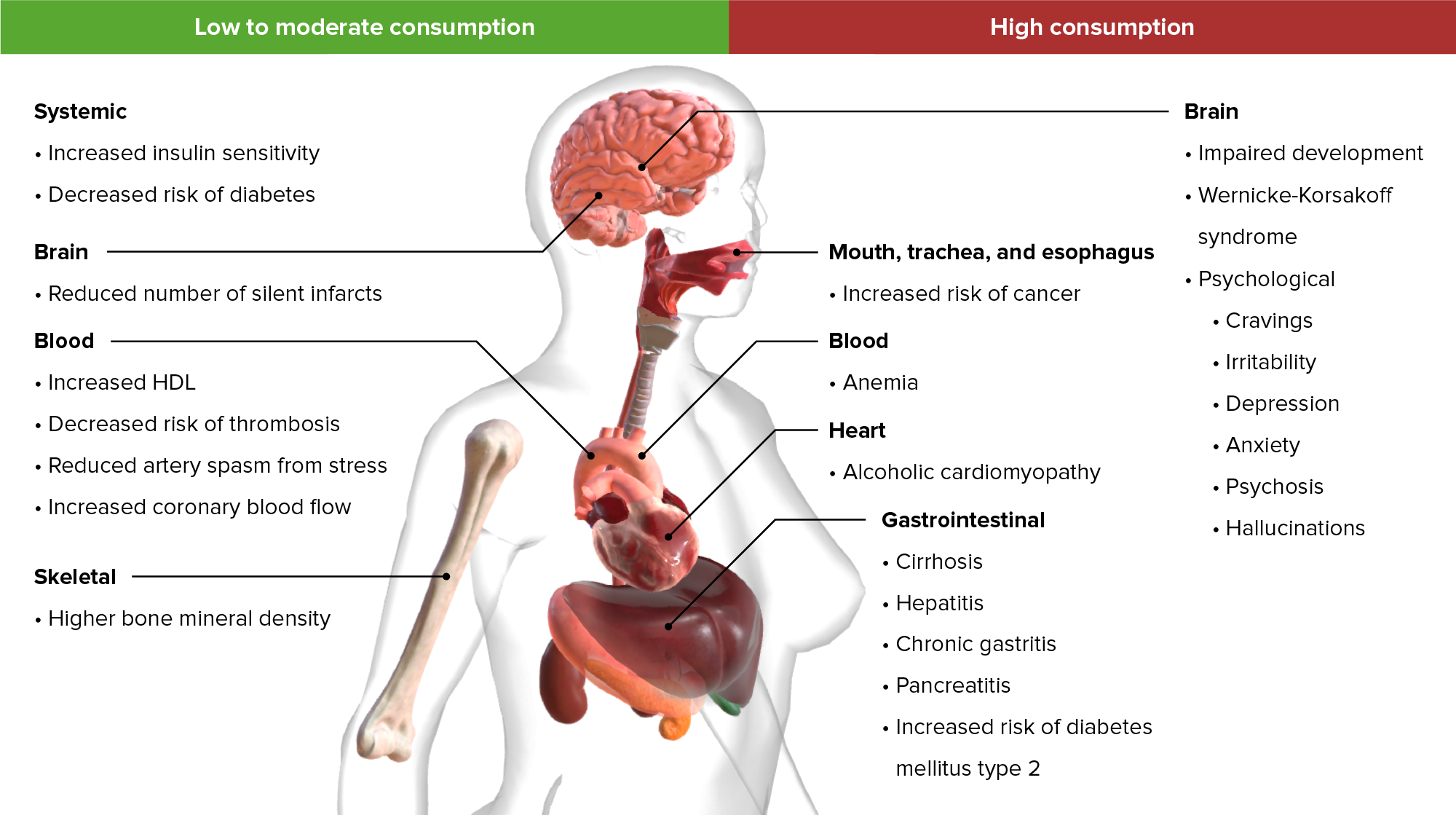
Efectos a largo plazo del consumo de etanol

Efectos importantes a largo plazo resultantes de un consumo bajo o alto de alcohol

Imagen por BioDigital, editado por Lecturio

Consumo de alcohol durante el embarazo:

  • Defectos cardíacos congénitos: comunicación interventricular y atrial, tetralogía de Fallot, conducto arterioso permeable
  • Síndrome de alcoholismo fetal:
    • Marcado por 3 dismorfismos faciales específicos:
      • Apertura palpebral disminuida
      • Filtrum indistinguible
      • Borde fino del bermellón
    • Asociado con baja estatura y/o peso, microcefalia, alteraciones cognitivas y conductuales

Diagnóstico Diferencial

  • Encefalopatía hepática: estado mental alterado secundario a enfermedad hepática grave. La encefalopatía hepática a menudo se presenta con deterioro cognitivo, ataxia Ataxia Impairment of the ability to perform smoothly coordinated voluntary movements. This condition may affect the limbs, trunk, eyes, pharynx, larynx, and other structures. Ataxia may result from impaired sensory or motor function. Sensory ataxia may result from posterior column injury or peripheral nerve diseases. Motor ataxia may be associated with cerebellar diseases; cerebral cortex diseases; thalamic diseases; basal ganglia diseases; injury to the red nucleus; and other conditions. Ataxia-telangiectasia y hallazgos de enfermedad hepática crónica, que se encuentran comúnmente en EN Erythema nodosum is an immune-mediated panniculitis (inflammation of the subcutaneous fat) caused by a type IV (delayed-type) hypersensitivity reaction. It commonly manifests in young women as tender, erythematous nodules on the shins. Erythema Nodosum personas con antecedentes de consumo crónico de alcohol. Incluso en EN Erythema nodosum is an immune-mediated panniculitis (inflammation of the subcutaneous fat) caused by a type IV (delayed-type) hypersensitivity reaction. It commonly manifests in young women as tender, erythematous nodules on the shins. Erythema Nodosum personas con trastorno por consumo de alcohol grave, se debe realizar un estudio completo para determinar otras posibles causas de encefalopatía hepática. El tratamiento es de soporte.
  • Intoxicación por sedantes e hipnóticos: los LOS Neisseria agentes sedantes e hipnóticos incluyen benzodiacepinas, barbitúricos y no benzodiacepinas. Médicamente, los LOS Neisseria agentes sedantes e hipnóticos se utilizan como ansiolíticos, hipnóticos, medicamentos anticonvulsivos y relajantes musculares. Los LOS Neisseria síntomas incluyen ataxia Ataxia Impairment of the ability to perform smoothly coordinated voluntary movements. This condition may affect the limbs, trunk, eyes, pharynx, larynx, and other structures. Ataxia may result from impaired sensory or motor function. Sensory ataxia may result from posterior column injury or peripheral nerve diseases. Motor ataxia may be associated with cerebellar diseases; cerebral cortex diseases; thalamic diseases; basal ganglia diseases; injury to the red nucleus; and other conditions. Ataxia-telangiectasia y pérdida de memoria a corto plazo. Los LOS Neisseria antecedentes y el examen toxicológico en EN Erythema nodosum is an immune-mediated panniculitis (inflammation of the subcutaneous fat) caused by a type IV (delayed-type) hypersensitivity reaction. It commonly manifests in young women as tender, erythematous nodules on the shins. Erythema Nodosum orina pueden distinguir el uso de sedantes e hipnóticos del trastorno por consumo de alcohol; sin embargo, el alcohol a menudo se ingiere con sedantes e hipnóticos, lo que produce efectos sinérgicos. El tratamiento es de soporte, con especial atención a la vía aérea (aspiración, insuficiencia respiratoria) y arritmias cardíacas.

Referencias

  1. Sadock, B. J., Sadock, V. A., Ruiz, P. (2014). Substance use and addictive disorders. Chapter 20 of Kaplan and Sadock’s Synopsis of Psychiatry: Behavioral Sciences/Clinical Psychiatry, 11th ed. Philadelphia: Lippincott Williams & Wilkins, pp. 659–666.
  2. Thompson, A. (2021). Alcohol and drug withdrawal syndromes and their clinical management. DeckerMed Medicine. Retrieved February 16, 2021. doi:10.2310/im.13042
  3. Tetrault, J., O’Connor, P. G. (2024). Risky drinking and alcohol use disorder: Epidemiology, clinical features, adverse consequences, screening, and assessment. UpToDate. Retrieved December 10, 2024, from  https://www.uptodate.com/contents/risky-drinking-and-alcohol-use-disorder-epidemiology-pathogenesis-clinical-manifestations-course-assessment-and-diagnosis 
  4. Holt, S. R. (2024). Alcohol use disorder: Treatment overview. UpToDate. Retrieved December 10, 2024, from https://www.uptodate.com/contents/alcohol-use-disorder-treatment-overview
  5. Holt, S. R. (2024). Alcohol use disorder: Pharmacologic management. UpToDate. Retrieved December 10, 2024, from https://www.uptodate.com/contents/alcohol-use-disorder-pharmacologic-management
  6. Saxon, A. J., McKay, J. R. (2024). Alcohol use disorder: Psychosocial management. UpToDate. Retrieved December 10, 2024, from https://www.uptodate.com/contents/alcohol-use-disorder-psychosocial-management
  7. Sullivan, J. T., Sykora, K., Schneiderman, J., Naranjo, C. A., Sellers, E. M. (1989). Assessment of alcohol withdrawal: the revised Clinical Institute Withdrawal Assessment for Alcohol Scale (CIWA-Ar). British Journal of Addiction 84:1353–1357. https://doi.org/10.1111/j.1360-0443.1989.tb00737.x
  8. Alcohol and its Biomarkers. (2015). Alcohol Biomarkers: An Overview. Chapter 4 of Clinical Aspects and Laboratory Determination. Elsevier, pp. 91–120. https://www.sciencedirect.com/science/article/pii/B9780128003398000043 
  9. National Institute on Alcohol Abuse and Alcoholism. Alcohol Use Disorders Identification Test (AUDIT). Retrieved July 31, 2021, from https://pubs.niaaa.nih.gov/publications/audit.htm 
  10. Babor, T.F., de la Fuente, J.R., Saunders, J., Grant, M. AUDIT: the Alcohol Use Disorders Identification Test: guidelines for use in primary health care. Geneva, Switzerland: World Health Organization, 1992.

¡Crea tu cuenta gratis o inicia una sesión para seguir leyendo!

Regístrate ahora y obtén acceso gratuito a Lecturio con páginas de concepto, videos médicos y cuestionarios para tu educación médica.

User Reviews

Que tengas una sesión de estudio alegre y navideña 🎁 Ahorra 50% en todos los planes >>

Details