
Domina Conceptos Médicos

Estudia para la escuela de medicina y tus examenes con Lecturio.

Poliquistosis Renal Autosómica Dominante (PQRAD)

La poliquistosis renal (PQR) es un trastorno genético hereditario que conduce al AL Amyloidosis desarrollo de numerosos quistes llenos de líquido en EN Erythema nodosum is an immune-mediated panniculitis (inflammation of the subcutaneous fat) caused by a type IV (delayed-type) hypersensitivity reaction. It commonly manifests in young women as tender, erythematous nodules on the shins. Erythema Nodosum los LOS Neisseria riñones. Los LOS Neisseria 2 tipos principales de PQR son la poliquistosis renal autosómica dominante (PQRAD), que suele diagnosticarse en EN Erythema nodosum is an immune-mediated panniculitis (inflammation of the subcutaneous fat) caused by a type IV (delayed-type) hypersensitivity reaction. It commonly manifests in young women as tender, erythematous nodules on the shins. Erythema Nodosum la edad adulta, y la poliquistosis renal autosómica recesiva (PQRAR), que suele diagnosticarse prenatalmente o poco después del nacimiento. Los LOS Neisseria pacientes con PQRAD suelen presentar hipertensión, hematuria Hematuria Presence of blood in the urine. Renal Cell Carcinoma y dolor Dolor Inflammation de costado. Las manifestaciones extrarrenales incluyen aneurisma intracerebral, quistes hepáticos y pancreáticos, y anomalías valvulares cardíacas. El diagnóstico se realiza mediante los LOS Neisseria antecedentes, el examen físico y el ultrasonido. El tratamiento requiere un enfoque multidisciplinario y muchos pacientes necesitan terapia de reemplazo renal. El objetivo final es frenar la progresión de la enfermedad renal mediante el control de la hipertensión, la proteinuria Proteinuria The presence of proteins in the urine, an indicator of kidney diseases. Nephrotic Syndrome in Children y los LOS Neisseria síntomas. El pronóstico de la PQRAD depende de varios factores. Un aneurisma cerebral es una complicación asociada a un pronóstico especialmente malo.

Last updated: Apr 25, 2022

Editorial responsibility: Stanley Oiseth, Lindsay Jones, Evelin Maza

Epidemiología y Etiología

Epidemiología

La poliquistosis renal (PQR) afecta a aproximadamente 500 000 personas en EN Erythema nodosum is an immune-mediated panniculitis (inflammation of the subcutaneous fat) caused by a type IV (delayed-type) hypersensitivity reaction. It commonly manifests in young women as tender, erythematous nodules on the shins. Erythema Nodosum Estados Unidos. Uno de los LOS Neisseria 2 tipos principales de PQR es la poliquistosis renal autosómica dominante (PQRAD).

  • Es la enfermedad renal hereditaria más común
  • Prevalencia: 1 de cada 1 000 nacidos vivos
  • Causa de la ERC en EN Erythema nodosum is an immune-mediated panniculitis (inflammation of the subcutaneous fat) caused by a type IV (delayed-type) hypersensitivity reaction. It commonly manifests in young women as tender, erythematous nodules on the shins. Erythema Nodosum el 5% de los LOS Neisseria pacientes que inician diálisis anualmente
  • El deterioro de la función renal suele ser evidente en EN Erythema nodosum is an immune-mediated panniculitis (inflammation of the subcutaneous fat) caused by a type IV (delayed-type) hypersensitivity reaction. It commonly manifests in young women as tender, erythematous nodules on the shins. Erythema Nodosum la 4ta década de la vida

Etiología

  • Autosómica dominante (antecedentes familiares positivos)
  • Puede ser una mutación de:
    • PKD1 (codifica la policistina-1) en EN Erythema nodosum is an immune-mediated panniculitis (inflammation of the subcutaneous fat) caused by a type IV (delayed-type) hypersensitivity reaction. It commonly manifests in young women as tender, erythematous nodules on the shins. Erythema Nodosum el cromosoma 16 O
    • PKD2 (codifica la policistina-2) en EN Erythema nodosum is an immune-mediated panniculitis (inflammation of the subcutaneous fat) caused by a type IV (delayed-type) hypersensitivity reaction. It commonly manifests in young women as tender, erythematous nodules on the shins. Erythema Nodosum el cromosoma 4

Presentación Clínica

La edad de inicio de los LOS Neisseria síntomas es variable Variable Variables represent information about something that can change. The design of the measurement scales, or of the methods for obtaining information, will determine the data gathered and the characteristics of that data. As a result, a variable can be qualitative or quantitative, and may be further classified into subgroups. Types of Variables, pero normalmente ocurre en EN Erythema nodosum is an immune-mediated panniculitis (inflammation of the subcutaneous fat) caused by a type IV (delayed-type) hypersensitivity reaction. It commonly manifests in young women as tender, erythematous nodules on the shins. Erythema Nodosum la adultez. Los LOS Neisseria pacientes con la mutación de PKD1 presentan síntomas antes que los LOS Neisseria pacientes con PKD2.

Manifestaciones renales

  • Hipertensión
  • Hematuria Hematuria Presence of blood in the urine. Renal Cell Carcinoma
  • Proteinuria Proteinuria The presence of proteins in the urine, an indicator of kidney diseases. Nephrotic Syndrome in Children
  • Deterioro de la función renal
  • Dolor Dolor Inflammation de costado o abdominal
  • Riñones agrandados y palpables en EN Erythema nodosum is an immune-mediated panniculitis (inflammation of the subcutaneous fat) caused by a type IV (delayed-type) hypersensitivity reaction. It commonly manifests in young women as tender, erythematous nodules on the shins. Erythema Nodosum el examen físico ( los LOS Neisseria pacientes con la mutación PKD1 tienen riñones más grandes y más quistes que los LOS Neisseria pacientes con PKD2)
  • Infecciones del tracto urinario (ITU) recurrentes
  • Nefrolitiasis

Manifestaciones extrarrenales

  • Aneurisma cerebral:
    • Riesgo 4 veces superior al AL Amyloidosis de la población general
    • Puede romperse, causando una hemorragia subaracnoidea o una hemorragia intracerebral
    • El factor de riesgo más grave asociado a la PQRAD
  • Quistes hepáticos benignos y asintomáticos:
    • Mayor prevalencia a medida que aumenta la edad
    • Puede complicarse con una infección del quiste o una hemorragia
  • Quistes pancreáticos benignos y asintomáticos
  • Quistes de la vesícula seminal
  • Anomalías valvulares cardíacas:
    • Frecuentemente, se trata de un prolapso leve de la válvula mitral o una regurgitación aórtica
    • Suelen ser asintomáticas, con un leve soplo
  • Divertículos colónicos
  • Hernias inguinales y de la pared abdominal

Diagnóstico

El diagnóstico se realiza con la combinación de antecedentes familiares positivos y la presencia de múltiples quistes renales bilaterales.

Examen físico

  • Evaluar si los LOS Neisseria riñones son palpables.
  • Evaluar las características sindrómicas y las manifestaciones extrarrenales.

Imagenología

  • Ultrasonido de abdomen para detectar quistes renales (1era línea)
  • TC o RM:
    • Si los LOS Neisseria resultados del ultrasonido no son concluyentes
    • Puede detectar quistes de menor tamaño
    • Determina el volumen renal total (ayuda a evaluar el riesgo de progresión de la enfermedad renal)
Ultrasonido de la poliquistosis renal autosómica dominante

Ultrasonido de la poliquistosis renal autosómica dominante (PQRAD): El ultrasonido sagital en escala de grises de ambos riñones muestra numerosas lesiones quísticas ocupantes espacio con marcados restos ecogénicos internos y septos gruesos, que representan los numerosos quistes infectados

Imagen: “Value of ultrasound-guided irrigation and drainage of refractory pyocysts in ADPKD” por Saedi D, Varedi P, Varedi P, Mahmoodi S, Gashti HN, Darabi M. Licencia: CC BY 2.0

Pruebas genéticas

  • Si las pruebas imagenologías son inciertas
  • Si los LOS Neisseria rasgos son atípicos:
    • PQRAD temprana y severa
    • Insuficiencia renal sin agrandamiento significativo de los LOS Neisseria riñones
    • La enfermedad es significativamente discordante con los LOS Neisseria miembros de la familia.
    • Asimetría significativa de la enfermedad entre cada riñón
    • PQRAD sin antecedentes familiares
  • Si se necesita información para el asesoramiento en EN Erythema nodosum is an immune-mediated panniculitis (inflammation of the subcutaneous fat) caused by a type IV (delayed-type) hypersensitivity reaction. It commonly manifests in young women as tender, erythematous nodules on the shins. Erythema Nodosum materia de reproducción

Tratamiento y Pronóstico

Enfoque terapéutico

Objetivos:

  • Frenar la progresión de la enfermedad renal.
  • Controlar la presión arterial y reducir el riesgo cardiovascular.

Medidas de tratamiento:

  • Inhibidores de la ECA y ARA para el control de la presión arterial
  • Restringir el sodio en EN Erythema nodosum is an immune-mediated panniculitis (inflammation of the subcutaneous fat) caused by a type IV (delayed-type) hypersensitivity reaction. It commonly manifests in young women as tender, erythematous nodules on the shins. Erythema Nodosum la dieta.
  • Aumentar la ingesta de líquidos.
  • Tratar las complicaciones (e.g., ITU, nefrolitiasis).
  • Tolvaptan Tolvaptan A benzazepine derivative and selective vasopressin v2 receptor antagonist that is used to treat euvolemic and hypervolemic hyponatremia. It is also used in the treatment of rapidly progressing autosomal dominant polycystic kidney disease to slow the rate of cyst development and renal insufficiency. Syndrome of Inappropriate Antidiuretic Hormone Secretion (SIADH) para pacientes de alto riesgo:
    • Bloquea el efecto positivo de la vasopresina en EN Erythema nodosum is an immune-mediated panniculitis (inflammation of the subcutaneous fat) caused by a type IV (delayed-type) hypersensitivity reaction. It commonly manifests in young women as tender, erythematous nodules on the shins. Erythema Nodosum la producción de quistes
    • Puede disminuir el crecimiento de los LOS Neisseria quistes

Para la enfermedad renal en EN Erythema nodosum is an immune-mediated panniculitis (inflammation of the subcutaneous fat) caused by a type IV (delayed-type) hypersensitivity reaction. It commonly manifests in young women as tender, erythematous nodules on the shins. Erythema Nodosum estadio terminal:
  • Hemodiálisis o diálisis peritoneal
  • Trasplante renal

Tamizaje

  • Beneficios del consejo genético y del tamizaje para los LOS Neisseria pacientes y la familia:
    • Información sobre el diagnóstico y la prevención/tratamiento de las complicaciones
    • Planificación familiar (riesgos de transmitir la enfermedad a la descendencia)
    • Posible donante de riñón entre los LOS Neisseria familiares
  • Tamizaje de aneurismas intracerebrales con imagenología presintomática (angiografía por RM o TC):
    • Antecedentes familiares de aneurisma intracraneal
    • Planificación para someterse a una cirugía mayor
    • Ocupaciones de alto riesgo (la ruptura del aneurisma podría poner en EN Erythema nodosum is an immune-mediated panniculitis (inflammation of the subcutaneous fat) caused by a type IV (delayed-type) hypersensitivity reaction. It commonly manifests in young women as tender, erythematous nodules on the shins. Erythema Nodosum riesgo otras vidas, e.g., pilotos)
    • Requerimiento de anticoagulación (mayor riesgo de hemorragia)

Pronóstico

  • Varía de persona a persona
  • Por lo general, la progresión de la enfermedad es lenta.
  • Aproximadamente la mitad de los LOS Neisseria pacientes ≥ 75 años de edad requieren diálisis y/o trasplante renal.
  • La mayoría de los LOS Neisseria pacientes mueren por causas cardíacas.
  • El pronóstico es especialmente malo en EN Erythema nodosum is an immune-mediated panniculitis (inflammation of the subcutaneous fat) caused by a type IV (delayed-type) hypersensitivity reaction. It commonly manifests in young women as tender, erythematous nodules on the shins. Erythema Nodosum caso de ruptura de aneurisma cerebral.
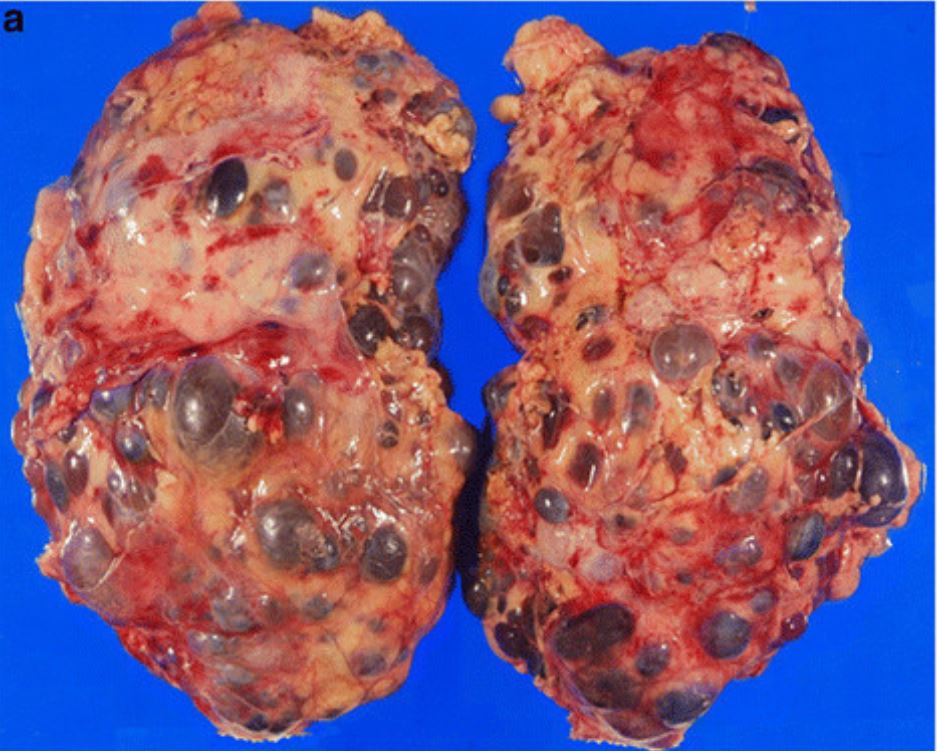
Patología macroscópica de nefrectomía en un paciente con poliquistosis renal autosómica dominante

Patología macroscópica de nefrectomía en un paciente con poliquistosis renal autosómica dominante (PQRAD)

Imagen: “Incidental renal cell carcinoma presenting in a renal transplant recipient with autosomal dominant polycystic kidney disease” por Misumi T, Ide K, Onoe T, Banshodani M, Tazawa H, Teraoka Y, Hotta R, Yamashita M, Tashiro H, Ohdan H. Licencia: CC BY 2.0, editada por Lecturio.

Comparación

Los LOS Neisseria dos tipos principales de poliquistosis renal son la PQRAD y la poliquistosis renal autosómica recesiva (PQRAR).

Tabla: PQRAD vs PQRAR
PQRAD PQRAR
Herencia Autosómica dominante Autosómica recesiva
Genes Genes A category of nucleic acid sequences that function as units of heredity and which code for the basic instructions for the development, reproduction, and maintenance of organisms. DNA Types and Structure implicados PKD1, PKD2 PKD1, PKD2 Autosomal dominant polycystic kidney disease (ADPKD) PKHD1 PKHD1 Autosomal Recessive Polycystic Kidney Disease (ARPKD)
Proteínas asociadas Policistina-1, policistina-2 Fibrocistina
Edad de presentación Adultez Prenatal, neonatal, infantil
Hallazgos clínicos
  • Deterioro de la función renal
  • Riñones agrandados
  • Aneurisma cerebral
  • Quistes hepáticos y pancreáticos
  • Diverticulosis Diverticulosis A pathological condition characterized by the presence of a number of colonic diverticula in the colon. Its pathogenesis is multifactorial, including colon aging, motor dysfunction, increases in intraluminal pressure, and lack of dietary fibers. Diverticular Disease en EN Erythema nodosum is an immune-mediated panniculitis (inflammation of the subcutaneous fat) caused by a type IV (delayed-type) hypersensitivity reaction. It commonly manifests in young women as tender, erythematous nodules on the shins. Erythema Nodosum el colon Colon The large intestines constitute the last portion of the digestive system. The large intestine consists of the cecum, appendix, colon (with ascending, transverse, descending, and sigmoid segments), rectum, and anal canal. The primary function of the colon is to remove water and compact the stool prior to expulsion from the body via the rectum and anal canal. Colon, Cecum, and Appendix: Anatomy
  • Hernias abdominales
  • Deterioro de la función renal
  • Riñones agrandados
  • Dilatación de la vía biliar intrahepática y fibrosis Fibrosis Any pathological condition where fibrous connective tissue invades any organ, usually as a consequence of inflammation or other injury. Bronchiolitis Obliterans hepática
  • Hipoplasia pulmonar
Morfología macroscópica y patológica
  • Riñones grandes, superficie llena de quistes, arquitectura renal distorsionada
  • Quistes redondos de tamaño variable Variable Variables represent information about something that can change. The design of the measurement scales, or of the methods for obtaining information, will determine the data gathered and the characteristics of that data. As a result, a variable can be qualitative or quantitative, and may be further classified into subgroups. Types of Variables (microquistes y macroquistes)
  • Nefronas funcionales entre los LOS Neisseria quistes
  • Riñones grandes, superficie lisa, forma general de los LOS Neisseria riñones conservada
  • Microquistes (generalmente < 2 mm), que son tubulares (afectan a los LOS Neisseria conductos colectores y a los LOS Neisseria túbulos), que irradian desde la médula hasta la corteza
  • Dilatación de los LOS Neisseria conductos colectores
Resultados del ultrasonido Múltiples quistes (según la edad):
  • < 40 años de edad: ≥ 3
  • 40–59 años de edad: ≥ 2 cada riñón
  • 60 años y más: ≥ 4 cada riñón
  • Riñones agrandados y ecogénicos
  • Pobre diferenciación corticomedular
  • Múltiples quistes diminutos
PQRAD: enfermedad renal poliquística autosómica dominante
PQRAR: enfermedad renal poliquística autosómica recesiva

Diagnóstico Diferencial

  • Múltiples quistes simples benignos: Los LOS Neisseria quistes renales son un hallazgo común, asintomático e incidental en EN Erythema nodosum is an immune-mediated panniculitis (inflammation of the subcutaneous fat) caused by a type IV (delayed-type) hypersensitivity reaction. It commonly manifests in young women as tender, erythematous nodules on the shins. Erythema Nodosum los LOS Neisseria adultos. Los LOS Neisseria quistes aumentan en EN Erythema nodosum is an immune-mediated panniculitis (inflammation of the subcutaneous fat) caused by a type IV (delayed-type) hypersensitivity reaction. It commonly manifests in young women as tender, erythematous nodules on the shins. Erythema Nodosum número con la edad. La diferenciación de la PQRAD leve puede ser difícil. Los LOS Neisseria pacientes sin PQRAD no suelen tener antecedentes familiares, hematuria Hematuria Presence of blood in the urine. Renal Cell Carcinoma macroscópica, dolor Dolor Inflammation de costado o insuficiencia renal.
  • Enfermedad quística renal localizada: una enfermedad localizada y benigna que se confunde con la PQR. A diferencia de la PQR, se trata de una enfermedad quística localizada y no bilateral ni progresiva. Los LOS Neisseria pacientes no tienen antecedentes familiares de PQRAD.
  • Enfermedad quística renal adquirida: la enfermedad renal crónica se asocia frecuentemente con el desarrollo de múltiples quistes pequeños bilaterales. Los LOS Neisseria quistes suelen ser pequeños (< 0,5 cm) y los LOS Neisseria pacientes no tienen antecedentes familiares. Los LOS Neisseria riñones tienen un contorno liso y un tamaño entre pequeño y normal. No se observan manifestaciones extrarrenales asociadas.
  • Riñón esponjoso medular: malformación de los LOS Neisseria conductos colectores (dilatación tubular) limitada a las pirámides medulares. Puede imitar la PQR en EN Erythema nodosum is an immune-mediated panniculitis (inflammation of the subcutaneous fat) caused by a type IV (delayed-type) hypersensitivity reaction. It commonly manifests in young women as tender, erythematous nodules on the shins. Erythema Nodosum los LOS Neisseria estudios urográficos. Los LOS Neisseria pacientes pueden presentar cálculos renales, hematuria Hematuria Presence of blood in the urine. Renal Cell Carcinoma e ITU. A diferencia de la PQR, la corteza renal no está dañada, lo que puede apreciarse en EN Erythema nodosum is an immune-mediated panniculitis (inflammation of the subcutaneous fat) caused by a type IV (delayed-type) hypersensitivity reaction. It commonly manifests in young women as tender, erythematous nodules on the shins. Erythema Nodosum la TC o la RM.
  • Complejo de esclerosis tuberosa autosómica dominante: quistes renales múltiples y bilaterales. Otros hallazgos incluyen angiomiolipomas renales, angiofibromas faciales, máculas hipomelanóticas y hamartomas nodulares de la retina Retina The ten-layered nervous tissue membrane of the eye. It is continuous with the optic nerve and receives images of external objects and transmits visual impulses to the brain. Its outer surface is in contact with the choroid and the inner surface with the vitreous body. The outermost layer is pigmented, whereas the inner nine layers are transparent. Eye: Anatomy. El diagnóstico se basa en EN Erythema nodosum is an immune-mediated panniculitis (inflammation of the subcutaneous fat) caused by a type IV (delayed-type) hypersensitivity reaction. It commonly manifests in young women as tender, erythematous nodules on the shins. Erythema Nodosum los LOS Neisseria hallazgos clínicos y en EN Erythema nodosum is an immune-mediated panniculitis (inflammation of the subcutaneous fat) caused by a type IV (delayed-type) hypersensitivity reaction. It commonly manifests in young women as tender, erythematous nodules on the shins. Erythema Nodosum las pruebas genéticas (mutación patogénica de TSC1 o TSC2).
  • Enfermedad renal tubulointersticial autosómica dominante: un raro trastorno genético caracterizado por un declive gradual de la función renal a partir de la adolescencia. La aparición de la enfermedad renal en EN Erythema nodosum is an immune-mediated panniculitis (inflammation of the subcutaneous fat) caused by a type IV (delayed-type) hypersensitivity reaction. It commonly manifests in young women as tender, erythematous nodules on the shins. Erythema Nodosum estadio terminal es variable Variable Variables represent information about something that can change. The design of the measurement scales, or of the methods for obtaining information, will determine the data gathered and the characteristics of that data. As a result, a variable can be qualitative or quantitative, and may be further classified into subgroups. Types of Variables. La presentación incluye gota de aparición temprana, hiperuricemia y, en EN Erythema nodosum is an immune-mediated panniculitis (inflammation of the subcutaneous fat) caused by a type IV (delayed-type) hypersensitivity reaction. It commonly manifests in young women as tender, erythematous nodules on the shins. Erythema Nodosum algunos casos, quistes renales. A diferencia de la PQR, los LOS Neisseria quistes se encuentran en EN Erythema nodosum is an immune-mediated panniculitis (inflammation of the subcutaneous fat) caused by a type IV (delayed-type) hypersensitivity reaction. It commonly manifests in young women as tender, erythematous nodules on the shins. Erythema Nodosum la unión corticomedular y los LOS Neisseria riñones son de tamaño pequeño a normal.

Referencias

  1. Bennett W.M., Torres V.E. (2020). Autosomal dominant polycystic kidney disease (ADPKD): Extrarenal manifestations. UpToDate. Retrieved Feb 25, 2021, from https://www.uptodate.com/contents/autosomal-dominant-polycystic-kidney-disease-adpkd-extrarenal-manifestations
  2. Chapman AB, Rahbari-Oskoui FF, Bennett WM. (2020). Autosomal dominant polycystic kidney disease (ADPKD): Renal manifestations. UpToDate. Retrieved Feb 25, 2021, from https://www.uptodate.com/contents/autosomal-dominant-polycystic-kidney-disease-adpkd-renal-manifestations
  3. Chapman A.B., Rahbari-Oskoui, F.F., Bennett, W.M. (2020). Autosomal dominant polycystic kidney disease (ADPKD): Treatment. UpToDate. Retrieved Feb 25, 2021, from https://www.uptodate.com/contents/autosomal-dominant-polycystic-kidney-disease-adpkd-treatment
  4. Genetic and Rare Disease Information Center. (2020). Autosomal dominant polycystic kidney disease. Retrieved February 25, 2021, from https://rarediseases.info.nih.gov/diseases/10413/autosomal-dominant-polycystic-kidney-disease
  5. Guler, S., Cimen, S., Hurton, S., et al. (2015). Diagnosis and Treatment Modalities of Symptomatic Polycystic Kidney Disease. En Li X (Ed.), Polycystic Kidney Disease [Internet]. Brisbane (AU): Codon Publications. https://www.ncbi.nlm.nih.gov/books/NBK373387/
  6. Halvorson, C.R., Bremmer, M.S., Jacobs, S.C. (2010). Polycystic kidney disease: inheritance, pathophysiology, prognosis, and treatment. Int. J. Nephrol. Renovasc. Dis. 3:69–83.
  7. Kruskal, J.B., Richie, J.P. (2021). Simple and complex renal cysts in adults. UpToDate. Retrieved Feb 25, 2021, from https://www.uptodate.com/contents/simple-and-complex-renal-cysts-in-adults
  8. Manual Merck. (2019). Autosomal Dominant Polycystic Kidney Disease (ADPKD). https://rarediseases.info.nih.gov/diseases/10413/autosomal-dominant-polycystic-kidney-disease
  9. National Institute of Diabetes and Digestive and Kidney Diseases. (2017). What is Polycystic Kidney Disease? https://www.niddk.nih.gov/health-information/kidney-disease/polycystic-kidney-disease/what-is-pkd#symptoms
  10. Patil A., Sweeney W.E. Jr., Avner E.D., et al. (2015). Childhood Polycystic Kidney Disease. Polycystic Kidney Disease. https://www.ncbi.nlm.nih.gov/books/NBK373381/
  11. Torres V.E., Bennett W.M. (2021). Autosomal dominant polycystic kidney disease (ADPKD) in adults: Epidemiology, clinical presentation, and diagnosis. UpToDate. Retrieved Feb 25, 2021, from https://www.uptodate.com/contents/autosomal-dominant-polycystic-kidney-disease-adpkd-in-adults-epidemiology-clinical-presentation-and-diagnosis
  12. Zhou J, & Pollak M.R. (2018). Polycystic kidney disease and other inherited disorders of tubule growth and development. In Jameson LJ, et al. (Ed.), Harrison’s Principles of Internal Medicine (20th ed.) https://accessmedicine-mhmedical-com.aucmed.idm.oclc.org/content.aspx?bookid=2129&sectionid=192281464

¡Crea tu cuenta gratis o inicia una sesión para seguir leyendo!

Regístrate ahora y obtén acceso gratuito a Lecturio con páginas de concepto, videos médicos y cuestionarios para tu educación médica.

User Reviews

Que tengas una sesión de estudio alegre y navideña 🎁 Ahorra 50% en todos los planes >>

Details