Domina Conceptos Médicos

Estudia para la escuela de medicina y tus examenes con Lecturio.

Policitemia Vera

La policitemia vera es una neoplasia mieloproliferativa crónica caracterizada por la sobreproducción de eritrocitos. Además, también aumentan los LOS Neisseria recuentos de leucocitos y plaquetas, lo que diferencia la policitemia de la eritrocitosis que se observa en EN Erythema nodosum is an immune-mediated panniculitis (inflammation of the subcutaneous fat) caused by a type IV (delayed-type) hypersensitivity reaction. It commonly manifests in young women as tender, erythematous nodules on the shins. Erythema Nodosum la hipoxia crónica y otras afecciones crónicas. Se presume que la policitemia vera tiene una base genética debido a mutaciones en EN Erythema nodosum is an immune-mediated panniculitis (inflammation of the subcutaneous fat) caused by a type IV (delayed-type) hypersensitivity reaction. It commonly manifests in young women as tender, erythematous nodules on the shins. Erythema Nodosum el gen Janus kinase-2. La presentación clínica incluye síntomas relacionados con la enfermedad que pueden afectar varios sistemas de órganos. A veces, la enfermedad puede ser un hallazgo incidental durante las pruebas de laboratorio. El diagnóstico se basa en EN Erythema nodosum is an immune-mediated panniculitis (inflammation of the subcutaneous fat) caused by a type IV (delayed-type) hypersensitivity reaction. It commonly manifests in young women as tender, erythematous nodules on the shins. Erythema Nodosum el análisis de sangre periférica y los LOS Neisseria hallazgos de la biopsia de médula ósea. El tratamiento es con flebotomía o terapia con medicamentos. El pronóstico generalmente es bueno y se prevé que la supervivencia del paciente mejore aún más con el amplio uso de nuevas terapias.

Last updated: Dec 15, 2025

Editorial responsibility: Stanley Oiseth, Lindsay Jones, Evelin Maza

Descripción General

Definición

La policitemia vera es una neoplasia mieloproliferativa crónica caracterizada por la sobreproducción de eritrocitosis, leucocitos y plaquetas. Esta tríada diferencia la policitemia vera de la eritrocitosis que se observa en EN Erythema nodosum is an immune-mediated panniculitis (inflammation of the subcutaneous fat) caused by a type IV (delayed-type) hypersensitivity reaction. It commonly manifests in young women as tender, erythematous nodules on the shins. Erythema Nodosum la hipoxia crónica y otras afecciones.

Clasificación

  • La policitemia vera primaria se debe a un trastorno mieloproliferativo.
  • La policitemia vera secundaria se debe a un aumento de eritropoyetina causado por circunstancias ambientales u otras condiciones:
    • Enfermedad pulmonar/hipoxia crónica
    • Apnea del sueño
    • Hábito tabáquico
    • Alta altitud
    • Tumores secretores de eritropoyetina, como el carcinoma de células renales

Epidemiología

  • Afecta a un estimado de 44–57 de 100 000 personas en EN Erythema nodosum is an immune-mediated panniculitis (inflammation of the subcutaneous fat) caused by a type IV (delayed-type) hypersensitivity reaction. It commonly manifests in young women as tender, erythematous nodules on the shins. Erythema Nodosum los LOS Neisseria EE. UU.
  • La incidencia es ligeramente mayor en EN Erythema nodosum is an immune-mediated panniculitis (inflammation of the subcutaneous fat) caused by a type IV (delayed-type) hypersensitivity reaction. It commonly manifests in young women as tender, erythematous nodules on the shins. Erythema Nodosum hombres que en EN Erythema nodosum is an immune-mediated panniculitis (inflammation of the subcutaneous fat) caused by a type IV (delayed-type) hypersensitivity reaction. It commonly manifests in young women as tender, erythematous nodules on the shins. Erythema Nodosum mujeres por razones poco claras
  • Puede observarse en EN Erythema nodosum is an immune-mediated panniculitis (inflammation of the subcutaneous fat) caused by a type IV (delayed-type) hypersensitivity reaction. It commonly manifests in young women as tender, erythematous nodules on the shins. Erythema Nodosum todas las edades, pero la incidencia aumenta con la edad y alcanza su punto máximo entre los LOS Neisseria 50 y los LOS Neisseria 70 años
  • Afecta a todos los LOS Neisseria grupos étnicos

Etiología y Fisiopatología

Etiología

  • No se comprende completamente.
  • La mayoría de los LOS Neisseria pacientes tienen una mutación del gen Janus kinase-2 (JAK2) en EN Erythema nodosum is an immune-mediated panniculitis (inflammation of the subcutaneous fat) caused by a type IV (delayed-type) hypersensitivity reaction. It commonly manifests in young women as tender, erythematous nodules on the shins. Erythema Nodosum el cromosoma 9, que codifica una proteína esencial para la producción de eritrocitos.

Fisiopatología

  • El gen JAK2 participa en EN Erythema nodosum is an immune-mediated panniculitis (inflammation of the subcutaneous fat) caused by a type IV (delayed-type) hypersensitivity reaction. It commonly manifests in young women as tender, erythematous nodules on the shins. Erythema Nodosum la transducción de señales de EPO EPO Glycoprotein hormone, secreted chiefly by the kidney in the adult and the liver in the fetus, that acts on erythroid stem cells of the bone marrow to stimulate proliferation and differentiation. Erythrocytes: Histology, trombopoyetina y factor estimulante de colonias de granulocitos (G-CSF).
  • Una mutación JAK2, que se encuentra en EN Erythema nodosum is an immune-mediated panniculitis (inflammation of the subcutaneous fat) caused by a type IV (delayed-type) hypersensitivity reaction. It commonly manifests in young women as tender, erythematous nodules on the shins. Erythema Nodosum el 98 % de los LOS Neisseria pacientes con policitemia vera, da como resultado una señalización mejorada de citoquinas que da como resultado una mayor producción de todas las células madre hematopoyéticas.
  • Otras mutaciones conducen a la activación sostenida de la cinasa JAK2, que provoca un exceso de producción de células sanguíneas independiente de la EPO EPO Glycoprotein hormone, secreted chiefly by the kidney in the adult and the liver in the fetus, that acts on erythroid stem cells of the bone marrow to stimulate proliferation and differentiation. Erythrocytes: Histology:
    • Se han encontrado mutaciones de calreticulina (CALR) en EN Erythema nodosum is an immune-mediated panniculitis (inflammation of the subcutaneous fat) caused by a type IV (delayed-type) hypersensitivity reaction. It commonly manifests in young women as tender, erythematous nodules on the shins. Erythema Nodosum pacientes con policitemia vera sin una mutación JAK2.
    • Se han encontrado mutaciones de la proteína adaptadora linfocítica (LNK) en EN Erythema nodosum is an immune-mediated panniculitis (inflammation of the subcutaneous fat) caused by a type IV (delayed-type) hypersensitivity reaction. It commonly manifests in young women as tender, erythematous nodules on the shins. Erythema Nodosum pacientes con eritrocitosis aislada.

Presentación Clínica

La policitemia vera a menudo se diagnostica de manera incidental cuando un hemograma completo obtenido por otras razones revela un aumento de hemoglobina y hematocrito. Los LOS Neisseria pacientes también presentan síntomas o complicaciones relacionados con la enfermedad.
  • Neurológicos:
    • Cefalea
    • Mareo
    • Alteraciones visuales
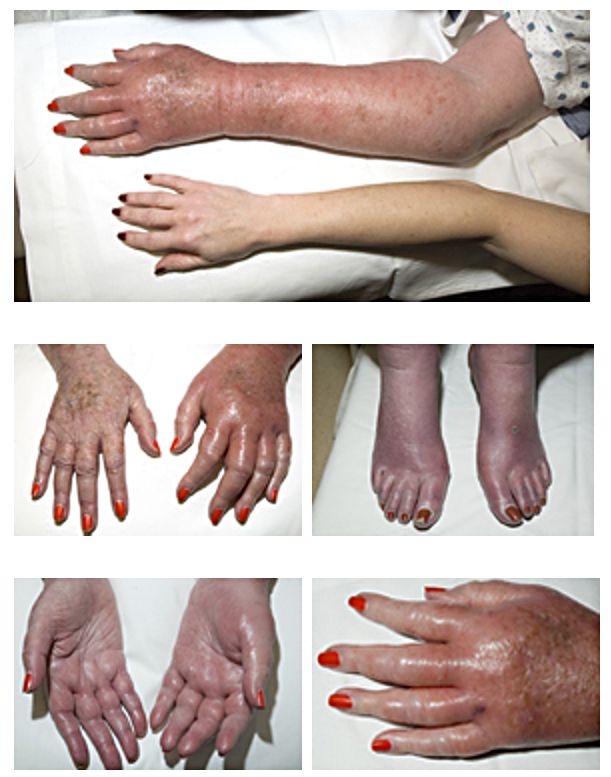
    • Eritromelalgia, dolor Dolor Inflammation quemante en EN Erythema nodosum is an immune-mediated panniculitis (inflammation of the subcutaneous fat) caused by a type IV (delayed-type) hypersensitivity reaction. It commonly manifests in young women as tender, erythematous nodules on the shins. Erythema Nodosum los LOS Neisseria pies o manos acompañado de eritema, palidez o cianosis, en EN Erythema nodosum is an immune-mediated panniculitis (inflammation of the subcutaneous fat) caused by a type IV (delayed-type) hypersensitivity reaction. It commonly manifests in young women as tender, erythematous nodules on the shins. Erythema Nodosum presencia de pulsos palpables (29% de los LOS Neisseria casos)
  • Dermatológicos y musculoesqueléticos:
    • Plétora (tez rojiza)
    • Prurito, especialmente después de un baño o ducha caliente (36%)
    • Tofos gotosos
    • Petequias
  • Gastrointestinales:
    • Esplenomegalia (36%)
    • Hepatomegalia
    • Dolor Dolor Inflammation epigástrico
    • Enfermedad ulcerosa péptica
  • Cardiovasculares:
    • Hipertensión (46%)
    • Trombosis venosa (7%)
    • Trombosis arterial
    • Angina pectoris Angina pectoris The symptom of paroxysmal pain consequent to myocardial ischemia usually of distinctive character, location and radiation. It is thought to be provoked by a transient stressful situation during which the oxygen requirements of the myocardium exceed that supplied by the coronary circulation. Stable and Unstable Angina
    • Accidente cerebrovascular
    • Claudicación intermitente
  • Hematológicos (debido a disfunción plaquetaria):
eritromelalgia

Eritromelalgia:
Sensación de dolor quemante en pies o manos acompañado de eritema, palidez o cianosis, en presencia de pulsos palpables

Imagen: “Erythromelalgia” por Herbert L. Fred, MD and Hendrik A. van Dijk. Licencia: CC BY 2.0

Diagnóstico

Se sospecha policitemia vera en EN Erythema nodosum is an immune-mediated panniculitis (inflammation of the subcutaneous fat) caused by a type IV (delayed-type) hypersensitivity reaction. It commonly manifests in young women as tender, erythematous nodules on the shins. Erythema Nodosum pacientes con hallazgos físicos característicos y/o niveles elevados de hemoglobina y hematocrito en EN Erythema nodosum is an immune-mediated panniculitis (inflammation of the subcutaneous fat) caused by a type IV (delayed-type) hypersensitivity reaction. It commonly manifests in young women as tender, erythematous nodules on the shins. Erythema Nodosum un hemograma completo.

Descartar causas secundarias de policitemia (niveles altos de eritropoyetina):

  • Alta altitud
  • Hipoxia crónica
  • Síndrome paraneoplásico (carcinoma de células renales)

Otros hallazgos de laboratorio para policitemia vera primaria:
  • Hemograma y química:
    • Aumentado:
      • Hemoglobina y hematocrito
      • Leucocitos
      • Plaquetas
      • Ácido úrico y B12 (no necesarios para el diagnóstico)
      • LDH LDH Osteosarcoma
    • Disminuido:
      • Volumen corpuscular medio
      • Hierro
      • Eritropoyetina
  • Frotis periférico: Los LOS Neisseria hallazgos dependen del estadio en EN Erythema nodosum is an immune-mediated panniculitis (inflammation of the subcutaneous fat) caused by a type IV (delayed-type) hypersensitivity reaction. It commonly manifests in young women as tender, erythematous nodules on the shins. Erythema Nodosum el momento del diagnóstico.
    • Eritrocitosis (exceso de eritrocitos)
    • Dacriocitos (eritrocitos en EN Erythema nodosum is an immune-mediated panniculitis (inflammation of the subcutaneous fat) caused by a type IV (delayed-type) hypersensitivity reaction. It commonly manifests in young women as tender, erythematous nodules on the shins. Erythema Nodosum forma de lágrima)
    • Poiquilocitosis (eritrocitos de forma anormal)
    • Eritrocitos nucleados circulantes
    • Hipocromía y microcitosis en EN Erythema nodosum is an immune-mediated panniculitis (inflammation of the subcutaneous fat) caused by a type IV (delayed-type) hypersensitivity reaction. It commonly manifests in young women as tender, erythematous nodules on the shins. Erythema Nodosum caso de deficiencia de hierro
    • Trombocitosis
    • Leucocitosis en EN Erythema nodosum is an immune-mediated panniculitis (inflammation of the subcutaneous fat) caused by a type IV (delayed-type) hypersensitivity reaction. It commonly manifests in young women as tender, erythematous nodules on the shins. Erythema Nodosum ausencia de fiebre o infección
  • Pruebas para mutaciones JAK2, CALR y LNK (realizadas secuencialmente)
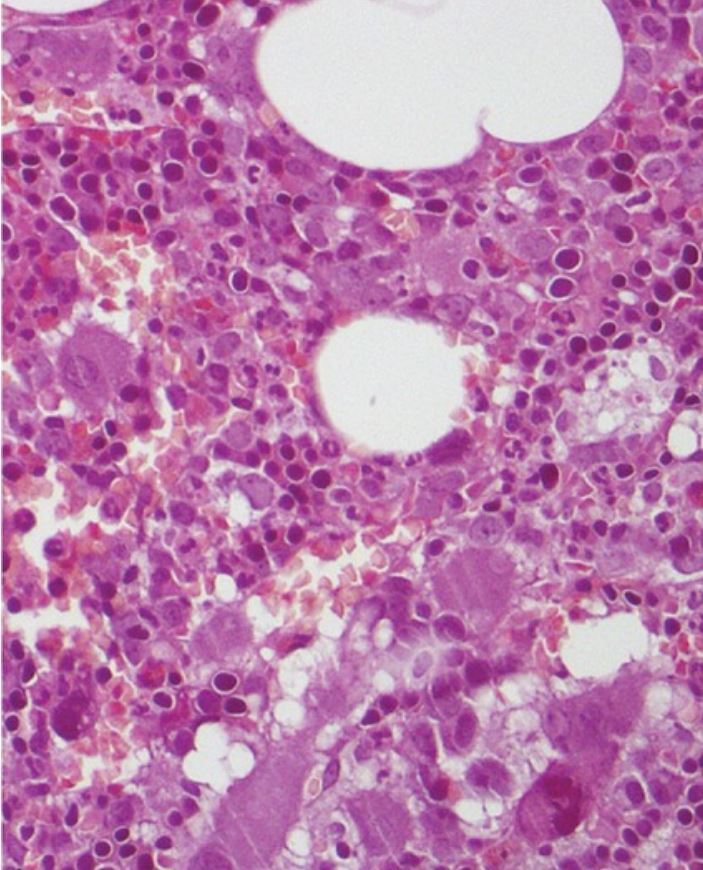
  • Biopsia de médula ósea:
    • Ningún hallazgo en EN Erythema nodosum is an immune-mediated panniculitis (inflammation of the subcutaneous fat) caused by a type IV (delayed-type) hypersensitivity reaction. It commonly manifests in young women as tender, erythematous nodules on the shins. Erythema Nodosum la médula ósea diferencia absolutamente la policitemia vera de otros trastornos causantes de eritrocitosis.
    • Aumento de la celularidad (a diferencia de la fibrosis Fibrosis Any pathological condition where fibrous connective tissue invades any organ, usually as a consequence of inflammation or other injury. Bronchiolitis Obliterans)
    • Típicamente muestra panmielosis
    • Megacariocitos grandes y agrupados
    • Aumento ocasional de las fibras de reticulina

Tratamiento y Pronóstico

Tratamiento

  • El objetivo terapéutico es reducir el hematocrito a <45 % en EN Erythema nodosum is an immune-mediated panniculitis (inflammation of the subcutaneous fat) caused by a type IV (delayed-type) hypersensitivity reaction. It commonly manifests in young women as tender, erythematous nodules on the shins. Erythema Nodosum hombres y <42 % en EN Erythema nodosum is an immune-mediated panniculitis (inflammation of the subcutaneous fat) caused by a type IV (delayed-type) hypersensitivity reaction. It commonly manifests in young women as tender, erythematous nodules on the shins. Erythema Nodosum mujeres.
  • La flebotomía es el pilar de la terapia.
  • Terapias mielosupresoras:
  • La aspirina en EN Erythema nodosum is an immune-mediated panniculitis (inflammation of the subcutaneous fat) caused by a type IV (delayed-type) hypersensitivity reaction. It commonly manifests in young women as tender, erythematous nodules on the shins. Erythema Nodosum dosis bajas se usa para reducir los LOS Neisseria síntomas de eventos microvasculares.
  • El alopurinol se emplea para la hiperuricemia.
  • Los LOS Neisseria antihistamínicos se utilizan para aliviar la sensación de prurito.
  • En EN Erythema nodosum is an immune-mediated panniculitis (inflammation of the subcutaneous fat) caused by a type IV (delayed-type) hypersensitivity reaction. It commonly manifests in young women as tender, erythematous nodules on the shins. Erythema Nodosum casos raros, se puede realizar un trasplante de células madre.

Pronóstico y Complicaciones

  • La trombosis es la causa más común de morbilidad y muerte, seguida de las complicaciones de la mielofibrosis y el desarrollo de leucemia.
  • Alrededor de 10%–30% de los LOS Neisseria pacientes progresan a un síndrome compatible con mielofibrosis primaria pero con mejor supervivencia.
  • La transformación leucémica de la policitemia vera se produce en EN Erythema nodosum is an immune-mediated panniculitis (inflammation of the subcutaneous fat) caused by a type IV (delayed-type) hypersensitivity reaction. It commonly manifests in young women as tender, erythematous nodules on the shins. Erythema Nodosum aproximadamente el 2% de los LOS Neisseria pacientes a los LOS Neisseria 10 años y en EN Erythema nodosum is an immune-mediated panniculitis (inflammation of the subcutaneous fat) caused by a type IV (delayed-type) hypersensitivity reaction. It commonly manifests in young women as tender, erythematous nodules on the shins. Erythema Nodosum aproximadamente el 8% a los LOS Neisseria 20 años.

Diagnóstico Diferencial

  • Policitemia secundaria: un aumento en EN Erythema nodosum is an immune-mediated panniculitis (inflammation of the subcutaneous fat) caused by a type IV (delayed-type) hypersensitivity reaction. It commonly manifests in young women as tender, erythematous nodules on the shins. Erythema Nodosum los LOS Neisseria eritrocitos debido a hipoxemia crónica, eritrocitemia familiar, síndromes paraneoplásicos o policitemia relativa debido a la contracción del volumen plasmático como se observa con la deshidratación.
  • Trombocitosis esencial (trombocitemia primaria): un trastorno mieloproliferativo crónico no reactivo en EN Erythema nodosum is an immune-mediated panniculitis (inflammation of the subcutaneous fat) caused by a type IV (delayed-type) hypersensitivity reaction. It commonly manifests in young women as tender, erythematous nodules on the shins. Erythema Nodosum el que se observa una proliferación excesiva de megacariocitos y plaquetas. Los LOS Neisseria pacientes son en EN Erythema nodosum is an immune-mediated panniculitis (inflammation of the subcutaneous fat) caused by a type IV (delayed-type) hypersensitivity reaction. It commonly manifests in young women as tender, erythematous nodules on the shins. Erythema Nodosum gran parte asintomáticos, pero pueden desarrollar trombosis y sangrado.
  • Leucemia mieloide crónica: un trastorno mieloproliferativo caracterizado por un aumento en EN Erythema nodosum is an immune-mediated panniculitis (inflammation of the subcutaneous fat) caused by a type IV (delayed-type) hypersensitivity reaction. It commonly manifests in young women as tender, erythematous nodules on the shins. Erythema Nodosum los LOS Neisseria leucocitos, incluido un aumento en EN Erythema nodosum is an immune-mediated panniculitis (inflammation of the subcutaneous fat) caused by a type IV (delayed-type) hypersensitivity reaction. It commonly manifests in young women as tender, erythematous nodules on the shins. Erythema Nodosum el número de granulocitos y sus precursores inmaduros. Ocasionalmente, también se ven células blásticas.
  • Mielofibrosis primaria: un trastorno clonal que surge de la transformación neoplásica de células madre hematopoyéticas tempranas. La mielofibrosis primaria se caracteriza por anemia Anemia Anemia is a condition in which individuals have low Hb levels, which can arise from various causes. Anemia is accompanied by a reduced number of RBCs and may manifest with fatigue, shortness of breath, pallor, and weakness. Subtypes are classified by the size of RBCs, chronicity, and etiology. Anemia: Overview and Types, fibrosis Fibrosis Any pathological condition where fibrous connective tissue invades any organ, usually as a consequence of inflammation or other injury. Bronchiolitis Obliterans de la médula ósea, hematopoyesis extramedular, leucoeritroblastosis, eritrocitos en EN Erythema nodosum is an immune-mediated panniculitis (inflammation of the subcutaneous fat) caused by a type IV (delayed-type) hypersensitivity reaction. It commonly manifests in young women as tender, erythematous nodules on the shins. Erythema Nodosum forma de lágrima y hepatoesplenomegalia.
  • Mutaciones del receptor Receptor Receptors are proteins located either on the surface of or within a cell that can bind to signaling molecules known as ligands (e.g., hormones) and cause some type of response within the cell. Receptors de eritropoyetina: un trastorno familiar raro que puede imitar los LOS Neisseria hallazgos básicos de la policitemia vera (hemoglobina y hematocrito elevados con eritropoyetina sérica baja). Antecedente familiar positivo, una edad temprana al AL Amyloidosis inicio de la enfermedad y la falta de hallazgos clínicos asociados con policitemia vera pueden ayudar a distinguir las mutaciones del receptor Receptor Receptors are proteins located either on the surface of or within a cell that can bind to signaling molecules known as ligands (e.g., hormones) and cause some type of response within the cell. Receptors de eritropoyetina de la policitemia vera primaria.

Referencias

  1. Tefferi, A. (2024). Clinical manifestations and diagnosis of polycythemia vera. UpToDate. Retrieved July 16, 2025, from https://www.uptodate.com/contents/clinical-manifestations-and-diagnosis-of-polycythemia-vera
  2. Liesveld, J. (2023). Polycythemia vera. Merck Manual Professional Version. Retrieved July 16, 2025, from https://www.merckmanuals.com/professional/hematology-and-oncology/myeloproliferative-disorders/polycythemia-vera
  3. Tefferi, A., et al. (2013). Survival and prognosis among 1545 patients with contemporary polycythemia vera: An international study. Leukemia. 27(9),1874–1881. https://pubmed.ncbi.nlm.nih.gov/23739289/
  4. Nagala, S. (2024). Polycythemia vera. Medscape. Retrieved July 16, 2025, from https://emedicine.medscape.com/article/205114-differential
  5. Waggoner, M. (2023). Polycythemia vera: Thinking beyond the hematocrit. Journal of the Advanced Practitioner in Oncology, 14(5), 405–413. https://doi.org/10.6004/jadpro.2023.14.5.5

¡Crea tu cuenta gratis o inicia una sesión para seguir leyendo!

Regístrate ahora y obtén acceso gratuito a Lecturio con páginas de concepto, videos médicos y cuestionarios para tu educación médica.

User Reviews

Que tengas una sesión de estudio alegre y navideña 🎁 Ahorra 50% en todos los planes >>

Details