Domina Conceptos Médicos

Estudia para la escuela de medicina y tus examenes con Lecturio.

Nevos

Los LOS Neisseria nevos, también conocidos como “lunares”, son neoplasias benignas de la piel. El término nevo es inespecífico porque abarca tanto lesiones congénitas como adquiridas, lesiones hiperpigmentadas e hipopigmentadas y lesiones elevadas o planas. Además, los LOS Neisseria nevos se pueden encontrar en EN Erythema nodosum is an immune-mediated panniculitis (inflammation of the subcutaneous fat) caused by a type IV (delayed-type) hypersensitivity reaction. It commonly manifests in young women as tender, erythematous nodules on the shins. Erythema Nodosum diferentes profundidades de las capas de la piel y se originan a partir de varios tipos de células (e.g., melanocíticas, tejido conectivo, vascular). Los LOS Neisseria nevos también tienen una amplia variedad de formas características, que deben entenderse bien para diferenciar los LOS Neisseria nevos del melanoma Melanoma Melanoma is a malignant tumor arising from melanocytes, the melanin-producing cells of the epidermis. These tumors are most common in fair-skinned individuals with a history of excessive sun exposure and sunburns. Melanoma maligno. En EN Erythema nodosum is an immune-mediated panniculitis (inflammation of the subcutaneous fat) caused by a type IV (delayed-type) hypersensitivity reaction. It commonly manifests in young women as tender, erythematous nodules on the shins. Erythema Nodosum esta página, cubriremos las clasificaciones básicas y los LOS Neisseria tipos más comunes de nevos, así como los LOS Neisseria criterios clínicos utilizados para evaluarlos.

Last updated: Dec 15, 2025

Editorial responsibility: Stanley Oiseth, Lindsay Jones, Evelin Maza

Definición y Clasificación

Definición

Un nevo es una neoplasia benigna de la piel:

  • Comúnmente conocido como “lunar”, “marca de belleza” o “marca de nacimiento”
  • Nevo es un término médico inespecífico porque abarca varios tipos de lesiones (e.g., congénitas y adquiridas, hiperpigmentadas e hipopigmentadas, elevadas o planas).
  • Por lo general, se usa para referirse a una lesión hiperpigmentada y ligeramente elevada (nevo melanocítico)
  • Algunas fuentes se refieren a los LOS Neisseria nevos como neoplasias benignas compuestas por células del nevo, que son variantes de los LOS Neisseria melanocitos que se encuentran en EN Erythema nodosum is an immune-mediated panniculitis (inflammation of the subcutaneous fat) caused by a type IV (delayed-type) hypersensitivity reaction. It commonly manifests in young women as tender, erythematous nodules on the shins. Erythema Nodosum la unión dermoepidérmica o en EN Erythema nodosum is an immune-mediated panniculitis (inflammation of the subcutaneous fat) caused by a type IV (delayed-type) hypersensitivity reaction. It commonly manifests in young women as tender, erythematous nodules on the shins. Erythema Nodosum la dermis Dermis A layer of vascularized connective tissue underneath the epidermis. The surface of the dermis contains innervated papillae. Embedded in or beneath the dermis are sweat glands; hair follicles; and sebaceous glands. Skin: Structure and Functions.
    • Melanocitos: células productoras de melanina derivadas de la cresta neural, ubicadas en EN Erythema nodosum is an immune-mediated panniculitis (inflammation of the subcutaneous fat) caused by a type IV (delayed-type) hypersensitivity reaction. It commonly manifests in young women as tender, erythematous nodules on the shins. Erythema Nodosum el estrato basal de la epidermis Epidermis The external, nonvascular layer of the skin. It is made up, from within outward, of five layers of epithelium: (1) basal layer (stratum basale epidermidis); (2) spinous layer (stratum spinosum epidermidis); (3) granular layer (stratum granulosum epidermidis); (4) clear layer (stratum lucidum epidermidis); and (5) horny layer (stratum corneum epidermidis). Skin: Structure and Functions, así como en EN Erythema nodosum is an immune-mediated panniculitis (inflammation of the subcutaneous fat) caused by a type IV (delayed-type) hypersensitivity reaction. It commonly manifests in young women as tender, erythematous nodules on the shins. Erythema Nodosum otros lugares del cuerpo.
    • Esta definición solo se refiere a los LOS Neisseria nevos melanocíticos.

Clasificación

Los LOS Neisseria nevos se pueden clasificar de varias formas, según varios factores que no son mutuamente excluyentes:
  • Antecedentes:
    • Congénito: presente al AL Amyloidosis nacer o que se desarrolla dentro de las 1as 4 semanas de vida, aunque algunas fuentes incluyen nevos que aparecen hasta 2 años después del nacimiento
    • Adquirido: presente más adelante en EN Erythema nodosum is an immune-mediated panniculitis (inflammation of the subcutaneous fat) caused by a type IV (delayed-type) hypersensitivity reaction. It commonly manifests in young women as tender, erythematous nodules on the shins. Erythema Nodosum la vida
  • Ubicación o profundidad de la lesión:
    • Epidérmico: ubicado en EN Erythema nodosum is an immune-mediated panniculitis (inflammation of the subcutaneous fat) caused by a type IV (delayed-type) hypersensitivity reaction. It commonly manifests in young women as tender, erythematous nodules on the shins. Erythema Nodosum la epidermis Epidermis The external, nonvascular layer of the skin. It is made up, from within outward, of five layers of epithelium: (1) basal layer (stratum basale epidermidis); (2) spinous layer (stratum spinosum epidermidis); (3) granular layer (stratum granulosum epidermidis); (4) clear layer (stratum lucidum epidermidis); and (5) horny layer (stratum corneum epidermidis). Skin: Structure and Functions (capa más superficial de la piel); por lo general comprende queratinocitos o estructuras anexiales (glándulas sebáceas y sudoríparas)
    • Unión: ubicado en EN Erythema nodosum is an immune-mediated panniculitis (inflammation of the subcutaneous fat) caused by a type IV (delayed-type) hypersensitivity reaction. It commonly manifests in young women as tender, erythematous nodules on the shins. Erythema Nodosum las puntas de las crestas de la unión dermoepidérmica; por lo general comprende melanocitos
    • Compuesto: ubicado tanto en EN Erythema nodosum is an immune-mediated panniculitis (inflammation of the subcutaneous fat) caused by a type IV (delayed-type) hypersensitivity reaction. It commonly manifests in young women as tender, erythematous nodules on the shins. Erythema Nodosum la unión dermoepidérmica como en EN Erythema nodosum is an immune-mediated panniculitis (inflammation of the subcutaneous fat) caused by a type IV (delayed-type) hypersensitivity reaction. It commonly manifests in young women as tender, erythematous nodules on the shins. Erythema Nodosum la dermis Dermis A layer of vascularized connective tissue underneath the epidermis. The surface of the dermis contains innervated papillae. Embedded in or beneath the dermis are sweat glands; hair follicles; and sebaceous glands. Skin: Structure and Functions; por lo general comprende melanocitos
    • Dérmico: ubicado únicamente en EN Erythema nodosum is an immune-mediated panniculitis (inflammation of the subcutaneous fat) caused by a type IV (delayed-type) hypersensitivity reaction. It commonly manifests in young women as tender, erythematous nodules on the shins. Erythema Nodosum la dermis Dermis A layer of vascularized connective tissue underneath the epidermis. The surface of the dermis contains innervated papillae. Embedded in or beneath the dermis are sweat glands; hair follicles; and sebaceous glands. Skin: Structure and Functions; por lo general comprende melanocitos
    • Subcutáneo: ubicado debajo de la piel; por lo general comprende tejido adiposo (grasa)
  • Componentes u origen:
    • Melanocítico: compuesto por grupos de melanocitos (más común)
    • Vascular: compuesto de vasos sanguíneos anormales, incluidos los LOS Neisseria capilares.
    • Tejido conectivo: compuesto por grupos anormales de matriz extracelular dérmica (e.g., colágeno, fibras elásticas, fibroblastos)
  • Morfología o distribución:
    • Globular: presenta un patrón de glóbulos marrones en EN Erythema nodosum is an immune-mediated panniculitis (inflammation of the subcutaneous fat) caused by a type IV (delayed-type) hypersensitivity reaction. It commonly manifests in young women as tender, erythematous nodules on the shins. Erythema Nodosum toda la lesión pero especialmente en EN Erythema nodosum is an immune-mediated panniculitis (inflammation of the subcutaneous fat) caused by a type IV (delayed-type) hypersensitivity reaction. It commonly manifests in young women as tender, erythematous nodules on the shins. Erythema Nodosum la periferia, generalmente congénito
    • Reticular: presenta una red de pigmento parcheada con o sin áreas de hipopigmentación o coloración marrón-negra sin estructura; generalmente adquirido
    • Estallido de estrellas (Spitz/Reed): se presenta en EN Erythema nodosum is an immune-mediated panniculitis (inflammation of the subcutaneous fat) caused by a type IV (delayed-type) hypersensitivity reaction. It commonly manifests in young women as tender, erythematous nodules on the shins. Erythema Nodosum un patrón en EN Erythema nodosum is an immune-mediated panniculitis (inflammation of the subcutaneous fat) caused by a type IV (delayed-type) hypersensitivity reaction. It commonly manifests in young women as tender, erythematous nodules on the shins. Erythema Nodosum estallido de estrellas, lo que significa múltiples rayas y/o glóbulos de pigmentación dispuestos en EN Erythema nodosum is an immune-mediated panniculitis (inflammation of the subcutaneous fat) caused by a type IV (delayed-type) hypersensitivity reaction. It commonly manifests in young women as tender, erythematous nodules on the shins. Erythema Nodosum un patrón radial
  • Pigmentación:
    • Hiperpigmentado: ya sea debido a grupos de melanocitos o capilares, puede ser de color negro- azulado, marrón, rosa o rojo.
    • Hipopigmentado: debido a la falta de melanina o vasos sanguíneos contraídos, generalmente de color blanco
  • Características o riesgo asociado de melanoma Melanoma Melanoma is a malignant tumor arising from melanocytes, the melanin-producing cells of the epidermis. These tumors are most common in fair-skinned individuals with a history of excessive sun exposure and sunburns. Melanoma:
    • Típico: tiene las características comunes esperadas de un nevo
    • Atípico o displásico: tiene una apariencia que difiere de los nevos/“lunares” comunes según los LOS Neisseria criterios ABCDE (asimetría, irregularidad del borde, variedad de colores, diámetro ≥ 6 mm y evolución)
  • Otras clasificaciones:
    • Nevos relacionados con el sitio
    • Nevos con características especiales (e.g., nevo con halo)
    • Nevos inclasificables
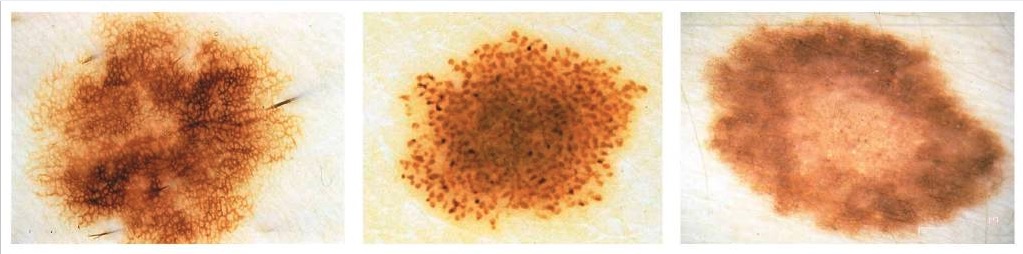
Clasificación de las lesiones melanocíticas específicas

De izquierda a derecha: tipos de nevos reticular, estallido de estrellas y globular

Imagen : “Clark nevus” por the Department of Automatics and Biomedical Engineering, AGH University of Science and Technology, Aleja Mickiewicza 30, 30-059 Krakow, Poland. Licencia: CC BY 4.0.
Nevos Comunes Congénitos

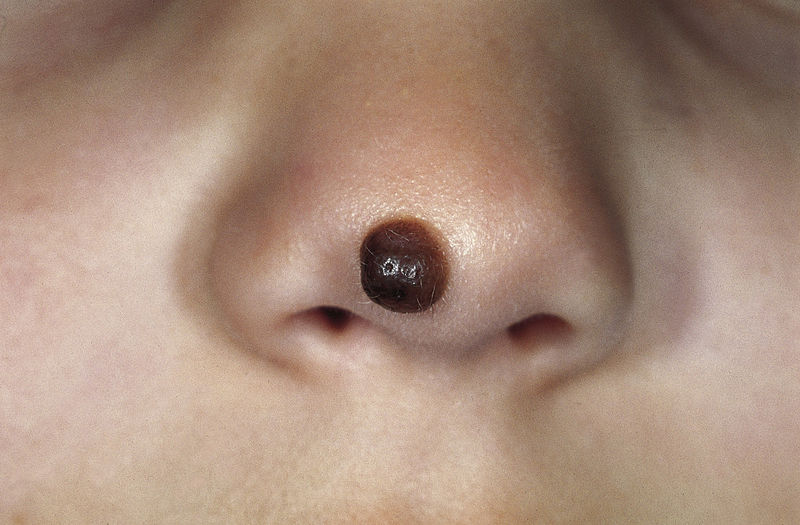
Nevo melanocítico congénito

  • Epidemiología: ocurre en EN Erythema nodosum is an immune-mediated panniculitis (inflammation of the subcutaneous fat) caused by a type IV (delayed-type) hypersensitivity reaction. It commonly manifests in young women as tender, erythematous nodules on the shins. Erythema Nodosum 1%–3% de los LOS Neisseria recién nacidos
  • Apariencia:
    • Lesiones de color marrón claro a negro.
    • Puede ocurrir en EN Erythema nodosum is an immune-mediated panniculitis (inflammation of the subcutaneous fat) caused by a type IV (delayed-type) hypersensitivity reaction. It commonly manifests in young women as tender, erythematous nodules on the shins. Erythema Nodosum cualquier área del cuerpo que esté cubierta de piel.
    • Tienen bordes algo irregulares pero definidos.
    • Por lo general, comienza plano, pero puede elevarse con el tiempo.
    • Puede presentarse con crecimiento de pelo terminal dentro de la lesión, a veces asociado con hipertricosis (crecimiento excesivo de pelo)
    • Aumento de tamaño proporcional al AL Amyloidosis crecimiento de por vida del individuo.
  • Clasificación por tamaño:
    • Pequeño: < 1,5 cm
    • Mediano: 1,5–19,9 cm
    • Grande: ≥ 20 cm
  • Potencial maligno: asociado al AL Amyloidosis tamaño del nevo:
    • Riesgo de nevos pequeños y medianos: < 1%
    • Riesgo de nevos congénitos gigantes: 5%–10%
Nevus melanocítico congénito

Nevo melanocítico congénito: una pápula marrón bien delimitada en la nariz que se desarrolló poco después del nacimiento

Imagen: “Congenital melanocytic nevus” por M. Sand et al. Licencia: CC BY 2.0.
Melanocitosis dérmica congénita

  • Anteriormente llamada “manchas mongólicas”
  • Epidemiología: más común en EN Erythema nodosum is an immune-mediated panniculitis (inflammation of the subcutaneous fat) caused by a type IV (delayed-type) hypersensitivity reaction. It commonly manifests in young women as tender, erythematous nodules on the shins. Erythema Nodosum nativos americanos, afroamericanos y personas de ascendencia asiática y latina
  • Apariencia:
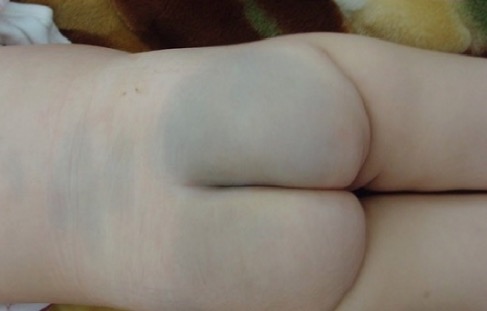
    • Aparecen como parches azul-grisáceos con bordes indefinidos
    • El color azul-negro se debe al AL Amyloidosis atrapamiento de los LOS Neisseria melanocitos en EN Erythema nodosum is an immune-mediated panniculitis (inflammation of the subcutaneous fat) caused by a type IV (delayed-type) hypersensitivity reaction. It commonly manifests in young women as tender, erythematous nodules on the shins. Erythema Nodosum la dermis Dermis A layer of vascularized connective tissue underneath the epidermis. The surface of the dermis contains innervated papillae. Embedded in or beneath the dermis are sweat glands; hair follicles; and sebaceous glands. Skin: Structure and Functions, en EN Erythema nodosum is an immune-mediated panniculitis (inflammation of the subcutaneous fat) caused by a type IV (delayed-type) hypersensitivity reaction. It commonly manifests in young women as tender, erythematous nodules on the shins. Erythema Nodosum lugar de la epidermis Epidermis The external, nonvascular layer of the skin. It is made up, from within outward, of five layers of epithelium: (1) basal layer (stratum basale epidermidis); (2) spinous layer (stratum spinosum epidermidis); (3) granular layer (stratum granulosum epidermidis); (4) clear layer (stratum lucidum epidermidis); and (5) horny layer (stratum corneum epidermidis). Skin: Structure and Functions.
    • Generalmente en EN Erythema nodosum is an immune-mediated panniculitis (inflammation of the subcutaneous fat) caused by a type IV (delayed-type) hypersensitivity reaction. It commonly manifests in young women as tender, erythematous nodules on the shins. Erythema Nodosum la zona lumbosacra o glútea.
    • Son siempre planas (mácula)
    • Normalmente desaparecen 2–3 años después del nacimiento y casi siempre en EN Erythema nodosum is an immune-mediated panniculitis (inflammation of the subcutaneous fat) caused by a type IV (delayed-type) hypersensitivity reaction. It commonly manifests in young women as tender, erythematous nodules on the shins. Erythema Nodosum la pubertad
  • Potencial maligno: no hay informes de casos de desarrollo de melanoma Melanoma Melanoma is a malignant tumor arising from melanocytes, the melanin-producing cells of the epidermis. These tumors are most common in fair-skinned individuals with a history of excessive sun exposure and sunburns. Melanoma a partir de melanocitosis dérmica congénita.
Manchas de Mongolia

Mancha mongólica o melanocitosis dérmica congénita sobre las regiones lumbar y glútea

Imagen: “Enorme tache mongoloïde” por Service de Pédiatrie, Hôpital Militaire d’Instruction Mohamed V, Université Med V, Souissi, Maroc. Licencia: CC BY 2.0.
Nevo de Ito

  • Epidemiología: más común en EN Erythema nodosum is an immune-mediated panniculitis (inflammation of the subcutaneous fat) caused by a type IV (delayed-type) hypersensitivity reaction. It commonly manifests in young women as tender, erythematous nodules on the shins. Erythema Nodosum asiáticos y afroamericanos
  • Apariencia:
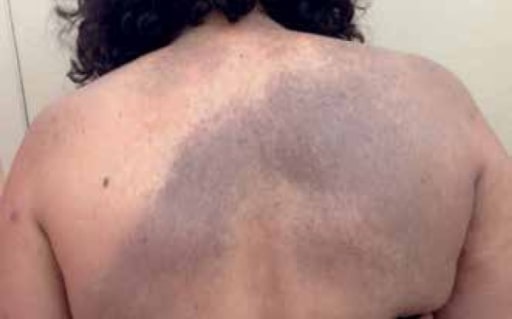
    • Lesión azul, gris o marrón
    • Afecta preferentemente áreas inervadas por los LOS Neisseria nervios supraclaviculares posteriores, como el hombro, la parte superior del tórax y el costado del cuello.
    • Generalmente unilateral
  • Potencial maligno: el melanoma Melanoma Melanoma is a malignant tumor arising from melanocytes, the melanin-producing cells of the epidermis. These tumors are most common in fair-skinned individuals with a history of excessive sun exposure and sunburns. Melanoma muy rara vez se desarrolla a partir de un nevo de Ito.
Nevo de Ito

Nevo de Ito congénito: mácula gris-azulada, que representa una melanocitosis dérmica benigna que afecta preferentemente las áreas inervadas por los nervios supraclaviculares posteriores

Imagen: “Nevus of Ito” por the U.S. National Library of Medicine Licencia: CC BY 4.0.
Nevo de Ota

  • Epidemiología:
    • Más común en EN Erythema nodosum is an immune-mediated panniculitis (inflammation of the subcutaneous fat) caused by a type IV (delayed-type) hypersensitivity reaction. It commonly manifests in young women as tender, erythematous nodules on the shins. Erythema Nodosum asiáticos y afroamericanos.
    • Las mujeres se ven afectadas casi 5 veces más que los LOS Neisseria hombres.
  • Apariencia:
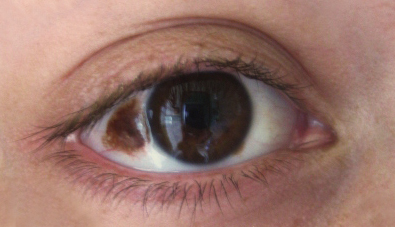
    • Hiperpigmentación plana azulada o pardusca (mácula)
    • Afecta preferentemente áreas inervadas por la 1ra y 2da división del nervio trigémino (e.g., frente, nariz, mejilla, región periorbitaria y sien)
    • A menudo afecta a las escleróticas.
  • Potencial maligno:
    • El melanoma Melanoma Melanoma is a malignant tumor arising from melanocytes, the melanin-producing cells of the epidermis. These tumors are most common in fair-skinned individuals with a history of excessive sun exposure and sunburns. Melanoma muy rara vez se desarrolla a partir de un nevo de Ota.
    • Requiere exámenes oftalmológicos anuales debido al AL Amyloidosis raro riesgo de glaucoma Glaucoma Glaucoma is an optic neuropathy characterized by typical visual field defects and optic nerve atrophy seen as optic disc cupping on examination. The acute form of glaucoma is a medical emergency. Glaucoma is often, but not always, caused by increased intraocular pressure (IOP). Glaucoma
Ojo nevus

Nevo de Ota congénito: melanocitosis dérmica benigna que afecta preferentemente a zonas inervadas por la 1ra y 2da división del nervio trigémino. Un nevo de Ota congénito a menudo afecta las escleróticas.

Imagen: “Nevus” por Luninsky. Licencia: CC BY 3.0.

Nevus Comunes Adquiridos

Epidemiología

  • Presente en EN Erythema nodosum is an immune-mediated panniculitis (inflammation of the subcutaneous fat) caused by a type IV (delayed-type) hypersensitivity reaction. It commonly manifests in young women as tender, erythematous nodules on the shins. Erythema Nodosum casi todas las personas; el 55% de los LOS Neisseria adultos tienen de 10–45 nevos mayores de 2 mm.
  • Aumento de la incidencia que alcanza su punto máximo alrededor de la 4ta década, disminuyendo en EN Erythema nodosum is an immune-mediated panniculitis (inflammation of the subcutaneous fat) caused by a type IV (delayed-type) hypersensitivity reaction. It commonly manifests in young women as tender, erythematous nodules on the shins. Erythema Nodosum número con el avance de la edad
  • Factores de riesgo/desencadenantes del desarrollo de nevos:
    • Antecedentes familiares
    • Tez clara
    • Exposición prolongada o excesiva al AL Amyloidosis sol
    • Cuanto mayor sea el número de nevos, mayor será el riesgo de desarrollar melanoma Melanoma Melanoma is a malignant tumor arising from melanocytes, the melanin-producing cells of the epidermis. These tumors are most common in fair-skinned individuals with a history of excessive sun exposure and sunburns. Melanoma.

Etiología

  • Neoplasias benignas de células del nevo que suelen surgir después de los LOS Neisseria 6 meses de edad:
    • Las células del nevo son una variante de los LOS Neisseria melanocitos, derivados de la cresta neural.
  • Por lo general, se forman como resultado de mutaciones activadoras de BRAF-V600E:
    • A pesar de tener la mutación, la mayoría de los LOS Neisseria nevos no progresan a melanoma Melanoma Melanoma is a malignant tumor arising from melanocytes, the melanin-producing cells of the epidermis. These tumors are most common in fair-skinned individuals with a history of excessive sun exposure and sunburns. Melanoma porque los LOS Neisseria nevos adquiridos comunes son neoplasias de crecimiento detenido.
    • El 33% de los LOS Neisseria melanomas surgen de un nevo preexistente.

Histopatología

  • Dos características histopatológicas cardinales de los LOS Neisseria nevos son la anidación y la maduración:
    • Anidación: la tendencia de las células del nevo a formar pequeños grupos de células dentro de un tejido:
      • Las células del nevo también pueden agregarse en EN Erythema nodosum is an immune-mediated panniculitis (inflammation of the subcutaneous fat) caused by a type IV (delayed-type) hypersensitivity reaction. It commonly manifests in young women as tender, erythematous nodules on the shins. Erythema Nodosum un patrón no anidado en EN Erythema nodosum is an immune-mediated panniculitis (inflammation of the subcutaneous fat) caused by a type IV (delayed-type) hypersensitivity reaction. It commonly manifests in young women as tender, erythematous nodules on the shins. Erythema Nodosum la unión dermoepidérmica.
    • Maduración: los LOS Neisseria nevos en EN Erythema nodosum is an immune-mediated panniculitis (inflammation of the subcutaneous fat) caused by a type IV (delayed-type) hypersensitivity reaction. It commonly manifests in young women as tender, erythematous nodules on the shins. Erythema Nodosum la dermis Dermis A layer of vascularized connective tissue underneath the epidermis. The surface of the dermis contains innervated papillae. Embedded in or beneath the dermis are sweat glands; hair follicles; and sebaceous glands. Skin: Structure and Functions muestran un cambio gradual y progresivo (de superficial a profundo) en EN Erythema nodosum is an immune-mediated panniculitis (inflammation of the subcutaneous fat) caused by a type IV (delayed-type) hypersensitivity reaction. It commonly manifests in young women as tender, erythematous nodules on the shins. Erythema Nodosum la arquitectura y citología del nido.
  • En EN Erythema nodosum is an immune-mediated panniculitis (inflammation of the subcutaneous fat) caused by a type IV (delayed-type) hypersensitivity reaction. It commonly manifests in young women as tender, erythematous nodules on the shins. Erythema Nodosum un nevo no se observan figuras mitóticas, o son raras.
  • Los nevos melanocíticos adquiridos se clasifican en 3 tipos según su profundidad, lo que representa las diferentes etapas de una progresión continua de crecimiento:
    1. Nevo de unión = 1ra etapa de crecimiento
    2. Nevo compuesto = 2da etapa de crecimiento
    3. Nevo dérmico o intradérmico = 3ra etapa de crecimiento
  • A medida que las células migran a mayor profundidad, los LOS Neisseria nevos adquiridos comunes desarrollan una morfología de tipo neural o de tipo Schwannian antes de sufrir una regresión o atrofia completas, y finalmente son reemplazados por tejido adiposo y fibrótico.
Tabla: Nevos adquiridos
Tipo Descripción Presentación
Nevos de unión
  • Células del nevo encontradas en EN Erythema nodosum is an immune-mediated panniculitis (inflammation of the subcutaneous fat) caused by a type IV (delayed-type) hypersensitivity reaction. It commonly manifests in young women as tender, erythematous nodules on the shins. Erythema Nodosum la unión dermoepidérmica
  • Células grandes que producen melanina.
  • El lunar más común en EN Erythema nodosum is an immune-mediated panniculitis (inflammation of the subcutaneous fat) caused by a type IV (delayed-type) hypersensitivity reaction. It commonly manifests in young women as tender, erythematous nodules on the shins. Erythema Nodosum los LOS Neisseria niños
  • Máculas parduscas bien delimitadas y mínimamente elevadas
  • Uniformemente pigmentados, marrón claro-oscuro/negro
  • Usualmente ≤ 5 mm
Nevos compuestos Células del nevo encontradas en EN Erythema nodosum is an immune-mediated panniculitis (inflammation of the subcutaneous fat) caused by a type IV (delayed-type) hypersensitivity reaction. It commonly manifests in young women as tender, erythematous nodules on the shins. Erythema Nodosum la unión dermoepidérmica e intradérmicamente, células más pequeñas que producen menos melanina
  • Pápulas pigmentadas
  • Liso, en EN Erythema nodosum is an immune-mediated panniculitis (inflammation of the subcutaneous fat) caused by a type IV (delayed-type) hypersensitivity reaction. It commonly manifests in young women as tender, erythematous nodules on the shins. Erythema Nodosum forma de cúpula
  • Similar a los LOS Neisseria nevos de unión pero con elevación y color más claro
Nevos intradérmicos Células del nevo encontradas intradérmicamente, células pequeñas que producen poca o ninguna melanina
  • El lunar más común en EN Erythema nodosum is an immune-mediated panniculitis (inflammation of the subcutaneous fat) caused by a type IV (delayed-type) hypersensitivity reaction. It commonly manifests in young women as tender, erythematous nodules on the shins. Erythema Nodosum adultos
  • Color piel a marrón claro
  • Similar al AL Amyloidosis nevo compuesto
  • En EN Erythema nodosum is an immune-mediated panniculitis (inflammation of the subcutaneous fat) caused by a type IV (delayed-type) hypersensitivity reaction. It commonly manifests in young women as tender, erythematous nodules on the shins. Erythema Nodosum forma de cúpula o papilomatosa
  • Puede presentarse con pelo terminal, textura fibrótica, aspecto moteado
no melanoma

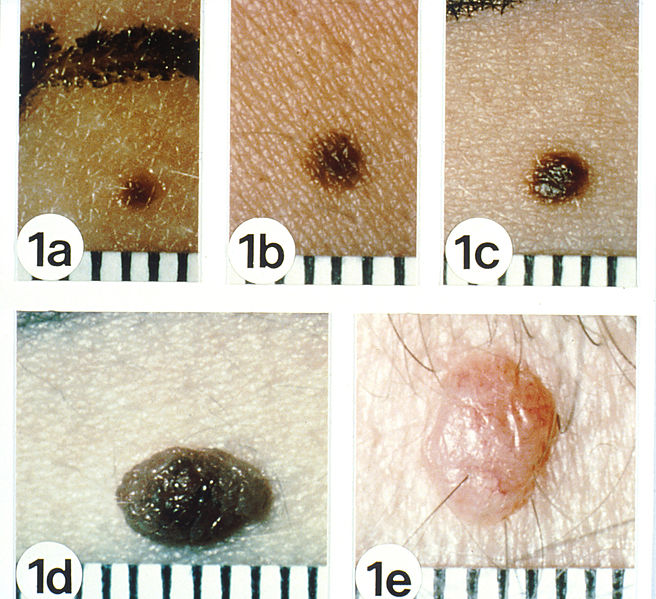
Historia natural de los nevos melanocíticos adquiridos

Los nevos comunes (“lunares”) comienzan como máculas uniformemente marrón claro a oscuro, de 1 a 2 mm de diámetro (a) se expanden a una mácula más grande (b), progresan a una pápula pigmentada que puede ser mínima (c) u obviamente (d) elevada por encima de la superficie de la piel y termina como una pápula rosada o de color piel (e).
Los nevos melanocíticos adquiridos son de unión (a, b), compuestos (c, d), y dérmicos (e), respectivamente. Tenga en cuenta sus bordes lisos, coloración uniforme y una clara demarcación de la piel circundante con bordes lisos.
Los nevos melanocíticos adquiridos suelen ser < 5 mm de diámetro.

Imagen: “No melanoma” por Visualsonline.cancer.gov. Licencia: Dominio Público.

Diagnóstico

Según la apariencia clínica, un nevo benigno típico debe tener las siguientes características:

  • Simétrico
  • < 5 mm de diámetro
  • Borde liso
  • Color uniforme e inmutable.
  • Antecedentes de crecimiento lento

Tratamiento

  • Vigilancia de la piel que incluye fotos periódicas para seguir la evolución de los LOS Neisseria lunares en EN Erythema nodosum is an immune-mediated panniculitis (inflammation of the subcutaneous fat) caused by a type IV (delayed-type) hypersensitivity reaction. It commonly manifests in young women as tender, erythematous nodules on the shins. Erythema Nodosum pacientes con mayor riesgo de melanoma Melanoma Melanoma is a malignant tumor arising from melanocytes, the melanin-producing cells of the epidermis. These tumors are most common in fair-skinned individuals with a history of excessive sun exposure and sunburns. Melanoma
  • Cualquier lesión sospechosa de melanoma Melanoma Melanoma is a malignant tumor arising from melanocytes, the melanin-producing cells of the epidermis. These tumors are most common in fair-skinned individuals with a history of excessive sun exposure and sunburns. Melanoma debe ser biopsiada o referida para biopsia.
  • Un nevo con pequeñas manchas oscuras dentro (“focos hiperpigmentados”) puede significar que el melanoma Melanoma Melanoma is a malignant tumor arising from melanocytes, the melanin-producing cells of the epidermis. These tumors are most common in fair-skinned individuals with a history of excessive sun exposure and sunburns. Melanoma surge en EN Erythema nodosum is an immune-mediated panniculitis (inflammation of the subcutaneous fat) caused by a type IV (delayed-type) hypersensitivity reaction. It commonly manifests in young women as tender, erythematous nodules on the shins. Erythema Nodosum un lunar previamente benigno.

Nevos Displásicos o Atípicos

Definición

Un nevo displásico o atípico es un nevo melanocítico benigno con una apariencia que difiere de los nevos comunes o “lunares” según los LOS Neisseria criterios ABCDE (asimetría, irregularidad de los LOS Neisseria bordes, variedad de colores, diámetro ≥ 6 mm y evolución):

  • Algunas fuentes se refieren a los LOS Neisseria nevos displásicos como lesiones premalignas o precancerosas.
  • Algunas fuentes se refieren a los nevos displásicos como un término para “incertidumbre diagnóstica”, donde la lesión es benigna o maligna, pero aún no ha HA Hemolytic anemia (HA) is the term given to a large group of anemias that are caused by the premature destruction/hemolysis of circulating red blood cells (RBCs). Hemolysis can occur within (intravascular hemolysis) or outside the blood vessels (extravascular hemolysis). Hemolytic Anemia sido confirmada mediante biopsia.

Etiología y Epidemiología

  • A menudo aparecen durante la pubertad.
  • Prevalecen en EN Erythema nodosum is an immune-mediated panniculitis (inflammation of the subcutaneous fat) caused by a type IV (delayed-type) hypersensitivity reaction. It commonly manifests in young women as tender, erythematous nodules on the shins. Erythema Nodosum poblaciones blancas: 2%–10%
  • Comparte algunas de las características clínicas de los LOS Neisseria melanomas:
    • Asimetría
    • Variedad de colores
    • Bordes irregulares
    • Diámetro ≥ 5 mm
  • El desarrollo se debe principalmente a la genética: asociado con la activación de mutaciones en EN Erythema nodosum is an immune-mediated panniculitis (inflammation of the subcutaneous fat) caused by a type IV (delayed-type) hypersensitivity reaction. It commonly manifests in young women as tender, erythematous nodules on the shins. Erythema Nodosum los LOS Neisseria genes Genes A category of nucleic acid sequences that function as units of heredity and which code for the basic instructions for the development, reproduction, and maintenance of organisms. DNA Types and Structure NRAS o BRAF, entre otros
  • Asociado con un riesgo de melanoma Melanoma Melanoma is a malignant tumor arising from melanocytes, the melanin-producing cells of the epidermis. These tumors are most common in fair-skinned individuals with a history of excessive sun exposure and sunburns. Melanoma de 3-20 veces mayor
  • Factores de riesgo para desarrollar nevos atípicos:
    • Tez clara
    • Exposición prolongada o excesiva al AL Amyloidosis sol, pero puede ocurrir en EN Erythema nodosum is an immune-mediated panniculitis (inflammation of the subcutaneous fat) caused by a type IV (delayed-type) hypersensitivity reaction. It commonly manifests in young women as tender, erythematous nodules on the shins. Erythema Nodosum superficies no expuestas
    • Antecedentes familiares/personales de melanoma Melanoma Melanoma is a malignant tumor arising from melanocytes, the melanin-producing cells of the epidermis. These tumors are most common in fair-skinned individuals with a history of excessive sun exposure and sunburns. Melanoma
    • Síndrome familiar de lunares atípicos múltiples y melanomas:
      • Autosómico dominante
      • El 40% de los LOS Neisseria casos tienen mutaciones en EN Erythema nodosum is an immune-mediated panniculitis (inflammation of the subcutaneous fat) caused by a type IV (delayed-type) hypersensitivity reaction. It commonly manifests in young women as tender, erythematous nodules on the shins. Erythema Nodosum CDKN2A, un gen supresor de tumores
      • Mayor riesgo de neoplasias malignas, especialmente del páncreas, mama y esófago

Diagnóstico

  • Se puede realizar sobre una base clínica y puede ser asistido por dermatoscopia, pero las lesiones deben ser biopsiadas para su confirmación y para descartar melanoma Melanoma Melanoma is a malignant tumor arising from melanocytes, the melanin-producing cells of the epidermis. These tumors are most common in fair-skinned individuals with a history of excessive sun exposure and sunburns. Melanoma.
  • Histológicamente caracterizado por:
    • Atipia arquitectónica y citológica
    • Agrandamiento de las células nevus Nevus Nevi (singular nevus), also known as “moles,” are benign neoplasms of the skin. Nevus is a non-specific medical term because it encompasses both congenital and acquired lesions, hyper- and hypopigmented lesions, and raised or flat lesions. Nevus/Nevi
    • Nidos que a menudo se fusionan con nidos adyacentes
  • Los LOS Neisseria criterios/mnemotecnia ABCDE pueden ayudar a diferenciar un nevo de un melanoma Melanoma Melanoma is a malignant tumor arising from melanocytes, the melanin-producing cells of the epidermis. These tumors are most common in fair-skinned individuals with a history of excessive sun exposure and sunburns. Melanoma.
Tabla: Criterios ABCDE para diferenciar un nevo y un melanoma Melanoma Melanoma is a malignant tumor arising from melanocytes, the melanin-producing cells of the epidermis. These tumors are most common in fair-skinned individuals with a history of excessive sun exposure and sunburns. Melanoma
Nevos comunes (benignos) Nevos atípicos Melanomas (m.)
Asimetría (A) Simetría (una línea recta trazada a través del centro de la lesión da 2 imágenes en EN Erythema nodosum is an immune-mediated panniculitis (inflammation of the subcutaneous fat) caused by a type IV (delayed-type) hypersensitivity reaction. It commonly manifests in young women as tender, erythematous nodules on the shins. Erythema Nodosum espejo)
  • Asimétrico
  • Puede tener componentes maculares y papulares
  • Asimétrico
  • Puede tener componentes maculares y papulares
Borde (B) Borde liso y bien definido Margen irregular con borde mal definido Margen irregular con borde mal definido
Color (C) Color uniforme o patrón de color regular Regular Insulin (e.g., moteado o estallido de estrellas) Color abigarrado o diferentes tonos de color. Color abigarrado o diferentes tonos de color.
Diámetro (D) < 5 mm Por lo general ≥ 5 mm > 6 mm
Evolución (E) Crecimiento estable o lento
  • No presente al AL Amyloidosis nacer
  • Generalmente permanece estable
  • Depende del tipo
  • Varía desde un crecimiento rápido (e.g., melanoma Melanoma Melanoma is a malignant tumor arising from melanocytes, the melanin-producing cells of the epidermis. These tumors are most common in fair-skinned individuals with a history of excessive sun exposure and sunburns. Melanoma nodular) hasta un crecimiento lento ( melanoma Melanoma Melanoma is a malignant tumor arising from melanocytes, the melanin-producing cells of the epidermis. These tumors are most common in fair-skinned individuals with a history of excessive sun exposure and sunburns. Melanoma lentigo maligno)
Ubicación (no es parte de los LOS Neisseria criterios, pero es un factor importante) Concentrado en EN Erythema nodosum is an immune-mediated panniculitis (inflammation of the subcutaneous fat) caused by a type IV (delayed-type) hypersensitivity reaction. It commonly manifests in young women as tender, erythematous nodules on the shins. Erythema Nodosum sitios expuestos al AL Amyloidosis sol.
  • Áreas expuestas al AL Amyloidosis sol y en EN Erythema nodosum is an immune-mediated panniculitis (inflammation of the subcutaneous fat) caused by a type IV (delayed-type) hypersensitivity reaction. It commonly manifests in young women as tender, erythematous nodules on the shins. Erythema Nodosum sitios inusuales (cuero cabelludo, glúteos, mamas)
  • En EN Erythema nodosum is an immune-mediated panniculitis (inflammation of the subcutaneous fat) caused by a type IV (delayed-type) hypersensitivity reaction. It commonly manifests in young women as tender, erythematous nodules on the shins. Erythema Nodosum formas familiares:
    • La espalda se ve VE Ventilation: Mechanics of Breathing más afectada tanto en EN Erythema nodosum is an immune-mediated panniculitis (inflammation of the subcutaneous fat) caused by a type IV (delayed-type) hypersensitivity reaction. It commonly manifests in young women as tender, erythematous nodules on the shins. Erythema Nodosum hombres como en EN Erythema nodosum is an immune-mediated panniculitis (inflammation of the subcutaneous fat) caused by a type IV (delayed-type) hypersensitivity reaction. It commonly manifests in young women as tender, erythematous nodules on the shins. Erythema Nodosum mujeres.
    • Las extremidades se ven más afectadas en EN Erythema nodosum is an immune-mediated panniculitis (inflammation of the subcutaneous fat) caused by a type IV (delayed-type) hypersensitivity reaction. It commonly manifests in young women as tender, erythematous nodules on the shins. Erythema Nodosum las mujeres.
Depende del tipo:
  • Tronco y extremidades en EN Erythema nodosum is an immune-mediated panniculitis (inflammation of the subcutaneous fat) caused by a type IV (delayed-type) hypersensitivity reaction. It commonly manifests in young women as tender, erythematous nodules on the shins. Erythema Nodosum melanoma Melanoma Melanoma is a malignant tumor arising from melanocytes, the melanin-producing cells of the epidermis. These tumors are most common in fair-skinned individuals with a history of excessive sun exposure and sunburns. Melanoma de extensión superficial y nodular.
  • Áreas expuestas al AL Amyloidosis sol en EN Erythema nodosum is an immune-mediated panniculitis (inflammation of the subcutaneous fat) caused by a type IV (delayed-type) hypersensitivity reaction. It commonly manifests in young women as tender, erythematous nodules on the shins. Erythema Nodosum melanoma Melanoma Melanoma is a malignant tumor arising from melanocytes, the melanin-producing cells of the epidermis. These tumors are most common in fair-skinned individuals with a history of excessive sun exposure and sunburns. Melanoma de extensión superficial
  • Palmas, plantas y debajo de la lámina ungueal, en EN Erythema nodosum is an immune-mediated panniculitis (inflammation of the subcutaneous fat) caused by a type IV (delayed-type) hypersensitivity reaction. It commonly manifests in young women as tender, erythematous nodules on the shins. Erythema Nodosum melanoma Melanoma Melanoma is a malignant tumor arising from melanocytes, the melanin-producing cells of the epidermis. These tumors are most common in fair-skinned individuals with a history of excessive sun exposure and sunburns. Melanoma acral-lentiginosao.

Manejo y seguimiento

  • Exámenes anuales de la piel
  • Fomentar el uso de protector solar de amplio espectro.
  • Escisión de lesiones sospechosas
  • Exámenes oftalmológicos de rutina

Diagnóstico Diferencial

  • Melanoma Melanoma Melanoma is a malignant tumor arising from melanocytes, the melanin-producing cells of the epidermis. These tumors are most common in fair-skinned individuals with a history of excessive sun exposure and sunburns. Melanoma: el más mortal de todos los LOS Neisseria cánceres de piel. Las características clínicas que difieren de los LOS Neisseria nevos atípicos o displásicos son los LOS Neisseria tonos azul-grisáceo del signo del patito feo (nevos distintos que difieren del patrón de nevos en EN Erythema nodosum is an immune-mediated panniculitis (inflammation of the subcutaneous fat) caused by a type IV (delayed-type) hypersensitivity reaction. It commonly manifests in young women as tender, erythematous nodules on the shins. Erythema Nodosum un individuo). Dos tercios surgen de novo y ⅓ surgen de nevos preexistentes.
  • Carcinoma basocelular: el tipo más común de cáncer de piel. Surge de la capa de células basales de la epidermis Epidermis The external, nonvascular layer of the skin. It is made up, from within outward, of five layers of epithelium: (1) basal layer (stratum basale epidermidis); (2) spinous layer (stratum spinosum epidermidis); (3) granular layer (stratum granulosum epidermidis); (4) clear layer (stratum lucidum epidermidis); and (5) horny layer (stratum corneum epidermidis). Skin: Structure and Functions. La mayoría de los LOS Neisseria pacientes presentan una lesión cutánea nodular perlada de crecimiento lento con vasos telangiectásicos en EN Erythema nodosum is an immune-mediated panniculitis (inflammation of the subcutaneous fat) caused by a type IV (delayed-type) hypersensitivity reaction. It commonly manifests in young women as tender, erythematous nodules on the shins. Erythema Nodosum la superficie.
  • Queratosis seborreica: neoplasia benigna formada por queratinocitos inmaduros. Ocurre más comúnmente en los ancianos. La queratosis seborreica está bien delimitada, es cerosa y tiene un aspecto de “estar pegada”.
  • Queratosis actínica: lesión precancerosa que afecta áreas expuestas al AL Amyloidosis sol (e.g., cuero cabelludo y manos) en EN Erythema nodosum is an immune-mediated panniculitis (inflammation of the subcutaneous fat) caused by a type IV (delayed-type) hypersensitivity reaction. It commonly manifests in young women as tender, erythematous nodules on the shins. Erythema Nodosum personas de edad avanzada y aparece como una lesión escamosa y ligeramente elevada que debe extirparse para prevenir el desarrollo de carcinoma de células escamosas invasivo.
  • Dermatofibroma: crecimiento mesenquimatoso de la piel donde los LOS Neisseria fibroblastos de la piel son los LOS Neisseria constituyentes principales. Aparece como un nódulo firme, indurado y móvil que mide entre 0,5 – 1 cm de tamaño. Se presenta con signo del “hoyuelo” a la compresión lateral. Se produce una depresión similar a un hoyuelo en EN Erythema nodosum is an immune-mediated panniculitis (inflammation of the subcutaneous fat) caused by a type IV (delayed-type) hypersensitivity reaction. It commonly manifests in young women as tender, erythematous nodules on the shins. Erythema Nodosum la piel suprayacente.
  • Mácula café con leche: lesión cutánea plana y pigmentada. Puede estar asociado con la neurofibromatosis tipo 1 y el síndrome de McCune-Albright.

Referencias

  1. Lazar, A.L. (2020). The Skin. In Kumar, V., Abbas, A. K., Aster, J.C., (Eds.), Robbins & Cotran Pathologic Basis of Disease. (10 ed. pp. 1135-1141). Elsevier, Inc.
  2. Dinulos, J.G.H. (2020). In Habif’s Clinical Dermatology (7th ed. pp. 863-875). Elsevier, Inc.
  3. Damsky, W. E., & Bosenberg, M. (2017). Melanocytic nevi and melanoma: unraveling a complex relationship. Oncogene, 36(42), 5771–5792. https://doi.org/10.1038/onc.2017.189
  4. Braun, R.P., Deinlein, T., & Salaudek, I. (2020). Classification of Nevi / Benign Nevus Pattern – Dermoscopedia. Dermoscopedia.Org. https://dermoscopedia.org/Classification_of_nevi_/_benign_nevus_pattern
  5. Rammel, K. (2017). Classification of Melanocytic Nevi. Medical University of Graz.

¡Crea tu cuenta gratis o inicia una sesión para seguir leyendo!

Regístrate ahora y obtén acceso gratuito a Lecturio con páginas de concepto, videos médicos y cuestionarios para tu educación médica.

User Reviews

Que tengas una sesión de estudio alegre y navideña 🎁 Ahorra 50% en todos los planes >>

Details