Domina Conceptos Médicos

Estudia para la escuela de medicina y tus examenes con Lecturio.

Modificaciones Postranscripcionales (Procesamiento del ARN)

Las modificaciones postranscripcionales son procesos que facilitan la generación de ácido ribonucleico (ARN) maduro y funcional. Estos mecanismos reguladores de rápida respuesta permiten que se produzcan diferentes proteínas a partir de un mismo gen y actúan como reguladores del fenotipo y de la tasa de proliferación. Estas modificaciones también desempeñan un papel en EN Erythema nodosum is an immune-mediated panniculitis (inflammation of the subcutaneous fat) caused by a type IV (delayed-type) hypersensitivity reaction. It commonly manifests in young women as tender, erythematous nodules on the shins. Erythema Nodosum algunas formas de cáncer y enfermedades neurodegenerativas. El ARN pre-mensajero (ARNm), llamado ARN heterogéneo nuclear (ARNhn), se modifica añadiendo una caperuza de 7-metilguanosina en EN Erythema nodosum is an immune-mediated panniculitis (inflammation of the subcutaneous fat) caused by a type IV (delayed-type) hypersensitivity reaction. It commonly manifests in young women as tender, erythematous nodules on the shins. Erythema Nodosum 5' y una cola de poli-A (poliadenilato) 3' para su estabilidad y protección. Además, los LOS Neisseria ARNhn que contienen intrones (secuencias no codificantes) entre las secuencias expresadas o los LOS Neisseria exones se someten a empalme. Este proceso elimina los LOS Neisseria intrones para producir un ARNm maduro que lleva la secuencia codificante para la traducción. El empalme alternativo, por su parte, también excluye los LOS Neisseria intrones, pero se enlazan combinaciones variables de exones, produciendo proteínas diferentes del ARNm original. En EN Erythema nodosum is an immune-mediated panniculitis (inflammation of the subcutaneous fat) caused by a type IV (delayed-type) hypersensitivity reaction. It commonly manifests in young women as tender, erythematous nodules on the shins. Erythema Nodosum la edición del ARN, la secuencia del ARNm se altera y difiere de la plantilla de ADN transcrita. El ARN de transferencia y el ARN ribosómico parten de moléculas precursoras más largas y pasan por etapas que incluyen la metilación, el recorte y la adición de nucleótidos.

Last updated: Apr 25, 2025

Editorial responsibility: Stanley Oiseth, Lindsay Jones, Evelin Maza

Descripción General

Transcripción

La información genética del ácido desoxirribonucleico (ADN) se copia en EN Erythema nodosum is an immune-mediated panniculitis (inflammation of the subcutaneous fat) caused by a type IV (delayed-type) hypersensitivity reaction. It commonly manifests in young women as tender, erythematous nodules on the shins. Erythema Nodosum el ARN mensajero (ARNm).
  • En EN Erythema nodosum is an immune-mediated panniculitis (inflammation of the subcutaneous fat) caused by a type IV (delayed-type) hypersensitivity reaction. It commonly manifests in young women as tender, erythematous nodules on the shins. Erythema Nodosum este proceso, el ARNm se sintetiza desde el extremo 5′ hasta el extremo 3′.
  • El transcrito inicial se conoce como ARN heterogéneo nuclear (ARNhn) o pre-ARNm.
Expresión de genes a partir del ADN

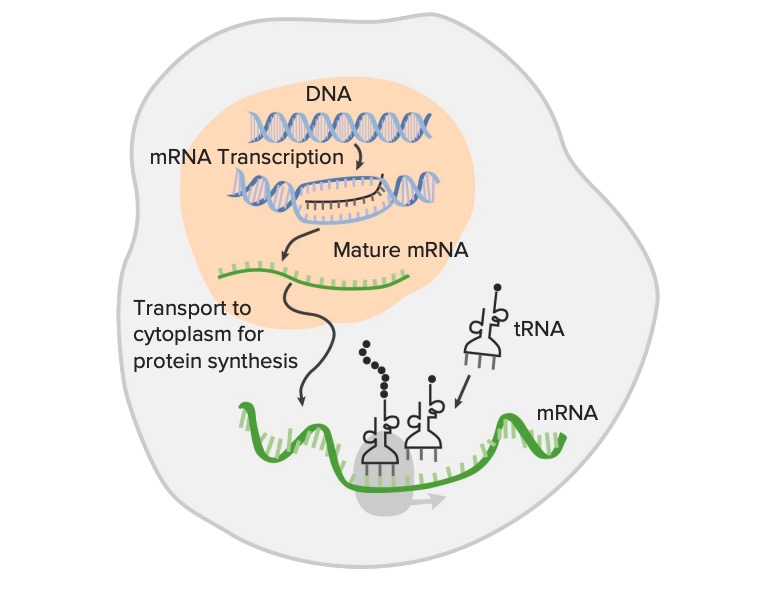
La expresión de los genes a partir del ADN, la secuencia genética, se transcribe en el ARN (transcripción):
La transcripción de la información genética es el primer paso en la expresión de los genes y es el proceso mediante el cual una región codificante del ADN (estructura de doble cadena) se utiliza como plantilla para la síntesis del ARN mensajero (ARNm). El ARNm maduro se traduce en aminoácidos, formando proteínas (traducción) con la ayuda del ARN ribosomal y el ARN de transferencia (ARNt). Esta imagen muestra la transcripción sin modificaciones post-transcripcionales del ARN.

Imagen por Lecturio.

Modificaciones

Los LOS Neisseria transcritos primarios, o productos inmediatos de la transcripción, sufren alteraciones para convertirse en EN Erythema nodosum is an immune-mediated panniculitis (inflammation of the subcutaneous fat) caused by a type IV (delayed-type) hypersensitivity reaction. It commonly manifests in young women as tender, erythematous nodules on the shins. Erythema Nodosum biológicamente funcionales.
  • ARNm:
    • Procariotas: La mayoría de los LOS Neisseria ARNm primarios no tienen modificaciones.
    • Eucariotas: El transcrito sintetizado del ARNm (o ARNhn) se procesa antes de salir del núcleo.
      • Adición de la caperuza 5′
      • Adición de la cola de poli-A 3′
      • Empalme
    • La modificación del ARNhn produce un ARNm maduro, que es transportado al AL Amyloidosis citoplasma a través de los LOS Neisseria poros nucleares.
    • En EN Erythema nodosum is an immune-mediated panniculitis (inflammation of the subcutaneous fat) caused by a type IV (delayed-type) hypersensitivity reaction. It commonly manifests in young women as tender, erythematous nodules on the shins. Erythema Nodosum algunos casos, la edición del ARN se produce con sustituciones de bases Bases Usually a hydroxide of lithium, sodium, potassium, rubidium or cesium, but also the carbonates of these metals, ammonia, and the amines. Acid-Base Balance, creando una secuencia diferente a la copiada del ADN.
    • Una secuencia diferente de ARNm produce una proteína diferente; esto varía de la antigua hipótesis de “un gen-un polipéptido”.
  • ARN de transferencia (ARNt) y ARN ribosómico (ARNr):
    • Moléculas estructurales que no se traducen
    • Ambos tienen pre-ARNt y pre-ARNr que se procesan.
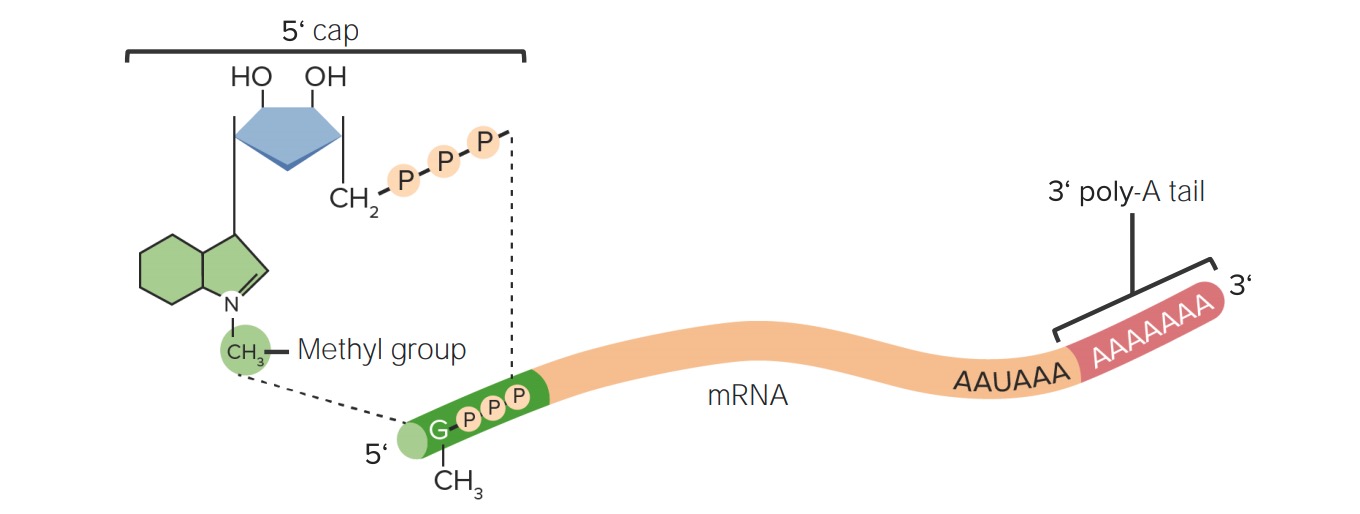
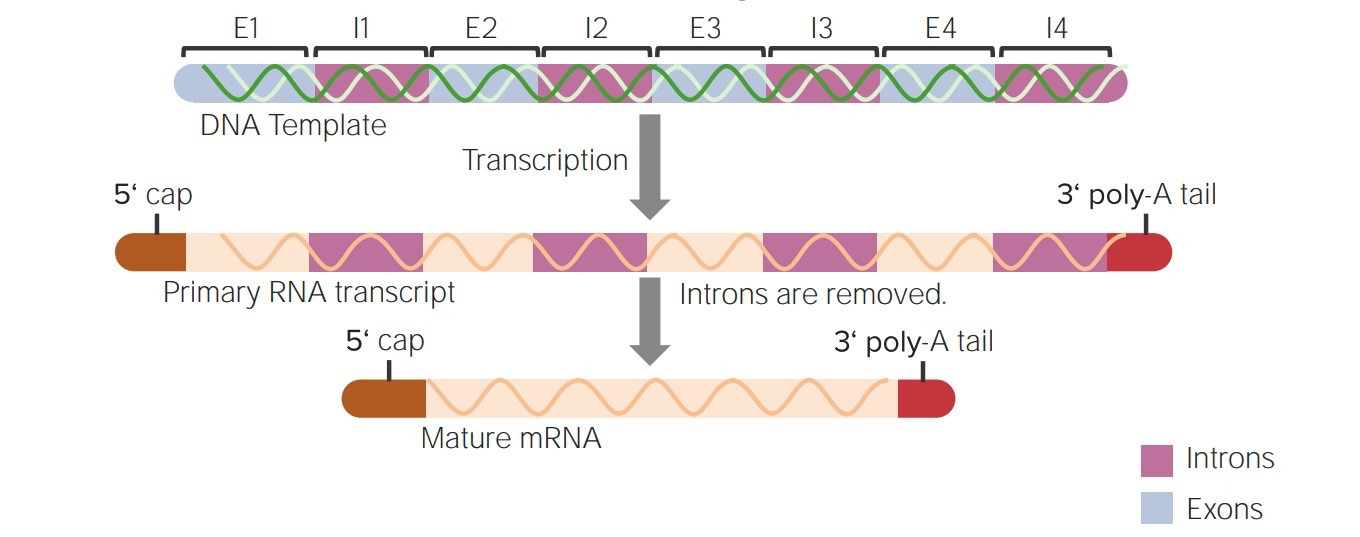
Resumen de las modificaciones post-transcripcionales del ARNh

Resumen de las modificaciones post-transcripcionales del ARNhn en un ARNm maduro:
La adición de la caperuza 5′ y la cola de poli-A 3′ y el empalme (eliminación de las secuencias intermedias o intrones)

Imagen por Lecturio.

Adición de la Caperuza 5′ y la Cola de Poli-A 3′

Caperuza 5′

La 7-metilguanosina (residuo de guanilo metilado) se añade al AL Amyloidosis extremo 5′ del ARNhn a través de:

  • Eliminación del grupo fosfato líder en EN Erythema nodosum is an immune-mediated panniculitis (inflammation of the subcutaneous fat) caused by a type IV (delayed-type) hypersensitivity reaction. It commonly manifests in young women as tender, erythematous nodules on the shins. Erythema Nodosum la terminal 5′ por la ARN trifosfatasa
  • Transferencia del guanosin monofosfato (GMP, por sus siglas en EN Erythema nodosum is an immune-mediated panniculitis (inflammation of the subcutaneous fat) caused by a type IV (delayed-type) hypersensitivity reaction. It commonly manifests in young women as tender, erythematous nodules on the shins. Erythema Nodosum inglés) del grupo guanosin trifosfato por la guanilil transferasa
  • Metilación de la guanina por la guanina-7-metiltransferasa (grupo metilo de la S-adenosilmetionina)

Funciones:

  • Evita la degradación de la exonucleasa
  • Secuencia de reconocimiento para la traducción

Cola de Poli-A 3′

De 50 a 250 residuos de adenilo adenosin monofosfato (AMP, por sus siglas en EN Erythema nodosum is an immune-mediated panniculitis (inflammation of the subcutaneous fat) caused by a type IV (delayed-type) hypersensitivity reaction. It commonly manifests in young women as tender, erythematous nodules on the shins. Erythema Nodosum inglés) se añaden al AL Amyloidosis extremo 3′ del ARNhn a través de:

  • Escisión de unos 20 nucleótidos a partir de una secuencia de reconocimiento de AAUAA
  • Adición (y extensión de hasta 250 nucleótidos) de la cola de poli-A (generada a partir de adenosin trifosfato (ATP, por sus siglas en EN Erythema nodosum is an immune-mediated panniculitis (inflammation of the subcutaneous fat) caused by a type IV (delayed-type) hypersensitivity reaction. It commonly manifests in young women as tender, erythematous nodules on the shins. Erythema Nodosum inglés)) por la poli-A polimerasa

Función:

  • Evita la degradación en EN Erythema nodosum is an immune-mediated panniculitis (inflammation of the subcutaneous fat) caused by a type IV (delayed-type) hypersensitivity reaction. It commonly manifests in young women as tender, erythematous nodules on the shins. Erythema Nodosum el citosol por las 3′ exoribonucleasas
  • Estabiliza el ARNm
Modificaciones post-transcripcionales del ARN

Modificaciones post-transcripcionales del ARN:
Las modificaciones de la caperuza 5′ (7-metilguanosina) y la cola de poli-A 3′ impiden la degradación del ARNm en el citosol.

Imagen por Lecturio.

Empalme de ARN Heterogéneo Nuclear

Exones e intrones

El heterogéneo nuclear (pre-ARNm) contiene:

  • Secciones codificantes llamadas exones (secuencias expresadas)
  • Secciones no codificantes llamadas intrones (secuencias intermedias)

Procesamiento:

  • El ARNhn necesita ser procesado (empalme) para producir el ARNm que lleva las secuencias codificantes adecuadas.
  • Se encuentra en EN Erythema nodosum is an immune-mediated panniculitis (inflammation of the subcutaneous fat) caused by a type IV (delayed-type) hypersensitivity reaction. It commonly manifests in young women as tender, erythematous nodules on the shins. Erythema Nodosum la mayoría de los LOS Neisseria genes Genes A category of nucleic acid sequences that function as units of heredity and which code for the basic instructions for the development, reproduction, and maintenance of organisms. DNA Types and Structure eucariotas, más comúnmente en EN Erythema nodosum is an immune-mediated panniculitis (inflammation of the subcutaneous fat) caused by a type IV (delayed-type) hypersensitivity reaction. It commonly manifests in young women as tender, erythematous nodules on the shins. Erythema Nodosum el ARNm
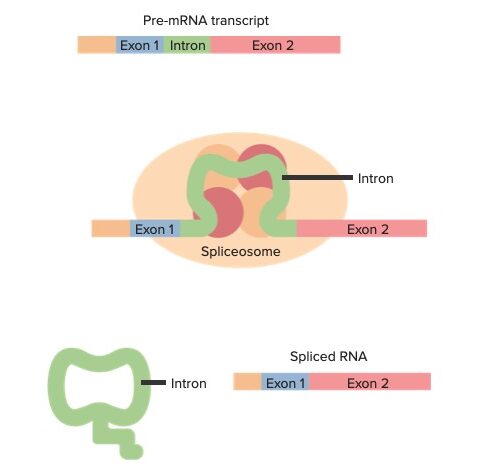
Exones e intrones del pre-ARNm con una visión general del splicing

Exones e intrones del pre-ARNm con una visión general del empalme (de arriba a abajo):
El transcrito del pre-ARNm contiene exones e intrones. Las interacciones del transcrito con las ribonucleoproteínas nucleares pequeñas y otras proteínas forman un espliceosoma en determinadas uniones del transcrito. Se realizan cortes en los sitios de empalme y se libera el intrón. El ARN empalmado ahora solo tiene exones, que contienen la secuencia codificante.
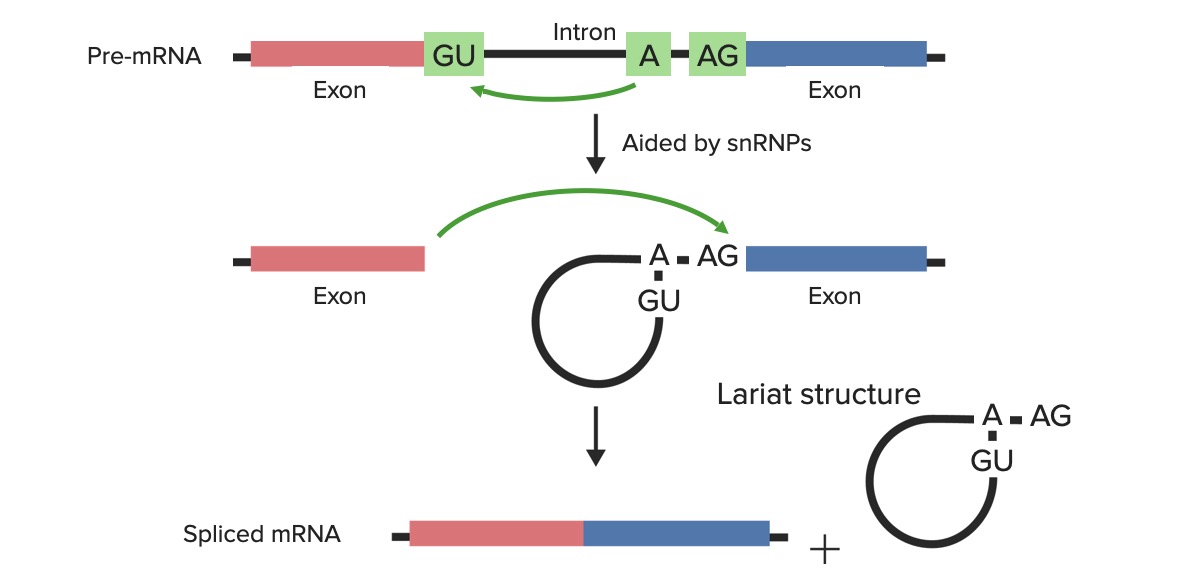
Imagen por Lecturio.

Empalme

  • Eliminación de los LOS Neisseria intrones del ARNhn/pre-ARNm, mientras se unen los LOS Neisseria exones para formar el ARNm maduro
  • En EN Erythema nodosum is an immune-mediated panniculitis (inflammation of the subcutaneous fat) caused by a type IV (delayed-type) hypersensitivity reaction. It commonly manifests in young women as tender, erythematous nodules on the shins. Erythema Nodosum el proceso intervienen el ARNhn y otros componentes adicionales:
    • Ribonucleoproteínas nucleares pequeñas (que están formadas por ARN nuclear pequeño (ARNnp) y proteínas)
    • Otras proteínas de unión
  • Uniones donde se produce la reacción de empalme:
    • Sitios de empalme:
      • Zonas de corte entre el exón y el intrón
      • Las secuencias de bases Bases Usually a hydroxide of lithium, sodium, potassium, rubidium or cesium, but also the carbonates of these metals, ammonia, and the amines. Acid-Base Balance identifican estos sitios, uno en EN Erythema nodosum is an immune-mediated panniculitis (inflammation of the subcutaneous fat) caused by a type IV (delayed-type) hypersensitivity reaction. It commonly manifests in young women as tender, erythematous nodules on the shins. Erythema Nodosum el lado 5′ (comienzo del intrón) y el otro en EN Erythema nodosum is an immune-mediated panniculitis (inflammation of the subcutaneous fat) caused by a type IV (delayed-type) hypersensitivity reaction. It commonly manifests in young women as tender, erythematous nodules on the shins. Erythema Nodosum el lado 3′ (final del intrón).
      • Sitio de empalme 5’/donador: GU invariable
      • Sitio de empalme 3’/aceptor: AG AG Metabolic Acidosis invariable
    • Sitio de ramificación: situado ascendente al AL Amyloidosis sitio 3′
  • Mecanismo:
    1. Las ribonucleoproteínas nucleares pequeñas reconocen los LOS Neisseria sitios de empalme y el sitio de ramificación debido a las secuencias de bases Bases Usually a hydroxide of lithium, sodium, potassium, rubidium or cesium, but also the carbonates of these metals, ammonia, and the amines. Acid-Base Balance en EN Erythema nodosum is an immune-mediated panniculitis (inflammation of the subcutaneous fat) caused by a type IV (delayed-type) hypersensitivity reaction. It commonly manifests in young women as tender, erythematous nodules on the shins. Erythema Nodosum el ARNhn.
    2. El ARNhn, las ribonucleoproteínas nucleares pequeñas y otras proteínas se combinan para formar el espliceosoma.
    3. El complejo del espliceosoma realiza un corte en EN Erythema nodosum is an immune-mediated panniculitis (inflammation of the subcutaneous fat) caused by a type IV (delayed-type) hypersensitivity reaction. It commonly manifests in young women as tender, erythematous nodules on the shins. Erythema Nodosum el sitio de empalme del donador 5′ (se produce a través de un ataque nucleofílico por un residuo de adenilo en EN Erythema nodosum is an immune-mediated panniculitis (inflammation of the subcutaneous fat) caused by a type IV (delayed-type) hypersensitivity reaction. It commonly manifests in young women as tender, erythematous nodules on the shins. Erythema Nodosum el sitio de ramificación).
    4. El extremo 5′ del intrón, ahora libre, se une al AL Amyloidosis sitio de ramificación, formando una estructura de bucle o lazo.
    5. Se reconoce el sitio de empalme 3′, y el segundo corte se produce allí. A continuación se libera el lazo, y los LOS Neisseria 2 exones se unen para formar el ARN maduro
  • Se produce simultáneamente con las modificaciones del ARNhn de la caperuza 5′ y de la cola de poli-A 3′
  • Afecciones relacionadas:
    • β-Talasemia:
      • Contiene defectos en EN Erythema nodosum is an immune-mediated panniculitis (inflammation of the subcutaneous fat) caused by a type IV (delayed-type) hypersensitivity reaction. It commonly manifests in young women as tender, erythematous nodules on the shins. Erythema Nodosum el empalme del ARNm del gen de la β-globina
      • Las mutaciones homocigóticas significativas (talasemia mayor) provocan una anemia Anemia Anemia is a condition in which individuals have low Hb levels, which can arise from various causes. Anemia is accompanied by a reduced number of RBCs and may manifest with fatigue, shortness of breath, pallor, and weakness. Subtypes are classified by the size of RBCs, chronicity, and etiology. Anemia: Overview and Types dependiente de las transfusiones
    • Atrofia muscular espinal:
      • Falta de funcionamiento del gen SMN1 Smn1 Spinal Muscular Atrophy debido a una mutación
      • El SMN2 Smn2 Spinal Muscular Atrophy restante es incapaz de compensar debido al AL Amyloidosis defecto en EN Erythema nodosum is an immune-mediated panniculitis (inflammation of the subcutaneous fat) caused by a type IV (delayed-type) hypersensitivity reaction. It commonly manifests in young women as tender, erythematous nodules on the shins. Erythema Nodosum el empalme del pre-ARNm (omisión del exón 7).
Aspectos técnicos del empalme

Aspectos técnicos del empalme:

El pre-ARNm/ARNhn está formado por exones e intrones. Las ribonucleoproteínas nucleares pequeñas + otras proteínas reconocen el sitio de ramificación y las uniones exón–intrón donde cortar: el sitio donador 5′ (que contiene la secuencia invariable GU) y el sitio aceptor 3′ (que contiene la secuencia invariable AG). El transcrito del ARNhn + las ribonucleoproteínas nucleares pequeñas + otras proteínas se combinan en estos sitios y forman el espliceosoma.
Imagen superior: Con la ayuda de las ribonucleoproteínas nucleares pequeñas (snRNPs), el primer corte lo realiza el residuo adenil (en el sitio de ramificación) mediante un ataque nucleofílico en el sitio donador 5′.
Imagen central: El extremo 5′ libre forma entonces un enlace con el sitio de ramificación (formando la estructura de lazo).
Imagen inferior: El segundo corte se realiza en el sitio 3′ del intrón y los exones se unen.
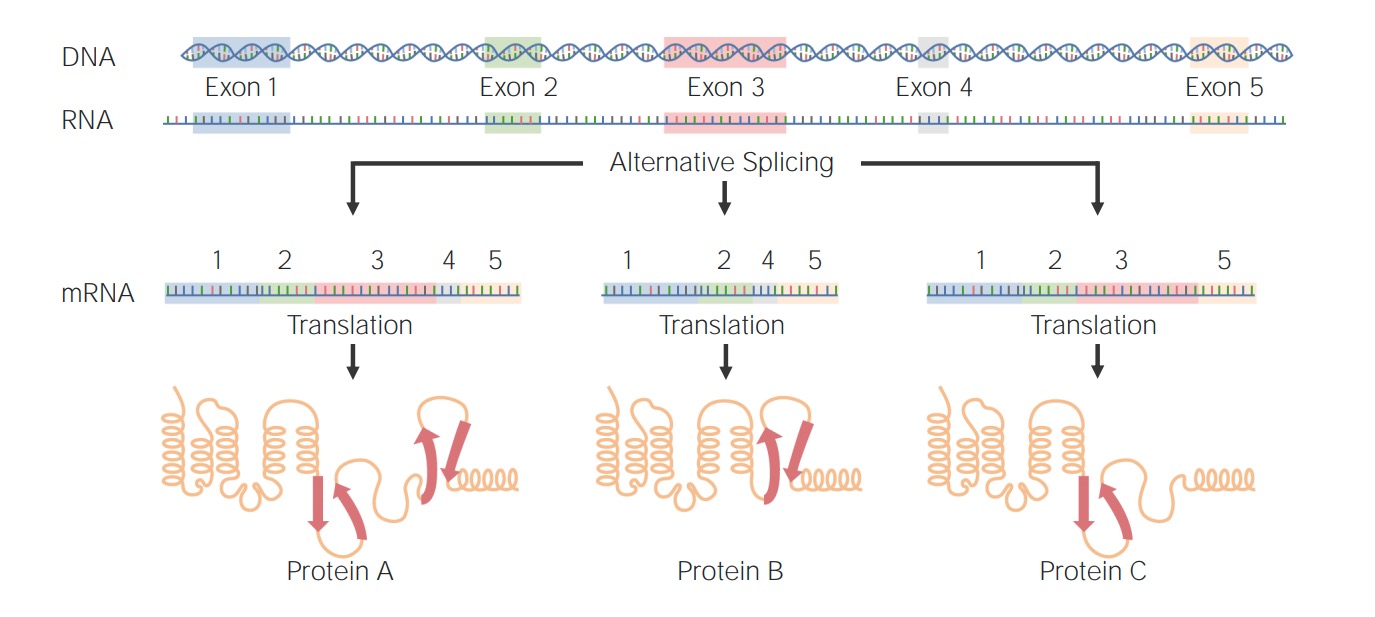
Imagen por Lecturio.

Empalme alternativo

  • Empalme diferencial de una secuencia de ARNhn
  • Mecanismos:
    • Los LOS Neisseria exones se incluyen o excluyen selectivamente.
    • Se utilizan sitios alternativos donador 5′ o aceptor 3′.
    • Los LOS Neisseria sitios de poliadenilación pueden ser diferentes.
  • Hasta el 95% de los LOS Neisseria genes Genes A category of nucleic acid sequences that function as units of heredity and which code for the basic instructions for the development, reproduction, and maintenance of organisms. DNA Types and Structure de varios exones sufren empalme alternativo para codificar proteínas con diferentes funciones celulares.
  • El empalme alternativo es un paso de regulación de respuesta rápida, necesario para ajustar la síntesis de proteínas y, por tanto, determinar los LOS Neisseria fenotipos celulares y las tasas de proliferación.
  • Aproximadamente el 15% de las enfermedades hereditarias y los LOS Neisseria cánceres están asociados al AL Amyloidosis empalme alternativo.
  • Diferentes combinaciones de exones pueden conducir a la creación de diferentes proteínas relacionadas a partir del mismo ARNhn:
    • Moléculas de inmunoglobulina ( los LOS Neisseria genes Genes A category of nucleic acid sequences that function as units of heredity and which code for the basic instructions for the development, reproduction, and maintenance of organisms. DNA Types and Structure de las cadenas pesadas tienen exones relacionados con los LOS Neisseria subtipos individuales)
    • Variantes de la tropomiosina en EN Erythema nodosum is an immune-mediated panniculitis (inflammation of the subcutaneous fat) caused by a type IV (delayed-type) hypersensitivity reaction. It commonly manifests in young women as tender, erythematous nodules on the shins. Erythema Nodosum el músculo
    • Receptores de dopamina en EN Erythema nodosum is an immune-mediated panniculitis (inflammation of the subcutaneous fat) caused by a type IV (delayed-type) hypersensitivity reaction. It commonly manifests in young women as tender, erythematous nodules on the shins. Erythema Nodosum el cerebro (receptores D2 con 2 isoformas)
Ejemplos de empalmes alternativos

Ejemplos de empalmes alternativos:
Proteína A: Los exones 1–5 se unieron tras el empalme de los intrones.
Proteínas B y C: Se excluyó selectivamente un exón para formar una proteína diferente.

Imagen por Lecturio.

Edición de ARN

Generalmente, la secuencia de ADN se refleja en EN Erythema nodosum is an immune-mediated panniculitis (inflammation of the subcutaneous fat) caused by a type IV (delayed-type) hypersensitivity reaction. It commonly manifests in young women as tender, erythematous nodules on the shins. Erythema Nodosum el ARNm maduro. La alteración de la secuencia o la edición del ARN es una excepción.

Definición

  • Un cambio en EN Erythema nodosum is an immune-mediated panniculitis (inflammation of the subcutaneous fat) caused by a type IV (delayed-type) hypersensitivity reaction. It commonly manifests in young women as tender, erythematous nodules on the shins. Erythema Nodosum la información de codificación después de la transcripción hace HACE Altitude Sickness que la secuencia de ARN difiera de la de su ADN original.
  • Se cree que contribuye a la regulación genética
  • Procesos:
    • Sustitución de bases Bases Usually a hydroxide of lithium, sodium, potassium, rubidium or cesium, but also the carbonates of these metals, ammonia, and the amines. Acid-Base Balance
    • Deleción de bases Bases Usually a hydroxide of lithium, sodium, potassium, rubidium or cesium, but also the carbonates of these metals, ammonia, and the amines. Acid-Base Balance
    • Inserción de bases Bases Usually a hydroxide of lithium, sodium, potassium, rubidium or cesium, but also the carbonates of these metals, ammonia, and the amines. Acid-Base Balance

Sustitución de bases Bases Usually a hydroxide of lithium, sodium, potassium, rubidium or cesium, but also the carbonates of these metals, ammonia, and the amines. Acid-Base Balance

Edición de C a U:

  • Gen de la apolipoproteína B (apoB): El mismo gen codifica la ApoB100 (sintetizada en EN Erythema nodosum is an immune-mediated panniculitis (inflammation of the subcutaneous fat) caused by a type IV (delayed-type) hypersensitivity reaction. It commonly manifests in young women as tender, erythematous nodules on the shins. Erythema Nodosum el hígado) y la ApoB48 (sintetizada en EN Erythema nodosum is an immune-mediated panniculitis (inflammation of the subcutaneous fat) caused by a type IV (delayed-type) hypersensitivity reaction. It commonly manifests in young women as tender, erythematous nodules on the shins. Erythema Nodosum el intestino).
  • En EN Erythema nodosum is an immune-mediated panniculitis (inflammation of the subcutaneous fat) caused by a type IV (delayed-type) hypersensitivity reaction. It commonly manifests in young women as tender, erythematous nodules on the shins. Erythema Nodosum el intestino:
    • Desaminación de la citosina (a uracilo) catalizada por la enzima citidina deaminasa.
    • Codón CAA (citidina-adenina-adenina) ( en EN Erythema nodosum is an immune-mediated panniculitis (inflammation of the subcutaneous fat) caused by a type IV (delayed-type) hypersensitivity reaction. It commonly manifests in young women as tender, erythematous nodules on the shins. Erythema Nodosum el ARNm) → UAA (uridina-adenina-adenina), una señal de terminación o un codón de parada
  • Como resultado de esta edición:
    • La ApoB100 es una proteína de 100-kDa compuesta por 4536 aminoácidos.
    • La ApoB48 es una proteína acortada de 48-kDa compuesta por 2152 aminoácidos.
    • El cambio produce ApoB48, que carece del dominio C-terminal de ApoB100 (responsable de la unión al AL Amyloidosis receptor Receptor Receptors are proteins located either on the surface of or within a cell that can bind to signaling molecules known as ligands (e.g., hormones) and cause some type of response within the cell. Receptors de lipoproteínas de baja densidad (LDL, por sus siglas en EN Erythema nodosum is an immune-mediated panniculitis (inflammation of the subcutaneous fat) caused by a type IV (delayed-type) hypersensitivity reaction. It commonly manifests in young women as tender, erythematous nodules on the shins. Erythema Nodosum inglés)).

Edición de A a I:

  • Afecta a sustratos de ARN de doble cadena
  • Desaminación de la adenina (a hipoxantina) catalizada por las ADAR (adenosina deaminasa que actúa sobre el ARN)
  • Las adenosinas se convierten en EN Erythema nodosum is an immune-mediated panniculitis (inflammation of the subcutaneous fat) caused by a type IV (delayed-type) hypersensitivity reaction. It commonly manifests in young women as tender, erythematous nodules on the shins. Erythema Nodosum inosinas, lo que da lugar a sustituciones de base A a G
  • Genera sitios de empalme alternativos

Inserciones/deleciones

  • Ocurren en EN Erythema nodosum is an immune-mediated panniculitis (inflammation of the subcutaneous fat) caused by a type IV (delayed-type) hypersensitivity reaction. It commonly manifests in young women as tender, erythematous nodules on the shins. Erythema Nodosum tripanosomas y protozoos relacionados, afectando al AL Amyloidosis ARNm mitocondrial
  • Implica la adición o deleción de uridina

Procesamiento del ARN Ribosómico y del ARN de Transferencia

ARN ribosómico

  • En EN Erythema nodosum is an immune-mediated panniculitis (inflammation of the subcutaneous fat) caused by a type IV (delayed-type) hypersensitivity reaction. It commonly manifests in young women as tender, erythematous nodules on the shins. Erythema Nodosum procariotas:
    • Como se ha HA Hemolytic anemia (HA) is the term given to a large group of anemias that are caused by the premature destruction/hemolysis of circulating red blood cells (RBCs). Hemolysis can occur within (intravascular hemolysis) or outside the blood vessels (extravascular hemolysis). Hemolytic Anemia estudiado en EN Erythema nodosum is an immune-mediated panniculitis (inflammation of the subcutaneous fat) caused by a type IV (delayed-type) hypersensitivity reaction. It commonly manifests in young women as tender, erythematous nodules on the shins. Erythema Nodosum Escherichia coli Escherichia coli The gram-negative bacterium Escherichia coli is a key component of the human gut microbiota. Most strains of E. coli are avirulent, but occasionally they escape the GI tract, infecting the urinary tract and other sites. Less common strains of E. coli are able to cause disease within the GI tract, most commonly presenting as abdominal pain and diarrhea. Escherichia coli, 3 tipos de ARNr (5S, 16S y 23S) tienen transcritos primarios policistrónicos.
    • Procesamiento inicial del transcrito mediante el corte endonucleolítico por las RNasas → pre-ARNr
    • Los LOS Neisseria extremos 5′ y 3′ del pre-ARNr son recortados por otro conjunto de RNasas.
    • La metilación se produce durante el ensamblaje de los LOS Neisseria ribosomas para protegerlos de la degradación.
  • En EN Erythema nodosum is an immune-mediated panniculitis (inflammation of the subcutaneous fat) caused by a type IV (delayed-type) hypersensitivity reaction. It commonly manifests in young women as tender, erythematous nodules on the shins. Erythema Nodosum los LOS Neisseria eucariotas, el transcrito primario es una gran molécula precursora 45S:
    • Contiene moléculas de ARNr (28S, 18S y 5,8S) con secuencias espaciadoras entre ellas
    • Se procesa en EN Erythema nodosum is an immune-mediated panniculitis (inflammation of the subcutaneous fat) caused by a type IV (delayed-type) hypersensitivity reaction. It commonly manifests in young women as tender, erythematous nodules on the shins. Erythema Nodosum el nucleolo:
      • Por metilación en EN Erythema nodosum is an immune-mediated panniculitis (inflammation of the subcutaneous fat) caused by a type IV (delayed-type) hypersensitivity reaction. It commonly manifests in young women as tender, erythematous nodules on the shins. Erythema Nodosum numerosos sitios (facilitada por ARN nucleolares pequeños (ARNnop))
      • A continuación, mediante la escisión y el recorte del ARN
    • El cuarto tipo de ARNr, el 5S, se procesa por separado.
    • Los LOS Neisseria ARNr maduros resultantes, que se asocian con otras proteínas, se convierten en EN Erythema nodosum is an immune-mediated panniculitis (inflammation of the subcutaneous fat) caused by a type IV (delayed-type) hypersensitivity reaction. It commonly manifests in young women as tender, erythematous nodules on the shins. Erythema Nodosum el andamio de las unidades ribosomales en EN Erythema nodosum is an immune-mediated panniculitis (inflammation of the subcutaneous fat) caused by a type IV (delayed-type) hypersensitivity reaction. It commonly manifests in young women as tender, erythematous nodules on the shins. Erythema Nodosum el citoplasma.
  • Algunos ARNr eucariotas tienen intrones, y en EN Erythema nodosum is an immune-mediated panniculitis (inflammation of the subcutaneous fat) caused by a type IV (delayed-type) hypersensitivity reaction. It commonly manifests in young women as tender, erythematous nodules on the shins. Erythema Nodosum ellos, los LOS Neisseria pre-ARNr se autoempalman (actúan como ribozimas).

ARN de transferencia

  • El ARN de transferencia es un polinucleótido único formado por una media de 75 nucleótidos con características únicas:
    • Debido a un plegado distinto, el extremo 5′ y el extremo 3′ forman el tallo aceptor.
    • El extremo 3′ también tiene una secuencia CCA (citosina-citosina-adenina).
    • Tiene bases Bases Usually a hydroxide of lithium, sodium, potassium, rubidium or cesium, but also the carbonates of these metals, ammonia, and the amines. Acid-Base Balance modificadas como la inosina, la dihidrouridina y la pseudouridina
  • El ARNt precursor contiene:
    • Nucleótidos adicionales en EN Erythema nodosum is an immune-mediated panniculitis (inflammation of the subcutaneous fat) caused by a type IV (delayed-type) hypersensitivity reaction. It commonly manifests in young women as tender, erythematous nodules on the shins. Erythema Nodosum los LOS Neisseria extremos 3′ y 5′
    • Intrones
  • El procesamiento implica:
    • Eliminación de los LOS Neisseria nucleótidos e intrones extra
    • Modificación de bases Bases Usually a hydroxide of lithium, sodium, potassium, rubidium or cesium, but also the carbonates of these metals, ammonia, and the amines. Acid-Base Balance estándar (como la metilación y la desaminación)
    • Utiliza la RNasa P (una ribozima) para formar el extremo 5′
    • Adición de CCA en EN Erythema nodosum is an immune-mediated panniculitis (inflammation of the subcutaneous fat) caused by a type IV (delayed-type) hypersensitivity reaction. It commonly manifests in young women as tender, erythematous nodules on the shins. Erythema Nodosum el extremo 3′ por la nucleotidiltransferasa del ARNt
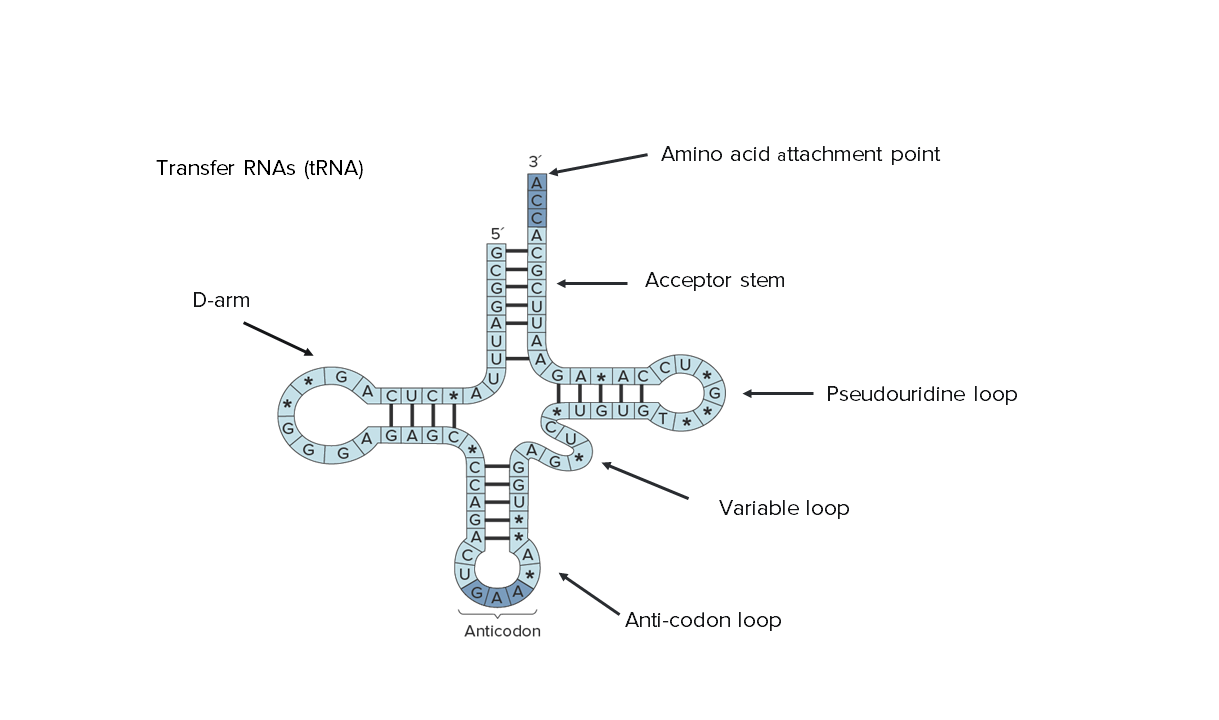
ARN de transferencia (ARNt)

Estructura secundaria del ARN de transferencia (ARNt). Observe que toda la secuencia puede ser vista, lo que indica su tamaño reducido.

Imagen por Lecturio.

Related videos

Referencias

  1. Fatima, M., Khan, F. D., Munir, F., Beg, S., Rashid, H., & Rathore, A. W. (2024). Emerging influence of RNA post-transcriptional modifications in the synovial homeostasis of rheumatoid arthritis. Frontiers in Immunology, 15. https://doi.org/10.3389/fimmu.2024.1494873
  2. Gao, B., & Sun, Q. (2025). Post-translational assembly of multi-functional antibody. Biotechnology Advances, 80, 108533. https://doi.org/10.1016/j.biotechadv.2025.108533
  3. Herbert, C., Harvanek, Z. M., Fu, T., Ryvkin, P., & Gregory, B. D. (2024). Analysis of RNA and its modifications. Annual Review of Analytical Chemistry, 17(1), 47–68. https://doi.org/10.1146/annurev-anchem-061622-125954
  4. Mattiazzi, A., Sánchez, J. M., Said, M., Vittone, L., & Mundiña-Weilenmann, C. (2025). CaMKII at the crossroads: Calcium dysregulation, and post‐translational modifications driving cell death. The Journal of Physiology. https://doi.org/10.1113/JP285941
  5. Nelson, D. L., & Cox, M. M. (2021). Lehninger principles of biochemistry (8th ed.). W. H. Freeman and Company.
  6. RNA modifications overview: Types, mechanisms, and their biological impact – CD Genomics. (n.d.). Retrieved May 20, 2025, from https://rna.cd-genomics.com/resource/overview-rna-modifications.html
  7. Zhang, Y., Li, Z., Zhang, L., Zhang, T., Xu, W., & Li, X. (2025). Post-translational modifications as a key mechanism for herpes simplex virus type I evasion of host innate immunity. Frontiers in Microbiology, 16. https://doi.org/10.3389/fmicb.2025.1543676

¡Crea tu cuenta gratis o inicia una sesión para seguir leyendo!

Regístrate ahora y obtén acceso gratuito a Lecturio con páginas de concepto, videos médicos y cuestionarios para tu educación médica.

User Reviews

Que tengas una sesión de estudio alegre y navideña 🎁 Ahorra 50% en todos los planes >>

Details