Domina Conceptos Médicos

Estudia para la escuela de medicina y tus examenes con Lecturio.

Meninges: Anatomía

El cerebro y la médula espinal están envueltos por 3 capas superpuestas de tejido conectivo llamadas meninges Meninges The brain and the spinal cord are enveloped by 3 overlapping layers of connective tissue called the meninges. The layers are, from the most external layer to the most internal layer, the dura mater, arachnoid mater, and pia mater. Between these layers are 3 potential spaces called the epidural, subdural, and subarachnoid spaces. Meninges: Anatomy. Las capas son, desde la más externa a la más interna; la duramadre, la aracnoides y la piamadre. Entre estas capas hay 3 espacios potenciales llamados; espacio epidural, subdural y subaracnoideo. Las meninges Meninges The brain and the spinal cord are enveloped by 3 overlapping layers of connective tissue called the meninges. The layers are, from the most external layer to the most internal layer, the dura mater, arachnoid mater, and pia mater. Between these layers are 3 potential spaces called the epidural, subdural, and subarachnoid spaces. Meninges: Anatomy tienen la función de proteger el contenido del cerebro y la médula espinal. La infección del SNC se presenta con una inflamación de las meninges Meninges The brain and the spinal cord are enveloped by 3 overlapping layers of connective tissue called the meninges. The layers are, from the most external layer to the most internal layer, the dura mater, arachnoid mater, and pia mater. Between these layers are 3 potential spaces called the epidural, subdural, and subarachnoid spaces. Meninges: Anatomy, y la etiología se puede investigar examinando el LCR, que está contenido en EN Erythema nodosum is an immune-mediated panniculitis (inflammation of the subcutaneous fat) caused by a type IV (delayed-type) hypersensitivity reaction. It commonly manifests in young women as tender, erythematous nodules on the shins. Erythema Nodosum el espacio subaracnoideo.

Last updated: Dec 15, 2025

Editorial responsibility: Stanley Oiseth, Lindsay Jones, Evelin Maza

Capas de las Meninges

Las meninges Meninges The brain and the spinal cord are enveloped by 3 overlapping layers of connective tissue called the meninges. The layers are, from the most external layer to the most internal layer, the dura mater, arachnoid mater, and pia mater. Between these layers are 3 potential spaces called the epidural, subdural, and subarachnoid spaces. Meninges: Anatomy son capas de tejido conectivo que protegen el cerebro y la médula espinal.

Las meninges Meninges The brain and the spinal cord are enveloped by 3 overlapping layers of connective tissue called the meninges. The layers are, from the most external layer to the most internal layer, the dura mater, arachnoid mater, and pia mater. Between these layers are 3 potential spaces called the epidural, subdural, and subarachnoid spaces. Meninges: Anatomy están formadas por 3 capas de tejido conectivo, con espacios potenciales entre ellas:

  • Duramadre: capa más externa
  • Aracnoides: capa media
  • Piamadre: capa más interna
Tabla: Capas de las meninges Meninges The brain and the spinal cord are enveloped by 3 overlapping layers of connective tissue called the meninges. The layers are, from the most external layer to the most internal layer, the dura mater, arachnoid mater, and pia mater. Between these layers are 3 potential spaces called the epidural, subdural, and subarachnoid spaces. Meninges: Anatomy de superficial a profunda
Capa Origen Características
Espacio epidural NA
  • Espacio potencial entre la duramadre y el cráneo/columna vertebral
  • Contiene vasos sanguíneos y grasa
  • Lugar de extracción de sangre en EN Erythema nodosum is an immune-mediated panniculitis (inflammation of the subcutaneous fat) caused by a type IV (delayed-type) hypersensitivity reaction. It commonly manifests in young women as tender, erythematous nodules on the shins. Erythema Nodosum casos de lesión de la arteria meníngea media
Duramadre Mesodermo
  • Dividido en EN Erythema nodosum is an immune-mediated panniculitis (inflammation of the subcutaneous fat) caused by a type IV (delayed-type) hypersensitivity reaction. It commonly manifests in young women as tender, erythematous nodules on the shins. Erythema Nodosum 2 capas:
    • Capa superficial del periostio
    • Capa meníngea interna
  • Crece adherida al AL Amyloidosis periostio de la calota
  • Irrigación sanguínea: arteria meníngea media
  • Inervada por:
    • Ramas del nervio trigémino: inervan estructuras supratentoriales
    • Nervios cervicales (C2 y C3): inervan estructuras infratentoriales
Espacio subdural NA
  • Espacio potencial entre la aracnoides y la duramadre
  • Contiene “venas puente” que discurren entre los LOS Neisseria hemisferios cerebrales y los LOS Neisseria senos venosos durales
  • Este espacio suele existir solo en EN Erythema nodosum is an immune-mediated panniculitis (inflammation of the subcutaneous fat) caused by a type IV (delayed-type) hypersensitivity reaction. It commonly manifests in young women as tender, erythematous nodules on the shins. Erythema Nodosum condiciones patológicas, como en EN Erythema nodosum is an immune-mediated panniculitis (inflammation of the subcutaneous fat) caused by a type IV (delayed-type) hypersensitivity reaction. It commonly manifests in young women as tender, erythematous nodules on the shins. Erythema Nodosum el caso de un hematoma Hematoma A collection of blood outside the blood vessels. Hematoma can be localized in an organ, space, or tissue. Intussusception subdural.
Aracnoides ( leptomeninges Leptomeninges Meninges: Anatomy) Cresta neural
  • La capa externa del espacio subaracnoideo
  • Avascular Avascular Corneal Abrasions, Erosion, and Ulcers
  • Trabéculas aracnoideas: filamentos en EN Erythema nodosum is an immune-mediated panniculitis (inflammation of the subcutaneous fat) caused by a type IV (delayed-type) hypersensitivity reaction. It commonly manifests in young women as tender, erythematous nodules on the shins. Erythema Nodosum forma de telaraña que separan la aracnoides y la piamadre.
Espacio subaracnoideo Plexo coroideo
  • Granulaciones aracnoideas: permiten la entrada del LCR desde el espacio subaracnoideo al AL Amyloidosis sistema venoso
  • LCR: producido por el plexo coroideo y contenido en EN Erythema nodosum is an immune-mediated panniculitis (inflammation of the subcutaneous fat) caused by a type IV (delayed-type) hypersensitivity reaction. It commonly manifests in young women as tender, erythematous nodules on the shins. Erythema Nodosum el espacio subaracnoideo
  • Las principales arterias del cerebro atraviesan el espacio subaracnoideo.
Piamadre ( leptomeninges Leptomeninges Meninges: Anatomy) Cresta neural
  • La capa interna del espacio subaracnoideo
  • Adherida al AL Amyloidosis cerebro
  • Aspecto brillante macroscópicamente
  • Altamente vascularizada
NA: no aplicable
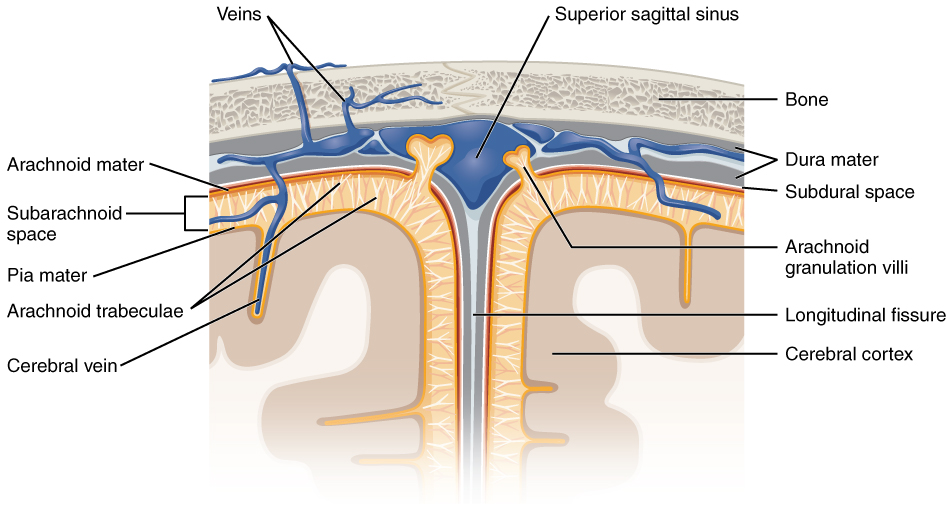
Meninges y espacio subaracnoideo

Capas de las meninges y sus relaciones bajo el cráneo

Imagen: “Diagram of section of top of brain showing the meninges and subarachnoid space” por OpenStax. Licencia: CC BY 4.0

Pliegues, Reflexiones y Senos Durales

La duramadre es la capa más gruesa de las meninges Meninges The brain and the spinal cord are enveloped by 3 overlapping layers of connective tissue called the meninges. The layers are, from the most external layer to the most internal layer, the dura mater, arachnoid mater, and pia mater. Between these layers are 3 potential spaces called the epidural, subdural, and subarachnoid spaces. Meninges: Anatomy y provee estructura al AL Amyloidosis cerebro.

Los LOS Neisseria pliegues durales y los LOS Neisseria senos durales proceden de la duramadre.

  • Los LOS Neisseria pliegues durales separan los LOS Neisseria hemisferios derecho e izquierdo:
    • Hoz del cerebro
    • Hoz del cerebelo
    • Tienda del cerebelo
    • Diafragma estriado
  • Los LOS Neisseria senos durales (senos venosos) se forman entre las capas de la duramadre. El LCR fluye a través de los LOS Neisseria senos durales.
Tabla: Características de los LOS Neisseria pliegues, reflexiones y senos durales
Estructura Características
Hoz del cerebro Separación de los LOS Neisseria hemisferios cerebrales derecho e izquierdo
Hoz del cerebelo Separa los LOS Neisseria hemisferios cerebelosos derecho e izquierdo
Tienda del cerebelo Tienda, o techo, sobre el cerebelo
Diafragma estriado El techo de la glándula hipófisis
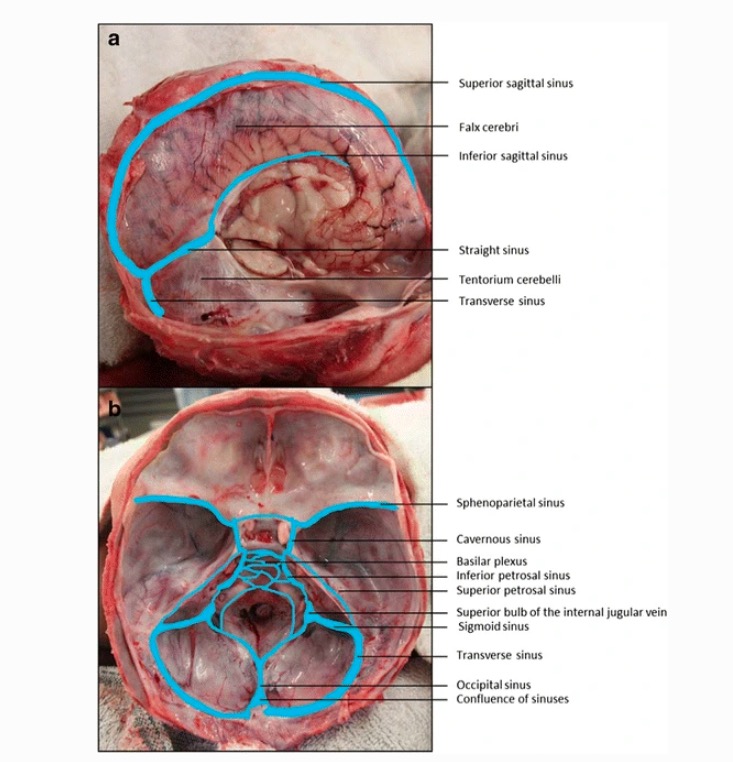
Senos durales Las dos capas de la duramadre se extienden juntas por la mayor parte del cráneo. Cuando se separan, el hueco entre ellos se llama seno venoso dural. Estos senos drenan la sangre y el líquido cefalorraquídeo del cerebro y desembocan en EN Erythema nodosum is an immune-mediated panniculitis (inflammation of the subcutaneous fat) caused by a type IV (delayed-type) hypersensitivity reaction. It commonly manifests in young women as tender, erythematous nodules on the shins. Erythema Nodosum la vena yugular interna.
Senos venosos durales

Senos venosos durales

Imagen: “Dural venous sinuses” por Jmarchn. Licencia: CC BY-SA 3.0, editado por Emma C. Cheshire et al. (2017).

Relevancia Clínica

Trastornos neoplásicos:

  • Los LOS Neisseria meningiomas son la neoplasia craneal más común, surgen de las células aracnoideas que se encuentran en EN Erythema nodosum is an immune-mediated panniculitis (inflammation of the subcutaneous fat) caused by a type IV (delayed-type) hypersensitivity reaction. It commonly manifests in young women as tender, erythematous nodules on the shins. Erythema Nodosum las vellosidades aracnoideas. Los LOS Neisseria meningiomas suelen ser tumores benignos de crecimiento lento, pero a veces pueden presentarse de forma atípica o maligna. Los LOS Neisseria síntomas de los LOS Neisseria meningiomas dependen de su localización. Los LOS Neisseria síntomas se producen como consecuencia de la compresión por parte del tumor Tumor Inflammation sobre las estructuras cercanas. El tratamiento más común es la escisión quirúrgica.

Trastornos infecciosos:

  • Meningitis Meningitis Meningitis is inflammation of the meninges, the protective membranes of the brain, and spinal cord. The causes of meningitis are varied, with the most common being bacterial or viral infection. The classic presentation of meningitis is a triad of fever, altered mental status, and nuchal rigidity. Meningitis: inflamación de las meninges Meninges The brain and the spinal cord are enveloped by 3 overlapping layers of connective tissue called the meninges. The layers are, from the most external layer to the most internal layer, the dura mater, arachnoid mater, and pia mater. Between these layers are 3 potential spaces called the epidural, subdural, and subarachnoid spaces. Meninges: Anatomy que rodean el cerebro y la médula espinal. En EN Erythema nodosum is an immune-mediated panniculitis (inflammation of the subcutaneous fat) caused by a type IV (delayed-type) hypersensitivity reaction. It commonly manifests in young women as tender, erythematous nodules on the shins. Erythema Nodosum general, la meningitis Meningitis Meningitis is inflammation of the meninges, the protective membranes of the brain, and spinal cord. The causes of meningitis are varied, with the most common being bacterial or viral infection. The classic presentation of meningitis is a triad of fever, altered mental status, and nuchal rigidity. Meningitis provoca síntomas como cefalea, fiebre y rigidez nucal. Esta enfermedad se subdivide en EN Erythema nodosum is an immune-mediated panniculitis (inflammation of the subcutaneous fat) caused by a type IV (delayed-type) hypersensitivity reaction. It commonly manifests in young women as tender, erythematous nodules on the shins. Erythema Nodosum meningitis Meningitis Meningitis is inflammation of the meninges, the protective membranes of the brain, and spinal cord. The causes of meningitis are varied, with the most common being bacterial or viral infection. The classic presentation of meningitis is a triad of fever, altered mental status, and nuchal rigidity. Meningitis bacteriana (causa más común), viral y parasitaria. Las etiologías infecciosas se diagnostican con una punción lumbar y deben ser tratadas agresivamente con medicamentos antimicrobianos.

Trastornos traumáticos:

  • Hemorragia epidural: hemorragia en EN Erythema nodosum is an immune-mediated panniculitis (inflammation of the subcutaneous fat) caused by a type IV (delayed-type) hypersensitivity reaction. It commonly manifests in young women as tender, erythematous nodules on the shins. Erythema Nodosum el espacio externo a la duramadre, justo debajo del cráneo. La hemorragia epidural se produce con mayor frecuencia tras un traumatismo directo en EN Erythema nodosum is an immune-mediated panniculitis (inflammation of the subcutaneous fat) caused by a type IV (delayed-type) hypersensitivity reaction. It commonly manifests in young women as tender, erythematous nodules on the shins. Erythema Nodosum la cabeza. Los LOS Neisseria pacientes presentan pérdida de la conciencia tras un golpe directo en EN Erythema nodosum is an immune-mediated panniculitis (inflammation of the subcutaneous fat) caused by a type IV (delayed-type) hypersensitivity reaction. It commonly manifests in young women as tender, erythematous nodules on the shins. Erythema Nodosum la cabeza y, en EN Erythema nodosum is an immune-mediated panniculitis (inflammation of the subcutaneous fat) caused by a type IV (delayed-type) hypersensitivity reaction. It commonly manifests in young women as tender, erythematous nodules on the shins. Erythema Nodosum ocasiones, alteración del estado mental. Si son sintomáticos, los LOS Neisseria pacientes deben ser sometidos a una craneotomía con evacuación del hematoma Hematoma A collection of blood outside the blood vessels. Hematoma can be localized in an organ, space, or tissue. Intussusception.
  • Hemorragia subdural: se produce debajo de la duramadre y suele ser más crónica que las hemorragias epidurales. En EN Erythema nodosum is an immune-mediated panniculitis (inflammation of the subcutaneous fat) caused by a type IV (delayed-type) hypersensitivity reaction. It commonly manifests in young women as tender, erythematous nodules on the shins. Erythema Nodosum infantes, la hemorragia subdural suele producirse como resultado de abuso infantil. En EN Erythema nodosum is an immune-mediated panniculitis (inflammation of the subcutaneous fat) caused by a type IV (delayed-type) hypersensitivity reaction. It commonly manifests in young women as tender, erythematous nodules on the shins. Erythema Nodosum los LOS Neisseria adultos jóvenes, las causas más comunes son los LOS Neisseria accidentes de bicicleta o de automóvil; y en EN Erythema nodosum is an immune-mediated panniculitis (inflammation of the subcutaneous fat) caused by a type IV (delayed-type) hypersensitivity reaction. It commonly manifests in young women as tender, erythematous nodules on the shins. Erythema Nodosum los LOS Neisseria adultos mayores, las hemorragias subdurales suelen ser el resultado de caídas. Si son sintomáticos, los LOS Neisseria pacientes deben ser sometidos a una craneotomía con evacuación del hematoma Hematoma A collection of blood outside the blood vessels. Hematoma can be localized in an organ, space, or tissue. Intussusception.
  • Trombosis del seno dural: pueden formarse coágulos de sangre en EN Erythema nodosum is an immune-mediated panniculitis (inflammation of the subcutaneous fat) caused by a type IV (delayed-type) hypersensitivity reaction. It commonly manifests in young women as tender, erythematous nodules on the shins. Erythema Nodosum los LOS Neisseria senos durales como consecuencia de un traumatismo o una infección. La trombosis del seno dural puede provocar un infarto hemorrágico y edema Edema Edema is a condition in which excess serous fluid accumulates in the body cavity or interstitial space of connective tissues. Edema is a symptom observed in several medical conditions. It can be categorized into 2 types, namely, peripheral (in the extremities) and internal (in an organ or body cavity). Edema cerebral. La trombosis del seno cavernoso es un subtipo de trombosis del seno dural que se produce debido a la siembra de una infección procedente de la zona nasal.

Referencias

  1. Ağca, M., Duman, I. E., Sade, R., & Polat, Y. D. (2025). Diagnostic performance of non-contrast MRI for evaluation of chronic subdural hematoma compared to CT. Clinical Neuroradiology, 35(1), 84-91.
  2. Apra, C., Peyre, M., & Kalamarides, M. (2018). Current treatment options for meningioma. Expert Review of Neurotherapeutics, 18(3), 241-249.
  3. Aspelund, A., Antila, S., Proulx, S. T., Karlsen, T. V., Karaman, S., Detmar, M., Wiig, H., & Alitalo, K. (2015). A dural lymphatic vascular system that drains brain interstitial fluid and macromolecules. Journal of Experimental Medicine, 212(7), 991-999.
  4. Atchaneeyasakul, K., & Tipirneni, A. (2024). Novel approaches in bacterial meningitis: An update on diagnosis and management. Current Infectious Disease Reports, 26(3), 112-124.
  5. Bi, W. L., & Dunn, I. F. (2017). Current and emerging principles in surgery for meningioma. Chinese Clinical Oncology, 6(Suppl 1), S7.
  6. Das, J. M., & Chandra, S. R. (2024). Meninges: A comprehensive review of structure, function, and clinical significance. Journal of Neuroscience Research, 102(3), 784-799.
  7. Greenberg, R. W., Lane, E. L., Cinnamon, J., Farmer, P., & Hyman, R. A. (1994). The cranial meninges: anatomic considerations. Seminars in Ultrasound, CT and MR, 15(6), 454-465.
  8. Hoffman, O., & Weber, R. J. (2009). Pathophysiology and treatment of bacterial meningitis. Therapeutic Advances in Neurological Disorders, 2(6), 401-412.
  9. Kushner, D. S., & Albin, M. S. (2022). Epidural hematoma: Pathophysiology, diagnosis, and management. Journal of Neurosurgical Sciences, 66(1), 35-47.
  10. Lee, J. H. (2008). Meningiomas: diagnosis, treatment, and outcome. Springer Science & Business Media, pp. 3-13.
  11. Louveau, A., Smirnov, I., Keyes, T. J., Eccles, J. D., Rouhani, S. J., Peske, J. D., Derecki, N. C., Castle, D., Mandell, J. W., Lee, K. S., Harris, T. H., & Kipnis, J. (2015). Structural and functional features of central nervous system lymphatic vessels. Nature, 523(7560), 337-341.
  12. Mehta, V., Harward, S. C., Sankey, E. W., Nayar, G., & Codd, P. J. (2018). Evidence-based diagnosis and management of chronic subdural hematoma: A review of the literature. Journal of Clinical Neuroscience, 50, 7-15.
  13. Rai, R., Iwanaga, J., Shokouhi, G., Oskouian, R. J., & Tubbs, R. S. (2018). The tentorium cerebelli: a comprehensive review including its anatomy, embryology, and surgical techniques. Cureus, 10(7), e3079.
  14. Ruiz, A., & Yeung, K. T. (2025). Advanced imaging techniques for meningeal disorders: Current trends and future directions. American Journal of Neuroradiology, 46(1), 72-84.
  15. Starr, C. J., & Cha, S. (2017). Meningioma mimics: five key imaging features to differentiate them from meningiomas. Clinical Radiology, 72(9), 722-728.
  16. Van Gijn, J., & Rinkel, G. J. E. (2021). Subarachnoid haemorrhage: Diagnosis, causes and management. Brain, 144(5), 1312-1332.
  17. Wiemels, J., Wrensch, M., & Claus, E. B. (2010). Epidemiology and etiology of meningioma. Journal of Neuro-Oncology, 99(3), 307-314.
  18. Wu, Y., & Peng, Z. (2024). Meningeal lymphatics in CNS homeostasis and disease: Recent advances and therapeutic potential. Nature Reviews Neuroscience, 25(6), 341-356.

¡Crea tu cuenta gratis o inicia una sesión para seguir leyendo!

Regístrate ahora y obtén acceso gratuito a Lecturio con páginas de concepto, videos médicos y cuestionarios para tu educación médica.

User Reviews

Que tengas una sesión de estudio alegre y navideña 🎁 Ahorra 50% en todos los planes >>

Details