
Domina Conceptos Médicos

Estudia para la escuela de medicina y tus examenes con Lecturio.

Intoxicación por Monóxido de Carbono

El monóxido de carbono (CO) es un gas inodoro, incoloro, insípido y no irritante que se forma en EN Erythema nodosum is an immune-mediated panniculitis (inflammation of the subcutaneous fat) caused by a type IV (delayed-type) hypersensitivity reaction. It commonly manifests in young women as tender, erythematous nodules on the shins. Erythema Nodosum la combustión de hidrocarburos (e.g., incendios, gases de escape de automóviles, calentadores de gas). El monóxido de carbono tiene mayor afinidad con la hemoglobina que el oxígeno, formando carboxihemoglobina. El aumento de los LOS Neisseria niveles de carboxihemoglobina provoca hipoxia tisular y daño cerebral. Los LOS Neisseria síntomas de la intoxicación por CO incluyen cefalea, náuseas, debilidad, dolor Dolor Inflammation torácico, dificultad para respirar, convulsiones, coma Coma Coma is defined as a deep state of unarousable unresponsiveness, characterized by a score of 3 points on the GCS. A comatose state can be caused by a multitude of conditions, making the precise epidemiology and prognosis of coma difficult to determine. Coma e incluso la muerte. La oxigenoterapia es clave en EN Erythema nodosum is an immune-mediated panniculitis (inflammation of the subcutaneous fat) caused by a type IV (delayed-type) hypersensitivity reaction. It commonly manifests in young women as tender, erythematous nodules on the shins. Erythema Nodosum el tratamiento de la intoxicación por CO.

Last updated: Dec 15, 2025

Editorial responsibility: Stanley Oiseth, Lindsay Jones, Evelin Maza

Etiología

  • Inhalación de humo relacionada con incendios:
    • La causa más común de intoxicación por monóxido de carbono (CO)
    • La intoxicación por CO es la causa más común de muerte relacionada con los LOS Neisseria incendios en EN Erythema nodosum is an immune-mediated panniculitis (inflammation of the subcutaneous fat) caused by a type IV (delayed-type) hypersensitivity reaction. It commonly manifests in young women as tender, erythematous nodules on the shins. Erythema Nodosum Estados Unidos.
  • Otras fuentes de CO son las siguientes, especialmente en EN Erythema nodosum is an immune-mediated panniculitis (inflammation of the subcutaneous fat) caused by a type IV (delayed-type) hypersensitivity reaction. It commonly manifests in young women as tender, erythematous nodules on the shins. Erythema Nodosum zonas mal ventiladas:
    • Generadores de gas en EN Erythema nodosum is an immune-mediated panniculitis (inflammation of the subcutaneous fat) caused by a type IV (delayed-type) hypersensitivity reaction. It commonly manifests in young women as tender, erythematous nodules on the shins. Erythema Nodosum los LOS Neisseria hogares
    • Obstrucción de la ventilación de la calefacción del hogar
    • Estufas de leña
    • Gases de escape de vehículos de motor Motor Neurons which send impulses peripherally to activate muscles or secretory cells. Nervous System: Histology (puede estar asociado a un intento de suicidio)
    • Fumar mucha pipa de agua o narguile
  • Más común en EN Erythema nodosum is an immune-mediated panniculitis (inflammation of the subcutaneous fat) caused by a type IV (delayed-type) hypersensitivity reaction. It commonly manifests in young women as tender, erythematous nodules on the shins. Erythema Nodosum los LOS Neisseria meses de invierno debido al AL Amyloidosis mayor uso de los LOS Neisseria aparatos de calefacción
  • Por lo general, varios miembros de la familia se ven afectados y pueden presentar síntomas similares.

Fisiopatología

  • El CO tiene una afinidad por la hemoglobina aproximadamente 240 veces mayor que el oxígeno, lo que provoca un desplazamiento del oxígeno de la hemoglobina en EN Erythema nodosum is an immune-mediated panniculitis (inflammation of the subcutaneous fat) caused by a type IV (delayed-type) hypersensitivity reaction. It commonly manifests in young women as tender, erythematous nodules on the shins. Erythema Nodosum los LOS Neisseria pulmones
  • El CO se une a la hemoglobina, formando carboxihemoglobina y provocando un cambio configuracional en EN Erythema nodosum is an immune-mediated panniculitis (inflammation of the subcutaneous fat) caused by a type IV (delayed-type) hypersensitivity reaction. It commonly manifests in young women as tender, erythematous nodules on the shins. Erythema Nodosum la hemoglobina que impide la liberación de oxígeno en EN Erythema nodosum is an immune-mediated panniculitis (inflammation of the subcutaneous fat) caused by a type IV (delayed-type) hypersensitivity reaction. It commonly manifests in young women as tender, erythematous nodules on the shins. Erythema Nodosum los LOS Neisseria tejidos periféricos.
  • Provoca un desplazamiento hacia la izquierda de la curva de oxígeno-hemoglobina
  • Inhibe la fosforilación oxidativa a nivel mitocondrial, provocando la respiración anaeróbica y la muerte celular
  • El CO también se une a la mioglobina cardíaca, provocando depresión miocárdica, hipotensión y arritmias.
  • El CO induce una lesión por reoxigenación y la formación de radicales libres de oxígeno en EN Erythema nodosum is an immune-mediated panniculitis (inflammation of the subcutaneous fat) caused by a type IV (delayed-type) hypersensitivity reaction. It commonly manifests in young women as tender, erythematous nodules on the shins. Erythema Nodosum el sistema nervioso.

Presentación Clínica

Los LOS Neisseria síntomas de la intoxicación por CO son variados e inespecíficos.

La gravedad de la presentación clínica de la intoxicación por CO depende de la cantidad de CO en EN Erythema nodosum is an immune-mediated panniculitis (inflammation of the subcutaneous fat) caused by a type IV (delayed-type) hypersensitivity reaction. It commonly manifests in young women as tender, erythematous nodules on the shins. Erythema Nodosum el aire inhalado, la duración de la exposición y el estado general de salud del individuo afectado.
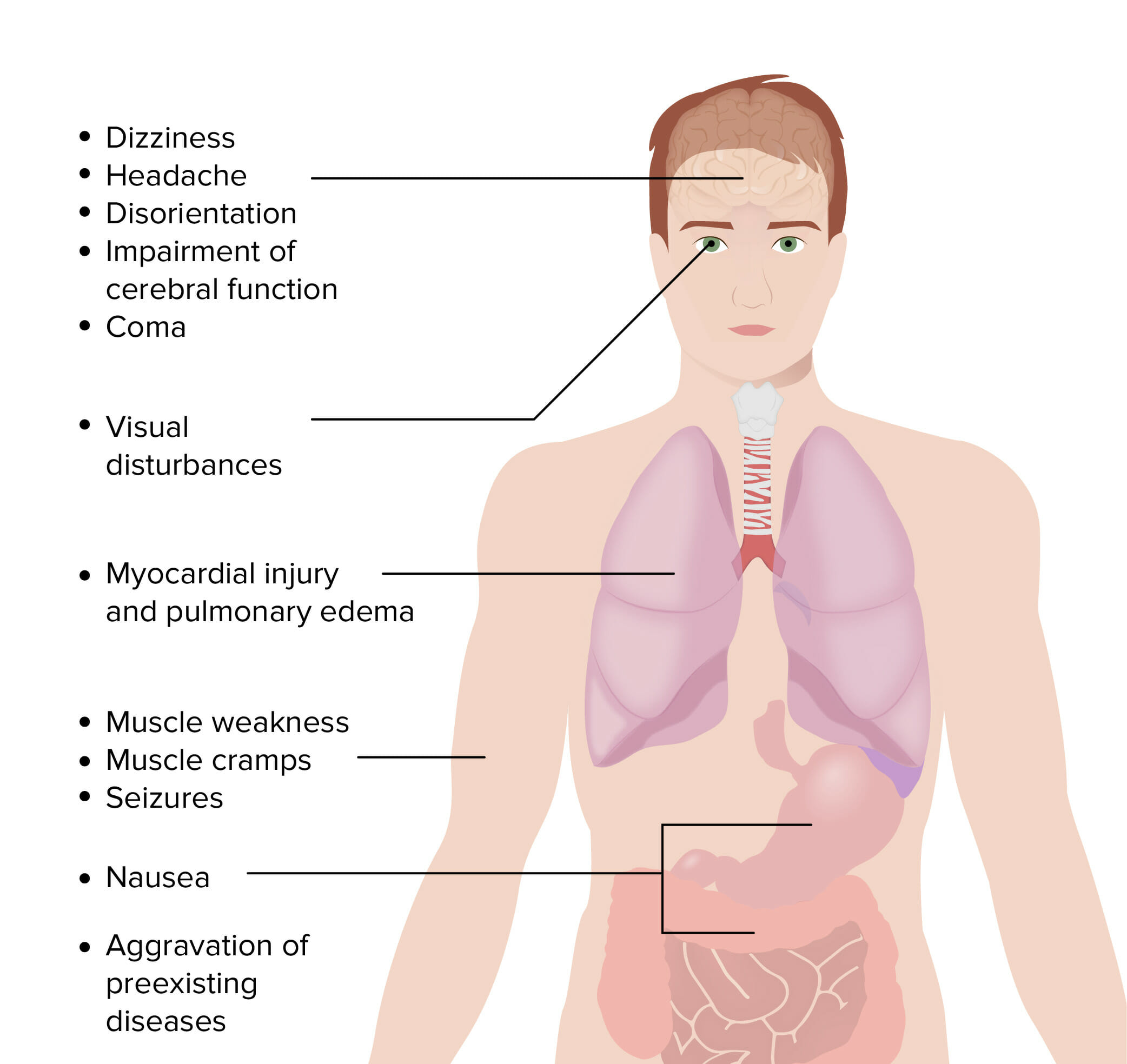
Individuos con intoxicación leve o moderada

  • Cefalea (el síntoma de presentación más común)
  • Malestar general
  • Náuseas/vómitos
  • Mareo
  • Deterioro del juicio y dificultad para concentrarse
  • Confusión
  • Dificultad para respirar

Individuos con intoxicación severa

  • Síntomas neurológicos:
    • Convulsiones
    • Síncope
    • Alteración del estado mental
    • Pérdida de conocimiento y/o coma Coma Coma is defined as a deep state of unarousable unresponsiveness, characterized by a score of 3 points on the GCS. A comatose state can be caused by a multitude of conditions, making the precise epidemiology and prognosis of coma difficult to determine. Coma
  • Síntomas cardiovasculares:
    • Dolor Dolor Inflammation torácico y dificultad para respirar (debido a un infarto de miocardio)
    • Palpitaciones y arritmias
    • Hipotensión
  • Síntomas respiratorios:
    • Dificultad para respirar
    • Edema Edema Edema is a condition in which excess serous fluid accumulates in the body cavity or interstitial space of connective tissues. Edema is a symptom observed in several medical conditions. It can be categorized into 2 types, namely, peripheral (in the extremities) and internal (in an organ or body cavity). Edema pulmonar
    • Insuficiencia respiratoria
    • Lesiones concomitantes de las vías respiratorias debidas a la inhalación de humo ( en EN Erythema nodosum is an immune-mediated panniculitis (inflammation of the subcutaneous fat) caused by a type IV (delayed-type) hypersensitivity reaction. It commonly manifests in young women as tender, erythematous nodules on the shins. Erythema Nodosum casos de incendios domésticos)
  • Síndrome neuropsiquiátrico retardado: se presenta en EN Erythema nodosum is an immune-mediated panniculitis (inflammation of the subcutaneous fat) caused by a type IV (delayed-type) hypersensitivity reaction. It commonly manifests in young women as tender, erythematous nodules on the shins. Erythema Nodosum el 30% de los LOS Neisseria casos, generalmente en EN Erythema nodosum is an immune-mediated panniculitis (inflammation of the subcutaneous fat) caused by a type IV (delayed-type) hypersensitivity reaction. It commonly manifests in young women as tender, erythematous nodules on the shins. Erythema Nodosum los LOS Neisseria primeros 30 días, pero a veces hasta 240 días después de la exposición
    • Demencia
    • Cambios de personalidad
    • Dificultades cognitivas y de aprendizaje
    • Psicosis
    • Trastornos del movimiento (e.g., parkinsonismo, parálisis, corea)
Symptoms of carbon monoxide poisoning

Síntomas de intoxicación por monóxido de carbono

Imagen por Lecturio.

Diagnóstico y Tratamiento

Diagnóstico

  • La sospecha clínica es un factor clave para establecer el diagnóstico de intoxicación por CO.
  • La gran variedad y la inespecificidad de los LOS Neisseria síntomas hacen que los LOS Neisseria diagnósticos errados sean muy frecuentes, especialmente en EN Erythema nodosum is an immune-mediated panniculitis (inflammation of the subcutaneous fat) caused by a type IV (delayed-type) hypersensitivity reaction. It commonly manifests in young women as tender, erythematous nodules on the shins. Erythema Nodosum ausencia de una exposición evidente.
  • Los LOS Neisseria antecedentes de exposición al AL Amyloidosis CO son esenciales, pero no siempre son evidentes: Debido a la falta de olor, color y sabor del gas, los LOS Neisseria individuos pueden no ser conscientes de su exposición.
  • Abordaje diagnóstico:
    • La gasometría arterial muestra niveles elevados de carboxihemoglobina (> 3% en EN Erythema nodosum is an immune-mediated panniculitis (inflammation of the subcutaneous fat) caused by a type IV (delayed-type) hypersensitivity reaction. It commonly manifests in young women as tender, erythematous nodules on the shins. Erythema Nodosum no fumadores, > 10% en EN Erythema nodosum is an immune-mediated panniculitis (inflammation of the subcutaneous fat) caused by a type IV (delayed-type) hypersensitivity reaction. It commonly manifests in young women as tender, erythematous nodules on the shins. Erythema Nodosum fumadores).
    • La oximetría de pulso no es útil y puede parecer normal porque no puede diferenciar entre carboxihemoglobina y oxihemoglobina.
    • Electrocardiograma ( ECG ECG An electrocardiogram (ECG) is a graphic representation of the electrical activity of the heart plotted against time. Adhesive electrodes are affixed to the skin surface allowing measurement of cardiac impulses from many angles. The ECG provides 3-dimensional information about the conduction system of the heart, the myocardium, and other cardiac structures. Electrocardiogram (ECG)) y/o enzimas cardíacas para descartar isquemia miocárdica
    • Examinar las vías respiratorias para evaluar lesiones por inhalación de humo

Tratamiento

  • Tratamiento inicial con oxígeno de alto flujo al AL Amyloidosis 100%: La oxigenoterapia debe comenzar inmediatamente si la sospecha clínica es alta.
  • Considere el oxígeno hiperbárico en EN Erythema nodosum is an immune-mediated panniculitis (inflammation of the subcutaneous fat) caused by a type IV (delayed-type) hypersensitivity reaction. It commonly manifests in young women as tender, erythematous nodules on the shins. Erythema Nodosum las siguientes condiciones:
    • Falla en EN Erythema nodosum is an immune-mediated panniculitis (inflammation of the subcutaneous fat) caused by a type IV (delayed-type) hypersensitivity reaction. It commonly manifests in young women as tender, erythematous nodules on the shins. Erythema Nodosum el tratamiento inicial
    • Nivel de CO > 25% sin hallazgos clínicos
    • Nivel de CO > 15% en EN Erythema nodosum is an immune-mediated panniculitis (inflammation of the subcutaneous fat) caused by a type IV (delayed-type) hypersensitivity reaction. It commonly manifests in young women as tender, erythematous nodules on the shins. Erythema Nodosum pacientes embarazadas con sufrimiento fetal
    • Pérdida de conocimiento
    • Convulsión
    • Acidosis Acidosis A pathologic condition of acid accumulation or depletion of base in the body. The two main types are respiratory acidosis and metabolic acidosis, due to metabolic acid build up. Respiratory Acidosis metabólica grave ( pH pH The quantitative measurement of the acidity or basicity of a solution. Acid-Base Balance < 7,1)
    • Evidencia de isquemia en EN Erythema nodosum is an immune-mediated panniculitis (inflammation of the subcutaneous fat) caused by a type IV (delayed-type) hypersensitivity reaction. It commonly manifests in young women as tender, erythematous nodules on the shins. Erythema Nodosum los LOS Neisseria órganos diana (e.g., cambios en EN Erythema nodosum is an immune-mediated panniculitis (inflammation of the subcutaneous fat) caused by a type IV (delayed-type) hypersensitivity reaction. It commonly manifests in young women as tender, erythematous nodules on the shins. Erythema Nodosum el ECG ECG An electrocardiogram (ECG) is a graphic representation of the electrical activity of the heart plotted against time. Adhesive electrodes are affixed to the skin surface allowing measurement of cardiac impulses from many angles. The ECG provides 3-dimensional information about the conduction system of the heart, the myocardium, and other cardiac structures. Electrocardiogram (ECG), dolor Dolor Inflammation torácico, alteración del estado mental)
  • Considerar la intubación y la ventilación mecánica para los LOS Neisseria pacientes gravemente afectados.

Diagnóstico Diferencial

  • Insuficiencia respiratoria: se produce cuando hay una inadecuada oxigenación de la sangre o una inadecuada ventilación/eliminación de CO2 o ambas. Puede ser una condición aguda que se desarrolla en EN Erythema nodosum is an immune-mediated panniculitis (inflammation of the subcutaneous fat) caused by a type IV (delayed-type) hypersensitivity reaction. It commonly manifests in young women as tender, erythematous nodules on the shins. Erythema Nodosum horas o una condición crónica que tarda meses o años en EN Erythema nodosum is an immune-mediated panniculitis (inflammation of the subcutaneous fat) caused by a type IV (delayed-type) hypersensitivity reaction. It commonly manifests in young women as tender, erythematous nodules on the shins. Erythema Nodosum desarrollarse. El manejo implica tratar la causa subyacente, la administración de oxígeno y, si es necesario, la ventilación mecánica.
  • Intoxicación por cianuro: El cianuro de hidrógeno (HCN) es un líquido incoloro, extremadamente venenoso e inflamable que se utiliza en EN Erythema nodosum is an immune-mediated panniculitis (inflammation of the subcutaneous fat) caused by a type IV (delayed-type) hypersensitivity reaction. It commonly manifests in young women as tender, erythematous nodules on the shins. Erythema Nodosum múltiples industrias y productos, como el caucho, el plástico y las pinturas domésticas. Las complicaciones letales de la intoxicación por cianuro se producen en EN Erythema nodosum is an immune-mediated panniculitis (inflammation of the subcutaneous fat) caused by a type IV (delayed-type) hypersensitivity reaction. It commonly manifests in young women as tender, erythematous nodules on the shins. Erythema Nodosum los LOS Neisseria incendios en EN Erythema nodosum is an immune-mediated panniculitis (inflammation of the subcutaneous fat) caused by a type IV (delayed-type) hypersensitivity reaction. It commonly manifests in young women as tender, erythematous nodules on the shins. Erythema Nodosum espacios cerrados cuando los LOS Neisseria plásticos son quemados. La exposición es por inhalación, dérmica o intestinal. Los LOS Neisseria síntomas se desarrollan en EN Erythema nodosum is an immune-mediated panniculitis (inflammation of the subcutaneous fat) caused by a type IV (delayed-type) hypersensitivity reaction. It commonly manifests in young women as tender, erythematous nodules on the shins. Erythema Nodosum cuestión de segundos o minutos e implican cambios cardiovasculares, respiratorios y neurológicos. El tratamiento incluye tiosulfato de sodio, nitritos e hidroxocobalamina.
  • Síndrome de dificultad respiratoria aguda (SDRA): reacción inflamatoria grave de los pulmones que se caracteriza por la presencia de infiltrados pulmonares debido a la acumulación de líquido alveolar. El síndrome de respuesta inflamatoria sistémica y la sepsis son las principales causas del SDRA. El principal hallazgo es la insuficiencia respiratoria. La radiografía de tórax suele mostrar infiltrados pulmonares bilaterales difusos (“opacidad en mariposa”).
  • Intoxicación por alcohol: el alcoholismo es un nivel de consumo de alcohol que supera la norma sociocultural. La afección se caracteriza por una adicción mental y física con un deseo irresistible de alcohol y tolerancia a la droga. La intoxicación alcohólica grave se presenta con náuseas, vómitos, problemas para hablar y articular, amnesia, delirio, letargo, depresión respiratoria, convulsiones, coma Coma Coma is defined as a deep state of unarousable unresponsiveness, characterized by a score of 3 points on the GCS. A comatose state can be caused by a multitude of conditions, making the precise epidemiology and prognosis of coma difficult to determine. Coma e incluso la muerte.
  • Meningitis Meningitis Meningitis is inflammation of the meninges, the protective membranes of the brain, and spinal cord. The causes of meningitis are varied, with the most common being bacterial or viral infection. The classic presentation of meningitis is a triad of fever, altered mental status, and nuchal rigidity. Meningitis: infección de las meninges Meninges The brain and the spinal cord are enveloped by 3 overlapping layers of connective tissue called the meninges. The layers are, from the most external layer to the most internal layer, the dura mater, arachnoid mater, and pia mater. Between these layers are 3 potential spaces called the epidural, subdural, and subarachnoid spaces. Meninges: Anatomy, las membranas protectoras que rodean el cerebro, causada con mayor frecuencia por Streptococcus Streptococcus Streptococcus is one of the two medically important genera of gram-positive cocci, the other being Staphylococcus. Streptococci are identified as different species on blood agar on the basis of their hemolytic pattern and sensitivity to optochin and bacitracin. There are many pathogenic species of streptococci, including S. pyogenes, S. agalactiae, S. pneumoniae, and the viridans streptococci. Streptococcus pneumoniae o Haemophilus Haemophilus Haemophilus is a genus of Gram-negative coccobacilli, all of whose strains require at least 1 of 2 factors for growth (factor V [NAD] and factor X [heme]); therefore, it is most often isolated on chocolate agar, which can supply both factors. The pathogenic species are H. influenzae and H. ducreyi. Haemophilus influenzae. Se presenta con fiebre, rigidez de cuello y cefalea. El diagnóstico se realiza mediante una punción lumbar para evaluar el líquido cefalorraquídeo (LCR). El tratamiento consiste en EN Erythema nodosum is an immune-mediated panniculitis (inflammation of the subcutaneous fat) caused by a type IV (delayed-type) hypersensitivity reaction. It commonly manifests in young women as tender, erythematous nodules on the shins. Erythema Nodosum administrar rápidamente antibióticos.
  • Intoxicación por opioides: Los LOS Neisseria opioides son depresores del sistema nervioso central utilizados médicamente como potentes analgésicos y de los LOS Neisseria que se suele abusar debido a su efecto eufórico. Las características de la intoxicación por opioides incluyen somnolencia, depresión respiratoria y pupilas puntiformes, que pueden ser manejadas con naloxona. Los LOS Neisseria pacientes pueden desarrollar síntomas de abstinencia (bostezos, lagrimeo, secreción nasal, piloerección, cólicos estomacales) que pueden ser controlados con metadona o buprenorfina.

Referencias

  1. Manaker, S., & Perry, H. (2024). Carbon monoxide poisoning. In UpToDate. Retrieved March 10, 2025, from https://www.uptodate.com/contents/carbon-monoxide-poisoning
  2. O’Malley, G.F. & O’Malley, R. (2022). Carbon Monoxide Poisoning. MSD Manuals. Retrieved March 10, 2025, from https://www.msdmanuals.com/professional/injuries-poisoning/poisoning/carbon-monoxide-poisoning
  3. Rose, J. J., Wang, L., Xu, Q., McTiernan, C. F., Shiva, S., Tejero, J., & Gladwin, M. T. (2016). Carbon Monoxide Poisoning: Pathogenesis, Management, and Future Directions of Therapy. American journal of respiratory and critical care medicine, 195(5), 596–606. https://doi.org/10.1164/rccm.201606-1275CI
  4. Wu, P. E., & Juurlink, D. N. (2014). Carbon monoxide poisoning. CMAJ : Canadian Medical Association journal = journal de l’Association medicale canadienne, 186(8), 611. https://doi.org/10.1503/cmaj.130972
  5. Gozubuyuk, A. A., Dag, H., Kacar, A., Karakurt, Y., & Arica, V. (2017). Epidemiology, pathophysiology, clinical evaluation, and treatment of carbon monoxide poisoning in child, infant, and fetus. Northern clinics of Istanbul, 4(1), 100–107. https://doi.org/10.14744/nci.2017.49368

¡Crea tu cuenta gratis o inicia una sesión para seguir leyendo!

Regístrate ahora y obtén acceso gratuito a Lecturio con páginas de concepto, videos médicos y cuestionarios para tu educación médica.

User Reviews

Que tengas una sesión de estudio alegre y navideña 🎁 Ahorra 50% en todos los planes >>

Details