Domina Conceptos Médicos

Estudia para la escuela de medicina y tus examenes con Lecturio.

Fisiología Prenatal y Posnatal del Recién Nacido

El período prenatal comienza con la formación del embrión y continúa con el desarrollo del feto, terminando con el nacimiento. La fisiología neonatal durante la vida prenatal difiere significativamente de la de la vida posnatal. Antes del nacimiento, el intercambio de nutrientes y gases y la eliminación de productos de desecho ocurren a través de la placenta Placenta A highly vascularized mammalian fetal-maternal organ and major site of transport of oxygen, nutrients, and fetal waste products. It includes a fetal portion (chorionic villi) derived from trophoblasts and a maternal portion (decidua) derived from the uterine endometrium. The placenta produces an array of steroid, protein and peptide hormones (placental hormones). Placenta, Umbilical Cord, and Amniotic Cavity. El feto recibe sangre rica en EN Erythema nodosum is an immune-mediated panniculitis (inflammation of the subcutaneous fat) caused by a type IV (delayed-type) hypersensitivity reaction. It commonly manifests in young women as tender, erythematous nodules on the shins. Erythema Nodosum nutrientes y oxigenada a través de la vena umbilical, y la sangre desoxigenada se devuelve a la placenta Placenta A highly vascularized mammalian fetal-maternal organ and major site of transport of oxygen, nutrients, and fetal waste products. It includes a fetal portion (chorionic villi) derived from trophoblasts and a maternal portion (decidua) derived from the uterine endometrium. The placenta produces an array of steroid, protein and peptide hormones (placental hormones). Placenta, Umbilical Cord, and Amniotic Cavity para eliminar los LOS Neisseria desechos a través de las arterias umbilicales. Las 3 derivaciones que ayudan a redirigir la circulación fetal son el conducto venoso, el foramen oval y el conducto arterioso. Estas derivaciones se cierran después del nacimiento, dejando remanentes vestigiales. Después del nacimiento, el sistema circulatorio fetal y los LOS Neisseria sistemas de órganos se adaptan al AL Amyloidosis entorno extrauterino. Se interrumpe el suministro de sangre a la placenta Placenta A highly vascularized mammalian fetal-maternal organ and major site of transport of oxygen, nutrients, and fetal waste products. It includes a fetal portion (chorionic villi) derived from trophoblasts and a maternal portion (decidua) derived from the uterine endometrium. The placenta produces an array of steroid, protein and peptide hormones (placental hormones). Placenta, Umbilical Cord, and Amniotic Cavity, lo que hace HACE Altitude Sickness que el recién nacido realice cambios de adaptación.

Last updated: Jul 2, 2022

Editorial responsibility: Stanley Oiseth, Lindsay Jones, Evelin Maza

Descripción General

  • Período prenatal: desde la formación del embrión hasta el nacimiento
  • Período posnatal: después del nacimiento
  • Período fetal: desde la semana 9 después de la fertilización (i.e., 11 semanas de gestación) hasta el nacimiento
  • La función de los LOS Neisseria órganos y la circulación en EN Erythema nodosum is an immune-mediated panniculitis (inflammation of the subcutaneous fat) caused by a type IV (delayed-type) hypersensitivity reaction. It commonly manifests in young women as tender, erythematous nodules on the shins. Erythema Nodosum los LOS Neisseria fetos difieren considerablemente de las de los LOS Neisseria adultos.
    • La placenta Placenta A highly vascularized mammalian fetal-maternal organ and major site of transport of oxygen, nutrients, and fetal waste products. It includes a fetal portion (chorionic villi) derived from trophoblasts and a maternal portion (decidua) derived from the uterine endometrium. The placenta produces an array of steroid, protein and peptide hormones (placental hormones). Placenta, Umbilical Cord, and Amniotic Cavity proporciona al AL Amyloidosis feto oxígeno, nutrientes de la madre y la eliminación de productos de desecho.
    • La circulación fetal difiere de la circulación adulta, principalmente porque los LOS Neisseria pulmones fetales no participan en EN Erythema nodosum is an immune-mediated panniculitis (inflammation of the subcutaneous fat) caused by a type IV (delayed-type) hypersensitivity reaction. It commonly manifests in young women as tender, erythematous nodules on the shins. Erythema Nodosum el intercambio de gases.
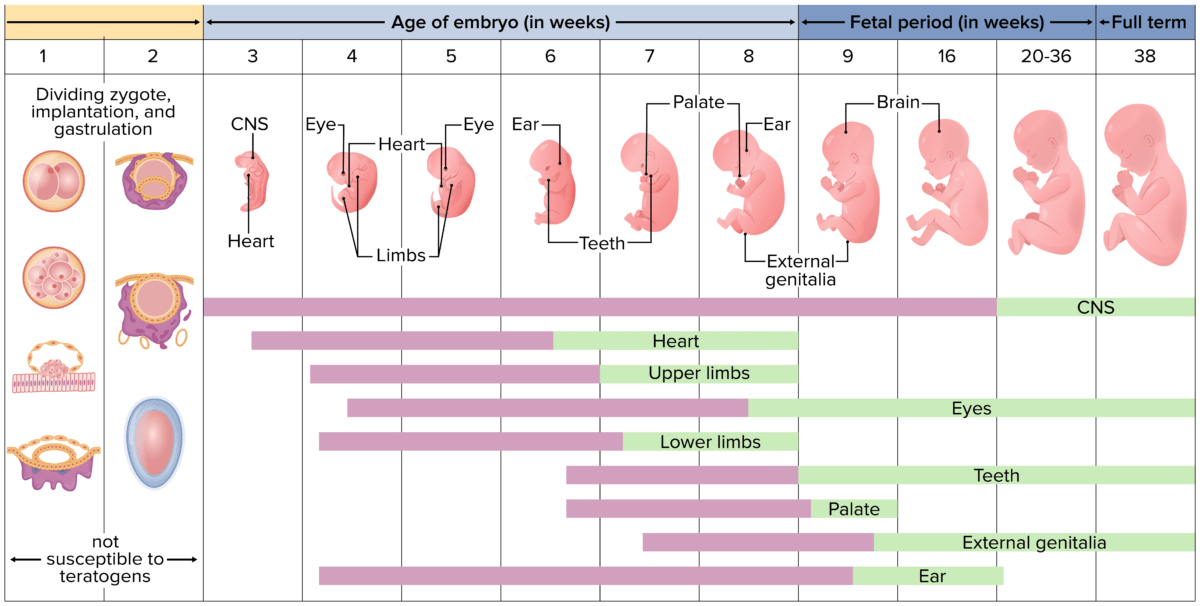
Tabla: Descripción general de hitos embriológicos durante el período prenatal
Edad gestacional en EN Erythema nodosum is an immune-mediated panniculitis (inflammation of the subcutaneous fat) caused by a type IV (delayed-type) hypersensitivity reaction. It commonly manifests in young women as tender, erythematous nodules on the shins. Erythema Nodosum semanas Características
Semanas 3–4
  • Se desarrolla el saco amniótico
  • Se desarrolla la placenta Placenta A highly vascularized mammalian fetal-maternal organ and major site of transport of oxygen, nutrients, and fetal waste products. It includes a fetal portion (chorionic villi) derived from trophoblasts and a maternal portion (decidua) derived from the uterine endometrium. The placenta produces an array of steroid, protein and peptide hormones (placental hormones). Placenta, Umbilical Cord, and Amniotic Cavity
Semanas 5–8
  • Formación del tubo neural
  • El tracto gastrointestinal comienza a desarrollarse.
Semanas 9–12
  • Se producen los LOS Neisseria 1ros movimientos respiratorios
  • La hematopoyesis se desplaza del hígado al AL Amyloidosis bazo
  • La cabeza sigue siendo desproporcionadamente grande
  • Las extremidades están completamente formadas
  • Todos los LOS Neisseria sistemas de órganos se forman y la mayoría comienza a funcionar
Semanas 13–16
  • El latido del corazón fetal es audible a través de Doppler Doppler Ultrasonography applying the doppler effect, with frequency-shifted ultrasound reflections produced by moving targets (usually red blood cells) in the bloodstream along the ultrasound axis in direct proportion to the velocity of movement of the targets, to determine both direction and velocity of blood flow. Ultrasound (Sonography).
  • Los LOS Neisseria sistemas de órganos maduran
  • Los LOS Neisseria genitales son visibles en EN Erythema nodosum is an immune-mediated panniculitis (inflammation of the subcutaneous fat) caused by a type IV (delayed-type) hypersensitivity reaction. It commonly manifests in young women as tender, erythematous nodules on the shins. Erythema Nodosum el ultrasonido.
  • Se produce una osificación activa y los LOS Neisseria huesos fetales son visibles en EN Erythema nodosum is an immune-mediated panniculitis (inflammation of the subcutaneous fat) caused by a type IV (delayed-type) hypersensitivity reaction. It commonly manifests in young women as tender, erythematous nodules on the shins. Erythema Nodosum el ultrasonido.
Semanas 17–20
  • El sistema musculoesquelético se desarrolla y los LOS Neisseria movimientos fetales se vuelven perceptibles para la madre.
  • El cuerpo está cubierto de pelo lanugo.
  • La piel está cubierta de vérnix caseosa, que protege al AL Amyloidosis feto.
Semanas 21–24
  • Comienza la secreción de surfactante.
  • Se produce el desarrollo de los LOS Neisseria alvéolos.
  • Ojos abiertos.
  • Las huellas fetales de los LOS Neisseria dedos de las manos y los LOS Neisseria pies son visibles.
Semanas 25–28
  • Se desarrollan las reservas de grasa.
  • Los LOS Neisseria tejidos pulmonares están lo suficientemente maduros para permitir el intercambio de gases.
  • La hematopoyesis comienza en EN Erythema nodosum is an immune-mediated panniculitis (inflammation of the subcutaneous fat) caused by a type IV (delayed-type) hypersensitivity reaction. It commonly manifests in young women as tender, erythematous nodules on the shins. Erythema Nodosum la médula ósea.
  • El aparato auditivo es completamente funcional.
Semanas 29–32
  • El desarrollo del cerebro se vuelve más rápido.
  • Los LOS Neisseria pulmones aún están inmaduros.
  • Otros sistemas de órganos están bien desarrollados.
Semanas 33–36
  • El feto crece y madura.
  • Los LOS Neisseria pulmones están cerca de madurar.
  • Se desarrollan reflejos coordinados.
  • El feto responde a la luz, el sonido y el tacto.
Semanas 37–40
  • El feto es lo suficientemente maduro para tolerar fácilmente la vida extrauterina a las 37 semanas.
Embryological milestones during the prenatal period

Hitos embriológicos durante el periodo prenatal

Imagen por Lecturio.
Cambios Cardiovasculares

Sistema prenatal

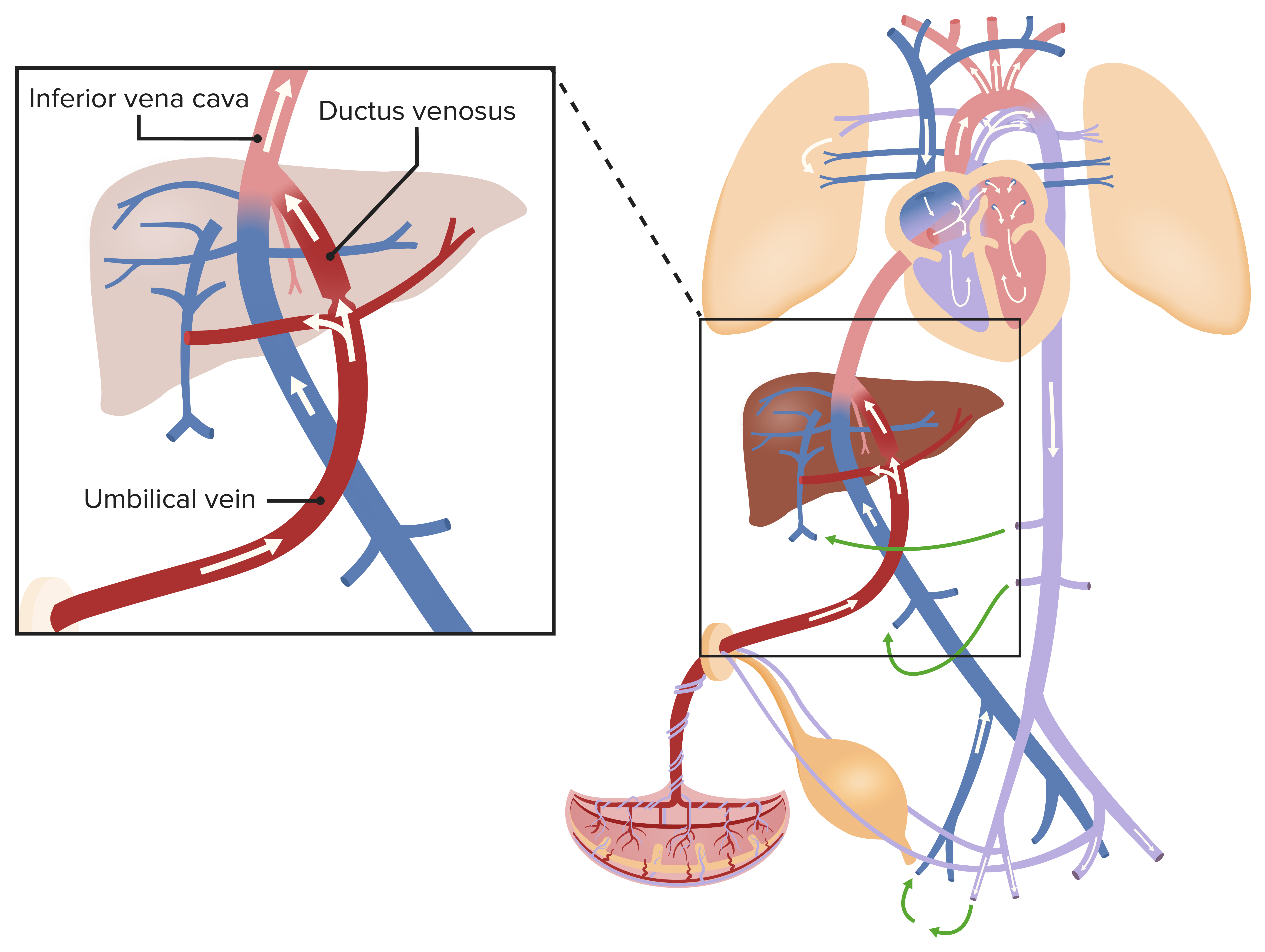
  • 3 estructuras fetales clave de la circulación fetal que no existen después del nacimiento:
    • Conducto venoso: derivación venosa que conecta la vena umbilical con la vena cava inferior sin pasar por el hígado
    • Conducto arterioso: derivación que conecta la arteria pulmonar con la aorta Aorta The main trunk of the systemic arteries. Mediastinum and Great Vessels: Anatomy ascendente, sin pasar por los LOS Neisseria pulmones
    • Foramen oval:
      • Apertura entre las 2 aurículas que permite el flujo de sangre oxigenada desde el lado derecho al AL Amyloidosis lado izquierdo del corazón, sin pasar por los LOS Neisseria pulmones
      • Cubierto por un colgajo de tejido, evita el “reflujo” (i.e., la sangre no puede fluir desde la aurícula izquierda a la aurícula derecha)
  • Ruta del flujo sanguíneo a través de la circulación fetal:
    • La sangre oxigenada de la placenta Placenta A highly vascularized mammalian fetal-maternal organ and major site of transport of oxygen, nutrients, and fetal waste products. It includes a fetal portion (chorionic villi) derived from trophoblasts and a maternal portion (decidua) derived from the uterine endometrium. The placenta produces an array of steroid, protein and peptide hormones (placental hormones). Placenta, Umbilical Cord, and Amniotic Cavity se transporta al AL Amyloidosis feto a través de la vena umbilical ubicada en EN Erythema nodosum is an immune-mediated panniculitis (inflammation of the subcutaneous fat) caused by a type IV (delayed-type) hypersensitivity reaction. It commonly manifests in young women as tender, erythematous nodules on the shins. Erythema Nodosum el cordón umbilical:
      • La mitad de la sangre de aquí llega a los LOS Neisseria sinusoides hepáticos a través de la vena porta.
      • La otra mitad de la sangre llega a la vena cava inferior a través del conducto venoso, sin pasar por la circulación hepática
    • La sangre de la vena cava inferior llega a la aurícula derecha.
    • La sangre de la mitad superior del cuerpo llega a la aurícula derecha a través de la vena cava superior.
    • In utero, los LOS Neisseria pulmones no realizan intercambio gaseoso:
      • La baja concentración de oxígeno en EN Erythema nodosum is an immune-mediated panniculitis (inflammation of the subcutaneous fat) caused by a type IV (delayed-type) hypersensitivity reaction. It commonly manifests in young women as tender, erythematous nodules on the shins. Erythema Nodosum los LOS Neisseria alvéolos pulmonares provoca vasoconstricción
      • Aumento de la resistencia arteriolar al AL Amyloidosis flujo sanguíneo → aumento de la presión en EN Erythema nodosum is an immune-mediated panniculitis (inflammation of the subcutaneous fat) caused by a type IV (delayed-type) hypersensitivity reaction. It commonly manifests in young women as tender, erythematous nodules on the shins. Erythema Nodosum la aurícula derecha y el ventrículo derecho
      • Presión en EN Erythema nodosum is an immune-mediated panniculitis (inflammation of the subcutaneous fat) caused by a type IV (delayed-type) hypersensitivity reaction. It commonly manifests in young women as tender, erythematous nodules on the shins. Erythema Nodosum el lado derecho del corazón > presión en EN Erythema nodosum is an immune-mediated panniculitis (inflammation of the subcutaneous fat) caused by a type IV (delayed-type) hypersensitivity reaction. It commonly manifests in young women as tender, erythematous nodules on the shins. Erythema Nodosum el lado izquierdo del corazón
  • El foramen oval desvía la sangre desde la aurícula derecha de alta presión a la aurícula izquierda de baja presión, evitando el ventrículo derecho y la circulación pulmonar.
  • Cierta cantidad de sangre va VA Ventilation: Mechanics of Breathing al AL Amyloidosis ventrículo derecho y luego a la arteria pulmonar:
    • El conducto arterioso desvía la mayor parte de la sangre de la arteria pulmonar de alta presión a la aorta Aorta The main trunk of the systemic arteries. Mediastinum and Great Vessels: Anatomy de baja presión, sin pasar por los LOS Neisseria pulmones.
    • Una pequeña cantidad de sangre fluye a través de la irrigación pulmonar y del lado izquierdo del corazón, donde se bombea desde el ventrículo izquierdo hacia la aorta Aorta The main trunk of the systemic arteries. Mediastinum and Great Vessels: Anatomy
  • La aorta Aorta The main trunk of the systemic arteries. Mediastinum and Great Vessels: Anatomy lleva la sangre al AL Amyloidosis resto del cuerpo.
  • La aorta Aorta The main trunk of the systemic arteries. Mediastinum and Great Vessels: Anatomy se divide en EN Erythema nodosum is an immune-mediated panniculitis (inflammation of the subcutaneous fat) caused by a type IV (delayed-type) hypersensitivity reaction. It commonly manifests in young women as tender, erythematous nodules on the shins. Erythema Nodosum arterias ilíacas comunes, derecha e izquierda, que se dividen en EN Erythema nodosum is an immune-mediated panniculitis (inflammation of the subcutaneous fat) caused by a type IV (delayed-type) hypersensitivity reaction. It commonly manifests in young women as tender, erythematous nodules on the shins. Erythema Nodosum arterias ilíacas externas e internas.
  • La arteria ilíaca interna da lugar a la arteria umbilical.
  • La arteria umbilical devuelve la sangre desoxigenada a la placenta Placenta A highly vascularized mammalian fetal-maternal organ and major site of transport of oxygen, nutrients, and fetal waste products. It includes a fetal portion (chorionic villi) derived from trophoblasts and a maternal portion (decidua) derived from the uterine endometrium. The placenta produces an array of steroid, protein and peptide hormones (placental hormones). Placenta, Umbilical Cord, and Amniotic Cavity.

Transición al AL Amyloidosis sistema posnatal

  • Al AL Amyloidosis nacer, 2 transiciones importantes desencadenan cambios circulatorios que conducen al AL Amyloidosis cierre del foramen oval:
    • El sistema de alta presión de la circulación pulmonar se convierte en EN Erythema nodosum is an immune-mediated panniculitis (inflammation of the subcutaneous fat) caused by a type IV (delayed-type) hypersensitivity reaction. It commonly manifests in young women as tender, erythematous nodules on the shins. Erythema Nodosum un sistema de baja presión.
      • La compresión mecánica y la reexpansión de la caja torácica hace HACE Altitude Sickness que el aire ingrese a los LOS Neisseria pulmones.
      • Cuando el bebé llora, el aire fluye hacia los LOS Neisseria pulmones.
      • Conduce a un aumento en EN Erythema nodosum is an immune-mediated panniculitis (inflammation of the subcutaneous fat) caused by a type IV (delayed-type) hypersensitivity reaction. It commonly manifests in young women as tender, erythematous nodules on the shins. Erythema Nodosum la presión parcial de oxígeno en EN Erythema nodosum is an immune-mediated panniculitis (inflammation of the subcutaneous fat) caused by a type IV (delayed-type) hypersensitivity reaction. It commonly manifests in young women as tender, erythematous nodules on the shins. Erythema Nodosum los LOS Neisseria alvéolos pulmonares, lo que conduce a la vasodilatación en EN Erythema nodosum is an immune-mediated panniculitis (inflammation of the subcutaneous fat) caused by a type IV (delayed-type) hypersensitivity reaction. It commonly manifests in young women as tender, erythematous nodules on the shins. Erythema Nodosum la totalidad de los LOS Neisseria pulmones
      • La presión en EN Erythema nodosum is an immune-mediated panniculitis (inflammation of the subcutaneous fat) caused by a type IV (delayed-type) hypersensitivity reaction. It commonly manifests in young women as tender, erythematous nodules on the shins. Erythema Nodosum el lado derecho del corazón disminuye drásticamente.
    • El lecho vascular de baja presión de la placenta Placenta A highly vascularized mammalian fetal-maternal organ and major site of transport of oxygen, nutrients, and fetal waste products. It includes a fetal portion (chorionic villi) derived from trophoblasts and a maternal portion (decidua) derived from the uterine endometrium. The placenta produces an array of steroid, protein and peptide hormones (placental hormones). Placenta, Umbilical Cord, and Amniotic Cavity se elimina:
      • El pinzamiento de la vena umbilical y las arterias provoca un aumento de la presión.
      • Aumenta la resistencia vascular sistémica
      • Esta resistencia, combinada con un mayor retorno de la sangre a través de la vena pulmonar hacia la aurícula izquierda, provoca un aumento de la presión en EN Erythema nodosum is an immune-mediated panniculitis (inflammation of the subcutaneous fat) caused by a type IV (delayed-type) hypersensitivity reaction. It commonly manifests in young women as tender, erythematous nodules on the shins. Erythema Nodosum el lado izquierdo del corazón.
  • Estos cambios hacen que el flujo de sangre a través del foramen oval cambie de dirección:
    • El colgajo de tejido (i.e., la válvula) sobre el foramen oval impide el flujo de izquierda a derecha.
    • Con el tiempo, el colgajo se fusionará, dejando solo una depresión poco profunda visible en EN Erythema nodosum is an immune-mediated panniculitis (inflammation of the subcutaneous fat) caused by a type IV (delayed-type) hypersensitivity reaction. It commonly manifests in young women as tender, erythematous nodules on the shins. Erythema Nodosum la pared entre las aurículas.
  • Los LOS Neisseria niveles de prostaglandina caen drásticamente al AL Amyloidosis nacer:
    • Se extrae la placenta Placenta A highly vascularized mammalian fetal-maternal organ and major site of transport of oxygen, nutrients, and fetal waste products. It includes a fetal portion (chorionic villi) derived from trophoblasts and a maternal portion (decidua) derived from the uterine endometrium. The placenta produces an array of steroid, protein and peptide hormones (placental hormones). Placenta, Umbilical Cord, and Amniotic Cavity, que es responsable de una gran parte de la producción de prostaglandinas.
    • La actividad del tejido pulmonar, incluido el metabolismo de las prostaglandinas, aumenta considerablemente al AL Amyloidosis nacer.
    • Una disminución en EN Erythema nodosum is an immune-mediated panniculitis (inflammation of the subcutaneous fat) caused by a type IV (delayed-type) hypersensitivity reaction. It commonly manifests in young women as tender, erythematous nodules on the shins. Erythema Nodosum el nivel de prostaglandinas conduce al AL Amyloidosis cierre del conducto arterioso.
  • Cuando se expone al AL Amyloidosis ambiente externo, la gelatina de Wharton se encoge y los LOS Neisseria vasos sanguíneos umbilicales colapsan:
    • Las arterias umbilicales se contraen y aplanan
    • Coágulos de sangre en EN Erythema nodosum is an immune-mediated panniculitis (inflammation of the subcutaneous fat) caused by a type IV (delayed-type) hypersensitivity reaction. It commonly manifests in young women as tender, erythematous nodules on the shins. Erythema Nodosum la vena umbilical y el conducto venoso.
    • Estos vasos se vuelven progresivamente más pequeños y eventualmente se convierten en EN Erythema nodosum is an immune-mediated panniculitis (inflammation of the subcutaneous fat) caused by a type IV (delayed-type) hypersensitivity reaction. It commonly manifests in young women as tender, erythematous nodules on the shins. Erythema Nodosum ligamentos.
Tabla: Los LOS Neisseria remanentes del sistema circulatorio fetal después del nacimiento
Estructura Remanentes
Arterias umbilicales
  • Las partes proximales forman las arterias vesicales superiores.
  • Las partes distales forman los LOS Neisseria ligamentos umbilicales mediales.
Vena umbilical
  • Forma el ligamento redondo
Conducto venoso
  • Forma el ligamento venoso
  • Funcionalmente se cierra después del nacimiento
Conducto arterioso
  • Generalmente, se cierra funcionalmente en EN Erythema nodosum is an immune-mediated panniculitis (inflammation of the subcutaneous fat) caused by a type IV (delayed-type) hypersensitivity reaction. It commonly manifests in young women as tender, erythematous nodules on the shins. Erythema Nodosum 10–12 horas después del nacimiento
  • Forma el ligamento arterioso
  • Puede mantenerse como conducto arterioso persistente
Foramen oval
  • Forma la fosa oval
  • El foramen oval se cierra funcionalmente inmediatamente después del nacimiento.
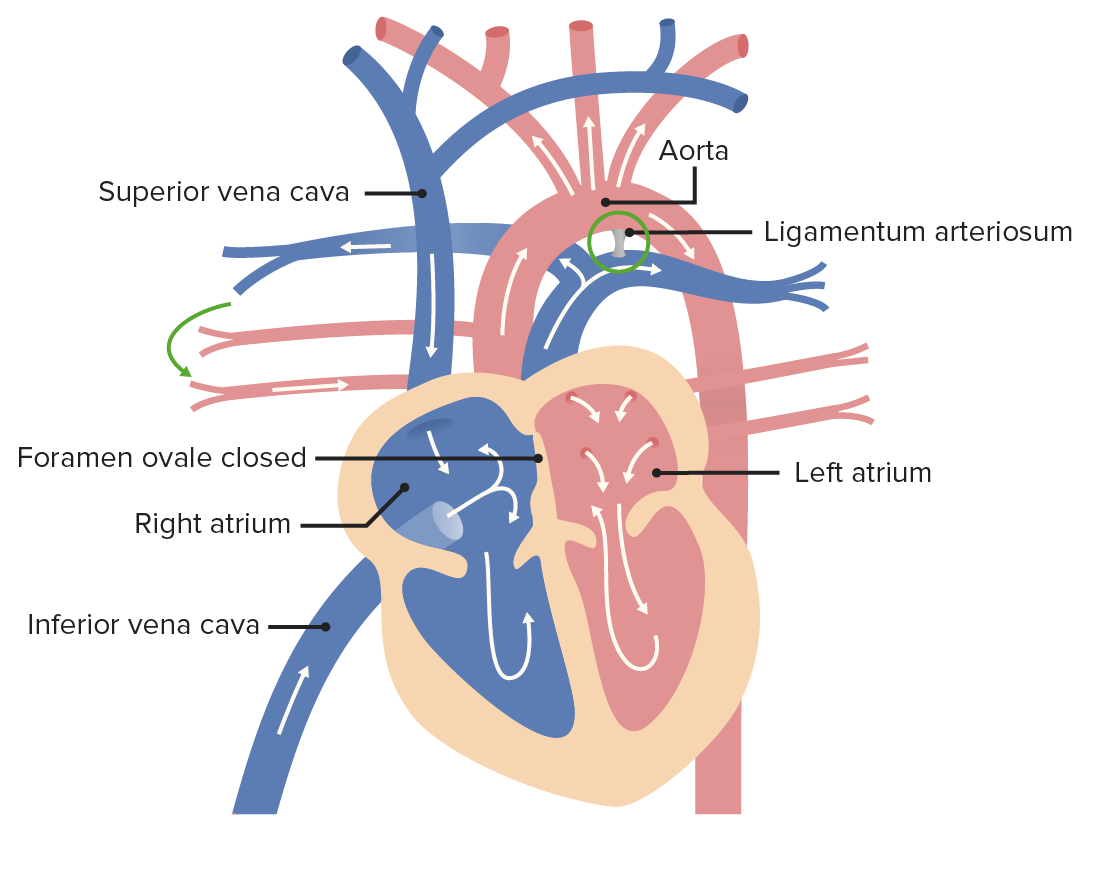
Ligamento arterioso

Después del nacimiento, el conducto arterioso se convierte en el ligamento arterioso, a medida que la sangre puede ingresar a los pulmones para ser oxigenada. El foramen oval se cierra y se convierte en la fosa oval debido al aumento de la presión en la aurícula izquierda.

Imagen por Lecturio.
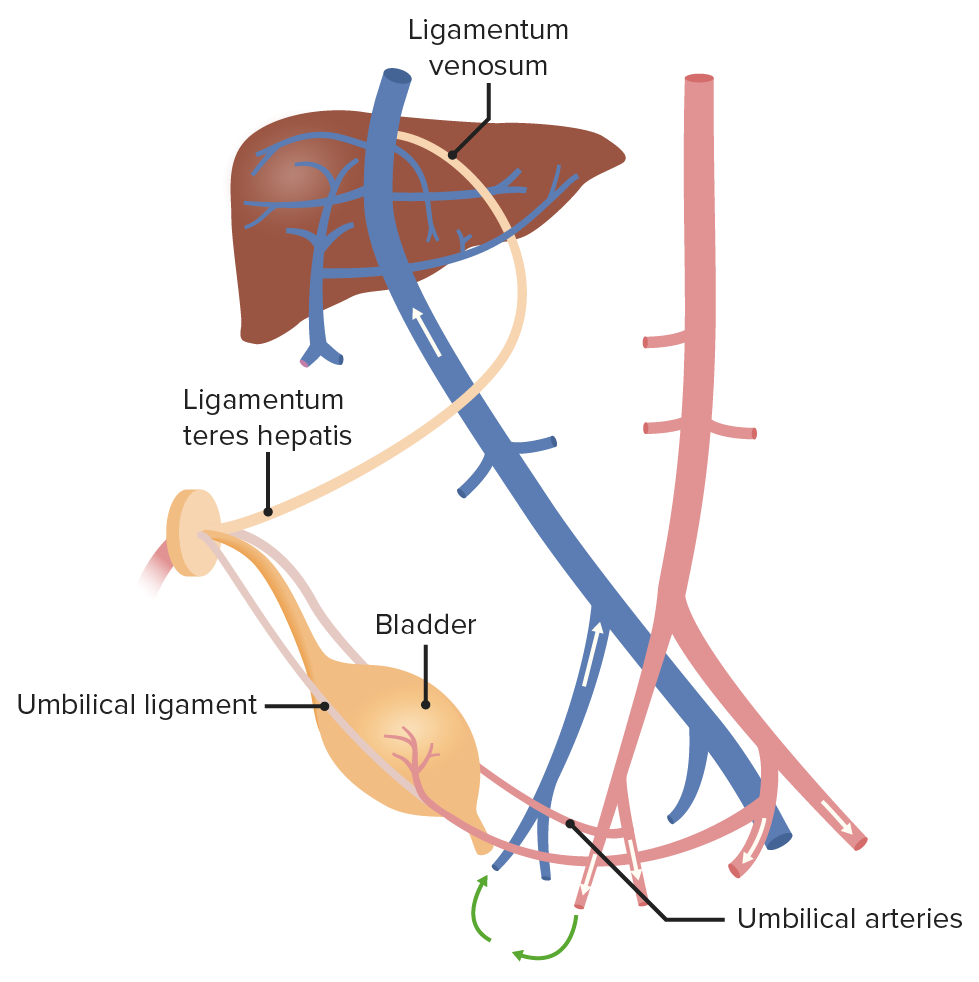
Ligamento redondo hepático Ligamento umbilical

Después del nacimiento, las arterias umbilicales se convierten en los ligamentos umbilicales mediales, mientras que la vena umbilical se convierte en el ligamento redondo hepático. El conducto venoso se convierte en el ligamento venoso.

Imagen por Lecturio.

Cambios Pulmonares

Sistema prenatal

  • El desarrollo pulmonar ocurre en EN Erythema nodosum is an immune-mediated panniculitis (inflammation of the subcutaneous fat) caused by a type IV (delayed-type) hypersensitivity reaction. It commonly manifests in young women as tender, erythematous nodules on the shins. Erythema Nodosum 5 etapas:
    • Embrionaria: desarrollo de la tráquea y brotes bronquiales primarios
    • Pseudoglandular: desarrollo del árbol bronquial hasta el nivel de los LOS Neisseria bronquiolos terminales
    • Canalicular: desarrollo de los LOS Neisseria bronquiolos respiratorios y los LOS Neisseria alvéolos primitivos
    • Sacular: maduración de los LOS Neisseria alvéolos y producción de surfactante
    • Alveolar: aumento en EN Erythema nodosum is an immune-mediated panniculitis (inflammation of the subcutaneous fat) caused by a type IV (delayed-type) hypersensitivity reaction. It commonly manifests in young women as tender, erythematous nodules on the shins. Erythema Nodosum el número de alvéolos, capilares y maduración continua
  • In utero, los LOS Neisseria pulmones:
    • Son innecesarios como órganos respiratorios (están inactivos)
    • Funcionan como una fuente primaria de líquido amniótico
    • Están llenos de líquido y no inflados
    • Los LOS Neisseria vasos pulmonares tienen una alta resistencia vascular.

Transición al AL Amyloidosis sistema posnatal

  • Inmediatamente después del nacimiento:
    • Los LOS Neisseria pulmones se expanden por 1ra vez con la 1ra respiración del bebé.
    • El líquido amniótico sale de los LOS Neisseria espacios de aire y entra en EN Erythema nodosum is an immune-mediated panniculitis (inflammation of the subcutaneous fat) caused by a type IV (delayed-type) hypersensitivity reaction. It commonly manifests in young women as tender, erythematous nodules on the shins. Erythema Nodosum la irrigación a medida que los LOS Neisseria pulmones se llenan de aire.
    • El surfactante ↓ la tensión superficial en EN Erythema nodosum is an immune-mediated panniculitis (inflammation of the subcutaneous fat) caused by a type IV (delayed-type) hypersensitivity reaction. It commonly manifests in young women as tender, erythematous nodules on the shins. Erythema Nodosum los LOS Neisseria alvéolos y mantiene abiertos los LOS Neisseria espacios de aire.
    • Tener surfactante adecuado suele ser un factor principal para determinar la supervivencia infantil en EN Erythema nodosum is an immune-mediated panniculitis (inflammation of the subcutaneous fat) caused by a type IV (delayed-type) hypersensitivity reaction. It commonly manifests in young women as tender, erythematous nodules on the shins. Erythema Nodosum los LOS Neisseria partos prematuros.
  • Producción de surfactante
    • El surfactante es un líquido complejo rico en EN Erythema nodosum is an immune-mediated panniculitis (inflammation of the subcutaneous fat) caused by a type IV (delayed-type) hypersensitivity reaction. It commonly manifests in young women as tender, erythematous nodules on the shins. Erythema Nodosum lípidos que recubre el interior de los LOS Neisseria alvéolos maduros y ayuda a mantener su forma, distensibilidad e intercambio de gases.
    • La producción de surfactante comienza alrededor de la semana 20 y aumenta lentamente durante la 2da mitad del embarazo.
    • La iniciación del trabajo de parto estimula la producción de surfactante.
    • El estiramiento de los LOS Neisseria alvéolos por aire también estimula la producción de surfactante.
  • La frecuencia respiratoria:
    • In utero, los LOS Neisseria lactantes “respiran” de manera errática.
    • Durante el trabajo de parto, las contracciones comprimen las arterias/vena umbilical, disminuyendo el lavado de CO2 por parte del feto, resultando en EN Erythema nodosum is an immune-mediated panniculitis (inflammation of the subcutaneous fat) caused by a type IV (delayed-type) hypersensitivity reaction. It commonly manifests in young women as tender, erythematous nodules on the shins. Erythema Nodosum una acidosis Acidosis A pathologic condition of acid accumulation or depletion of base in the body. The two main types are respiratory acidosis and metabolic acidosis, due to metabolic acid build up. Respiratory Acidosis leve
    • El aumento de CO2 estimula el centro de la respiración en EN Erythema nodosum is an immune-mediated panniculitis (inflammation of the subcutaneous fat) caused by a type IV (delayed-type) hypersensitivity reaction. It commonly manifests in young women as tender, erythematous nodules on the shins. Erythema Nodosum el cerebro, aumentando la frecuencia respiratoria.
    • La hipoxemia en EN Erythema nodosum is an immune-mediated panniculitis (inflammation of the subcutaneous fat) caused by a type IV (delayed-type) hypersensitivity reaction. It commonly manifests in young women as tender, erythematous nodules on the shins. Erythema Nodosum prematuros se ha HA Hemolytic anemia (HA) is the term given to a large group of anemias that are caused by the premature destruction/hemolysis of circulating red blood cells (RBCs). Hemolysis can occur within (intravascular hemolysis) or outside the blood vessels (extravascular hemolysis). Hemolytic Anemia relacionado con la supresión de los LOS Neisseria patrones de respiración regulares.

Cambios Metabólicos

Las tasas metabólicas fetales son relativamente bajas y deben aumentar significativamente para satisfacer las necesidades metabólicas de un recién nacido en EN Erythema nodosum is an immune-mediated panniculitis (inflammation of the subcutaneous fat) caused by a type IV (delayed-type) hypersensitivity reaction. It commonly manifests in young women as tender, erythematous nodules on the shins. Erythema Nodosum crecimiento después del nacimiento.

  • Durante la vida intrauterina, la glucosa se obtiene de la sangre materna a través de la placenta Placenta A highly vascularized mammalian fetal-maternal organ and major site of transport of oxygen, nutrients, and fetal waste products. It includes a fetal portion (chorionic villi) derived from trophoblasts and a maternal portion (decidua) derived from the uterine endometrium. The placenta produces an array of steroid, protein and peptide hormones (placental hormones). Placenta, Umbilical Cord, and Amniotic Cavity:
    • Las oleadas de catecolaminas durante el parto estimulan la producción de glucagón y reducen la producción de insulina.
    • Este incremento eleva los LOS Neisseria niveles de glucosa en EN Erythema nodosum is an immune-mediated panniculitis (inflammation of the subcutaneous fat) caused by a type IV (delayed-type) hypersensitivity reaction. It commonly manifests in young women as tender, erythematous nodules on the shins. Erythema Nodosum sangre en EN Erythema nodosum is an immune-mediated panniculitis (inflammation of the subcutaneous fat) caused by a type IV (delayed-type) hypersensitivity reaction. It commonly manifests in young women as tender, erythematous nodules on the shins. Erythema Nodosum el lactante al AL Amyloidosis estimular la gluconeogénesis y la liberación de las reservas de glucosa del hígado.
    • Al AL Amyloidosis nacer, el feto se separa de la placenta Placenta A highly vascularized mammalian fetal-maternal organ and major site of transport of oxygen, nutrients, and fetal waste products. It includes a fetal portion (chorionic villi) derived from trophoblasts and a maternal portion (decidua) derived from the uterine endometrium. The placenta produces an array of steroid, protein and peptide hormones (placental hormones). Placenta, Umbilical Cord, and Amniotic Cavity (y del suministro constante de glucosa materna) y comienza a absorber glucosa del tracto gastrointestinal después de una alimentación oral.
  • La producción de cortisol Cortisol Glucocorticoids es baja durante el desarrollo fetal:
    • Comienza a aumentar a las 30 semanas de gestación
    • Picos justo después del parto

Funciones de los Órganos

Tabla: Descripción general prenatal y posnatal de los LOS Neisseria sistemas de órganos
Sistema de órganos Antes del nacimiento Después del nacimiento
Sistema respiratorio
  • Los LOS Neisseria pulmones son inmaduros; no se produce intercambio gaseoso.
  • Los LOS Neisseria neumocitos tipo 2 producen poco surfactante.
  • Los LOS Neisseria pulmones se expanden y se produce el intercambio de gases.
  • ↑ Concentración de O2 en EN Erythema nodosum is an immune-mediated panniculitis (inflammation of the subcutaneous fat) caused by a type IV (delayed-type) hypersensitivity reaction. It commonly manifests in young women as tender, erythematous nodules on the shins. Erythema Nodosum los LOS Neisseria alvéolos → vasodilatación de la irrigación pulmonar
  • Líquido absorbido desde los LOS Neisseria alvéolos hacia la irrigación
Hígado
  • Inmaduro (todavía no en EN Erythema nodosum is an immune-mediated panniculitis (inflammation of the subcutaneous fat) caused by a type IV (delayed-type) hypersensitivity reaction. It commonly manifests in young women as tender, erythematous nodules on the shins. Erythema Nodosum plena función)
  • Produce factores de coagulación.
  • Ayuda en EN Erythema nodosum is an immune-mediated panniculitis (inflammation of the subcutaneous fat) caused by a type IV (delayed-type) hypersensitivity reaction. It commonly manifests in young women as tender, erythematous nodules on the shins. Erythema Nodosum la excreción de bilirrubina.
Sangre y sistema inmunológico
  • La hematopoyesis se produce en EN Erythema nodosum is an immune-mediated panniculitis (inflammation of the subcutaneous fat) caused by a type IV (delayed-type) hypersensitivity reaction. It commonly manifests in young women as tender, erythematous nodules on the shins. Erythema Nodosum el saco vitelino al AL Amyloidosis principio de la vida fetal y luego es llevada a cabo por el hígado y el bazo.
  • La hemoglobina fetal está formada por 2 subunidades alfa y 2 subunidades gamma.
  • La hemoglobina fetal tiene una mayor afinidad por el O2 que la hemoglobina del adulto.
  • No se producen inmunoglobulinas
  • La inmunoglobulina G ( IgG IgG The major immunoglobulin isotype class in normal human serum. There are several isotype subclasses of igg, for example, igg1, igg2a, and igg2b. Hypersensitivity Pneumonitis) materna atraviesa la placenta Placenta A highly vascularized mammalian fetal-maternal organ and major site of transport of oxygen, nutrients, and fetal waste products. It includes a fetal portion (chorionic villi) derived from trophoblasts and a maternal portion (decidua) derived from the uterine endometrium. The placenta produces an array of steroid, protein and peptide hormones (placental hormones). Placenta, Umbilical Cord, and Amniotic Cavity y proporciona inmunidad pasiva.
  • La mayor parte de la hematopoyesis ocurre en EN Erythema nodosum is an immune-mediated panniculitis (inflammation of the subcutaneous fat) caused by a type IV (delayed-type) hypersensitivity reaction. It commonly manifests in young women as tender, erythematous nodules on the shins. Erythema Nodosum la médula ósea.
  • La hemoglobina fetal cambia a la forma de hemoglobina del adulto.
  • El sistema inmunológico comienza a funcionar.
Tracto gastrointestinal
  • El meconio se produce y permanece en EN Erythema nodosum is an immune-mediated panniculitis (inflammation of the subcutaneous fat) caused by a type IV (delayed-type) hypersensitivity reaction. It commonly manifests in young women as tender, erythematous nodules on the shins. Erythema Nodosum el intestino hasta el nacimiento.
  • El meconio se elimina después del nacimiento en EN Erythema nodosum is an immune-mediated panniculitis (inflammation of the subcutaneous fat) caused by a type IV (delayed-type) hypersensitivity reaction. It commonly manifests in young women as tender, erythematous nodules on the shins. Erythema Nodosum la 1ra deposición del lactante.
Sistema urinario
  • El feto comienza a producir “orina” entre las 9–12 semanas de gestación
  • La placenta Placenta A highly vascularized mammalian fetal-maternal organ and major site of transport of oxygen, nutrients, and fetal waste products. It includes a fetal portion (chorionic villi) derived from trophoblasts and a maternal portion (decidua) derived from the uterine endometrium. The placenta produces an array of steroid, protein and peptide hormones (placental hormones). Placenta, Umbilical Cord, and Amniotic Cavity es responsable de la excreción de desechos solubles en EN Erythema nodosum is an immune-mediated panniculitis (inflammation of the subcutaneous fat) caused by a type IV (delayed-type) hypersensitivity reaction. It commonly manifests in young women as tender, erythematous nodules on the shins. Erythema Nodosum agua.
  • La concentración de orina se produce después del nacimiento.
  • Los LOS Neisseria riñones mantienen el equilibrio de líquidos y electrolitos.
Sistema de termorregulación
  • El feto produce el doble de calor Calor Inflammation que un adulto.
  • El calor Calor Inflammation se elimina a través de la piel fetal, el líquido amniótico y la pared uterina.
  • El recién nacido comienza a perder calor Calor Inflammation después del nacimiento.
  • Los LOS Neisseria recién nacidos se mantienen calientes gracias al AL Amyloidosis aumento de la actividad muscular y la quema de grasa parda.

Referencias

  1. Morton, S. U., Brodsky, D. (2016). Fetal physiology and the transition to extrauterine life. Clinics in Perinatology 43(3):395–407. https://doi.org/10.1016/j.clp.2016.04.001
  2. Fetal development: month-by-month stages of pregnancy. Cleveland Clinic. Retrieved December 20, 2021, from https://my.clevelandclinic.org/health/articles/7247-fetal-development-stages-of-growth
  3. Curran, M.A. Fetal development. Retrieved December 20, 2021, from https://perinatology.com/Reference/Fetal%20development.htm
  4. Fetal circulation. Retrieved December 20, 2021, from https://www.heart.org/en/health-topics/congenital-heart-defects/symptoms–diagnosis-of-congenital-heart-defects/fetal-circulation
  5. Prenatal development—development of organs. Retrieved December 20, 2021, from https://www.britannica.com/science/prenatal-development/Development-of-organs

¡Crea tu cuenta gratis o inicia una sesión para seguir leyendo!

Regístrate ahora y obtén acceso gratuito a Lecturio con páginas de concepto, videos médicos y cuestionarios para tu educación médica.

User Reviews

Details