Domina Conceptos Médicos

Estudia para la escuela de medicina y tus examenes con Lecturio.

Estómago: Anatomía

El estómago es un saco muscular en EN Erythema nodosum is an immune-mediated panniculitis (inflammation of the subcutaneous fat) caused by a type IV (delayed-type) hypersensitivity reaction. It commonly manifests in young women as tender, erythematous nodules on the shins. Erythema Nodosum la parte superior izquierda del abdomen que juega un papel fundamental en EN Erythema nodosum is an immune-mediated panniculitis (inflammation of the subcutaneous fat) caused by a type IV (delayed-type) hypersensitivity reaction. It commonly manifests in young women as tender, erythematous nodules on the shins. Erythema Nodosum la digestión. El estómago se desarrolla a partir del intestino anterior y conecta el esófago con el duodeno. Estructuralmente, el estómago tiene forma de J y forma una curvatura mayor y menor y se divide a grandes rasgos en EN Erythema nodosum is an immune-mediated panniculitis (inflammation of the subcutaneous fat) caused by a type IV (delayed-type) hypersensitivity reaction. It commonly manifests in young women as tender, erythematous nodules on the shins. Erythema Nodosum regiones: cardias, fundus Fundus The superior portion of the body of the stomach above the level of the cardiac notch. Stomach: Anatomy, cuerpo y píloro. A nivel microscópico, la pared del estómago tiene varias capas, que incluyen mucosa, submucosa, muscular y serosa. El estómago está lleno de glándulas que secretan una variedad de sustancias involucradas en EN Erythema nodosum is an immune-mediated panniculitis (inflammation of the subcutaneous fat) caused by a type IV (delayed-type) hypersensitivity reaction. It commonly manifests in young women as tender, erythematous nodules on the shins. Erythema Nodosum el proceso digestivo. La irrigación arterial al AL Amyloidosis estómago proviene principalmente de los LOS Neisseria vasos que se originan en EN Erythema nodosum is an immune-mediated panniculitis (inflammation of the subcutaneous fat) caused by a type IV (delayed-type) hypersensitivity reaction. It commonly manifests in young women as tender, erythematous nodules on the shins. Erythema Nodosum el tronco celíaco.

Last updated: Dec 15, 2025

Editorial responsibility: Stanley Oiseth, Lindsay Jones, Evelin Maza

Descripción General

El estómago es un saco muscular en EN Erythema nodosum is an immune-mediated panniculitis (inflammation of the subcutaneous fat) caused by a type IV (delayed-type) hypersensitivity reaction. It commonly manifests in young women as tender, erythematous nodules on the shins. Erythema Nodosum la parte superior del abdomen que juega un papel fundamental en EN Erythema nodosum is an immune-mediated panniculitis (inflammation of the subcutaneous fat) caused by a type IV (delayed-type) hypersensitivity reaction. It commonly manifests in young women as tender, erythematous nodules on the shins. Erythema Nodosum la digestión.
Funciones del estómago

  • Almacenamiento de alimentos
  • Digestión:
    • Rompe mecánicamente los LOS Neisseria alimentos
    • Mezcla los LOS Neisseria alimentos con las secreciones gástricas para producir quimo
  • Vaciado lento/controlado de quimo en EN Erythema nodosum is an immune-mediated panniculitis (inflammation of the subcutaneous fat) caused by a type IV (delayed-type) hypersensitivity reaction. It commonly manifests in young women as tender, erythematous nodules on the shins. Erythema Nodosum el intestino delgado
  • Secreción de:
    • Ácido clorhídrico ( HCl HCL Hairy cell leukemia (HCL) is a rare, chronic, B-cell leukemia characterized by the accumulation of small mature B lymphocytes that have “hair-like projections” visible on microscopy. The abnormal cells accumulate in the peripheral blood, bone marrow (causing fibrosis), and red pulp of the spleen, leading to cytopenias. Hairy Cell Leukemia):
      • Activa las enzimas digestivas
      • Rompe el tejido conectivo en EN Erythema nodosum is an immune-mediated panniculitis (inflammation of the subcutaneous fat) caused by a type IV (delayed-type) hypersensitivity reaction. It commonly manifests in young women as tender, erythematous nodules on the shins. Erythema Nodosum los LOS Neisseria alimentos
      • Destruye las bacterias y otros patógenos
    • Pepsinógeno: convertido en EN Erythema nodosum is an immune-mediated panniculitis (inflammation of the subcutaneous fat) caused by a type IV (delayed-type) hypersensitivity reaction. It commonly manifests in young women as tender, erythematous nodules on the shins. Erythema Nodosum pepsina por el HCl HCL Hairy cell leukemia (HCL) is a rare, chronic, B-cell leukemia characterized by the accumulation of small mature B lymphocytes that have “hair-like projections” visible on microscopy. The abnormal cells accumulate in the peripheral blood, bone marrow (causing fibrosis), and red pulp of the spleen, leading to cytopenias. Hairy Cell Leukemia, que digiere proteínas
    • Moco: protege las células gástricas del HCl HCL Hairy cell leukemia (HCL) is a rare, chronic, B-cell leukemia characterized by the accumulation of small mature B lymphocytes that have “hair-like projections” visible on microscopy. The abnormal cells accumulate in the peripheral blood, bone marrow (causing fibrosis), and red pulp of the spleen, leading to cytopenias. Hairy Cell Leukemia
    • Factor intrínseco: esencial para la absorción de la vitamina B12
    • Gastrina: estimula la secreción de HCl HCL Hairy cell leukemia (HCL) is a rare, chronic, B-cell leukemia characterized by the accumulation of small mature B lymphocytes that have “hair-like projections” visible on microscopy. The abnormal cells accumulate in the peripheral blood, bone marrow (causing fibrosis), and red pulp of the spleen, leading to cytopenias. Hairy Cell Leukemia y moco
    • Grelina (la “hormona del hambre”): estimula el apetito y promueve el almacenamiento de grasa

Desarrollo del estómago

  • Se desarrolla a partir del intestino anterior
  • Comienza como un tubo longitudinal
  • La pared dorsal crece más rápido que su pared ventral → el saco se expande hacia atrás y hacia la izquierda → desarrolla una forma de C
  • Gira a lo largo de su eje longitudinal hasta su posición final
  • Tiene un mesogastrio dorsal y ventral (mesenterio temprano que une el intestino anterior primitivo a la pared posterior del cuerpo):
    • Mesogastrio dorsal → epiplón mayor
    • Mesogastrio ventral → epiplón menor

Anatomía Macroscópica

Características generales

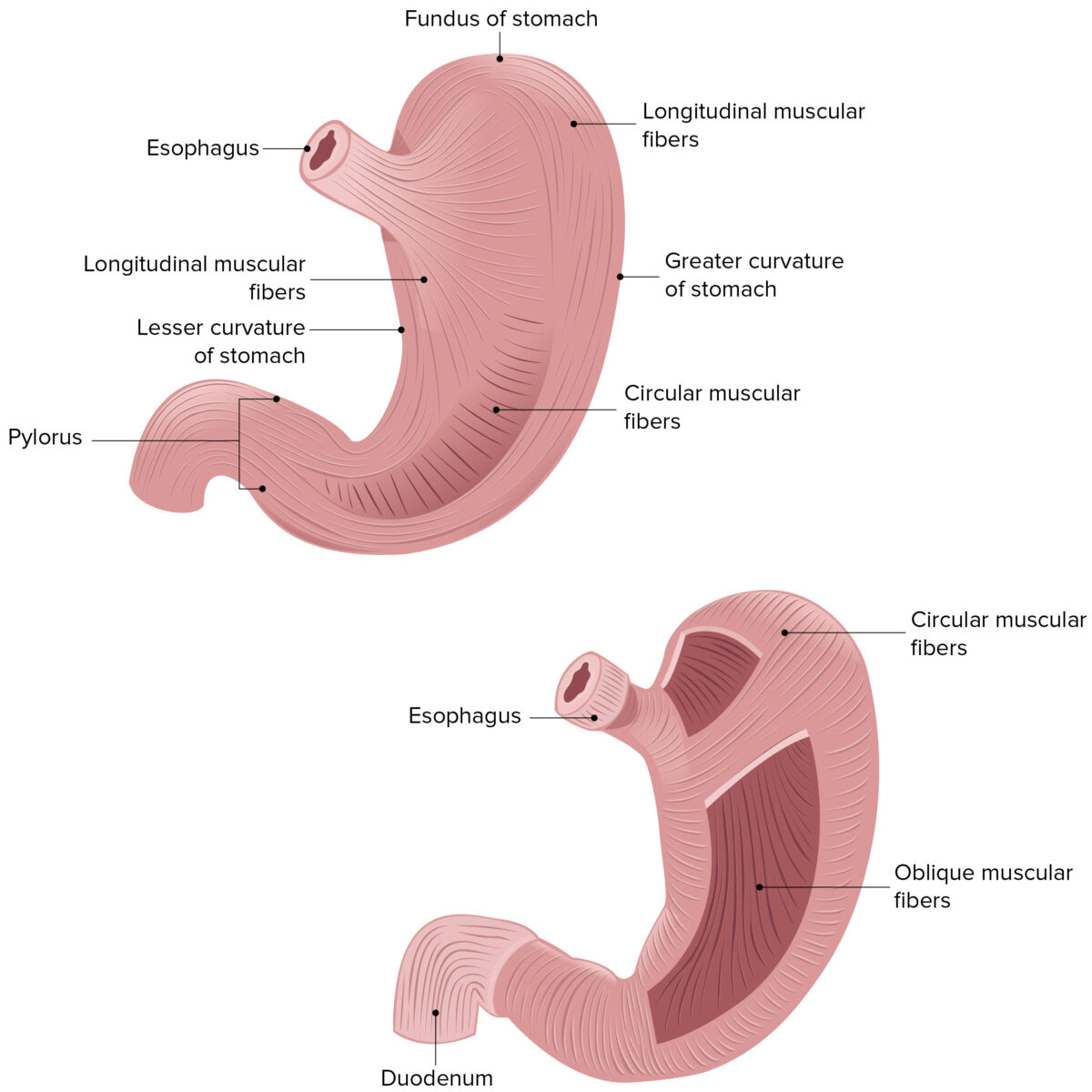
  • Órgano en EN Erythema nodosum is an immune-mediated panniculitis (inflammation of the subcutaneous fat) caused by a type IV (delayed-type) hypersensitivity reaction. It commonly manifests in young women as tender, erythematous nodules on the shins. Erythema Nodosum forma de saco y de C
  • Volumen interno:
    • Aproximadamente 50 ml cuando está vacío
    • Hasta 4 L cuando está lleno

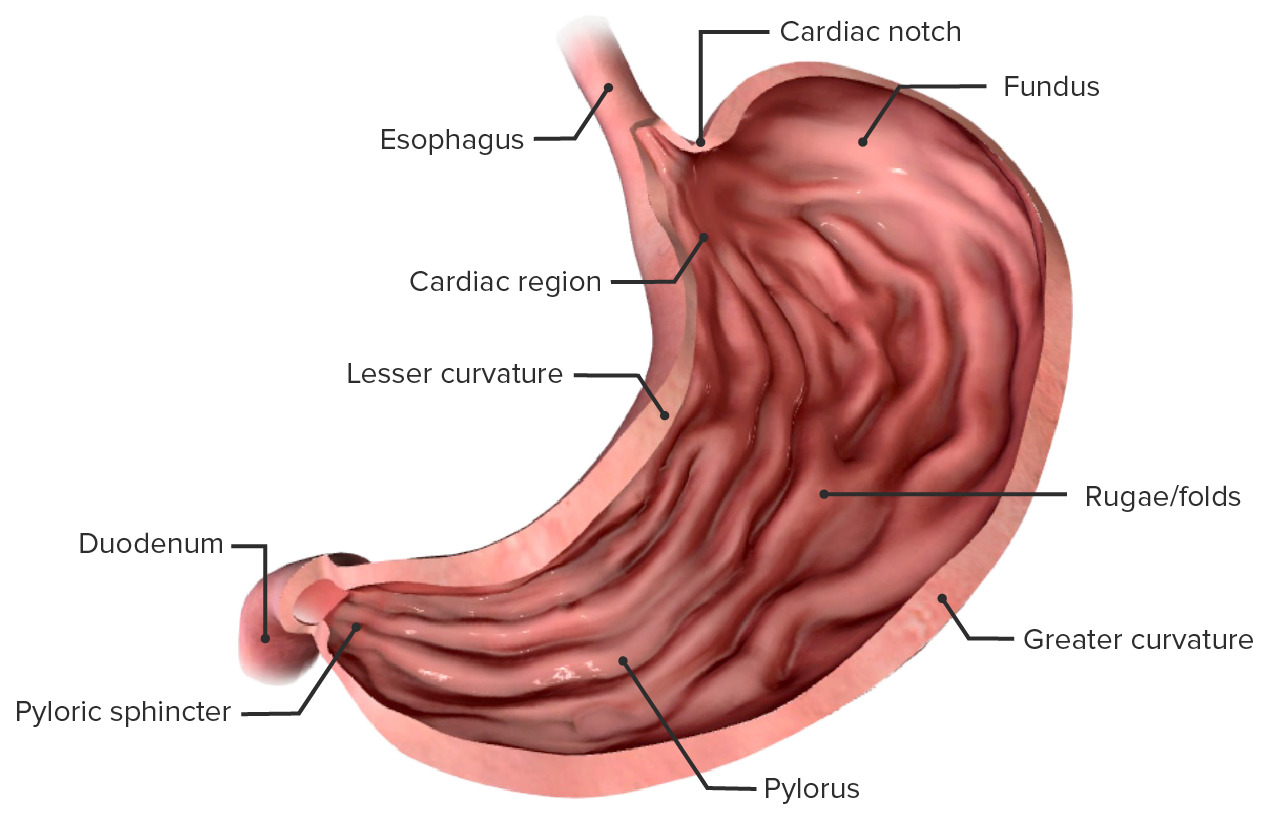
Partes del estómago y puntos de referencia anatómicos

  • Cardias:
    • Entrada del estómago
    • Adyacente al AL Amyloidosis esfínter esofágico inferior
  • Fundus Fundus The superior portion of the body of the stomach above the level of the cardiac notch. Stomach: Anatomy: región en EN Erythema nodosum is an immune-mediated panniculitis (inflammation of the subcutaneous fat) caused by a type IV (delayed-type) hypersensitivity reaction. It commonly manifests in young women as tender, erythematous nodules on the shins. Erythema Nodosum forma de cúpula ubicada en EN Erythema nodosum is an immune-mediated panniculitis (inflammation of the subcutaneous fat) caused by a type IV (delayed-type) hypersensitivity reaction. It commonly manifests in young women as tender, erythematous nodules on the shins. Erythema Nodosum el punto más alto del estómago, por encima de la abertura cardíaca
  • Cuerpo:
    • Sección principal del estómago
    • Se extiende desde el fundus Fundus The superior portion of the body of the stomach above the level of the cardiac notch. Stomach: Anatomy hasta el píloro
    • Limitado por las curvaturas menor y mayor
    • Contiene pliegues gruesos llamados rugosidades
  • Píloro (también llamado antro):
    • Se conecta al AL Amyloidosis duodeno a través del esfínter pilórico
    • Consiste en EN Erythema nodosum is an immune-mediated panniculitis (inflammation of the subcutaneous fat) caused by a type IV (delayed-type) hypersensitivity reaction. It commonly manifests in young women as tender, erythematous nodules on the shins. Erythema Nodosum un antro pilórico más ancho y un canal pilórico más estrecho
  • Curvatura menor:
  • Curvatura mayor:
  • Muesca cardíaca: ángulo creado entre el esófago y el fundus Fundus The superior portion of the body of the stomach above the level of the cardiac notch. Stomach: Anatomy
  • Incisura angular: muesca en EN Erythema nodosum is an immune-mediated panniculitis (inflammation of the subcutaneous fat) caused by a type IV (delayed-type) hypersensitivity reaction. It commonly manifests in young women as tender, erythematous nodules on the shins. Erythema Nodosum la curvatura menor en EN Erythema nodosum is an immune-mediated panniculitis (inflammation of the subcutaneous fat) caused by a type IV (delayed-type) hypersensitivity reaction. It commonly manifests in young women as tender, erythematous nodules on the shins. Erythema Nodosum la región pilórica
  • Lumen: espacio dentro de las paredes del estómago
Componentes anatómicos del estómago.

Componentes anatómicos del estómago

Imagen por BioDigital, editado por Lecturio

Localización

  • Cuadrante superior izquierdo de la cavidad peritoneal
  • Conectado a:
    • El esófago en EN Erythema nodosum is an immune-mediated panniculitis (inflammation of the subcutaneous fat) caused by a type IV (delayed-type) hypersensitivity reaction. It commonly manifests in young women as tender, erythematous nodules on the shins. Erythema Nodosum su extremo proximal
    • El duodeno en EN Erythema nodosum is an immune-mediated panniculitis (inflammation of the subcutaneous fat) caused by a type IV (delayed-type) hypersensitivity reaction. It commonly manifests in young women as tender, erythematous nodules on the shins. Erythema Nodosum su extremo distal

Relaciones anatómicas

El estómago está en EN Erythema nodosum is an immune-mediated panniculitis (inflammation of the subcutaneous fat) caused by a type IV (delayed-type) hypersensitivity reaction. It commonly manifests in young women as tender, erythematous nodules on the shins. Erythema Nodosum contacto directo con una serie de otros órganos, que incluyen:
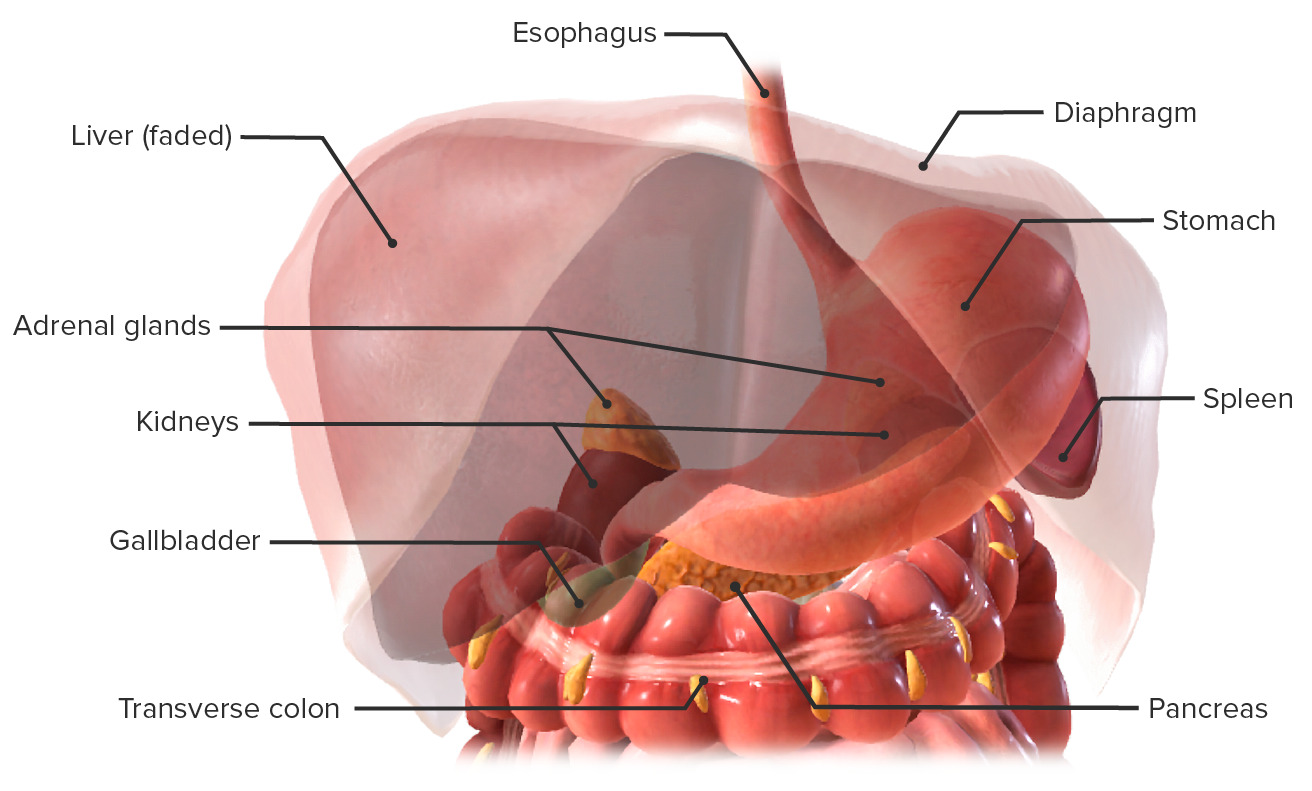
  • Cúpula diafragmática → fundus Fundus The superior portion of the body of the stomach above the level of the cardiac notch. Stomach: Anatomy y curvatura mayor
  • Lóbulo izquierdo del hígado → lado derecho y ventral del estómago
  • Bazo → mitad posterior izquierda del estómago
  • Cola del páncreas → cara dorsal del estómago
  • Colon Colon The large intestines constitute the last portion of the digestive system. The large intestine consists of the cecum, appendix, colon (with ascending, transverse, descending, and sigmoid segments), rectum, and anal canal. The primary function of the colon is to remove water and compact the stool prior to expulsion from the body via the rectum and anal canal. Colon, Cecum, and Appendix: Anatomy transverso → superficies posterior e inferior del cuerpo y píloro
  • Riñón izquierdo y glándula suprarrenal → superficie posterior del cuerpo gástrico

Estómago in situ y las relaciones con sus estructuras vecinas

Imagen por BioDigital, editado por Lecturio
Anatomía Microscópica

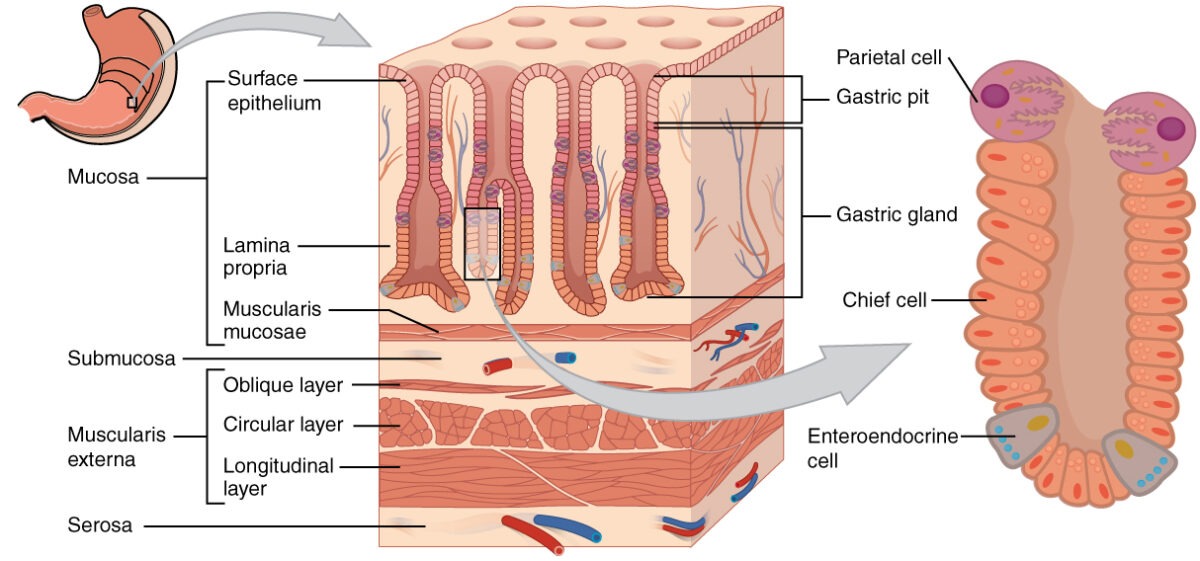
Capas de la pared del estómago

  • Mucosa:
    • Consta de 3 subcapas:
      • Epitelio cilíndrico simple (revestimiento más interno)
      • Lámina propia
      • Muscular de la mucosa
    • Fosas gástricas:
      • Depresiones en EN Erythema nodosum is an immune-mediated panniculitis (inflammation of the subcutaneous fat) caused by a type IV (delayed-type) hypersensitivity reaction. It commonly manifests in young women as tender, erythematous nodules on the shins. Erythema Nodosum la mucosa que conducen a las glándulas gástricas dentro de la lámina propia
      • Se abren hacia el lumen
    • Yace en EN Erythema nodosum is an immune-mediated panniculitis (inflammation of the subcutaneous fat) caused by a type IV (delayed-type) hypersensitivity reaction. It commonly manifests in young women as tender, erythematous nodules on the shins. Erythema Nodosum pliegues, llamados rugosidades, cuando el estómago está vacío
    • Las rugosidades se estiran y aplanan cuando se llena el estómago.
  • Submucosa:
    • Contiene el plexo nervioso submucoso (plexo de Meissner), que controla la muscular de la mucosa
    • Formada por tejido conectivo
  • Muscular externa:
    • Tiene 3 capas:
      • Capa oblicua (la más interna)
      • Capa circular (media)
      • Capa longitudinal (externa)
    • Contiene (y es controlado por) el plexo nervioso mientérico (plexo de Auerbach) entre las capas longitudinal y circular
    • Importante para la motilidad y la digestión mecánica
  • Serosa: capa externa de tejido conectivo

Glándulas gástricas

Características generales:

  • En EN Erythema nodosum is an immune-mediated panniculitis (inflammation of the subcutaneous fat) caused by a type IV (delayed-type) hypersensitivity reaction. It commonly manifests in young women as tender, erythematous nodules on the shins. Erythema Nodosum su mayoría glándulas exocrinas (secretan productos en EN Erythema nodosum is an immune-mediated panniculitis (inflammation of the subcutaneous fat) caused by a type IV (delayed-type) hypersensitivity reaction. It commonly manifests in young women as tender, erythematous nodules on the shins. Erythema Nodosum un espacio luminal en EN Erythema nodosum is an immune-mediated panniculitis (inflammation of the subcutaneous fat) caused by a type IV (delayed-type) hypersensitivity reaction. It commonly manifests in young women as tender, erythematous nodules on the shins. Erythema Nodosum lugar del torrente sanguíneo)
  • Localizadas debajo de las fosas gástricas dentro de la mucosa gástrica
  • Múltiples glándulas se abren en EN Erythema nodosum is an immune-mediated panniculitis (inflammation of the subcutaneous fat) caused by a type IV (delayed-type) hypersensitivity reaction. It commonly manifests in young women as tender, erythematous nodules on the shins. Erythema Nodosum una sola fosa gástrica (que se abre hacia la luz del estómago).
  • Región del cuello: área donde las glándulas gástricas se abren hacia las fosas gástricas

Tipos de glándulas:

  • Glándulas cardíacas y pilóricas:
    • Situadas en EN Erythema nodosum is an immune-mediated panniculitis (inflammation of the subcutaneous fat) caused by a type IV (delayed-type) hypersensitivity reaction. It commonly manifests in young women as tender, erythematous nodules on the shins. Erythema Nodosum las regiones gástricas del cardias y pilórica, respectivamente
    • Secretan moco
  • Glándulas gástricas:
    • Glándulas en EN Erythema nodosum is an immune-mediated panniculitis (inflammation of the subcutaneous fat) caused by a type IV (delayed-type) hypersensitivity reaction. It commonly manifests in young women as tender, erythematous nodules on the shins. Erythema Nodosum el fundus Fundus The superior portion of the body of the stomach above the level of the cardiac notch. Stomach: Anatomy y el cuerpo
    • Contienen múltiples tipos de células → múltiples productos secretores

Tipos de células dentro de las glándulas:

Comprende (de superficie a profundidad):
  • Células mucosas superficiales:
    • Recubren las fosas gástricas
    • Células columnares simples
    • Aparecen claro en EN Erythema nodosum is an immune-mediated panniculitis (inflammation of the subcutaneous fat) caused by a type IV (delayed-type) hypersensitivity reaction. It commonly manifests in young women as tender, erythematous nodules on the shins. Erythema Nodosum la tinción de hematoxilina eosina
    • Secretan un moco insoluble:
      • Forma una barrera protectora contra el ambiente ácido del estómago
      • Concentra bicarbonato en EN Erythema nodosum is an immune-mediated panniculitis (inflammation of the subcutaneous fat) caused by a type IV (delayed-type) hypersensitivity reaction. It commonly manifests in young women as tender, erythematous nodules on the shins. Erythema Nodosum el moco
  • Células mucosas del cuello:
    • Localizadas en EN Erythema nodosum is an immune-mediated panniculitis (inflammation of the subcutaneous fat) caused by a type IV (delayed-type) hypersensitivity reaction. It commonly manifests in young women as tender, erythematous nodules on the shins. Erythema Nodosum el cuello de las glándulas, donde se unen a las fosas gástricas
    • Secretan un moco soluble
    • Núcleos de tinción más oscura que las células mucosas superficiales
  • Células madre:
    • Se encuentran entre las fosas y la entrada de las glándulas
    • Producen nuevas células para reemplazar tanto las células mucosas superficiales en EN Erythema nodosum is an immune-mediated panniculitis (inflammation of the subcutaneous fat) caused by a type IV (delayed-type) hypersensitivity reaction. It commonly manifests in young women as tender, erythematous nodules on the shins. Erythema Nodosum las fosas como las células glandulares debajo
    • Las células epiteliales del estómago se reemplazan cada 3–6 días.
  • Células parietales:
    • Localizadas en EN Erythema nodosum is an immune-mediated panniculitis (inflammation of the subcutaneous fat) caused by a type IV (delayed-type) hypersensitivity reaction. It commonly manifests in young women as tender, erythematous nodules on the shins. Erythema Nodosum la región media de las glándulas
    • Eosinofílicas (tinción rosa en EN Erythema nodosum is an immune-mediated panniculitis (inflammation of the subcutaneous fat) caused by a type IV (delayed-type) hypersensitivity reaction. It commonly manifests in young women as tender, erythematous nodules on the shins. Erythema Nodosum hematoxilina eosina)
    • Secretan HCl HCL Hairy cell leukemia (HCL) is a rare, chronic, B-cell leukemia characterized by the accumulation of small mature B lymphocytes that have “hair-like projections” visible on microscopy. The abnormal cells accumulate in the peripheral blood, bone marrow (causing fibrosis), and red pulp of the spleen, leading to cytopenias. Hairy Cell Leukemia y factor intrínseco
  • Células principales:
    • Células glandulares más numerosas
    • Localizadas en EN Erythema nodosum is an immune-mediated panniculitis (inflammation of the subcutaneous fat) caused by a type IV (delayed-type) hypersensitivity reaction. It commonly manifests in young women as tender, erythematous nodules on the shins. Erythema Nodosum las bases Bases Usually a hydroxide of lithium, sodium, potassium, rubidium or cesium, but also the carbonates of these metals, ammonia, and the amines. Acid-Base Balance de las glándulas
    • Basófilas (tinción azul en EN Erythema nodosum is an immune-mediated panniculitis (inflammation of the subcutaneous fat) caused by a type IV (delayed-type) hypersensitivity reaction. It commonly manifests in young women as tender, erythematous nodules on the shins. Erythema Nodosum hematoxilina eosina)
    • Secretan pepsinógeno y lipasa gástrica
  • Células enteroendocrinas:
    • Localizadas en EN Erythema nodosum is an immune-mediated panniculitis (inflammation of the subcutaneous fat) caused by a type IV (delayed-type) hypersensitivity reaction. It commonly manifests in young women as tender, erythematous nodules on the shins. Erythema Nodosum las bases Bases Usually a hydroxide of lithium, sodium, potassium, rubidium or cesium, but also the carbonates of these metals, ammonia, and the amines. Acid-Base Balance de las glándulas
    • Producen diferentes tipos de hormonas

Irrigación e Inervación

Irrigación arterial

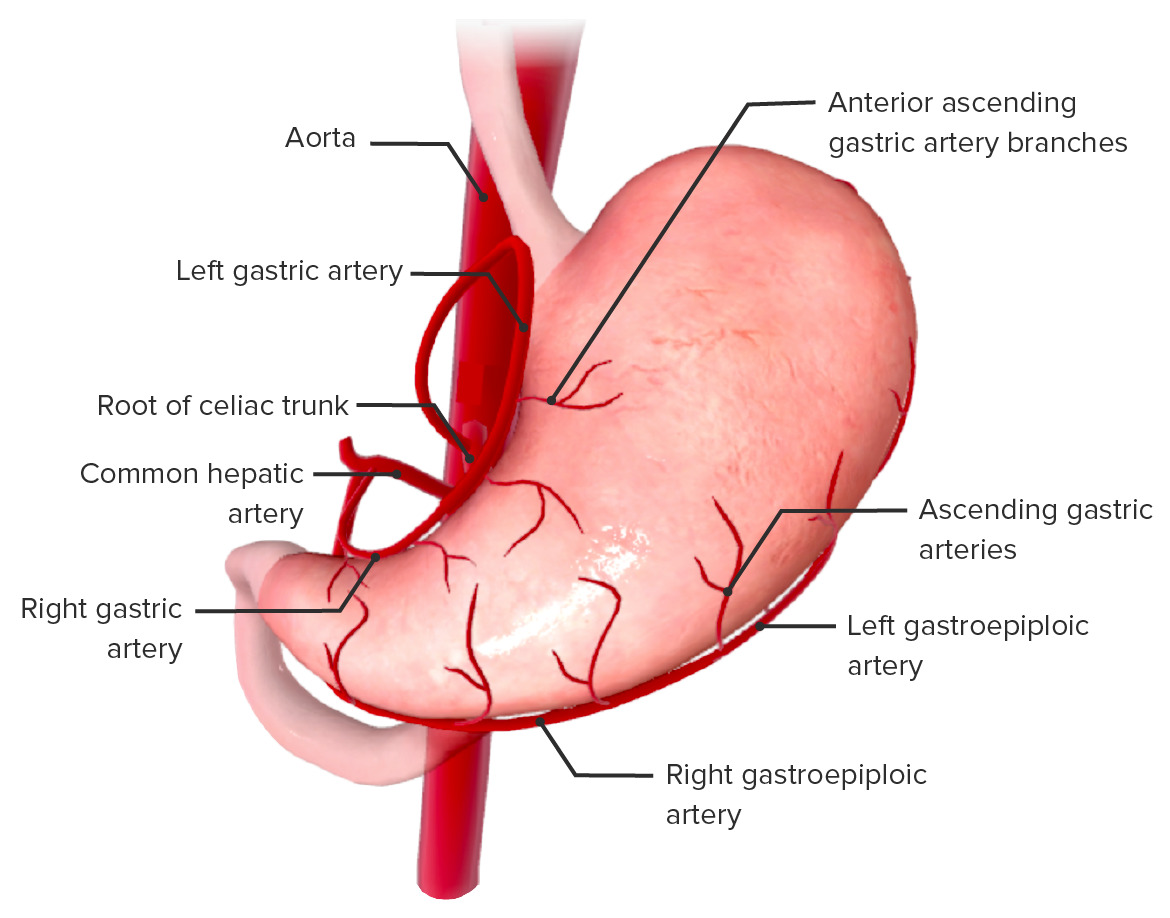
  • La irrigación arterial es del tronco celíaco.
  • Los LOS Neisseria vasos forman 2 bucles anastomóticos a lo largo de las curvaturas mayor y menor.
  • Arco vascular de la curvatura menor:
    • Arteria gástrica izquierda: directamente del tronco celíaco
    • Arteria gástrica derecha: sale de la arteria hepática (una rama del tronco celíaco)
  • Arco vascular de la curvatura mayor:
    • Arteria gastroepiploica izquierda: rama de la arteria esplénica (que es una rama del tronco celíaco)
    • Arteria gastroepiploica derecha: se ramifica de la arteria gastroduodenal (una rama de la arteria hepática)
    • Nota: Las arterias gastroepiploicas izquierda y derecha también se conocen como arterias gastroomentales.
  • Arterias gástricas cortas:
    • Surgen de la arteria esplénica terminal y de la arteria gastroepiploica izquierda
    • Irrigan el fundus Fundus The superior portion of the body of the stomach above the level of the cardiac notch. Stomach: Anatomy del estómago
Irrigación arterial del estómago

Imagen que muestra la irrigación del estómago

Imagen por BioDigital, editado por Lecturio
Drenaje venoso

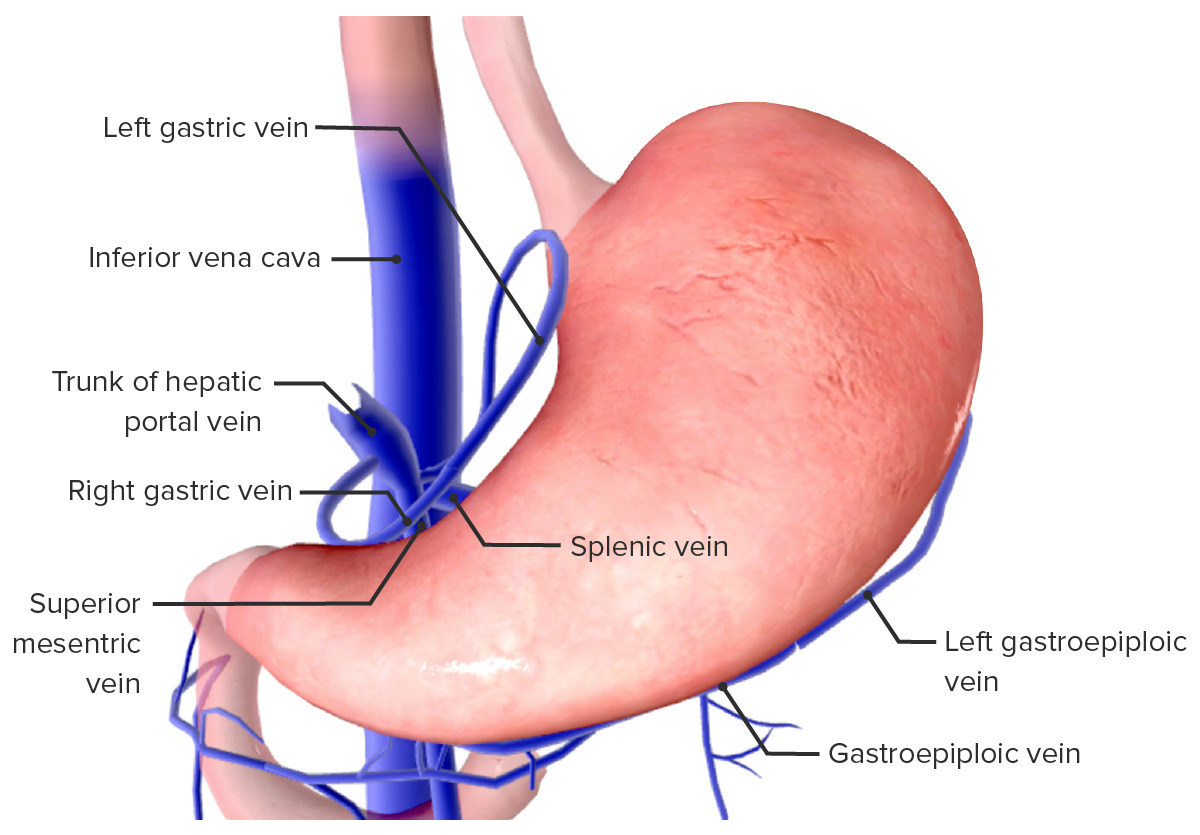
  • Por venas homónimas que acompañan a las arterias
  • Curvatura menor: venas gástricas derecha e izquierda → drenan en EN Erythema nodosum is an immune-mediated panniculitis (inflammation of the subcutaneous fat) caused by a type IV (delayed-type) hypersensitivity reaction. It commonly manifests in young women as tender, erythematous nodules on the shins. Erythema Nodosum la vena porta
  • Curvatura mayor:
    • Vena gastroepiploica izquierda y las venas gástricas cortas → drenan en EN Erythema nodosum is an immune-mediated panniculitis (inflammation of the subcutaneous fat) caused by a type IV (delayed-type) hypersensitivity reaction. It commonly manifests in young women as tender, erythematous nodules on the shins. Erythema Nodosum la vena esplénica
    • Vena gastroepiploica derecha → drena en EN Erythema nodosum is an immune-mediated panniculitis (inflammation of the subcutaneous fat) caused by a type IV (delayed-type) hypersensitivity reaction. It commonly manifests in young women as tender, erythematous nodules on the shins. Erythema Nodosum la vena mesentérica superior
Drenaje venoso del estómago.

Drenaje venoso del estómago

Imagen por BioDigital, editado por Lecturio

Drenaje linfático

Los LOS Neisseria ganglios linfáticos que drenan el estómago están dispuestos en EN Erythema nodosum is an immune-mediated panniculitis (inflammation of the subcutaneous fat) caused by a type IV (delayed-type) hypersensitivity reaction. It commonly manifests in young women as tender, erythematous nodules on the shins. Erythema Nodosum una red compleja.

  • Los LOS Neisseria vasos linfáticos dentro de la mucosa y la submucosa recogen la linfa.
  • Drenan en EN Erythema nodosum is an immune-mediated panniculitis (inflammation of the subcutaneous fat) caused by a type IV (delayed-type) hypersensitivity reaction. It commonly manifests in young women as tender, erythematous nodules on the shins. Erythema Nodosum los LOS Neisseria ganglios linfáticos perigástricos circundantes inmediatos:
    • Ganglios linfáticos paracardiacos derecho e izquierdo
    • Ganglios linfáticos suprapilóricos e infrapilóricos
  • Los LOS Neisseria ganglios linfáticos perigástricos drenan en EN Erythema nodosum is an immune-mediated panniculitis (inflammation of the subcutaneous fat) caused by a type IV (delayed-type) hypersensitivity reaction. It commonly manifests in young women as tender, erythematous nodules on the shins. Erythema Nodosum los LOS Neisseria ganglios y vasos linfáticos, que corren a lo largo de la vasculatura que irriga el estómago:
    • Arteria gástrica izquierda
    • Arteria hepática común
    • Vasos celíacos
    • Arteria esplénica
  • Finalmente, drenan en EN Erythema nodosum is an immune-mediated panniculitis (inflammation of the subcutaneous fat) caused by a type IV (delayed-type) hypersensitivity reaction. It commonly manifests in young women as tender, erythematous nodules on the shins. Erythema Nodosum los LOS Neisseria ganglios linfáticos paraaórticos

Inervación

El estómago está inervado por el sistema nervioso autónomo.
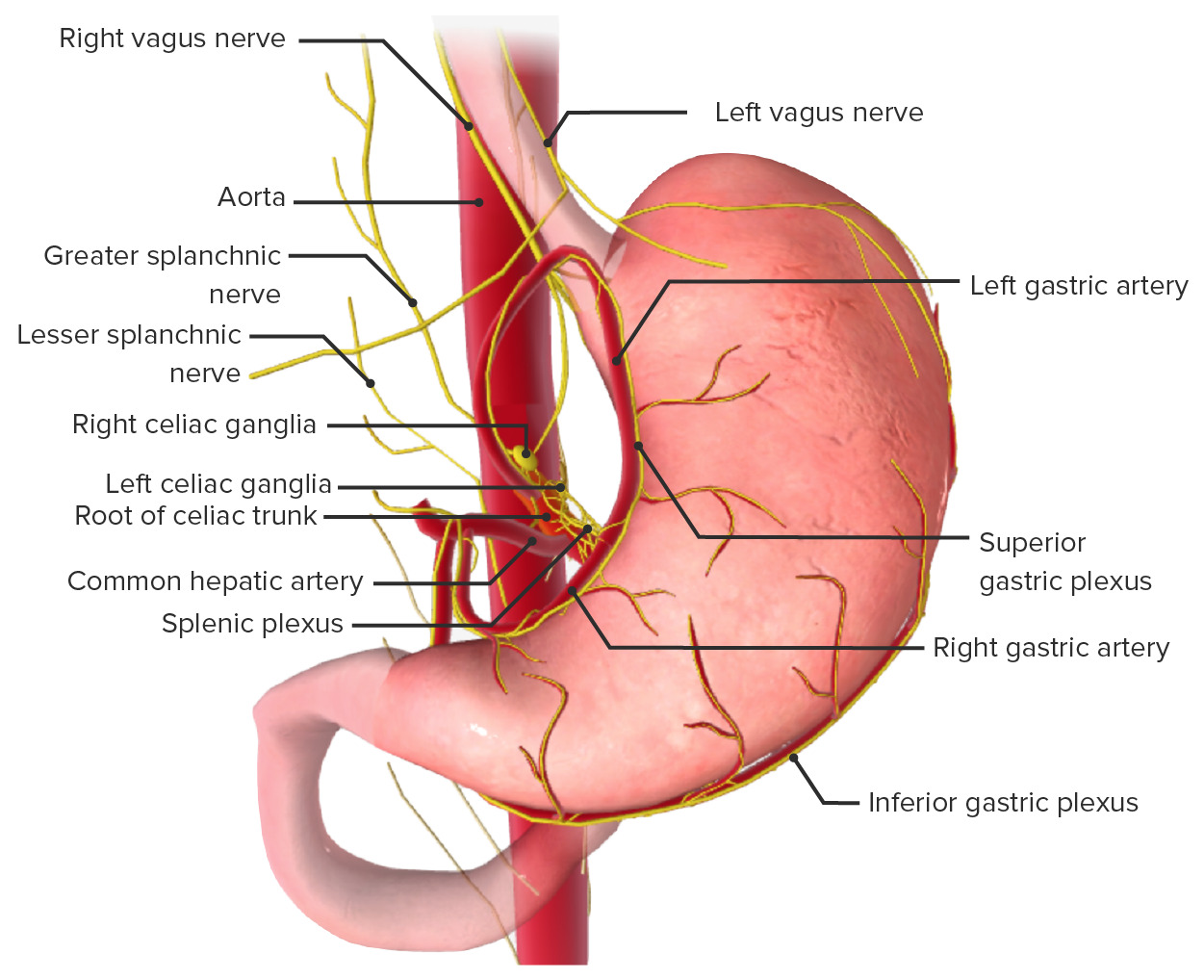
  • Inervación parasimpática: troncos anterior y posterior del nervio vago (estimulador)
  • Inervación simpática: nervio esplácnico mayor (inhibe la actividad digestiva del estómago)
Inervación del estómago

Inervación del estómago

Imagen por BioDigital, editado por Lecturio

Relevancia Clínica

  • Gastritis Gastritis Gastritis refers to inflammation of the gastric mucosa. Gastritis may occur suddenly (acute gastritis) or slowly over time (chronic gastritis). Gastritis may be asymptomatic or with symptoms, including burning abdominal pain (which either worsens or improves with eating), dyspepsia, nausea, and vomiting. Gastritis aguda: inflamación asociada a lesión de la mucosa gástrica. Las causas más comunes de gastritis Gastritis Gastritis refers to inflammation of the gastric mucosa. Gastritis may occur suddenly (acute gastritis) or slowly over time (chronic gastritis). Gastritis may be asymptomatic or with symptoms, including burning abdominal pain (which either worsens or improves with eating), dyspepsia, nausea, and vomiting. Gastritis aguda incluyen infección por Helicobacter pylori Helicobacter pylori A spiral bacterium active as a human gastric pathogen. It is a gram-negative, urease-positive, curved or slightly spiral organism initially isolated in 1982 from patients with lesions of gastritis or peptic ulcers in Western Australia. Helicobacter pylori was originally classified in the genus campylobacter, but RNA sequencing, cellular fatty acid profiles, growth patterns, and other taxonomic characteristics indicate that the micro-organism should be included in the genus Helicobacter. It has been officially transferred to Helicobacter gen. Helicobacter y reacciones inmunomediadas, aunque el alcohol, medicamentos (como los LOS Neisseria antiinflamatorios no esteroideos (AINE)) y la isquemia también pueden ser causantes; con frecuencia la etiología es desconocida. Los LOS Neisseria signos y síntomas clínicos incluyen vómitos, malestar/ dolor Dolor Inflammation abdominal y acidez estomacal. La endoscopia con biopsia de mucosa gástrica es la mejor herramienta para el diagnóstico.
  • Úlcera gástrica: defecto de la mucosa gástrica que se extiende hacia su capa muscular, con mayor frecuencia en EN Erythema nodosum is an immune-mediated panniculitis (inflammation of the subcutaneous fat) caused by a type IV (delayed-type) hypersensitivity reaction. It commonly manifests in young women as tender, erythematous nodules on the shins. Erythema Nodosum la curvatura menor y el antro del estómago. La mayoría de las úlceras gástricas son causadas por una infección por H. pylori H. pylori A spiral bacterium active as a human gastric pathogen. It is a gram-negative, urease-positive, curved or slightly spiral organism initially isolated in 1982 from patients with lesions of gastritis or peptic ulcers in Western Australia. Helicobacter pylori was originally classified in the genus campylobacter, but RNA sequencing, cellular fatty acid profiles, growth patterns, and other taxonomic characteristics indicate that the micro-organism should be included in the genus Helicobacter. It has been officially transferred to Helicobacter gen. Helicobacter. Los LOS Neisseria síntomas más comunes son dolor Dolor Inflammation epigástrico que empeora al AL Amyloidosis comer, plenitud epigástrica, saciedad temprana, intolerancia a alimentos grasos, náuseas y vómitos ocasionales. El diagnóstico se confirma con endoscopia.
  • Cáncer gástrico: neoplasia del estómago. El adenocarcinoma es el tipo más común, pero los LOS Neisseria tipos adicionales incluyen linfoma y tumores del estroma gastrointestinal y carcinoides. El cáncer gástrico típicamente se presenta con pérdida de peso, disfagia, dolor Dolor Inflammation abdominal vago, náuseas y saciedad temprana. La endoscopia superior con biopsia es el estándar de oro para el diagnóstico.
  • Estenosis pilórica: caracterizada por hipertrofia e hiperplasia del esfínter pilórico en EN Erythema nodosum is an immune-mediated panniculitis (inflammation of the subcutaneous fat) caused by a type IV (delayed-type) hypersensitivity reaction. It commonly manifests in young women as tender, erythematous nodules on the shins. Erythema Nodosum los LOS Neisseria primeros meses de vida. La estenosis pilórica es la causa más frecuente de obstrucción de la salida gástrica en EN Erythema nodosum is an immune-mediated panniculitis (inflammation of the subcutaneous fat) caused by a type IV (delayed-type) hypersensitivity reaction. It commonly manifests in young women as tender, erythematous nodules on the shins. Erythema Nodosum lactantes. La presentación clínica incluye vómitos posprandiales no biliosos y enérgicos (a menudo descritos como vómitos en EN Erythema nodosum is an immune-mediated panniculitis (inflammation of the subcutaneous fat) caused by a type IV (delayed-type) hypersensitivity reaction. It commonly manifests in young women as tender, erythematous nodules on the shins. Erythema Nodosum “proyectil”); una masa en EN Erythema nodosum is an immune-mediated panniculitis (inflammation of the subcutaneous fat) caused by a type IV (delayed-type) hypersensitivity reaction. It commonly manifests in young women as tender, erythematous nodules on the shins. Erythema Nodosum forma de oliva puede ser palpable en EN Erythema nodosum is an immune-mediated panniculitis (inflammation of the subcutaneous fat) caused by a type IV (delayed-type) hypersensitivity reaction. It commonly manifests in young women as tender, erythematous nodules on the shins. Erythema Nodosum el epigastrio.

Referencias

  1. Le, T., Bhushan, V., Sochat, M., et al. (Eds.) (2021). First Aid for the USMLE Step 1, 31st ed., pp. 371–372. McGraw-Hill Education.
  2. Vakil, N.B. (2020). Peptic ulcer disease: Clinical manifestations and diagnosis. UpToDate. Retrieved August 15, 2021, from https://www.uptodate.com/contents/peptic-ulcer-disease-clinical-manifestations-and-diagnosis
  3. Kapoor, V.K. (2017). Stomach anatomy. Medscape. Retrieved August 15, 2021, from https://emedicine.medscape.com/article/1899301-overview#a2
  4. Hebbard, P. (2021). Partial gastrectomy and gastrointestinal reconstruction. UpToDate. Retrieved August 16, 2021, from https://www.uptodate.com/contents/partial-gastrectomy-and-gastrointestinal-reconstruction 
  5. Lirosi, M. C., Biondi, A., Ricci, R. (2017). Surgical anatomy of gastric lymphatic drainage. Translational Gastroenterology and Hepatology 2(3):14. Retrieved August 18, 2021, from https://doi.org/10.21037/tgh.2016.12.06

¡Crea tu cuenta gratis o inicia una sesión para seguir leyendo!

Regístrate ahora y obtén acceso gratuito a Lecturio con páginas de concepto, videos médicos y cuestionarios para tu educación médica.

User Reviews

Que tengas una sesión de estudio alegre y navideña 🎁 Ahorra 50% en todos los planes >>

Details