Domina Conceptos Médicos

Estudia para la escuela de medicina y tus examenes con Lecturio.

Escherichia Coli

La bacteria Bacteria Bacteria are prokaryotic single-celled microorganisms that are metabolically active and divide by binary fission. Some of these organisms play a significant role in the pathogenesis of diseases. Bacteriology gramnegativa Escherichia coli Escherichia coli The gram-negative bacterium Escherichia coli is a key component of the human gut microbiota. Most strains of E. coli are avirulent, but occasionally they escape the GI tract, infecting the urinary tract and other sites. Less common strains of E. coli are able to cause disease within the GI tract, most commonly presenting as abdominal pain and diarrhea. Escherichia coli es un componente clave de la microbiota intestinal humana. La mayoría de las cepas de E. coli son avirulentas, pero ocasionalmente se escapan del tracto gastrointestinal e infectan el tracto urinario y otros sitios. Cepas menos comunes de E. coli pueden causar enfermedades dentro del tracto gastrointestinal, que se presentan con mayor frecuencia como dolor Dolor Inflammation abdominal y diarrea. E. coli se transmite a través de una ruta fecal-oral, que puede ocurrir con la preparación de alimentos insalubres, la contaminación de la carne o los LOS Neisseria productos agrícolas con estiércol, el riego o el lavado de cultivos/frutas con agua contaminada y el consumo de agua contaminada.

Last updated: Dec 15, 2025
Editorial responsibility: Stanley Oiseth, Lindsay Jones, Evelin Maza

Clasificación

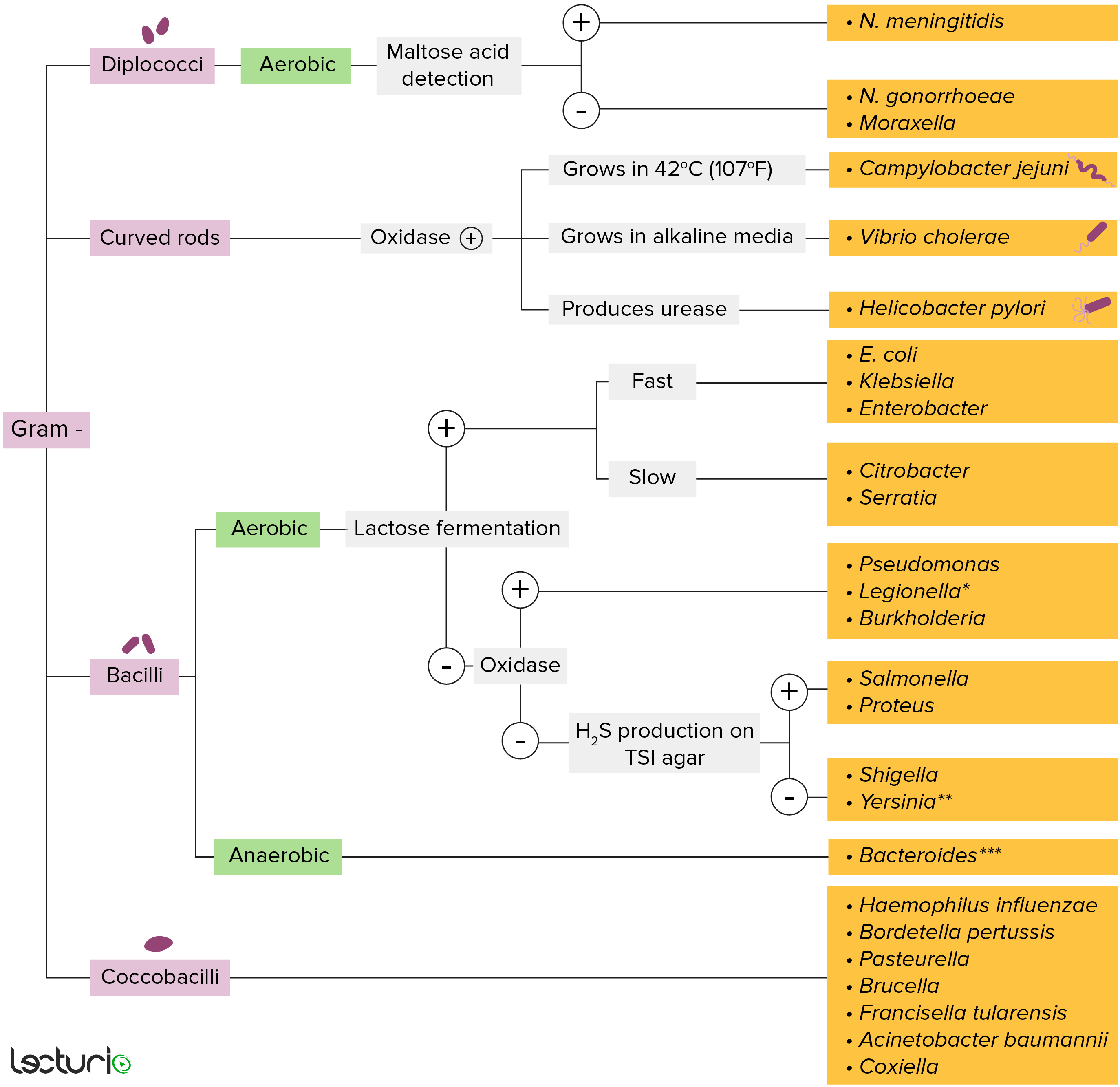
Diagrama de flujo de clasificación de bacterias gram negativas

Bacterias gram-negativas:
La mayoría de las bacterias se pueden clasificar de acuerdo con un procedimiento de laboratorio llamado tinción de Gram.
Las bacterias con paredes celulares que tienen una capa delgada de peptidoglicano no retienen la tinción de cristal violeta utilizada en la tinción de Gram. Sin embargo, estas bacterias retienen la contratinción de safranina y, por lo tanto, se tiñen de color rojo rosado, lo que las convierte en gram negativas. Estas bacterias pueden clasificarse además según su morfología (diplococos, bastones curvos, bacilos y cocobacilos) y su capacidad para crecer en presencia de oxígeno (aeróbicos frente a anaeróbicos). Las bacterias se pueden identificar de manera más estrecha cultivándolas en medios específicos (agar triple azúcar hierro (TSI, por sus siglas en inglés)) donde se pueden identificar sus enzimas (ureasa, oxidasa) y se puede probar su capacidad para fermentar lactosa.
* Se tiñe pobremente en la tinción de Gram
** Bastón pleomórfico/cocobacilo
*** Requieren medios de transporte especiales
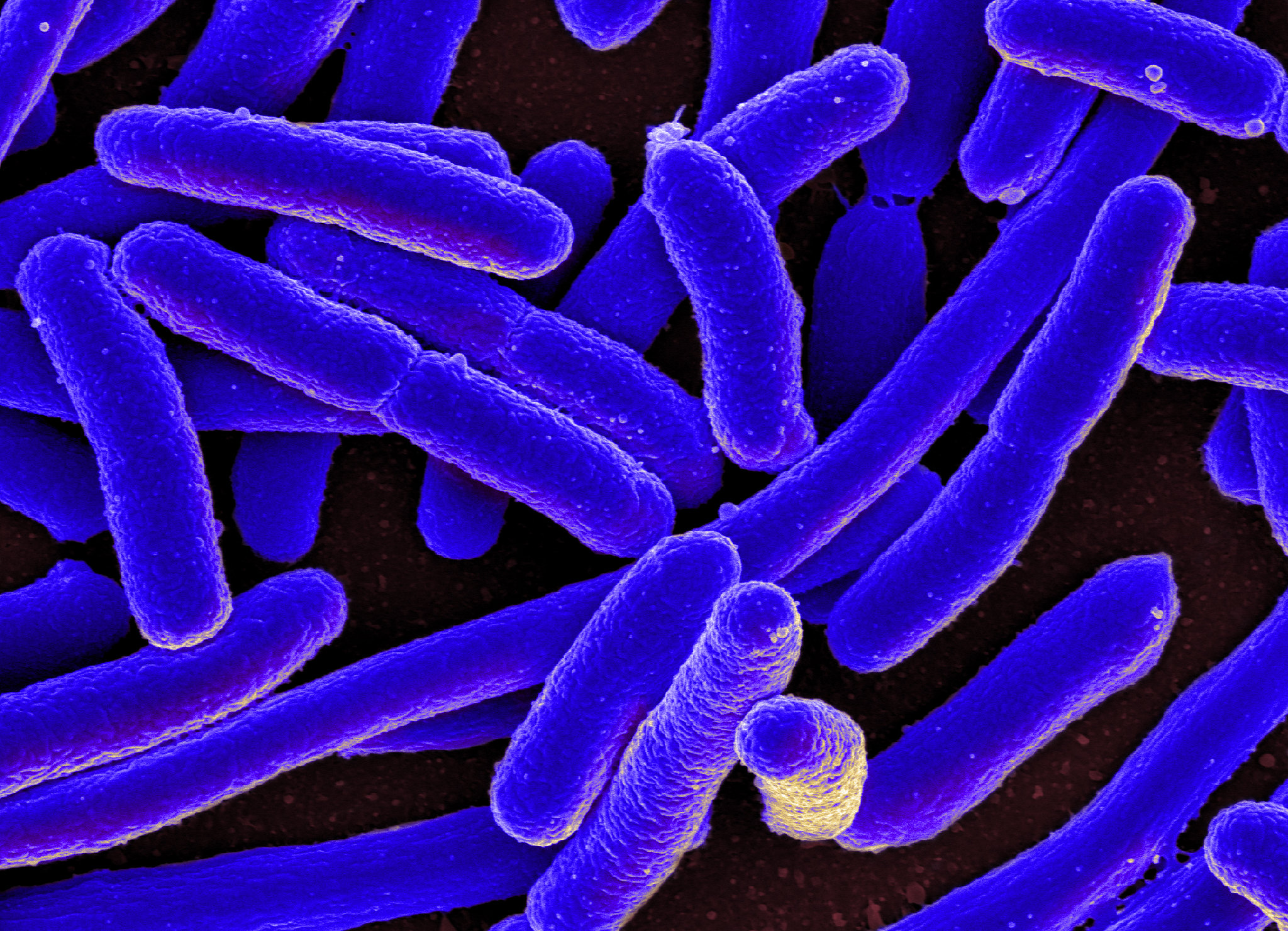
Imagen por Lecturio.

Características Generales

  • Características:
    • Tinción: gramnegativa
    • Morfología: bacilo (bastón)
    • Anaerobia facultativa
    • Inmóvil o móvil (flagelado)
    • Catalasa positiva
    • Fermenta la lactosa
  • Medios especiales y prueba bioquímica:
    • Agar MacConkey: crece como colonias rosadas
    • Agar eosina-azul de metileno: crece como colonias verdes metálicas
    • Prueba de indol positiva
Microfotografía de Escherichia coli

Microfotografía de Escherichia coli

Imagen: “E. coli Bacteria” por NIAID. Licencia: CC BY 2.0

Patogénesis y Factores de Virulencia

Virulencia

  • Estructuras antigénicas:
    • Antígeno O: componente del lipopolisacárido en EN Erythema nodosum is an immune-mediated panniculitis (inflammation of the subcutaneous fat) caused by a type IV (delayed-type) hypersensitivity reaction. It commonly manifests in young women as tender, erythematous nodules on the shins. Erythema Nodosum la pared celular
    • Antígeno H: proteína flagelar
    • Antígeno K: cápsula de polisacárido
  • Los LOS Neisseria factores de adherencia y las toxinas son específicos de la cepa de E. coli.

Variantes avirulentas de Escherichia coli Escherichia coli The gram-negative bacterium Escherichia coli is a key component of the human gut microbiota. Most strains of E. coli are avirulent, but occasionally they escape the GI tract, infecting the urinary tract and other sites. Less common strains of E. coli are able to cause disease within the GI tract, most commonly presenting as abdominal pain and diarrhea. Escherichia coli

  • Reservorio:
    • Los LOS Neisseria humanos son el reservorio primario.
    • Las cepas son parte de la flora intestinal normal.
  • Transmisión:
    • En EN Erythema nodosum is an immune-mediated panniculitis (inflammation of the subcutaneous fat) caused by a type IV (delayed-type) hypersensitivity reaction. It commonly manifests in young women as tender, erythematous nodules on the shins. Erythema Nodosum infecciones del tracto urinario (ITU):
      • La bacteria Bacteria Bacteria are prokaryotic single-celled microorganisms that are metabolically active and divide by binary fission. Some of these organisms play a significant role in the pathogenesis of diseases. Bacteriology asciende por la uretra para causar infección.
      • Más común en EN Erythema nodosum is an immune-mediated panniculitis (inflammation of the subcutaneous fat) caused by a type IV (delayed-type) hypersensitivity reaction. It commonly manifests in young women as tender, erythematous nodules on the shins. Erythema Nodosum mujeres o con uso de catéter
      • Fimbrias tipo 1 ( pili Pili Filamentous or elongated proteinaceous structures which extend from the cell surface in gram-negative bacteria that contain certain types of conjugative plasmid. These pili are the organs associated with genetic transfer and have essential roles in conjugation. Normally, only one or a few pili occur on a given donor cell. This preferred use of ‘pili’ refers to the sexual appendage, to be distinguished from bacterial fimbriae, also known as common pili, which are usually concerned with adhesion. Salmonella): factor de virulencia que permite la unión bacteriana a las células uroepiteliales.
    • En EN Erythema nodosum is an immune-mediated panniculitis (inflammation of the subcutaneous fat) caused by a type IV (delayed-type) hypersensitivity reaction. It commonly manifests in young women as tender, erythematous nodules on the shins. Erythema Nodosum la meningitis Meningitis Meningitis is inflammation of the meninges, the protective membranes of the brain, and spinal cord. The causes of meningitis are varied, with the most common being bacterial or viral infection. The classic presentation of meningitis is a triad of fever, altered mental status, and nuchal rigidity. Meningitis neonatal:
      • Lactante infectado con E. coli materna a través de ruptura de membranas o durante el parto
      • Polisacárido capsular K1: factor de virulencia en EN Erythema nodosum is an immune-mediated panniculitis (inflammation of the subcutaneous fat) caused by a type IV (delayed-type) hypersensitivity reaction. It commonly manifests in young women as tender, erythematous nodules on the shins. Erythema Nodosum la mayoría de los LOS Neisseria casos

Variantes patógenas de Escherichia coli Escherichia coli The gram-negative bacterium Escherichia coli is a key component of the human gut microbiota. Most strains of E. coli are avirulent, but occasionally they escape the GI tract, infecting the urinary tract and other sites. Less common strains of E. coli are able to cause disease within the GI tract, most commonly presenting as abdominal pain and diarrhea. Escherichia coli

  • Las cepas patógenas se encuentran de forma exógena y se introducen a través de la producción o preparación de alimentos antihigiénicos.
  • Transmisión:
    • Vía fecal-oral
    • Carne o productos contaminados
  • Emplean varios factores de virulencia para producir enfermedad, dependiendo del patógeno.
Tabla: Variantes patógenas de E. coli
Patógeno Factor de patogenia/virulencia Signos y Síntomas
E. coli enterotoxigénica
  • Las adhesinas fimbriales permiten la unión a la mucosa intestinal
  • La enterotoxina termolábil aumenta el AMPc → alteración del transporte de electrolitos (↑ secreción de cloruro) y diarrea
  • Enterotoxina termolábil: relacionado con la toxina del cólera
  • La enterotoxina termoestable aumenta el GMPc → diarrea
  • Sin inflamación ni invasión
Sin inflamación ni invasión → diarrea del viajero (acuosa)
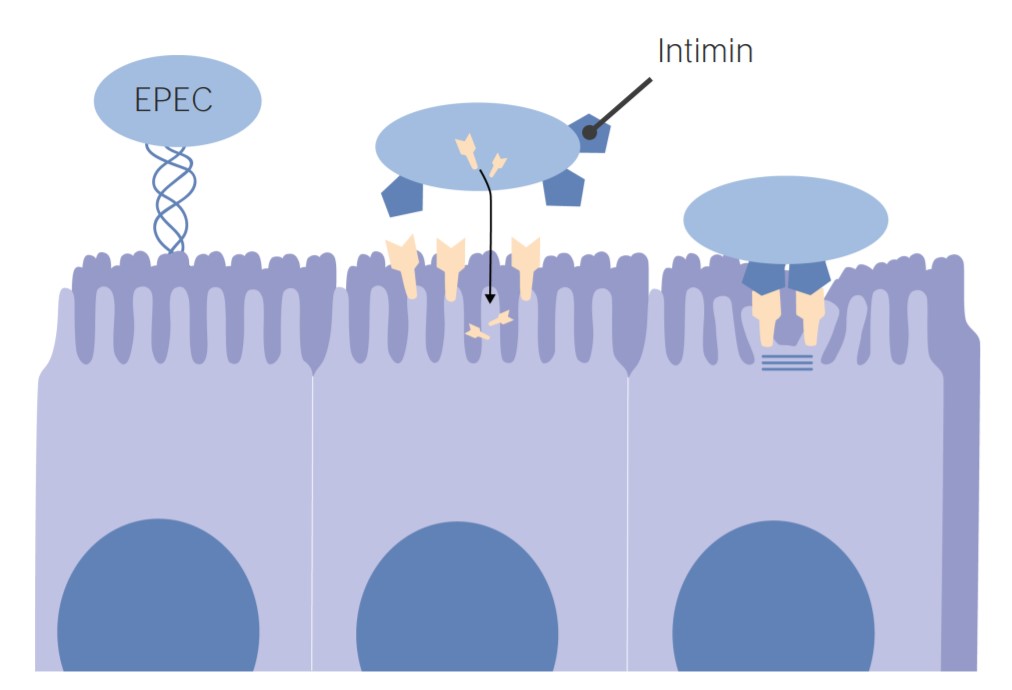
E. coli enteropatógena
  • Para la colonización, requiere pilus formadores de paquetes (codificados por un factor de adherencia de un plasmido de E. coli enteropatógena)
  • Lleva el locus Locus Specific regions that are mapped within a genome. Genetic loci are usually identified with a shorthand notation that indicates the chromosome number and the position of a specific band along the P or Q arm of the chromosome where they are found. For example the locus 6p21 is found within band 21 of the P-arm of chromosome 6. Many well known genetic loci are also known by common names that are associated with a genetic function or hereditary disease. Basic Terms of Genetics cromosómico de borramiento de enterocitos, que codifica la intimina, una adhesina específica que se une al AL Amyloidosis epitelio intestinal
  • Sin producción de toxinas
Inflamación leve → diarrea acuosa con mucosidad
E. coli enteroagregativa
  • Fimbrias de adherencia agregada para adherirse a la mucosa intestinal; forma una biopelícula
  • Patrón de adherencia de “ladrillos apilados”
  • Algunos poseen una enterotoxina termoestable, similar a E. coli enterotoxigénica
Inflamación leve → diarrea acuosa
E. coli enterohemorrágica
  • Se une al AL Amyloidosis epitelio intestinal a través de fimbrias bacterianas.
  • Emplea toxina Shiga codificada por fagos:
    • Citotóxica para las vellosidades intestinales y las células epiteliales del colon Colon The large intestines constitute the last portion of the digestive system. The large intestine consists of the cecum, appendix, colon (with ascending, transverse, descending, and sigmoid segments), rectum, and anal canal. The primary function of the colon is to remove water and compact the stool prior to expulsion from the body via the rectum and anal canal. Colon, Cecum, and Appendix: Anatomy
    • Inhibe la síntesis de proteínas → muerte celular
  • La cepa O157:H7 puede conducir al AL Amyloidosis síndrome urémico hemolítico.
Inflamación severa → disentería (diarrea con sangre)
E. coli enteroinvasiva Invasión directa del epitelio intestinal y formación de enterotoxinas → necrosis Necrosis The death of cells in an organ or tissue due to disease, injury or failure of the blood supply. Ischemic Cell Damage e inflamación Inflamación severa → disentería (diarrea sanguinolenta) similar a Shigella Shigella Shigella is a genus of gram-negative, non-lactose-fermenting facultative intracellular bacilli. Infection spreads most commonly via person-to-person contact or through contaminated food and water. Humans are the only known reservoir. Shigella

Enfermedades Asociadas

Infecciones del tracto urinario

  • La E. coli es la principal causa de infecciones urinarias en EN Erythema nodosum is an immune-mediated panniculitis (inflammation of the subcutaneous fat) caused by a type IV (delayed-type) hypersensitivity reaction. It commonly manifests in young women as tender, erythematous nodules on the shins. Erythema Nodosum las mujeres.
  • Diagnóstico: análisis de orina con urocultivo
  • Tratamiento: antibióticos (e.g., nitrofurantoína, trimetoprim-sulfametoxazol)

Meningitis Meningitis Meningitis is inflammation of the meninges, the protective membranes of the brain, and spinal cord. The causes of meningitis are varied, with the most common being bacterial or viral infection. The classic presentation of meningitis is a triad of fever, altered mental status, and nuchal rigidity. Meningitis neonatal

  • La E. coli puede causar meningitis Meningitis Meningitis is inflammation of the meninges, the protective membranes of the brain, and spinal cord. The causes of meningitis are varied, with the most common being bacterial or viral infection. The classic presentation of meningitis is a triad of fever, altered mental status, and nuchal rigidity. Meningitis y sepsis Sepsis Systemic inflammatory response syndrome with a proven or suspected infectious etiology. When sepsis is associated with organ dysfunction distant from the site of infection, it is called severe sepsis. When sepsis is accompanied by hypotension despite adequate fluid infusion, it is called septic shock. Sepsis and Septic Shock (que a menudo coexisten, o la sepsis Sepsis Systemic inflammatory response syndrome with a proven or suspected infectious etiology. When sepsis is associated with organ dysfunction distant from the site of infection, it is called severe sepsis. When sepsis is accompanied by hypotension despite adequate fluid infusion, it is called septic shock. Sepsis and Septic Shock puede preceder a la meningitis Meningitis Meningitis is inflammation of the meninges, the protective membranes of the brain, and spinal cord. The causes of meningitis are varied, with the most common being bacterial or viral infection. The classic presentation of meningitis is a triad of fever, altered mental status, and nuchal rigidity. Meningitis).
  • Signos y síntomas:
    • Fiebre
    • Fontanelas abombadas
    • Vómitos
    • Coma Coma Coma is defined as a deep state of unarousable unresponsiveness, characterized by a score of 3 points on the GCS. A comatose state can be caused by a multitude of conditions, making the precise epidemiology and prognosis of coma difficult to determine. Coma
    • Convulsiones
    • Reflejo de Moro pobre o ausente
    • Hipertonía o hipotonía
  • Diagnóstico: análisis del LCR que evidencia leucocitosis y glucosa baja y bacterias en EN Erythema nodosum is an immune-mediated panniculitis (inflammation of the subcutaneous fat) caused by a type IV (delayed-type) hypersensitivity reaction. It commonly manifests in young women as tender, erythematous nodules on the shins. Erythema Nodosum la tinción de Gram
  • Tratamiento: antibióticos (e.g., ceftriaxona)

Diarrea

  • E. coli enterotoxigénica:
    • La causa más común de diarrea del viajero a nivel mundial
    • La diarrea por lo general se presenta en EN Erythema nodosum is an immune-mediated panniculitis (inflammation of the subcutaneous fat) caused by a type IV (delayed-type) hypersensitivity reaction. It commonly manifests in young women as tender, erythematous nodules on the shins. Erythema Nodosum entornos de recursos limitados (especialmente con problemas de saneamiento)
    • Período de incubación corto que dura ≤ 5 días
    • Diarrea acuosa, secretora con náuseas y cólicos:
    • Diagnóstico: detección de enterotoxinas termolábiles o termoestables (por reacción en EN Erythema nodosum is an immune-mediated panniculitis (inflammation of the subcutaneous fat) caused by a type IV (delayed-type) hypersensitivity reaction. It commonly manifests in young women as tender, erythematous nodules on the shins. Erythema Nodosum cadena de la polimerasa ( PCR PCR Polymerase chain reaction (PCR) is a technique that amplifies DNA fragments exponentially for analysis. The process is highly specific, allowing for the targeting of specific genomic sequences, even with minuscule sample amounts. The PCR cycles multiple times through 3 phases: denaturation of the template DNA, annealing of a specific primer to the individual DNA strands, and synthesis/elongation of new DNA molecules. Polymerase Chain Reaction (PCR)))
    • El tratamiento es de soporte.
  • E. coli enteropatógena:
    • La E. coli enteropatógena es una de las principales causas de diarrea acuosa esporádica en EN Erythema nodosum is an immune-mediated panniculitis (inflammation of the subcutaneous fat) caused by a type IV (delayed-type) hypersensitivity reaction. It commonly manifests in young women as tender, erythematous nodules on the shins. Erythema Nodosum niños ( en EN Erythema nodosum is an immune-mediated panniculitis (inflammation of the subcutaneous fat) caused by a type IV (delayed-type) hypersensitivity reaction. It commonly manifests in young women as tender, erythematous nodules on the shins. Erythema Nodosum su mayoría < 2 años de edad) en EN Erythema nodosum is an immune-mediated panniculitis (inflammation of the subcutaneous fat) caused by a type IV (delayed-type) hypersensitivity reaction. It commonly manifests in young women as tender, erythematous nodules on the shins. Erythema Nodosum países en EN Erythema nodosum is an immune-mediated panniculitis (inflammation of the subcutaneous fat) caused by a type IV (delayed-type) hypersensitivity reaction. It commonly manifests in young women as tender, erythematous nodules on the shins. Erythema Nodosum vías de desarrollo.
    • Diarrea acuosa sin sangre ni pus
    • Diagnóstico: PCR PCR Polymerase chain reaction (PCR) is a technique that amplifies DNA fragments exponentially for analysis. The process is highly specific, allowing for the targeting of specific genomic sequences, even with minuscule sample amounts. The PCR cycles multiple times through 3 phases: denaturation of the template DNA, annealing of a specific primer to the individual DNA strands, and synthesis/elongation of new DNA molecules. Polymerase Chain Reaction (PCR) en EN Erythema nodosum is an immune-mediated panniculitis (inflammation of the subcutaneous fat) caused by a type IV (delayed-type) hypersensitivity reaction. It commonly manifests in young women as tender, erythematous nodules on the shins. Erythema Nodosum heces
    • El tratamiento es de soporte.
  • E. coli enteroagregativa:
    • E. coli enteroagregativa es la segunda causa más común de diarrea del viajero.
    • Resulta en EN Erythema nodosum is an immune-mediated panniculitis (inflammation of the subcutaneous fat) caused by a type IV (delayed-type) hypersensitivity reaction. It commonly manifests in young women as tender, erythematous nodules on the shins. Erythema Nodosum diarrea acuosa aguda y crónica en EN Erythema nodosum is an immune-mediated panniculitis (inflammation of the subcutaneous fat) caused by a type IV (delayed-type) hypersensitivity reaction. It commonly manifests in young women as tender, erythematous nodules on the shins. Erythema Nodosum pacientes con VIH y SIDA
    • Tratamiento: fluoroquinolonas para prevenir la infección crónica
  • E. coli enterohemorrágica (EHEC):
    • Principalmente, una infección transmitida por los LOS Neisseria alimentos
    • Diarrea dolorosa y sanguinolenta
    • La infección con la cepa O157:H7 puede provocar síndrome urémico hemolítico, una tríada de:
      • Anemia Anemia Anemia is a condition in which individuals have low Hb levels, which can arise from various causes. Anemia is accompanied by a reduced number of RBCs and may manifest with fatigue, shortness of breath, pallor, and weakness. Subtypes are classified by the size of RBCs, chronicity, and etiology. Anemia: Overview and Types hemolítica
      • Trombocitopenia
      • Insuficiencia renal aguda
    • Los LOS Neisseria niños son más propensos a desarrollar síndrome urémico hemolítico que los LOS Neisseria adultos.
    • Diagnóstico: detección de toxina Shiga por inmunoensayo enzimático o PCR PCR Polymerase chain reaction (PCR) is a technique that amplifies DNA fragments exponentially for analysis. The process is highly specific, allowing for the targeting of specific genomic sequences, even with minuscule sample amounts. The PCR cycles multiple times through 3 phases: denaturation of the template DNA, annealing of a specific primer to the individual DNA strands, and synthesis/elongation of new DNA molecules. Polymerase Chain Reaction (PCR)
    • Tratamiento:
      • De soporte
      • Evitar los LOS Neisseria antibióticos, ya que se han asociado con el desarrollo de síndrome urémico hemolítico.
  • E. coli enteroinvasiva:
    • Vista en EN Erythema nodosum is an immune-mediated panniculitis (inflammation of the subcutaneous fat) caused by a type IV (delayed-type) hypersensitivity reaction. It commonly manifests in young women as tender, erythematous nodules on the shins. Erythema Nodosum viajeros y niños en EN Erythema nodosum is an immune-mediated panniculitis (inflammation of the subcutaneous fat) caused by a type IV (delayed-type) hypersensitivity reaction. It commonly manifests in young women as tender, erythematous nodules on the shins. Erythema Nodosum países en EN Erythema nodosum is an immune-mediated panniculitis (inflammation of the subcutaneous fat) caused by a type IV (delayed-type) hypersensitivity reaction. It commonly manifests in young women as tender, erythematous nodules on the shins. Erythema Nodosum vías de desarrollo
    • E. coli enteroinvasiva invade directamente el epitelio intestinal, causando diarrea sanguinolenta.
    • El tratamiento es de soporte.

Referencias

  1. Holtz, L. R., & Tarr, P. I. (2024). Shiga toxin-producing Escherichia coli: Epidemiology, microbiology, clinical manifestations, and diagnosis. UpToDate. In S. B. Calderwood & S. L. Kaplan (Eds.), E. L. Baron (Deputy Ed.). Retrieved April 21, 2025, from https://www.uptodate.com/contents/shiga-toxin-producing-escherichia-coli-epidemiology-microbiology-clinical-manifestations-and-diagnosis
  2. Nataro, J. P., Calderwood, S. B. (2024). Pathogenic Escherichia coli associated with diarrhea. UpToDate. Retrieved April 21, 2025, from https://www.uptodate.com/contents/pathogenic-escherichia-coli-associated-with-diarrhea
  3. Nguyen, Y., Sperandio, V. (2012). Enterohemorrhagic E. coli (EHEC) pathogenesis. Frontiers in Cellular and Infection Microbiology 12:90. https://pubmed.ncbi.nlm.nih.gov/22919681/
  4. Ryan, K. J. (Ed.). (2017). Sherris Medical Microbiology, 7th ed. McGraw-Hill. https://accessmedicine.mhmedical.com/content.aspx?bookid=2268&sectionid=176087050
  5. Sarowska, J., Futoma-Koloch, B., Jama-Kmiecik, A., et al. (2019). Virulence factors, prevalence and potential transmission of extraintestinal pathogenic Escherichia coli isolated from different sources: recent reports. Gut Pathogens 11(10). https://doi.org/10.1186/s13099-019-0290-0 
  6. Steffen, R. (2005). Epidemiology of traveler’s diarrhea. Clinical Infectious Diseases 41:536–540. https://pubmed.ncbi.nlm.nih.gov/16267715/

¡Crea tu cuenta gratis o inicia una sesión para seguir leyendo!

Regístrate ahora y obtén acceso gratuito a Lecturio con páginas de concepto, videos médicos y cuestionarios para tu educación médica.

User Reviews

Que tengas una sesión de estudio alegre y navideña 🎁 Ahorra 50% en todos los planes >>

Details