
Domina Conceptos Médicos

Estudia para la escuela de medicina y tus examenes con Lecturio.

Enterococo

Enterococcus Enterococcus Enterococcus is a genus of oval-shaped gram-positive cocci that are arranged in pairs or short chains. Distinguishing factors include optochin resistance and the presence of pyrrolidonyl arylamidase (PYR) and Lancefield D antigen. Enterococcus is part of the normal flora of the human GI tract. Enterococcus es un género de cocos grampositivos de forma ovalada que se organizan en EN Erythema nodosum is an immune-mediated panniculitis (inflammation of the subcutaneous fat) caused by a type IV (delayed-type) hypersensitivity reaction. It commonly manifests in young women as tender, erythematous nodules on the shins. Erythema Nodosum pares o cadenas cortas. Los LOS Neisseria factores distintivos incluyen la resistencia a la optoquina y la presencia de pirrolidonil arilamidasa (PYR) y antígeno D de Lancefield. El Enterococcus Enterococcus Enterococcus is a genus of oval-shaped gram-positive cocci that are arranged in pairs or short chains. Distinguishing factors include optochin resistance and the presence of pyrrolidonyl arylamidase (PYR) and Lancefield D antigen. Enterococcus is part of the normal flora of the human GI tract. Enterococcus es parte de la flora normal del tracto gastrointestinal humano y con frecuencia está involucrado en EN Erythema nodosum is an immune-mediated panniculitis (inflammation of the subcutaneous fat) caused by a type IV (delayed-type) hypersensitivity reaction. It commonly manifests in young women as tender, erythematous nodules on the shins. Erythema Nodosum infecciones nosocomiales en EN Erythema nodosum is an immune-mediated panniculitis (inflammation of the subcutaneous fat) caused by a type IV (delayed-type) hypersensitivity reaction. It commonly manifests in young women as tender, erythematous nodules on the shins. Erythema Nodosum pacientes críticamente enfermos o inmunodeprimidos; especialmente aquellos tratados con ciclos prolongados de antibióticos. Las infecciones más comunes por enterococo incluyen infecciones del tracto urinario, endocarditis Endocarditis Endocarditis is an inflammatory disease involving the inner lining (endometrium) of the heart, most commonly affecting the cardiac valves. Both infectious and noninfectious etiologies lead to vegetations on the valve leaflets. Patients may present with nonspecific symptoms such as fever and fatigue. Endocarditis e infecciones intraabdominales. Los LOS Neisseria enterococos son conocidos por su resistencia intrínseca y adquirida a múltiples antimicrobianos, lo que hace HACE Altitude Sickness que el tratamiento de las infecciones por enterococos sea particularmente desafiante.

Last updated: Dec 15, 2025
Editorial responsibility: Stanley Oiseth, Lindsay Jones, Evelin Maza

Clasificación

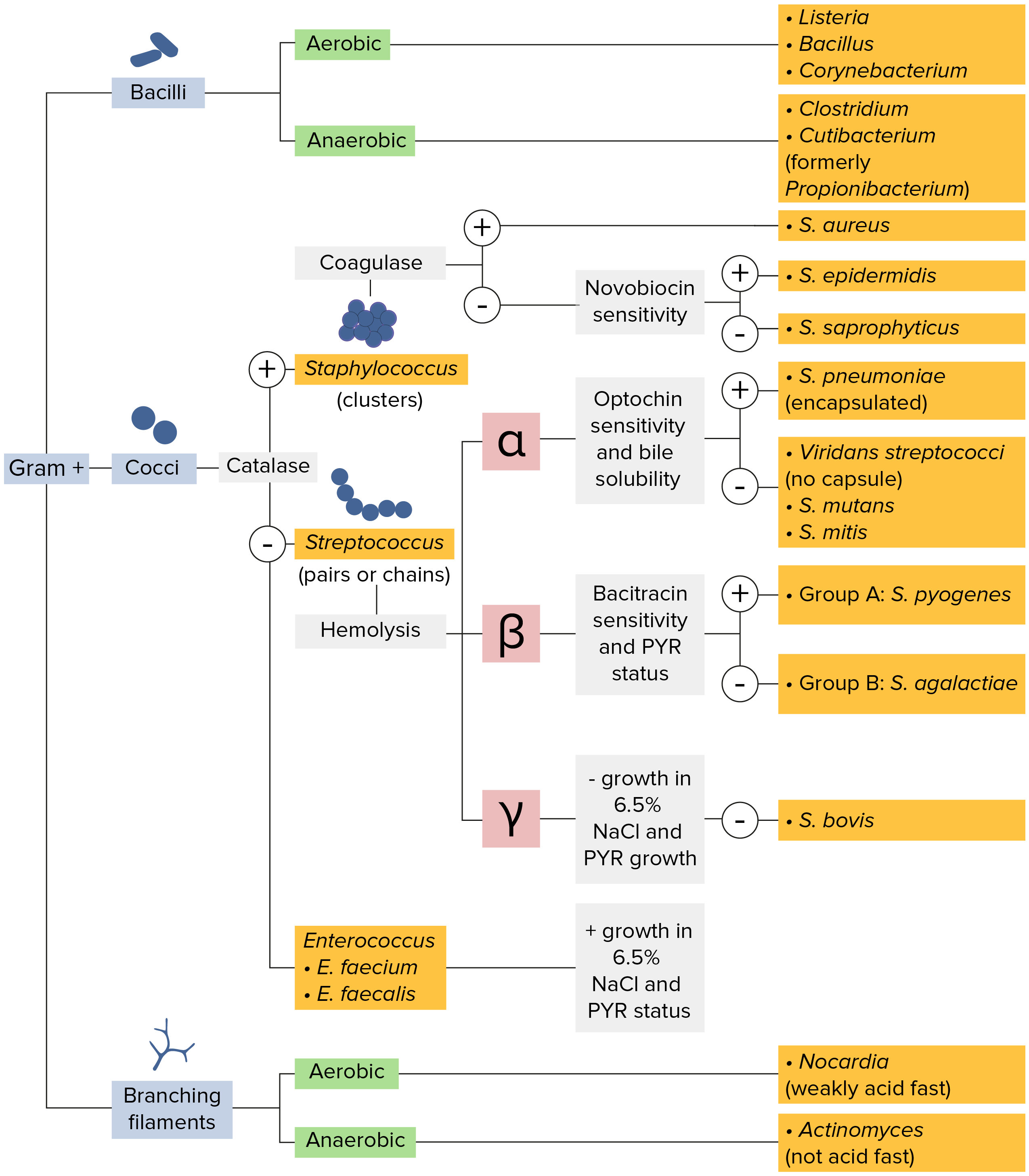
Diagrama de flujo de microbiología clasificación de bacterias grampositivas

Bacterias gram-positivas:
La mayoría de las bacterias se pueden clasificar de acuerdo con un procedimiento de laboratorio llamado tinción de Gram.
Las bacterias con paredes celulares que poseen una capa gruesa de peptidoglicano retienen la tinción cristal violeta utilizada en la tinción de Gram, pero no se ven afectadas por la contratinción de safranina. Estas bacterias aparecen como azul púrpura en las tinciones, lo que indica que son gram-positivas. Las bacterias pueden clasificarse además según su morfología (filamentos ramificados, bacilos y cocos en racimos o cadenas) y su capacidad para crecer en presencia de oxígeno (aeróbicos frente a anaeróbicos). Los cocos también pueden ser identificados de forma más detallada. Los estafilococos pueden reducirse en función de la presencia de la enzima coagulasa y de su sensibilidad al antibiótico novobiocina. Los estreptococos se cultivan en agar sangre y se clasifican según el modo de hemólisis que emplean (α, β o γ). Los estreptococos se reducen aún más en función de su respuesta a la prueba de pirrolidonil-β-naftilamida (PYR), su sensibilidad a antimicrobianos específicos (optoquina y bacitracina) y su capacidad para crecer en medios de cloruro de sodio (NaCl).

Imagen por Lecturio. Licencia: CC BY-NC-SA 4.0

Características Generales

Los LOS Neisseria enterococos (antes clasificados como estreptococos del grupo D) son parte de la flora normal del tracto gastrointestinal humano. Menos de ⅓ de las especies conocidas son responsables de enfermedades humanas clínicamente significativas.
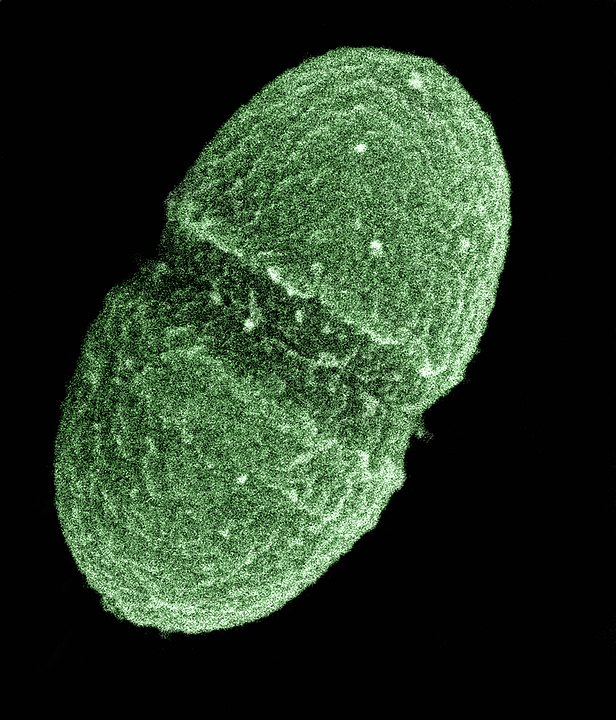
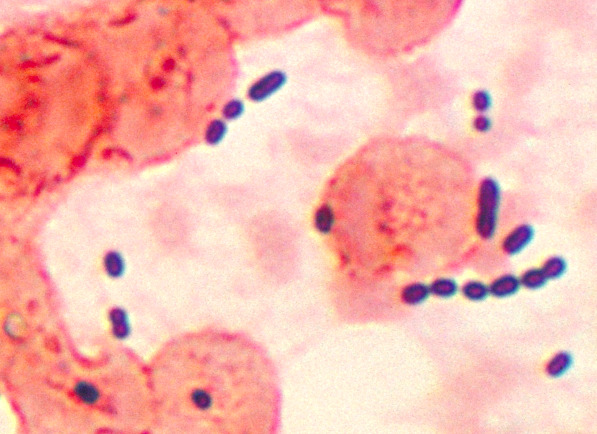
Características del género

  • Cocos grampositivos de forma ovalada
  • Dispuestos en EN Erythema nodosum is an immune-mediated panniculitis (inflammation of the subcutaneous fat) caused by a type IV (delayed-type) hypersensitivity reaction. It commonly manifests in young women as tender, erythematous nodules on the shins. Erythema Nodosum pares o cadenas cortas
  • Anaerobios facultativos
  • Catalasa negativos
  • Resistente a las optoquinas
  • Pirrolidonil arilamidasa (PYR): positivo
  • Poseen antígeno del grupo D de Lancefield (por lo tanto, previamente eran clasificados como estreptococos del grupo D)
  • Pueden ser cultivados en EN Erythema nodosum is an immune-mediated panniculitis (inflammation of the subcutaneous fat) caused by a type IV (delayed-type) hypersensitivity reaction. It commonly manifests in young women as tender, erythematous nodules on the shins. Erythema Nodosum medios biliares y NaCl al AL Amyloidosis 6,5%.
  • Patógenos humanos clínicamente significativos ( los LOS Neisseria más comunes):
    • Enterococcus Enterococcus Enterococcus is a genus of oval-shaped gram-positive cocci that are arranged in pairs or short chains. Distinguishing factors include optochin resistance and the presence of pyrrolidonyl arylamidase (PYR) and Lancefield D antigen. Enterococcus is part of the normal flora of the human GI tract. Enterococcus faecalis
    • E. faecium
Enterococcus faecalis

Enterococcus faecalis

Imagen : “Enterococcus faecalis 20023-300” por Gzuckier. Licencia: dominio público

Patogénesis

Los LOS Neisseria enterococos aparecen con mayor frecuencia en EN Erythema nodosum is an immune-mediated panniculitis (inflammation of the subcutaneous fat) caused by a type IV (delayed-type) hypersensitivity reaction. It commonly manifests in young women as tender, erythematous nodules on the shins. Erythema Nodosum infecciones nosocomiales.
  • Reservorio: tracto gastrointestinal humano
  • Transmisión:
    • Translocación desde el sitio de colonización en EN Erythema nodosum is an immune-mediated panniculitis (inflammation of the subcutaneous fat) caused by a type IV (delayed-type) hypersensitivity reaction. It commonly manifests in young women as tender, erythematous nodules on the shins. Erythema Nodosum el paciente colonizado (frecuentemente asociada con procedimientos gastrointestinales y genitourinarios)
    • Transmisión a los LOS Neisseria trabajadores de la salud y otros pacientes a través del contacto directo, transmisión fecal-oral o fómites
  • Factores de virulencia:
    • Resistencia antimicrobiana:
      • Intrínsecos (antibióticos betalactámicos (a través de proteínas de unión a penicilina), trimetoprima-sulfametoxazol, niveles bajos de clindamicina y aminoglucósidos)
      • Adquiridos (antibióticos betalactámicos (a través de betalactamasas), aminoglucósidos de alto nivel, tetraciclina, fluoroquinolonas, rifampicina, cloranfenicol y vancomicina)
    • Formación de biopelículas:
      • Protegen contra las defensas del huésped
      • Permiten el intercambio de genes Genes A category of nucleic acid sequences that function as units of heredity and which code for the basic instructions for the development, reproduction, and maintenance of organisms. DNA Types and Structure (promoviendo aún más la resistencia a los LOS Neisseria antibióticos)
  • Factores del huésped que aumentan la susceptibilidad:
    • Enfermedad crítica
    • Recibir ciclos prolongados de antibióticos
    • Neoplasias hematológicas
    • Trasplante de órganos sólidos

Relevancia Clínica

Epidemiología

  • Los LOS Neisseria enterococos son 1 de las 3 especies principales que causan infecciones nosocomiales.
  • La 4ta causa más común de infecciones nosocomiales del torrente sanguíneo en EN Erythema nodosum is an immune-mediated panniculitis (inflammation of the subcutaneous fat) caused by a type IV (delayed-type) hypersensitivity reaction. It commonly manifests in young women as tender, erythematous nodules on the shins. Erythema Nodosum los LOS Neisseria Estados Unidos
  • 35 %–40% de las infecciones por enterococos del torrente sanguíneo involucran E. faecium resistente a la vancomicina

Enfermedades causadas por enterococos

  • A menudo asociadas con:
    • Catéteres permanentes
    • Instrumentación quirúrgica
    • Anormalidades estructurales subyacentes
  • Las infecciones comunes asociadas con Enterococcus Enterococcus Enterococcus is a genus of oval-shaped gram-positive cocci that are arranged in pairs or short chains. Distinguishing factors include optochin resistance and the presence of pyrrolidonyl arylamidase (PYR) and Lancefield D antigen. Enterococcus is part of the normal flora of the human GI tract. Enterococcus incluyen:
    • Infecciones del tracto urinario (las más comúnes)
    • Endocarditis Endocarditis Endocarditis is an inflammatory disease involving the inner lining (endometrium) of the heart, most commonly affecting the cardiac valves. Both infectious and noninfectious etiologies lead to vegetations on the valve leaflets. Patients may present with nonspecific symptoms such as fever and fatigue. Endocarditis
    • Bacteriemia
    • Infecciones intraabdominales y pélvicas (a menudo colecistitis)
    • Infecciones de heridas
  • Otras infecciones menos frecuentes:
    • Meningitis Meningitis Meningitis is inflammation of the meninges, the protective membranes of the brain, and spinal cord. The causes of meningitis are varied, with the most common being bacterial or viral infection. The classic presentation of meningitis is a triad of fever, altered mental status, and nuchal rigidity. Meningitis
    • Infecciónes del espacio pleural
    • Infecciones de piel / tejidos blandos

Aislamiento del organismo

  • Hemocultivos: deben incluirse pruebas de susceptibilidad para elegir la terapia adecuada
  • Coprocultivos y cultivos perirrectales: para evaluar la colonización por enterococo resistente a vancomicina

Selección de antibióticos

  • Monoterapia:
    • Puede ser apropiada en EN Erythema nodosum is an immune-mediated panniculitis (inflammation of the subcutaneous fat) caused by a type IV (delayed-type) hypersensitivity reaction. It commonly manifests in young women as tender, erythematous nodules on the shins. Erythema Nodosum pacientes no críticos sin endocarditis Endocarditis Endocarditis is an inflammatory disease involving the inner lining (endometrium) of the heart, most commonly affecting the cardiac valves. Both infectious and noninfectious etiologies lead to vegetations on the valve leaflets. Patients may present with nonspecific symptoms such as fever and fatigue. Endocarditis.
    • La ampicilina es el medicamento de elección para las especies susceptibles.
  • Terapia combinada:
    • Más comúnmente utilizada en EN Erythema nodosum is an immune-mediated panniculitis (inflammation of the subcutaneous fat) caused by a type IV (delayed-type) hypersensitivity reaction. It commonly manifests in young women as tender, erythematous nodules on the shins. Erythema Nodosum la práctica
    • Para endocarditis Endocarditis Endocarditis is an inflammatory disease involving the inner lining (endometrium) of the heart, most commonly affecting the cardiac valves. Both infectious and noninfectious etiologies lead to vegetations on the valve leaflets. Patients may present with nonspecific symptoms such as fever and fatigue. Endocarditis y todos los LOS Neisseria pacientes críticamente enfermos
    • Inhibidor de la pared celular (ampicilina, ceftriaxona, vancomicina) + aminoglucósido
    • A menudo, ampicilina y gentamicina
  • Infecciones por enterococo resistente a la vancomicina:
    • Linezolid Linezolid An oxazolidinone and acetamide derived anti-bacterial agent and protein synthesis inhibitor that is used in the treatment of gram-positive bacterial infections of the skin and respiratory tract. Oxazolidinones
    • Daptomicina
    • Tigeciclina
  • Además de la terapia con antibióticos:
    • Se deben retirar todos los LOS Neisseria catéteres y líneas permanentes.
    • Los LOS Neisseria abscesos deben ser drenados.

Referencias

  1. Riedel S., et al AL Amyloidosis. (2019). In Jawetz, Melnick & Adelberg’s Medical Microbiology, pp. 215–233.
  2. Murray, B., Miller, W. (2024). Microbiology of enterococci. UpToDate, Retrieved January 20, 2025, from https://www.uptodate.com/contents/microbiology-of-enterococci
  3. Murray, B., Miller, W. (2024). Treatment of enterococcal infections Infections Invasion of the host organism by microorganisms or their toxins or by parasites that can cause pathological conditions or diseases. Chronic Granulomatous Disease. UpToDate, Retrieved January 20, 2025, from https://www.uptodate.com/contents/treatment-of-enterococcal-infections
  4. Fraser S.L. (2024). Enterococcal Infections Infections Invasion of the host organism by microorganisms or their toxins or by parasites that can cause pathological conditions or diseases. Chronic Granulomatous Disease Treatment & Management. Retrieved January 20, 2025, from https://emedicine.medscape.com/article/216993-treatment

¡Crea tu cuenta gratis o inicia una sesión para seguir leyendo!

Regístrate ahora y obtén acceso gratuito a Lecturio con páginas de concepto, videos médicos y cuestionarios para tu educación médica.

User Reviews

Que tengas una sesión de estudio alegre y navideña 🎁 Ahorra 50% en todos los planes >>

Details