Domina Conceptos Médicos

Estudia para la escuela de medicina y tus examenes con Lecturio.

Enfermedad de Parkinson

La enfermedad de Parkinson es un trastorno neurodegenerativo crónico y progresivo. Aunque se desconoce la causa, actualmente se están estudiando varios factores de riesgo genéticos y ambientales. Los LOS Neisseria individuos se presentan clínicamente con temblor en EN Erythema nodosum is an immune-mediated panniculitis (inflammation of the subcutaneous fat) caused by a type IV (delayed-type) hypersensitivity reaction. It commonly manifests in young women as tender, erythematous nodules on the shins. Erythema Nodosum reposo, bradicinesia, rigidez e inestabilidad postural. La enfermedad de Parkinson se diagnostica clínicamente sobre la base de signos y síntomas característicos. El hallazgo post mortem de cuerpos de Lewy en EN Erythema nodosum is an immune-mediated panniculitis (inflammation of the subcutaneous fat) caused by a type IV (delayed-type) hypersensitivity reaction. It commonly manifests in young women as tender, erythematous nodules on the shins. Erythema Nodosum el cerebro es la única forma de confirmación de la enfermedad. El tratamiento incluye atención física y emocional de soporte, además de medicamentos como levodopa Levodopa The naturally occurring form of dihydroxyphenylalanine and the immediate precursor of dopamine. Unlike dopamine itself, it can be taken orally and crosses the blood-brain barrier. It is rapidly taken up by dopaminergic neurons and converted to dopamine. It is used for the treatment of parkinsonian disorders and is usually given with agents that inhibit its conversion to dopamine outside of the central nervous system. Parkinson’s Disease Drugs/carbidopa, inhibidores de la monoamino oxidasa tipo B y agonistas de la dopamina.

Last updated: Dec 15, 2025

Editorial responsibility: Stanley Oiseth, Lindsay Jones, Evelin Maza

Descripción General

Definición

La enfermedad de Parkinson es un trastorno neurodegenerativo crónico y progresivo que afecta al AL Amyloidosis sistema nervioso central (SNC) con rasgos característicos de temblor en EN Erythema nodosum is an immune-mediated panniculitis (inflammation of the subcutaneous fat) caused by a type IV (delayed-type) hypersensitivity reaction. It commonly manifests in young women as tender, erythematous nodules on the shins. Erythema Nodosum reposo, rigidez, bradicinesia e inestabilidad postural.

Epidemiología

  • Uno de los LOS Neisseria trastornos neurodegenerativos más comunes
  • Incidencia anual: 4,5–21 casos por 100 000 habitantes
  • Edad media de inicio: aproximadamente a los LOS Neisseria 60 años
  • Riesgo de por vida: aproximadamente 2% para hombres y 1,3% para mujeres

Etiología

La etiología de la enfermedad de Parkinson no está clara, pero depende de varios factores genéticos y ambientales.

Factores de riesgo

  • Factores de riesgo ambientales y no genéticos:
    • Exposición a pesticidas
    • Exposición al AL Amyloidosis dióxido de nitrógeno
    • Antecedentes de lesión cerebral traumática
    • Exposición a disolventes de hidrocarburos
    • Vivir en EN Erythema nodosum is an immune-mediated panniculitis (inflammation of the subcutaneous fat) caused by a type IV (delayed-type) hypersensitivity reaction. It commonly manifests in young women as tender, erythematous nodules on the shins. Erythema Nodosum un entorno rural
    • Vivir cerca de plantas industriales o minas
    • Consumir agua de pozo
    • Se ha HA Hemolytic anemia (HA) is the term given to a large group of anemias that are caused by the premature destruction/hemolysis of circulating red blood cells (RBCs). Hemolysis can occur within (intravascular hemolysis) or outside the blood vessels (extravascular hemolysis). Hemolytic Anemia demostrado que el uso de 1-metil-4-fenil-1,2,3,6-tetrahidropiridina causa parkinsonismo irreversible.
    • Exceso de peso corporal
    • Diabetes Diabetes Diabetes mellitus (DM) is a metabolic disease characterized by hyperglycemia and dysfunction of the regulation of glucose metabolism by insulin. Type 1 DM is diagnosed mostly in children and young adults as the result of autoimmune destruction of β cells in the pancreas and the resulting lack of insulin. Type 2 DM has a significant association with obesity and is characterized by insulin resistance. Diabetes Mellitus tipo 2
  • Mutaciones genéticas asociadas con la enfermedad de Parkinson:
    • Gen de la alfa-sinucleína (SNCA)
    • Locus Locus Specific regions that are mapped within a genome. Genetic loci are usually identified with a shorthand notation that indicates the chromosome number and the position of a specific band along the P or Q arm of the chromosome where they are found. For example the locus 6p21 is found within band 21 of the P-arm of chromosome 6. Many well known genetic loci are also known by common names that are associated with a genetic function or hereditary disease. Basic Terms of Genetics del gen de la quinasa 2 repetida rica en EN Erythema nodosum is an immune-mediated panniculitis (inflammation of the subcutaneous fat) caused by a type IV (delayed-type) hypersensitivity reaction. It commonly manifests in young women as tender, erythematous nodules on the shins. Erythema Nodosum leucina (LRRK2)
    • Mutaciones del gen parkin (PARK2)
    • Locus Locus Specific regions that are mapped within a genome. Genetic loci are usually identified with a shorthand notation that indicates the chromosome number and the position of a specific band along the P or Q arm of the chromosome where they are found. For example the locus 6p21 is found within band 21 of the P-arm of chromosome 6. Many well known genetic loci are also known by common names that are associated with a genetic function or hereditary disease. Basic Terms of Genetics del gen putativo de la cinasa 1 (PINK1) inducida por el homólogo de fosfatasa y tensina (PTEN)

Fisiopatología

Los LOS Neisseria mecanismos compensatorios en EN Erythema nodosum is an immune-mediated panniculitis (inflammation of the subcutaneous fat) caused by a type IV (delayed-type) hypersensitivity reaction. It commonly manifests in young women as tender, erythematous nodules on the shins. Erythema Nodosum el cerebro pueden disminuir temporalmente los LOS Neisseria efectos del agotamiento de la dopamina hasta que estos mecanismos sean superados por la progresión de la enfermedad de Parkinson.

  • Depleción de las neuronas dopaminérgicas en EN Erythema nodosum is an immune-mediated panniculitis (inflammation of the subcutaneous fat) caused by a type IV (delayed-type) hypersensitivity reaction. It commonly manifests in young women as tender, erythematous nodules on the shins. Erythema Nodosum la pars compacta Pars compacta A region in the substantia nigra located dorsal to the pars reticulata. Parkinson’s Disease de la sustancia negra→ agotamiento de la dopamina en EN Erythema nodosum is an immune-mediated panniculitis (inflammation of the subcutaneous fat) caused by a type IV (delayed-type) hypersensitivity reaction. It commonly manifests in young women as tender, erythematous nodules on the shins. Erythema Nodosum la vía nigroestriatal → desarrollo de los LOS Neisseria síntomas motores
  • La hiperactividad de la vía indirecta inhabilita funcionalmente el papel de la sustancia negra.
  • Cuerpos de Lewy (sello patológico de la enfermedad de Parkinson):
    • Inclusiones neuronales intracitoplasmáticas, redondas, eosinofílicas
    • Contienen proteínas anormales de alfa-sinucleína
    • Observados en EN Erythema nodosum is an immune-mediated panniculitis (inflammation of the subcutaneous fat) caused by a type IV (delayed-type) hypersensitivity reaction. It commonly manifests in young women as tender, erythematous nodules on the shins. Erythema Nodosum:
      • Sustancia negra
      • Locus Locus Specific regions that are mapped within a genome. Genetic loci are usually identified with a shorthand notation that indicates the chromosome number and the position of a specific band along the P or Q arm of the chromosome where they are found. For example the locus 6p21 is found within band 21 of the P-arm of chromosome 6. Many well known genetic loci are also known by common names that are associated with a genetic function or hereditary disease. Basic Terms of Genetics cerúleo
      • Corteza cerebral
      • Ganglios simpáticos
  • Los LOS Neisseria cambios patológicos en EN Erythema nodosum is an immune-mediated panniculitis (inflammation of the subcutaneous fat) caused by a type IV (delayed-type) hypersensitivity reaction. It commonly manifests in young women as tender, erythematous nodules on the shins. Erythema Nodosum la enfermedad de Parkinson comienzan en EN Erythema nodosum is an immune-mediated panniculitis (inflammation of the subcutaneous fat) caused by a type IV (delayed-type) hypersensitivity reaction. It commonly manifests in young women as tender, erythematous nodules on the shins. Erythema Nodosum el bulbo olfatorio → progresan durante muchos años hasta la corteza cerebral en EN Erythema nodosum is an immune-mediated panniculitis (inflammation of the subcutaneous fat) caused by a type IV (delayed-type) hypersensitivity reaction. It commonly manifests in young women as tender, erythematous nodules on the shins. Erythema Nodosum 6 etapas, llamadas estadificación de Braak:
    • Etapas presintomáticas 1 y 2: los LOS Neisseria cambios patológicos se encuentran en EN Erythema nodosum is an immune-mediated panniculitis (inflammation of the subcutaneous fat) caused by a type IV (delayed-type) hypersensitivity reaction. It commonly manifests in young women as tender, erythematous nodules on the shins. Erythema Nodosum:
      • Bulbo olfatorio
      • Bulbo raquídeo
    • Etapas 3 y 4: los LOS Neisseria síntomas comienzan a aparecer a medida que la patología migra hacia:
      • Pars compacta Pars compacta A region in the substantia nigra located dorsal to the pars reticulata. Parkinson’s Disease de la sustancia negra
      • Estructuras del mesencéfalo
    • Etapas 5 y 6: el proceso patológico alcanza:
      • Lóbulo temporal
      • Lóbulo frontal Frontal The bone that forms the frontal aspect of the skull. Its flat part forms the forehead, articulating inferiorly with the nasal bone and the cheek bone on each side of the face. Skull: Anatomy

Presentación Clínica

Los LOS Neisseria signos de la enfermedad de Parkinson son progresivos y aparecen gradualmente durante un largo período de tiempo, ya sean años o décadas.

Manifestaciones motoras cardinales

  • Bradicinesia = lentitud en EN Erythema nodosum is an immune-mediated panniculitis (inflammation of the subcutaneous fat) caused by a type IV (delayed-type) hypersensitivity reaction. It commonly manifests in young women as tender, erythematous nodules on the shins. Erythema Nodosum los LOS Neisseria movimientos:
    • Se observa en EN Erythema nodosum is an immune-mediated panniculitis (inflammation of the subcutaneous fat) caused by a type IV (delayed-type) hypersensitivity reaction. It commonly manifests in young women as tender, erythematous nodules on the shins. Erythema Nodosum aproximadamente el 80% de las personas con enfermedad de Parkinson
    • Disminución de la destreza manual de los LOS Neisseria dedos
    • Progresa de manera proximal
    • Dificultad para completar tareas simples como atarse los LOS Neisseria cordones de los LOS Neisseria zapatos, abotonarse la ropa y recoger objetos pequeños.
    • Marcha con pasos cortos arrastrando los LOS Neisseria pies
    • Pérdida de la coordinación de los LOS Neisseria movimientos a medida que avanza la enfermedad
    • Etapas avanzadas: puede ocurrir congelamiento de movimientos.
  • Temblor:
    • Temblor en EN Erythema nodosum is an immune-mediated panniculitis (inflammation of the subcutaneous fat) caused by a type IV (delayed-type) hypersensitivity reaction. It commonly manifests in young women as tender, erythematous nodules on the shins. Erythema Nodosum reposo descrito como un “temblor de rodamiento de la píldora”
    • Intermitente en EN Erythema nodosum is an immune-mediated panniculitis (inflammation of the subcutaneous fat) caused by a type IV (delayed-type) hypersensitivity reaction. It commonly manifests in young women as tender, erythematous nodules on the shins. Erythema Nodosum las primeras etapas
    • Disminuye con acción voluntaria
    • Puede afectar las manos, piernas, labios, mandíbula y lengua
    • Exacerbado por la ansiedad, excitación emocional y situaciones estresantes
    • Afectación inicialmente unilateral → progresa a bilateral
  • Rigidez:
    • Se observa en EN Erythema nodosum is an immune-mediated panniculitis (inflammation of the subcutaneous fat) caused by a type IV (delayed-type) hypersensitivity reaction. It commonly manifests in young women as tender, erythematous nodules on the shins. Erythema Nodosum 70%–90% de las personas con enfermedad de Parkinson
    • Descrito como una mayor resistencia al AL Amyloidosis movimiento pasivo
    • Comienza unilateralmente → progresa hacia el lado contralateral; permanece asimétrica a lo largo del curso de la enfermedad.
    • Rigidez en EN Erythema nodosum is an immune-mediated panniculitis (inflammation of the subcutaneous fat) caused by a type IV (delayed-type) hypersensitivity reaction. It commonly manifests in young women as tender, erythematous nodules on the shins. Erythema Nodosum rueda dentada = un patrón de resistencia y relajación en EN Erythema nodosum is an immune-mediated panniculitis (inflammation of the subcutaneous fat) caused by a type IV (delayed-type) hypersensitivity reaction. It commonly manifests in young women as tender, erythematous nodules on the shins. Erythema Nodosum los LOS Neisseria movimientos pasivos
    • La rigidez en EN Erythema nodosum is an immune-mediated panniculitis (inflammation of the subcutaneous fat) caused by a type IV (delayed-type) hypersensitivity reaction. It commonly manifests in young women as tender, erythematous nodules on the shins. Erythema Nodosum “tubo de plomo” también se puede observar en EN Erythema nodosum is an immune-mediated panniculitis (inflammation of the subcutaneous fat) caused by a type IV (delayed-type) hypersensitivity reaction. It commonly manifests in young women as tender, erythematous nodules on the shins. Erythema Nodosum algunos individuos = resistencia tónica que es suave al AL Amyloidosis movimiento pasivo
  • Rigidez que afecta a la cara: característica “facies de máscara”
  • Inestabilidad postural = deterioro de los LOS Neisseria reflejos posturales que resulta en EN Erythema nodosum is an immune-mediated panniculitis (inflammation of the subcutaneous fat) caused by a type IV (delayed-type) hypersensitivity reaction. It commonly manifests in young women as tender, erythematous nodules on the shins. Erythema Nodosum una sensación de desequilibrio y tendencia a caer:
    • Generalmente, ocurre en EN Erythema nodosum is an immune-mediated panniculitis (inflammation of the subcutaneous fat) caused by a type IV (delayed-type) hypersensitivity reaction. It commonly manifests in young women as tender, erythematous nodules on the shins. Erythema Nodosum etapas avanzadas de la enfermedad de Parkinson
    • En EN Erythema nodosum is an immune-mediated panniculitis (inflammation of the subcutaneous fat) caused by a type IV (delayed-type) hypersensitivity reaction. It commonly manifests in young women as tender, erythematous nodules on the shins. Erythema Nodosum la “prueba de tracción”, el examinador se para detrás del individuo y tira del individuo por los LOS Neisseria hombros; es probable que las personas con enfermedad de Parkinson retrocedan unos pasos o se caigan.

Otras manifestaciones motoras

  • Deterioro del lenguaje
  • Disfunción laríngea y disfagia
  • Visión borrosa
  • Micrografía
  • Postura encorvada
  • Mioclonías
  • Alteraciones de la marcha:
    • Marcha con pasos cortos y arrastrando los LOS Neisseria pies
    • Congelación en EN Erythema nodosum is an immune-mediated panniculitis (inflammation of the subcutaneous fat) caused by a type IV (delayed-type) hypersensitivity reaction. It commonly manifests in young women as tender, erythematous nodules on the shins. Erythema Nodosum la marcha
    • Marcha festinada = patrón descrito como pasos cortos y cada vez más rápidos

Síntomas no motores

  • Disfunción autonómica que se presenta como:
    • Ortostasis
    • Estreñimiento
    • Diaforesis
    • Dificultades urinarias
    • Disfunción sexual
  • Disfunción olfatoria: anosmia Anosmia Complete or severe loss of the subjective sense of smell. Loss of smell may be caused by many factors such as a cold, allergy, olfactory nerve diseases, viral respiratory tract infections (e.g., COVID-19), aging and various neurological disorders (e.g., Alzheimer disease). Cranial Nerve Palsies
  • Trastornos del estado de ánimo, incluyendo depresión y ansiedad
  • Dolor Dolor Inflammation y alteraciones sensoriales
  • Disfunción cognitiva y demencia
    • Psicosis
    • Alucinaciones
  • Trastornos del sueño:
    • Insomnio
    • Somnolencia diurna
    • Trastorno del comportamiento del sueño de movimientos oculares rápidos

Diagnóstico

El diagnóstico de la enfermedad de Parkinson se realiza mediante los LOS Neisseria antecedentes clínicos y el examen neurológico.

El diagnóstico requiere de 4 cosas:

  1. Parkinsonismo motor Motor Neurons which send impulses peripherally to activate muscles or secretory cells. Nervous System: Histology
  2. Ausencia de criterios de exclusión absolutos
  3. Al AL Amyloidosis menos 2 criterios de soporte
  4. Sin banderas rojas

El parkinsonismo motor Motor Neurons which send impulses peripherally to activate muscles or secretory cells. Nervous System: Histology, un criterio esencial de la enfermedad de Parkinson, requiere bradicinesia y al AL Amyloidosis menos 1 de los LOS Neisseria siguientes:

  • Temblor en EN Erythema nodosum is an immune-mediated panniculitis (inflammation of the subcutaneous fat) caused by a type IV (delayed-type) hypersensitivity reaction. It commonly manifests in young women as tender, erythematous nodules on the shins. Erythema Nodosum reposo
  • Rigidez
  • Inestabilidad postural

Criterios de exclusión absolutos (incompatibles con un diagnóstico de enfermedad de Parkinson):

  • Anomalías cerebelosas como marcha cerebelosa o ataxia Ataxia Impairment of the ability to perform smoothly coordinated voluntary movements. This condition may affect the limbs, trunk, eyes, pharynx, larynx, and other structures. Ataxia may result from impaired sensory or motor function. Sensory ataxia may result from posterior column injury or peripheral nerve diseases. Motor ataxia may be associated with cerebellar diseases; cerebral cortex diseases; thalamic diseases; basal ganglia diseases; injury to the red nucleus; and other conditions. Ataxia-telangiectasia de las extremidades
  • Parálisis de la mirada supranuclear vertical hacia abajo o enlentecimiento selectivo de los LOS Neisseria movimientos sacádicos verticales hacia abajo
  • Diagnóstico de demencia frontotemporal dentro de los LOS Neisseria 1ros 5 años después del inicio de la enfermedad
  • Características parkinsonianas restringidas a las extremidades inferiores durante > 3 años
  • Tratamiento en EN Erythema nodosum is an immune-mediated panniculitis (inflammation of the subcutaneous fat) caused by a type IV (delayed-type) hypersensitivity reaction. It commonly manifests in young women as tender, erythematous nodules on the shins. Erythema Nodosum el último año con bloqueadores de los LOS Neisseria receptores de dopamina que pueden estar asociados con parkinsonismo inducido por medicamentos
  • Falta de respuesta a dosis altas de levodopa Levodopa The naturally occurring form of dihydroxyphenylalanine and the immediate precursor of dopamine. Unlike dopamine itself, it can be taken orally and crosses the blood-brain barrier. It is rapidly taken up by dopaminergic neurons and converted to dopamine. It is used for the treatment of parkinsonian disorders and is usually given with agents that inhibit its conversion to dopamine outside of the central nervous system. Parkinson’s Disease Drugs en EN Erythema nodosum is an immune-mediated panniculitis (inflammation of the subcutaneous fat) caused by a type IV (delayed-type) hypersensitivity reaction. It commonly manifests in young women as tender, erythematous nodules on the shins. Erythema Nodosum la enfermedad ( al AL Amyloidosis menos) moderada
  • Pérdida sensorial cortical (e.g., agrafesia, astereognosis), apraxia Apraxia A group of cognitive disorders characterized by the inability to perform previously learned skills that cannot be attributed to deficits of motor or sensory function. The two major subtypes of this condition are ideomotor and ideational apraxia, which refers to loss of the ability to mentally formulate the processes involved with performing an action. For example, dressing apraxia may result from an inability to mentally formulate the act of placing clothes on the body. Apraxias are generally associated with lesions of the dominant parietal lobe and supramarginal gyrus. Cranial Nerve Palsies ideomotora y/o afasia progresiva
  • La neuroimagen funcional del sistema dopaminérgico presináptico es normal.

Criterios de soporte:

  • Mejoría drástica de los LOS Neisseria síntomas con medicamentos dopaminérgicos
  • Discinesia inducida por levodopa Levodopa The naturally occurring form of dihydroxyphenylalanine and the immediate precursor of dopamine. Unlike dopamine itself, it can be taken orally and crosses the blood-brain barrier. It is rapidly taken up by dopaminergic neurons and converted to dopamine. It is used for the treatment of parkinsonian disorders and is usually given with agents that inhibit its conversion to dopamine outside of the central nervous system. Parkinson’s Disease Drugs
  • Temblor en EN Erythema nodosum is an immune-mediated panniculitis (inflammation of the subcutaneous fat) caused by a type IV (delayed-type) hypersensitivity reaction. It commonly manifests in young women as tender, erythematous nodules on the shins. Erythema Nodosum reposo de una extremidad (unilateral o bilateral)
  • Pérdida olfativa o denervación simpática cardíaca mediante imagenología de medicina nuclear

Banderas rojas (signos de una patología alterna que apuntan hacia otro diagnóstico):

  • Progresión rápida del deterioro de la marcha que requiere el uso de una silla de ruedas
  • Ausencia de la progresión de los LOS Neisseria síntomas o signos motores > 5 años
  • Disfunción bulbar temprana dentro en EN Erythema nodosum is an immune-mediated panniculitis (inflammation of the subcutaneous fat) caused by a type IV (delayed-type) hypersensitivity reaction. It commonly manifests in young women as tender, erythematous nodules on the shins. Erythema Nodosum los LOS Neisseria 1ros 5 años después del inicio:
    • Disfonía severa
    • Disartria severa
    • Disfagia severa
  • Estridor inspiratorio o disnea
  • Insuficiencia autonómica severa en EN Erythema nodosum is an immune-mediated panniculitis (inflammation of the subcutaneous fat) caused by a type IV (delayed-type) hypersensitivity reaction. It commonly manifests in young women as tender, erythematous nodules on the shins. Erythema Nodosum los LOS Neisseria 1ros 5 años después del inicio de la enfermedad:
    • Disfunción ortostática
    • Retención urinaria severa
  • Caídas recurrentes por alteraciones del equilibrio dentro de los LOS Neisseria 3 años posteriores al AL Amyloidosis inicio
  • Flexión involuntaria del cuello o contracturas de manos o pies
  • Ausencia de los LOS Neisseria síntomas no motores comunes en EN Erythema nodosum is an immune-mediated panniculitis (inflammation of the subcutaneous fat) caused by a type IV (delayed-type) hypersensitivity reaction. It commonly manifests in young women as tender, erythematous nodules on the shins. Erythema Nodosum los LOS Neisseria 1ros 5 años después del inicio de la enfermedad
  • Signos inexplicables del tracto piramidal:
    • Debilidad piramidal
    • Hiperreflexia patológica clara
  • Parkinsonismo simétrico bilateral

No existen análisis fisiológicos, radiológicos o de sangre para confirmar el diagnóstico clínico de la enfermedad de Parkinson:

  • Es posible que se necesiten estudios por imagenología para descartar otras causas de parkinsonismo (e.g., accidente cerebrovascular):
    • Resonancia magnética (RM)
    • DaTscan: un tipo de tomografía computarizada por emisión de fotón único, que puede visualizar los LOS Neisseria niveles del transportador de dopamina en EN Erythema nodosum is an immune-mediated panniculitis (inflammation of the subcutaneous fat) caused by a type IV (delayed-type) hypersensitivity reaction. It commonly manifests in young women as tender, erythematous nodules on the shins. Erythema Nodosum el cerebro
  • Las pruebas olfatorias y de medicina nuclear para las pruebas autonómicas de denervación simpática cardíaca son útiles para distinguir la enfermedad de Parkinson de otras causas de parkinsonismo (criterios de soporte como los LOS Neisseria anteriores).

La enfermedad de Parkinson se confirma mediante el hallazgo de cuerpos de Lewy en EN Erythema nodosum is an immune-mediated panniculitis (inflammation of the subcutaneous fat) caused by a type IV (delayed-type) hypersensitivity reaction. It commonly manifests in young women as tender, erythematous nodules on the shins. Erythema Nodosum el análisis post mortem.
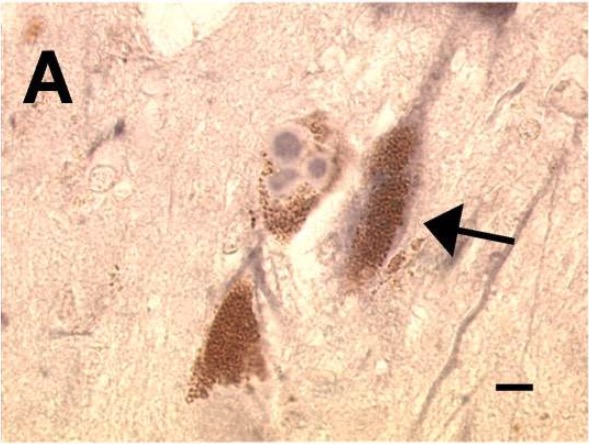
Cuerpos de Lewy que confirman la enfermedad de Parkinson

Cuerpos de Lewy observados en una muestra de la enfermedad de Parkinson

Imagen: “Staining of multiple Lewy bodies” por Division of Neurology, William Beaumont Hospital Research Institute, Royal Oak, MI 48073, USA Licencia: CC BY 2.0

Tratamiento

El objetivo del tratamiento es tratar las características motoras y no motoras sintomáticas del trastorno para mejorar la calidad de vida.

Tratamiento

Medidas generales:

  • Fisioterapia
  • Terapia ocupacional
  • Soporte emocional

Tratamiento médico:

  • La levodopa Levodopa The naturally occurring form of dihydroxyphenylalanine and the immediate precursor of dopamine. Unlike dopamine itself, it can be taken orally and crosses the blood-brain barrier. It is rapidly taken up by dopaminergic neurons and converted to dopamine. It is used for the treatment of parkinsonian disorders and is usually given with agents that inhibit its conversion to dopamine outside of the central nervous system. Parkinson’s Disease Drugs es el medicamento de elección en EN Erythema nodosum is an immune-mediated panniculitis (inflammation of the subcutaneous fat) caused by a type IV (delayed-type) hypersensitivity reaction. It commonly manifests in young women as tender, erythematous nodules on the shins. Erythema Nodosum personas de cualquier edad con síntomas moderados o severos:
    • Un precursor de la dopamina convertido en EN Erythema nodosum is an immune-mediated panniculitis (inflammation of the subcutaneous fat) caused by a type IV (delayed-type) hypersensitivity reaction. It commonly manifests in young women as tender, erythematous nodules on the shins. Erythema Nodosum dopamina después de cruzar la barrera hematoencefálica
    • Normalmente combinado con carbidopa, que mejora la biodisponibilidad en EN Erythema nodosum is an immune-mediated panniculitis (inflammation of the subcutaneous fat) caused by a type IV (delayed-type) hypersensitivity reaction. It commonly manifests in young women as tender, erythematous nodules on the shins. Erythema Nodosum el SNC
  • Inhibidores de la monoamino oxidasa tipo B (IMAO-B) (selegilina, rasagilina, safinamida):
    • Inhiben la enzima monoamino oxidasa para evitar la descomposición de la dopamina, serotonina, norepinefrina y tiramina en EN Erythema nodosum is an immune-mediated panniculitis (inflammation of the subcutaneous fat) caused by a type IV (delayed-type) hypersensitivity reaction. It commonly manifests in young women as tender, erythematous nodules on the shins. Erythema Nodosum el cerebro.
    • Eficaces como tratamiento sintomático precoz para la enfermedad de Parkinson
    • Monoterapia o en EN Erythema nodosum is an immune-mediated panniculitis (inflammation of the subcutaneous fat) caused by a type IV (delayed-type) hypersensitivity reaction. It commonly manifests in young women as tender, erythematous nodules on the shins. Erythema Nodosum combinación con levodopa Levodopa The naturally occurring form of dihydroxyphenylalanine and the immediate precursor of dopamine. Unlike dopamine itself, it can be taken orally and crosses the blood-brain barrier. It is rapidly taken up by dopaminergic neurons and converted to dopamine. It is used for the treatment of parkinsonian disorders and is usually given with agents that inhibit its conversion to dopamine outside of the central nervous system. Parkinson’s Disease Drugs/carbidopa
  • Agonistas dopaminérgicos no ergotamínicos (pramipexol, ropinirol, apomorfina):
    • Indicados para pacientes más jóvenes para posponer el uso de levodopa Levodopa The naturally occurring form of dihydroxyphenylalanine and the immediate precursor of dopamine. Unlike dopamine itself, it can be taken orally and crosses the blood-brain barrier. It is rapidly taken up by dopaminergic neurons and converted to dopamine. It is used for the treatment of parkinsonian disorders and is usually given with agents that inhibit its conversion to dopamine outside of the central nervous system. Parkinson’s Disease Drugs/carbidopa y evitar los LOS Neisseria efectos secundarios a largo plazo
    • Monoterapia o en EN Erythema nodosum is an immune-mediated panniculitis (inflammation of the subcutaneous fat) caused by a type IV (delayed-type) hypersensitivity reaction. It commonly manifests in young women as tender, erythematous nodules on the shins. Erythema Nodosum combinación con levodopa Levodopa The naturally occurring form of dihydroxyphenylalanine and the immediate precursor of dopamine. Unlike dopamine itself, it can be taken orally and crosses the blood-brain barrier. It is rapidly taken up by dopaminergic neurons and converted to dopamine. It is used for the treatment of parkinsonian disorders and is usually given with agents that inhibit its conversion to dopamine outside of the central nervous system. Parkinson’s Disease Drugs/carbidopa
    • No se deben suspender de manera abrupta

Estimulación cerebral profunda:

  • Implantación neuroquirúrgica de electrodos estimulantes en EN Erythema nodosum is an immune-mediated panniculitis (inflammation of the subcutaneous fat) caused by a type IV (delayed-type) hypersensitivity reaction. It commonly manifests in young women as tender, erythematous nodules on the shins. Erythema Nodosum la sustancia negra
  • Se desconoce el mecanismo de acción exacto.
  • Los LOS Neisseria mejores candidatos son pacientes que:
    • Son más jóvenes
    • Tienen un curso corto de enfermedad
    • Tienen una buena respuesta a la levodopa Levodopa The naturally occurring form of dihydroxyphenylalanine and the immediate precursor of dopamine. Unlike dopamine itself, it can be taken orally and crosses the blood-brain barrier. It is rapidly taken up by dopaminergic neurons and converted to dopamine. It is used for the treatment of parkinsonian disorders and is usually given with agents that inhibit its conversion to dopamine outside of the central nervous system. Parkinson’s Disease Drugs
  • No es recomendado para pacientes con parkinsonismo atípico
Parkinson's disease

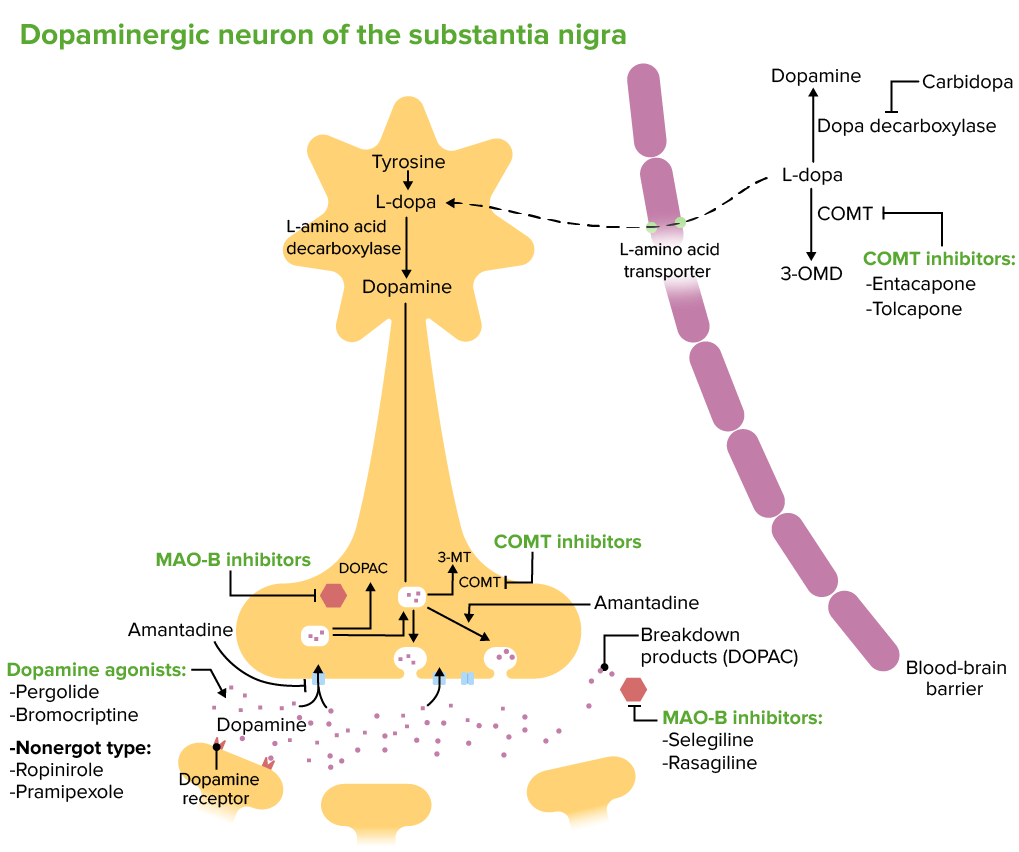
Efectos de los tratamientos de la enfermedad de Parkinson en las neuronas dopaminérgicas de la sustancia negra
3-OMD: 3-O-metildopa (un metabolito de la l-dopa)
3-MT: 3-metoxitiramina (un metabolito de la dopamina)
COMT: catecol O-metiltransferasa (un metabolito de la dopamina)
DOPAC: ácido 3,4-dihidroxifenilacético
MAO-B: monoamino oxidasa tipo B

Imagen por Lecturio.

Efectos secundarios de la terapia con dopamina

  • Náuseas
  • Ortostasis: empeorada por la terapia dopaminérgica
    • Puede ser necesario suspender la medicación antihipertensiva
    • Puede ser necesario reducir los LOS Neisseria agonistas de la dopamina y los LOS Neisseria IMAO-B
  • Discinesia inducida por medicamentos (pueden ocurrir movimientos involuntarios anormales con el uso prolongado de levodopa Levodopa The naturally occurring form of dihydroxyphenylalanine and the immediate precursor of dopamine. Unlike dopamine itself, it can be taken orally and crosses the blood-brain barrier. It is rapidly taken up by dopaminergic neurons and converted to dopamine. It is used for the treatment of parkinsonian disorders and is usually given with agents that inhibit its conversion to dopamine outside of the central nervous system. Parkinson’s Disease Drugs)
  • Confusión y alucinaciones
  • Trastornos del control de impulsos → debe reducirse la terapia con agonistas de la dopamina
  • Síndrome de desregulación de la dopamina:
    • Trastorno cíclico del estado de ánimo caracterizado por hipomanía o psicosis maníaca
    • La prevención del uso excesivo de medicamentos dopaminérgicos es imprescindible.

Diagnóstico Diferencial

  • Temblor esencial: causa neurológica más común de temblores de acción. El temblor esencial suele afectar tanto a las manos como a los LOS Neisseria brazos y es evidente cuando los LOS Neisseria brazos se mantienen extendidos o cuando se realizan actividades. El temblor esencial suele ser simétrico.
  • Demencia por cuerpos de Lewy: caracterizada clínicamente por demencia con alucinaciones visuales, cognición fluctuante, trastorno del comportamiento del sueño REM y parkinsonismo. La demencia ocurre antes del desarrollo de los LOS Neisseria signos de parkinsonismo. Los LOS Neisseria inhibidores de la colinesterasa, antipsicóticos atípicos y ejercicio regular Regular Insulin son utilizados para el tratamiento.
  • Degeneración corticobasal: forma distintiva del parkinsonismo que es un trastorno del movimiento asimétrico progresivo. Las características cognitivas de la degeneración corticobasal incluyen afasia, apraxia Apraxia A group of cognitive disorders characterized by the inability to perform previously learned skills that cannot be attributed to deficits of motor or sensory function. The two major subtypes of this condition are ideomotor and ideational apraxia, which refers to loss of the ability to mentally formulate the processes involved with performing an action. For example, dressing apraxia may result from an inability to mentally formulate the act of placing clothes on the body. Apraxias are generally associated with lesions of the dominant parietal lobe and supramarginal gyrus. Cranial Nerve Palsies, cambios de comportamiento, pérdida de la función ejecutiva y disfunción espaciovisual. En EN Erythema nodosum is an immune-mediated panniculitis (inflammation of the subcutaneous fat) caused by a type IV (delayed-type) hypersensitivity reaction. It commonly manifests in young women as tender, erythematous nodules on the shins. Erythema Nodosum la imagenología se observa atrofia cortical asimétrica.
  • Parálisis supranuclear progresiva: clínicamente se presenta como inestabilidad postural con antecedentes de múltiples caídas. La parálisis supranuclear progresiva es la forma degenerativa más común de parkinsonismo. El trastorno incluye disartria, disfagia, rigidez y síntomas cognitivos. La RM muestra el “signo del colibrí” o atrofia prominente del mesencéfalo sin atrofia pontina. El tratamiento es de soporte, con medidas farmacológicas y no farmacológicas.
  • Atrofia multisistémica: grupo raro de síntomas neurodegenerativos fatales. La atrofia multisistémica se presenta con parkinsonismo rígido acinético, disfunción autonómica y urogenital, ataxia Ataxia Impairment of the ability to perform smoothly coordinated voluntary movements. This condition may affect the limbs, trunk, eyes, pharynx, larynx, and other structures. Ataxia may result from impaired sensory or motor function. Sensory ataxia may result from posterior column injury or peripheral nerve diseases. Motor ataxia may be associated with cerebellar diseases; cerebral cortex diseases; thalamic diseases; basal ganglia diseases; injury to the red nucleus; and other conditions. Ataxia-telangiectasia cerebelosa y signos piramidales. La falta de respuesta a la levodopa Levodopa The naturally occurring form of dihydroxyphenylalanine and the immediate precursor of dopamine. Unlike dopamine itself, it can be taken orally and crosses the blood-brain barrier. It is rapidly taken up by dopaminergic neurons and converted to dopamine. It is used for the treatment of parkinsonian disorders and is usually given with agents that inhibit its conversion to dopamine outside of the central nervous system. Parkinson’s Disease Drugs puede ayudar a distinguir la atrofia multisistémica de la enfermedad de Parkinson y la atrofia multisistémica progresa más rápidamente que la enfermedad de Parkinson. El diagnóstico es clínico y el tratamiento es sintomático, ya que no existen tratamientos modificadores de la enfermedad disponibles.

Referencias

  1. Warren, C.O., Klein C., Schapira, A. H. V. (2018). Parkinson’s disease. In: Jameson J. L., et al. (Eds.). Harrison’s Principles of Internal Medicine, 20th ed., vol. 2, pp. 3120–3132. 
  2. Jankovic, J. (2021). Etiology and pathogenesis of Parkinson disease. UpToDate. Retrieved July 14, 2021, from https://www.uptodate.com/contents/etiology-and-pathogenesis-of-parkinson-disease
  3. Chou. K. L. (2021). Clinical manifestations of Parkinson disease. UpToDate. Retrieved July 14, 2021, from https://www.uptodate.com/contents/clinical-manifestations-of-parkinson-disease
  4. Chou, K. L. (2021). Diagnosis and differential diagnosis of Parkinson disease. UpToDate. Retrieved July 14, 2021, from https://www.uptodate.com/contents/diagnosis-and-differential-diagnosis-of-parkinson-disease
  5. Splinder, M. A. (2021). Initial pharmacologic treatment of Parkinson disease. UpToDate. Retrieved July 14, 2021, from https://www.uptodate.com/contents/initial-pharmacologic-treatment-of-parkinson-disease
  6. Hauser R. A. (2020). Parkinson disease. Medscape. Retrieved July 14, 2021, from https://emedicine.medscape.com/article/1831191
  7. Massano, J., Bhatia, K. P. (2012). Clinical approach to Parkinson’s disease: Features, diagnosis, and principles of management. Retrieved July 14, 2021, from https://www.ncbi.nlm.nih.gov/pmc/articles/PMC3367535/
  8. Kouli, A., Torsney, K. M., Kuan, W. (2018). Parkinson’s disease: etiology, neuropathology, and pathogenesis. Retrieved July 14, 2021, from https://www.ncbi.nlm.nih.gov/books/NBK536722/
  9. Zafar, S., Yaddanapudi, S.S. (2020). Parkinson disease. StatPearls. Retrieved July 14, 2021, from https://www.ncbi.nlm.nih.gov/books/NBK470193/

¡Crea tu cuenta gratis o inicia una sesión para seguir leyendo!

Regístrate ahora y obtén acceso gratuito a Lecturio con páginas de concepto, videos médicos y cuestionarios para tu educación médica.

User Reviews

Que tengas una sesión de estudio alegre y navideña 🎁 Ahorra 50% en todos los planes >>

Details