
Domina Conceptos Médicos

Estudia para la escuela de medicina y tus examenes con Lecturio.

Enfermedad de Osgood-Schlatter

La enfermedad de Osgood-Schlatter, o apofisitis del tubérculo tibial, es una afección ortopédica común que se observa en EN Erythema nodosum is an immune-mediated panniculitis (inflammation of the subcutaneous fat) caused by a type IV (delayed-type) hypersensitivity reaction. It commonly manifests in young women as tender, erythematous nodules on the shins. Erythema Nodosum niños de entre 10 y 15 años de edad. La enfermedad es causada por la aplicación repetitiva de fuerzas mecánicas sobre la rodilla, lo que provoca microtraumatismos en EN Erythema nodosum is an immune-mediated panniculitis (inflammation of the subcutaneous fat) caused by a type IV (delayed-type) hypersensitivity reaction. It commonly manifests in young women as tender, erythematous nodules on the shins. Erythema Nodosum el centro de osificación del lugar de inserción del ligamento rotuliano distal. Los LOS Neisseria pacientes presentan dolor Dolor Inflammation localizado en EN Erythema nodosum is an immune-mediated panniculitis (inflammation of the subcutaneous fat) caused by a type IV (delayed-type) hypersensitivity reaction. It commonly manifests in young women as tender, erythematous nodules on the shins. Erythema Nodosum la rodilla, sensibilidad e inflamación en EN Erythema nodosum is an immune-mediated panniculitis (inflammation of the subcutaneous fat) caused by a type IV (delayed-type) hypersensitivity reaction. It commonly manifests in young women as tender, erythematous nodules on the shins. Erythema Nodosum la parte anterior de la tibia Tibia The second longest bone of the skeleton. It is located on the medial side of the lower leg, articulating with the fibula laterally, the talus distally, and the femur proximally. Knee Joint: Anatomy. El diagnóstico es clínico y el tratamiento se centra en EN Erythema nodosum is an immune-mediated panniculitis (inflammation of the subcutaneous fat) caused by a type IV (delayed-type) hypersensitivity reaction. It commonly manifests in young women as tender, erythematous nodules on the shins. Erythema Nodosum el alivio sintomático. La enfermedad de Osgood-Schlatter es una afección autolimitada que se resuelve con la madurez del esqueleto.

Last updated: Dec 15, 2025

Editorial responsibility: Stanley Oiseth, Lindsay Jones, Evelin Maza

Descripción General

Definición

La enfermedad de Osgood-Schlatter es una apofisitis, una lesión dolorosa por tracción, del cartílago y el hueso del tubérculo tibial anterior y proximal, donde se inserta el tendón distal de la rótula.
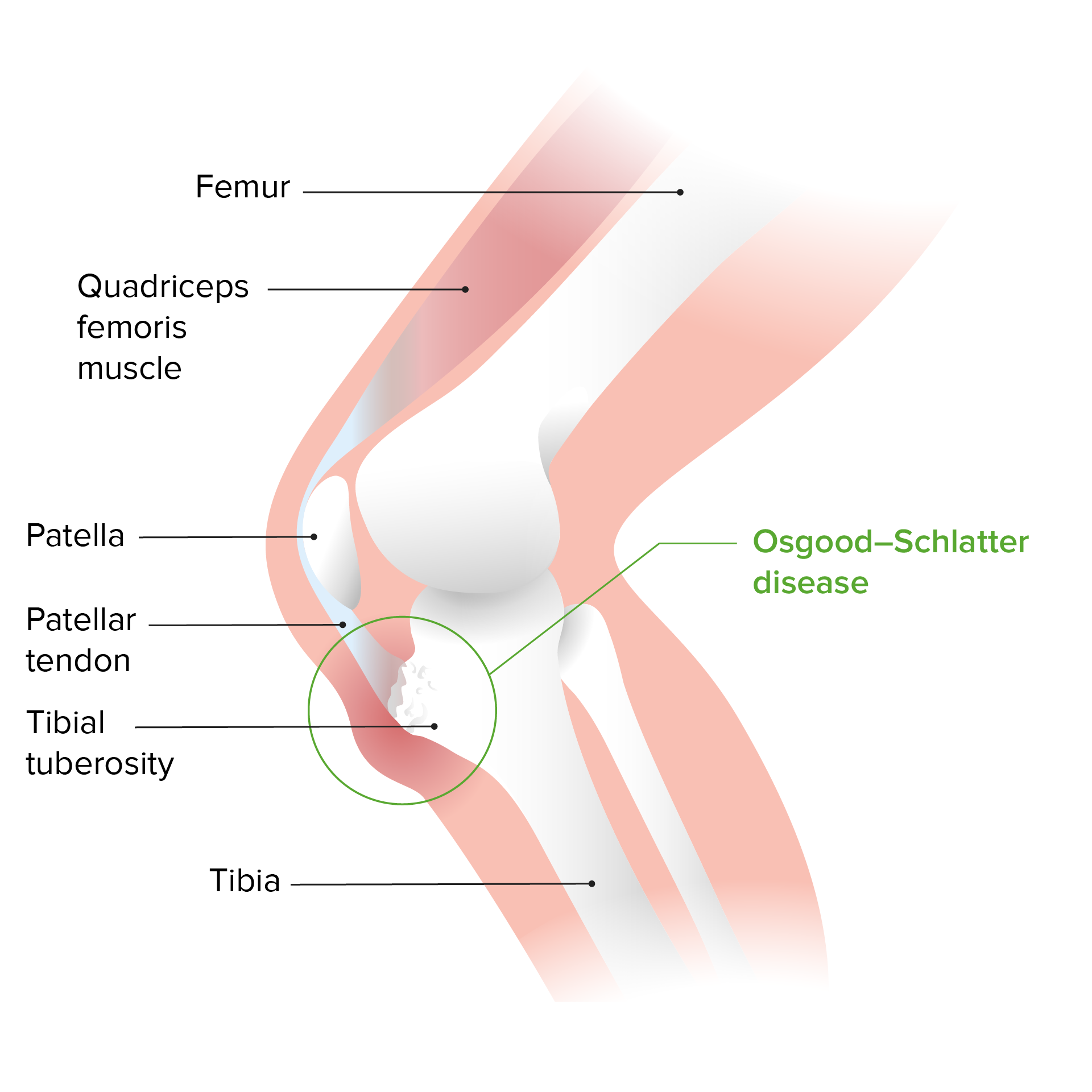
Enfermedad de Osgood-Shlatter

Enfermedad de Osgood-Schlatter: una inflamación dolorosa de la tuberosidad tibial causada por la tracción repetitiva del tendón rotuliano debido a un esfuerzo repetitivo, como correr o saltar

Imagen por Lecturio.

Epidemiología

  • Se da en EN Erythema nodosum is an immune-mediated panniculitis (inflammation of the subcutaneous fat) caused by a type IV (delayed-type) hypersensitivity reaction. It commonly manifests in young women as tender, erythematous nodules on the shins. Erythema Nodosum niños de 10–14 años de edad:
    • Niños: 12–14 años
    • Niñas: 10–13 años
  • Más frecuente en EN Erythema nodosum is an immune-mediated panniculitis (inflammation of the subcutaneous fat) caused by a type IV (delayed-type) hypersensitivity reaction. It commonly manifests in young women as tender, erythematous nodules on the shins. Erythema Nodosum adolescentes que practican deportes que implican correr o saltar (e.g., fútbol, fútbol americano, baloncesto, voleibol, carreras de velocidad, gimnasia, patinaje artístico y ballet)
  • Más común en EN Erythema nodosum is an immune-mediated panniculitis (inflammation of the subcutaneous fat) caused by a type IV (delayed-type) hypersensitivity reaction. It commonly manifests in young women as tender, erythematous nodules on the shins. Erythema Nodosum los LOS Neisseria niños que en EN Erythema nodosum is an immune-mediated panniculitis (inflammation of the subcutaneous fat) caused by a type IV (delayed-type) hypersensitivity reaction. It commonly manifests in young women as tender, erythematous nodules on the shins. Erythema Nodosum las niñas
  • Generalmente ocurre durante los LOS Neisseria períodos de crecimiento relativo acelerado
  • Bilateral en EN Erythema nodosum is an immune-mediated panniculitis (inflammation of the subcutaneous fat) caused by a type IV (delayed-type) hypersensitivity reaction. It commonly manifests in young women as tender, erythematous nodules on the shins. Erythema Nodosum 25%–50% de los LOS Neisseria casos

Fisiopatología

La enfermedad de Osgood-Schlatter se produce por una lesión por sobrecarga.

  • Las fuerzas mecánicas aplicadas a la rodilla, especialmente durante la carrera y los LOS Neisseria saltos, provocan microtraumatismos en EN Erythema nodosum is an immune-mediated panniculitis (inflammation of the subcutaneous fat) caused by a type IV (delayed-type) hypersensitivity reaction. It commonly manifests in young women as tender, erythematous nodules on the shins. Erythema Nodosum el tendón rotuliano.
  • Los LOS Neisseria microtraumatismos repetitivos provocan pequeñas avulsiones crónicas del tendón rotuliano en EN Erythema nodosum is an immune-mediated panniculitis (inflammation of the subcutaneous fat) caused by a type IV (delayed-type) hypersensitivity reaction. It commonly manifests in young women as tender, erythematous nodules on the shins. Erythema Nodosum el punto de inserción en EN Erythema nodosum is an immune-mediated panniculitis (inflammation of the subcutaneous fat) caused by a type IV (delayed-type) hypersensitivity reaction. It commonly manifests in young women as tender, erythematous nodules on the shins. Erythema Nodosum el tubérculo tibial.
  • A continuación se produce una inflamación y osificación del tendón rotuliano distal en EN Erythema nodosum is an immune-mediated panniculitis (inflammation of the subcutaneous fat) caused by a type IV (delayed-type) hypersensitivity reaction. It commonly manifests in young women as tender, erythematous nodules on the shins. Erythema Nodosum el punto de inserción en EN Erythema nodosum is an immune-mediated panniculitis (inflammation of the subcutaneous fat) caused by a type IV (delayed-type) hypersensitivity reaction. It commonly manifests in young women as tender, erythematous nodules on the shins. Erythema Nodosum la tibia Tibia The second longest bone of the skeleton. It is located on the medial side of the lower leg, articulating with the fibula laterally, the talus distally, and the femur proximally. Knee Joint: Anatomy.

Presentación Clínica

La enfermedad de Osgood-Schlatter suele presentarse durante la adolescencia temprana con la queja principal de dolor Dolor Inflammation de rodilla.
  • Dolor Dolor Inflammation de rodilla:
    • Generalmente se refiere exclusivamente al AL Amyloidosis tubérculo tibial
    • Crónica, que dura semanas o meses
    • No hay antecedente de un evento traumático que marque el inicio de los LOS Neisseria síntomas
    • Se agrava con la actividad, especialmente con los LOS Neisseria saltos
  • Hallazgos del examen clínico:
    • Inflamación o aumento de la prominencia del tubérculo tibial
    • Sensibilidad a la palpación en EN Erythema nodosum is an immune-mediated panniculitis (inflammation of the subcutaneous fat) caused by a type IV (delayed-type) hypersensitivity reaction. It commonly manifests in young women as tender, erythematous nodules on the shins. Erythema Nodosum la zona de la inflamación
    • Dolor Dolor Inflammation evocado al AL Amyloidosis levantarse de una sentadilla o al AL Amyloidosis extender la rodilla contra una resistencia
    • Los LOS Neisseria hallazgos pueden ser unilaterales o bilaterales

Diagnóstico

  • El examen clínico generalmente es suficiente para diagnosticar esta afección.
  • Se pueden realizar radiografías para descartar otros diagnósticos:
    • Tumor Tumor Inflammation
    • Avulsión aguda
    • Osteomielitis
    • Otra patología de la rodilla
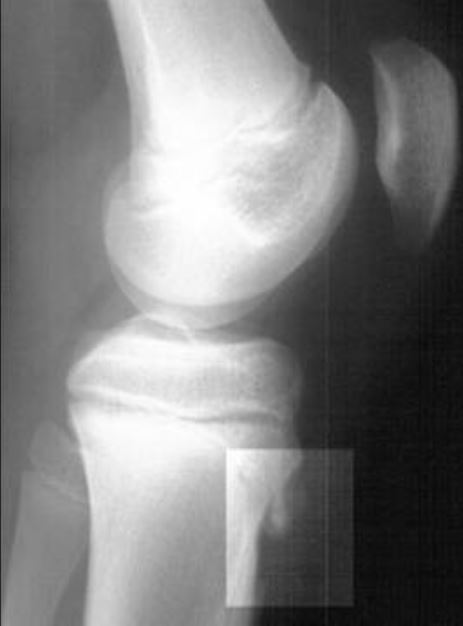
  • Los LOS Neisseria hallazgos radiográficos pueden incluir:
    • Inflamación del tejido blando anterior a la inserción tibial del tendón de la rótula
    • Fragmentación o irregularidad del tubérculo tibial
  • La ecografía es útil para visualizar:
    • Fragmentación del centro de osificación
    • Lesiones del tendón rotuliano
    • Edema Edema Edema is a condition in which excess serous fluid accumulates in the body cavity or interstitial space of connective tissues. Edema is a symptom observed in several medical conditions. It can be categorized into 2 types, namely, peripheral (in the extremities) and internal (in an organ or body cavity). Edema o bursitis reactiva
  • La resonancia magnética permite la detección temprana de:
    • Edema Edema Edema is a condition in which excess serous fluid accumulates in the body cavity or interstitial space of connective tissues. Edema is a symptom observed in several medical conditions. It can be categorized into 2 types, namely, peripheral (in the extremities) and internal (in an organ or body cavity). Edema o cambios en EN Erythema nodosum is an immune-mediated panniculitis (inflammation of the subcutaneous fat) caused by a type IV (delayed-type) hypersensitivity reaction. It commonly manifests in young women as tender, erythematous nodules on the shins. Erythema Nodosum el cartílago antes de que se produzcan desgarros en EN Erythema nodosum is an immune-mediated panniculitis (inflammation of the subcutaneous fat) caused by a type IV (delayed-type) hypersensitivity reaction. It commonly manifests in young women as tender, erythematous nodules on the shins. Erythema Nodosum el centro de osificación
    • Formación de huesecillos y engrosamiento del tendón en EN Erythema nodosum is an immune-mediated panniculitis (inflammation of the subcutaneous fat) caused by a type IV (delayed-type) hypersensitivity reaction. It commonly manifests in young women as tender, erythematous nodules on the shins. Erythema Nodosum etapas avanzadas
Enfermedad de Osgood-Schlatter

Enfermedad de Osgood-Schlatter: radiografía lateral de la rodilla que demuestra la fragmentación del tubérculo tibial con inflamación de los tejidos blandos suprayacentes

Imagen: “Review for the generalist: evaluation of anterior knee pain” por Houghton KM. Licencia: CC BY 2.0

Tratamiento

Tratamiento

La mayoría de los LOS Neisseria casos se tratan exitosamente con reposo relativo y control de los LOS Neisseria síntomas.

  • Tranquilizar y educar al AL Amyloidosis adolescente y a los LOS Neisseria padres:
    • Explicar que la afección es autolimitada.
    • Discutir el tratamiento y las razones para volver o ser reevaluado.
  • Control del dolor Dolor Inflammation y la inflamación:
    • Antiinflamatorios no esteroideos (AINE) o acetaminofén por un periodo de tiempo limitado
    • Aplicación de hielo durante 15–20 minutos hasta 2 veces/día
  • Modificación de la actividad:
    • Evitar la actividad que suponga una carga para la epífisis tibial.
    • No se recomienda el reposo absoluto
    • Considere la posibilidad de una rodillera o almohadilla para la rodilla.
  • Fisioterapia: ejercicios de estiramiento y fortalecimiento del centro corporal, la cadera y las extremidades inferiores
  • Cirugía:
    • Rara vez se realiza
    • Extirpación del huesecillo tras el cierre del cartílago de crecimiento si persiste el dolor Dolor Inflammation

Complicaciones

La mayoría de los LOS Neisseria pacientes son asintomáticos tras el cese del crecimiento. Las secuelas poco comunes son:

  • Persistencia de la prominencia del tubérculo tibial, normalmente sin dolor Dolor Inflammation:
    • Secuelas estéticas más notables
    • Algunos pacientes notan molestias al AL Amyloidosis arrodillarse sobre la prominencia.
  • Los LOS Neisseria huesecillos residuales se producen en EN Erythema nodosum is an immune-mediated panniculitis (inflammation of the subcutaneous fat) caused by a type IV (delayed-type) hypersensitivity reaction. It commonly manifests in young women as tender, erythematous nodules on the shins. Erythema Nodosum el 10% de los LOS Neisseria pacientes; rara vez causan un dolor Dolor Inflammation persistente que requiera su extirpación.
  • Asociación poco frecuente con el genu recurvatum Genu Recurvatum Osgood-Schlatter Disease (hiperextensión de la rodilla)

Referencias

  1. Cassas, K. J., & Cassettari-Wayhs, A. (2006). Childhood and adolescent sports-related overuse injuries. American Family Physician, 73(6), 1014. https://www.ncbi.nlm.nih.gov/pubmed/16570735
  2. Ebraheim, N. A., Thomas, B. J., et al. (2019). Orthopedic surgery. In F. C. Brunicardiet al. (Ed.), Schwartz’s principles of surgery, 11th ed. McGraw-Hill Education.
  3. Lawrence, J. T. (2020). The knee. In R. M. Kliegman, et al. (Ed.), Nelson textbook of pediatrics, pp. 361–3623.e1.
  4. Corbi, F., Matas, S., Álvarez-Herms, J., Sitko, S., Baiget, E., Reverter-Masia, J., & López-Laval, I. (2022). Osgood-Schlatter disease: Appearance, diagnosis, and treatment: A narrative review. Healthcare, 10(6), 1011. https://doi.org/10.3390/healthcare10061011
  5. Kienstra, A. J., & Macias, C. G. (2024, July 25). Osgood-Schlatter disease (tibial tuberosity avulsion). UpToDate. Retrieved January 9, 2025, from https://www.uptodate.com/contents/osgood-schlatter-disease-tibial-tuberosity-avulsion

¡Crea tu cuenta gratis o inicia una sesión para seguir leyendo!

Regístrate ahora y obtén acceso gratuito a Lecturio con páginas de concepto, videos médicos y cuestionarios para tu educación médica.

User Reviews

Que tengas una sesión de estudio alegre y navideña 🎁 Ahorra 50% en todos los planes >>

Details