
Domina Conceptos Médicos

Estudia para la escuela de medicina y tus examenes con Lecturio.

Deficiencia de C3

La deficiencia del componente 3 del complemento (C3) es la ausencia, reducción o disfunción del factor C3 del complemento y sus fragmentos, C3a y C3b. Los LOS Neisseria factores del complemento son componentes clave del sistema inmunológico innato. Los LOS Neisseria niveles reducidos de C3b aumentan la probabilidad de desarrollar infecciones por organismos encapsulados (e.g., Pneumococcus, Haemophilus Haemophilus Haemophilus is a genus of Gram-negative coccobacilli, all of whose strains require at least 1 of 2 factors for growth (factor V [NAD] and factor X [heme]); therefore, it is most often isolated on chocolate agar, which can supply both factors. The pathogenic species are H. influenzae and H. ducreyi. Haemophilus influenza Influenza Influenza viruses are members of the Orthomyxoviridae family and the causative organisms of influenza, a highly contagious febrile respiratory disease. There are 3 primary influenza viruses (A, B, and C) and various subtypes, which are classified based on their virulent surface antigens, hemagglutinin (HA) and neuraminidase (NA). Influenza typically presents with a fever, myalgia, headache, and symptoms of an upper respiratory infection. Influenza Viruses/Influenza, Neisseria meningitidis Neisseria meningitidis A species of gram-negative, aerobic bacteria. It is a commensal and pathogen only of humans, and can be carried asymptomatically in the nasopharynx. When found in cerebrospinal fluid it is the causative agent of cerebrospinal meningitis. It is also found in venereal discharges and blood. There are at least 13 serogroups based on antigenic differences in the capsular polysaccharides; the ones causing most meningitis infections being a, b, c, y, and w-135. Each serogroup can be further classified by serotype, serosubtype, and immunotype. Neisseria), especialmente infecciones respiratorias, debido a la reducción de la opsonización. Los LOS Neisseria individuos con deficiencias de C3 también son más susceptibles de sufrir reacciones de hipersensibilidad de tipo III, ya que una menor eliminación de los LOS Neisseria complejos antígeno-anticuerpo C3b de la circulación provoca un mayor riesgo de reacciones de hipersensibilidad.

Last updated: Dec 15, 2025

Editorial responsibility: Stanley Oiseth, Lindsay Jones, Evelin Maza

Descripción General

Epidemiología

La deficiencia del componente 3 del complemento (C3) forma parte de la categoría más amplia de deficiencias del complemento:
  • Las deficiencias del complemento son raras: Constituyen el 5% de todas las inmunodeficiencias.
  • La prevalencia varía según la ubicación geográfica.
  • No se reporta propensión al AL Amyloidosis sexo o a la etnia.
  • Se han reportado menos de 50 casos de deficiencia de C3 en EN Erythema nodosum is an immune-mediated panniculitis (inflammation of the subcutaneous fat) caused by a type IV (delayed-type) hypersensitivity reaction. It commonly manifests in young women as tender, erythematous nodules on the shins. Erythema Nodosum todo el mundo.

Etiología

  • Deficiencia hereditaria de C3:
    • Codificada en EN Erythema nodosum is an immune-mediated panniculitis (inflammation of the subcutaneous fat) caused by a type IV (delayed-type) hypersensitivity reaction. It commonly manifests in young women as tender, erythematous nodules on the shins. Erythema Nodosum el cromosoma 19 por el gen C3
    • 17 mutaciones en EN Erythema nodosum is an immune-mediated panniculitis (inflammation of the subcutaneous fat) caused by a type IV (delayed-type) hypersensitivity reaction. It commonly manifests in young women as tender, erythematous nodules on the shins. Erythema Nodosum el gen C3 impiden la formación de la proteína C3: comúnmente afecta al AL Amyloidosis fragmento C3b
    • Herencia autosómica recesiva
  • Deficiencia adquirida de C3:
    • Aumento del consumo de C3 durante la infección:
      • Sobreactivación de C3 por complejos inmunes
      • Se observa en EN Erythema nodosum is an immune-mediated panniculitis (inflammation of the subcutaneous fat) caused by a type IV (delayed-type) hypersensitivity reaction. It commonly manifests in young women as tender, erythematous nodules on the shins. Erythema Nodosum lepra lepromatosa, endocarditis Endocarditis Endocarditis is an inflammatory disease involving the inner lining (endometrium) of the heart, most commonly affecting the cardiac valves. Both infectious and noninfectious etiologies lead to vegetations on the valve leaflets. Patients may present with nonspecific symptoms such as fever and fatigue. Endocarditis bacteriana, malaria Malaria Malaria is an infectious parasitic disease affecting humans and other animals. Most commonly transmitted via the bite of a female Anopheles mosquito infected with microorganisms of the Plasmodium genus. Patients present with fever, chills, myalgia, headache, and diaphoresis. Plasmodium/Malaria, mononucleosis Mononucleosis Infectious mononucleosis (IM), also known as “the kissing disease,” is a highly contagious viral infection caused by the Epstein-Barr virus. Its common name is derived from its main method of transmission: the spread of infected saliva via kissing. Clinical manifestations of IM include fever, tonsillar pharyngitis, and lymphadenopathy. Mononucleosis infecciosa, dengue Dengue An acute febrile disease transmitted by the bite of aedes mosquitoes infected with dengue virus. It is self-limiting and characterized by fever, myalgia, headache, and rash. Severe dengue is a more virulent form of dengue. Dengue Virus hemorrágico y hepatitis B Hepatitis B Hepatitis B virus (HBV) is a partially double-stranded DNA virus, which belongs to the Orthohepadnavirus genus and the Hepadnaviridae family. Most individuals with acute HBV infection are asymptomatic or have mild, self-limiting symptoms. Chronic infection can be asymptomatic or create hepatic inflammation, leading to liver cirrhosis and hepatocellular carcinoma (HCC). Hepatitis B Virus aguda
    • Consumo de C3 debido a condiciones médicas:
      • Lupus
      • Glomerulonefritis membranoproliferativa

Fisiopatología

  • Cascada del complemento (3 vías que convergen en una vía común):
    1. Vía clásica (C1qrs, C2, C4)
    2. Vía alternativa (C3, factor B, properdina)
    3. Vía de las lectinas (lectina de unión a manosa)
  • La deficiencia de C3 provoca un mal funcionamiento de la cascada del complemento:
    • Disminución de los LOS Neisseria niveles de opsonina C3b → deterioro de la opsonización de patógenos (especialmente bacterias)
    • Lleva a una reducción de la eliminación de los LOS Neisseria complejos inmunes
    • Mayor riesgo de infecciones bacterianas piógenas
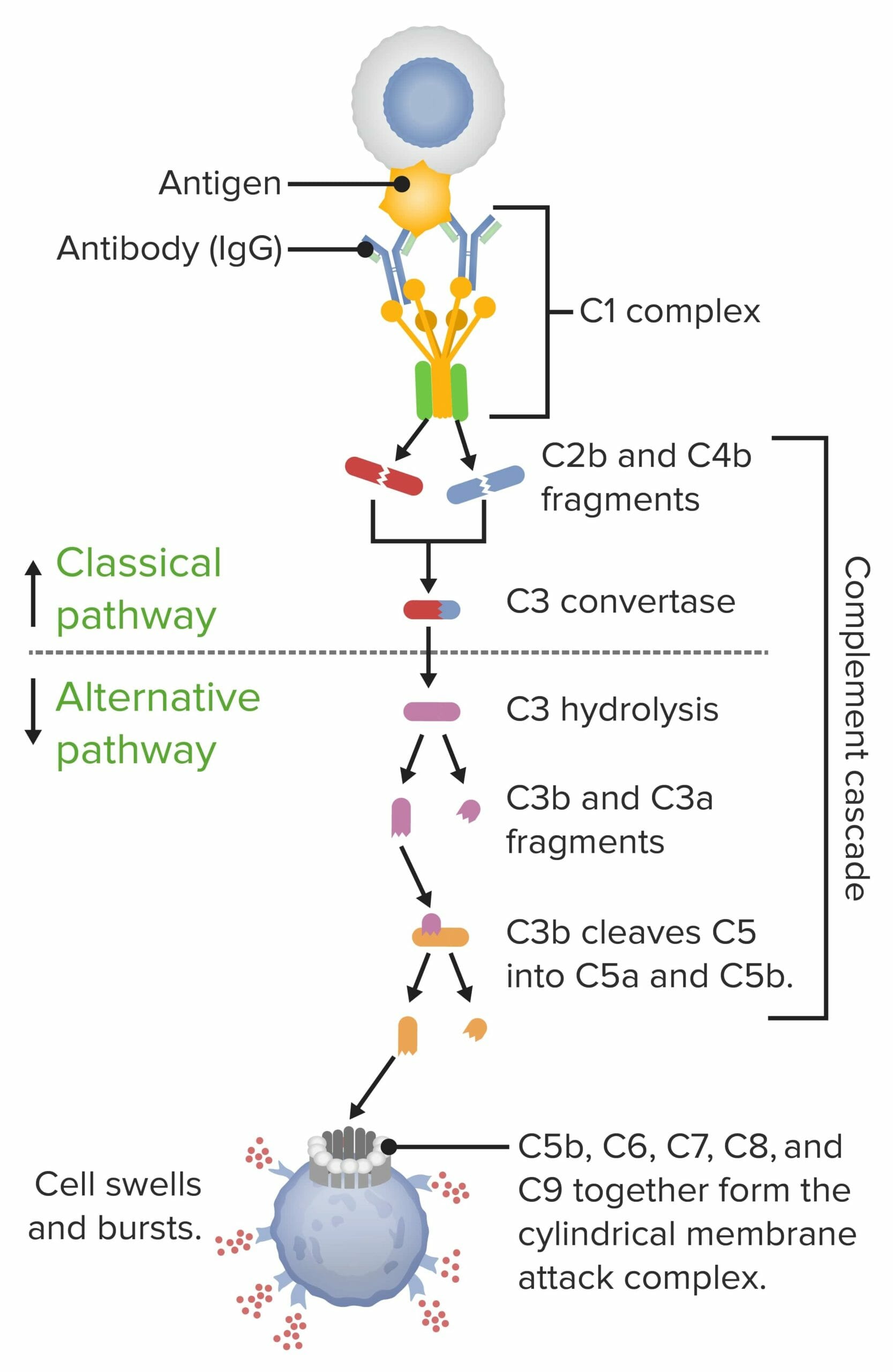
Membrane attack complex (MAC) formation

Formación del complejo de ataque a la membrana:
Cuando la 1ra proteína de la serie del complemento se activa (normalmente por un anticuerpo que se ha fijado a un antígeno), pone en marcha un efecto dominó. Cada componente sigue su turno en una cadena precisa de pasos conocida como la cascada del complemento. El producto final es un cilindro del complejo de ataque a la membrana que se inserta en la pared de la célula (y se perfora). Con los fluidos y las moléculas que entran y salen, la célula se hincha y estalla.

Imagen por Lecturio.

Diagnóstico

Presentación clínica

  • Infecciones bacterianas recurrentes durante la infancia, especialmente por organismos encapsulados:
    • Infecciones del tracto respiratorio superior
    • Neumonía
    • Meningitis Meningitis Meningitis is inflammation of the meninges, the protective membranes of the brain, and spinal cord. The causes of meningitis are varied, with the most common being bacterial or viral infection. The classic presentation of meningitis is a triad of fever, altered mental status, and nuchal rigidity. Meningitis
  • Pueden producirse infecciones generalizadas y sepsis Sepsis Systemic inflammatory response syndrome with a proven or suspected infectious etiology. When sepsis is associated with organ dysfunction distant from the site of infection, it is called severe sepsis. When sepsis is accompanied by hypotension despite adequate fluid infusion, it is called septic shock. Sepsis and Septic Shock similares a la agammaglobulinemia de Bruton: infecciones por Staphylococcus Staphylococcus Staphylococcus is a medically important genera of Gram-positive, aerobic cocci. These bacteria form clusters resembling grapes on culture plates. Staphylococci are ubiquitous for humans, and many strains compose the normal skin flora. Staphylococcus, Pneumococcus o Haemophilus influenzae Haemophilus Influenzae A species of Haemophilus found on the mucous membranes of humans and a variety of animals. The species is further divided into biotypes I through viii. Haemophilus
  • También se asocia a enfermedades autoinmunes:
    • Lupus eritematoso sistémico
    • Reacciones de hipersensibilidad de tipo III
    • El 25% de los LOS Neisseria pacientes desarrollan glomerulonefritis.

Pruebas de laboratorio

Pruebas clínicas dirigidas por el patrón de infección:

  • Tipos de bacterias
  • Localización de la infección

Tratamiento

El tratamiento de los LOS Neisseria pacientes con deficiencia de C3 se centra en EN Erythema nodosum is an immune-mediated panniculitis (inflammation of the subcutaneous fat) caused by a type IV (delayed-type) hypersensitivity reaction. It commonly manifests in young women as tender, erythematous nodules on the shins. Erythema Nodosum la prevención de enfermedad.

Prevención de infección

  • Fomento de la higiene y del lavado de manos frecuente
  • Vigilar de cerca los LOS Neisseria primeros signos de enfermedad.
  • Vacunación: las vacunas contra el meningococo, el neumococo y el H. influenzae H. influenzae A species of Haemophilus found on the mucous membranes of humans and a variety of animals. The species is further divided into biotypes I through VIII. Haemophilus son fundamentales.
  • Antibiótico profiláctico:
    • La profilaxis crónica es controvertida.
    • Puede estar indicado en EN Erythema nodosum is an immune-mediated panniculitis (inflammation of the subcutaneous fat) caused by a type IV (delayed-type) hypersensitivity reaction. It commonly manifests in young women as tender, erythematous nodules on the shins. Erythema Nodosum individuos seleccionados en EN Erythema nodosum is an immune-mediated panniculitis (inflammation of the subcutaneous fat) caused by a type IV (delayed-type) hypersensitivity reaction. It commonly manifests in young women as tender, erythematous nodules on the shins. Erythema Nodosum función de la severidad, la frecuencia y el tipo de infección

Tratamiento de la infección

  • Terapia antibiótica dirigida según bacterias aisladas
  • Infusión de complemento: indicada en EN Erythema nodosum is an immune-mediated panniculitis (inflammation of the subcutaneous fat) caused by a type IV (delayed-type) hypersensitivity reaction. It commonly manifests in young women as tender, erythematous nodules on the shins. Erythema Nodosum caso de enfermedad aguda

Referencias

  1. Bernacchia A, Ginaca A, Rotondo S, Tejada MP, Di Giovanni D. Case Report: C3 deficiency in two siblings. Front. Pediatr., July 2024; 12:1424380. Retrieved November 6, 2024, from https://www.frontiersin.org/journals/pediatrics/articles/10.3389/fped.2024.1424380/full.
  2. Grumach, A. S., & Kirschfink, M. (2014). Are complement deficiencies really rare? Overview on prevalence, clinical importance and modern diagnostic approach. Molecular immunology61(2), 110–117. https://doi.org/10.1016/j.molimm.2014.06.030
  3. Botto, M., Kirschfink, M., Macor, P., Pickering, M. C., Würzner, R., & Tedesco, F. (2009). Complement in human diseases: Lessons from complement deficiencies. Molecular immunology46(14), 2774–2783. https://doi.org/10.1016/j.molimm.2009.04.029

¡Crea tu cuenta gratis o inicia una sesión para seguir leyendo!

Regístrate ahora y obtén acceso gratuito a Lecturio con páginas de concepto, videos médicos y cuestionarios para tu educación médica.

User Reviews

Que tengas una sesión de estudio alegre y navideña 🎁 Ahorra 50% en todos los planes >>

Details