
Domina Conceptos Médicos

Estudia para la escuela de medicina y tus examenes con Lecturio.

Cefalea Tensional

La cefalea tensional es el más común de las cefaleas primarias y uno de los LOS Neisseria trastornos más comunes que se presentan para evaluación médica a nivel mundial. Las cefaleas tensionales generalmente se describen como bilaterales, no-pulsátiles y de gravedad leve a moderada. No hay aura Aura Reversible neurological phenomena that often precede or coincide with headache onset. Migraine Headache u otras características asociadas. El diagnóstico es clínico, a menudo autodiagnosticado por el paciente o en EN Erythema nodosum is an immune-mediated panniculitis (inflammation of the subcutaneous fat) caused by a type IV (delayed-type) hypersensitivity reaction. It commonly manifests in young women as tender, erythematous nodules on the shins. Erythema Nodosum el entorno de atención primaria. El tratamiento consiste en EN Erythema nodosum is an immune-mediated panniculitis (inflammation of the subcutaneous fat) caused by a type IV (delayed-type) hypersensitivity reaction. It commonly manifests in young women as tender, erythematous nodules on the shins. Erythema Nodosum analgésicos abortivos, como AINE y aspirina para ataques aislados, y medidas preventivas, como cambios de comportamiento, biorretroalimentación y administración preventiva de medicamentos para ataques más crónicos.

Last updated: Dec 15, 2025

Editorial responsibility: Stanley Oiseth, Lindsay Jones, Evelin Maza

Descripción General

Definición

Una cefalea tensional se define por las siguientes características:

  • Intensidad de leve a moderada
  • Bilateral
  • No pulsátil 
  • Con o sin sensibilidad en EN Erythema nodosum is an immune-mediated panniculitis (inflammation of the subcutaneous fat) caused by a type IV (delayed-type) hypersensitivity reaction. It commonly manifests in young women as tender, erythematous nodules on the shins. Erythema Nodosum los LOS Neisseria músculos pericraneales
  • Generalmente sin otros síntomas asociados
    • Sin aura Aura Reversible neurological phenomena that often precede or coincide with headache onset. Migraine Headache
    • Sin síntomas neurológicos focales
    • Puede presentarse fotofobia, pero no junto con fonofobia
    • Puede presentarse fonofobia, pero no junto con fotofobia
    • Sin náuseas o vómitos

Clasificación

Tres cefaleas primarias:

  1. Migraña
  2. Cefalea en EN Erythema nodosum is an immune-mediated panniculitis (inflammation of the subcutaneous fat) caused by a type IV (delayed-type) hypersensitivity reaction. It commonly manifests in young women as tender, erythematous nodules on the shins. Erythema Nodosum racimos
  3. Cefalea tensional

Tres subtipos de cefalea tensional:

  1. Cefalea tensional episódica infrecuente: < 1 cefalea al AL Amyloidosis día por mes
  2. Cefalea tensional episódica frecuente: 1–14 cefaleas por mes
  3. Cefalea tensional crónica: ≥ 15 cefaleas al AL Amyloidosis mes durante > 3 meses (≥ 180 días/año)

Epidemiología

  • Cefalea más prevalente en EN Erythema nodosum is an immune-mediated panniculitis (inflammation of the subcutaneous fat) caused by a type IV (delayed-type) hypersensitivity reaction. It commonly manifests in young women as tender, erythematous nodules on the shins. Erythema Nodosum la población general
  • Causa principal de pérdida de productividad laboral
  • Prevalencia: afecta a alrededor del 75% de la población en EN Erythema nodosum is an immune-mediated panniculitis (inflammation of the subcutaneous fat) caused by a type IV (delayed-type) hypersensitivity reaction. It commonly manifests in young women as tender, erythematous nodules on the shins. Erythema Nodosum algún momento
  • Mujeres > hombres
  • Subtipo más común: episódico infrecuente

Fisiopatología

La fisiopatología de la cefalea tensional es multifactorial, pero los LOS Neisseria mecanismos precisos se desconocen en EN Erythema nodosum is an immune-mediated panniculitis (inflammation of the subcutaneous fat) caused by a type IV (delayed-type) hypersensitivity reaction. It commonly manifests in young women as tender, erythematous nodules on the shins. Erythema Nodosum gran medida. Los LOS Neisseria mecanismos del dolor Dolor Inflammation son dinámicos y varían de un individuo a otro.

Activación periférica

Activación de los LOS Neisseria nociceptores miofasciales debido a la exposición a estímulos ambientales nocivos:

  • El mecanismo más probable en EN Erythema nodosum is an immune-mediated panniculitis (inflammation of the subcutaneous fat) caused by a type IV (delayed-type) hypersensitivity reaction. It commonly manifests in young women as tender, erythematous nodules on the shins. Erythema Nodosum la cefalea tensional episódica infrecuente
  • Los LOS Neisseria estímulos ambientales pueden incluir (entre otros):
    • Estrés
    • Tensión mental/emocional
    • Luz brillante
    • Ruidos fuertes
    • Olores
    • Hambre
    • Temperaturas ambientales extremas
    • Gorras/binchas/coletas
    • Corrección subóptima/inadecuada de la visión
    • Tensión de los LOS Neisseria músculos pericraneales

Sensibilización periférica

Sensibilización de los LOS Neisseria nociceptores miofasciales:

  • Debido a la exposición persistente a estímulos ambientales nocivos
  • Menor umbral de dolor Dolor Inflammation a estímulos normalmente nocivos
  • Desarrollo de puntos gatillo latentes en EN Erythema nodosum is an immune-mediated panniculitis (inflammation of the subcutaneous fat) caused by a type IV (delayed-type) hypersensitivity reaction. It commonly manifests in young women as tender, erythematous nodules on the shins. Erythema Nodosum la musculatura pericraneal
  • Mecanismo probable en EN Erythema nodosum is an immune-mediated panniculitis (inflammation of the subcutaneous fat) caused by a type IV (delayed-type) hypersensitivity reaction. It commonly manifests in young women as tender, erythematous nodules on the shins. Erythema Nodosum la cefalea tensional episódica frecuente
  • Trampolín al AL Amyloidosis desarrollo de cefalea tensional crónica

Sensibilización central

Sensibilización de las vías del dolor Dolor Inflammation en EN Erythema nodosum is an immune-mediated panniculitis (inflammation of the subcutaneous fat) caused by a type IV (delayed-type) hypersensitivity reaction. It commonly manifests in young women as tender, erythematous nodules on the shins. Erythema Nodosum el sistema nervioso central:

  • Mecanismo probable en EN Erythema nodosum is an immune-mediated panniculitis (inflammation of the subcutaneous fat) caused by a type IV (delayed-type) hypersensitivity reaction. It commonly manifests in young women as tender, erythematous nodules on the shins. Erythema Nodosum la cefalea tensional crónica
  • Debido a estímulos nociceptivos prolongados del tejido miofascial pericraneal sensibilizado periféricamente
  • Umbral de dolor Dolor Inflammation más bajo para estímulos normalmente nocivos (hipersensibilidad)
  • Los LOS Neisseria estímulos normalmente inocuos se malinterpretan como dolor Dolor Inflammation (alodinia):
    • Mayor facilitación de la transmisión del dolor Dolor Inflammation en EN Erythema nodosum is an immune-mediated panniculitis (inflammation of the subcutaneous fat) caused by a type IV (delayed-type) hypersensitivity reaction. It commonly manifests in young women as tender, erythematous nodules on the shins. Erythema Nodosum el asta dorsal espinal/núcleo trigémino
    • Disminución de la inhibición de la transmisión del dolor Dolor Inflammation en EN Erythema nodosum is an immune-mediated panniculitis (inflammation of the subcutaneous fat) caused by a type IV (delayed-type) hypersensitivity reaction. It commonly manifests in young women as tender, erythematous nodules on the shins. Erythema Nodosum el asta dorsal espinal/núcleo trigémino
    • Aumento pericraneal actividad muscular

Factores genéticos

Se ha HA Hemolytic anemia (HA) is the term given to a large group of anemias that are caused by the premature destruction/hemolysis of circulating red blood cells (RBCs). Hemolysis can occur within (intravascular hemolysis) or outside the blood vessels (extravascular hemolysis). Hemolytic Anemia demostrado que los LOS Neisseria factores genéticos desempeñan un papel en EN Erythema nodosum is an immune-mediated panniculitis (inflammation of the subcutaneous fat) caused by a type IV (delayed-type) hypersensitivity reaction. It commonly manifests in young women as tender, erythematous nodules on the shins. Erythema Nodosum la patogenia de la cefalea tensional crónica.

  • Los LOS Neisseria familiares de 1er grado de personas con cefalea tensional crónica tienen un riesgo > 3 veces mayor de cefalea tensional crónica.
  • Patrón de herencia multifactorial propuesto pero no probado

Presentación Clínica

La cefalea tensional puede presentarse con una amplia variación en EN Erythema nodosum is an immune-mediated panniculitis (inflammation of the subcutaneous fat) caused by a type IV (delayed-type) hypersensitivity reaction. It commonly manifests in young women as tender, erythematous nodules on the shins. Erythema Nodosum frecuencia e intensidad entre individuos, en EN Erythema nodosum is an immune-mediated panniculitis (inflammation of the subcutaneous fat) caused by a type IV (delayed-type) hypersensitivity reaction. It commonly manifests in young women as tender, erythematous nodules on the shins. Erythema Nodosum el mismo individuo a lo largo del tiempo y de un ataque a otro en EN Erythema nodosum is an immune-mediated panniculitis (inflammation of the subcutaneous fat) caused by a type IV (delayed-type) hypersensitivity reaction. It commonly manifests in young women as tender, erythematous nodules on the shins. Erythema Nodosum el mismo individuo.
Antecedentes

  • Descriptores clásicos del dolor Dolor Inflammation:
    • Sordo
    • Opresivo
    • Plenitud
    • Cabeza se siente grande
    • Como una gorra ajustada
    • Banda
    • Peso pesado en EN Erythema nodosum is an immune-mediated panniculitis (inflammation of the subcutaneous fat) caused by a type IV (delayed-type) hypersensitivity reaction. It commonly manifests in young women as tender, erythematous nodules on the shins. Erythema Nodosum la cabeza o los LOS Neisseria hombros
  • Características:
    • Típicamente bilateral
    • Duración de 30 minutos a varios días
    • No empeora con la actividad física
    • Tensión de los LOS Neisseria músculos pericraneales
    • Presencia de puntos gatillo miofasciales

Examen físico

  • Sensibilidad de los LOS Neisseria músculos pericraneales:
  • Sensibilidad de los LOS Neisseria músculos extracraneales:
    • Masetero
    • Pterigoideo
    • Esternocleidomastoideo
    • Esplenio
    • Trapecio
  • Presencia de puntos gatillo miofasciales (pericraneales o extracraneales)
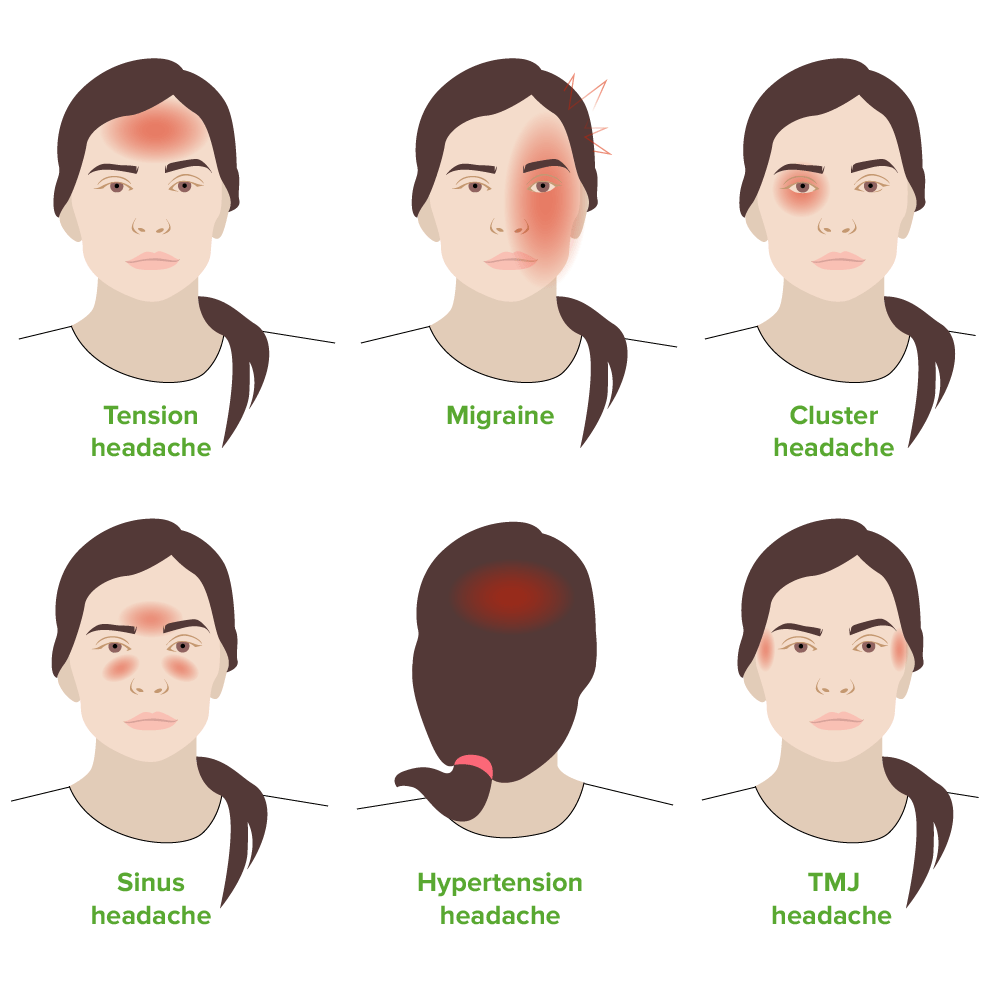
Tension headache

Ilustración que muestra las localizaciones del dolor para los diferentes tipos de cefalea
ATM: articulación temporomandibular

Imagen por Lecturio.

Diagnóstico

Criterios

  • ≥ 10 episodios de dolor Dolor Inflammation, de 30 minutos a 7 días de duración (cefalea tensional episódica), con al AL Amyloidosis menos 2 de lo siguiente:
    • Localización bilateral
    • Calidad opresiva o tensa (no pulsátil) 
    • Intensidad leve o moderada
    • No agravada por la actividad física rutinaria (caminar, subir escaleras)
  • Deben cumplirse también las dos condiciones siguientess:
    • Sin náuseas o vómitos
    • No más de 1:
      • Fotofobia
      • Fonofobia
  • Clasificación por cronicidad:
    • Cefalea tensional episódica infrecuente: ≤ 1 cefalea por mes
    • Cefalea tensional episódica frecuente: 2–14 cefaleas por mes
    • Cefalea tensional crónica: ≥ 15 días de cefalea al AL Amyloidosis mes durante > 3 meses

Evaluación de laboratorio

La evaluación de laboratorio está indicada solo en EN Erythema nodosum is an immune-mediated panniculitis (inflammation of the subcutaneous fat) caused by a type IV (delayed-type) hypersensitivity reaction. It commonly manifests in young women as tender, erythematous nodules on the shins. Erythema Nodosum los LOS Neisseria siguientes casos:

  • Sospecha de proceso infeccioso
  • Sospecha de disfunción orgánica
  • Sospecha de depleción/sobrecarga de volumen
  • Sospecha de alteración electrolítica

Las pruebas de laboratorio deben ser específicas para la(s) causa(s) subyacente(s):

  • Sospecha de proceso infeccioso:
    • Hemograma
    • Estudios de LCR
  • Sospecha de disfunción orgánica:
    • Biomarcadores cardíacos
    • Nitrogeno de urea Urea A compound formed in the liver from ammonia produced by the deamination of amino acids. It is the principal end product of protein catabolism and constitutes about one half of the total urinary solids. Urea Cycle (BUN, por sus siglas en EN Erythema nodosum is an immune-mediated panniculitis (inflammation of the subcutaneous fat) caused by a type IV (delayed-type) hypersensitivity reaction. It commonly manifests in young women as tender, erythematous nodules on the shins. Erythema Nodosum inglés), creatinina (función renal)
    • AST AST Enzymes of the transferase class that catalyze the conversion of l-aspartate and 2-ketoglutarate to oxaloacetate and l-glutamate. Liver Function Tests/ ALT ALT An enzyme that catalyzes the conversion of l-alanine and 2-oxoglutarate to pyruvate and l-glutamate. Liver Function Tests (función hepática)
  • Sospecha de depleción/sobrecarga de volumen:
    • BUN/creatinina (función renal)
    • AST AST Enzymes of the transferase class that catalyze the conversion of l-aspartate and 2-ketoglutarate to oxaloacetate and l-glutamate. Liver Function Tests/ ALT ALT An enzyme that catalyzes the conversion of l-alanine and 2-oxoglutarate to pyruvate and l-glutamate. Liver Function Tests (función hepática)
    • BNP BNP A peptide that is secreted by the brain and the heart atria, stored mainly in cardiac ventricular myocardium. It can cause natriuresis; diuresis; vasodilation; and inhibits secretion of renin and aldosterone. It improves heart function. It contains 32 amino acids. Renal Sodium and Water Regulation (indica insuficiencia cardíaca)
    • Estudios de tiroides
  • Sospecha de alteración electrolítica: panel de química o panel de electrolitos

Imagenologia

La imagenologia están indicadas solo en EN Erythema nodosum is an immune-mediated panniculitis (inflammation of the subcutaneous fat) caused by a type IV (delayed-type) hypersensitivity reaction. It commonly manifests in young women as tender, erythematous nodules on the shins. Erythema Nodosum los LOS Neisseria siguientes casos:

  • Cefalea con signos de alarma
  • Hallazgos neurológicos focales 
  • La cefalea no clasifica como ninguno de las cefaleas primarias

Modalidades de imagenologia:

  • La RM del cerebro con y sin contraste es el estudio de elección. 
  • La TC es más rápida para la clasificación de sospecha de hemorragia intracraneal aguda.

Tratamiento

El tratamiento de la cefalea tensional suele ser autodirigido por los LOS Neisseria pacientes que usan analgésicos de venta libre sin buscar atención médica ni indicaciones. El médico de atención primaria debe ser capaz de diagnosticar y tratar la cefalea tensional sin necesidad de consultar a un especialista.

Terapia abortiva

  • Medicamentos de 1ra línea: analgésicos simples (ingrediente único, no opioide, sin barbitúricos):
    • Aspirina
    • Acetaminofén
    • AINE (ibuprofeno, naproxeno) 
  • Medicamentos de 2da línea:
    • Analgésicos simples + cafeína/codeína (evitar combinaciones que contengan opioides o barbitúricos)
    • Clorpromazina
    • Metoclopramida
    • Ketorolaco (AINE)
  • Más efectivos si se administran poco después del inicio de los LOS Neisseria síntomas
  • La frecuencia de dosificación debe limitarse para evitar cefalea por uso excesivo de medicamentos (efecto rebote), especialmente para medicamentos combinados que contienen:
    • Cafeína
    • Codeína
    • Butalbital

Terapia preventiva

  • Considerado en EN Erythema nodosum is an immune-mediated panniculitis (inflammation of the subcutaneous fat) caused by a type IV (delayed-type) hypersensitivity reaction. It commonly manifests in young women as tender, erythematous nodules on the shins. Erythema Nodosum el tratamiento a medida que aumenta la frecuencia de los LOS Neisseria ataques
  • Indicado para:
    • Cefalea tensional crónica 
    • Casos seleccionados de cefalea tensional frecuente 
    • Fracaso/intolerancia de la terapia aguda
    • Prevención/tratamiento de la cefalea por uso excesivo de medicamentos
  • Terapia farmacológica:
    • Antidepresivos
      • Tricíclicos 
      • Mirtazapina
      • Venlafaxina
    • Anticonvulsivos
      • Topiramato
      • Gabapentina
    • Toxina botulínica (protocolo para cefalea)
  • Terapias no farmacológicas:
    • Neuromodulación (estimulación eléctrica de baja frecuencia) 
    • Inyecciones en EN Erythema nodosum is an immune-mediated panniculitis (inflammation of the subcutaneous fat) caused by a type IV (delayed-type) hypersensitivity reaction. It commonly manifests in young women as tender, erythematous nodules on the shins. Erythema Nodosum puntos gatillo
    • Acupuntura
  • Enfoques conductuales:
    • Modificaciones en EN Erythema nodosum is an immune-mediated panniculitis (inflammation of the subcutaneous fat) caused by a type IV (delayed-type) hypersensitivity reaction. It commonly manifests in young women as tender, erythematous nodules on the shins. Erythema Nodosum el estilo de vida
    • Terapia cognitivo conductual
    • Relajación
    • Biorretroalimentación

Diagnóstico Diferencial

  • Cefalea en EN Erythema nodosum is an immune-mediated panniculitis (inflammation of the subcutaneous fat) caused by a type IV (delayed-type) hypersensitivity reaction. It commonly manifests in young women as tender, erythematous nodules on the shins. Erythema Nodosum racimos: cefalea primaria que es grave y unilateral, a menudo alrededor del ojo, con una duración de minutos hasta 3 horas. Más común en EN Erythema nodosum is an immune-mediated panniculitis (inflammation of the subcutaneous fat) caused by a type IV (delayed-type) hypersensitivity reaction. It commonly manifests in young women as tender, erythematous nodules on the shins. Erythema Nodosum hombres. Los LOS Neisseria pacientes suelen presentar síntomas autonómicos acompañantes, como congestión nasal e hinchazón o lagrimeo del ojo. El diagnóstico es clínico basado en EN Erythema nodosum is an immune-mediated panniculitis (inflammation of the subcutaneous fat) caused by a type IV (delayed-type) hypersensitivity reaction. It commonly manifests in young women as tender, erythematous nodules on the shins. Erythema Nodosum los LOS Neisseria síntomas típicos. El tratamiento incluye la administración de oxígeno y triptanos y evitar los LOS Neisseria desencadenantes, como el tabaquismo y el alcohol.
  • Cefalea migrañosa: tipo de cefalea primaria severa, generalmente descrita como unilateral y pulsátil, y asociada a síntomas neurológicos, como náuseas y/o sensibilidad a la luz y al AL Amyloidosis sonido. Los LOS Neisseria ataques de migraña duran entre 4 y 72 horas y son más comunes en EN Erythema nodosum is an immune-mediated panniculitis (inflammation of the subcutaneous fat) caused by a type IV (delayed-type) hypersensitivity reaction. It commonly manifests in young women as tender, erythematous nodules on the shins. Erythema Nodosum mujeres. Los LOS Neisseria pacientes pueden experimentar un aura Aura Reversible neurological phenomena that often precede or coincide with headache onset. Migraine Headache antes del inicio de la cefalea, como fenómenos visuales, hormigueo en EN Erythema nodosum is an immune-mediated panniculitis (inflammation of the subcutaneous fat) caused by a type IV (delayed-type) hypersensitivity reaction. It commonly manifests in young women as tender, erythematous nodules on the shins. Erythema Nodosum la piel o dificultad para hablar. El diagnóstico es clínico basado en EN Erythema nodosum is an immune-mediated panniculitis (inflammation of the subcutaneous fat) caused by a type IV (delayed-type) hypersensitivity reaction. It commonly manifests in young women as tender, erythematous nodules on the shins. Erythema Nodosum los LOS Neisseria síntomas típicos. El tratamiento incluye evitar los LOS Neisseria ruidos fuertes y la luz y la administración de analgésicos simples y/o triptanos.
  • Cefalea por uso excesivo de medicamentos: también llamado cefalea de rebote. Un tipo de cefalea secundaria en EN Erythema nodosum is an immune-mediated panniculitis (inflammation of the subcutaneous fat) caused by a type IV (delayed-type) hypersensitivity reaction. It commonly manifests in young women as tender, erythematous nodules on the shins. Erythema Nodosum pacientes que tienen cefaleas frecuentes o diarias a pesar de, o debido al AL Amyloidosis uso regular Regular Insulin de medicamentos para la cefalea. La cefalea por uso excesivo de medicamentos suele estar precedida por un trastorno de cefalea primario episódico que se ha HA Hemolytic anemia (HA) is the term given to a large group of anemias that are caused by the premature destruction/hemolysis of circulating red blood cells (RBCs). Hemolysis can occur within (intravascular hemolysis) or outside the blood vessels (extravascular hemolysis). Hemolytic Anemia tratado con cantidades excesivas de medicamentos abortivos, especialmente medicamentos combinados con cafeína y codeína. El tratamiento incluye una reducción gradual de la dosis.
  • Cefalea cervicogénica: cefalea causada por dolor Dolor Inflammation referido desde las articulaciones cervicales superiores. Típicamente unilateral, de intensidad moderada a severa, incrementada por el movimiento de la cabeza, con radiación desde la región occipital Occipital Part of the back and base of the cranium that encloses the foramen magnum. Skull: Anatomy a la frontal Frontal The bone that forms the frontal aspect of the skull. Its flat part forms the forehead, articulating inferiorly with the nasal bone and the cheek bone on each side of the face. Skull: Anatomy. El diagnóstico es clínico basado en EN Erythema nodosum is an immune-mediated panniculitis (inflammation of the subcutaneous fat) caused by a type IV (delayed-type) hypersensitivity reaction. It commonly manifests in young women as tender, erythematous nodules on the shins. Erythema Nodosum los LOS Neisseria síntomas típicos. El tratamiento incluye analgésicos simples, fisioterapia, bloqueos nerviosos o manipulación espinal. 
  • Cefalea sinusal: cefalea que se produce en EN Erythema nodosum is an immune-mediated panniculitis (inflammation of the subcutaneous fat) caused by a type IV (delayed-type) hypersensitivity reaction. It commonly manifests in young women as tender, erythematous nodules on the shins. Erythema Nodosum el contexto de una sinusitis Sinusitis Sinusitis refers to inflammation of the mucosal lining of the paranasal sinuses. The condition usually occurs concurrently with inflammation of the nasal mucosa (rhinitis), a condition known as rhinosinusitis. Acute sinusitis is due to an upper respiratory infection caused by a viral, bacterial, or fungal agent. Sinusitis aguda o crónica. El dolor Dolor Inflammation generalmente se describe como constante y profundo alrededor de las mejillas, la frente o el puente de la nariz. La cefalea sinusal se asocia con síntomas que incluyen secreción nasal, hinchazón o lagrimeo de los LOS Neisseria ojos y fiebre. El tratamiento incluye descongestionantes, antihistamínicos en EN Erythema nodosum is an immune-mediated panniculitis (inflammation of the subcutaneous fat) caused by a type IV (delayed-type) hypersensitivity reaction. It commonly manifests in young women as tender, erythematous nodules on the shins. Erythema Nodosum caso de alergia y antibióticos en EN Erythema nodosum is an immune-mediated panniculitis (inflammation of the subcutaneous fat) caused by a type IV (delayed-type) hypersensitivity reaction. It commonly manifests in young women as tender, erythematous nodules on the shins. Erythema Nodosum presencia de una infección bacteriana.

Referencias

  1. Taylor, F. R. (2025). Tension-type headache in adults: Etiology, clinical features, and diagnosis. UpToDate. Retrieved September 27, 2025, from https://www.uptodate.com/contents/tension-type-headache-in-adults-etiology-clinical-features-and-diagnosis
  2. Taylor F. (2024). Tension-type headache in adults: Acute treatment. Retrieved September 27, 2025, from https://www.uptodate.com/contents/tension-type-headache-in-adults-acute-treatment
  3. Taylor F. (2024). Tension-type headache in adults: Preventive treatment. Retrieved September 27, 2025, from https://www.uptodate.com/contents/tension-type-headache-in-adults-preventive-treatment
  4. American Migraine Foundation. (2023). Tension-type headache. American Migraine Foundation. Retrieved September 27, 2025, from https://americanmigrainefoundation.org/resource-library/tension-type-headache/

¡Crea tu cuenta gratis o inicia una sesión para seguir leyendo!

Regístrate ahora y obtén acceso gratuito a Lecturio con páginas de concepto, videos médicos y cuestionarios para tu educación médica.

User Reviews

Que tengas una sesión de estudio alegre y navideña 🎁 Ahorra 50% en todos los planes >>

Details