Domina Conceptos Médicos

Estudia para la escuela de medicina y tus examenes con Lecturio.

Apendicectomía

La apendicectomía es un procedimiento quirúrgico invasivo realizado con el objetivo de resecar y extraer el apéndice vermiforme a través de un abordaje abierto o laparoscópico. La indicación más común es la apendicitis aguda, por lo que las apendicectomías suelen realizarse de manera urgente. Es uno de los LOS Neisseria procedimientos abdominales de emergencia más frecuentes. Puede asociarse a una serie de complicaciones postoperatorias; sin embargo, la mayoría de los LOS Neisseria pacientes evolucionan muy bien y se recuperan rápidamente.

Last updated: Dec 15, 2025

Editorial responsibility: Stanley Oiseth, Lindsay Jones, Evelin Maza

Anatomía Quirúrgica

Definición

La apendicectomía se refiere a la extirpación quirúrgica del apéndice vermiforme.

Embriología

Es importante revisar el desarrollo de los LOS Neisseria órganos abdominales para entender la ubicación del apéndice dentro de la cavidad abdominal y sus posibles variantes.

  • El ciego y el apéndice se derivan del intestino medio.
  • El ciego es visible durante la 5ta semana de gestación.
  • El apéndice aparece como una evaginación cecal alrededor de la 8va semana.
  • La base del apéndice se mueve gradualmente hacia la válvula ileocecal.
  • Durante la rotación normal del intestino medio embrionario, el ciego y el apéndice terminan en EN Erythema nodosum is an immune-mediated panniculitis (inflammation of the subcutaneous fat) caused by a type IV (delayed-type) hypersensitivity reaction. It commonly manifests in young women as tender, erythematous nodules on the shins. Erythema Nodosum el cuadrante abdominal inferior derecho. En EN Erythema nodosum is an immune-mediated panniculitis (inflammation of the subcutaneous fat) caused by a type IV (delayed-type) hypersensitivity reaction. It commonly manifests in young women as tender, erythematous nodules on the shins. Erythema Nodosum la malrotación congénita, pueden encontrarse en EN Erythema nodosum is an immune-mediated panniculitis (inflammation of the subcutaneous fat) caused by a type IV (delayed-type) hypersensitivity reaction. It commonly manifests in young women as tender, erythematous nodules on the shins. Erythema Nodosum la parte media superior del abdomen.

Anatomía

Es importante revisar la anatomía del colon Colon The large intestines constitute the last portion of the digestive system. The large intestine consists of the cecum, appendix, colon (with ascending, transverse, descending, and sigmoid segments), rectum, and anal canal. The primary function of the colon is to remove water and compact the stool prior to expulsion from the body via the rectum and anal canal. Colon, Cecum, and Appendix: Anatomy para localizar y reconocer más fácilmente el ciego y el apéndice dentro de la cavidad abdominal durante la cirugía.
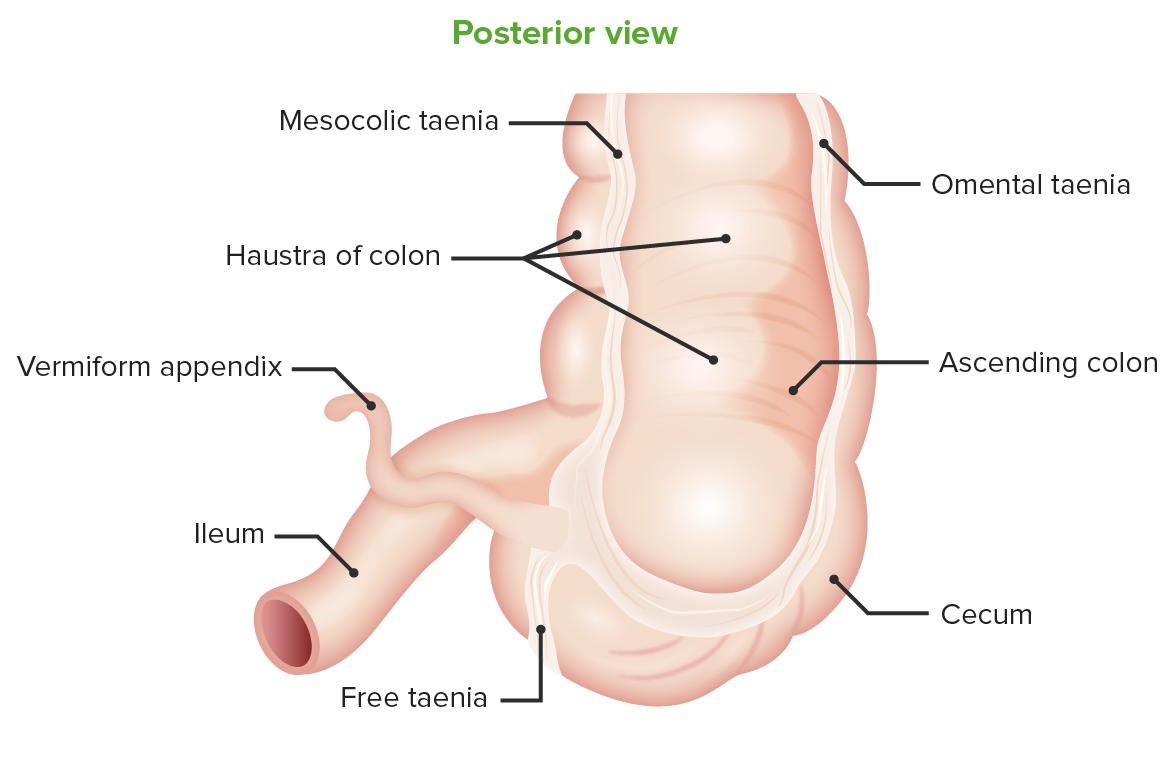
  • El apéndice es una bolsa delgada y hueca, de extremo ciego, unida al AL Amyloidosis ciego proximal.
  • El orificio apendicular se encuentra siempre en EN Erythema nodosum is an immune-mediated panniculitis (inflammation of the subcutaneous fat) caused by a type IV (delayed-type) hypersensitivity reaction. It commonly manifests in young women as tender, erythematous nodules on the shins. Erythema Nodosum la confluencia de las tenias del colon Colon The large intestines constitute the last portion of the digestive system. The large intestine consists of the cecum, appendix, colon (with ascending, transverse, descending, and sigmoid segments), rectum, and anal canal. The primary function of the colon is to remove water and compact the stool prior to expulsion from the body via the rectum and anal canal. Colon, Cecum, and Appendix: Anatomy.
  • En EN Erythema nodosum is an immune-mediated panniculitis (inflammation of the subcutaneous fat) caused by a type IV (delayed-type) hypersensitivity reaction. It commonly manifests in young women as tender, erythematous nodules on the shins. Erythema Nodosum promedio, el apéndice mide aproximadamente 9 cm de largo, pero puede variar de 2 a 22 cm.
  • Mesenterio del apéndice:
    • Llamado el mesoapéndice
    • Se une al AL Amyloidosis ciego y al AL Amyloidosis apéndice proximal
    • Contiene la arteria y la vena apendicular
  • Irrigación sanguínea:
    • La arteria apendicular es una rama de la arteria ileocólica.
    • La vena apendicular es tributaria de la vena ileocólica.
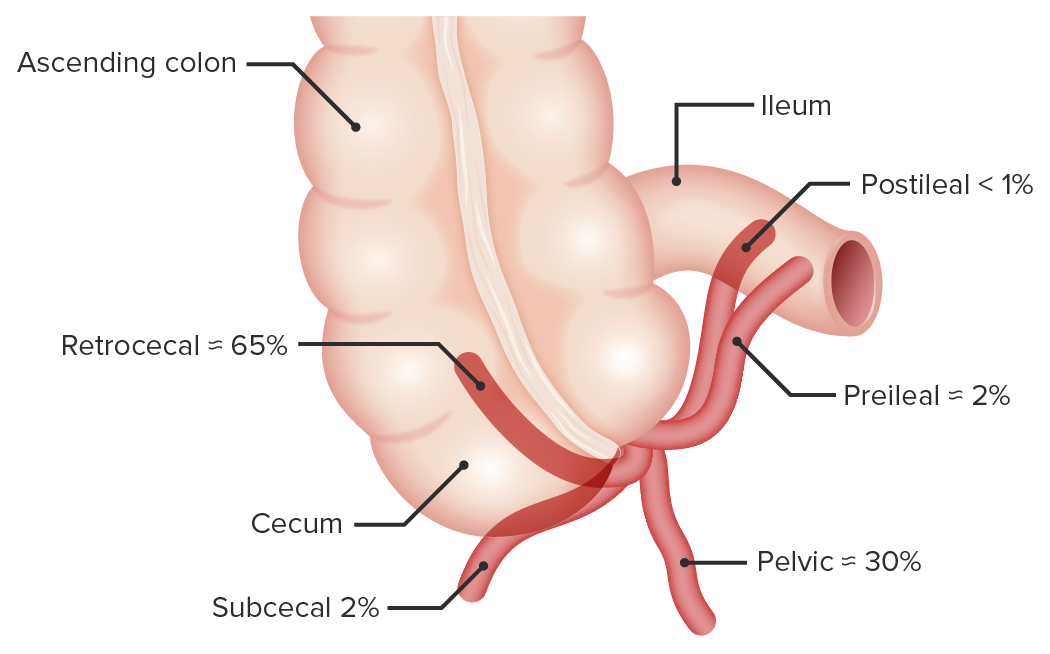
  • Posiciones del apéndice:
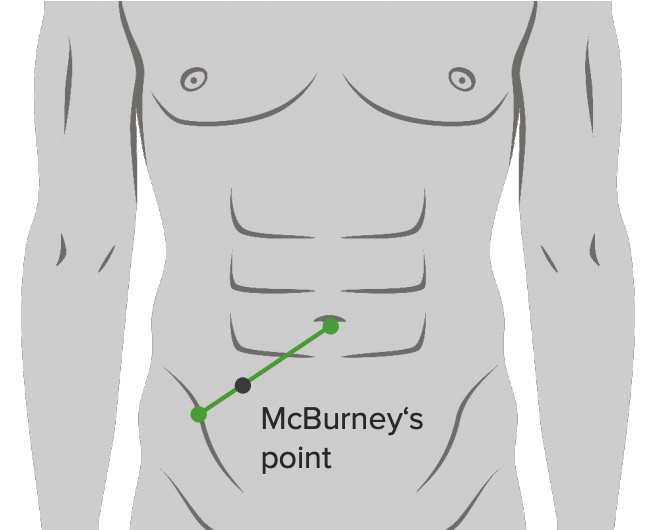
  • Punto de McBurney:
    • Es la unión entre los LOS Neisseria tercios lateral y medial de una línea trazada desde la espina ilíaca anterosuperior hasta el ombligo
    • El dolor Dolor Inflammation localizado en EN Erythema nodosum is an immune-mediated panniculitis (inflammation of the subcutaneous fat) caused by a type IV (delayed-type) hypersensitivity reaction. It commonly manifests in young women as tender, erythematous nodules on the shins. Erythema Nodosum este punto es un signo clásico de apendicitis.
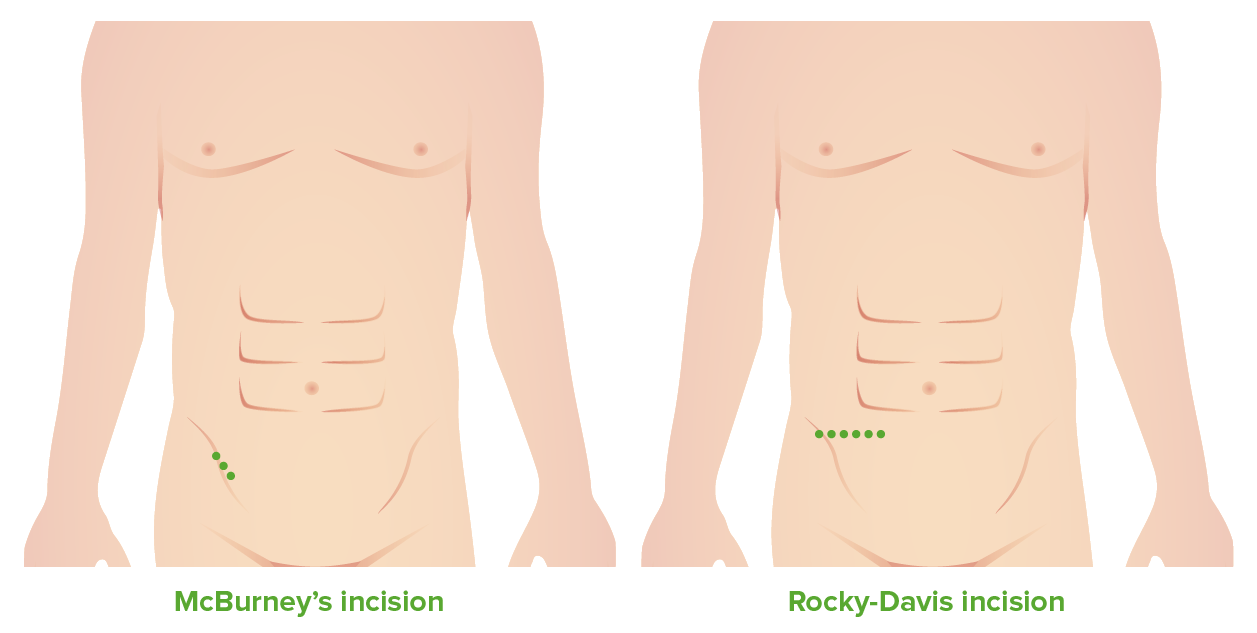
    • Tanto la incisión de McBurney como la de Rocky-Davis para la apendicectomía abierta pueden realizarse en EN Erythema nodosum is an immune-mediated panniculitis (inflammation of the subcutaneous fat) caused by a type IV (delayed-type) hypersensitivity reaction. It commonly manifests in young women as tender, erythematous nodules on the shins. Erythema Nodosum este punto.

Indicaciones y Contraindicaciones

Indicaciones

  • Apendicitis aguda:
    • Emergencia quirúrgica abdominal más común
    • La apendicectomía es el tratamiento de primera línea.
  • Neoplasias apendiculares (0,5–0.9% de las apendicectomías):
    • En EN Erythema nodosum is an immune-mediated panniculitis (inflammation of the subcutaneous fat) caused by a type IV (delayed-type) hypersensitivity reaction. It commonly manifests in young women as tender, erythematous nodules on the shins. Erythema Nodosum la mayoría de los LOS Neisseria casos, se descubren de forma intraoperatoria o postoperatoria en EN Erythema nodosum is an immune-mediated panniculitis (inflammation of the subcutaneous fat) caused by a type IV (delayed-type) hypersensitivity reaction. It commonly manifests in young women as tender, erythematous nodules on the shins. Erythema Nodosum un informe de patología tras la realización de una apendicectomía por presunta apendicitis.
    • Tumores apendiculares más comunes:
      • Tumor Tumor Inflammation neuroendocrino o carcinoide
      • Carcinoma de células caliciformes
      • Linfoma
      • Adenocarcinoma primario
      • Neoplasia mucinosa
    • Puede requerir una nueva intervención quirúrgica (hemicolectomía derecha), según el estadio del tumor Tumor Inflammation
  • Apendicectomía profiláctica:
    • Extirpación de un apéndice vermiforme macroscópicamente normal, generalmente durante la cirugía, por otra indicación
    • La apendicectomía profiláctica es controvertida y no se recomienda de manera rutinaria.
    • A veces se realiza este procedimiento para evitar la incertidumbre diagnóstica futura.
    • Algunas condiciones en EN Erythema nodosum is an immune-mediated panniculitis (inflammation of the subcutaneous fat) caused by a type IV (delayed-type) hypersensitivity reaction. It commonly manifests in young women as tender, erythematous nodules on the shins. Erythema Nodosum las que se justifica una apendicectomía profiláctica:
      • Durante el procedimiento de Ladd por malrotación
      • Cirugía de la enfermedad de Crohn, si el ciego no está gravemente inflamado
      • “Apendicitis crónica” ( dolor Dolor Inflammation abdominal bajo crónico): El apéndice puede tener una apariencia macroscópica normal pero presentar anomalías histológicas.
      • Apéndice macroscópicamente normal durante la cirugía por presunta apendicitis

Contraindicaciones

  • La mayoría de las apendicectomías se realizan de manera urgente por apendicitis, y no existen contraindicaciones absolutas.
  • En EN Erythema nodosum is an immune-mediated panniculitis (inflammation of the subcutaneous fat) caused by a type IV (delayed-type) hypersensitivity reaction. It commonly manifests in young women as tender, erythematous nodules on the shins. Erythema Nodosum determinadas circunstancias, cuando un paciente tiene un alto riesgo de complicaciones, la apendicitis puede tratarse con antibióticos y retrasar la cirugía o evitarla por completo.
  • Algunas contraindicaciones relativas son:
    • Apendicitis perforada en EN Erythema nodosum is an immune-mediated panniculitis (inflammation of the subcutaneous fat) caused by a type IV (delayed-type) hypersensitivity reaction. It commonly manifests in young women as tender, erythematous nodules on the shins. Erythema Nodosum un paciente estable con flemón cecal grande o absceso
    • Tratamiento anticoagulante: Estar en EN Erythema nodosum is an immune-mediated panniculitis (inflammation of the subcutaneous fat) caused by a type IV (delayed-type) hypersensitivity reaction. It commonly manifests in young women as tender, erythematous nodules on the shins. Erythema Nodosum tratamiento con agentes antiplaquetarios (e.g., aspirina, Plavix Plavix A ticlopidine analog and platelet purinergic p2y receptor antagonist that inhibits adenosine diphosphate-mediated platelet aggregation. It is used to prevent thromboembolism in patients with arterial occlusive diseases; myocardial infarction; stroke; or atrial fibrillation. Antiplatelet Drugs) no se considera una contraindicación.
    • Enfermedad cardíaca grave:
      • Infarto al AL Amyloidosis miocardio reciente ( en EN Erythema nodosum is an immune-mediated panniculitis (inflammation of the subcutaneous fat) caused by a type IV (delayed-type) hypersensitivity reaction. It commonly manifests in young women as tender, erythematous nodules on the shins. Erythema Nodosum los LOS Neisseria últimos 6 meses)
      • Insuficiencia cardíaca descompensada
      • Estenosis aórtica severa
    • Enfermedad pulmonar grave: si existe un alto riesgo de no poder desconectar al AL Amyloidosis paciente del ventilador después de la cirugía

Procedimiento

Preparación preoperatoria

  • Tratamiento de soporte inicial:
    • Reanimación con líquidos
    • Corrección de electrolitos.
    • Manejo del dolor Dolor Inflammation y las náuseas
    • Reposo intestinal (nada por vía oral)
  • Antibióticos preoperatorios:
    • Deben administrarse 30-60 minutos antes de la incisión
    • Deberían cubrir la flora cutánea e intestinal
    • Cefalosporina de primera generación o fluoroquinolona + cobertura anaeróbica (e.g., cefazolina-metronidazol, ciprofloxacina-metronidazol)
  • Anestesia:
    • La anestesia general es la más utilizada para ambos abordajes, abierto y laparoscópico.
    • Para una apendicectomía abierta sin complicaciones se puede utilizar anestesia espinal o regional.
  • Sonda de Foley:
    • Opcional
    • A menudo se coloca en EN Erythema nodosum is an immune-mediated panniculitis (inflammation of the subcutaneous fat) caused by a type IV (delayed-type) hypersensitivity reaction. It commonly manifests in young women as tender, erythematous nodules on the shins. Erythema Nodosum el abordaje laparoscópico para evitar lesiones por trocar a la vejiga

Tipos y pasos de los LOS Neisseria procedimientos

Se consideran aceptables tanto el abordaje abierto como el laparoscópico. La elección depende de la experiencia del cirujano y la preferencia del paciente. Las apendicectomías laparoscópicas se asocian a estancias hospitalarias ligeramente más cortas y a mejores puntuaciones en EN Erythema nodosum is an immune-mediated panniculitis (inflammation of the subcutaneous fat) caused by a type IV (delayed-type) hypersensitivity reaction. It commonly manifests in young women as tender, erythematous nodules on the shins. Erythema Nodosum la escala subjetiva de dolor Dolor Inflammation.

Apendicectomía abierta:

  1. El paciente se coloca en EN Erythema nodosum is an immune-mediated panniculitis (inflammation of the subcutaneous fat) caused by a type IV (delayed-type) hypersensitivity reaction. It commonly manifests in young women as tender, erythematous nodules on the shins. Erythema Nodosum posición supina, con una inclinación de la cabeza hacia abajo de al AL Amyloidosis menos 15 grados (posición de Trendelenburg).
    • Esta posición permite que el intestino delgado se separe del cuadrante inferior derecho para proporcionar una mejor exposición del ciego y el apéndice.
  2. Se hace HACE Altitude Sickness una incisión a través del punto de McBurney, que puede ser:
    • Oblicua (incisión de McBurney)
    • Transversal (incisión Rocky-Davis)
  3. Se entra en EN Erythema nodosum is an immune-mediated panniculitis (inflammation of the subcutaneous fat) caused by a type IV (delayed-type) hypersensitivity reaction. It commonly manifests in young women as tender, erythematous nodules on the shins. Erythema Nodosum la cavidad peritoneal tras atravesar las siguientes capas de la pared abdominal:
    • Piel
    • Fascia Fascia Layers of connective tissue of variable thickness. The superficial fascia is found immediately below the skin; the deep fascia invests muscles, nerves, and other organs. Cellulitis de Camper (tejido graso subcutáneo)
    • Fascia Fascia Layers of connective tissue of variable thickness. The superficial fascia is found immediately below the skin; the deep fascia invests muscles, nerves, and other organs. Cellulitis de Scarpa (capa membranosa de la pared abdominal anterior)
    • Músculo oblicuo abdominal externo y su fascia Fascia Layers of connective tissue of variable thickness. The superficial fascia is found immediately below the skin; the deep fascia invests muscles, nerves, and other organs. Cellulitis
    • Músculo oblicuo abdominal interno
    • Músculo transverso del abdomen
    • Fascia Fascia Layers of connective tissue of variable thickness. The superficial fascia is found immediately below the skin; the deep fascia invests muscles, nerves, and other organs. Cellulitis transversal
    • Grasa preperitoneal
    • Peritoneo
  4. Se secciona el mesoapéndice y se ligan los LOS Neisseria vasos apendiculares.
  5. El apéndice se secciona en EN Erythema nodosum is an immune-mediated panniculitis (inflammation of the subcutaneous fat) caused by a type IV (delayed-type) hypersensitivity reaction. It commonly manifests in young women as tender, erythematous nodules on the shins. Erythema Nodosum la base, ya sea con una grapadora o con tijeras, y el muñón se liga.
  6. El apéndice se extrae de la cavidad abdominal.
  7. La pared abdominal se cierra por capas.
Incisión de McBurney y Rocky-Davis

Incisiones de McBurney y Rocky-Davis

Imagen por Lecturio. Licencia: CC BY-NC-SA 4.0
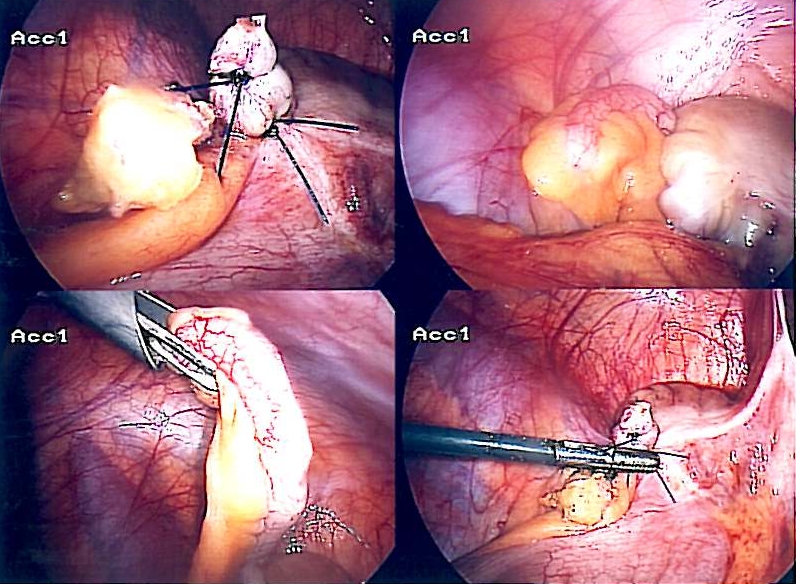
Apendicectomía laparoscópica:

  1. El paciente se coloca en EN Erythema nodosum is an immune-mediated panniculitis (inflammation of the subcutaneous fat) caused by a type IV (delayed-type) hypersensitivity reaction. It commonly manifests in young women as tender, erythematous nodules on the shins. Erythema Nodosum la posición de Trendelenburg.
  2. Lo más habitual es que se coloquen tres trocares:
    • Uno a través del ombligo, otro en EN Erythema nodosum is an immune-mediated panniculitis (inflammation of the subcutaneous fat) caused by a type IV (delayed-type) hypersensitivity reaction. It commonly manifests in young women as tender, erythematous nodules on the shins. Erythema Nodosum el cuadrante inferior izquierdo y otro suprapúbico
    • Son posibles otras variantes, según la preferencia del cirujano.
  3. El mesoapéndice se divide con dispositivos de energía o una grapadora para controlar la hemorragia de los LOS Neisseria vasos apendiculares.
  4. El apéndice se secciona en EN Erythema nodosum is an immune-mediated panniculitis (inflammation of the subcutaneous fat) caused by a type IV (delayed-type) hypersensitivity reaction. It commonly manifests in young women as tender, erythematous nodules on the shins. Erythema Nodosum su base con una grapadora o tijeras y ligadura con asa ASA Anterior Cord Syndrome desprendible (endoloop).
  5. El apéndice se coloca en EN Erythema nodosum is an immune-mediated panniculitis (inflammation of the subcutaneous fat) caused by a type IV (delayed-type) hypersensitivity reaction. It commonly manifests in young women as tender, erythematous nodules on the shins. Erythema Nodosum una bolsa y se extrae de la cavidad abdominal a través de uno de los LOS Neisseria sitios de los LOS Neisseria trocares, generalmente el ombligo.
Apéndice-Entfernung

Apendicectomía laparoscópica

Imagen: “Appendix-Entfernung” por Life-of-hannes.de. License: Dominio Público

Consideraciones especiales

Lavado peritoneal:

  • Si se observa pus en EN Erythema nodosum is an immune-mediated panniculitis (inflammation of the subcutaneous fat) caused by a type IV (delayed-type) hypersensitivity reaction. It commonly manifests in young women as tender, erythematous nodules on the shins. Erythema Nodosum el abdomen, la cavidad peritoneal se lava ampliamente con solución salina normal.
  • En EN Erythema nodosum is an immune-mediated panniculitis (inflammation of the subcutaneous fat) caused by a type IV (delayed-type) hypersensitivity reaction. It commonly manifests in young women as tender, erythematous nodules on the shins. Erythema Nodosum el caso de una cavidad de absceso localizada, se coloca un drenaje de Jackson-Pratt.

Laparotomía exploratoria:

  • Normalmente, se realiza a través de una incisión vertical en EN Erythema nodosum is an immune-mediated panniculitis (inflammation of the subcutaneous fat) caused by a type IV (delayed-type) hypersensitivity reaction. It commonly manifests in young women as tender, erythematous nodules on the shins. Erythema Nodosum la línea media
  • Abordaje preferido en EN Erythema nodosum is an immune-mediated panniculitis (inflammation of the subcutaneous fat) caused by a type IV (delayed-type) hypersensitivity reaction. It commonly manifests in young women as tender, erythematous nodules on the shins. Erythema Nodosum un paciente con perforación de apéndice y peritonitis Peritonitis Inflammation of the peritoneum lining the abdominal cavity as the result of infectious, autoimmune, or chemical processes. Primary peritonitis is due to infection of the peritoneal cavity via hematogenous or lymphatic spread and without intra-abdominal source. Secondary peritonitis arises from the abdominal cavity itself through rupture or abscess of intra-abdominal organs. Penetrating Abdominal Injury generalizada
  • Permite una mejor visualización, el lavado abdominal y la conversión a una cirugía más extensa si es necesario

Mujeres embarazadas:

  • El abordaje laparoscópico es generalmente seguro.
  • Se debería utilizar una presión intraabdominal más baja.
  • La colocación del trocar debe modificarse para evitar lesiones en EN Erythema nodosum is an immune-mediated panniculitis (inflammation of the subcutaneous fat) caused by a type IV (delayed-type) hypersensitivity reaction. It commonly manifests in young women as tender, erythematous nodules on the shins. Erythema Nodosum el útero grávido.
  • Durante las últimas etapas del embarazo, puede ser más factible un abordaje abierto, ya que un útero grande desplaza el apéndice y dificulta la visualización y manipulación laparoscópica.

Cuidados postoperatorios

  • Apendicectomía no complicada con apéndice no perforado:
    • Los LOS Neisseria antibióticos deberían suspenderse en EN Erythema nodosum is an immune-mediated panniculitis (inflammation of the subcutaneous fat) caused by a type IV (delayed-type) hypersensitivity reaction. It commonly manifests in young women as tender, erythematous nodules on the shins. Erythema Nodosum 24 horas.
    • La dieta se suele retomar rápidamente.
    • El paciente suele ser dado de alta a las 24 horas.
  • Apéndice perforado:
    • Generalmente 3-5 días de antibióticos postoperatorios
    • La dieta se retoma según tolerancia, en EN Erythema nodosum is an immune-mediated panniculitis (inflammation of the subcutaneous fat) caused by a type IV (delayed-type) hypersensitivity reaction. It commonly manifests in young women as tender, erythematous nodules on the shins. Erythema Nodosum función de la recuperación del paciente.
    • Se da el alta a casa cuando el paciente está afebril, está tolerando la dieta y tiene niveles de dolor Dolor Inflammation aceptables.

Complicaciones

  • Infección del sitio quirúrgico (la más común):
    • Infección de la herida:
      • Ocurre en EN Erythema nodosum is an immune-mediated panniculitis (inflammation of the subcutaneous fat) caused by a type IV (delayed-type) hypersensitivity reaction. It commonly manifests in young women as tender, erythematous nodules on the shins. Erythema Nodosum el <5% de las apendicectomías
      • Más frecuente en EN Erythema nodosum is an immune-mediated panniculitis (inflammation of the subcutaneous fat) caused by a type IV (delayed-type) hypersensitivity reaction. It commonly manifests in young women as tender, erythematous nodules on the shins. Erythema Nodosum apendicectomías abiertas y apendicitis perforada
      • El retraso en EN Erythema nodosum is an immune-mediated panniculitis (inflammation of the subcutaneous fat) caused by a type IV (delayed-type) hypersensitivity reaction. It commonly manifests in young women as tender, erythematous nodules on the shins. Erythema Nodosum el cierre de la herida primaria no reduce la tasa de infección.
    • Absceso pélvico:
      • Se produce en EN Erythema nodosum is an immune-mediated panniculitis (inflammation of the subcutaneous fat) caused by a type IV (delayed-type) hypersensitivity reaction. It commonly manifests in young women as tender, erythematous nodules on the shins. Erythema Nodosum el 9,4% de las apendicectomías
      • Ligeramente más común con el abordaje laparoscópico
      • Más común con la apendicitis perforada
  • Íleo postoperatorio:
    • Ralentización transitoria de la motilidad intestinal
    • Especialmente común en EN Erythema nodosum is an immune-mediated panniculitis (inflammation of the subcutaneous fat) caused by a type IV (delayed-type) hypersensitivity reaction. It commonly manifests in young women as tender, erythematous nodules on the shins. Erythema Nodosum los LOS Neisseria apéndices perforados
    • Se trata con reposo intestinal, descompresión con sonda nasogástrica e hidratación intravenosa
  • Obstrucción del intestino delgado:
    • Secundaria a adherencias/inflamación
    • Más frecuente tras un abordaje abierto y un apéndice perforado
    • Puede ocurrir en EN Erythema nodosum is an immune-mediated panniculitis (inflammation of the subcutaneous fat) caused by a type IV (delayed-type) hypersensitivity reaction. It commonly manifests in young women as tender, erythematous nodules on the shins. Erythema Nodosum el período postoperatorio temprano o años después
    • En EN Erythema nodosum is an immune-mediated panniculitis (inflammation of the subcutaneous fat) caused by a type IV (delayed-type) hypersensitivity reaction. It commonly manifests in young women as tender, erythematous nodules on the shins. Erythema Nodosum primer lugar, se intenta el tratamiento no quirúrgico, pero a veces puede ser necesaria la lisis quirúrgica de las adherencias.
  • Apendicitis del muñón:
    • Puede ocurrir si el apéndice no se reseca completamente (muñón apendicular > 0,5 cm)
    • Es necesario realizar una resección del muñón (laparoscópica o abierta).
    • El muñón apendicular perforado puede requerir una resección intestinal más extensa.
  • Infertilidad:
    • Muy raro
    • Resulta de una lesión intraoperatoria de las trompas de Falopio
  • Mortalidad:
    • Tasa global < 1%
    • Predictores de mortalidad:
      • Edad > 80 años
      • Inmunosupresión
      • Enfermedad cardiovascular grave
      • Apéndice perforado
      • Terapia antimicrobiana previa

Referencias

  1. Dahdaleh F.S., & Heidt D, & Turaga K.K. (2019). The appendix. Brunicardi F, & Andersen D.K., & Billiar T.R., & Dunn D.L., & Kao L.S., & Hunter J.G., & Matthews J.B., & Pollock R.E.(Eds.), Schwartz’s Principles of Surgery, 11e. McGraw-Hill Education. https://accessmedicine.mhmedical.com/content.aspx?bookid=2576&sectionid=216215350
  2. Craig, S. (2022). Appendicitis. In B. E. Brenner (Ed.), Medscape. Retrieved June 18, 2025, from https://emedicine.medscape.com/article/773895-overview
  3. Quick CRG, Biers SM, Arulampalam THA. (2020). Appendicitis. In: Quick CRG, Biers SM, Arulampalam THA, Tan HA (Eds.), Essential surgery: Problems, diagnosis and management (pp. 366–373). https://www.clinicalkey.es/#!/content/3-s2.0-B9780702076312000262
  4. Richmond B. (2018). Apéndice. In: Townsend CM, Beauchamp RD, Evers BM, Mattox KL (Eds.), Sabiston. tratado de cirugía (pp. 1296–1311). https://www.clinicalkey.es/#!/content/3-s2.0-B9788491131328000500
  5. Valente MA. (2021). Appendectomy. In Delaney CP (Ed.), Netter’s Surgical Anatomy and Approaches (pp. 263–274). https://www.clinicalkey.es/#!/content/3-s2.0-B9780323673464000256

¡Crea tu cuenta gratis o inicia una sesión para seguir leyendo!

Regístrate ahora y obtén acceso gratuito a Lecturio con páginas de concepto, videos médicos y cuestionarios para tu educación médica.

User Reviews

Que tengas una sesión de estudio alegre y navideña 🎁 Ahorra 50% en todos los planes >>

Details