
Domina Conceptos Médicos

Estudia para la escuela de medicina y tus examenes con Lecturio.

Amebicidas

Los LOS Neisseria amebicidas son medicamentos tóxicos para amebas como Entamoeba histolytica Entamoeba Histolytica A species of parasitic protozoa causing entamoebiasis and amebic dysentery (dysentery, amebic). Characteristics include a single nucleus containing a small central karyosome and peripheral chromatin that is finely and regularly beaded. Amebicides (el organismo causante de la amebiasis Amebiasis Amebiasis, or amoebic dysentery, is an infection caused by the parasite Entamoeba histolytica. Transmission is through the fecal-oral route or by consumption of contaminated food and water. Most patients infected with E. histolytica are asymptomatic, but about 10% may develop dysentery. Entamoeba spp./Amebiasis). Los LOS Neisseria parásitos ingresan al AL Amyloidosis tracto gastrointestinal donde los LOS Neisseria trofozoítos pueden penetrar la pared intestinal y causar una infección invasiva. Los LOS Neisseria amebicidas se clasifican según el lugar donde el medicamento es más eficaz: el lumen o los LOS Neisseria tejidos intestinales. Los LOS Neisseria amebicidas del lumen intestinal incluyen yodoquinol y paromomicina. Los LOS Neisseria amebicidas tisulares incluyen la clase de medicamentos nitroimidazol (e.g., metronidazol, tinidazol). El tratamiento de la enfermedad sintomática generalmente requiere una combinación de ambas clases.

Last updated: Dec 15, 2025
Editorial responsibility: Stanley Oiseth, Lindsay Jones, Evelin Maza

Descripción General

Amebiasis Amebiasis Amebiasis, or amoebic dysentery, is an infection caused by the parasite Entamoeba histolytica. Transmission is through the fecal-oral route or by consumption of contaminated food and water. Most patients infected with E. histolytica are asymptomatic, but about 10% may develop dysentery. Entamoeba spp./Amebiasis

  • También conocida como amebiasis Amebiasis Amebiasis, or amoebic dysentery, is an infection caused by the parasite Entamoeba histolytica. Transmission is through the fecal-oral route or by consumption of contaminated food and water. Most patients infected with E. histolytica are asymptomatic, but about 10% may develop dysentery. Entamoeba spp./Amebiasis intestinal, manifestándose como disentería amebiana
  • Infección causada por el parásito Entamoeba histolytica Entamoeba Histolytica A species of parasitic protozoa causing entamoebiasis and amebic dysentery (dysentery, amebic). Characteristics include a single nucleus containing a small central karyosome and peripheral chromatin that is finely and regularly beaded. Amebicides
  • Transmisión:
    • Vía fecal-oral
    • Consumo de agua y alimentos contaminados
  • La infección invasiva se caracteriza por:
  • Complicaciones graves:
    • Absceso hepático
    • Fístulas intestinales
    • Colitis Colitis Inflammation of the colon section of the large intestine, usually with symptoms such as diarrhea (often with blood and mucus), abdominal pain, and fever. Pseudomembranous Colitis fulminante
Patogenia de la entamoeba histolytica

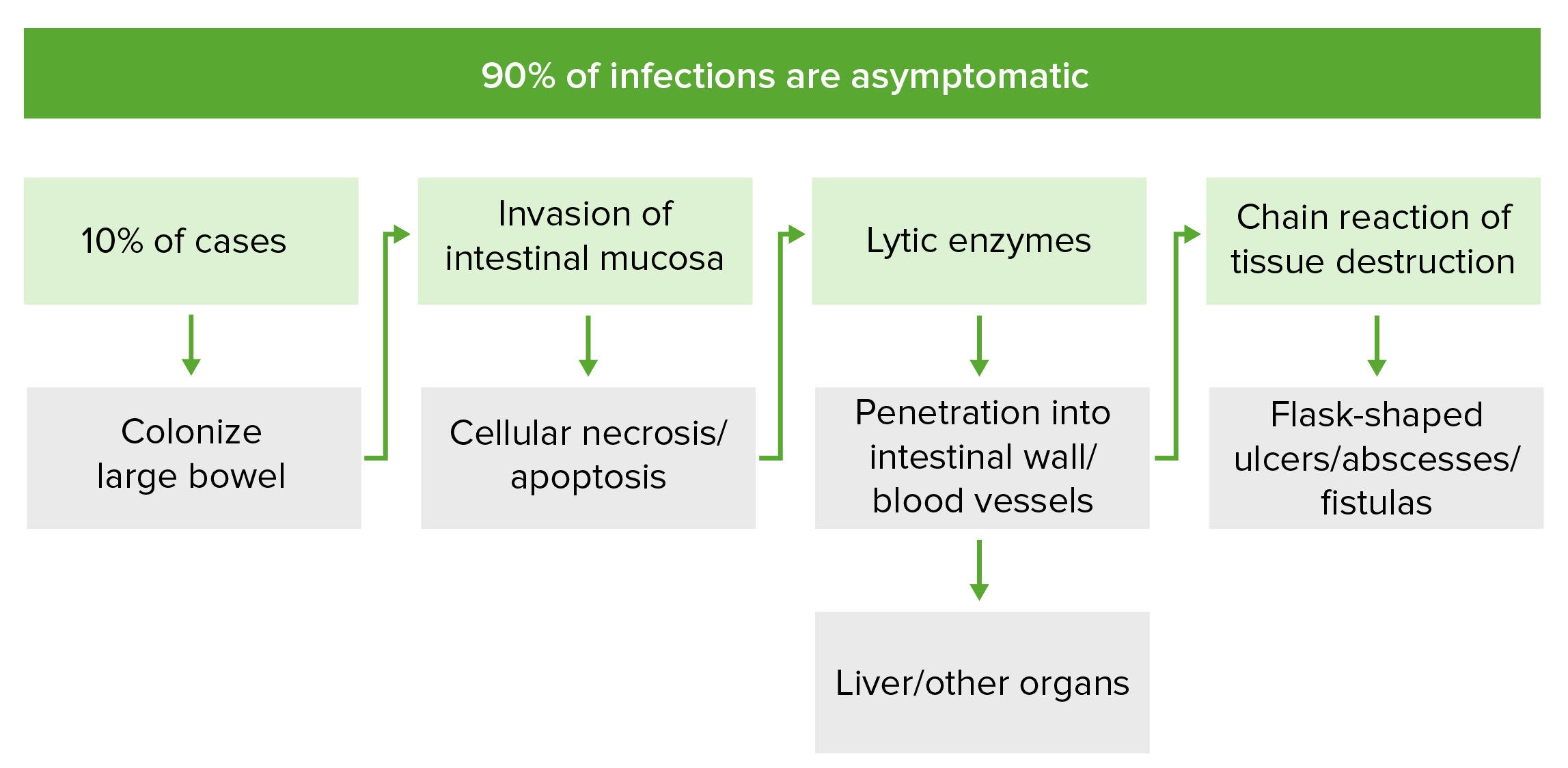
Patogénesis de la infección invasiva por Entamoeba histolytica:
En el 10% de los casos, E. histolytica coloniza la mucosa del intestino grueso e invade mediante la secreción de proteinasas y enzimas líticas. Esto provoca necrosis celular y lisis de las membranas, respectivamente. Esta cadena de eventos induce la apoptosis de las células de la mucosa y rompe las uniones estrechas entre las células, lo que permite la formación de úlceras en forma de botella, abscesos y fístulas. La invasión puede alcanzar el sistema venoso portal, a través del cual E. histolytica puede diseminarse a otros órganos.

Imagen por Lecturio. Licencia: CC BY-NC-SA 4.0

Clasificación de los LOS Neisseria amebicidas

Se prescribe una combinación de amebicidas tisulares y luminales para tratar la amebiasis Amebiasis Amebiasis, or amoebic dysentery, is an infection caused by the parasite Entamoeba histolytica. Transmission is through the fecal-oral route or by consumption of contaminated food and water. Most patients infected with E. histolytica are asymptomatic, but about 10% may develop dysentery. Entamoeba spp./Amebiasis.

Amebicidas luminales:

  • Destruir quistes y trofozoítos en EN Erythema nodosum is an immune-mediated panniculitis (inflammation of the subcutaneous fat) caused by a type IV (delayed-type) hypersensitivity reaction. It commonly manifests in young women as tender, erythematous nodules on the shins. Erythema Nodosum el lumen intestinal
  • Generalmente, se absorben mal (el medicamento permanece en EN Erythema nodosum is an immune-mediated panniculitis (inflammation of the subcutaneous fat) caused by a type IV (delayed-type) hypersensitivity reaction. It commonly manifests in young women as tender, erythematous nodules on the shins. Erythema Nodosum el lumen intestinal)
  • Incluyen:
    • Yodoquinol
    • Paromomicina

Amebicidas tisulares:

  • Destruye los LOS Neisseria trofozoítos que invaden los LOS Neisseria tejidos
  • Generalmente, se absorben bien (muy poco permanece en EN Erythema nodosum is an immune-mediated panniculitis (inflammation of the subcutaneous fat) caused by a type IV (delayed-type) hypersensitivity reaction. It commonly manifests in young women as tender, erythematous nodules on the shins. Erythema Nodosum el intestino)
  • Incluye los LOS Neisseria nitroimidazoles Nitroimidazoles Nitroimidazoles are prodrugs composed of an imidazole ring with an attached nitro group. Nitroimidazoles are reduced within susceptible microorganisms, leading to free radical formation and disruption of DNA integrity. Nitroimidazoles:
    • Metronidazol
    • Tinidazol

Yodoquinol

Mecanismo de acción

  • Amebicida luminal
  • El mecanismo de acción no se entiende completamente.

Farmacocinética

  • Mala absorción (aproximadamente el 90% permanece en EN Erythema nodosum is an immune-mediated panniculitis (inflammation of the subcutaneous fat) caused by a type IV (delayed-type) hypersensitivity reaction. It commonly manifests in young women as tender, erythematous nodules on the shins. Erythema Nodosum el intestino)
  • Excretado en EN Erythema nodosum is an immune-mediated panniculitis (inflammation of the subcutaneous fat) caused by a type IV (delayed-type) hypersensitivity reaction. It commonly manifests in young women as tender, erythematous nodules on the shins. Erythema Nodosum las heces

Indicaciones

El yodoquinol se utilizaba para tratar la amebiasis Amebiasis Amebiasis, or amoebic dysentery, is an infection caused by the parasite Entamoeba histolytica. Transmission is through the fecal-oral route or by consumption of contaminated food and water. Most patients infected with E. histolytica are asymptomatic, but about 10% may develop dysentery. Entamoeba spp./Amebiasis intestinal. Ya no está disponible en EN Erythema nodosum is an immune-mediated panniculitis (inflammation of the subcutaneous fat) caused by a type IV (delayed-type) hypersensitivity reaction. It commonly manifests in young women as tender, erythematous nodules on the shins. Erythema Nodosum los LOS Neisseria Estados Unidos a partir de 2025 debido a la aplicación de medidas de la FDA contra productos no aprobados.

  • Acción contra quistes y trofozoítos en EN Erythema nodosum is an immune-mediated panniculitis (inflammation of the subcutaneous fat) caused by a type IV (delayed-type) hypersensitivity reaction. It commonly manifests in young women as tender, erythematous nodules on the shins. Erythema Nodosum el lumen intestinal
  • Generalmente, se usa en EN Erythema nodosum is an immune-mediated panniculitis (inflammation of the subcutaneous fat) caused by a type IV (delayed-type) hypersensitivity reaction. It commonly manifests in young women as tender, erythematous nodules on the shins. Erythema Nodosum combinación con un amebicida tisular para infecciones sintomáticas
  • Se puede usar solo para infecciones asintomáticas

Efectos secundarios

  • Diarrea
  • Anorexia Anorexia The lack or loss of appetite accompanied by an aversion to food and the inability to eat. It is the defining characteristic of the disorder anorexia nervosa. Anorexia Nervosa
  • Náusea y vómitos
  • Dolor Dolor Inflammation abdominal
  • Cefalea
  • Erupción y prurito
  • Neuropatía periférica
  • Neuritis o atrofia óptica

Contraindicaciones

El yodoquinol está contraindicado en EN Erythema nodosum is an immune-mediated panniculitis (inflammation of the subcutaneous fat) caused by a type IV (delayed-type) hypersensitivity reaction. It commonly manifests in young women as tender, erythematous nodules on the shins. Erythema Nodosum personas con alergia o intolerancia al AL Amyloidosis yodo.
Paromomicina

Mecanismo de acción

  • Amebicida luminal
  • Aminoglucósido
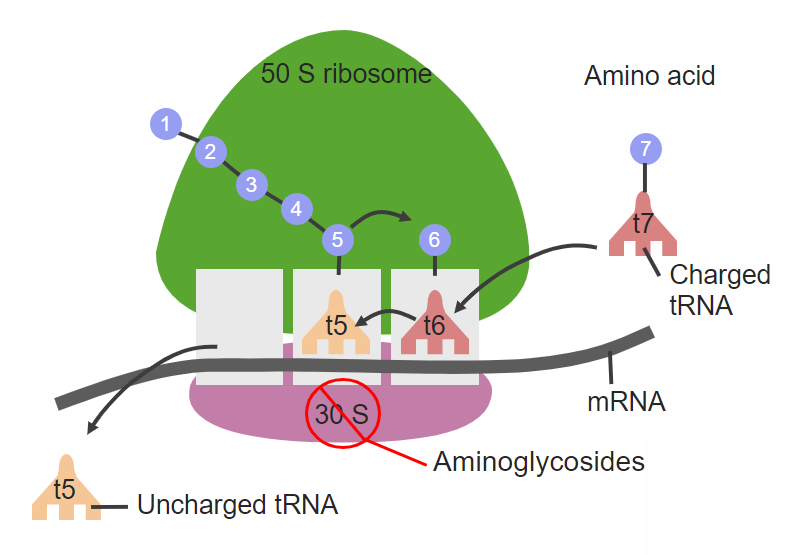
  • Se une a la subunidad ribosomal 30S → inhibe la síntesis de proteínas
Sitio de acción de los aminoglucósidos Amebicidas

El sitio de acción de los aminoglucósidos, que se dirigen a la subunidad ribosomal 30S
tRNA: ARN de transferencia (por sus siglas en inglés)
mRNA: ARN mensajero (por sus siglas en inglés)

Imagen por Lecturio. Licencia: CC BY-NC-SA 4.0

Farmacocinética

  • Absorción:
    • Mala por vía oral (la mayoría permanece en EN Erythema nodosum is an immune-mediated panniculitis (inflammation of the subcutaneous fat) caused by a type IV (delayed-type) hypersensitivity reaction. It commonly manifests in young women as tender, erythematous nodules on the shins. Erythema Nodosum el lumen intestinal)
    • Se absorbe una pequeña cantidad.
  • Excreción:
    • Principalmente en EN Erythema nodosum is an immune-mediated panniculitis (inflammation of the subcutaneous fat) caused by a type IV (delayed-type) hypersensitivity reaction. It commonly manifests in young women as tender, erythematous nodules on the shins. Erythema Nodosum las heces
    • El medicamento absorbido se excreta en EN Erythema nodosum is an immune-mediated panniculitis (inflammation of the subcutaneous fat) caused by a type IV (delayed-type) hypersensitivity reaction. It commonly manifests in young women as tender, erythematous nodules on the shins. Erythema Nodosum la orina (sin cambios).

Indicaciones

  • Amebiasis Amebiasis Amebiasis, or amoebic dysentery, is an infection caused by the parasite Entamoeba histolytica. Transmission is through the fecal-oral route or by consumption of contaminated food and water. Most patients infected with E. histolytica are asymptomatic, but about 10% may develop dysentery. Entamoeba spp./Amebiasis:
    • Acción contra quistes y trofozoítos en EN Erythema nodosum is an immune-mediated panniculitis (inflammation of the subcutaneous fat) caused by a type IV (delayed-type) hypersensitivity reaction. It commonly manifests in young women as tender, erythematous nodules on the shins. Erythema Nodosum el lumen intestinal
    • Generalmente utilizado en EN Erythema nodosum is an immune-mediated panniculitis (inflammation of the subcutaneous fat) caused by a type IV (delayed-type) hypersensitivity reaction. It commonly manifests in young women as tender, erythematous nodules on the shins. Erythema Nodosum combinación con un amebicida tisular para infecciones sintomáticas
    • Se puede usar solo para infecciones asintomáticas
  • Giardiasis Giardiasis An infection of the small intestine caused by the flagellated protozoan giardia. It is spread via contaminated food and water and by direct person-to-person contact. Giardia/Giardiasis
  • Leishmaniasis Leishmaniasis Leishmania species are obligate intracellular parasites that are transmitted by an infected sandfly. The mildest form is cutaneous leishmaniasis (CL), characterized by painless skin ulcers. The mucocutaneous type involves more tissue destruction, causing deformities. Visceral leishmaniasis (VL), the most severe form, presents with hepatosplenomegaly, anemia, thrombocytopenia, and fever. Leishmania/Leishmaniasis

Efectos secundarios

  • Cólicos abdominales
  • Náusea y vómitos
  • Diarrea
  • Ototoxicidad

Precauciones

Se debe tener precaución en EN Erythema nodosum is an immune-mediated panniculitis (inflammation of the subcutaneous fat) caused by a type IV (delayed-type) hypersensitivity reaction. It commonly manifests in young women as tender, erythematous nodules on the shins. Erythema Nodosum personas con:

  • Insuficiencia renal → ↑ acumulación y toxicidad
  • Obstrucción o enfermedad intestinal ulcerosa/inflamatoria → ↑ absorción

Nitroimidazoles

Miembros de la clase de medicamento

  • Metronidazol
  • Tinidazol

Mecanismo de acción

  • Amebicida tisular
  • Los LOS Neisseria nitroimidazoles Nitroimidazoles Nitroimidazoles are prodrugs composed of an imidazole ring with an attached nitro group. Nitroimidazoles are reduced within susceptible microorganisms, leading to free radical formation and disruption of DNA integrity. Nitroimidazoles se difunden pasivamente en EN Erythema nodosum is an immune-mediated panniculitis (inflammation of the subcutaneous fat) caused by a type IV (delayed-type) hypersensitivity reaction. It commonly manifests in young women as tender, erythematous nodules on the shins. Erythema Nodosum la célula microbiana.
  • Nitroreductasas (producidas por organismos susceptibles) → reducen el grupo nitro en EN Erythema nodosum is an immune-mediated panniculitis (inflammation of the subcutaneous fat) caused by a type IV (delayed-type) hypersensitivity reaction. It commonly manifests in young women as tender, erythematous nodules on the shins. Erythema Nodosum la molécula
  • Resultados en EN Erythema nodosum is an immune-mediated panniculitis (inflammation of the subcutaneous fat) caused by a type IV (delayed-type) hypersensitivity reaction. It commonly manifests in young women as tender, erythematous nodules on the shins. Erythema Nodosum la producción de:
    • Radicales libres
    • Metabolitos citotóxicos → interactúan con el ADN del huésped → rotura de la cadena y desestabilización de la hélice del ADN
  • Muerte celular
  • Efecto:
    • Bactericida contra bacterias anaerobias
    • Antiprotozoario

Farmacocinética

  • Absorción:
    • Se absorbe casi por completo cuando se administra por vía oral
    • Biodisponibilidad > 90%
  • Distribución:
    • Distribuido ampliamente en EN Erythema nodosum is an immune-mediated panniculitis (inflammation of the subcutaneous fat) caused by a type IV (delayed-type) hypersensitivity reaction. It commonly manifests in young women as tender, erythematous nodules on the shins. Erythema Nodosum los LOS Neisseria tejidos
    • Baja unión a proteínas (< 20%)
    • Atraviesa la barrera hematoencefálica
  • Metabolismo y excreción:
    • Ampliamente metabolizado en EN Erythema nodosum is an immune-mediated panniculitis (inflammation of the subcutaneous fat) caused by a type IV (delayed-type) hypersensitivity reaction. It commonly manifests in young women as tender, erythematous nodules on the shins. Erythema Nodosum el hígado
    • Se excreta principalmente a través de la orina

Indicaciones

Además de las infecciones por bacterias anaeróbicas, los LOS Neisseria nitroimidazoles Nitroimidazoles Nitroimidazoles are prodrugs composed of an imidazole ring with an attached nitro group. Nitroimidazoles are reduced within susceptible microorganisms, leading to free radical formation and disruption of DNA integrity. Nitroimidazoles se pueden usar para:

  • Amebiasis Amebiasis Amebiasis, or amoebic dysentery, is an infection caused by the parasite Entamoeba histolytica. Transmission is through the fecal-oral route or by consumption of contaminated food and water. Most patients infected with E. histolytica are asymptomatic, but about 10% may develop dysentery. Entamoeba spp./Amebiasis:
    • Eficaz para la pared intestinal y trofozoítos extraluminales
    • No mata los LOS Neisseria quistes
    • Generalmente empleado en EN Erythema nodosum is an immune-mediated panniculitis (inflammation of the subcutaneous fat) caused by a type IV (delayed-type) hypersensitivity reaction. It commonly manifests in young women as tender, erythematous nodules on the shins. Erythema Nodosum combinación con un amebicida luminal
  • Giardiasis Giardiasis An infection of the small intestine caused by the flagellated protozoan giardia. It is spread via contaminated food and water and by direct person-to-person contact. Giardia/Giardiasis
  • Tricomoniasis

Efectos secundarios

  • Malestar gastrointestinal
  • Reacción tipo disulfiram con el alcohol (debido a la inhibición del aldehído deshidrogenasa)
  • Disgeusia (sabor metálico)
  • Neuropatía periférica
  • Cefalea
  • Mareo
  • Convulsiones
  • Cambios de color de la orina (color rojo/marrón)

Contraindicaciones

  • Embarazo (1er trimestre)
  • Lactancia
  • Insuficiencia hepática grave

Interacciones medicamentosas

  • Elixires que contienen etanol:
    • Jarabes para la tos TOS Thoracic outlet syndrome (TOS) is a broad term used for a spectrum of syndromes related to the general region of the thoracic outlet, which involves the compression or irritation of elements of the brachial plexus, subclavian artery, or subclavian vein. Thoracic Outlet Syndrome
    • Trimetoprim-sulfametoxazol intravenoso
  • Disulfiram (puede causar psicosis aguda)
  • ↓ Eliminación de:
    • Litio
    • Ergot
  • ↓ Metabolismo hepático de:
    • Fenitoína
    • Warfarina
    • Carbamazepina

Referencias

  1. Rosenthal, P.J. (2012). Antiprotozoal drugs. In Katzung, B.G., Masters, S.B., and Trevor, A.J. (Eds.), Basic & Clinical Pharmacology (12th edition, pp. 915–936). https://pharmacomedicale.org/images/cnpm/CNPM_2016/katzung-pharmacology.pdf
  2. Weller, P.F. (2023). Antiprotozoal therapies. In Bogorodskaya, M. (Ed.), UpToDate. Retrieved January 24, 2025, from https://www.uptodate.com/contents/antiprotozoal-therapies
  3. Metronidazole (systemic): Drug information. UpToDate Lexicomp. (2025). https://www.uptodate.com/contents/metronidazole-systemic-drug-information
  4. Tinidazole: Drug information. UpToDate Lexicomp. (2025). https://www.uptodate.com/contents/tinidazole-drug-information
  5. Paromomycin: Drug information. UpToDate Lexicomp. (2025). https://www.uptodate.com/contents/paromomycin-drug-information
  6. Campbell, S., and Soman-Faulkner, K. (2023). Antiparasitic drugs. StatPearls. Retrieved January 24, 2025, from https://www.ncbi.nlm.nih.gov/books/NBK544251/
  7. Dhawan, V.K., Cleveland, K.O., and Cantey, J.R. (2024). Amebiasis medication. In Bronze, M.S. (Ed.), Medscape. Retrieved January 24, 2025, from https://emedicine.medscape.com/article/212029-medication
  8. FDA. (n.d.). FDA notification regarding Iodoquinol Drugs. U.S. Food and Drug Administration. https://www.fda.gov/drugs/unapproved-drugs/fda-notification-regarding-iodoquinol-drugs

¡Crea tu cuenta gratis o inicia una sesión para seguir leyendo!

Regístrate ahora y obtén acceso gratuito a Lecturio con páginas de concepto, videos médicos y cuestionarios para tu educación médica.

User Reviews

Que tengas una sesión de estudio alegre y navideña 🎁 Ahorra 50% en todos los planes >>

Details