


Vírus JC e Vírus BK

O vírus BK (BKV) e o vírus JC (JCV) são pequenos vírus de DNA DNA A deoxyribonucleotide polymer that is the primary genetic material of all cells. Eukaryotic and prokaryotic organisms normally contain DNA in a double-stranded state, yet several important biological processes transiently involve single-stranded regions. DNA, which consists of a polysugar-phosphate backbone possessing projections of purines (adenine and guanine) and pyrimidines (thymine and cytosine), forms a double helix that is held together by hydrogen bonds between these purines and pyrimidines (adenine to thymine and guanine to cytosine). DNA Types and Structure de cadeia dupla, não envelopados, pertencentes à família Polyomaviridae Polyomaviridae A family of small, non-enveloped DNA viruses, infecting mainly mammals. JC Virus and BK Virus, que são onipresentes na população humana. Embora a infeção primária seja geralmente assintomática, o vírus permanece latente nos rins e nos órgãos linfoides. As infeções latentes podem tornar-se ativas em pacientes imunossuprimidos. A reativação do BKV é mais MAIS Androgen Insensitivity Syndrome frequentemente observada em pacientes transplantados e pode levar a nefropatia, perda do enxerto, cistite hemorrágica e estenose uretral. A reativação do JCV causa leucoencefalopatia multifocal Multifocal Retinoblastoma progressiva ( LMP LMP The 1st day of a woman’s LMP Pregnancy: Diagnosis, Physiology, and Care), que é considerada uma doença definidora de SIDA. O diagnóstico pode ser confirmado com PCR PCR Polymerase chain reaction (PCR) is a technique that amplifies DNA fragments exponentially for analysis. The process is highly specific, allowing for the targeting of specific genomic sequences, even with minuscule sample amounts. The PCR cycles multiple times through 3 phases: denaturation of the template DNA, annealing of a specific primer to the individual DNA strands, and synthesis/elongation of new DNA molecules. Polymerase Chain Reaction (PCR) ou biópsia de tecido. A terapia específica não está disponível. O tratamento visa reduzir a imunossupressão.

Last updated: Dec 15, 2025
Editorial responsibility: Stanley Oiseth, Lindsay Jones, Evelin Maza

Classificação

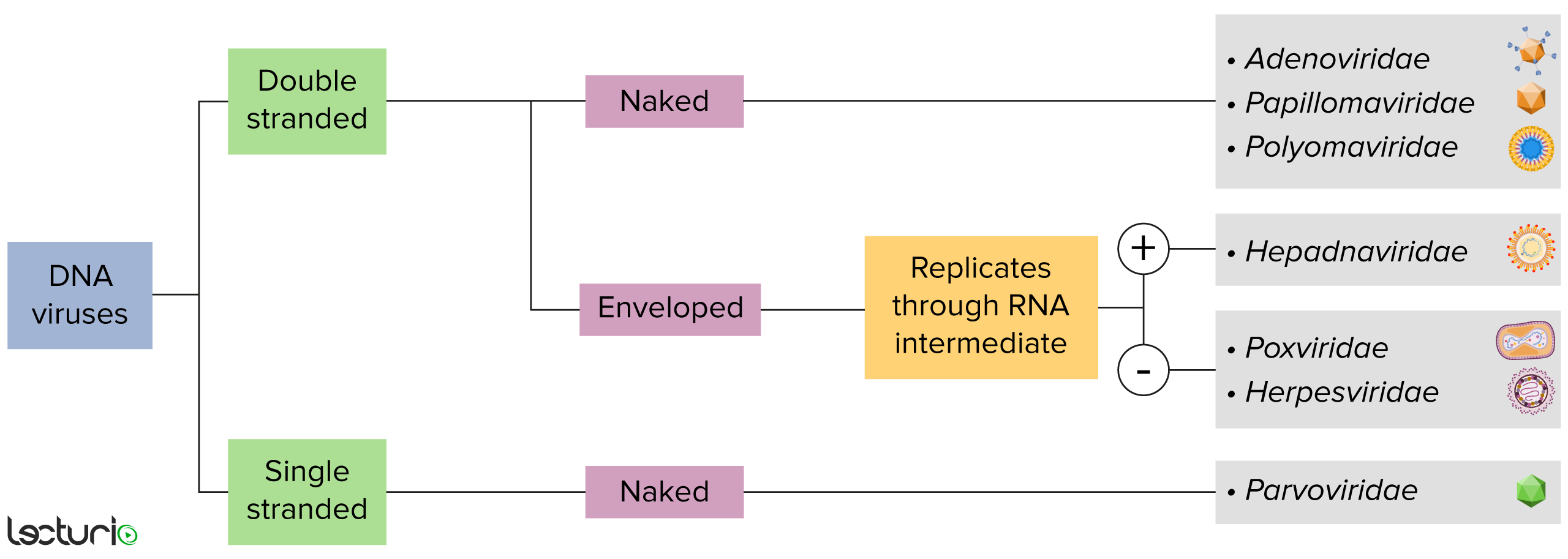
Fluxograma de classificação de vírus de DNA

Identificação de vírus de DNA:
Os vírus podem ser classificados de várias formas. Contudo, a maioria dos vírus possui um genoma formado por DNA ou RNA. Os vírus com genoma de DNA podem ainda ser caracterizados como de cadeia simples ou dupla. Os vírus com envelope são revestidos por uma camada fina de membrana celular, que geralmente é retirada da célula hospedeira. Os vírus sem envelope são apelidados de vírus “nus”. Alguns vírus com envelope traduzem DNA em RNA antes de serem incorporados no genoma da célula hospedeira.

Imagem por Lecturio. Licença: CC BY-NC-SA 4.0

Características Gerais e Epidemiologia

Taxonomia

  • Família: Polyomaviridae Polyomaviridae A family of small, non-enveloped DNA viruses, infecting mainly mammals. JC Virus and BK Virus
  • Género: Betapoliomavírus
  • Espécies:
    • Poliomavírus humano 1: vírus BK (BKV, pela sigla em inglês)
    • Poliomavírus humano 2: vírus JC (JCV, pela sigla em inglês)

Características gerais

Os vírus BKV e JCV compartilham características semelhantes:
  • Vírus de DNA DNA A deoxyribonucleotide polymer that is the primary genetic material of all cells. Eukaryotic and prokaryotic organisms normally contain DNA in a double-stranded state, yet several important biological processes transiently involve single-stranded regions. DNA, which consists of a polysugar-phosphate backbone possessing projections of purines (adenine and guanine) and pyrimidines (thymine and cytosine), forms a double helix that is held together by hydrogen bonds between these purines and pyrimidines (adenine to thymine and guanine to cytosine). DNA Types and Structure:
    • Circular
    • Cadeia dupla
  • Estrutura:
    • Pequena
    • Sem envelope Envelope Bilayer lipid membrane acquired by viral particles during viral morphogenesis. Although the lipids of the viral envelope are host derived, various virus-encoded integral membrane proteins, i.e. Viral envelope proteins are incorporated there. Virology
    • Icosaédrica
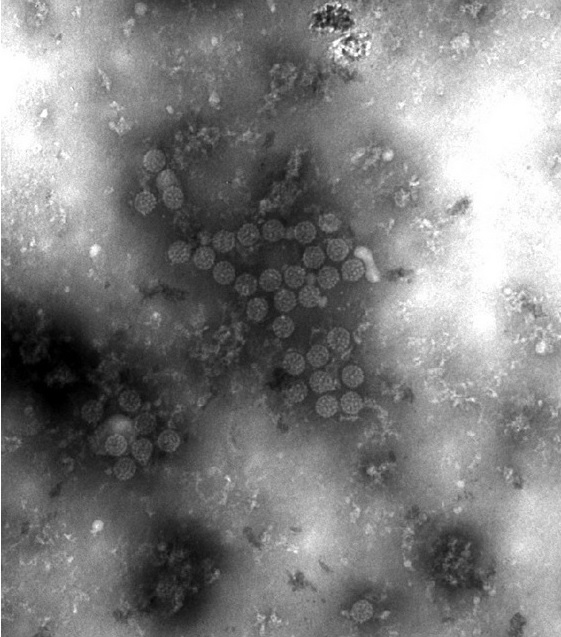
Micrografia eletrônica mostrando vírus BK vírus jc e vírus bk

Micrografia eletrónica onde é possível observar as características dos viriões do vírus BK (BKV):
o tamanho pequeno e a simetria icosaédrica.

Imagem: “Viral inclusions seen on electron microscopy of urine epithelial cells” por Perram J et al. Licença: CC BY 3.0

Doenças associadas

Epidemiologia

  • Grande parte da epidemiologia do BKV e JCV na população geral é desconhecida
  • Seroprevalência:
    • Nos Estados Unidos e Europa: 30%-90%
    • Aumenta com a idade
  • A infeção assintomática é detetável em 10%–30% dos indivíduos saudáveis.
  • As manifestações clínicas são raras.

Patogénese

Reservatório

Os seres humanos são os hospedeiros naturais do JCV e do BKV (sem reservatório animal).

Transmissão

  • Os métodos de transmissão ainda são pouco compreendidos tanto para o BKV como para o JVC.
  • Hipóteses possíveis:
    • Oral
    • Respiratória
    • Perinatal
    • Tecido de doador

Fatores de risco do hospedeiro

A doença clínica surge mais MAIS Androgen Insensitivity Syndrome frequentemente da reativação do vírus em pacientes imunodeprimidos:

  • VIH/SIDA (a LMP LMP The 1st day of a woman’s LMP Pregnancy: Diagnosis, Physiology, and Care é considerada uma condição definidora de SIDA)
  • Transplante de órgão
  • Transplante de células hematopoiéticas (TCH)
  • Neoplasias malignas hematológicas

Fisiopatologia

  • A infeção primária leva a uma persistência subclínica ao longo da vida no tecido do hospedeiro.
  • Uma vez dentro da célula, o vírus percorre até ao núcleo e estabelece uma infeção latente ou lítica.
  • A infeção é controlada por anticorpos e células T citotóxicas.
  • Falha da resposta imune → reativação
    • JCV:
      • Estabelece a latência (principalmente nos rins e tecido linfoide)
      • Reativação → replicação e produção de variantes neurotrópicas
      • Pode atravessar a barreira hematoencefálica → replicação lítica em oligodendrócitos → desmielinização → LMP LMP The 1st day of a woman’s LMP Pregnancy: Diagnosis, Physiology, and Care
    • BKV:
      • Latência nos rins
      • Reativação → ↑ replicação → lesão das células tubulares renais e uroepiteliais e infiltração inflamatória
      • Inflamação intersticial → fibrose e lesão tubular

Apresentação Clínica

BKV

Infeção primária:

  • A maioria dos pacientes é assintomática.
  • Alguns indivíduos podem manifestar doença respiratória ligeira.

Infeção secundária:

  • Ocorre em pacientes imunodeprimidos
  • Nefropatia associada ao BKV ( mais MAIS Androgen Insensitivity Syndrome comum em pacientes submetidos a transplante renal):
    • Lesão renal aguda
    • Hematúria, piúria e cilindros celulares
    • Pode resultar em disfunção ou perda do aloenxerto renal
  • Estenose ureteral:
    • Obstrução do trato urinário
    • Lesão renal aguda
  • Cistite hemorrágica ( mais MAIS Androgen Insensitivity Syndrome comum em recetores de HCT):
    • Disúria
    • Urgência miccional
    • Dor abdominal inferior
    • Hematúria
    • Lesão renal aguda (secundária à obstrução)

JCV

A LMP LMP The 1st day of a woman’s LMP Pregnancy: Diagnosis, Physiology, and Care é uma doença progressiva (e muitas vezes fatal) mais MAIS Androgen Insensitivity Syndrome frequentemente observada em pacientes com SIDA (considerada uma doença definidora de SIDA) com contagem de CD4 < 200 células/µL.

  • Descoordenação
  • Hemiparesia (achado mais MAIS Androgen Insensitivity Syndrome comum)
  • Afasia e disartria
  • Hemianopsia ou diplopia Diplopia A visual symptom in which a single object is perceived by the visual cortex as two objects rather than one. Disorders associated with this condition include refractive errors; strabismus; oculomotor nerve diseases; trochlear nerve diseases; abducens nerve diseases; and diseases of the brain stem and occipital lobe. Myasthenia Gravis
  • Ataxia Ataxia Impairment of the ability to perform smoothly coordinated voluntary movements. This condition may affect the limbs, trunk, eyes, pharynx, larynx, and other structures. Ataxia may result from impaired sensory or motor function. Sensory ataxia may result from posterior column injury or peripheral nerve diseases. Motor ataxia may be associated with cerebellar diseases; cerebral cortex diseases; thalamic diseases; basal ganglia diseases; injury to the red nucleus; and other conditions. Ataxia-telangiectasia da marcha
  • Défice cognitivo
  • Lentificação motora
  • Cefaleia
  • Convulsões (raro)

Diagnóstico e Tratamento

Diagnóstico

BKV:

  • Técnica de PCR PCR Polymerase chain reaction (PCR) is a technique that amplifies DNA fragments exponentially for analysis. The process is highly specific, allowing for the targeting of specific genomic sequences, even with minuscule sample amounts. The PCR cycles multiple times through 3 phases: denaturation of the template DNA, annealing of a specific primer to the individual DNA strands, and synthesis/elongation of new DNA molecules. Polymerase Chain Reaction (PCR) quantitativo de plasma Plasma The residual portion of blood that is left after removal of blood cells by centrifugation without prior blood coagulation. Transfusion Products para DNA DNA A deoxyribonucleotide polymer that is the primary genetic material of all cells. Eukaryotic and prokaryotic organisms normally contain DNA in a double-stranded state, yet several important biological processes transiently involve single-stranded regions. DNA, which consists of a polysugar-phosphate backbone possessing projections of purines (adenine and guanine) and pyrimidines (thymine and cytosine), forms a double helix that is held together by hydrogen bonds between these purines and pyrimidines (adenine to thymine and guanine to cytosine). DNA Types and Structure de BKV:
    • Teste de escolha
    • Deve ser realizada em todos os pacientes transplantados renais.
  • Citologia da urina para identificação de células infetadas
  • Biópsia de aloenxerto renal:
    • É o exame “gold standard” para o diagnóstico
    • A imunohistoquímica pode ser usada para detetar antigénios de BKV.
    • Achados:
      • Inclusões virais basofílicas intranucleares
      • Variação no tamanho dos núcleos celulares ou hipercromasia (indica lesão nuclear)
      • Lesão tubular com infiltrados celulares inflamatórios intersticiais
      • Tubulite (linfócitos na membrana basal tubular)

JCV:

  • TC ou RM do cérebro:
    • Lesões disseminadas, sem realce, de substância branca (indica desmielinização)
    • Não se limita aos territórios cerebrovasculares
    • Sem efeito de massa
  • Punção lombar com análise do LCR: PCR PCR Polymerase chain reaction (PCR) is a technique that amplifies DNA fragments exponentially for analysis. The process is highly specific, allowing for the targeting of specific genomic sequences, even with minuscule sample amounts. The PCR cycles multiple times through 3 phases: denaturation of the template DNA, annealing of a specific primer to the individual DNA strands, and synthesis/elongation of new DNA molecules. Polymerase Chain Reaction (PCR) para DNA DNA A deoxyribonucleotide polymer that is the primary genetic material of all cells. Eukaryotic and prokaryotic organisms normally contain DNA in a double-stranded state, yet several important biological processes transiently involve single-stranded regions. DNA, which consists of a polysugar-phosphate backbone possessing projections of purines (adenine and guanine) and pyrimidines (thymine and cytosine), forms a double helix that is held together by hydrogen bonds between these purines and pyrimidines (adenine to thymine and guanine to cytosine). DNA Types and Structure de JCV (exame preferencial)
  • Biópsia cerebral:
    • Deve ser considerada se a PCR PCR Polymerase chain reaction (PCR) is a technique that amplifies DNA fragments exponentially for analysis. The process is highly specific, allowing for the targeting of specific genomic sequences, even with minuscule sample amounts. The PCR cycles multiple times through 3 phases: denaturation of the template DNA, annealing of a specific primer to the individual DNA strands, and synthesis/elongation of new DNA molecules. Polymerase Chain Reaction (PCR) for negativa, mas a suspeita diagnóstica permanecer alta
    • Achados:
      • Desmielinização
      • Astrócitos anormais
      • Núcleos oligodendrogliais aumentados
      • Habitualmente não há infiltrados inflamatórios
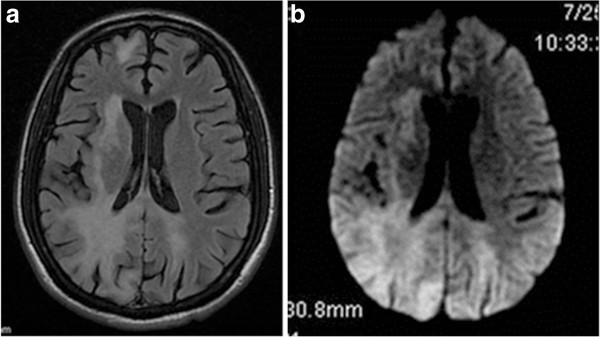
Leucoencefalopatia multifocal de imagens de ressonância magnética

Ressonância magnética (RM) de um paciente com leucoencefalopatia multifocal progressiva (LMP):
a: RM cerebral axial ponderada em T2 a demonstrar hiperintensidade de sinal bilateral na substância branca parietooccipital
b: imagem axial ponderada em difusão em T2

Imagem: “Axial T2-Flair MRI and axial T2-Flair diffuse-weighted image” por Jeyaraman VA et al. Licença: CC BY 2.0

Tratamento

Não existe um tratamento específico disponível para BKV ou JCV. O tratamento visa reduzir a imunossupressão.

  • Reduzir a terapêutica imunossupressora (quando possível)
  • Terapêutica antirretroviral para VIH/SIDA
  • Tratamento de suporte

Diagnósticos Diferenciais

  • Linfoma do SNC: neoplasia associada à infeção por Epstein-Barr, que pode ocorrer em pacientes com SIDA com contagem de CD4 < 50 células/µL. Os pacientes podem manifestar-se com cefaleia, confusão, défices neurológicos focais, convulsões e sintomas constitucionais. O diagnóstico pode ser estabelecido através de exames de imagem cerebrais, estudo do LCR para citologia e PCR PCR Polymerase chain reaction (PCR) is a technique that amplifies DNA fragments exponentially for analysis. The process is highly specific, allowing for the targeting of specific genomic sequences, even with minuscule sample amounts. The PCR cycles multiple times through 3 phases: denaturation of the template DNA, annealing of a specific primer to the individual DNA strands, and synthesis/elongation of new DNA molecules. Polymerase Chain Reaction (PCR) e biópsia cerebral. O tratamento inclui terapêutica antirretroviral e quimioterapia.
  • Demência associada ao VIH: situação clínica em pacientes com SIDA com contagem de CD4< 200 células/µL. Os pacientes apresentam perda de memória, comprometimento do funcionamento executivo, alterações do comportamento e humor Humor Defense Mechanisms e perda gradual da capacidade motora. A RM pode revelar hiperintensidades difusas e irregulares da substância branca. Devem ser excluídas outras possíveis causas, como LMP LMP The 1st day of a woman’s LMP Pregnancy: Diagnosis, Physiology, and Care e linfoma, através da análise do LCR. O tratamento inclui terapêutica antirretroviral e medidas de suporte.
  • Esclerose múltipla (EM): doença autoimune inflamatória crónica que leva à desmielinização do SNC. A apresentação clínica pode incluir sintomas neurológicos, que afetam a visão, função motora e autonómica. A apresentação varia dependendo do local das lesões. O diagnóstico é obtido através de ressonância magnética cerebral e da coluna vertebral e ainda exame do LCR. O tratamento envolve corticoterapia nas exacerbações agudas e agentes modificadores da doença, de forma a retardar a progressão da doença.
  • Citomegalovírus: vírus de DNA DNA A deoxyribonucleotide polymer that is the primary genetic material of all cells. Eukaryotic and prokaryotic organisms normally contain DNA in a double-stranded state, yet several important biological processes transiently involve single-stranded regions. DNA, which consists of a polysugar-phosphate backbone possessing projections of purines (adenine and guanine) and pyrimidines (thymine and cytosine), forms a double helix that is held together by hydrogen bonds between these purines and pyrimidines (adenine to thymine and guanine to cytosine). DNA Types and Structure de cadeia dupla, ubíquo, pertencente à família Herpesviridae Herpesviridae A family of enveloped, linear, double-stranded DNA viruses infecting a wide variety of animals. Subfamilies, based on biological characteristics, include: alphaherpesvirinae; betaherpesvirinae; and gammaherpesvirinae. Herpes Simplex Virus 1 and 2. A infeção inicial é geralmente assintomática no hospedeiro imunocompetente. No entanto, a reativação pode ocorrer em pacientes imunodeprimidos, manifestando-se de várias formas, como colite, hepatite, pneumonite, meningoencefalite e nefrite. O diagnóstico pode ser confirmado com PCR PCR Polymerase chain reaction (PCR) is a technique that amplifies DNA fragments exponentially for analysis. The process is highly specific, allowing for the targeting of specific genomic sequences, even with minuscule sample amounts. The PCR cycles multiple times through 3 phases: denaturation of the template DNA, annealing of a specific primer to the individual DNA strands, and synthesis/elongation of new DNA molecules. Polymerase Chain Reaction (PCR) ou biópsia. O tratamento inclui antivirais e diminuição da imunossupressão.

Referências

  1. Zanotto E, Allesina A, Barreca A, Sidoti F, Gallo E, Bottino P, Iannaccone M, Bianco G, Biancone L, Cavallo R, Costa C. (2020). Renal Allograft Biopsies with Polyomavirus BK Nephropathy: Turin Transplant Center, 2015–19. Viruses; 12(9):1047. https://www.mdpi.com/1999-4915/12/9/1047
  2. Tan CS, Koralnik IJ. (2010). Progressive multifocal leukoencephalopathy and other disorders caused by JC virus: clinical features and pathogenesis. Lancet Neurol; 9(4):425–37. https://pubmed.ncbi.nlm.nih.gov/20298966/
  3. Iacobaeus E, Burkill S, Bahmanyar S, Hakim R, Byström C, Fored M. Olsson T, Brundin L, Montgomery S. (2018). The national incidence of PML in Sweden, 1988-2013. Neurology; 90(6):e498–e506. https://pubmed.ncbi.nlm.nih.gov/29321229/
  4. Tan K, Roda R, Ostrow L, McArthur J, Nath A. (2009). PML-IRIS in patients with HIV infection: clinical manifestations and treatment with steroids. Neurology; 72(17):1458–64. https://pubmed.ncbi.nlm.nih.gov/19129505/
  5. Kleinschmidt-DeMasters BK, Tyler KL. (2005). Progressive multifocal leukoencephalopathy complicating treatment with natalizumab and interferon beta-1a for multiple sclerosis. N Engl J Med; 353(4):369–74. https://pubmed.ncbi.nlm.nih.gov/15947079/
  6. Carson KR, Evens AM, Richey EA, Habermann TM, Focosi D, Seymour JF, Laubach J, Bawn SD, Gordon LI, Winter JN, Furman RR, Vose JM, Zelenetz AD, Mamtani R, Raisch DW, Dorshimer GW, Rosen ST, Muro K, Gottardi-Littell NR, Talley R., Sartor O, Green D, Major EO, Bennett CL. (2009). Progressive multifocal leukoencephalopathy after rituximab therapy in HIV-negative patients: a report of 57 cases from the Research on Adverse Drug Events and Reports project. Blood; 113(20):4834–40. https://pubmed.ncbi.nlm.nih.gov/19264918/
  7. Gómez-Cibeira E, Ivanovic-Barbeito Y, Gutiérrez-Martínez E, Morales E, Abradelo M, Hilario A, Ramos A, Ruiz-Morales J, Villarejo-Galende A. (2016). Eculizumab-related progressive multifocal leukoencephalopathy. Neurology; 86(4):399–400. https://pubmed.ncbi.nlm.nih.gov/26718572/
  8. Harypursat V, Zhou Y, Tang S, Chen Y. (2020). JC Polyomavirus, progressive multifocal leukoencephalopathy, and immune reconstitution inflammatory syndrome: a review. AIDS Res Ther; 17(1):37. https://pubmed.ncbi.nlm.nih.gov/32631361/
  9. Bohra C, Sokol L, Dalia S. (2017). Progressive Multifocal Leukoencephalopathy and Monoclonal Antibodies: A Review. Cancer Control. 24 (4): 1073274817729901. https://pubmed.ncbi.nlm.nih.gov/28975841/
  10. Kartau M, Sipilä JO, Auvinen E, Palomäki M, Verkkoniemi-Ahola A. (2019). Progressive Multifocal Leukoencephalopathy: Current Insights. Degenerative Neurological and Neuromuscular Disease. 9: 109–121. https://www.ncbi.nlm.nih.gov/pmc/articles/PMC6896915/
  11. Greenlee, JE. (2024). Progressive multifocal leukoencephalopathy (PML). MSD Manual Professional Version. Retrieved February 18, 2025, from https://www.msdmanuals.com/professional/neurologic-disorders/brain-infections/progressive-multifocal-leukoencephalopathy-pml
  12. Hirsch, HH. (2025). Overview of JC polyomavirus, BK polyomavirus, and other polyovavirus infections. In Bond, S. (Ed.), UpToDate. Retrieved February 18, 2025, from https://www.uptodate.com/contents/overview-of-jc-polyomavirus-bk-polyomavirus-and-other-polyomavirus-infections
  13. Koralnik, IJ. (2025). Progressive multifocal leukoencephalopathy (PML): Epidemiology, clinical manifestations, and diagnosis. In Dasche, JF. (Ed.), UpToDate. Retrieved February 18, 2025, from https://www.uptodate.com/contents/progressive-multifocal-leukoencephalopathy-pml-epidemiology-clinical-manifestations-and-diagnosis

Crie sua conta gratuita ou faça login para continuar lendo!

Cadastre-se agora e tenha acesso grátis ao Lecturio, com páginas de conceitos, vídeos de medicina e questões para sua educação médica.

Aprende mais com a Lecturio:

Multiple devices displaying human anatomy and health education content.

Complementa o teu estudo da faculdade com o companheiro de estudo tudo-em-um da Lecturio, através de métodos de ensino baseados em evidência.

Estuda onde quiseres

Two iPhones display medical education apps, one showing anatomy, the other Bookmatcher.

A Lecturio Medical complementa o teu estudo através de métodos de ensino baseados em evidência, vídeos de palestras, perguntas e muito mais – tudo combinado num só lugar e fácil de usar.

User Reviews

Have a holly, jolly study session 🎁 Save 50% on all plans now >>

Que tengas una sesión de estudio alegre y navideña 🎁 Ahorra 50% en todos los planes >>

Details