


Virologia: Descrição Geral

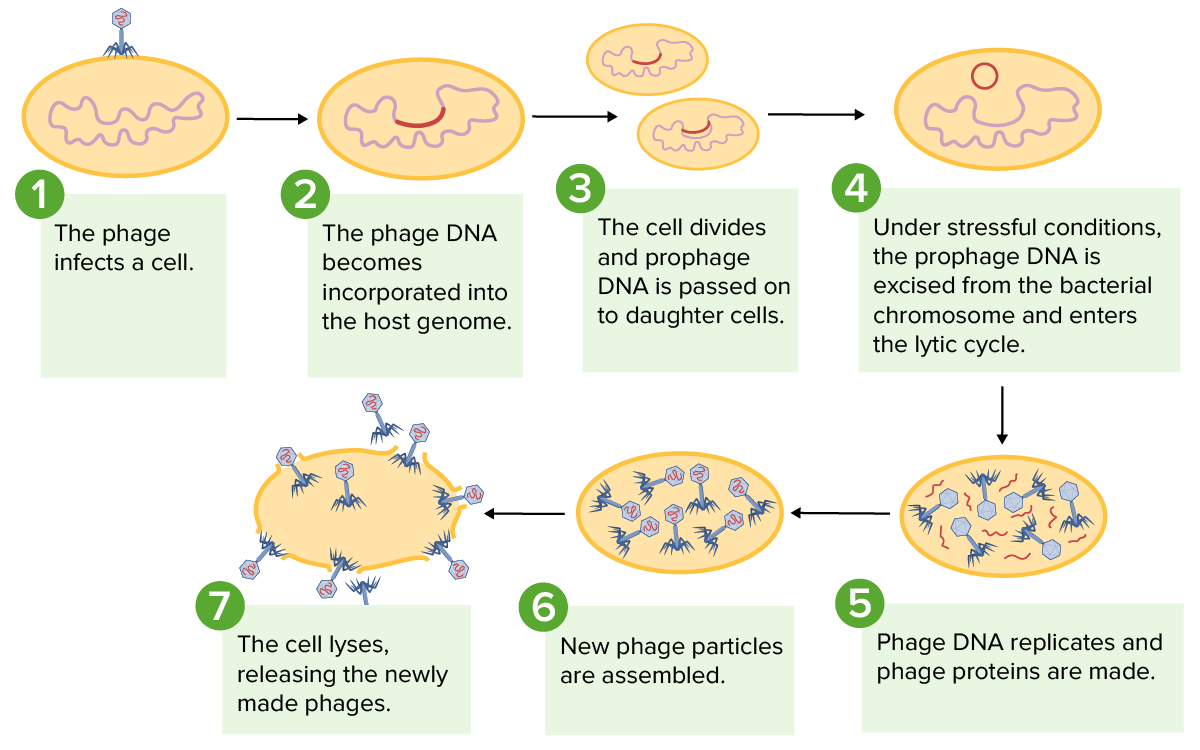
Os vírus são parasitas intracelulares obrigatórios, infeciosos, compostos por um núcleo de ácido nucleico circundado por uma cápside proteica. Os vírus podem ser nus (não envelopados) ou envelopados. A classificação dos vírus é complexa e baseada em muitos fatores, incluindo o tipo e a estrutura do nucleoide e da cápside, a presença de um envelope Envelope Bilayer lipid membrane acquired by viral particles during viral morphogenesis. Although the lipids of the viral envelope are host derived, various virus-encoded integral membrane proteins, i.e. Viral envelope proteins are incorporated there. Virology, o ciclo de replicação e a variedade de hospedeiros. O ciclo de replicação difere entre vírus que infetam bactérias (bacteriófagos) e vírus que infetam células eucarióticas. Os bacteriófagos têm um ciclo de replicação lítico ou lisogénico, enquanto os vírus eucariotas apresentam um processo de replicação definido em 6 etapas.

Last updated: Dec 15, 2025

Editorial responsibility: Stanley Oiseth, Lindsay Jones, Evelin Maza

Definição

Os vírus são parasitas intracelulares obrigatórios, infeciosos, compostos por um núcleo de ácido nucleico (ácido desoxirribonucleico ( DNA DNA A deoxyribonucleotide polymer that is the primary genetic material of all cells. Eukaryotic and prokaryotic organisms normally contain DNA in a double-stranded state, yet several important biological processes transiently involve single-stranded regions. DNA, which consists of a polysugar-phosphate backbone possessing projections of purines (adenine and guanine) and pyrimidines (thymine and cytosine), forms a double helix that is held together by hydrogen bonds between these purines and pyrimidines (adenine to thymine and guanine to cytosine). DNA Types and Structure, pela sigla em inglês) ou ácido ribonucleico ( RNA RNA A polynucleotide consisting essentially of chains with a repeating backbone of phosphate and ribose units to which nitrogenous bases are attached. RNA is unique among biological macromolecules in that it can encode genetic information, serve as an abundant structural component of cells, and also possesses catalytic activity. RNA Types and Structure, pela sigla em inglês)) circundado por uma cápside proteica; por vezes, os vírus são ainda revestidos por um envelope Envelope Bilayer lipid membrane acquired by viral particles during viral morphogenesis. Although the lipids of the viral envelope are host derived, various virus-encoded integral membrane proteins, i.e. Viral envelope proteins are incorporated there. Virology derivado das membranas das células hospedeiras.
Tipos de vírus

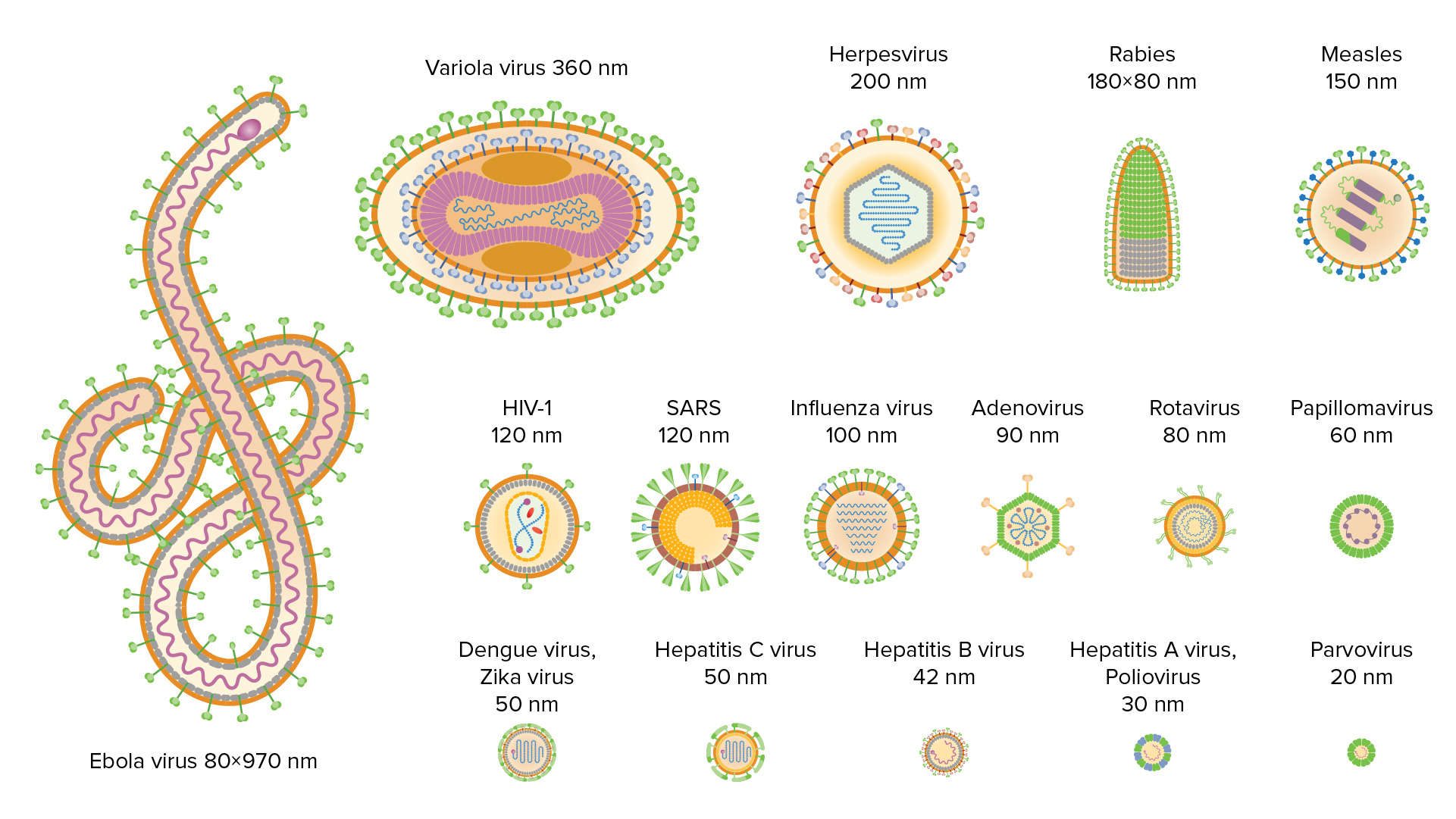
Variedade de vírus existentes, incluindo tamanho e morfologia

Imagem por Lecturio. Licença: CC BY-NC-SA 4.0

Estrutura

A estrutura básica dos vírus consiste em:
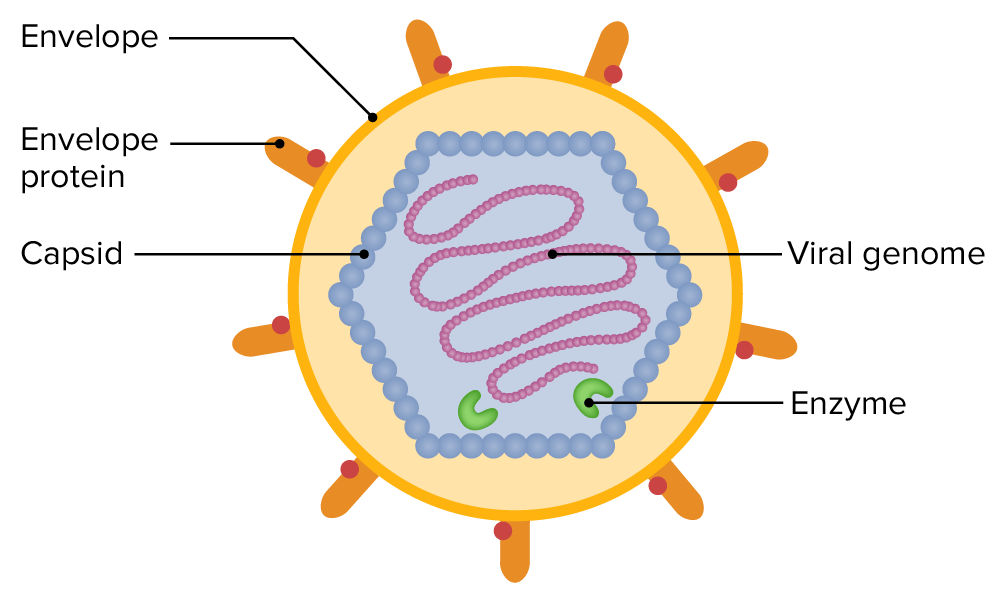
  • Componentes do interior da célula que permitem que o vírus se replique dentro das células hospedeiras
  • Componente estrutural externa que permite que o vírus sobreviva no ambiente e se ligue às células hospedeiras
Anatomy of virus

Anatomia de um vírus

Imagem por Lecturio.
Componentes internos

  • Genoma viral (nucleoide): composto por RNA RNA A polynucleotide consisting essentially of chains with a repeating backbone of phosphate and ribose units to which nitrogenous bases are attached. RNA is unique among biological macromolecules in that it can encode genetic information, serve as an abundant structural component of cells, and also possesses catalytic activity. RNA Types and Structure ou DNA DNA A deoxyribonucleotide polymer that is the primary genetic material of all cells. Eukaryotic and prokaryotic organisms normally contain DNA in a double-stranded state, yet several important biological processes transiently involve single-stranded regions. DNA, which consists of a polysugar-phosphate backbone possessing projections of purines (adenine and guanine) and pyrimidines (thymine and cytosine), forms a double helix that is held together by hydrogen bonds between these purines and pyrimidines (adenine to thymine and guanine to cytosine). DNA Types and Structure
  • Enzimas virais: necessárias para a replicação viral dentro da célula hospedeira:
    • RNA RNA A polynucleotide consisting essentially of chains with a repeating backbone of phosphate and ribose units to which nitrogenous bases are attached. RNA is unique among biological macromolecules in that it can encode genetic information, serve as an abundant structural component of cells, and also possesses catalytic activity. RNA Types and Structure polimerase dependente de DNA DNA A deoxyribonucleotide polymer that is the primary genetic material of all cells. Eukaryotic and prokaryotic organisms normally contain DNA in a double-stranded state, yet several important biological processes transiently involve single-stranded regions. DNA, which consists of a polysugar-phosphate backbone possessing projections of purines (adenine and guanine) and pyrimidines (thymine and cytosine), forms a double helix that is held together by hydrogen bonds between these purines and pyrimidines (adenine to thymine and guanine to cytosine). DNA Types and Structure
    • RNA RNA A polynucleotide consisting essentially of chains with a repeating backbone of phosphate and ribose units to which nitrogenous bases are attached. RNA is unique among biological macromolecules in that it can encode genetic information, serve as an abundant structural component of cells, and also possesses catalytic activity. RNA Types and Structure polimerase dependente de RNA RNA A polynucleotide consisting essentially of chains with a repeating backbone of phosphate and ribose units to which nitrogenous bases are attached. RNA is unique among biological macromolecules in that it can encode genetic information, serve as an abundant structural component of cells, and also possesses catalytic activity. RNA Types and Structure
    • DNA DNA A deoxyribonucleotide polymer that is the primary genetic material of all cells. Eukaryotic and prokaryotic organisms normally contain DNA in a double-stranded state, yet several important biological processes transiently involve single-stranded regions. DNA, which consists of a polysugar-phosphate backbone possessing projections of purines (adenine and guanine) and pyrimidines (thymine and cytosine), forms a double helix that is held together by hydrogen bonds between these purines and pyrimidines (adenine to thymine and guanine to cytosine). DNA Types and Structure polimerase dependente de RNA RNA A polynucleotide consisting essentially of chains with a repeating backbone of phosphate and ribose units to which nitrogenous bases are attached. RNA is unique among biological macromolecules in that it can encode genetic information, serve as an abundant structural component of cells, and also possesses catalytic activity. RNA Types and Structure (transcriptase reversa)

Componentes externos

  • Cápside:
    • Invólucro proteico de camada simples ou dupla que envolve o ácido nucleico
    • Dispostos por subunidades, conhecidas por capsómeros
    • 3 padrões estruturais:
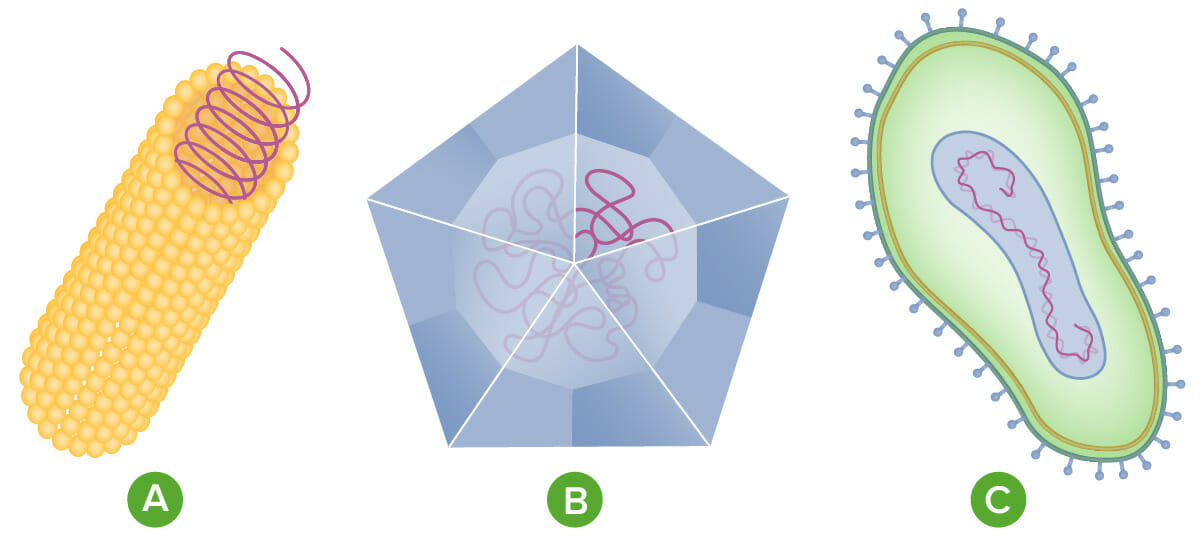
      • Icosaédrico
      • Helicoidal
      • Complexo
  • Envelope Envelope Bilayer lipid membrane acquired by viral particles during viral morphogenesis. Although the lipids of the viral envelope are host derived, various virus-encoded integral membrane proteins, i.e. Viral envelope proteins are incorporated there. Virology:
    • Pode ou não estar presente
    • Envolve o nucleocápside
    • Composto por proteínas específicas do vírus, lípidos e hidratos de carbono (derivados das membranas das células hospedeiras)
Viral capsid types

A cápside viral pode ser (a) helicoidal, (b) poliédrica ou (c) ter uma forma complexa

Imagem por Lecturio.
Classificação

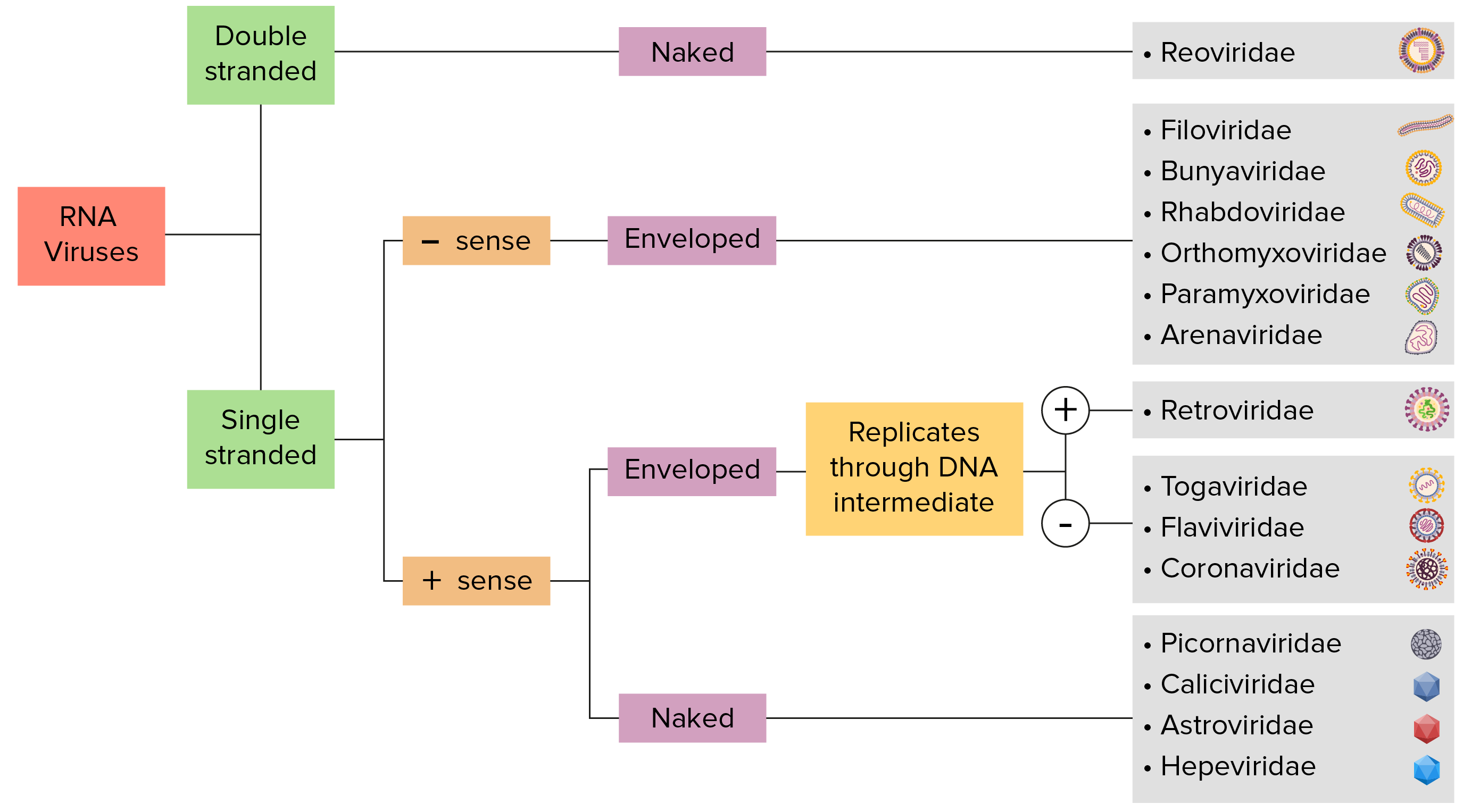
Classificação do fluxograma de vírus de RNA

Identificação do vírus RNA:
Os vírus podem ser classificados de várias formas. Contudo, a maioria dos vírus possui um genoma formado por DNA ou RNA. Os vírus com genoma de DNA podem ainda ser caracterizados como de cadeia simples ou dupla. Os vírus com envelope são revestidos por uma camada fina de membrana celular, que geralmente é retirada da célula hospedeira. Os vírus sem envelope são apelidados de vírus “nus”. Os vírus com genoma de cadeia simples são vírus de “sentido positivo”, se o genoma for transcrito diretamente em RNA mensageiro (mRNA), que é traduzido em proteínas. Os vírus de “sentido negativo” necessitam da enzima RNA polimerase dependente de RNA para transcrever o seu genoma em RNA mensageiro.

Imagem por Lecturio. Licença: CC BY-NC-SA 4.0

Existem vários esquemas de classificação de vírus, com base nas suas características físicas e estratégias de replicação.

Tabela: Classificações de vírus
Classificação por: Tipos
Tipo e estrutura do nucleoide
  • DNA DNA A deoxyribonucleotide polymer that is the primary genetic material of all cells. Eukaryotic and prokaryotic organisms normally contain DNA in a double-stranded state, yet several important biological processes transiently involve single-stranded regions. DNA, which consists of a polysugar-phosphate backbone possessing projections of purines (adenine and guanine) and pyrimidines (thymine and cytosine), forms a double helix that is held together by hydrogen bonds between these purines and pyrimidines (adenine to thymine and guanine to cytosine). DNA Types and Structure ou RNA RNA A polynucleotide consisting essentially of chains with a repeating backbone of phosphate and ribose units to which nitrogenous bases are attached. RNA is unique among biological macromolecules in that it can encode genetic information, serve as an abundant structural component of cells, and also possesses catalytic activity. RNA Types and Structure:
    • Para vírus de RNA RNA A polynucleotide consisting essentially of chains with a repeating backbone of phosphate and ribose units to which nitrogenous bases are attached. RNA is unique among biological macromolecules in that it can encode genetic information, serve as an abundant structural component of cells, and also possesses catalytic activity. RNA Types and Structure:
      • Genoma de cadeia simples (ss-RNA) (sentido positivo ou negativo)
      • Genoma de cadeia dupla (ds-RNA)
    • Para vírus de DNA DNA A deoxyribonucleotide polymer that is the primary genetic material of all cells. Eukaryotic and prokaryotic organisms normally contain DNA in a double-stranded state, yet several important biological processes transiently involve single-stranded regions. DNA, which consists of a polysugar-phosphate backbone possessing projections of purines (adenine and guanine) and pyrimidines (thymine and cytosine), forms a double helix that is held together by hydrogen bonds between these purines and pyrimidines (adenine to thymine and guanine to cytosine). DNA Types and Structure: Todos são ds-DNA (exceto Parvoviridae Parvoviridae A family of very small DNA viruses containing a single molecule of single-stranded DNA and consisting of two subfamilies: parvovirinae and densovirinae. They infect both vertebrates and invertebrates. Parvovirus B19 ).
  • Linear ou circular
  • Segmentado ou não segmentado
Estrutura da cápside
  • Icosaédrica
  • Helicoidal
  • Simetria complexa
Presença de envelope Envelope Bilayer lipid membrane acquired by viral particles during viral morphogenesis. Although the lipids of the viral envelope are host derived, various virus-encoded integral membrane proteins, i.e. Viral envelope proteins are incorporated there. Virology
  • Sem envelope Envelope Bilayer lipid membrane acquired by viral particles during viral morphogenesis. Although the lipids of the viral envelope are host derived, various virus-encoded integral membrane proteins, i.e. Viral envelope proteins are incorporated there. Virology
  • Com envelope Envelope Bilayer lipid membrane acquired by viral particles during viral morphogenesis. Although the lipids of the viral envelope are host derived, various virus-encoded integral membrane proteins, i.e. Viral envelope proteins are incorporated there. Virology
Ciclo de replicação (para bacteriófagos)
  • Lítico
  • Lisogénico ou temperado
Outras
  • Variedade de hospedeiros
  • Características imunológicas
  • Sensibilidade a certos produtos químicos ou propriedades físicas

Related videos

Replicação

É importante diferenciar entre a replicação de bacteriófagos (vírus que infetam bactérias) e vírus eucariotas (vírus que infetam células eucarióticas).

Ciclo de replicação de bacteriófagos

Existem 2 vias de replicação quando um vírus está dentro da célula hospedeira bacteriana:
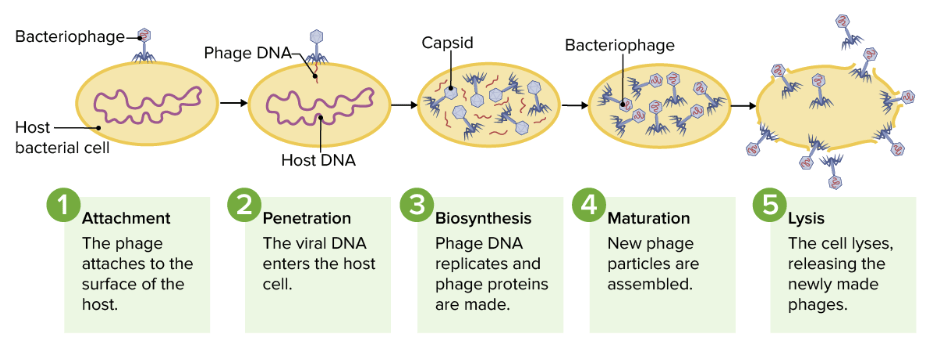
  1. Ciclo lítico:
    • Ocorre sob condições de dano ao DNA ou outra forma de “stress”
    • O bacteriófago assume a transcrição da célula hospedeira e a tradução (expressão imediata e rápida de genes Genes A category of nucleic acid sequences that function as units of heredity and which code for the basic instructions for the development, reproduction, and maintenance of organisms. DNA Types and Structure e proteínas de fagos).
    • Causa a lise da célula bacteriana hospedeira
  2. Ciclo lisogénico ou temperado:
    • Genomas de bacteriófagos incorporados no genoma do hospedeiro bacteriano
    • O genoma do fago é então replicado num estado benigno e dormente: O genoma do fago pode ser expresso quando a célula bacteriana está sob “stress” (por exemplo, depleção de nutrientes).

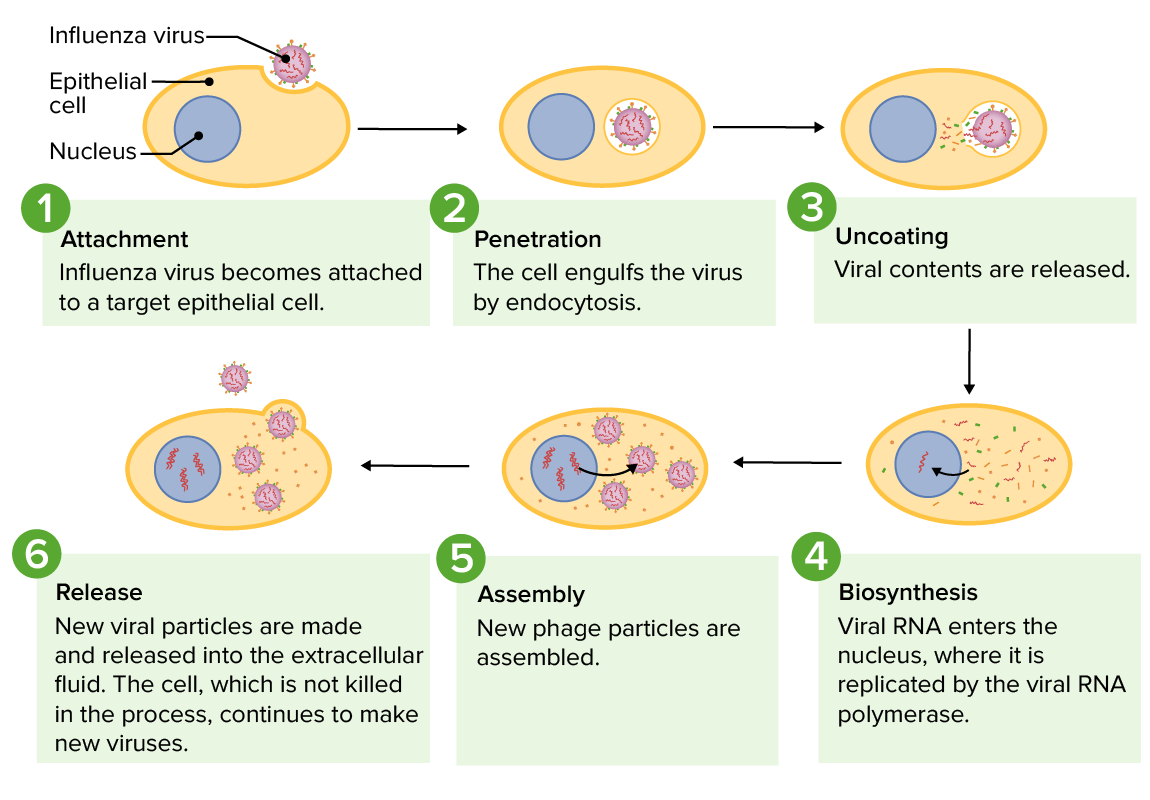
Ciclo de replicação de vírus eucariotas

  • Genoma viral libertado na célula hospedeira infetada
  • Etapas da replicação viral:
    1. Anexo: Ligação das proteínas virais especializadas à célula hospedeira.
    2. Penetração: Invasão da célula hospedeira
    3. Desrevestimento: Desmontagem da cápside e consequente disponibilização do material genético
    4. Biossíntese: Sintetização do ácido nucleico viral e proteínas
    5. Incorporação: Os viriões são incorporados dentro da célula hospedeira
    6. Libertação: por lise da célula hospedeira (para vírus “nus”) ou por eclosão da membrana celular (para vírus com envelope Envelope Bilayer lipid membrane acquired by viral particles during viral morphogenesis. Although the lipids of the viral envelope are host derived, various virus-encoded integral membrane proteins, i.e. Viral envelope proteins are incorporated there. Virology)
  • Todos os vírus de DNA DNA A deoxyribonucleotide polymer that is the primary genetic material of all cells. Eukaryotic and prokaryotic organisms normally contain DNA in a double-stranded state, yet several important biological processes transiently involve single-stranded regions. DNA, which consists of a polysugar-phosphate backbone possessing projections of purines (adenine and guanine) and pyrimidines (thymine and cytosine), forms a double helix that is held together by hydrogen bonds between these purines and pyrimidines (adenine to thymine and guanine to cytosine). DNA Types and Structure replicam-se no núcleo (exceto o poxvírus).
  • Todos os vírus de RNA RNA A polynucleotide consisting essentially of chains with a repeating backbone of phosphate and ribose units to which nitrogenous bases are attached. RNA is unique among biological macromolecules in that it can encode genetic information, serve as an abundant structural component of cells, and also possesses catalytic activity. RNA Types and Structure replicam-se no citoplasma (exceto influenza Influenza Influenza viruses are members of the Orthomyxoviridae family and the causative organisms of influenza, a highly contagious febrile respiratory disease. There are 3 primary influenza viruses (A, B, and C) and various subtypes, which are classified based on their virulent surface antigens, hemagglutinin (HA) and neuraminidase (NA). Influenza typically presents with a fever, myalgia, headache, and symptoms of an upper respiratory infection. Influenza Viruses/Influenza e retrovírus).

Diversificação Genética

Os vírus desenvolveram muitos processos para aumentar a sua diversidade genética:
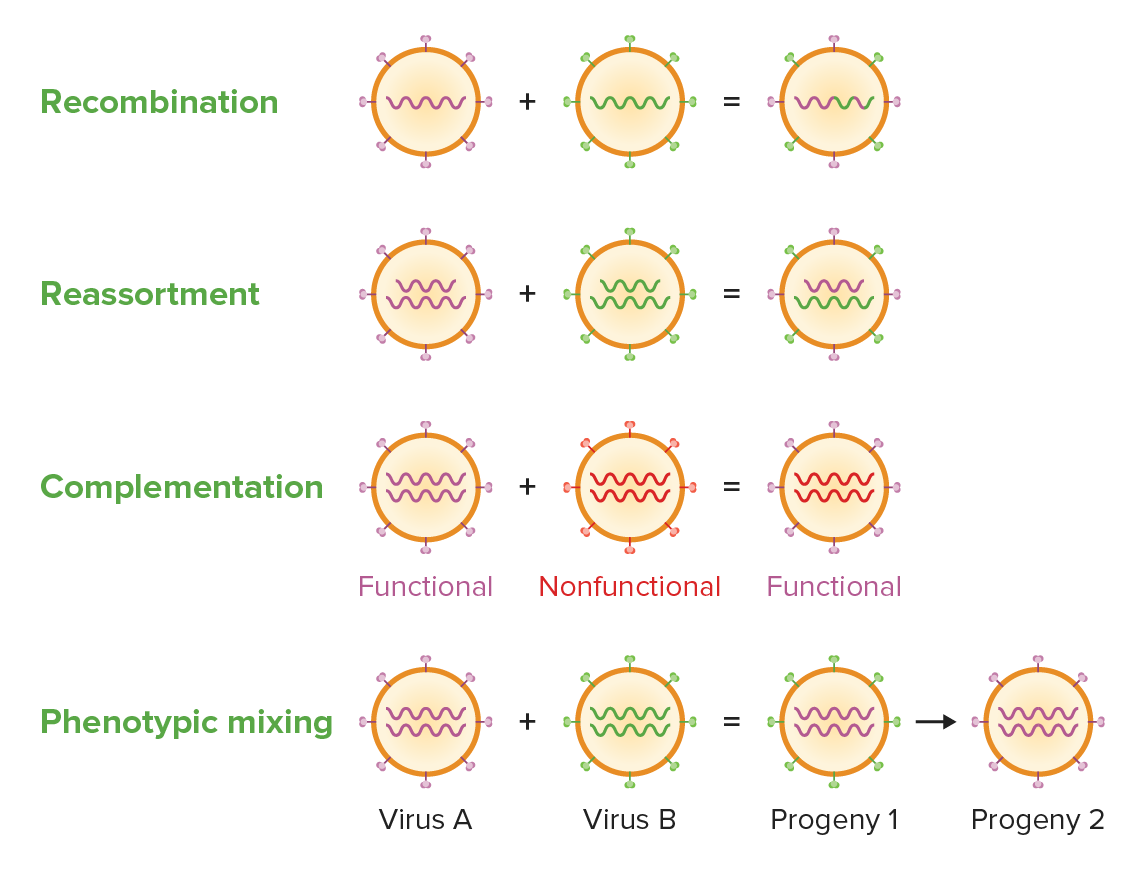
  • Recombinação: troca de genes Genes A category of nucleic acid sequences that function as units of heredity and which code for the basic instructions for the development, reproduction, and maintenance of organisms. DNA Types and Structure entre 2 cromossomas por cruzamento em regiões homólogas
  • Rearranjo:
    • Os vírus com genomas segmentados trocam material genético.
    • Pode levar a uma mudança antigénica (por exemplo, vírus influenza Influenza Influenza viruses are members of the Orthomyxoviridae family and the causative organisms of influenza, a highly contagious febrile respiratory disease. There are 3 primary influenza viruses (A, B, and C) and various subtypes, which are classified based on their virulent surface antigens, hemagglutinin (HA) and neuraminidase (NA). Influenza typically presents with a fever, myalgia, headache, and symptoms of an upper respiratory infection. Influenza Viruses/Influenza)
  • Complementação:
    • Ocorre quando o vírus tem uma mutação que resulta numa proteína não funcional
    • Um vírus não mutado “complementa” um vírus mutado (quando co-infetado numa célula hospedeira), produzindo uma proteína funcional que serve a ambos os vírus (p. HBsAg (uma proteína de envelope Envelope Bilayer lipid membrane acquired by viral particles during viral morphogenesis. Although the lipids of the viral envelope are host derived, various virus-encoded integral membrane proteins, i.e. Viral envelope proteins are incorporated there. Virology chave para HDV HDV Hepatitis D virus (HDV) is a small enveloped, single-stranded RNA virus. Hepatitis D virus is considered a satellite virus, as it requires the presence of hepatitis B virus (HBV) for assembly and secretion. Therefore, in order for an individual to contract hepatitis D, coinfection or superinfection with HBV is required. Hepatitis D Virus)).
  • Mistura fenotípica:
    • Infeção simultânea da célula hospedeira com 2 vírus
    • Geralmente envolve a mistura do genoma de 1 vírus com proteínas de superfície do 2º vírus
Diversificação genética de vírus

Os vírus desenvolveram diversas estratégias para aumentar a diversidade genética, incluindo recombinação (troca de genes entre 2 cromossomas por cruzamento de regiões homólogas), rearranjo (troca de segmentos de cromossomas), complementação (troca de material genético de um vírus funcional com um vírus não funcional, para converter este último em funcional) e mistura fenotípica (mistura de 2 genomas virais numa célula hospedeira infetada simultaneamente originando a progénie com genomas misturados).

Imagem por Lecturio. Licença: CC BY-NC-SA 4.0

Casos Especiais

Retrovírus

  • Vírus de RNA RNA A polynucleotide consisting essentially of chains with a repeating backbone of phosphate and ribose units to which nitrogenous bases are attached. RNA is unique among biological macromolecules in that it can encode genetic information, serve as an abundant structural component of cells, and also possesses catalytic activity. RNA Types and Structure
  • Contém uma transcriptase reversa (polimerase de DNA DNA A deoxyribonucleotide polymer that is the primary genetic material of all cells. Eukaryotic and prokaryotic organisms normally contain DNA in a double-stranded state, yet several important biological processes transiently involve single-stranded regions. DNA, which consists of a polysugar-phosphate backbone possessing projections of purines (adenine and guanine) and pyrimidines (thymine and cytosine), forms a double helix that is held together by hydrogen bonds between these purines and pyrimidines (adenine to thymine and guanine to cytosine). DNA Types and Structure dependente de RNA RNA A polynucleotide consisting essentially of chains with a repeating backbone of phosphate and ribose units to which nitrogenous bases are attached. RNA is unique among biological macromolecules in that it can encode genetic information, serve as an abundant structural component of cells, and also possesses catalytic activity. RNA Types and Structure)
  • O retrovírus mais MAIS Androgen Insensitivity Syndrome proeminente é o vírus da imunodeficiência humana (VIH).

Priões

  • Não são tecnicamente vírus
  • Proteínas infeciosas que não contêm um nucleoide
  • Causam encefalopatias espongiformes transmissíveis:
    • Doença de Creutzfeldt-Jakob
    • Kuru Kuru A prion disease found exclusively among the fore linguistic group natives of the highlands of new guinea. The illness is primarily restricted to adult females and children of both sexes. It is marked by the subacute onset of tremor and ataxia followed by motor weakness and incontinence. Death occurs within 3-6 months of disease onset. The condition is associated with ritual cannibalism, and has become rare since this practice has been discontinued. Pathologic features include a noninflammatory loss of neurons that is most prominent in the cerebellum, glial proliferation, and amyloid plaques. Transmissible Spongiform Encephalopathies
    • Encefalopatia espongiforme bovina (doença das vacas loucas)

Referências

  1. Parker, N., Schneegurt, M., Thi Tu, A.H., Lister, P., & Forster, B. Microbiology. (2016). Chapter 6.2, The Viral Life Cycle. https://openstax.org/details/books/microbiology
  2. Pellett, P. E., Mitra, S., & Holland, T. C. (2014). Basics of virology. Handbook of clinical neurology123, 45–66. https://doi.org/10.1016/B978-0-444-53488-0.00002-X

Crie sua conta gratuita ou faça login para continuar lendo!

Cadastre-se agora e tenha acesso grátis ao Lecturio, com páginas de conceitos, vídeos de medicina e questões para sua educação médica.

Aprende mais com a Lecturio:

Multiple devices displaying human anatomy and health education content.

Complementa o teu estudo da faculdade com o companheiro de estudo tudo-em-um da Lecturio, através de métodos de ensino baseados em evidência.

Estuda onde quiseres

Two iPhones display medical education apps, one showing anatomy, the other Bookmatcher.

A Lecturio Medical complementa o teu estudo através de métodos de ensino baseados em evidência, vídeos de palestras, perguntas e muito mais – tudo combinado num só lugar e fácil de usar.

User Reviews

Have a holly, jolly study session 🎁 Save 50% on all plans now >>

Que tengas una sesión de estudio alegre y navideña 🎁 Ahorra 50% en todos los planes >>

Details