



Rinovírus

O rinovírus é um vírus de RNA RNA A polynucleotide consisting essentially of chains with a repeating backbone of phosphate and ribose units to which nitrogenous bases are attached. RNA is unique among biological macromolecules in that it can encode genetic information, serve as an abundant structural component of cells, and also possesses catalytic activity. RNA Types and Structure de sentido positivo, lábil em ácido, da família Picornavirus. O vírus, que causa a constipação comum, é mais MAIS Androgen Insensitivity Syndrome frequentemente adquirido nas vias aéreas através da inalação de aerossóis que contêm rinovírus e fomites Fomites Inanimate objects that carry pathogenic microorganisms and thus can serve as the source of infection. Microorganisms typically survive on fomites for minutes or hours. Common fomites include clothing, tissue paper, hairbrushes, and cooking and eating utensils. Adenovirus. Como o rinovírus é inativado pelo ácido gástrico, o vírus só consegue afetar a mucosa nasal e a conjuntiva, causando edema Edema Edema is a condition in which excess serous fluid accumulates in the body cavity or interstitial space of connective tissues. Edema is a symptom observed in several medical conditions. It can be categorized into 2 types, namely, peripheral (in the extremities) and internal (in an organ or body cavity). Edema dos tecidos subepiteliais e resultando na constipação comum 1 a 3 dias após a transmissão. O diagnóstico é clínico e a doença é tipicamente ligeira e autolimitada. O tratamento é de suporte e pode incluir o aumento da ingestão de fuidos, AINEs e descongestionantes nasais.

Last updated: Dec 15, 2025
Editorial responsibility: Stanley Oiseth, Lindsay Jones, Evelin Maza

Classificação

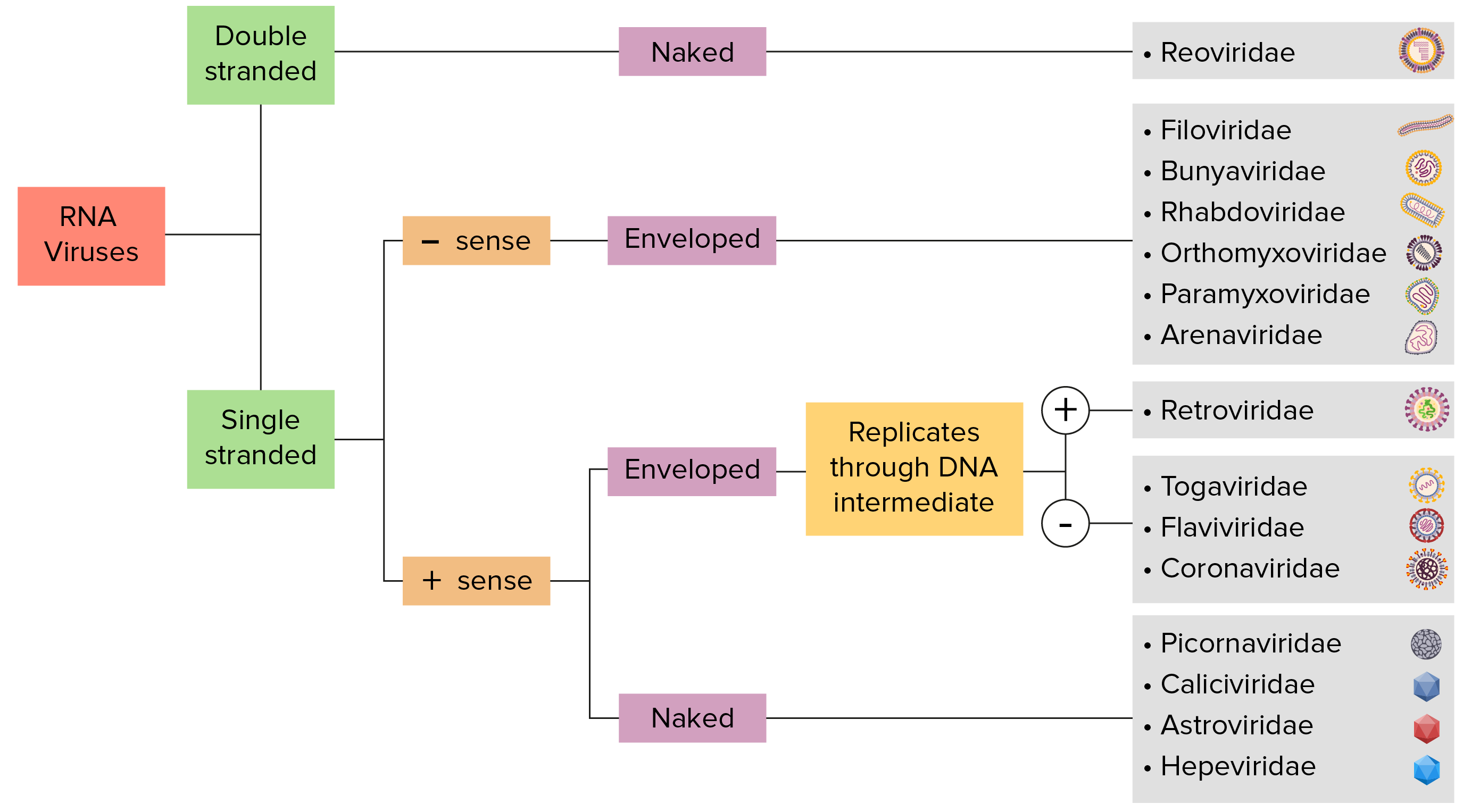
Classificação do fluxograma de vírus de RNA

Identificação do vírus RNA:
Os vírus podem ser classificados de várias maneiras. A maioria dos vírus tem um genoma formado por DNA ou RNA. Os vírus do genoma de RNA podem ser ainda caracterizados por um RNA de cadeia simples ou dupla. Os vírus “envelopados” são cobertos por uma fina camada de membrana celular (geralmente retirada da célula hospedeira). Se a camada estiver ausente, os vírus são chamados de vírus “nus”. Os vírus com genomas de cadeia simples são vírus de “sentido positivo” se o genoma for usado diretamente como mRNA, que é traduzido em proteínas. Os vírus de “sentido negativo” de cadeia simples usam a RNA polimerase dependente de RNA, uma enzima viral, para transcrever o seu genoma em mRNA.
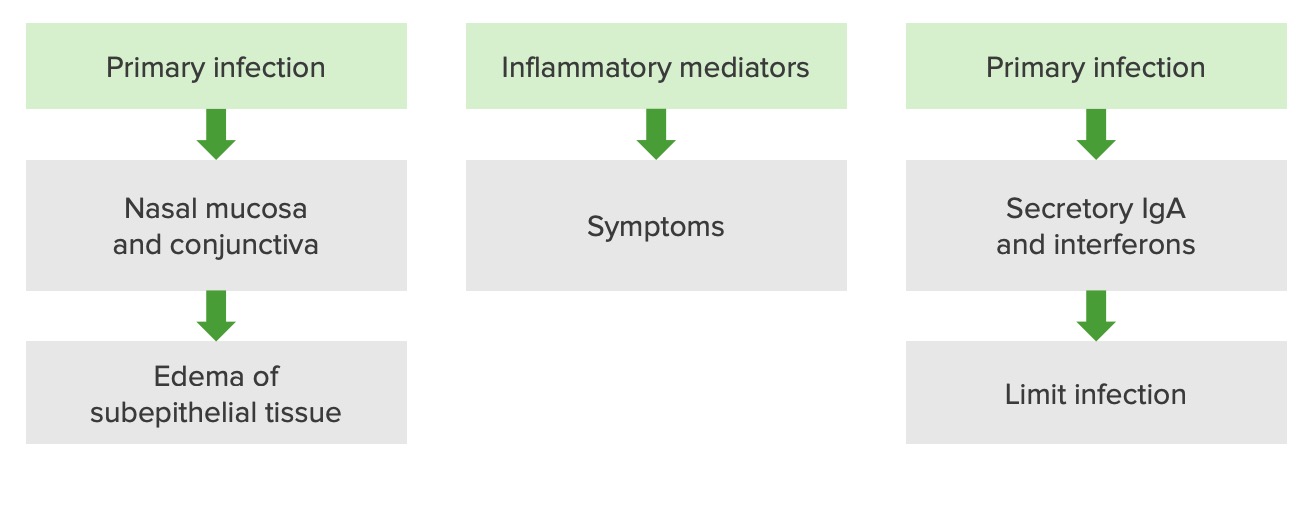
Imagem por Lecturio. Licença: CC BY-NC-SA 4.0

Características Gerais

Estrutura

  • Família Picornavírus
  • Vírus RNA RNA A polynucleotide consisting essentially of chains with a repeating backbone of phosphate and ribose units to which nitrogenous bases are attached. RNA is unique among biological macromolecules in that it can encode genetic information, serve as an abundant structural component of cells, and also possesses catalytic activity. RNA Types and Structure
  • RNA RNA A polynucleotide consisting essentially of chains with a repeating backbone of phosphate and ribose units to which nitrogenous bases are attached. RNA is unique among biological macromolecules in that it can encode genetic information, serve as an abundant structural component of cells, and also possesses catalytic activity. RNA Types and Structure de cadeia simples (ssRNA, pela sigla em inglês) de sentido positivo
  • Sem envelope Envelope Bilayer lipid membrane acquired by viral particles during viral morphogenesis. Although the lipids of the viral envelope are host derived, various virus-encoded integral membrane proteins, i.e. Viral envelope proteins are incorporated there. Virology (vírus nu)

Caraterísticas básicas

  • Muito pequeno: 30 nm
  • Lábil em ácido → inativado pelo ácido gástrico
  • Temperatura para proliferação: 33-35°C (encontrado no nariz)
  • > 100 serotipos podem causar infeções respiratórias superiores (constipação comum).
  • Capaz de sobreviver nas mãos por horas

Doenças associadas

  • Infeções do trato respiratório superior
  • Bronquiolite
  • Rinite
  • Otite média
  • Sinusite
  • Bronquite crónica

Patogénese

Epidemiologia

  • Outono mais MAIS Androgen Insensitivity Syndrome comum → primavera
  • A incidência é maior em crianças no pré-escolar e no ensino básico (média de 3 a 8 constipações por ano).
  • Os adultos geralmente têm 2 a 4 constipações por ano.

Transmissão

  • Os humanos são o único reservatório.
  • Partículas de aerossol
  • Contacto direto
  • Fomites Fomites Inanimate objects that carry pathogenic microorganisms and thus can serve as the source of infection. Microorganisms typically survive on fomites for minutes or hours. Common fomites include clothing, tissue paper, hairbrushes, and cooking and eating utensils. Adenovirus (podem reter o vírus das gotículas respiratórias)
  • O rinovírus pode sobreviver fora de um hospedeiro humano até 3 horas.

Fatores de risco

  • Asma ASMA Autoimmune Hepatitis
  • Fibrose quística (CF, pela sigla em inglês)
  • Bronquite crónica
  • Doença pulmonar obstrutiva crónica (DPOC)
  • Lactentes e idosos
  • Indivíduos imunocomprometidos

Fisiopatologia

  • Período de incubação: 1-3 dias
  • Inoculação na mucosa nasal → ligação ao epitélio respiratório e dispersão localmente → provoca uma resposta imune inata que leva à inflamação e remodelação das vias aéreas
  • Poucas células são realmente infetadas pelo rinovírus (apenas uma pequena porção do epitélio está envolvida).
Fisiopatologia de uma infecção por rinovírus

Fisiopatologia de uma infeção por rinovírus

Imagem por Lecturio. Licença: CC BY-NC-SA 4.0

Prevenção

  • Lavar as mãos com água e sabão.
  • Desinfetar as mãos e superfícies.
  • Evitar o contacto do rosto com as mãos.
  • Usar uma máscara (por exemplo, cirúrgica, KN95, FFP2).

Apresentação Clínica

  • Período de incubação: 12-72 horas
  • Duração: 7 a 10 dias
  • Infeções causadas:
    • Constipação comum (na maioria das vezes)
    • Infeção no ouvido
    • Infeção dos seios perinasais
    • Pneumonia Pneumonia Pneumonia or pulmonary inflammation is an acute or chronic inflammation of lung tissue. Causes include infection with bacteria, viruses, or fungi. In more rare cases, pneumonia can also be caused through toxic triggers through inhalation of toxic substances, immunological processes, or in the course of radiotherapy. Pneumonia e bronquiolite (raro)
  • Sintomas:
    • Mal-estar
    • Odinofagia
    • Secreção nasal
    • Congestão nasal
    • Esternutos
    • Cefaleia
    • Pressão facial e auricular
    • Rouquidão

Diagnóstico

  • O diagnóstico é estabelecido pela história clínica e exame objetivo.
  • Achados do exame objetivo:
    • Nariz vermelho
    • Rinorreia
    • As membranas mucosas nasais aparecem brilhantes e vítreas sem eritema ou edema Edema Edema is a condition in which excess serous fluid accumulates in the body cavity or interstitial space of connective tissues. Edema is a symptom observed in several medical conditions. It can be categorized into 2 types, namely, peripheral (in the extremities) and internal (in an organ or body cavity). Edema óbvios.
    • A faringe geralmente parece normal.
  • Opções de teste para obter um diagnóstico específico:
    • Testes Testes Gonadal Hormones diretos de antigénio:
      • Síndrome respiratória grave aguda por coronavírus 2 (SARS-CoV-2)
      • Influenza Influenza Influenza viruses are members of the Orthomyxoviridae family and the causative organisms of influenza, a highly contagious febrile respiratory disease. There are 3 primary influenza viruses (A, B, and C) and various subtypes, which are classified based on their virulent surface antigens, hemagglutinin (HA) and neuraminidase (NA). Influenza typically presents with a fever, myalgia, headache, and symptoms of an upper respiratory infection. Influenza Viruses/Influenza
      • Vírus sincicial respiratório (VSR)
      • Teste de antigénio direto para parainfluenza e adenovírus
    • Testes Testes Gonadal Hormones de PCR PCR Polymerase chain reaction (PCR) is a technique that amplifies DNA fragments exponentially for analysis. The process is highly specific, allowing for the targeting of specific genomic sequences, even with minuscule sample amounts. The PCR cycles multiple times through 3 phases: denaturation of the template DNA, annealing of a specific primer to the individual DNA strands, and synthesis/elongation of new DNA molecules. Polymerase Chain Reaction (PCR): SARS-CoV-2

Tratamento e Complicações

Tratamento

  • Autolimitado
  • Cuidados de suporte:
    • Descanso
    • Hidratação
    • AINEs
    • Descongestionantes nasais
    • Anti-histamínicos

Complicações

  • Otite média
  • Sinusite
  • Exacerbação de doença reativa das vias aéreas
  • Infeções do trato respiratório inferior

Comparação de Espécies

Tabela: Apresentação clínica de infeções por vírus respiratórios comuns
Sintoma Coronavírus ( COVID-19 COVID-19 Coronavirus disease 2019 (COVID-19) is an infectious disease caused by the severe acute respiratory syndrome coronavirus 2 (SARS-CoV-2) that mainly affects the respiratory system but can also cause damage to other body systems (cardiovascular, gastrointestinal, renal, and central nervous systems). ) Influenza Influenza Influenza viruses are members of the Orthomyxoviridae family and the causative organisms of influenza, a highly contagious febrile respiratory disease. There are 3 primary influenza viruses (A, B, and C) and various subtypes, which are classified based on their virulent surface antigens, hemagglutinin (HA) and neuraminidase (NA). Influenza typically presents with a fever, myalgia, headache, and symptoms of an upper respiratory infection. Influenza Viruses/Influenza (Vírus da gripe) Rinovírus (constipação comum) Alergias sazonais
Febre Frequentemente Frequentemente Rara Rara
Fadiga Frequentemente Frequentemente Às vezes Frequentemente
Tosse Frequentemente Frequentemente Às vezes Frequentemente
Esternutos Rara Não Frequentemente Frequentemente
Mialgias Às vezes Frequentemente Às vezes Não
Rinorreia ou congestão nasal Rara Às vezes Frequentemente Frequentemente
Dor de garganta Às vezes Às vezes Frequentemente Não
Diarreia Rara Às vezes Não Não
Cefaleia Às vezes Frequentemente Frequentemente Às vezes
Dispneia Frequentemente Rara Rara Rara
Perda de paladar e olfato Frequentemente Rara Às vezes Rara

Diagnóstico Diferencial

  • Rinite: inflamação da mucosa nasal. A rinite pode ser classificada como infeciosa, alérgica ou não alérgica com base na etiologia. Todos os 3 tipos de rinite apresentam-se com congestão nasal, rinorreia e esternutos. O diagnóstico é principalmente clínico. O tratamento inclui anti-histamínicos, descongestionantes e imunoterapia (“vacinas da alergia”).
  • Influenza Influenza Influenza viruses are members of the Orthomyxoviridae family and the causative organisms of influenza, a highly contagious febrile respiratory disease. There are 3 primary influenza viruses (A, B, and C) and various subtypes, which are classified based on their virulent surface antigens, hemagglutinin (HA) and neuraminidase (NA). Influenza typically presents with a fever, myalgia, headache, and symptoms of an upper respiratory infection. Influenza Viruses/Influenza: doença respiratória altamente contagiosa que se apresenta com febre, mialgia, cefaleia e sintomas de infeção respiratória superior. Sintomas de gastroenterite também podem ocorrer e são mais MAIS Androgen Insensitivity Syndrome comuns em crianças. A gripe é geralmente autolimitada, embora a pneumonia Pneumonia Pneumonia or pulmonary inflammation is an acute or chronic inflammation of lung tissue. Causes include infection with bacteria, viruses, or fungi. In more rare cases, pneumonia can also be caused through toxic triggers through inhalation of toxic substances, immunological processes, or in the course of radiotherapy. Pneumonia viral ou bacteriana secundária possa complicar a doença. O tratamento é geralmente de suporte, embora os inibidores da neuraminidase Neuraminidase An enzyme that catalyzes the hydrolysis of alpha-2, 3, alpha-2, 6-, and alpha-2, 8-glycosidic linkages (at a decreasing rate, respectively) of terminal sialic residues in oligosaccharides, glycoproteins, glycolipids, colominic acid, and synthetic substrate. Antivirals for Influenza possam ser administrados no início da doença.
  • Vírus parainfluenza humano ( HPIVs HPIVs Human parainfluenza viruses (HPIVs) are single-stranded, linear, negative-sense RNA viruses of the family paramyxoviridae and the genus paramyxovirus. Human parainfluenza viruses are the 2nd most common cause of lower respiratory disease in children, after the respiratory syncytial virus. Parainfluenza Virus, pela sigla em inglês): vírus de RNA RNA A polynucleotide consisting essentially of chains with a repeating backbone of phosphate and ribose units to which nitrogenous bases are attached. RNA is unique among biological macromolecules in that it can encode genetic information, serve as an abundant structural component of cells, and also possesses catalytic activity. RNA Types and Structure de cadeia simples da família Paramyxoviridae Paramyxoviridae A family of spherical viruses, of the order mononegavirales, somewhat larger than the orthomyxoviruses, and containing single-stranded RNA. Subfamilies include paramyxoviridae and pneumovirinae. Respiratory Syncytial Virus, que podem causar doenças do trato respiratório superior e inferior, incluindo croup Croup Croup, also known as laryngotracheobronchitis, is a disease most commonly caused by a viral infection that leads to severe inflammation of the upper airway. It usually presents in children < 5 years of age. Patients develop a hoarse, "seal-like" barking cough and inspiratory stridor. Croup (laringotraqueobronquite), bronquiolite e pneumonia Pneumonia Pneumonia or pulmonary inflammation is an acute or chronic inflammation of lung tissue. Causes include infection with bacteria, viruses, or fungi. In more rare cases, pneumonia can also be caused through toxic triggers through inhalation of toxic substances, immunological processes, or in the course of radiotherapy. Pneumonia. O tratamento é maioritariamente de suporte.
  • Adenovírus: vírus de DNA DNA A deoxyribonucleotide polymer that is the primary genetic material of all cells. Eukaryotic and prokaryotic organisms normally contain DNA in a double-stranded state, yet several important biological processes transiently involve single-stranded regions. DNA, which consists of a polysugar-phosphate backbone possessing projections of purines (adenine and guanine) and pyrimidines (thymine and cytosine), forms a double helix that is held together by hydrogen bonds between these purines and pyrimidines (adenine to thymine and guanine to cytosine). DNA Types and Structure de cadeia dupla sem envelope Envelope Bilayer lipid membrane acquired by viral particles during viral morphogenesis. Although the lipids of the viral envelope are host derived, various virus-encoded integral membrane proteins, i.e. Viral envelope proteins are incorporated there. Virology que geralmente causam infeções respiratórias ligeiras (sintomas de constipação comum). Os adenovírus também podem causar conjuntivite, pneumonia Pneumonia Pneumonia or pulmonary inflammation is an acute or chronic inflammation of lung tissue. Causes include infection with bacteria, viruses, or fungi. In more rare cases, pneumonia can also be caused through toxic triggers through inhalation of toxic substances, immunological processes, or in the course of radiotherapy. Pneumonia atípica, gastroenterite ou apendicite. A transmissão é por aerossóis, fomites Fomites Inanimate objects that carry pathogenic microorganisms and thus can serve as the source of infection. Microorganisms typically survive on fomites for minutes or hours. Common fomites include clothing, tissue paper, hairbrushes, and cooking and eating utensils. Adenovirus, contacto fecal-oral e contacto direto. O tratamento é de suporte.
  • Pneumonia: infeção do trato respiratório inferior, que resulta em “sacos aéreos” (air sacs) preenchidos por líquido ou pus. Os sintomas incluem tosse com catarro, febre, calafrios e dificuldade respiratória. Para causas bacterianas, os antibióticos são indicados no tratamento. Algumas formas de pneumonia Pneumonia Pneumonia or pulmonary inflammation is an acute or chronic inflammation of lung tissue. Causes include infection with bacteria, viruses, or fungi. In more rare cases, pneumonia can also be caused through toxic triggers through inhalation of toxic substances, immunological processes, or in the course of radiotherapy. Pneumonia, como a pneumonia Pneumonia Pneumonia or pulmonary inflammation is an acute or chronic inflammation of lung tissue. Causes include infection with bacteria, viruses, or fungi. In more rare cases, pneumonia can also be caused through toxic triggers through inhalation of toxic substances, immunological processes, or in the course of radiotherapy. Pneumonia pneumocócica, podem ser prevenidas por vacinas.

Referências

  1. Pappas, D. (2025). Epidemiology, clinical manifestations, and pathogenesis of rhinovirus infections. UpToDate. Retrieved March 25, 2025, from https://www.uptodate.com/contents/epidemiology-clinical-manifestations-and-pathogenesis-of-rhinovirus-infections
  2. Buensalido, J. (2023). Rhinovirus (RV) Infection (Common Cold). Emedicine. Retrieved March 25, 2025, from https://emedicine.medscape.com/article/227820-overview
  3. Martin ET, Fairchok MP, Stednick ZJ, Kuypers J, Englund JA. Epidemiology of multiple respiratory viruses in childcare attendees. J Infect Dis. 2013 Mar. 207(6):982-9. 
  4. Makris, S, & Johnston, S. (2018). Recent advances in understanding rhinovirus immunity. F1000Research, 7, F1000 Faculty Rev-1537. https://doi.org/10.12688/f1000research.15337.1

Crie sua conta gratuita ou faça login para continuar lendo!

Cadastre-se agora e tenha acesso grátis ao Lecturio, com páginas de conceitos, vídeos de medicina e questões para sua educação médica.

Aprende mais com a Lecturio:

Multiple devices displaying human anatomy and health education content.

Complementa o teu estudo da faculdade com o companheiro de estudo tudo-em-um da Lecturio, através de métodos de ensino baseados em evidência.

Estuda onde quiseres

Two iPhones display medical education apps, one showing anatomy, the other Bookmatcher.

A Lecturio Medical complementa o teu estudo através de métodos de ensino baseados em evidência, vídeos de palestras, perguntas e muito mais – tudo combinado num só lugar e fácil de usar.

User Reviews

Have a holly, jolly study session 🎁 Save 50% on all plans now >>

Que tengas una sesión de estudio alegre y navideña 🎁 Ahorra 50% en todos los planes >>

Details