


Retroviridae: VIH

O vírus da imunodeficiência humana (VIH, pela sigla em inglês) é uma espécie de Lentivirus Lentivirus A genus of the family retroviridae consisting of non-oncogenic retroviruses that produce multi-organ diseases characterized by long incubation periods and persistent infection. Lentiviruses are unique in that they contain open reading frames (orfs) between the pol and env genes and in the 3' env region. Five serogroups are recognized, reflecting the mammalian hosts with which they are associated. HIV-1 is the type species. Human Immunodeficiency Virus (HIV), um género pertencente à família Retroviridae Retroviridae The human immunodeficiency virus (HIV) is a species of Lentivirus, a genus of the family Retroviridae, which causes HIV infections and acquired immunodeficiency syndrome (AIDS). The virus has high genetic variability and is divided into 2 major types, HIV type 1 (HIV-1) and HIV type 2 (HIV-2). The human immunodeficiency virus is a single-stranded, positive-sense, enveloped RNA virus, which targets and destroys WBCs, leading to frequent opportunistic infections and, eventually, death. Human Immunodeficiency Virus (HIV), que causa infeções por VIH e a síndrome da imunodeficiência adquirida (SIDA). Este vírus possui uma elevada variabilidade genética e é dividido em 2 tipos principais, VIH tipo 1 (VIH-1) e VIH tipo 2 (VIH-2). O vírus da imunodeficiência humana é um vírus de RNA RNA A polynucleotide consisting essentially of chains with a repeating backbone of phosphate and ribose units to which nitrogenous bases are attached. RNA is unique among biological macromolecules in that it can encode genetic information, serve as an abundant structural component of cells, and also possesses catalytic activity. RNA Types and Structure de cadeia simples, de sentido positivo, com invólucro, que tem como alvo os leucócitos, causando a sua destruição e levando ao desenvolvimento de infeções oportunistas frequentes e, eventualmente, à morte.

Last updated: Dec 15, 2025

Editorial responsibility: Stanley Oiseth, Lindsay Jones, Evelin Maza

Classificação e Subtipos

Classificação

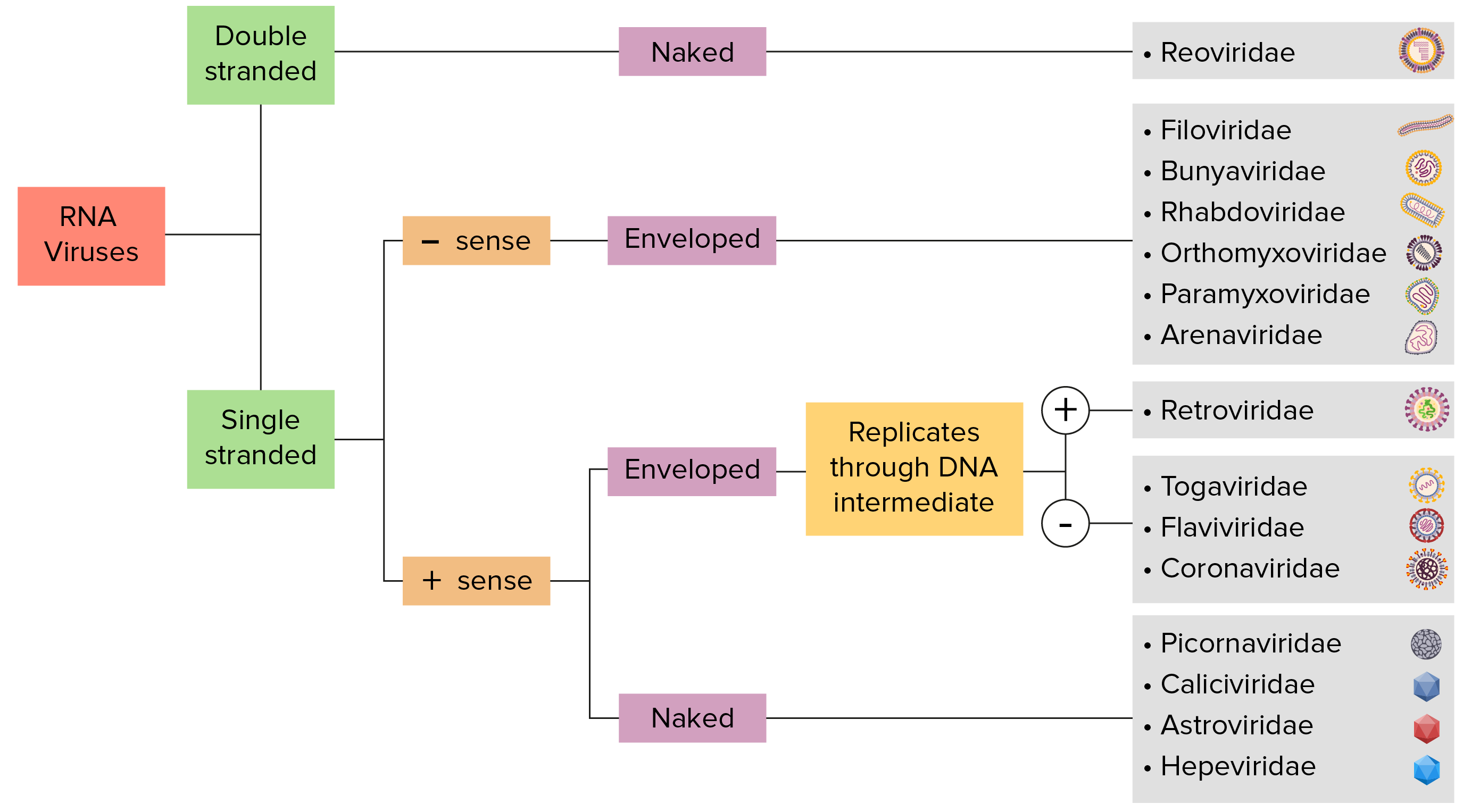
Classificação do fluxograma de vírus de RNA

Identificação dos vírus de RNA:
Os vírus podem ser classificados de várias formas. A maioria dos vírus terá, no entanto, um genoma formado por DNA ou por RNA. Os vírus com um genoma de RNA podem ser melhor caracterizados por um RNA de cadeia simples ou dupla. Os vírus com invólucro são cobertos por uma fina camada de membrana celular (geralmente retirada da célula hospedeira). Se o invólucro estiver ausente, os vírus são chamados de vírus “nus”. Os vírus com genomas de cadeia simples são considerados vírus de “sentido positivo” se o genoma for usado diretamente como RNA mensageiro (mRNA), que é traduzido para proteínas. Os vírus de “sentido negativo” de cadeia simples usam a RNA polimerase dependente de RNA, uma enzima vírica, para transcrever o seu genoma em RNA mensageiro.
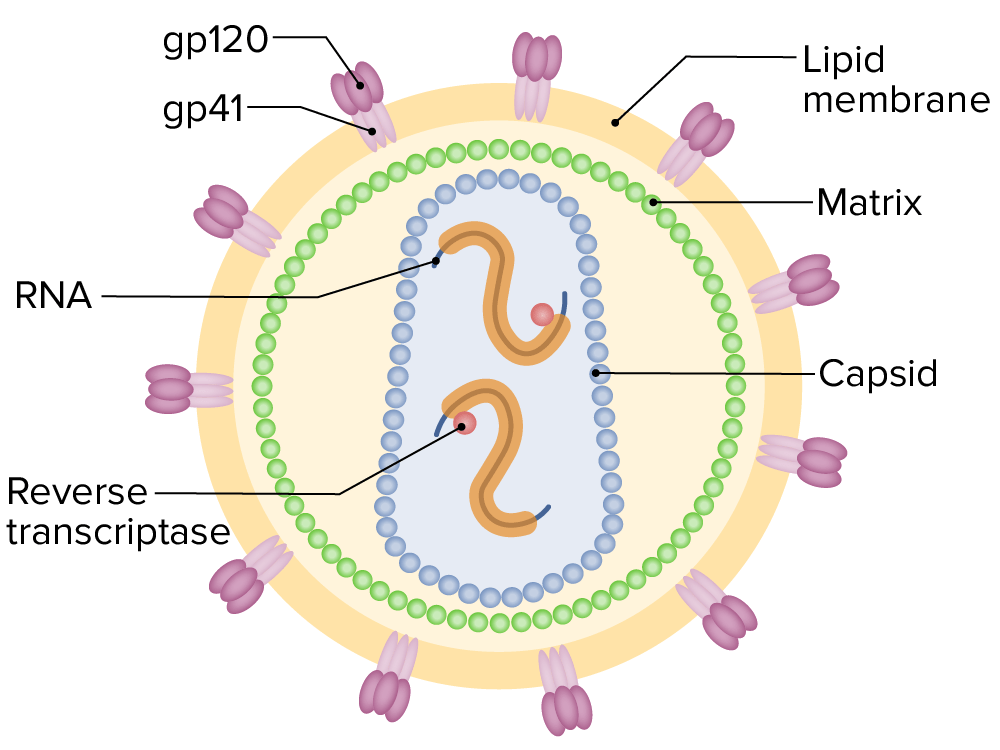
Imagem de Lecturio. Licença: CC BY-NC-SA 4.0
  • Família Retroviridae Retroviridae The human immunodeficiency virus (HIV) is a species of Lentivirus, a genus of the family Retroviridae, which causes HIV infections and acquired immunodeficiency syndrome (AIDS). The virus has high genetic variability and is divided into 2 major types, HIV type 1 (HIV-1) and HIV type 2 (HIV-2). The human immunodeficiency virus is a single-stranded, positive-sense, enveloped RNA virus, which targets and destroys WBCs, leading to frequent opportunistic infections and, eventually, death. Human Immunodeficiency Virus (HIV): Os vírus utilizam a enzima transcriptase reversa para produzir ácido desoxirribonucleico ( DNA DNA A deoxyribonucleotide polymer that is the primary genetic material of all cells. Eukaryotic and prokaryotic organisms normally contain DNA in a double-stranded state, yet several important biological processes transiently involve single-stranded regions. DNA, which consists of a polysugar-phosphate backbone possessing projections of purines (adenine and guanine) and pyrimidines (thymine and cytosine), forms a double helix that is held together by hydrogen bonds between these purines and pyrimidines (adenine to thymine and guanine to cytosine). DNA Types and Structure) a partir do seu genoma de ácido ribonucleico ( RNA RNA A polynucleotide consisting essentially of chains with a repeating backbone of phosphate and ribose units to which nitrogenous bases are attached. RNA is unique among biological macromolecules in that it can encode genetic information, serve as an abundant structural component of cells, and also possesses catalytic activity. RNA Types and Structure) (inverso do processo habitual = “retro”).
  • Género Lentivírus:
    • Causam doenças crónicas fatais
    • Longos períodos de incubação
    • Integram o cDNA viral no DNA DNA A deoxyribonucleotide polymer that is the primary genetic material of all cells. Eukaryotic and prokaryotic organisms normally contain DNA in a double-stranded state, yet several important biological processes transiently involve single-stranded regions. DNA, which consists of a polysugar-phosphate backbone possessing projections of purines (adenine and guanine) and pyrimidines (thymine and cytosine), forms a double helix that is held together by hydrogen bonds between these purines and pyrimidines (adenine to thymine and guanine to cytosine). DNA Types and Structure do hospedeiro, infetando células que não se encontram em divisão

Dois subtipos de vírus da imunodeficiência humana (VIH)

  • VIH-1 (descoberto primeiro, mais virulento e mais infecioso que o VIH-2):
    • Grupo M: significa “major”; mais de 90% dos casos de VIH/SIDA, vários subtipos ou formas recombinantes
    • Grupo N: significa “não-M, não-O”
    • Grupo O: significa “outlier”; isolado na África Centro-Oeste
    • Grupo P: significa “encontra-se pendente a identificação de outros casos humanos”; descoberto em agosto de 2009, isolado nos Camarões
  • VIH-2:
    • Infeciosidade inferior, menos virulento
    • Em grande parte confinado à África Ocidental
    • 8 subgrupos conhecidos (A a H)

Estrutura e Genoma

Virião do VIH

  • Aproximadamente esférico
  • Cerca de 110 nm de diâmetro
  • Estrutura:
    • O invólucro do virião contém 2 glicoproteínas membranares:
      • Gp41 Gp41 Transmembrane envelope protein of the human immunodeficiency virus which is encoded by the HIV env gene. It has a molecular weight of 41, 000 and is glycosylated. The n-terminal part of gp41 is thought to be involved in cell fusion with the CD4 antigens of T4 lymphocytes, leading to syncytial formation. Gp41 is one of the most common HIV antigens detected by immunoblotting. HIV Infection and AIDS (transmembranar)
      • Gp120 Gp120 External envelope protein of the human immunodeficiency virus which is encoded by the HIV env gene. It has a molecular weight of 120 kda and contains numerous glycosylation sites. Gp120 binds to cells expressing CD4 cell-surface antigens, most notably t4-lymphocytes and monocytes/macrophages. Gp120 has been shown to interfere with the normal function of CD4 and is at least partly responsible for the cytopathic effect of HIV. HIV Infection and AIDS (proteína de superfície / de ancoragem)
    • Proteína da matriz p17: circunda o núcleo do vírus
    • Núcleo do vírus:
      • Proteína da cápside p24
      • 2 cadeias simples de ácido ribonucleico ( RNA RNA A polynucleotide consisting essentially of chains with a repeating backbone of phosphate and ribose units to which nitrogenous bases are attached. RNA is unique among biological macromolecules in that it can encode genetic information, serve as an abundant structural component of cells, and also possesses catalytic activity. RNA Types and Structure) de sentido positivo com invólucro revestidas por proteínas da nucleocápside
      • Enzimas (transcriptase reversa, integrase Integrase Enzyme of the human immunodeficiency virus that is required to integrate viral DNA into cellular DNA in the nucleus of a host cell. HIV integrase is a DNA nucleotidyltransferase encoded by the pol gene. HIV Infection and AIDS, protease Protease Enzyme of the human immunodeficiency virus that is required for post-translational cleavage of gag and gag-pol precursor polyproteins into functional products needed for viral assembly. HIV protease is an aspartic protease encoded by the amino terminus of the pol gene. HIV Infection and AIDS)

Genoma do VIH (9 genes Genes A category of nucleic acid sequences that function as units of heredity and which code for the basic instructions for the development, reproduction, and maintenance of organisms. DNA Types and Structure que codificam 15 proteínas víricas)

  • O gene Gene A category of nucleic acid sequences that function as units of heredity and which code for the basic instructions for the development, reproduction, and maintenance of organisms. Basic Terms of Genetics Env codifica a gp160 gp160 An envelope protein of the human immunodeficiency virus that is encoded by the HIV env gene. It has a molecular weight of 160, 000 kda and contains numerous glycosylation sites. It serves as a precursor for both the HIV envelope protein gp120 and the HIV envelope protein gp41. Human Immunodeficiency Virus (HIV), que é clivada para formar glicoproteínas do invólucro:
    • gp120 Gp120 External envelope protein of the human immunodeficiency virus which is encoded by the HIV env gene. It has a molecular weight of 120 kda and contains numerous glycosylation sites. Gp120 binds to cells expressing CD4 cell-surface antigens, most notably t4-lymphocytes and monocytes/macrophages. Gp120 has been shown to interfere with the normal function of CD4 and is at least partly responsible for the cytopathic effect of HIV. HIV Infection and AIDS: adesão à célula T CD4+ hospedeira
    • gp41 Gp41 Transmembrane envelope protein of the human immunodeficiency virus which is encoded by the HIV env gene. It has a molecular weight of 41, 000 and is glycosylated. The n-terminal part of gp41 is thought to be involved in cell fusion with the CD4 antigens of T4 lymphocytes, leading to syncytial formation. Gp41 is one of the most common HIV antigens detected by immunoblotting. HIV Infection and AIDS: fusão e entrada na célula hospedeira
  • O gene Gene A category of nucleic acid sequences that function as units of heredity and which code for the basic instructions for the development, reproduction, and maintenance of organisms. Basic Terms of Genetics Gag codifica a p24 e a p17, proteínas da cápside e da matriz, respetivamente.
  • O gene Gene A category of nucleic acid sequences that function as units of heredity and which code for the basic instructions for the development, reproduction, and maintenance of organisms. Basic Terms of Genetics Pol codifica as enzimas transcriptase reversa, integrase Integrase Enzyme of the human immunodeficiency virus that is required to integrate viral DNA into cellular DNA in the nucleus of a host cell. HIV integrase is a DNA nucleotidyltransferase encoded by the pol gene. HIV Infection and AIDS e protease Protease Enzyme of the human immunodeficiency virus that is required for post-translational cleavage of gag and gag-pol precursor polyproteins into functional products needed for viral assembly. HIV protease is an aspartic protease encoded by the amino terminus of the pol gene. HIV Infection and AIDS.
  • Elementos reguladores: tat, rev, vpr, vif, nef e vpu

Variabilidade genética (muito alta)

  • Recombinação entre as 2 cópias de RNA RNA A polynucleotide consisting essentially of chains with a repeating backbone of phosphate and ribose units to which nitrogenous bases are attached. RNA is unique among biological macromolecules in that it can encode genetic information, serve as an abundant structural component of cells, and also possesses catalytic activity. RNA Types and Structure em cada partícula
  • Replicação rápida
  • Alta taxa de mutações
Diagram of the HIV-1 virion

Diagrama do virião VIH tipo 1 mostrando a estrutura genómica, enzimas principais e glicoproteínas (GP120 and GP41)

Imagem por Lecturio.
Ciclo de Vida

Tropismo

  • O VIH consegue infetar células T CD4+, macrófagos e células da microglia Microglia The third type of glial cell, along with astrocytes and oligodendrocytes (which together form the macroglia). Microglia vary in appearance depending on developmental stage, functional state, and anatomical location; subtype terms include ramified, perivascular, ameboid, resting, and activated. Microglia clearly are capable of phagocytosis and play an important role in a wide spectrum of neuropathologies. They have also been suggested to act in several other roles including in secretion (e.g., of cytokines and neural growth factors), in immunological processing (e.g., antigen presentation), and in central nervous system development and remodeling. Nervous System: Histology.
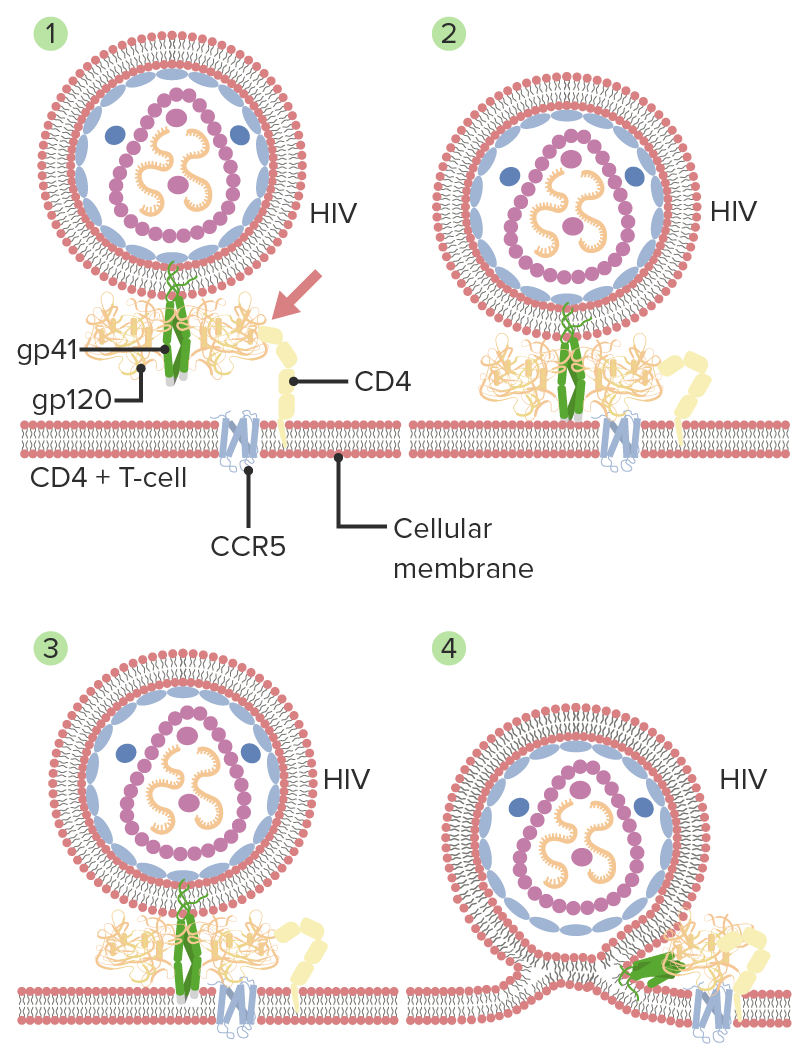
  • A glicoproteína de superfície do VIH Gp160 gp160 An envelope protein of the human immunodeficiency virus that is encoded by the HIV env gene. It has a molecular weight of 160, 000 kda and contains numerous glycosylation sites. It serves as a precursor for both the HIV envelope protein gp120 and the HIV envelope protein gp41. Human Immunodeficiency Virus (HIV) (composta pela gp120 Gp120 External envelope protein of the human immunodeficiency virus which is encoded by the HIV env gene. It has a molecular weight of 120 kda and contains numerous glycosylation sites. Gp120 binds to cells expressing CD4 cell-surface antigens, most notably t4-lymphocytes and monocytes/macrophages. Gp120 has been shown to interfere with the normal function of CD4 and is at least partly responsible for the cytopathic effect of HIV. HIV Infection and AIDS e pela gp41 Gp41 Transmembrane envelope protein of the human immunodeficiency virus which is encoded by the HIV env gene. It has a molecular weight of 41, 000 and is glycosylated. The n-terminal part of gp41 is thought to be involved in cell fusion with the CD4 antigens of T4 lymphocytes, leading to syncytial formation. Gp41 is one of the most common HIV antigens detected by immunoblotting. HIV Infection and AIDS): chave para a adesão do vírus às moléculas de superfície CD4 e aos correcetores de quimiocinas
  • CD4: expresso na superfície das células T helper, células T reguladoras, monócitos, macrófagos e células dendríticas
  • CCR5 CCR5 Ccr receptors with specificity for chemokine ccl3; chemokine ccl4; and chemokine ccl5. They are expressed at high levels in T-lymphocytes; B-lymphocytes; macrophages; mast cells; and nk cells. The ccr5 receptor is used by the human immunodeficiency virus to infect cells. HIV Infection and AIDS: expresso nas células T (de memória e linfócitos CD4 ativados), nos tecidos linfoides associados ao intestino (GALTs), macrófagos, células dendríticas e microglia Microglia The third type of glial cell, along with astrocytes and oligodendrocytes (which together form the macroglia). Microglia vary in appearance depending on developmental stage, functional state, and anatomical location; subtype terms include ramified, perivascular, ameboid, resting, and activated. Microglia clearly are capable of phagocytosis and play an important role in a wide spectrum of neuropathologies. They have also been suggested to act in several other roles including in secretion (e.g., of cytokines and neural growth factors), in immunological processing (e.g., antigen presentation), and in central nervous system development and remodeling. Nervous System: Histology
  • CXCR4 CXCR4 Cxcr receptors with specificity for cxcl12 chemokine. The receptors may play a role in hematopoiesis regulation and can also function as coreceptors for the human immunodeficiency virus. HIV Infection and AIDS: expresso nas células T (linfócitos CD4 naive e em repouso, bem como células CD8), células B, neutrófilos e eosinófilos
  • Estirpes de VIH: podem expressar tropismo para CCR5 CCR5 Ccr receptors with specificity for chemokine ccl3; chemokine ccl4; and chemokine ccl5. They are expressed at high levels in T-lymphocytes; B-lymphocytes; macrophages; mast cells; and nk cells. The ccr5 receptor is used by the human immunodeficiency virus to infect cells. HIV Infection and AIDS (R5 ou M), CXCR4 CXCR4 Cxcr receptors with specificity for cxcl12 chemokine. The receptors may play a role in hematopoiesis regulation and can also function as coreceptors for the human immunodeficiency virus. HIV Infection and AIDS (X4 ou T) ou tropismo duplo (X4R5)

Ciclo de replicação do VIH

  • Células-alvo: células T CD4+, macrófagos e células dendríticas
  • Entrada do VIH nas células:
    • O virião entra primeiro através de uma ruptura na membrana mucosa.
    • O virião atravessa a barreira mucosa e procura células-alvo.
  • Replicação do VIH:
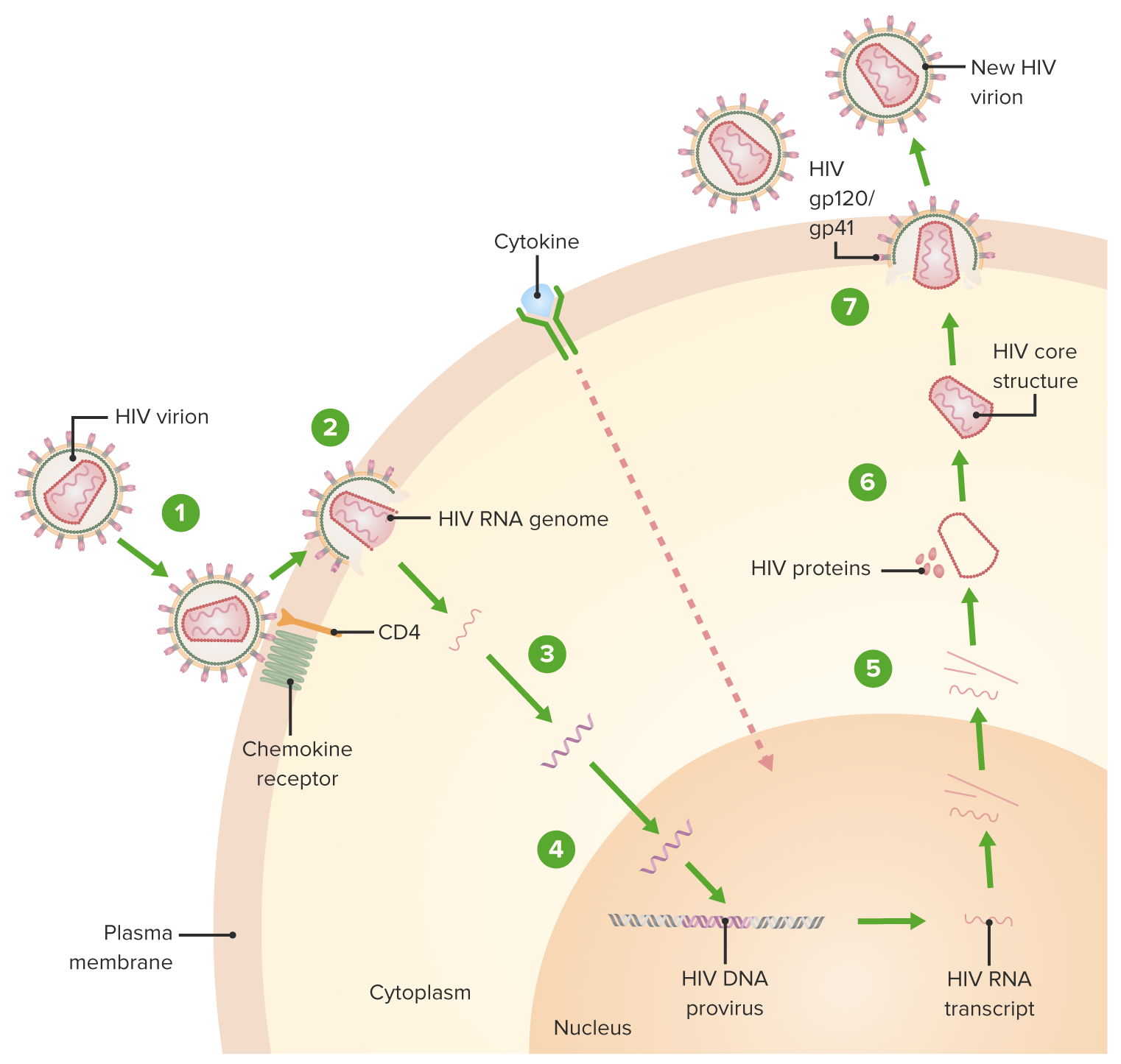
    1. Fusão das membranas e ligação aos recetores (entrada): O virião (que transporta RNA RNA A polynucleotide consisting essentially of chains with a repeating backbone of phosphate and ribose units to which nitrogenous bases are attached. RNA is unique among biological macromolecules in that it can encode genetic information, serve as an abundant structural component of cells, and also possesses catalytic activity. RNA Types and Structure viral, a transcriptase reversa, a integrase Integrase Enzyme of the human immunodeficiency virus that is required to integrate viral DNA into cellular DNA in the nucleus of a host cell. HIV integrase is a DNA nucleotidyltransferase encoded by the pol gene. HIV Infection and AIDS e outras proteínas) inicia a entrada na célula hospedeira.
      • O virião liga-se ao recetor CD4 e a um recetor de quimiocinas ( CCR5 CCR5 Ccr receptors with specificity for chemokine ccl3; chemokine ccl4; and chemokine ccl5. They are expressed at high levels in T-lymphocytes; B-lymphocytes; macrophages; mast cells; and nk cells. The ccr5 receptor is used by the human immunodeficiency virus to infect cells. HIV Infection and AIDS nos macrófagos, CXCR4 CXCR4 Cxcr receptors with specificity for cxcl12 chemokine. The receptors may play a role in hematopoiesis regulation and can also function as coreceptors for the human immunodeficiency virus. HIV Infection and AIDS nas células T).
        • Vírus com tropismo para macrófagos: estirpes R5
        • Vírus com tropismo para células T: estirpes X4
      • A ligação da gp120 Gp120 External envelope protein of the human immunodeficiency virus which is encoded by the HIV env gene. It has a molecular weight of 120 kda and contains numerous glycosylation sites. Gp120 binds to cells expressing CD4 cell-surface antigens, most notably t4-lymphocytes and monocytes/macrophages. Gp120 has been shown to interfere with the normal function of CD4 and is at least partly responsible for the cytopathic effect of HIV. HIV Infection and AIDS ao CD4 e aos recetores de quimiocinas leva a uma alteração conformacional, expondo o domínio de fusão da gp41 Gp41 Transmembrane envelope protein of the human immunodeficiency virus which is encoded by the HIV env gene. It has a molecular weight of 41, 000 and is glycosylated. The n-terminal part of gp41 is thought to be involved in cell fusion with the CD4 antigens of T4 lymphocytes, leading to syncytial formation. Gp41 is one of the most common HIV antigens detected by immunoblotting. HIV Infection and AIDS.
      • A mudança conformacional une as membranas viral e celular, fundindo-as.
    2. A cápside proteica (que envolve o RNA RNA A polynucleotide consisting essentially of chains with a repeating backbone of phosphate and ribose units to which nitrogenous bases are attached. RNA is unique among biological macromolecules in that it can encode genetic information, serve as an abundant structural component of cells, and also possesses catalytic activity. RNA Types and Structure viral e as proteínas) é exposta à medida que o virião atravessa o citoplasma.
    3. Transcrição reversa: ocorre a síntese de DNA DNA A deoxyribonucleotide polymer that is the primary genetic material of all cells. Eukaryotic and prokaryotic organisms normally contain DNA in a double-stranded state, yet several important biological processes transiently involve single-stranded regions. DNA, which consists of a polysugar-phosphate backbone possessing projections of purines (adenine and guanine) and pyrimidines (thymine and cytosine), forms a double helix that is held together by hydrogen bonds between these purines and pyrimidines (adenine to thymine and guanine to cytosine). DNA Types and Structure proviral (a partir do RNA RNA A polynucleotide consisting essentially of chains with a repeating backbone of phosphate and ribose units to which nitrogenous bases are attached. RNA is unique among biological macromolecules in that it can encode genetic information, serve as an abundant structural component of cells, and also possesses catalytic activity. RNA Types and Structure viral) mediada pela transcriptase reversa.
    4. Integração: O DNA DNA A deoxyribonucleotide polymer that is the primary genetic material of all cells. Eukaryotic and prokaryotic organisms normally contain DNA in a double-stranded state, yet several important biological processes transiently involve single-stranded regions. DNA, which consists of a polysugar-phosphate backbone possessing projections of purines (adenine and guanine) and pyrimidines (thymine and cytosine), forms a double helix that is held together by hydrogen bonds between these purines and pyrimidines (adenine to thymine and guanine to cytosine). DNA Types and Structure viral é transportado através do núcleo e integrado no DNA DNA A deoxyribonucleotide polymer that is the primary genetic material of all cells. Eukaryotic and prokaryotic organisms normally contain DNA in a double-stranded state, yet several important biological processes transiently involve single-stranded regions. DNA, which consists of a polysugar-phosphate backbone possessing projections of purines (adenine and guanine) and pyrimidines (thymine and cytosine), forms a double helix that is held together by hydrogen bonds between these purines and pyrimidines (adenine to thymine and guanine to cytosine). DNA Types and Structure do hospedeiro por ação da integrase Integrase Enzyme of the human immunodeficiency virus that is required to integrate viral DNA into cellular DNA in the nucleus of a host cell. HIV integrase is a DNA nucleotidyltransferase encoded by the pol gene. HIV Infection and AIDS.
    5. Replicação: O DNA DNA A deoxyribonucleotide polymer that is the primary genetic material of all cells. Eukaryotic and prokaryotic organisms normally contain DNA in a double-stranded state, yet several important biological processes transiently involve single-stranded regions. DNA, which consists of a polysugar-phosphate backbone possessing projections of purines (adenine and guanine) and pyrimidines (thymine and cytosine), forms a double helix that is held together by hydrogen bonds between these purines and pyrimidines (adenine to thymine and guanine to cytosine). DNA Types and Structure viral é transcrito; são formadas múltiplas cópias do novo RNA RNA A polynucleotide consisting essentially of chains with a repeating backbone of phosphate and ribose units to which nitrogenous bases are attached. RNA is unique among biological macromolecules in that it can encode genetic information, serve as an abundant structural component of cells, and also possesses catalytic activity. RNA Types and Structure do VIH e transportadas para o citoplasma.
      • O novo RNA RNA A polynucleotide consisting essentially of chains with a repeating backbone of phosphate and ribose units to which nitrogenous bases are attached. RNA is unique among biological macromolecules in that it can encode genetic information, serve as an abundant structural component of cells, and also possesses catalytic activity. RNA Types and Structure do VIH torna-se o genoma de um novo vírus.
      • Outras cópias do RNA RNA A polynucleotide consisting essentially of chains with a repeating backbone of phosphate and ribose units to which nitrogenous bases are attached. RNA is unique among biological macromolecules in that it can encode genetic information, serve as an abundant structural component of cells, and also possesses catalytic activity. RNA Types and Structure são usadas para produzir novas proteínas do VIH.
    6. Montagem: o novo RNA RNA A polynucleotide consisting essentially of chains with a repeating backbone of phosphate and ribose units to which nitrogenous bases are attached. RNA is unique among biological macromolecules in that it can encode genetic information, serve as an abundant structural component of cells, and also possesses catalytic activity. RNA Types and Structure viral + proteínas + enzimas movem-se para a superfície da célula e formam uma partícula não infeciosa.
    7. Gemulação e maturação:
      • As partículas ( RNA RNA A polynucleotide consisting essentially of chains with a repeating backbone of phosphate and ribose units to which nitrogenous bases are attached. RNA is unique among biological macromolecules in that it can encode genetic information, serve as an abundant structural component of cells, and also possesses catalytic activity. RNA Types and Structure viral + proteínas) eventualmente brotam da célula hospedeira com o VIH imaturo.
      • A protease Protease Enzyme of the human immunodeficiency virus that is required for post-translational cleavage of gag and gag-pol precursor polyproteins into functional products needed for viral assembly. HIV protease is an aspartic protease encoded by the amino terminus of the pol gene. HIV Infection and AIDS viral cliva as poliproteínas recém-sintetizadas, resultando num virião de VIH maduro.
Ciclo de replicação do HIV

Ciclo de replicação do VIH:
1. O virião liga-se ao recetor CD4 e a um recetor de quimiocinas, o que leva a uma mudança conformacional que facilita a fusão do virião com a célula hospedeira.
2. A cápside proteica (que envolve o RNA viral e as proteínas) é exposta à medida que o virião atravessa o citoplasma.
3. Ocorre a síntese de DNA proviral mediada pela transcriptase reversa.
4. O DNA viral é transportado através do núcleo e integrado no DNA do hospedeiro por ação da integrase.
5. O DNA viral é transcrito; são formadas múltiplas cópias do novo RNA do VIH e transportadas para o citoplasma. O novo RNA do VIH torna-se o genoma de um novo vírus. Também ocorre a ativação de citocinas da célula.6. O novo RNA viral + proteínas + enzimas movem-se para a superfície da célula e formam uma partícula não infeciosa.7. A partícula (RNA viral + proteínas) eventualmente brota da célula hospedeira com o VIH imaturo. A protease viral (enzima) cliva as poliproteínas recém-sintetizadas resultando num virão de VIH maduro.
Imagem de Lecturio. Licença: CC BY-NC-SA 4.0

Infeção pelo VIH

Transmissão

  • Sexual:
    • > 80% em todo o mundo através do contacto heterossexual
    • O risco aumenta:
      • Na presença de outras doenças sexualmente transmissíveis
      • Com relações repetidas com um parceiro infetado
      • No caso de uma elevada carga viral
    • O tratamento antirretroviral diminui o risco de transmissão.
  • Parentérica:
    • Utilizadores de drogas endovenosas
    • Transfusão de sangue
    • Picadas de agulhas em profissionais de saúde
  • Vertical (mãe para filho):
    • Durante a gravidez
    • Durante o parto
    • Através da amamentação
    • O risco diminui com o tratamento antirretroviral

Fisiopatologia

  • A entrada inicial ocorre habitualmente através da mucosa anogenital.
  • As células dendríticas intersticiais podem ser o alvo inicial.
  • A nova infeção é mais MAIS Androgen Insensitivity Syndrome frequentemente disseminada por vírus com tropismo para os macrófagos.
  • As células infetadas fundem-se então com as células T CD4+ e a infeção dissemina-se.
  • O aumento rápido inicial do RNA RNA A polynucleotide consisting essentially of chains with a repeating backbone of phosphate and ribose units to which nitrogenous bases are attached. RNA is unique among biological macromolecules in that it can encode genetic information, serve as an abundant structural component of cells, and also possesses catalytic activity. RNA Types and Structure viral corresponde à seroconversão (fase aguda).
  • Os níveis de RNA RNA A polynucleotide consisting essentially of chains with a repeating backbone of phosphate and ribose units to which nitrogenous bases are attached. RNA is unique among biological macromolecules in that it can encode genetic information, serve as an abundant structural component of cells, and also possesses catalytic activity. RNA Types and Structure viral caem em resposta ao surgimento de células T CD8+ específicas para o VIH.
  • Eventualmente, o nível de RNA RNA A polynucleotide consisting essentially of chains with a repeating backbone of phosphate and ribose units to which nitrogenous bases are attached. RNA is unique among biological macromolecules in that it can encode genetic information, serve as an abundant structural component of cells, and also possesses catalytic activity. RNA Types and Structure atinge um “set point” ( mais MAIS Androgen Insensitivity Syndrome de 6 meses).
  • Declínio progressivo lento nas células CD4+:
    • Efeitos citopáticos diretos do vírus
    • Citotoxicidade mediada pela gp120 Gp120 External envelope protein of the human immunodeficiency virus which is encoded by the HIV env gene. It has a molecular weight of 120 kda and contains numerous glycosylation sites. Gp120 binds to cells expressing CD4 cell-surface antigens, most notably t4-lymphocytes and monocytes/macrophages. Gp120 has been shown to interfere with the normal function of CD4 and is at least partly responsible for the cytopathic effect of HIV. HIV Infection and AIDS
    • Apoptose celular induzida por ativação
    • Morte celular pelas CD8+ de células CD4+ infetadas
  • A síndrome da imunodeficiência adquirida (SIDA) desenvolve-se quando as células T CD4+ < 200 células/μL.

Apresentação clínica

  • Fase precoce/aguda:
    • 60% são assintomáticos.
    • Se forem sintomáticos, apresentam-se com uma síndrome mononucleose-like:
      • Febre
      • Odinofagia
      • Cefaleias, exantema, diarreia
      • Mialgias/artralgias
    • Se os sintomas durarem > 14 dias há uma progressão mais MAIS Androgen Insensitivity Syndrome rápida para SIDA.
  • Infeção crónica (sem SIDA):
    • Geralmente dura entre 8 a 10 anos
    • Quase sempre assintomática
    • Acompanhada por fadiga, sudorese e perda de peso
    • Adenopatias generalizadas
    • Pode apresentar candidíase recorrente, foliculite e formas graves de herpes, papiloma ou zona.
  • SIDA: definida por uma contagem de CD4+ < 200 células/μL e pela presença de doenças definidoras de SIDA (doenças oportunistas secundárias à imunossupressão)

Identificação

  • Anticorpo anti-VIH (ensaio imunoabsorvente ligado a enzima ( ELISA ELISA An immunoassay utilizing an antibody labeled with an enzyme marker such as horseradish peroxidase. While either the enzyme or the antibody is bound to an immunosorbent substrate, they both retain their biologic activity; the change in enzyme activity as a result of the enzyme-antibody-antigen reaction is proportional to the concentration of the antigen and can be measured spectrophotometrically or with the naked eye. Many variations of the method have been developed. St. Louis Encephalitis Virus))
  • Anticorpo e antigénio do VIH
  • Antigénio do VIH
  • RNA RNA A polynucleotide consisting essentially of chains with a repeating backbone of phosphate and ribose units to which nitrogenous bases are attached. RNA is unique among biological macromolecules in that it can encode genetic information, serve as an abundant structural component of cells, and also possesses catalytic activity. RNA Types and Structure do VIH

Referências

  1. Cloyd M.W. (1996). Human Retroviruses. Retrieved 08 January 2021, from https://www.ncbi.nlm.nih.gov/books/NBK7934/
  2. Quinn T.C. (2019). Global epidemiology of HIV infection. Retrieved 09 January 2021, from https://www.uptodate.com/contents/global-epidemiology-of-hiv-infection
  3. Sax P.E. (2020). Acute and early HIV infection: Pathogenesis and epidemiology. Retrieved 10 January 2021, from https://www.uptodate.com/contents/acute-and-early-hiv-infection-clinical-manifestations-and-diagnosis
  4. Sax P.E. (2020). Acute and early HIV infection: Clinical manifestations and diagnosis. Retrieved 10 January 2021, from https://www.uptodate.com/contents/acute-and-early-hiv-infection-clinical-manifestations-and-diagnosis
  5. Sax P.E., Wood B.R. (2019). The natural history and clinical features of HIV infection in adults and adolescents. Retrieved 08 January 2021, from https://www.uptodate.com/contents/the-natural-history-and-clinical-features-of-hiv-infection-in-adults-and-adolescents

Crie sua conta gratuita ou faça login para continuar lendo!

Cadastre-se agora e tenha acesso grátis ao Lecturio, com páginas de conceitos, vídeos de medicina e questões para sua educação médica.

Aprende mais com a Lecturio:

Multiple devices displaying human anatomy and health education content.

Complementa o teu estudo da faculdade com o companheiro de estudo tudo-em-um da Lecturio, através de métodos de ensino baseados em evidência.

Estuda onde quiseres

Two iPhones display medical education apps, one showing anatomy, the other Bookmatcher.

A Lecturio Medical complementa o teu estudo através de métodos de ensino baseados em evidência, vídeos de palestras, perguntas e muito mais – tudo combinado num só lugar e fácil de usar.

User Reviews

Details