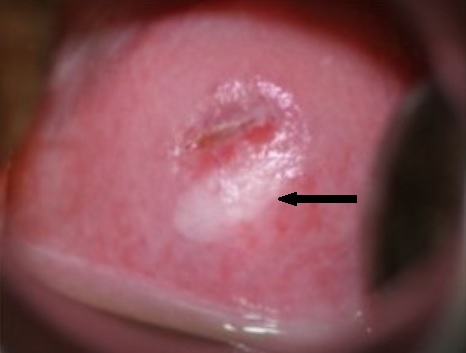



Papillomaviridae: HPV

O vírus do papiloma humano ( HPV HPV Human papillomavirus (HPV) is a nonenveloped, circular, double-stranded DNA virus belonging to the Papillomaviridae family. Humans are the only reservoir, and transmission occurs through close skin-to-skin or sexual contact. Human papillomaviruses infect basal epithelial cells and can affect cell-regulatory proteins to result in cell proliferation. Papillomavirus (HPV), pela sigla em inglês) é um vírus de DNA DNA A deoxyribonucleotide polymer that is the primary genetic material of all cells. Eukaryotic and prokaryotic organisms normally contain DNA in a double-stranded state, yet several important biological processes transiently involve single-stranded regions. DNA, which consists of a polysugar-phosphate backbone possessing projections of purines (adenine and guanine) and pyrimidines (thymine and cytosine), forms a double helix that is held together by hydrogen bonds between these purines and pyrimidines (adenine to thymine and guanine to cytosine). DNA Types and Structure de cadeia dupla, circular e sem envelope Envelope Bilayer lipid membrane acquired by viral particles during viral morphogenesis. Although the lipids of the viral envelope are host derived, various virus-encoded integral membrane proteins, i.e. Viral envelope proteins are incorporated there. Virology, pertencente à família Papillomaviridae Papillomaviridae A family of small, non-enveloped DNA viruses infecting birds and most mammals, especially humans. They are grouped into multiple genera, but the viruses are highly host-species specific and tissue-restricted. They are commonly divided into hundreds of papillomavirus 'types. Papillomavirus (HPV). Os seres humanos são o único reservatório e a transmissão ocorre através do contacto com a pele ou sexual. Os vírus do papiloma humano infetam células epiteliais basais e podem afetar proteínas reguladoras de células, resultando na proliferação celular. Existem > 200 genótipos que podem causar várias condições, como verrugas cutâneas, verrugas anogenitais e neoplasias.

Last updated: Dec 15, 2025
Editorial responsibility: Stanley Oiseth, Lindsay Jones, Evelin Maza

Classificação

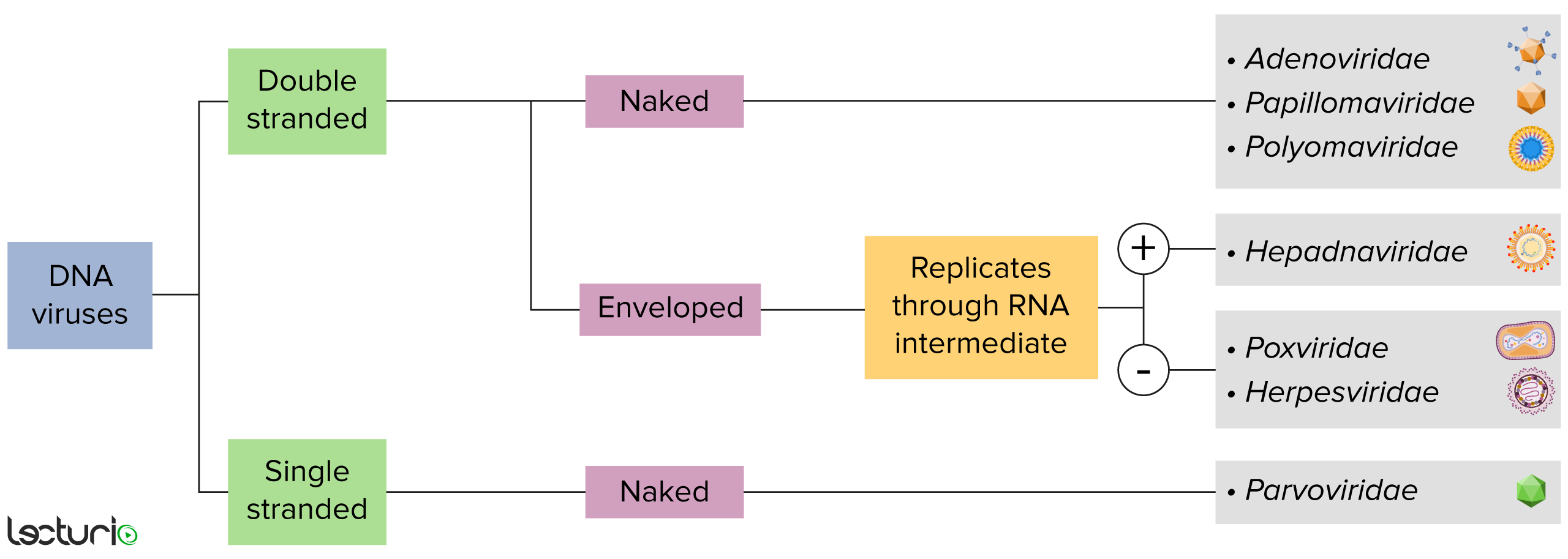
Fluxograma de classificação de vírus de DNA

Identificação de vírus de DNA:
Os vírus podem ser classificados de várias formas. Contudo, a maioria dos vírus possui um genoma formado por DNA ou RNA. Os vírus com genoma de DNA podem ainda ser caracterizados como de cadeia simples ou dupla. Os vírus com envelope são revestidos por uma camada fina de membrana celular, que geralmente é retirada da célula hospedeira. Os vírus sem envelope são apelidados de vírus “nus”. Alguns vírus com envelope traduzem DNA em RNA antes de serem incorporados no genoma da célula hospedeira.
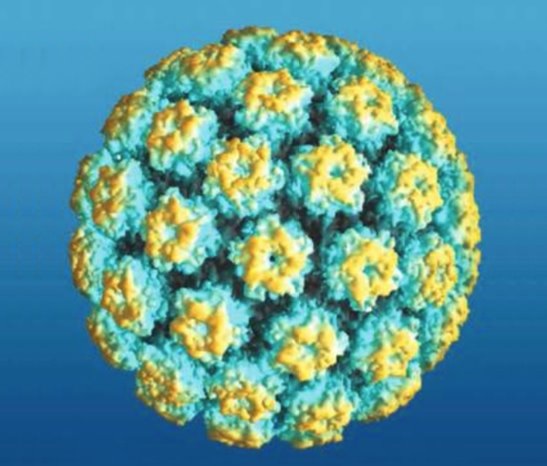
Imagem por Lecturio.

Características Gerais

Principais características do vírus do papiloma humano ( HPV HPV Human papillomavirus (HPV) is a nonenveloped, circular, double-stranded DNA virus belonging to the Papillomaviridae family. Humans are the only reservoir, and transmission occurs through close skin-to-skin or sexual contact. Human papillomaviruses infect basal epithelial cells and can affect cell-regulatory proteins to result in cell proliferation. Papillomavirus (HPV), pela sigla em inglês)

  • Taxonomia:
    • Família: Papillomaviridae Papillomaviridae A family of small, non-enveloped DNA viruses infecting birds and most mammals, especially humans. They are grouped into multiple genera, but the viruses are highly host-species specific and tissue-restricted. They are commonly divided into hundreds of papillomavirus ‘types. Papillomavirus (HPV)
    • Géneros:
      • Alfapapilomavírus
      • Betapapilomavírus
      • Vírus Gamapapiloma
      • Mupapilomavírus
      • Nupapilomavírus
  • Vírus DNA DNA A deoxyribonucleotide polymer that is the primary genetic material of all cells. Eukaryotic and prokaryotic organisms normally contain DNA in a double-stranded state, yet several important biological processes transiently involve single-stranded regions. DNA, which consists of a polysugar-phosphate backbone possessing projections of purines (adenine and guanine) and pyrimidines (thymine and cytosine), forms a double helix that is held together by hydrogen bonds between these purines and pyrimidines (adenine to thymine and guanine to cytosine). DNA Types and Structure:
    • Cadeia dupla
    • Genoma circular
  • Estrutura:
    • Sem envelope Envelope Bilayer lipid membrane acquired by viral particles during viral morphogenesis. Although the lipids of the viral envelope are host derived, various virus-encoded integral membrane proteins, i.e. Viral envelope proteins are incorporated there. Virology
    • Constituído por uma cápside icosaédrica
Um modelo de microscópio eletrônico de varredura do papilomavírus humano

Papilomavírus humano em imagem de microscópio eletrónico de varredura

Imagem: “An atomic model of human papillomavirus” por Zhao et al; BioMed Central Ltda. Licença: CC BY 2.0

Espécies clinicamente relevantes

Existem > 200 genótipos de HPV HPV Human papillomavirus (HPV) is a nonenveloped, circular, double-stranded DNA virus belonging to the Papillomaviridae family. Humans are the only reservoir, and transmission occurs through close skin-to-skin or sexual contact. Human papillomaviruses infect basal epithelial cells and can affect cell-regulatory proteins to result in cell proliferation. Papillomavirus (HPV). Os genótipos mais MAIS Androgen Insensitivity Syndrome relevantes são:

  • Subtipos de baixo risco (agentes causadores de verrugas genitais):
    • HPV 6 HPV 6 A type of alphapapillomavirus usually associated with genital warts; and laryngeal neoplasms. Papillomavirus (HPV)
    • HPV 11 HPV 11 A type of alphapapillomavirus causing recurrent respiratory papillomatosis; genital warts; and other neoplasms. Papillomavirus (HPV)
  • Subtipos de alto risco (associados a malignidade):
    • HPV 16 HPV 16 A type of alphapapillomavirus usually associated with genital warts; and laryngeal neoplasms. Papillomavirus (HPV)
    • HPV 18 HPV 18 A type of human papillomavirus especially associated with malignant tumors of the genital and respiratory mucosa. Papillomavirus (HPV)
  • Outros tipos de alto risco incluem HPV HPV Human papillomavirus (HPV) is a nonenveloped, circular, double-stranded DNA virus belonging to the Papillomaviridae family. Humans are the only reservoir, and transmission occurs through close skin-to-skin or sexual contact. Human papillomaviruses infect basal epithelial cells and can affect cell-regulatory proteins to result in cell proliferation. Papillomavirus (HPV) 31, 33, 45, 52 e 58, fortemente associados ao cancro do colo do útero e outros cancros anogenitais.

Doenças associadas

Related videos

Patogénese

Reservatório

Os humanos são o único reservatório.

Transmissão

  • Transmissão direta por contacto pele a pele
  • Atividade sexual
  • Contacto com fómites
  • Transmissão vertical (infeção perinatal)

Fatores de risco do hospedeiro

  • Múltiplos parceiros sexuais e atividade sexual em idade jovem
  • Uso de anticoncecionais orais
  • Imunossupressão (e.g., coinfeção por VIH, especialmente em indivíduos mais MAIS Androgen Insensitivity Syndrome velhos)
  • Tabagismo
  • Radiação/exposição UV
  • Elevado número de parceiros sexuais orogenitais

Fisiopatologia

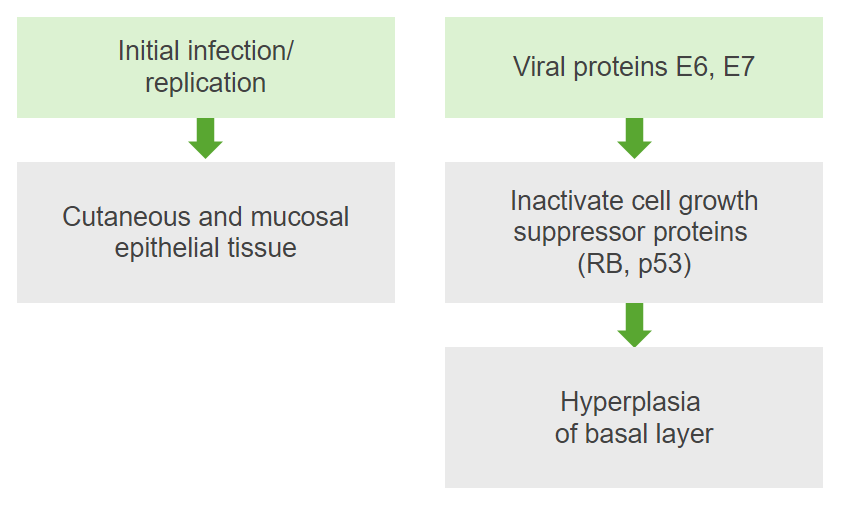
  • O vírus entra no epitélio através da rutura da pele ou mucosa.
  • Infeta as células epiteliais basais → pode entrar na fase latente
  • O ADN viral pode:
    • Integrar no genoma do hospedeiro
      • A integração perturba frequentemente o gene Gene A category of nucleic acid sequences that function as units of heredity and which code for the basic instructions for the development, reproduction, and maintenance of organisms. Basic Terms of Genetics E2 e regula positivamente Eg/E7.
    • Permanecer como um epissoma independente
  • As proteínas virais oncogénicas (E6 e E7):
    • E6 promove a degradação do supressor tumoral p53
    • O E7 liga-se e inativa a proteína retinoblastoma Retinoblastoma Retinoblastoma is a rare tumor but the most common primary intraocular malignancy of childhood. It is believed that the condition arises from a neuronal progenitor cell. Retinoblastoma can be heritable or non-heritable. Retinoblastoma ( Rb RB Chlamydia), levando a:
      • Proliferação de células epiteliais basais → verrugas
      • ↓ Capacidade de manter células com ADN danificado na fase G1 e ↓ capacidade de iniciar apoptose → propensão para mais MAIS Androgen Insensitivity Syndrome mutações → ↑ probabilidade de neoplasia
    • A progressão para malignidade requer alterações genéticas ou imunológicas adicionais no hospedeiro, tais como mutação do p53 ou desregulação das citocinas (e.g., perda da inibição do IFN-α ou TGF-β).
    • A imunossupressão está associada a ↑ infeções por HPV HPV Human papillomavirus (HPV) is a nonenveloped, circular, double-stranded DNA virus belonging to the Papillomaviridae family. Humans are the only reservoir, and transmission occurs through close skin-to-skin or sexual contact. Human papillomaviruses infect basal epithelial cells and can affect cell-regulatory proteins to result in cell proliferation. Papillomavirus (HPV) de alto risco e malignidades relacionadas.
Fisiopatologia da infecção pelo papilomavírus humano

Diagrama que resume a fisiopatologia de uma infeção pelo papilomavírus humano

Imagem por Lecturio. Licença: CC BY-NC-SA 4.0

Doenças Causadas pelo HPV

Tabela: Doenças causadas pelo HPV HPV Human papillomavirus (HPV) is a nonenveloped, circular, double-stranded DNA virus belonging to the Papillomaviridae family. Humans are the only reservoir, and transmission occurs through close skin-to-skin or sexual contact. Human papillomaviruses infect basal epithelial cells and can affect cell-regulatory proteins to result in cell proliferation. Papillomavirus (HPV)
Genótipos mais MAIS Androgen Insensitivity Syndrome relevantes Doença Características clínicas
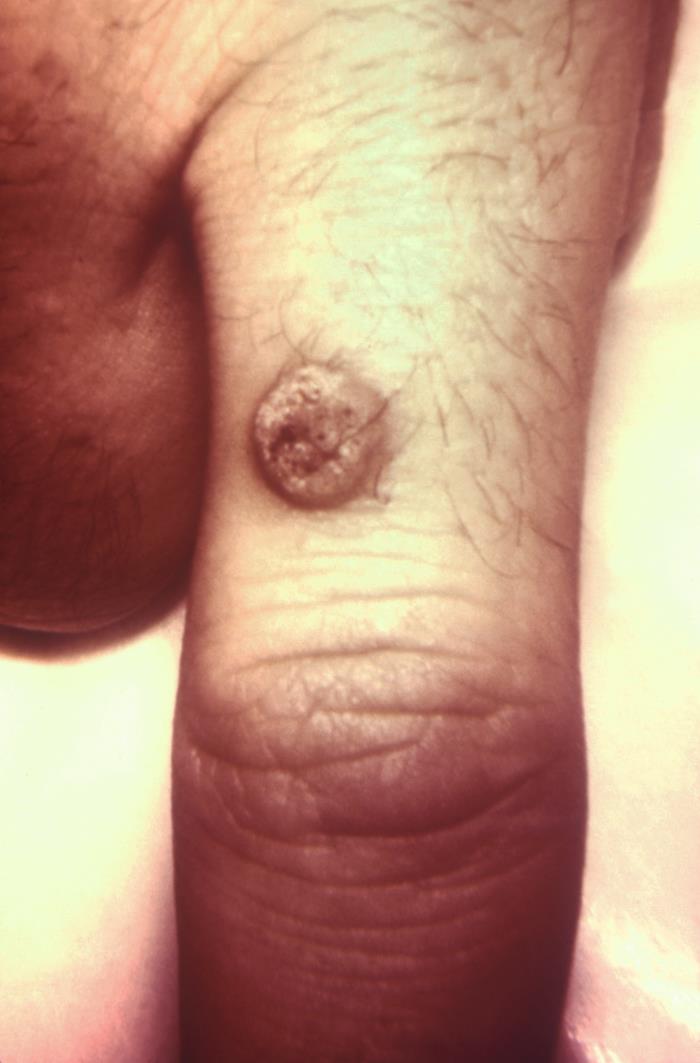
1, 2, 3, 4, 10, 27, 57 Verrugas cutâneas:
  • Comum
  • Plantar
  • Plana
  • Condição benigna
  • Pápulas macias, de cor bronzeada, semelhantes à couve-flor
  • Geralmente nas mãos e pés
  • Pode ser única ou agrupadas
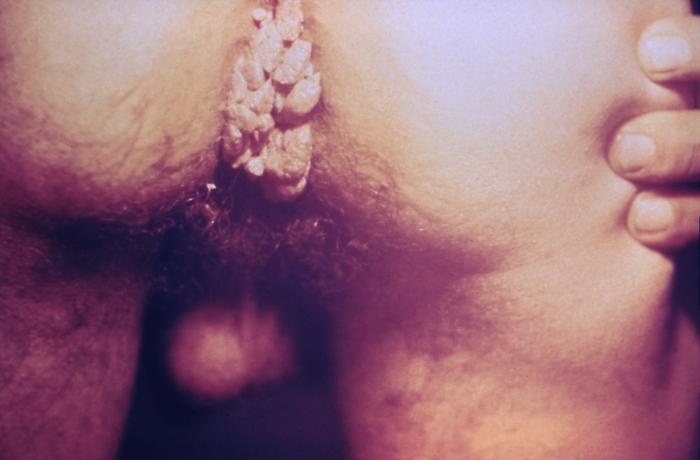
6 e 11 Verrugas anogenitais (condiloma acuminado)
  • Lesões exofíticas benignas
  • Localizadas nos genitais externos e região perianal
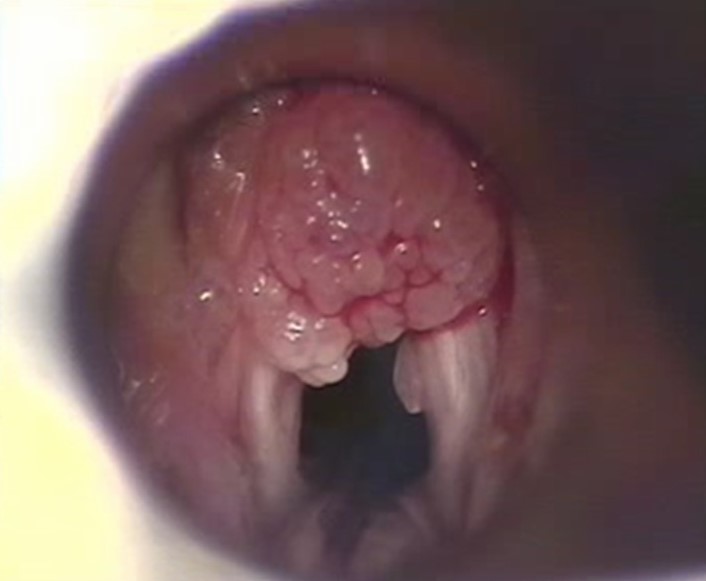
Papilomatose laríngea
  • Tumores benignos da laringe
  • Pode levar à obstrução das vias aéreas
16 e 18
(31, 33, 45, 52 e 58 em indivíduos imunocomprometidos)
Neoplasia:
  • Cancro do colo do útero
  • Cancro da vulva Vulva The vulva is the external genitalia of the female and includes the mons pubis, labia majora, labia minora, clitoris, vestibule, vestibular bulb, and greater vestibular glands. Vagina, Vulva, and Pelvic Floor: Anatomy e vagina Vagina The vagina is the female genital canal, extending from the vulva externally to the cervix uteri internally. The structures have sexual, reproductive, and urinary functions and a rich blood supply, mainly arising from the internal iliac artery. Vagina, Vulva, and Pelvic Floor: Anatomy
  • Cancro do pénis
  • Cancro anal
  • Cancro da orofaringe
  • As mutações nas células da mucosa levam à displasia.
  • Progressão para carcinoma in situ e carcinoma invasivo

Comparações de Vírus de DNA Semelhantes

A tabela a seguir compara 2 vírus de DNA DNA A deoxyribonucleotide polymer that is the primary genetic material of all cells. Eukaryotic and prokaryotic organisms normally contain DNA in a double-stranded state, yet several important biological processes transiently involve single-stranded regions. DNA, which consists of a polysugar-phosphate backbone possessing projections of purines (adenine and guanine) and pyrimidines (thymine and cytosine), forms a double helix that is held together by hydrogen bonds between these purines and pyrimidines (adenine to thymine and guanine to cytosine). DNA Types and Structure de fita dupla clinicamente semelhantes:

Microorganismo Vírus do papiloma humano Vírus herpes simplex Herpes Simplex A group of acute infections caused by herpes simplex virus type 1 or type 2 that is characterized by the development of one or more small fluid-filled vesicles with a raised erythematous base on the skin or mucous membrane. It occurs as a primary infection or recurs due to a reactivation of a latent infection. Congenital TORCH Infections
Características
  • Sem envelope Envelope Bilayer lipid membrane acquired by viral particles during viral morphogenesis. Although the lipids of the viral envelope are host derived, various virus-encoded integral membrane proteins, i.e. Viral envelope proteins are incorporated there. Virology
  • Circular
  • DNA DNA A deoxyribonucleotide polymer that is the primary genetic material of all cells. Eukaryotic and prokaryotic organisms normally contain DNA in a double-stranded state, yet several important biological processes transiently involve single-stranded regions. DNA, which consists of a polysugar-phosphate backbone possessing projections of purines (adenine and guanine) and pyrimidines (thymine and cytosine), forms a double helix that is held together by hydrogen bonds between these purines and pyrimidines (adenine to thymine and guanine to cytosine). DNA Types and Structure de cadeia dupla
  • > 200 genótipos
  • Envelope Envelope Bilayer lipid membrane acquired by viral particles during viral morphogenesis. Although the lipids of the viral envelope are host derived, various virus-encoded integral membrane proteins, i.e. Viral envelope proteins are incorporated there. Virology
  • Linear
  • DNA DNA A deoxyribonucleotide polymer that is the primary genetic material of all cells. Eukaryotic and prokaryotic organisms normally contain DNA in a double-stranded state, yet several important biological processes transiently involve single-stranded regions. DNA, which consists of a polysugar-phosphate backbone possessing projections of purines (adenine and guanine) and pyrimidines (thymine and cytosine), forms a double helix that is held together by hydrogen bonds between these purines and pyrimidines (adenine to thymine and guanine to cytosine). DNA Types and Structure de cadeia dupla
  • 2 genótipos
Transmissão
  • Contacto direto com a pele
  • Atividade sexual
  • Contacto com a saliva Saliva The clear, viscous fluid secreted by the salivary glands and mucous glands of the mouth. It contains mucins, water, organic salts, and ptyalin. Salivary Glands: Anatomy
  • Contacto com lesões
Clínica
  • Verrugas cutâneas
  • Verrugas anogenitais
  • Neoplasias
  • Gengivoestomatite
  • Herpes genital
  • Panarício herpético
  • Proctite
  • Hepatite
  • Esofagite
  • Encefalite e meningite assética
  • Pneumonia Pneumonia Pneumonia or pulmonary inflammation is an acute or chronic inflammation of lung tissue. Causes include infection with bacteria, viruses, or fungi. In more rare cases, pneumonia can also be caused through toxic triggers through inhalation of toxic substances, immunological processes, or in the course of radiotherapy. Pneumonia
Diagnóstico
  • Clínico
  • Biópsia
  • Teste de DNA DNA A deoxyribonucleotide polymer that is the primary genetic material of all cells. Eukaryotic and prokaryotic organisms normally contain DNA in a double-stranded state, yet several important biological processes transiently involve single-stranded regions. DNA, which consists of a polysugar-phosphate backbone possessing projections of purines (adenine and guanine) and pyrimidines (thymine and cytosine), forms a double helix that is held together by hydrogen bonds between these purines and pyrimidines (adenine to thymine and guanine to cytosine). DNA Types and Structure do HPV HPV Human papillomavirus (HPV) is a nonenveloped, circular, double-stranded DNA virus belonging to the Papillomaviridae family. Humans are the only reservoir, and transmission occurs through close skin-to-skin or sexual contact. Human papillomaviruses infect basal epithelial cells and can affect cell-regulatory proteins to result in cell proliferation. Papillomavirus (HPV)
  • Clínico
  • PCR PCR Polymerase chain reaction (PCR) is a technique that amplifies DNA fragments exponentially for analysis. The process is highly specific, allowing for the targeting of specific genomic sequences, even with minuscule sample amounts. The PCR cycles multiple times through 3 phases: denaturation of the template DNA, annealing of a specific primer to the individual DNA strands, and synthesis/elongation of new DNA molecules. Polymerase Chain Reaction (PCR) – reação em cadeia da polimerase
  • Cultura viral
  • Biópsia
  • Teste de anticorpos

Referências

  1. Nunes, E.M., Talpe-Nunes, V., Sichero, L. (2018) Epidemiology and biology of cutaneous human papillomavirus. Clinics (Sao Paulo); 73(suppl 1):e489s. https://www.ncbi.nlm.nih.gov/pmc/articles/PMC6097087/
  2. Araldi, R.P., Sant’Ana, T.A., Módolo, D.G., de Melo, T.C., Spadacci-Morena, D.D., de Cassia Stocco, R., Cerutti, J.M., de Souza, E.B. (2018). The human papillomavirus (HPV)-related cancer biology: An overview. Biomed Pharmacother. 106, 1537-1556. https://pubmed.ncbi.nlm.nih.gov/30119229/
  3. Van Dyne, E.A., Henley, S.J., Saraiya, M., Thomas, C.C., Markowitz, L.E., Benard, V.B. (2018). Trends in human papillomavirus-associated cancers – United States, 1999-2015. MMWR Morb Mortal Wkly Rep. 67(33), 918-924. https://www.ncbi.nlm.nih.gov/pmc/articles/PMC6107321/
  4. Arrossi, S., Temin, S., Garland, S., Eckert, L.O., Bhatla, N., Castellsagué, X., Alkaff, S.E., Felder, T., Hammouda, D., Konno, R., Lopes, G., Mugisha, E., Murillo, R., Scarinci, I.C., Stanley, M., Tsu, V., Wheeler, C.M., Adewole, I.F., de Sanjosé, S. (2017). Primary Prevention of Cervical Cancer: American Society of Clinical Oncology Resource-Stratified Guideline. J Glob Oncol. 3(5), 611-634. https://www.ncbi.nlm.nih.gov/pmc/articles/PMC5646902/
  5. Khan, M.J., Castle, P.E., Lorincz, A.T., Wacholder, S., Sherman, M., Scott, D.R., Rush, B.B., Glass, A.G., Schiffman, M. (2005) The elevated 10-year risk of cervical precancer and cancer in women with human papillomavirus (HPV) type 16 or 18 and the possible utility of type-specific HPV testing in clinical practice. J Natl Cancer Inst. 97(14), 1072-1079. https://pubmed.ncbi.nlm.nih.gov/16030305/
  6. Palefsky, J.M. (2020). Human papillomavirus infections: Epidemiology and disease associations. In Bloom, A. (Ed.), UpToDate. Retrieved May 25, 2021, from https://www.uptodate.com/contents/human-papillomavirus-infections-epidemiology-and-disease-associations
  7. Palefsky, J.M. (2019). Virology of human papillomavirus infections and the link to cancer. In Bloom, A. (Ed.), UpToDate. Retrieved May 25, 2021, from https://www.uptodate.com/contents/virology-of-human-papillomavirus-infections-and-the-link-to-cancer
  8. Morris, S.R. (2020). Human papillomavirus (HPV) infection. [online] MSD Manual Professional Version. Retrieved May 25, 2021, from https://www.msdmanuals.com/professional/infectious-diseases/sexually-transmitted-diseases-stds/human-papillomavirus-hpv-infection
  9. Luria, L., Cardoza-Favarato, G. (2021). Human papillomavirus. [online] StatPearls. Retrieved May 25, 2021, from https://www.ncbi.nlm.nih.gov/books/NBK448132/
  10. Gearhart, P.A., Randall, T.C., Buckley, Jr., R.M., Higgins, R.V. (2020). Human papillomavirus (HPV). In Chandrasekar, P.H. (Ed.), Medscape. Retrieved May 25, 2021, from https://emedicine.medscape.com/article/219110-overview

Crie sua conta gratuita ou faça login para continuar lendo!

Cadastre-se agora e tenha acesso grátis ao Lecturio, com páginas de conceitos, vídeos de medicina e questões para sua educação médica.

Aprende mais com a Lecturio:

Multiple devices displaying human anatomy and health education content.

Complementa o teu estudo da faculdade com o companheiro de estudo tudo-em-um da Lecturio, através de métodos de ensino baseados em evidência.

Estuda onde quiseres

Two iPhones display medical education apps, one showing anatomy, the other Bookmatcher.

A Lecturio Medical complementa o teu estudo através de métodos de ensino baseados em evidência, vídeos de palestras, perguntas e muito mais – tudo combinado num só lugar e fácil de usar.

User Reviews

Have a holly, jolly study session 🎁 Save 50% on all plans now >>

Que tengas una sesión de estudio alegre y navideña 🎁 Ahorra 50% en todos los planes >>

Details