



Hipogonadismo

No hipogonadismo existe uma redução ou ausência de produção de hormonas sexuais, pelos testículos ou ovários. A falência pode ser primária (hipergonadotrófico) ou secundária (hipogonadotrófico). O hipogonadismo hipergonadotrófico ocorre quando as gónadas não conseguem produzir hormonas sexuais, e o hipogonadismo hipogonadotrófico resulta da falência no eixo hipotálamo-hipófise-gonadal. Os sintomas incluem infertilidade, aumento do risco de osteoporose, disfunção erétil, diminuição da libido e regressão (ou ausência) dos carateres sexuais secundários. O diagnóstico é sugerido pela história clínica, exame objetivo, medição dos níveis hormonais e procura da etiologia subjacente. O  tratamento baseia-se na reposição hormonal.

Last updated: Dec 15, 2025

Editorial responsibility: Stanley Oiseth, Lindsay Jones, Evelin Maza

Descrição Geral

Definição

O hipogonadismo é uma patologia na qual há uma diminuição da produção de hormonas sexuais pelos testículos ou ovários.
Etiologia

  • Hipogonadismo hipergonadotrófico (hipogonadismo primário) em homens:
    • Síndrome de Klinefelter
    • Criptorquidia
    • Tratamento prévio com quimio ou radioterapia
    • Anorquia bilateral congénita
    • Trauma testicular
    • Gonadectomia
    • Defeitos na determinação testicular: disgenesia gonadal
    • Síndrome de só células de Sertoli
    • Resistência à hormona luteinizante ( LH LH A major gonadotropin secreted by the adenohypophysis. Luteinizing hormone regulates steroid production by the interstitial cells of the testis and the ovary. The preovulatory luteinizing hormone surge in females induces ovulation, and subsequent luteinization of the follicle. Luteinizing hormone consists of two noncovalently linked subunits, alpha and beta. Within a species, the alpha subunit is common in the three pituitary glycoprotein hormones (TSH, LH, and FSH), but the beta subunit is unique and confers its biological specificity. Menstrual Cycle, pela sigla em inglês)
    • Vírus da parotidite epidémica
    • Perturbações da síntese de andrógenos:
      • Défice de 17β-hidroxilase desidrogenase
      • Défice de 5α-redutase
      • Défice de 17-hidroxilase
  • Hipogonadismo hipergonadotrófico (hipogonadismo primário) em mulheres:
    • Síndrome de Turner
    • Disgenesia gonadal XX e XY
    • Insuficiência ovárica prematura
    • Ooforite autoimune
    • Galactosemia Galactosemia Galactosemia is a disorder caused by defects in galactose metabolism. Galactosemia is an inherited, autosomal-recessive condition, which results in inadequate galactose processing and high blood levels of monosaccharide. The rare disorder often presents in infants with symptoms of lethargy, nausea, vomiting, diarrhea, and jaundice. Galactosemia
    • Mutações no gene Gene A category of nucleic acid sequences that function as units of heredity and which code for the basic instructions for the development, reproduction, and maintenance of organisms. Basic Terms of Genetics do recetor da hormona folículo-estimulante ( FSH FSH A major gonadotropin secreted by the adenohypophysis. Follicle-stimulating hormone stimulates gametogenesis and the supporting cells such as the ovarian granulosa cells, the testicular sertoli cells, and leydig cells. Fsh consists of two noncovalently linked subunits, alpha and beta. Within a species, the alpha subunit is common in the three pituitary glycoprotein hormones (TSH, LH, and FSH), but the beta subunit is unique and confers its biological specificity. Menstrual Cycle, pela sigla em inglês)
    • Resistência à LH LH A major gonadotropin secreted by the adenohypophysis. Luteinizing hormone regulates steroid production by the interstitial cells of the testis and the ovary. The preovulatory luteinizing hormone surge in females induces ovulation, and subsequent luteinization of the follicle. Luteinizing hormone consists of two noncovalently linked subunits, alpha and beta. Within a species, the alpha subunit is common in the three pituitary glycoprotein hormones (TSH, LH, and FSH), but the beta subunit is unique and confers its biological specificity. Menstrual Cycle ou hCG
    • Síndrome de Noonan
    • Tratamento prévio com quimio ou radioterapia
  • Hipogonadismo hipogonadotrófico (hipogonadismo secundário): alteração no eixo hormonal do hipotálamo ou da hipófise
    • Sarcoidose
    • Hemocromatose
    • Tuberculose
    • Fármacos:
      • Opioides analgésicos
      • Glucocorticoides
      • Leuprolida
    • Tumores hipotalâmicos ou hipofisários (adenoma hipofisário)
    • Patologias congénitas:
      • Síndrome de Kallmann
      • Síndrome de Prader-Willi
      • Síndrome de Angelman
      • Doença de Gaucher
    • Outras patologias:
      • Perturbações do comportamento alimentar
      • Hipogonadismo induzido pelo exercício
      • Hiperprolactinemia
      • Síndrome de Cushing
      • VIH/ SIDA
      • Obesidade mórbida
      • Diabetes Diabetes Diabetes mellitus (DM) is a metabolic disease characterized by hyperglycemia and dysfunction of the regulation of glucose metabolism by insulin. Type 1 DM is diagnosed mostly in children and young adults as the result of autoimmune destruction of β cells in the pancreas and the resulting lack of insulin. Type 2 DM has a significant association with obesity and is characterized by insulin resistance. Diabetes Mellitus mellitus tipo 2

Epidemiologia

  • O hipogonadismo pode ocorrer em qualquer idade.
  • Muitas vezes subdiagnosticado
  • Hipogonadismo primário:
    • A causa mais MAIS Androgen Insensitivity Syndrome comum em mulheres é a síndrome de Turner (incidência: 1 em 2.000-2.500 nados-vivos).
    • A causa mais MAIS Androgen Insensitivity Syndrome comum em homens é a síndrome de Klinefelter (incidência: 1 em 600 nados-vivos do sexo masculino).
    • Homens > mulheres (uma vez que a incidência da síndrome de Klinefelter > incidência da síndrome de Turner)
  • Hipogonadismo secundário:
    • Menos comum que o hipogonadismo primário
    • Incidência: 1 em 10.000–86.000 pessoas
    • Homens = mulheres
    • Em aproximadamente ⅔ dos casos congénitos, a causa é a síndrome de Kallmann.

Fisiopatologia

Fisiologia normal

  • As gónadas fazem parte do eixo hipotálamo-hipófise-gonadal, que atua com mecanismos de feedback negativo:
    • Um gerador de pulsos hipotalâmico localizado no núcleo arqueado → liberta a hormona libertadora de gonadotrofinas (GnRH, pela sigla em inglês) no sistema portal hipotalâmico-hipofisário
    • A hipófise anterior secreta FSH FSH A major gonadotropin secreted by the adenohypophysis. Follicle-stimulating hormone stimulates gametogenesis and the supporting cells such as the ovarian granulosa cells, the testicular sertoli cells, and leydig cells. Fsh consists of two noncovalently linked subunits, alpha and beta. Within a species, the alpha subunit is common in the three pituitary glycoprotein hormones (TSH, LH, and FSH), but the beta subunit is unique and confers its biological specificity. Menstrual Cycle e LH LH A major gonadotropin secreted by the adenohypophysis. Luteinizing hormone regulates steroid production by the interstitial cells of the testis and the ovary. The preovulatory luteinizing hormone surge in females induces ovulation, and subsequent luteinization of the follicle. Luteinizing hormone consists of two noncovalently linked subunits, alpha and beta. Within a species, the alpha subunit is common in the three pituitary glycoprotein hormones (TSH, LH, and FSH), but the beta subunit is unique and confers its biological specificity. Menstrual Cycle → estimula a atividade gonadal → produção das hormonas sexuais (por exemplo, testosterona, estrogénio)
    • ↑ Hormonas gonadais → ↓ Secreção de FSH FSH A major gonadotropin secreted by the adenohypophysis. Follicle-stimulating hormone stimulates gametogenesis and the supporting cells such as the ovarian granulosa cells, the testicular sertoli cells, and leydig cells. Fsh consists of two noncovalently linked subunits, alpha and beta. Within a species, the alpha subunit is common in the three pituitary glycoprotein hormones (TSH, LH, and FSH), but the beta subunit is unique and confers its biological specificity. Menstrual Cycle e LH LH A major gonadotropin secreted by the adenohypophysis. Luteinizing hormone regulates steroid production by the interstitial cells of the testis and the ovary. The preovulatory luteinizing hormone surge in females induces ovulation, and subsequent luteinization of the follicle. Luteinizing hormone consists of two noncovalently linked subunits, alpha and beta. Within a species, the alpha subunit is common in the three pituitary glycoprotein hormones (TSH, LH, and FSH), but the beta subunit is unique and confers its biological specificity. Menstrual Cycle ao nível da hipófise → completa-se um ciclo de feedback
  • Nos homens (testículos):
    • LH LH A major gonadotropin secreted by the adenohypophysis. Luteinizing hormone regulates steroid production by the interstitial cells of the testis and the ovary. The preovulatory luteinizing hormone surge in females induces ovulation, and subsequent luteinization of the follicle. Luteinizing hormone consists of two noncovalently linked subunits, alpha and beta. Within a species, the alpha subunit is common in the three pituitary glycoprotein hormones (TSH, LH, and FSH), but the beta subunit is unique and confers its biological specificity. Menstrual Cycle → As células de Leydig secretam testosterona.
    • FSH FSH A major gonadotropin secreted by the adenohypophysis. Follicle-stimulating hormone stimulates gametogenesis and the supporting cells such as the ovarian granulosa cells, the testicular sertoli cells, and leydig cells. Fsh consists of two noncovalently linked subunits, alpha and beta. Within a species, the alpha subunit is common in the three pituitary glycoprotein hormones (TSH, LH, and FSH), but the beta subunit is unique and confers its biological specificity. Menstrual Cycle → Crescimento tubular
  • Nas mulheres (ovários):
    • LH LH A major gonadotropin secreted by the adenohypophysis. Luteinizing hormone regulates steroid production by the interstitial cells of the testis and the ovary. The preovulatory luteinizing hormone surge in females induces ovulation, and subsequent luteinization of the follicle. Luteinizing hormone consists of two noncovalently linked subunits, alpha and beta. Within a species, the alpha subunit is common in the three pituitary glycoprotein hormones (TSH, LH, and FSH), but the beta subunit is unique and confers its biological specificity. Menstrual Cycle → Células da teca e intersticiais → produzem progestogénios e androgénios
    • FSH FSH A major gonadotropin secreted by the adenohypophysis. Follicle-stimulating hormone stimulates gametogenesis and the supporting cells such as the ovarian granulosa cells, the testicular sertoli cells, and leydig cells. Fsh consists of two noncovalently linked subunits, alpha and beta. Within a species, the alpha subunit is common in the three pituitary glycoprotein hormones (TSH, LH, and FSH), but the beta subunit is unique and confers its biological specificity. Menstrual Cycle → Células da granulosa → esteroides precursores de estrogénio
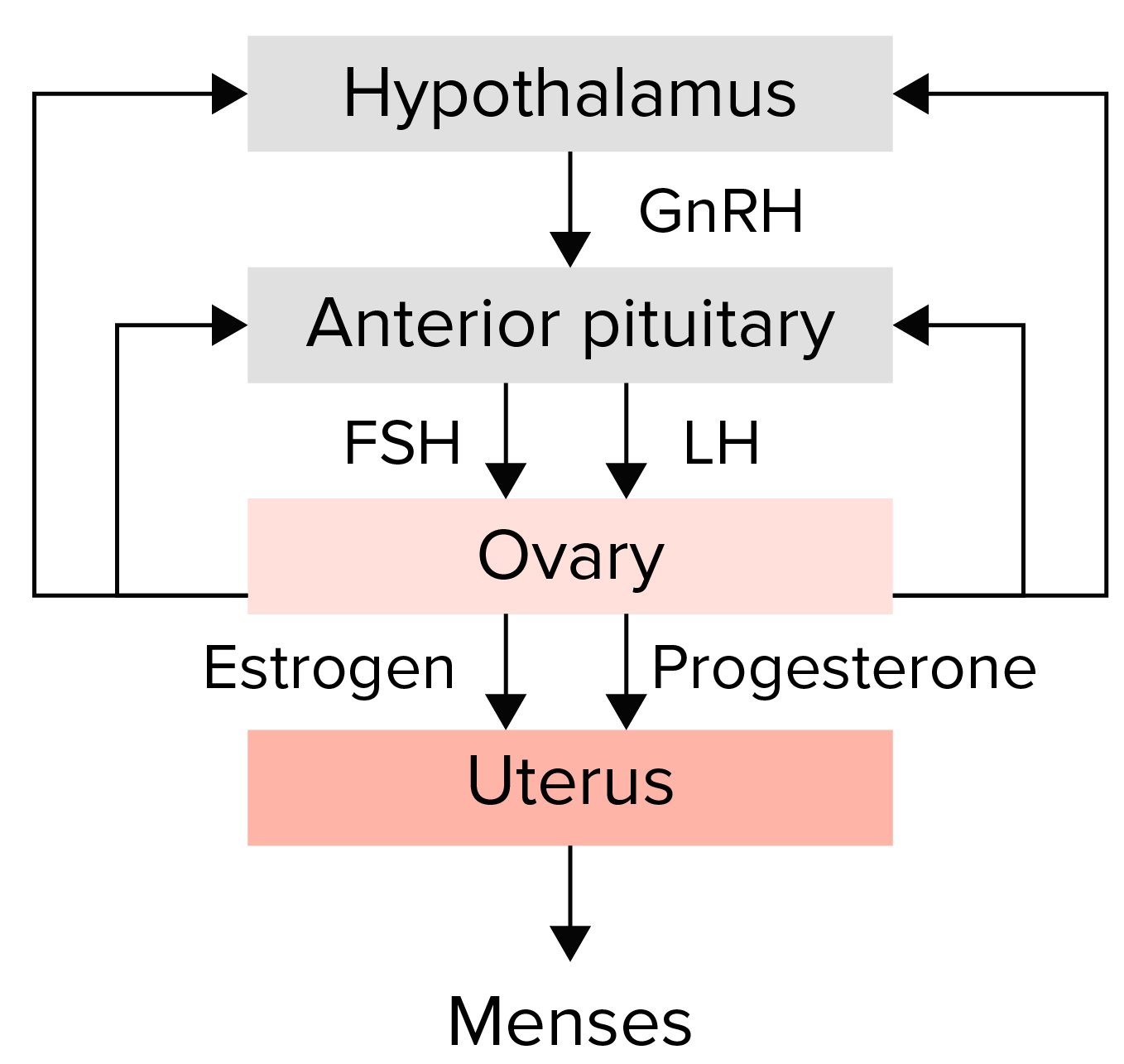
Resumo do eixo hipotálamo-hipófise-ovariano

Resumo do eixo hipotálamo-hipófise-ovário:
O hipotálamo secreta a hormona libertadora de gonadotrofinas (GNRH, pela sigla em inglês), que estimula a hipófise anterior a libertar as gonadotrofinas: hormona folículo-estimulante (FSH, pela sigla em inglês) e a hormona luteinizante (LH, pela sigla em inglês). As gonadotrofinas estimulam o ovário a produzir estrogénio e progesterona, que, por sua vez, levam ao crescimento e maturação endometrial. Qualquer alteração neste eixo pode levar a amenorreia.

Imagem por Lecturio. Licença: CC BY-NC-SA 4.0

Hipogonadismo

O hipogonadismo resulta de uma alteração no eixo hipotálamo-hipófise-gonadal a qualquer nível.
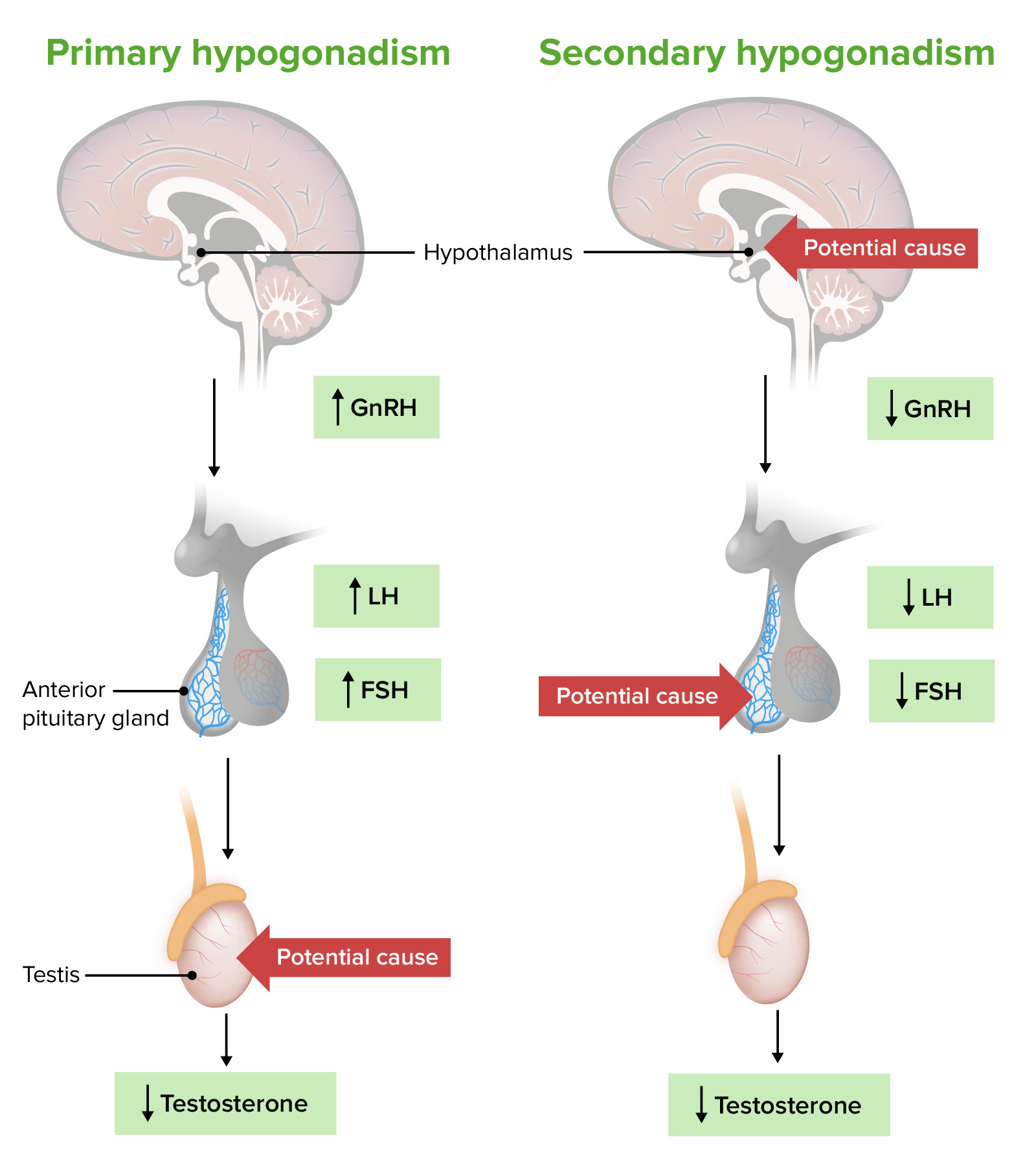
  • Primário (hipogonadismo hipergonadotrófico):
    • A gónada não produz uma quantidade de esteroides sexuais suficientes para suprimir a LH LH A major gonadotropin secreted by the adenohypophysis. Luteinizing hormone regulates steroid production by the interstitial cells of the testis and the ovary. The preovulatory luteinizing hormone surge in females induces ovulation, and subsequent luteinization of the follicle. Luteinizing hormone consists of two noncovalently linked subunits, alpha and beta. Within a species, the alpha subunit is common in the three pituitary glycoprotein hormones (TSH, LH, and FSH), but the beta subunit is unique and confers its biological specificity. Menstrual Cycle e FSH FSH A major gonadotropin secreted by the adenohypophysis. Follicle-stimulating hormone stimulates gametogenesis and the supporting cells such as the ovarian granulosa cells, the testicular sertoli cells, and leydig cells. Fsh consists of two noncovalently linked subunits, alpha and beta. Within a species, the alpha subunit is common in the three pituitary glycoprotein hormones (TSH, LH, and FSH), but the beta subunit is unique and confers its biological specificity. Menstrual Cycle.
    • Níveis hormonais: ↑ LH LH A major gonadotropin secreted by the adenohypophysis. Luteinizing hormone regulates steroid production by the interstitial cells of the testis and the ovary. The preovulatory luteinizing hormone surge in females induces ovulation, and subsequent luteinization of the follicle. Luteinizing hormone consists of two noncovalently linked subunits, alpha and beta. Within a species, the alpha subunit is common in the three pituitary glycoprotein hormones (TSH, LH, and FSH), but the beta subunit is unique and confers its biological specificity. Menstrual Cycle e FSH FSH A major gonadotropin secreted by the adenohypophysis. Follicle-stimulating hormone stimulates gametogenesis and the supporting cells such as the ovarian granulosa cells, the testicular sertoli cells, and leydig cells. Fsh consists of two noncovalently linked subunits, alpha and beta. Within a species, the alpha subunit is common in the three pituitary glycoprotein hormones (TSH, LH, and FSH), but the beta subunit is unique and confers its biological specificity. Menstrual Cycle (devido à ausência de feedback), ↓ hormonas sexuais
  • Secundário (hipogonadismo hipogonadotrófico):
    • Ocorre a partir de:
      • Falha no gerador de pulsos de GnRH hipotalâmico
      • Incapacidade da hipófise de responder com a secreção de LH LH A major gonadotropin secreted by the adenohypophysis. Luteinizing hormone regulates steroid production by the interstitial cells of the testis and the ovary. The preovulatory luteinizing hormone surge in females induces ovulation, and subsequent luteinization of the follicle. Luteinizing hormone consists of two noncovalently linked subunits, alpha and beta. Within a species, the alpha subunit is common in the three pituitary glycoprotein hormones (TSH, LH, and FSH), but the beta subunit is unique and confers its biological specificity. Menstrual Cycle e FSH FSH A major gonadotropin secreted by the adenohypophysis. Follicle-stimulating hormone stimulates gametogenesis and the supporting cells such as the ovarian granulosa cells, the testicular sertoli cells, and leydig cells. Fsh consists of two noncovalently linked subunits, alpha and beta. Within a species, the alpha subunit is common in the three pituitary glycoprotein hormones (TSH, LH, and FSH), but the beta subunit is unique and confers its biological specificity. Menstrual Cycle
    • Níveis hormonais: ↓ GnRH, LH LH A major gonadotropin secreted by the adenohypophysis. Luteinizing hormone regulates steroid production by the interstitial cells of the testis and the ovary. The preovulatory luteinizing hormone surge in females induces ovulation, and subsequent luteinization of the follicle. Luteinizing hormone consists of two noncovalently linked subunits, alpha and beta. Within a species, the alpha subunit is common in the three pituitary glycoprotein hormones (TSH, LH, and FSH), but the beta subunit is unique and confers its biological specificity. Menstrual Cycle, FSH FSH A major gonadotropin secreted by the adenohypophysis. Follicle-stimulating hormone stimulates gametogenesis and the supporting cells such as the ovarian granulosa cells, the testicular sertoli cells, and leydig cells. Fsh consists of two noncovalently linked subunits, alpha and beta. Within a species, the alpha subunit is common in the three pituitary glycoprotein hormones (TSH, LH, and FSH), but the beta subunit is unique and confers its biological specificity. Menstrual Cycle e hormonas sexuais
    • Causado mais MAIS Androgen Insensitivity Syndrome frequentemente por malformações no desenvolvimento da hipófise ou por lesões adquiridas.
Patogênese do hipogonadismo primário versus secundário

Patogénese do hipogonadismo primário versus secundário:
O hipogonadismo primário advém de uma alteração localizada nos testículos (ou ovários), resultando na diminuição da produção de hormonas sexuais, apesar dos níveis adequados (ou elevados) de hormona libertadora de gonadotrofinas (GnRH, pela sigla em inglês), hormona luteinizante (LH, pela sigla em inglês) e hormona folículo-estimulante (FSH, pela sigla em inglês).
No hipogonadismo secundário, uma alteração no hipotálamo ou na hipófise resulta na diminuição de GnRH, LH e FSH, com baixa produção de hormonas sexuais (apesar dos testículos ou ovários serem normais).

Imagem por Lecturio. Licença: CC BY-NC-SA 4.0

Related videos

Apresentação Clínica

A clínica varia consoante a idade à apresentação e o sexo.

Apresentação clínica nos homens

  • Homens pré-púberes:
    • Eunucoidismo
    • Pelos do corpo esparsos
    • Ausência ou regressão dos carateres sexuais secundários
    • Ausência de diminuição da tonalidade vocal
    • Pouco desenvolvimento da massa muscular
    • Atraso no encerramento das epífises → braços e pernas longos
  • Homens pós-púberes:
    • Falta de energia
    • ↓ Libido
    • Disfunção erétil
    • Depressão
    • ↓ Massa muscular
    • ↓ Pelos corporais
    • ↓ Massa óssea
    • Ginecomastia ( mais MAIS Androgen Insensitivity Syndrome frequente no hipogonadismo primário)
    • Infertilidade (↓ contagem de espermatozoides)

Apresentação clínica nas mulheres

  • Mulheres pré-púberes:
    • Ausência de desenvolvimento pubertário adequado
    • Ausência ou regressão dos carateres sexuais secundários
    • Amenorreia primária
  • Mulheres pós-púberes:
    • Amenorreia secundária
    • Infertilidade
    • Fadiga
    • ↓ Libido

Diagnóstico e Tratamento

Avaliação laboratorial

Homens:

  • Avaliação inicial:
    • ↓ Testosterona sérica:
      • Horário ideal: manhã (devido à variação diurna)
      • Se anormal, deve ser medida novamente em 1-2 ocasiões diferentes.
    • Os níveis de FSH FSH A major gonadotropin secreted by the adenohypophysis. Follicle-stimulating hormone stimulates gametogenesis and the supporting cells such as the ovarian granulosa cells, the testicular sertoli cells, and leydig cells. Fsh consists of two noncovalently linked subunits, alpha and beta. Within a species, the alpha subunit is common in the three pituitary glycoprotein hormones (TSH, LH, and FSH), but the beta subunit is unique and confers its biological specificity. Menstrual Cycle e LH LH A major gonadotropin secreted by the adenohypophysis. Luteinizing hormone regulates steroid production by the interstitial cells of the testis and the ovary. The preovulatory luteinizing hormone surge in females induces ovulation, and subsequent luteinization of the follicle. Luteinizing hormone consists of two noncovalently linked subunits, alpha and beta. Within a species, the alpha subunit is common in the three pituitary glycoprotein hormones (TSH, LH, and FSH), but the beta subunit is unique and confers its biological specificity. Menstrual Cycle permitem diferenciar entre hipogonadismo primário e secundário:
      • Elevados: hipogonadismo primário
      • Diminuídos: hipogonadismo secundário
  • Se a suspeita for de hipogonadismo primário:
    • A etiologia é conhecida (por exemplo, quimioterapia, história de orquite por parotidite epidémica)?
    • Se não → análise de cariótipo
  • Se a suspeita for de hipogonadismo secundário:
  • Avaliação da fertilidade: análise do sémen

Mulheres:

  • Começar sempre com um teste de gravidez urinário ou um teste qualitativo da hCG para descartar uma gravidez.
  • FSH FSH A major gonadotropin secreted by the adenohypophysis. Follicle-stimulating hormone stimulates gametogenesis and the supporting cells such as the ovarian granulosa cells, the testicular sertoli cells, and leydig cells. Fsh consists of two noncovalently linked subunits, alpha and beta. Within a species, the alpha subunit is common in the three pituitary glycoprotein hormones (TSH, LH, and FSH), but the beta subunit is unique and confers its biological specificity. Menstrual Cycle, LH LH A major gonadotropin secreted by the adenohypophysis. Luteinizing hormone regulates steroid production by the interstitial cells of the testis and the ovary. The preovulatory luteinizing hormone surge in females induces ovulation, and subsequent luteinization of the follicle. Luteinizing hormone consists of two noncovalently linked subunits, alpha and beta. Within a species, the alpha subunit is common in the three pituitary glycoprotein hormones (TSH, LH, and FSH), but the beta subunit is unique and confers its biological specificity. Menstrual Cycle e estradiol Estradiol The 17-beta-isomer of estradiol, an aromatized C18 steroid with hydroxyl group at 3-beta- and 17-beta-position. Estradiol-17-beta is the most potent form of mammalian estrogenic steroids. Noncontraceptive Estrogen and Progestins:
    • FSH FSH A major gonadotropin secreted by the adenohypophysis. Follicle-stimulating hormone stimulates gametogenesis and the supporting cells such as the ovarian granulosa cells, the testicular sertoli cells, and leydig cells. Fsh consists of two noncovalently linked subunits, alpha and beta. Within a species, the alpha subunit is common in the three pituitary glycoprotein hormones (TSH, LH, and FSH), but the beta subunit is unique and confers its biological specificity. Menstrual Cycle e LH LH A major gonadotropin secreted by the adenohypophysis. Luteinizing hormone regulates steroid production by the interstitial cells of the testis and the ovary. The preovulatory luteinizing hormone surge in females induces ovulation, and subsequent luteinization of the follicle. Luteinizing hormone consists of two noncovalently linked subunits, alpha and beta. Within a species, the alpha subunit is common in the three pituitary glycoprotein hormones (TSH, LH, and FSH), but the beta subunit is unique and confers its biological specificity. Menstrual Cycle, ↓ estradiol Estradiol The 17-beta-isomer of estradiol, an aromatized C18 steroid with hydroxyl group at 3-beta- and 17-beta-position. Estradiol-17-beta is the most potent form of mammalian estrogenic steroids. Noncontraceptive Estrogen and Progestins: hipogonadismo primário
    • FSH FSH A major gonadotropin secreted by the adenohypophysis. Follicle-stimulating hormone stimulates gametogenesis and the supporting cells such as the ovarian granulosa cells, the testicular sertoli cells, and leydig cells. Fsh consists of two noncovalently linked subunits, alpha and beta. Within a species, the alpha subunit is common in the three pituitary glycoprotein hormones (TSH, LH, and FSH), but the beta subunit is unique and confers its biological specificity. Menstrual Cycle e LH LH A major gonadotropin secreted by the adenohypophysis. Luteinizing hormone regulates steroid production by the interstitial cells of the testis and the ovary. The preovulatory luteinizing hormone surge in females induces ovulation, and subsequent luteinization of the follicle. Luteinizing hormone consists of two noncovalently linked subunits, alpha and beta. Within a species, the alpha subunit is common in the three pituitary glycoprotein hormones (TSH, LH, and FSH), but the beta subunit is unique and confers its biological specificity. Menstrual Cycle, ↓ estradiol Estradiol The 17-beta-isomer of estradiol, an aromatized C18 steroid with hydroxyl group at 3-beta- and 17-beta-position. Estradiol-17-beta is the most potent form of mammalian estrogenic steroids. Noncontraceptive Estrogen and Progestins: hipogonadismo secundário
  • A avaliação etiológica é semelhante à dos homens.

Imagiologia

  • A RMN cerebral deve ser considerada para:
    • Alterações das hormonas hipofisárias (por exemplo, hiperprolactinemia)
    • Defeitos do campo visual
    • Alterações neurológicas
  • RMN pélvica ou ecografia dos ovários em mulheres com suspeita de agenesia
  • Ecografia dos testículos na/o:
    • Suspeita de orquite por parotidite epidémica
    • Desenvolvimento anormal dos testículos

Tratamento

  • Tratamento da causa subjacente.
  • Terapêutica de reposição hormonal com os objetivos de:
    • Promover o desenvolvimento e manutenção dos carateres sexuais secundários, com uma função sexual normal
    • Promover e manter a massa óssea e muscular normal
    • Auxiliar uma adaptação psicossocial adequada
  • Nos homens: reposição de testosterona
  • Nas mulheres: reposição de estrogénio
  • A terapêutica com GnRH pulsátil promove a fertilidade no hipogonadismo hipogonadotrófico.

Relevância Clínica

  • Síndrome de Klinefelter: uma aneuploidia cromossómica caracterizada pela presença de ≥ 1 cromossoma X extra num doente com cariótipo masculino, mais MAIS Androgen Insensitivity Syndrome frequentemente 47, XXY XXY Klinefelter syndrome is a chromosomal aneuploidy characterized by the presence of 1 or more extra X chromosomes in a male karyotype, most commonly leading to karyotype 47,XXY. Klinefelter syndrome is associated with decreased levels of testosterone and is the most common cause of congenital hypogonadism. Klinefelter Syndrome. Estes doentes são altos, fenotipicamente homens, com testículos pequenos, diminuição dos pelos corporais, ginecomastia e infertilidade. O tratamento consiste numa terapêutica de reposição com testosterona para toda a vida.
  • Criptorquidia: entre as anomalias congénitas mais MAIS Androgen Insensitivity Syndrome comuns em rapazes. Normalmente, esta patologia assintomática é observada durante um exame de rotina infantil, em que 1 ou ambos os testículos não são palpáveis no escroto. Se o testículo for palpável, mas não na localização intra-escrotal da porção dependente, o tratamento consiste numa orquipexia (trazer o testículo ao escroto).
  • Adenomas hipofisários: tumores que se desenvolvem no lobo anterior da glândula hipofisária. Os adenomas não funcionantes ou não secretores não secretam hormonas, mas comprimem o tecido circundante, causando hipopituitarismo. Os adenomas secretores podem secretam várias hormonas diferentes, dependendo do tipo de célula do qual evoluíram, causando hiperpituitarismo. O diagnóstico é confirmado com exames de imagem. O tratamento depende do tipo de adenoma, mas pode incluir resseção cirúrgica, radiação e agonistas dopaminérgicos.
  • Vírus da parotidite epidémica: causada por um vírus de ARN de fita simples, linear e sentido negativo, da família Paramyxoviridae Paramyxoviridae A family of spherical viruses, of the order mononegavirales, somewhat larger than the orthomyxoviruses, and containing single-stranded RNA. Subfamilies include paramyxoviridae and pneumovirinae. Respiratory Syncytial Virus. A parotidite epidémica manifesta-se inicialmente com febre, mialgias, cefaleia, anorexia Anorexia The lack or loss of appetite accompanied by an aversion to food and the inability to eat. It is the defining characteristic of the disorder anorexia nervosa. Anorexia Nervosa, mal-estar geral e parotidite. As complicações incluem meningite, pancreatite, surdez e inflamação testicular, que pode resultar em infertilidade. A infeção é tratada com cuidados de suporte e pode ser prevenida por vacinação.
  • Síndrome de Turner: uma condição genética que afeta as mulheres, na qual um cromossoma X está parcial ou completamente ausente. O resultado clássico é um cariótipo 45,X0 com fenótipo feminino. A aparência característica é com baixa estatura, pescoço alado, tórax largo, aumento do espaçamento dos mamilos, amenorreia e edema Edema Edema is a condition in which excess serous fluid accumulates in the body cavity or interstitial space of connective tissues. Edema is a symptom observed in several medical conditions. It can be categorized into 2 types, namely, peripheral (in the extremities) and internal (in an organ or body cavity). Edema periférico das mãos e dos pés. O teste genético confirma o diagnóstico. O tratamento consiste em terapêutica de reposição hormonal.

Referências

  1. Vogiatzi, M. (2024). Hypogonadism treatment & management. Medscape. Retrieved October 12, 2025, from https://emedicine.medscape.com/article/922038-treatment#d7
  2. Snyder, P. (2025). Clinical features and diagnosis of male hypogonadism. UpToDate. Retrieved October 12, 2025, from https://www.uptodate.com/contents/clinical-features-and-diagnosis-of-male-hypogonadism
  3. Snyder, P. (2024). Causes of primary hypogonadism in males. UpToDate. Retrieved October 12, 2025, from https://www.uptodate.com/contents/causes-of-primary-hypogonadism-in-males
  4. Snyder, P. J. (2024). Causes of secondary (hypogonadotropic) hypogonadism in males. In K. A. Martin (Ed.), UpToDate. Retrieved October 12, 2025, from https://www.uptodate.com/contents/causes-of-secondary-hypogonadotropic-hypogonadism-in-males
  5. Welt, C., Barbieri, R. (2024). Evaluation and management of primary amenorrhea. UpToDate. Retrieved October 12, 2025, from https://www.uptodate.com/contents/evaluation-and-management-of-primary-amenorrhea
  6. Welt, C., Barbieri, R. (2023). Epidemiology and causes of secondary amenorrhea. UpToDate. Retrieved October 12, 2025, from https://www.uptodate.com/contents/epidemiology-and-causes-of-secondary-amenorrhea
  7. Jimbo, M. (2025, April). Male hypogonadism. MSD Manual Professional Version. Retrieved October 12, 2025, from https://www.msdmanuals.com/professional/genitourinary-disorders/male-reproductive-endocrinology-and-related-disorders/male-hypogonadism
  8. Sizar, O., Schwartz, J. (2024). Hypogonadism. StatPearls. Retrieved October 12, 2025, from https://www.ncbi.nlm.nih.gov/books/NBK532933/

Crie sua conta gratuita ou faça login para continuar lendo!

Cadastre-se agora e tenha acesso grátis ao Lecturio, com páginas de conceitos, vídeos de medicina e questões para sua educação médica.

Aprende mais com a Lecturio:

Multiple devices displaying human anatomy and health education content.

Complementa o teu estudo da faculdade com o companheiro de estudo tudo-em-um da Lecturio, através de métodos de ensino baseados em evidência.

Estuda onde quiseres

Two iPhones display medical education apps, one showing anatomy, the other Bookmatcher.

A Lecturio Medical complementa o teu estudo através de métodos de ensino baseados em evidência, vídeos de palestras, perguntas e muito mais – tudo combinado num só lugar e fácil de usar.

User Reviews

Have a holly, jolly study session 🎁 Save 50% on all plans now >>

Que tengas una sesión de estudio alegre y navideña 🎁 Ahorra 50% en todos los planes >>

Details