A tradução é o processo de sintetizar uma proteína a partir de um transcrito de RNA mensageiro (mRNA). Este processo é dividido em três fases primárias: iniciação, alongamento e finalização. A tradução é catalisada por estruturas conhecidas como ribossomas, grandes complexos de proteínas e RNA ribossomal (rRNA). O ribossoma "lê" o mRNAmRNARNA sequences that serve as templates for protein synthesis. Bacterial mRNAs are generally primary transcripts in that they do not require post-transcriptional processing. Eukaryotic mRNA is synthesized in the nucleus and must be exported to the cytoplasm for translation. Most eukaryotic mRNAs have a sequence of polyadenylic acid at the 3' end, referred to as the poly(a) tail. The function of this tail is not known for certain, but it may play a role in the export of mature mRNA from the nucleus as well as in helping stabilize some mRNA molecules by retarding their degradation in the cytoplasm.RNA Types and Structure, e traz os RNARNAA polynucleotide consisting essentially of chains with a repeating backbone of phosphate and ribose units to which nitrogenous bases are attached. RNA is unique among biological macromolecules in that it can encode genetic information, serve as an abundant structural component of cells, and also possesses catalytic activity.RNA Types and Structure de transferência (tRNAs), cada um ligado a um aminoácido específico, na ordem correta. Estes aminoácidos são então ligados uns aos outros por um componente enzimático do ribossoma conhecido como peptidil transferase. A tradução pode ser regulada em várias etapas, inclusive através de um processo conhecido como interferência de RNARNAA polynucleotide consisting essentially of chains with a repeating backbone of phosphate and ribose units to which nitrogenous bases are attached. RNA is unique among biological macromolecules in that it can encode genetic information, serve as an abundant structural component of cells, and also possesses catalytic activity.RNA Types and Structure. Este processo envolve pequenos segmentos de RNARNAA polynucleotide consisting essentially of chains with a repeating backbone of phosphate and ribose units to which nitrogenous bases are attached. RNA is unique among biological macromolecules in that it can encode genetic information, serve as an abundant structural component of cells, and also possesses catalytic activity.RNA Types and Structure de cadeia dupla que são capazes de inibir a tradução de mRNAmRNARNA sequences that serve as templates for protein synthesis. Bacterial mRNAs are generally primary transcripts in that they do not require post-transcriptional processing. Eukaryotic mRNA is synthesized in the nucleus and must be exported to the cytoplasm for translation. Most eukaryotic mRNAs have a sequence of polyadenylic acid at the 3' end, referred to as the poly(a) tail. The function of this tail is not known for certain, but it may play a role in the export of mature mRNA from the nucleus as well as in helping stabilize some mRNA molecules by retarding their degradation in the cytoplasm.RNA Types and Structure.
O dogma central da expressão génica: Para expressar um geneGeneA category of nucleic acid sequences that function as units of heredity and which code for the basic instructions for the development, reproduction, and maintenance of organisms.Basic Terms of Genetics, o DNADNAA deoxyribonucleotide polymer that is the primary genetic material of all cells. Eukaryotic and prokaryotic organisms normally contain DNA in a double-stranded state, yet several important biological processes transiently involve single-stranded regions. DNA, which consists of a polysugar-phosphate backbone possessing projections of purines (adenine and guanine) and pyrimidines (thymine and cytosine), forms a double helix that is held together by hydrogen bonds between these purines and pyrimidines (adenine to thymine and guanine to cytosine).DNA Types and Structure é transcrito para RNARNAA polynucleotide consisting essentially of chains with a repeating backbone of phosphate and ribose units to which nitrogenous bases are attached. RNA is unique among biological macromolecules in that it can encode genetic information, serve as an abundant structural component of cells, and also possesses catalytic activity.RNA Types and Structure, que é então traduzido para um polipéptido.
A tradução é o processo pelo qual o RNARNAA polynucleotide consisting essentially of chains with a repeating backbone of phosphate and ribose units to which nitrogenous bases are attached. RNA is unique among biological macromolecules in that it can encode genetic information, serve as an abundant structural component of cells, and also possesses catalytic activity.RNA Types and Structure mensageiro (mRNAmRNARNA sequences that serve as templates for protein synthesis. Bacterial mRNAs are generally primary transcripts in that they do not require post-transcriptional processing. Eukaryotic mRNA is synthesized in the nucleus and must be exported to the cytoplasm for translation. Most eukaryotic mRNAs have a sequence of polyadenylic acid at the 3′ end, referred to as the poly(a) tail. The function of this tail is not known for certain, but it may play a role in the export of mature mRNA from the nucleus as well as in helping stabilize some mRNA molecules by retarding their degradation in the cytoplasm.RNA Types and Structure) é usado como modelo para fazer polipéptidos.
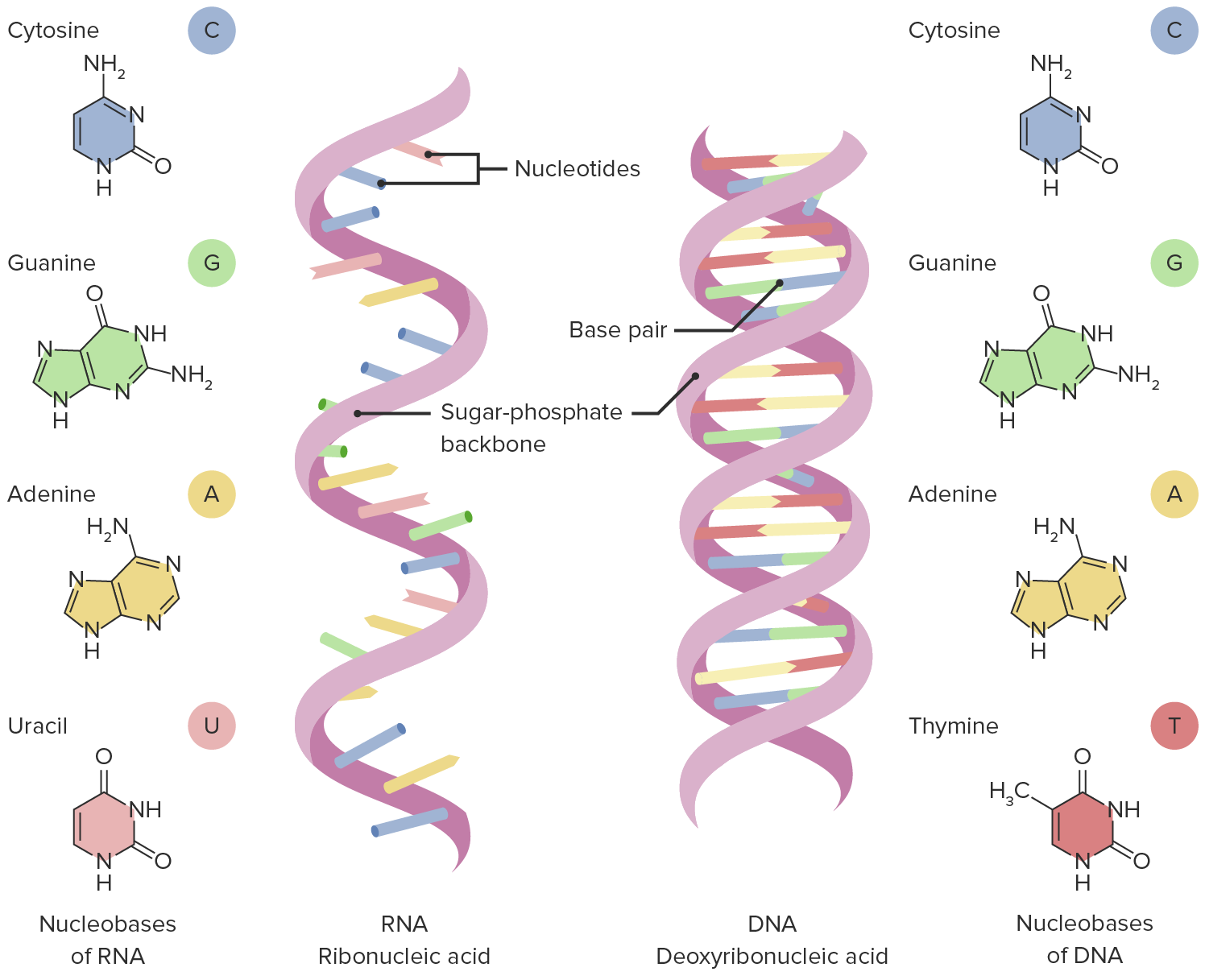
DNADNAA deoxyribonucleotide polymer that is the primary genetic material of all cells. Eukaryotic and prokaryotic organisms normally contain DNA in a double-stranded state, yet several important biological processes transiently involve single-stranded regions. DNA, which consists of a polysugar-phosphate backbone possessing projections of purines (adenine and guanine) and pyrimidines (thymine and cytosine), forms a double helix that is held together by hydrogen bonds between these purines and pyrimidines (adenine to thymine and guanine to cytosine).DNA Types and Structure
Uma molécula em dupla hélice constituída por 2 cadeias antiparalelas, com uma estrutura semelhante a uma escada entrelaçada:
Os “lados” de cada escada são compostos por moléculas alternadas de desoxirribose (um açúcar de 5 carbonos) e fosfato.
Os “degraus” da escada são feitos de moléculas que contêm nitrogénio, chamadas nucleótidos, frequentemente chamadas “bases”.
Pares de base do DNADNAA deoxyribonucleotide polymer that is the primary genetic material of all cells. Eukaryotic and prokaryotic organisms normally contain DNA in a double-stranded state, yet several important biological processes transiently involve single-stranded regions. DNA, which consists of a polysugar-phosphate backbone possessing projections of purines (adenine and guanine) and pyrimidines (thymine and cytosine), forms a double helix that is held together by hydrogen bonds between these purines and pyrimidines (adenine to thymine and guanine to cytosine).DNA Types and Structure:
Guanina (G), citosina (C), adenina (A), e timina (T)
G emparelha-se com C (e vice-versa) através de 3 pontes de hidrogénio.
A emparelha-se com T (e vice-versa) através de 2 pontes de hidrogénio.
Estes pares de bases podem ser “lidos” como uma sequência de letras; por exemplo, GTATCGA.
Esta sequência de letras é o “código”, ou manual de instruções, usado, em última análise, para criar proteínas.
RNARNAA polynucleotide consisting essentially of chains with a repeating backbone of phosphate and ribose units to which nitrogenous bases are attached. RNA is unique among biological macromolecules in that it can encode genetic information, serve as an abundant structural component of cells, and also possesses catalytic activity.RNA Types and Structure
Uma molécula de cadeia simples composta por moléculas alternadas de riboseRiboseA pentose active in biological systems usually in its d-form.Nucleic Acids (um açúcar de 5 carbonos) e fosfato
Cada riboseRiboseA pentose active in biological systems usually in its d-form.Nucleic Acids está ligada a um nucleótido de RNARNAA polynucleotide consisting essentially of chains with a repeating backbone of phosphate and ribose units to which nitrogenous bases are attached. RNA is unique among biological macromolecules in that it can encode genetic information, serve as an abundant structural component of cells, and also possesses catalytic activity.RNA Types and Structure:
Guanina (G), citosina (C), adenina (A), e uracilo (U)
Note-se que, em vez de timina, a adenina liga-se com o uracilo (e vice-versa) através de 2 pontes de hidrogénio.
Codão: uma série de 3 nucleótidos seguidos que codificam um determinado aminoácido.
Tipos de RNARNAA polynucleotide consisting essentially of chains with a repeating backbone of phosphate and ribose units to which nitrogenous bases are attached. RNA is unique among biological macromolecules in that it can encode genetic information, serve as an abundant structural component of cells, and also possesses catalytic activity.RNA Types and Structure:
mRNAmRNARNA sequences that serve as templates for protein synthesis. Bacterial mRNAs are generally primary transcripts in that they do not require post-transcriptional processing. Eukaryotic mRNA is synthesized in the nucleus and must be exported to the cytoplasm for translation. Most eukaryotic mRNAs have a sequence of polyadenylic acid at the 3′ end, referred to as the poly(a) tail. The function of this tail is not known for certain, but it may play a role in the export of mature mRNA from the nucleus as well as in helping stabilize some mRNA molecules by retarding their degradation in the cytoplasm.RNA Types and Structure: cadeias modelo que são traduzidas em polipéptidos pelos complexos ribossómicos
RNARNAA polynucleotide consisting essentially of chains with a repeating backbone of phosphate and ribose units to which nitrogenous bases are attached. RNA is unique among biological macromolecules in that it can encode genetic information, serve as an abundant structural component of cells, and also possesses catalytic activity.RNA Types and Structure ribossómico (rRNArRNAThe most abundant form of RNA. Together with proteins, it forms the ribosomes, playing a structural role and also a role in ribosomal binding of mRNA and tRNAs. Individual chains are conventionally designated by their sedimentation coefficients. In eukaryotes, four large chains exist, synthesized in the nucleolus and constituting about 50% of the ribosome.RNA Types and Structure): um componente do complexo ribossómico que ajuda na síntese de proteínas.
RNARNAA polynucleotide consisting essentially of chains with a repeating backbone of phosphate and ribose units to which nitrogenous bases are attached. RNA is unique among biological macromolecules in that it can encode genetic information, serve as an abundant structural component of cells, and also possesses catalytic activity.RNA Types and Structure de transferência (tRNAtRNAThe small RNA molecules, 73-80 nucleotides long, that function during translation (translation, genetic) to align amino acids at the ribosomes in a sequence determined by the mRNA (RNA, messenger). There are about 30 different transfer rnas. Each recognizes a specific codon set on the mRNA through its own anticodon and as aminoacyl trnas (RNA, transfer, amino Acyl), each carries a specific amino acid to the ribosome to add to the elongating peptide chains.RNA Types and Structure): moléculas que carregam aminoácidos para o ribossoma, onde se ligam ao mRNAmRNARNA sequences that serve as templates for protein synthesis. Bacterial mRNAs are generally primary transcripts in that they do not require post-transcriptional processing. Eukaryotic mRNA is synthesized in the nucleus and must be exported to the cytoplasm for translation. Most eukaryotic mRNAs have a sequence of polyadenylic acid at the 3′ end, referred to as the poly(a) tail. The function of this tail is not known for certain, but it may play a role in the export of mature mRNA from the nucleus as well as in helping stabilize some mRNA molecules by retarding their degradation in the cytoplasm.RNA Types and Structure
Estruturas de RNA e DNA
Image by Lecturio.
O código genético
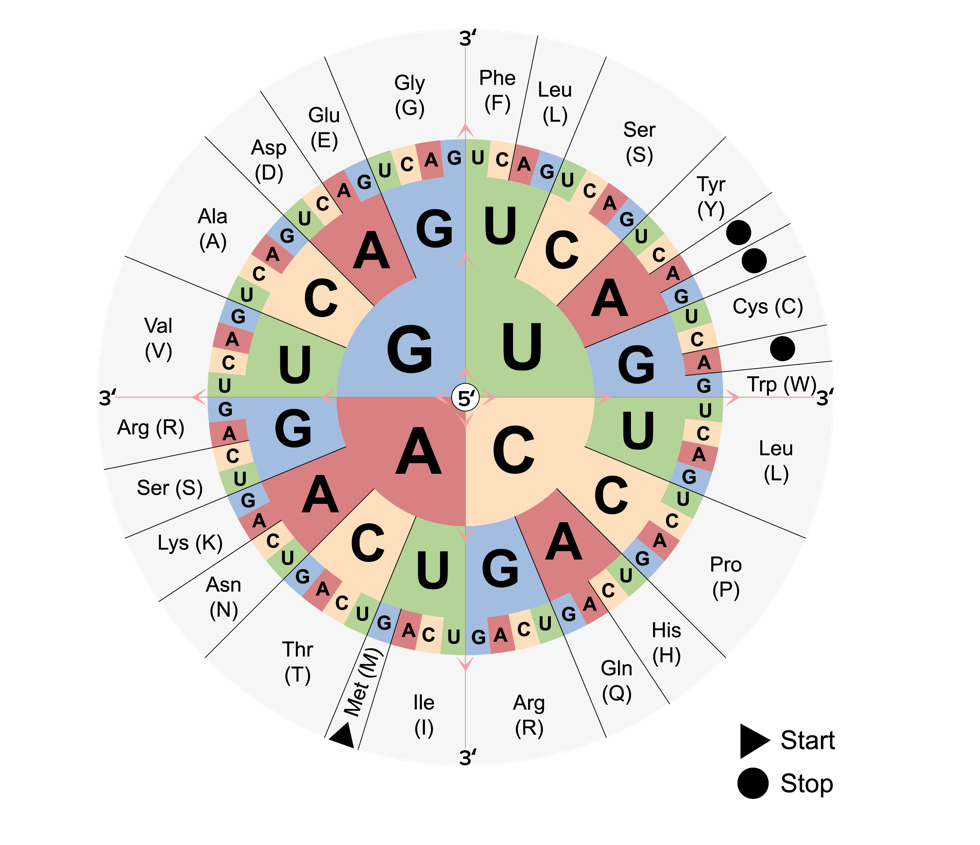
O código genéticoé como os organismos traduzem uma sequência de basesBasesUsually a hydroxide of lithium, sodium, potassium, rubidium or cesium, but also the carbonates of these metals, ammonia, and the amines.Acid-Base Balance numa proteína real.
A informação no mRNAmRNARNA sequences that serve as templates for protein synthesis. Bacterial mRNAs are generally primary transcripts in that they do not require post-transcriptional processing. Eukaryotic mRNA is synthesized in the nucleus and must be exported to the cytoplasm for translation. Most eukaryotic mRNAs have a sequence of polyadenylic acid at the 3′ end, referred to as the poly(a) tail. The function of this tail is not known for certain, but it may play a role in the export of mature mRNA from the nucleus as well as in helping stabilize some mRNA molecules by retarding their degradation in the cytoplasm.RNA Types and Structure está contida em sequências de 3 basesBasesUsually a hydroxide of lithium, sodium, potassium, rubidium or cesium, but also the carbonates of these metals, ammonia, and the amines.Acid-Base Balance chamadas codões.
O código é específico: cada codão codifica apenas para 1 aminoácido.
O código é redundante:
Com 4 basesBasesUsually a hydroxide of lithium, sodium, potassium, rubidium or cesium, but also the carbonates of these metals, ammonia, and the amines.Acid-Base Balance, há 64 possíveis codões de 3 basesBasesUsually a hydroxide of lithium, sodium, potassium, rubidium or cesium, but also the carbonates of these metals, ammonia, and the amines.Acid-Base Balance, mas apenas 20 aminoácidos.
Alguns aminoácidos podem ser codificados por vários codões diferentes:
Normalmente é a 3.ª base que difere (conhecida como a base oscilante).
As mutações na base oscilante são frequentemente mutações silenciosas que não afetam a sequência de aminoácidos.
Por exemplo, GGG, GGA, GGC e GGU são todos códigos para a glicina, portanto, mesmo que a GGG mude para GGA, a proteína final será a mesma.
O código contém “pontuação”:
Codão de iniciação (inicia a tradução): AUG → codifica para metionina
Codões de paragem (terminam a tradução): UAA, UAG, UGA
O código é universal:
O código é o mesmo em todas as espécies, incluindo procariontes e eucariontes.
Exceção: vários codões são ligeiramente diferentes dentro das mitocôndrias.
O código é lido pelos tRNAtRNAThe small RNA molecules, 73-80 nucleotides long, that function during translation (translation, genetic) to align amino acids at the ribosomes in a sequence determined by the mRNA (RNA, messenger). There are about 30 different transfer rnas. Each recognizes a specific codon set on the mRNA through its own anticodon and as aminoacyl trnas (RNA, transfer, amino Acyl), each carries a specific amino acid to the ribosome to add to the elongating peptide chains.RNA Types and Structure dentro dos ribossomas.
O código genético: Começa no centro e é lido para determinar para quais aminoácidos cada um dos 64 códigos de codão. Os codões de iniciação e de paragem são anotados.
Os mRNAmRNARNA sequences that serve as templates for protein synthesis. Bacterial mRNAs are generally primary transcripts in that they do not require post-transcriptional processing. Eukaryotic mRNA is synthesized in the nucleus and must be exported to the cytoplasm for translation. Most eukaryotic mRNAs have a sequence of polyadenylic acid at the 3′ end, referred to as the poly(a) tail. The function of this tail is not known for certain, but it may play a role in the export of mature mRNA from the nucleus as well as in helping stabilize some mRNA molecules by retarding their degradation in the cytoplasm.RNA Types and Structure são traduzidos em proteínas pelos ribossomas e pelos RNARNAA polynucleotide consisting essentially of chains with a repeating backbone of phosphate and ribose units to which nitrogenous bases are attached. RNA is unique among biological macromolecules in that it can encode genetic information, serve as an abundant structural component of cells, and also possesses catalytic activity.RNA Types and Structure de transferência.
RNARNAA polynucleotide consisting essentially of chains with a repeating backbone of phosphate and ribose units to which nitrogenous bases are attached. RNA is unique among biological macromolecules in that it can encode genetic information, serve as an abundant structural component of cells, and also possesses catalytic activity.RNA Types and Structure de transferência (tRNAs)
Os tRNAtRNAThe small RNA molecules, 73-80 nucleotides long, that function during translation (translation, genetic) to align amino acids at the ribosomes in a sequence determined by the mRNA (RNA, messenger). There are about 30 different transfer rnas. Each recognizes a specific codon set on the mRNA through its own anticodon and as aminoacyl trnas (RNA, transfer, amino Acyl), each carries a specific amino acid to the ribosome to add to the elongating peptide chains.RNA Types and Structure carregam os aminoácidos até aos ribossomas, onde eles se ligam ao mRNAmRNARNA sequences that serve as templates for protein synthesis. Bacterial mRNAs are generally primary transcripts in that they do not require post-transcriptional processing. Eukaryotic mRNA is synthesized in the nucleus and must be exported to the cytoplasm for translation. Most eukaryotic mRNAs have a sequence of polyadenylic acid at the 3′ end, referred to as the poly(a) tail. The function of this tail is not known for certain, but it may play a role in the export of mature mRNA from the nucleus as well as in helping stabilize some mRNA molecules by retarding their degradation in the cytoplasm.RNA Types and Structure, alinhando os aminoácidos que se ligarão para formar o polipéptido em crescimento.
Sintetizado por:
RNARNAA polynucleotide consisting essentially of chains with a repeating backbone of phosphate and ribose units to which nitrogenous bases are attached. RNA is unique among biological macromolecules in that it can encode genetic information, serve as an abundant structural component of cells, and also possesses catalytic activity.RNA Types and Structure polimerase em procariontes
RNARNAA polynucleotide consisting essentially of chains with a repeating backbone of phosphate and ribose units to which nitrogenous bases are attached. RNA is unique among biological macromolecules in that it can encode genetic information, serve as an abundant structural component of cells, and also possesses catalytic activity.RNA Types and Structure polimerase III em eucariontes
Existe um tRNAtRNAThe small RNA molecules, 73-80 nucleotides long, that function during translation (translation, genetic) to align amino acids at the ribosomes in a sequence determined by the mRNA (RNA, messenger). There are about 30 different transfer rnas. Each recognizes a specific codon set on the mRNA through its own anticodon and as aminoacyl trnas (RNA, transfer, amino Acyl), each carries a specific amino acid to the ribosome to add to the elongating peptide chains.RNA Types and Structure único para cada aminoácido.
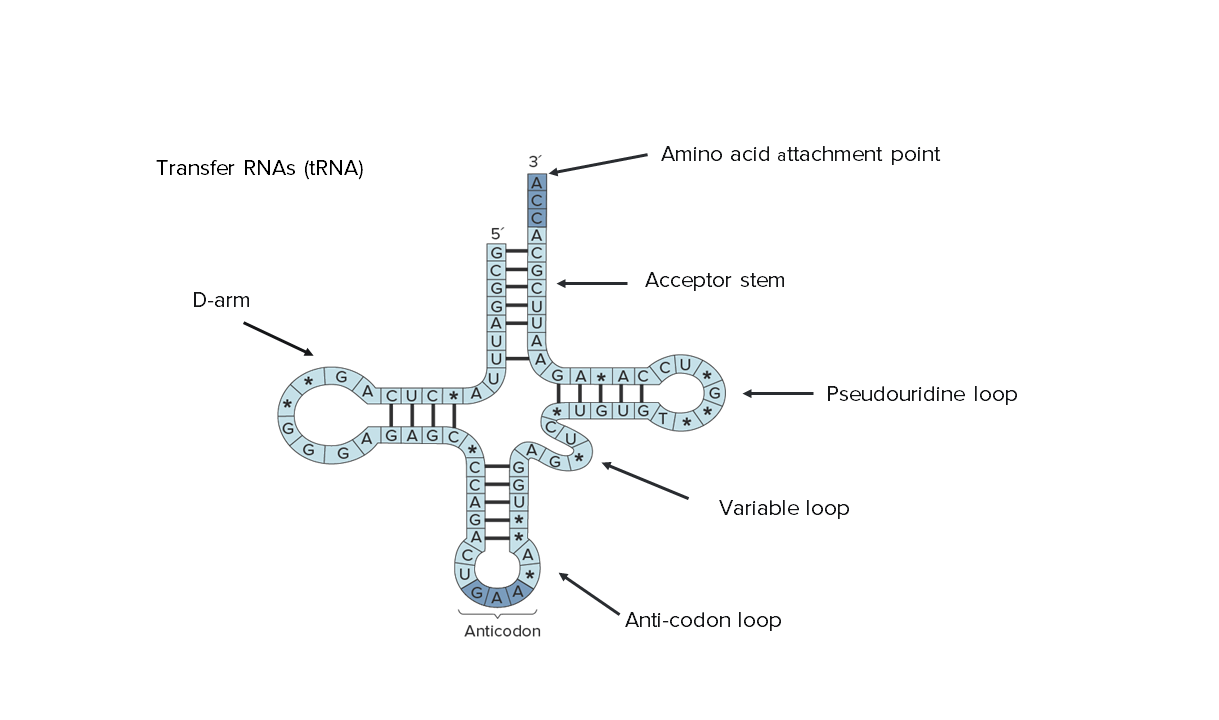
Estrutura:
Uma molécula de RNARNAA polynucleotide consisting essentially of chains with a repeating backbone of phosphate and ribose units to which nitrogenous bases are attached. RNA is unique among biological macromolecules in that it can encode genetic information, serve as an abundant structural component of cells, and also possesses catalytic activity.RNA Types and Structure de cadeia simples tem 70-85 nucleótidos de comprimento.
Formam-se pares de pontes de hidrogénio/basesBasesUsually a hydroxide of lithium, sodium, potassium, rubidium or cesium, but also the carbonates of these metals, ammonia, and the amines.Acid-Base Balance para criar uma estrutura em folhas de trevo (secundária)
A extremidade 3′ (no caule do trevo) é um local de ligação para um aminoácido.
O laço do centro do trevo contém um anticodão:
Uma sequência de 3 basesBasesUsually a hydroxide of lithium, sodium, potassium, rubidium or cesium, but also the carbonates of these metals, ammonia, and the amines.Acid-Base Balance que são complementares a um codão de mRNAmRNARNA sequences that serve as templates for protein synthesis. Bacterial mRNAs are generally primary transcripts in that they do not require post-transcriptional processing. Eukaryotic mRNA is synthesized in the nucleus and must be exported to the cytoplasm for translation. Most eukaryotic mRNAs have a sequence of polyadenylic acid at the 3′ end, referred to as the poly(a) tail. The function of this tail is not known for certain, but it may play a role in the export of mature mRNA from the nucleus as well as in helping stabilize some mRNA molecules by retarding their degradation in the cytoplasm.RNA Types and Structure.
Permitem que o tRNAtRNAThe small RNA molecules, 73-80 nucleotides long, that function during translation (translation, genetic) to align amino acids at the ribosomes in a sequence determined by the mRNA (RNA, messenger). There are about 30 different transfer rnas. Each recognizes a specific codon set on the mRNA through its own anticodon and as aminoacyl trnas (RNA, transfer, amino Acyl), each carries a specific amino acid to the ribosome to add to the elongating peptide chains.RNA Types and Structure se ligue a um mRNAmRNARNA sequences that serve as templates for protein synthesis. Bacterial mRNAs are generally primary transcripts in that they do not require post-transcriptional processing. Eukaryotic mRNA is synthesized in the nucleus and must be exported to the cytoplasm for translation. Most eukaryotic mRNAs have a sequence of polyadenylic acid at the 3′ end, referred to as the poly(a) tail. The function of this tail is not known for certain, but it may play a role in the export of mature mRNA from the nucleus as well as in helping stabilize some mRNA molecules by retarding their degradation in the cytoplasm.RNA Types and Structure onde o codão e o anticodão coincidem
Carregamento de tRNAtRNAThe small RNA molecules, 73-80 nucleotides long, that function during translation (translation, genetic) to align amino acids at the ribosomes in a sequence determined by the mRNA (RNA, messenger). There are about 30 different transfer rnas. Each recognizes a specific codon set on the mRNA through its own anticodon and as aminoacyl trnas (RNA, transfer, amino Acyl), each carries a specific amino acid to the ribosome to add to the elongating peptide chains.RNA Types and Structure:
O processo de ligar um aminoácido ao tRNAtRNAThe small RNA molecules, 73-80 nucleotides long, that function during translation (translation, genetic) to align amino acids at the ribosomes in a sequence determined by the mRNA (RNA, messenger). There are about 30 different transfer rnas. Each recognizes a specific codon set on the mRNA through its own anticodon and as aminoacyl trnas (RNA, transfer, amino Acyl), each carries a specific amino acid to the ribosome to add to the elongating peptide chains.RNA Types and Structure
Catalisado pela enzima aminoacil-tRNA sintase
Aminoacil-tRNA sintase:
É responsável por ligar o aminoácido correto ao tRNAtRNAThe small RNA molecules, 73-80 nucleotides long, that function during translation (translation, genetic) to align amino acids at the ribosomes in a sequence determined by the mRNA (RNA, messenger). There are about 30 different transfer rnas. Each recognizes a specific codon set on the mRNA through its own anticodon and as aminoacyl trnas (RNA, transfer, amino Acyl), each carries a specific amino acid to the ribosome to add to the elongating peptide chains.RNA Types and Structure correspondente
Existe uma aminoacil-tRNA sintase diferente para cada aminoácido/tRNAtRNAThe small RNA molecules, 73-80 nucleotides long, that function during translation (translation, genetic) to align amino acids at the ribosomes in a sequence determined by the mRNA (RNA, messenger). There are about 30 different transfer rnas. Each recognizes a specific codon set on the mRNA through its own anticodon and as aminoacyl trnas (RNA, transfer, amino Acyl), each carries a specific amino acid to the ribosome to add to the elongating peptide chains.RNA Types and Structure.
Contém 2 locais de ligação primários:
Local de ligação de tRNAtRNAThe small RNA molecules, 73-80 nucleotides long, that function during translation (translation, genetic) to align amino acids at the ribosomes in a sequence determined by the mRNA (RNA, messenger). There are about 30 different transfer rnas. Each recognizes a specific codon set on the mRNA through its own anticodon and as aminoacyl trnas (RNA, transfer, amino Acyl), each carries a specific amino acid to the ribosome to add to the elongating peptide chains.RNA Types and Structure: inclui uma estrutura tipo codão que se liga ao anticodão do tRNAtRNAThe small RNA molecules, 73-80 nucleotides long, that function during translation (translation, genetic) to align amino acids at the ribosomes in a sequence determined by the mRNA (RNA, messenger). There are about 30 different transfer rnas. Each recognizes a specific codon set on the mRNA through its own anticodon and as aminoacyl trnas (RNA, transfer, amino Acyl), each carries a specific amino acid to the ribosome to add to the elongating peptide chains.RNA Types and Structure
Local de ligação de aminoácidos: encaixa no aminoácido que combina com aquele anticodão.
Processo de carregamento:
O aminoácido é carregado no seu local de ligação
O ATP é clivado, criando um AMP para carregar o aminoácido.
O tRNAtRNAThe small RNA molecules, 73-80 nucleotides long, that function during translation (translation, genetic) to align amino acids at the ribosomes in a sequence determined by the mRNA (RNA, messenger). There are about 30 different transfer rnas. Each recognizes a specific codon set on the mRNA through its own anticodon and as aminoacyl trnas (RNA, transfer, amino Acyl), each carries a specific amino acid to the ribosome to add to the elongating peptide chains.RNA Types and Structure é carregado no seu local de ligação.
O aminoácido é emparelhado com o tRNAtRNAThe small RNA molecules, 73-80 nucleotides long, that function during translation (translation, genetic) to align amino acids at the ribosomes in a sequence determined by the mRNA (RNA, messenger). There are about 30 different transfer rnas. Each recognizes a specific codon set on the mRNA through its own anticodon and as aminoacyl trnas (RNA, transfer, amino Acyl), each carries a specific amino acid to the ribosome to add to the elongating peptide chains.RNA Types and Structure, enquanto o AMP é libertado.
O tRNAtRNAThe small RNA molecules, 73-80 nucleotides long, that function during translation (translation, genetic) to align amino acids at the ribosomes in a sequence determined by the mRNA (RNA, messenger). There are about 30 different transfer rnas. Each recognizes a specific codon set on the mRNA through its own anticodon and as aminoacyl trnas (RNA, transfer, amino Acyl), each carries a specific amino acid to the ribosome to add to the elongating peptide chains.RNA Types and Structure carregado é libertado da enzima.
O aminoácido ligado à extremidade 3′ do tRNAtRNAThe small RNA molecules, 73-80 nucleotides long, that function during translation (translation, genetic) to align amino acids at the ribosomes in a sequence determined by the mRNA (RNA, messenger). There are about 30 different transfer rnas. Each recognizes a specific codon set on the mRNA through its own anticodon and as aminoacyl trnas (RNA, transfer, amino Acyl), each carries a specific amino acid to the ribosome to add to the elongating peptide chains.RNA Types and Structure corresponderá ao codão no mRNAmRNARNA sequences that serve as templates for protein synthesis. Bacterial mRNAs are generally primary transcripts in that they do not require post-transcriptional processing. Eukaryotic mRNA is synthesized in the nucleus and must be exported to the cytoplasm for translation. Most eukaryotic mRNAs have a sequence of polyadenylic acid at the 3′ end, referred to as the poly(a) tail. The function of this tail is not known for certain, but it may play a role in the export of mature mRNA from the nucleus as well as in helping stabilize some mRNA molecules by retarding their degradation in the cytoplasm.RNA Types and Structure ao qual o anticodão do tRNAtRNAThe small RNA molecules, 73-80 nucleotides long, that function during translation (translation, genetic) to align amino acids at the ribosomes in a sequence determined by the mRNA (RNA, messenger). There are about 30 different transfer rnas. Each recognizes a specific codon set on the mRNA through its own anticodon and as aminoacyl trnas (RNA, transfer, amino Acyl), each carries a specific amino acid to the ribosome to add to the elongating peptide chains.RNA Types and Structure se pode ligar.
tRNAtRNAThe small RNA molecules, 73-80 nucleotides long, that function during translation (translation, genetic) to align amino acids at the ribosomes in a sequence determined by the mRNA (RNA, messenger). There are about 30 different transfer rnas. Each recognizes a specific codon set on the mRNA through its own anticodon and as aminoacyl trnas (RNA, transfer, amino Acyl), each carries a specific amino acid to the ribosome to add to the elongating peptide chains.RNA Types and Structure iniciadores: os tRNAtRNAThe small RNA molecules, 73-80 nucleotides long, that function during translation (translation, genetic) to align amino acids at the ribosomes in a sequence determined by the mRNA (RNA, messenger). There are about 30 different transfer rnas. Each recognizes a specific codon set on the mRNA through its own anticodon and as aminoacyl trnas (RNA, transfer, amino Acyl), each carries a specific amino acid to the ribosome to add to the elongating peptide chains.RNA Types and Structure que se emparelham com o codão de iniciação
Em procariontes, o tRNAtRNAThe small RNA molecules, 73-80 nucleotides long, that function during translation (translation, genetic) to align amino acids at the ribosomes in a sequence determined by the mRNA (RNA, messenger). There are about 30 different transfer rnas. Each recognizes a specific codon set on the mRNA through its own anticodon and as aminoacyl trnas (RNA, transfer, amino Acyl), each carries a specific amino acid to the ribosome to add to the elongating peptide chains.RNA Types and Structure iniciador é N-formilmetionina(fMet)-tRNA
Em eucariotas, o tRNAtRNAThe small RNA molecules, 73-80 nucleotides long, that function during translation (translation, genetic) to align amino acids at the ribosomes in a sequence determined by the mRNA (RNA, messenger). There are about 30 different transfer rnas. Each recognizes a specific codon set on the mRNA through its own anticodon and as aminoacyl trnas (RNA, transfer, amino Acyl), each carries a specific amino acid to the ribosome to add to the elongating peptide chains.RNA Types and Structure iniciador é metionina-tRNA (met-tRNAi)
Estrutura secundária do RNA transferência (tRNA). Note-se que toda a sua sequência pode ser vista, indicando o tamanho reduzido.
Image by Lecturio.
Carregamento de um tRNA na aminoacil sintase
Image by Lecturio.
Ribosomas
Os ribossomas são complexos catalíticos que incluem componentes proteicos e rRNArRNAThe most abundant form of RNA. Together with proteins, it forms the ribosomes, playing a structural role and also a role in ribosomal binding of mRNA and tRNAs. Individual chains are conventionally designated by their sedimentation coefficients. In eukaryotes, four large chains exist, synthesized in the nucleolus and constituting about 50% of the ribosome.RNA Types and Structure. Dentro do complexo ribossómico, o mRNAmRNARNA sequences that serve as templates for protein synthesis. Bacterial mRNAs are generally primary transcripts in that they do not require post-transcriptional processing. Eukaryotic mRNA is synthesized in the nucleus and must be exported to the cytoplasm for translation. Most eukaryotic mRNAs have a sequence of polyadenylic acid at the 3′ end, referred to as the poly(a) tail. The function of this tail is not known for certain, but it may play a role in the export of mature mRNA from the nucleus as well as in helping stabilize some mRNA molecules by retarding their degradation in the cytoplasm.RNA Types and Structure é lido por tRNAs e é criado um polipéptido.
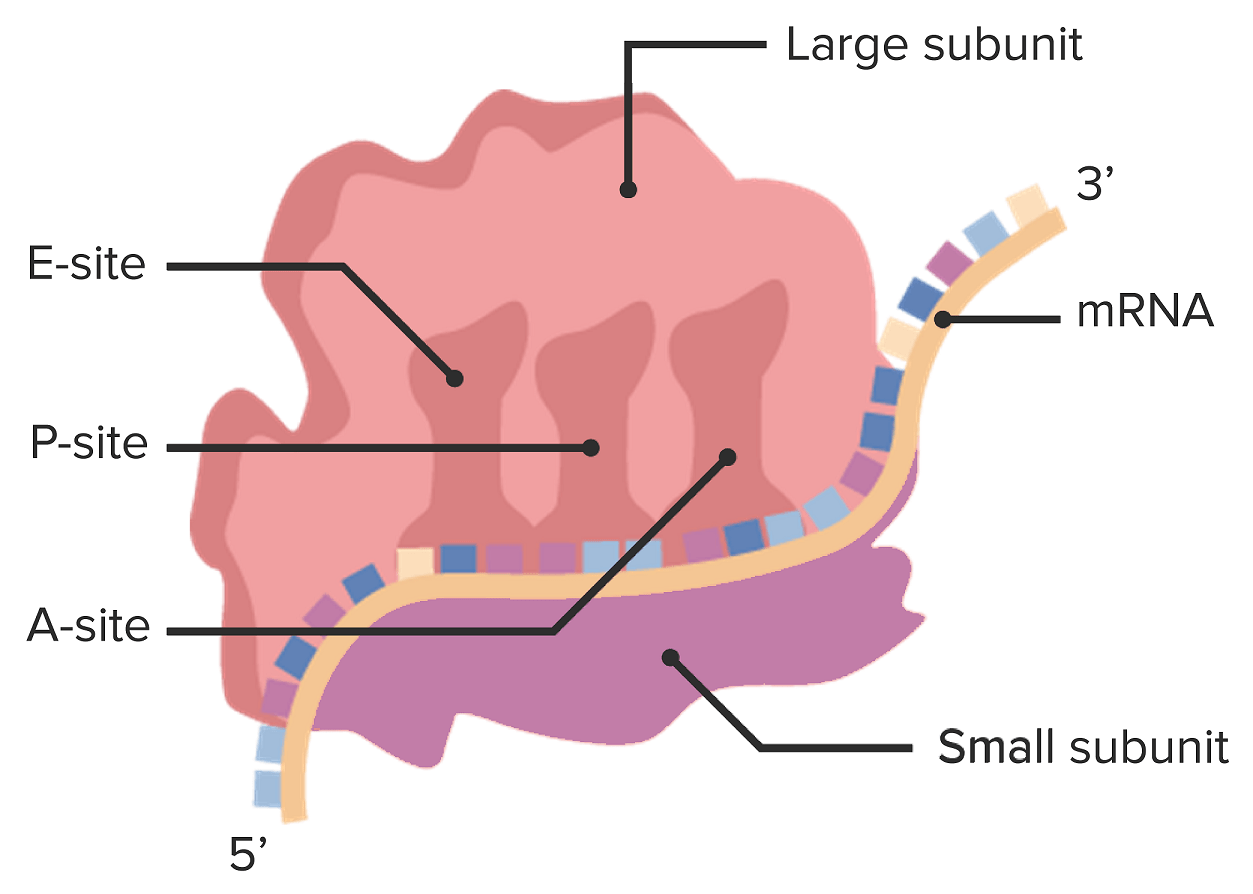
Estrutura do ribossoma:
Composto por 2 subunidades primárias: uma subunidade grande e uma subunidade menor
Contém múltiplas proteínas e rRNArRNAThe most abundant form of RNA. Together with proteins, it forms the ribosomes, playing a structural role and also a role in ribosomal binding of mRNA and tRNAs. Individual chains are conventionally designated by their sedimentation coefficients. In eukaryotes, four large chains exist, synthesized in the nucleolus and constituting about 50% of the ribosome.RNA Types and Structure
Os rRNArRNAThe most abundant form of RNA. Together with proteins, it forms the ribosomes, playing a structural role and also a role in ribosomal binding of mRNA and tRNAs. Individual chains are conventionally designated by their sedimentation coefficients. In eukaryotes, four large chains exist, synthesized in the nucleolus and constituting about 50% of the ribosome.RNA Types and Structure formam extensas estruturas secundárias através do emparelhamento entre si.
Subunidade grande:
Contém peptidil transferase:
Uma ribozima (um rRNArRNAThe most abundant form of RNA. Together with proteins, it forms the ribosomes, playing a structural role and also a role in ribosomal binding of mRNA and tRNAs. Individual chains are conventionally designated by their sedimentation coefficients. In eukaryotes, four large chains exist, synthesized in the nucleolus and constituting about 50% of the ribosome.RNA Types and Structure que funciona como uma enzima para catalisar uma reação): o maior rRNArRNAThe most abundant form of RNA. Together with proteins, it forms the ribosomes, playing a structural role and also a role in ribosomal binding of mRNA and tRNAs. Individual chains are conventionally designated by their sedimentation coefficients. In eukaryotes, four large chains exist, synthesized in the nucleolus and constituting about 50% of the ribosome.RNA Types and Structure dentro do ribossoma.
Cria as ligações peptídicas entre os aminoácidos
Contém 3 locais de ligação para tRNAtRNAThe small RNA molecules, 73-80 nucleotides long, that function during translation (translation, genetic) to align amino acids at the ribosomes in a sequence determined by the mRNA (RNA, messenger). There are about 30 different transfer rnas. Each recognizes a specific codon set on the mRNA through its own anticodon and as aminoacyl trnas (RNA, transfer, amino Acyl), each carries a specific amino acid to the ribosome to add to the elongating peptide chains.RNA Types and Structure carregados:
Posição de chegada (A)
Posição do polipéptido (P)
Posição de saída (E)
Pequena subunidade: descodifica o mRNAmRNARNA sequences that serve as templates for protein synthesis. Bacterial mRNAs are generally primary transcripts in that they do not require post-transcriptional processing. Eukaryotic mRNA is synthesized in the nucleus and must be exported to the cytoplasm for translation. Most eukaryotic mRNAs have a sequence of polyadenylic acid at the 3′ end, referred to as the poly(a) tail. The function of this tail is not known for certain, but it may play a role in the export of mature mRNA from the nucleus as well as in helping stabilize some mRNA molecules by retarding their degradation in the cytoplasm.RNA Types and Structure
Ribossomas leem mRNAmRNARNA sequences that serve as templates for protein synthesis. Bacterial mRNAs are generally primary transcripts in that they do not require post-transcriptional processing. Eukaryotic mRNA is synthesized in the nucleus and must be exported to the cytoplasm for translation. Most eukaryotic mRNAs have a sequence of polyadenylic acid at the 3′ end, referred to as the poly(a) tail. The function of this tail is not known for certain, but it may play a role in the export of mature mRNA from the nucleus as well as in helping stabilize some mRNA molecules by retarding their degradation in the cytoplasm.RNA Types and Structure de 5′ a 3′.
Flutuam livremente dentro do citosol ou podem-se fixar ao retículo endoplasmático rugoso (RER)
Estrutura do ribossoma que demonstra a grande subunidade no topo, com os locais de ligação A, P, e E para tRNAs carregados. A subunidade menor está abaixo do mRNA.
Image by Lecturio.
Tabela: Ribossomas procarióticos versus eucarióticos
Procariontes
Eucariontes
Tamanho da subunidade pequena
30 S
40 S
Tamanho da subunidade grande
50 S
60 S
Número de proteínas
52
88
Número de rRNArRNAThe most abundant form of RNA. Together with proteins, it forms the ribosomes, playing a structural role and also a role in ribosomal binding of mRNA and tRNAs. Individual chains are conventionally designated by their sedimentation coefficients. In eukaryotes, four large chains exist, synthesized in the nucleolus and constituting about 50% of the ribosome.RNA Types and Structure
3
4
Tamanho dos rRNArRNAThe most abundant form of RNA. Together with proteins, it forms the ribosomes, playing a structural role and also a role in ribosomal binding of mRNA and tRNAs. Individual chains are conventionally designated by their sedimentation coefficients. In eukaryotes, four large chains exist, synthesized in the nucleolus and constituting about 50% of the ribosome.RNA Types and Structure homólogos na subunidade pequena
16 S
18 S
Tamanhos de rRNArRNAThe most abundant form of RNA. Together with proteins, it forms the ribosomes, playing a structural role and also a role in ribosomal binding of mRNA and tRNAs. Individual chains are conventionally designated by their sedimentation coefficients. In eukaryotes, four large chains exist, synthesized in the nucleolus and constituting about 50% of the ribosome.RNA Types and Structure homólogos na subunidade grande
5 S
23 S*
5 S
28 S*
Tamanho do rRNArRNAThe most abundant form of RNA. Together with proteins, it forms the ribosomes, playing a structural role and also a role in ribosomal binding of mRNA and tRNAs. Individual chains are conventionally designated by their sedimentation coefficients. In eukaryotes, four large chains exist, synthesized in the nucleolus and constituting about 50% of the ribosome.RNA Types and Structure na subunidade grande sem um homólogo procariótico
5,8 S
* O rRNA conhecido como peptidil transferase catalisa a formação de ligações peptídicas entre aminoácidos na cadeia polipeptídica em crescimento.
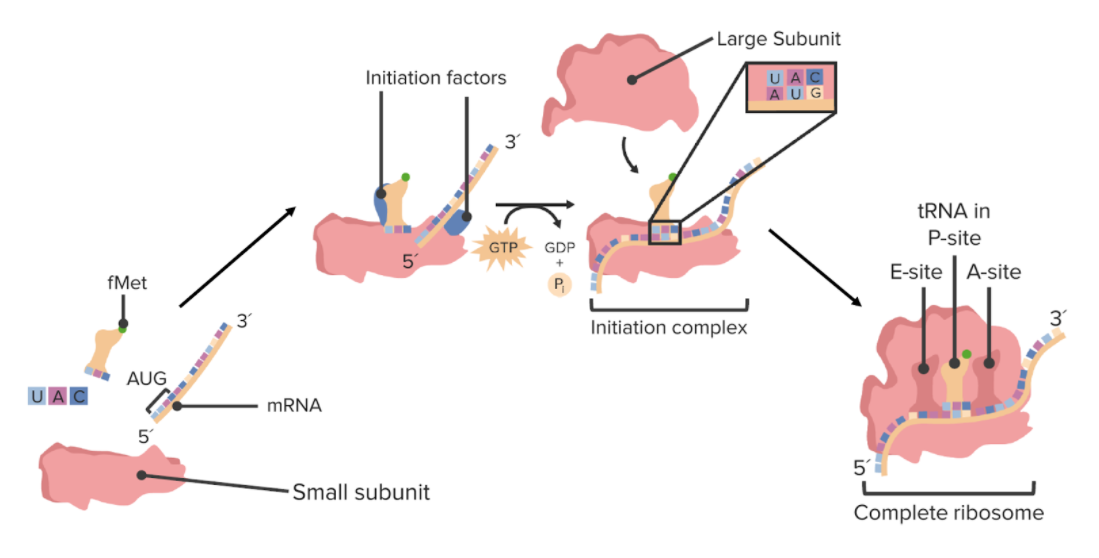
O início da tradução envolve a montagem do ribossoma no mRNAmRNARNA sequences that serve as templates for protein synthesis. Bacterial mRNAs are generally primary transcripts in that they do not require post-transcriptional processing. Eukaryotic mRNA is synthesized in the nucleus and must be exported to the cytoplasm for translation. Most eukaryotic mRNAs have a sequence of polyadenylic acid at the 3′ end, referred to as the poly(a) tail. The function of this tail is not known for certain, but it may play a role in the export of mature mRNA from the nucleus as well as in helping stabilize some mRNA molecules by retarding their degradation in the cytoplasm.RNA Types and Structure na direção correta e encontrar o codão inicial.
Montagem do ribossoma
As subunidades ribossomais são desmontadas no citosol quando não estão em uso.
A pequena subunidade do ribossoma fixa-se à extremidade 5′ do mRNAmRNARNA sequences that serve as templates for protein synthesis. Bacterial mRNAs are generally primary transcripts in that they do not require post-transcriptional processing. Eukaryotic mRNA is synthesized in the nucleus and must be exported to the cytoplasm for translation. Most eukaryotic mRNAs have a sequence of polyadenylic acid at the 3′ end, referred to as the poly(a) tail. The function of this tail is not known for certain, but it may play a role in the export of mature mRNA from the nucleus as well as in helping stabilize some mRNA molecules by retarding their degradation in the cytoplasm.RNA Types and Structure.
A subunidade grande só se liga depois de o tRNAtRNAThe small RNA molecules, 73-80 nucleotides long, that function during translation (translation, genetic) to align amino acids at the ribosomes in a sequence determined by the mRNA (RNA, messenger). There are about 30 different transfer rnas. Each recognizes a specific codon set on the mRNA through its own anticodon and as aminoacyl trnas (RNA, transfer, amino Acyl), each carries a specific amino acid to the ribosome to add to the elongating peptide chains.RNA Types and Structure iniciador se ligar ao codão inicial.
Em procariontes:
O ribossoma monta-se no mRNAmRNARNA sequences that serve as templates for protein synthesis. Bacterial mRNAs are generally primary transcripts in that they do not require post-transcriptional processing. Eukaryotic mRNA is synthesized in the nucleus and must be exported to the cytoplasm for translation. Most eukaryotic mRNAs have a sequence of polyadenylic acid at the 3′ end, referred to as the poly(a) tail. The function of this tail is not known for certain, but it may play a role in the export of mature mRNA from the nucleus as well as in helping stabilize some mRNA molecules by retarding their degradation in the cytoplasm.RNA Types and Structure à medida que é transcrito a partir do DNADNAA deoxyribonucleotide polymer that is the primary genetic material of all cells. Eukaryotic and prokaryotic organisms normally contain DNA in a double-stranded state, yet several important biological processes transiently involve single-stranded regions. DNA, which consists of a polysugar-phosphate backbone possessing projections of purines (adenine and guanine) and pyrimidines (thymine and cytosine), forms a double helix that is held together by hydrogen bonds between these purines and pyrimidines (adenine to thymine and guanine to cytosine).DNA Types and Structure.
Nenhuma cabeça está presente ou é necessária para determinar a direção.
Em eucariontes:
O mRNAmRNARNA sequences that serve as templates for protein synthesis. Bacterial mRNAs are generally primary transcripts in that they do not require post-transcriptional processing. Eukaryotic mRNA is synthesized in the nucleus and must be exported to the cytoplasm for translation. Most eukaryotic mRNAs have a sequence of polyadenylic acid at the 3′ end, referred to as the poly(a) tail. The function of this tail is not known for certain, but it may play a role in the export of mature mRNA from the nucleus as well as in helping stabilize some mRNA molecules by retarding their degradation in the cytoplasm.RNA Types and Structure deve ser transportado do núcleo, onde foi transcrito, para o citosol para a tradução.
Os mRNAmRNARNA sequences that serve as templates for protein synthesis. Bacterial mRNAs are generally primary transcripts in that they do not require post-transcriptional processing. Eukaryotic mRNA is synthesized in the nucleus and must be exported to the cytoplasm for translation. Most eukaryotic mRNAs have a sequence of polyadenylic acid at the 3′ end, referred to as the poly(a) tail. The function of this tail is not known for certain, but it may play a role in the export of mature mRNA from the nucleus as well as in helping stabilize some mRNA molecules by retarding their degradation in the cytoplasm.RNA Types and Structure têm uma cabeça 5′, que:
Indicam a direção do mRNAmRNARNA sequences that serve as templates for protein synthesis. Bacterial mRNAs are generally primary transcripts in that they do not require post-transcriptional processing. Eukaryotic mRNA is synthesized in the nucleus and must be exported to the cytoplasm for translation. Most eukaryotic mRNAs have a sequence of polyadenylic acid at the 3′ end, referred to as the poly(a) tail. The function of this tail is not known for certain, but it may play a role in the export of mature mRNA from the nucleus as well as in helping stabilize some mRNA molecules by retarding their degradation in the cytoplasm.RNA Types and Structure
Serve como um local de ligação para fatores de iniciação eucariótica (FIe)
São necessários múltiplos FIe para ajudar a pequena subunidade e o tRNAtRNAThe small RNA molecules, 73-80 nucleotides long, that function during translation (translation, genetic) to align amino acids at the ribosomes in a sequence determined by the mRNA (RNA, messenger). There are about 30 different transfer rnas. Each recognizes a specific codon set on the mRNA through its own anticodon and as aminoacyl trnas (RNA, transfer, amino Acyl), each carries a specific amino acid to the ribosome to add to the elongating peptide chains.RNA Types and Structure iniciador a ligar-se ao mRNAmRNARNA sequences that serve as templates for protein synthesis. Bacterial mRNAs are generally primary transcripts in that they do not require post-transcriptional processing. Eukaryotic mRNA is synthesized in the nucleus and must be exported to the cytoplasm for translation. Most eukaryotic mRNAs have a sequence of polyadenylic acid at the 3′ end, referred to as the poly(a) tail. The function of this tail is not known for certain, but it may play a role in the export of mature mRNA from the nucleus as well as in helping stabilize some mRNA molecules by retarding their degradation in the cytoplasm.RNA Types and Structure.
A ligação das FIe e das subunidades ribossomais requer energia.
Procura do local de início
Assim que a subunidade pequena se liga à extremidade 5′ do mRNAmRNARNA sequences that serve as templates for protein synthesis. Bacterial mRNAs are generally primary transcripts in that they do not require post-transcriptional processing. Eukaryotic mRNA is synthesized in the nucleus and must be exported to the cytoplasm for translation. Most eukaryotic mRNAs have a sequence of polyadenylic acid at the 3′ end, referred to as the poly(a) tail. The function of this tail is not known for certain, but it may play a role in the export of mature mRNA from the nucleus as well as in helping stabilize some mRNA molecules by retarding their degradation in the cytoplasm.RNA Types and Structure, esta começa a procurar o local de início.
O local de início: AUG (o códão para a metionina)
Procariontes: usam uma sequência específica rica em purinas na extremidade 5′ para distinguir o AUG inicial de outros AUG (internos)
O complexo ribossomal analisao mRNAmRNARNA sequences that serve as templates for protein synthesis. Bacterial mRNAs are generally primary transcripts in that they do not require post-transcriptional processing. Eukaryotic mRNA is synthesized in the nucleus and must be exported to the cytoplasm for translation. Most eukaryotic mRNAs have a sequence of polyadenylic acid at the 3′ end, referred to as the poly(a) tail. The function of this tail is not known for certain, but it may play a role in the export of mature mRNA from the nucleus as well as in helping stabilize some mRNA molecules by retarding their degradation in the cytoplasm.RNA Types and Structure à procura do codão inicial (AUG) ao se mover, passo a passo, na direção 5′ a 3′ ao longo do mRNAmRNARNA sequences that serve as templates for protein synthesis. Bacterial mRNAs are generally primary transcripts in that they do not require post-transcriptional processing. Eukaryotic mRNA is synthesized in the nucleus and must be exported to the cytoplasm for translation. Most eukaryotic mRNAs have a sequence of polyadenylic acid at the 3′ end, referred to as the poly(a) tail. The function of this tail is not known for certain, but it may play a role in the export of mature mRNA from the nucleus as well as in helping stabilize some mRNA molecules by retarding their degradation in the cytoplasm.RNA Types and Structure. Este processo requer energia da hidrólise ATP para o movimento.
Quando a pequena subunidade alcança o codão inicial (AUG) no mRNAmRNARNA sequences that serve as templates for protein synthesis. Bacterial mRNAs are generally primary transcripts in that they do not require post-transcriptional processing. Eukaryotic mRNA is synthesized in the nucleus and must be exported to the cytoplasm for translation. Most eukaryotic mRNAs have a sequence of polyadenylic acid at the 3′ end, referred to as the poly(a) tail. The function of this tail is not known for certain, but it may play a role in the export of mature mRNA from the nucleus as well as in helping stabilize some mRNA molecules by retarding their degradation in the cytoplasm.RNA Types and Structure, este ligar-se-á a um tRNAtRNAThe small RNA molecules, 73-80 nucleotides long, that function during translation (translation, genetic) to align amino acids at the ribosomes in a sequence determined by the mRNA (RNA, messenger). There are about 30 different transfer rnas. Each recognizes a specific codon set on the mRNA through its own anticodon and as aminoacyl trnas (RNA, transfer, amino Acyl), each carries a specific amino acid to the ribosome to add to the elongating peptide chains.RNA Types and Structure iniciador.
Assim que o tRNAtRNAThe small RNA molecules, 73-80 nucleotides long, that function during translation (translation, genetic) to align amino acids at the ribosomes in a sequence determined by the mRNA (RNA, messenger). There are about 30 different transfer rnas. Each recognizes a specific codon set on the mRNA through its own anticodon and as aminoacyl trnas (RNA, transfer, amino Acyl), each carries a specific amino acid to the ribosome to add to the elongating peptide chains.RNA Types and Structure iniciador esteja ligado ao mRNAmRNARNA sequences that serve as templates for protein synthesis. Bacterial mRNAs are generally primary transcripts in that they do not require post-transcriptional processing. Eukaryotic mRNA is synthesized in the nucleus and must be exported to the cytoplasm for translation. Most eukaryotic mRNAs have a sequence of polyadenylic acid at the 3′ end, referred to as the poly(a) tail. The function of this tail is not known for certain, but it may play a role in the export of mature mRNA from the nucleus as well as in helping stabilize some mRNA molecules by retarding their degradation in the cytoplasm.RNA Types and Structure, a subunidade grande entrará e orienta-se de modo que o tRNAtRNAThe small RNA molecules, 73-80 nucleotides long, that function during translation (translation, genetic) to align amino acids at the ribosomes in a sequence determined by the mRNA (RNA, messenger). There are about 30 different transfer rnas. Each recognizes a specific codon set on the mRNA through its own anticodon and as aminoacyl trnas (RNA, transfer, amino Acyl), each carries a specific amino acid to the ribosome to add to the elongating peptide chains.RNA Types and Structure iniciador esteja localizado no local P do complexo.
São necessários FIe e energia adicionais em eucariontes para a montagem completa do ribossoma.
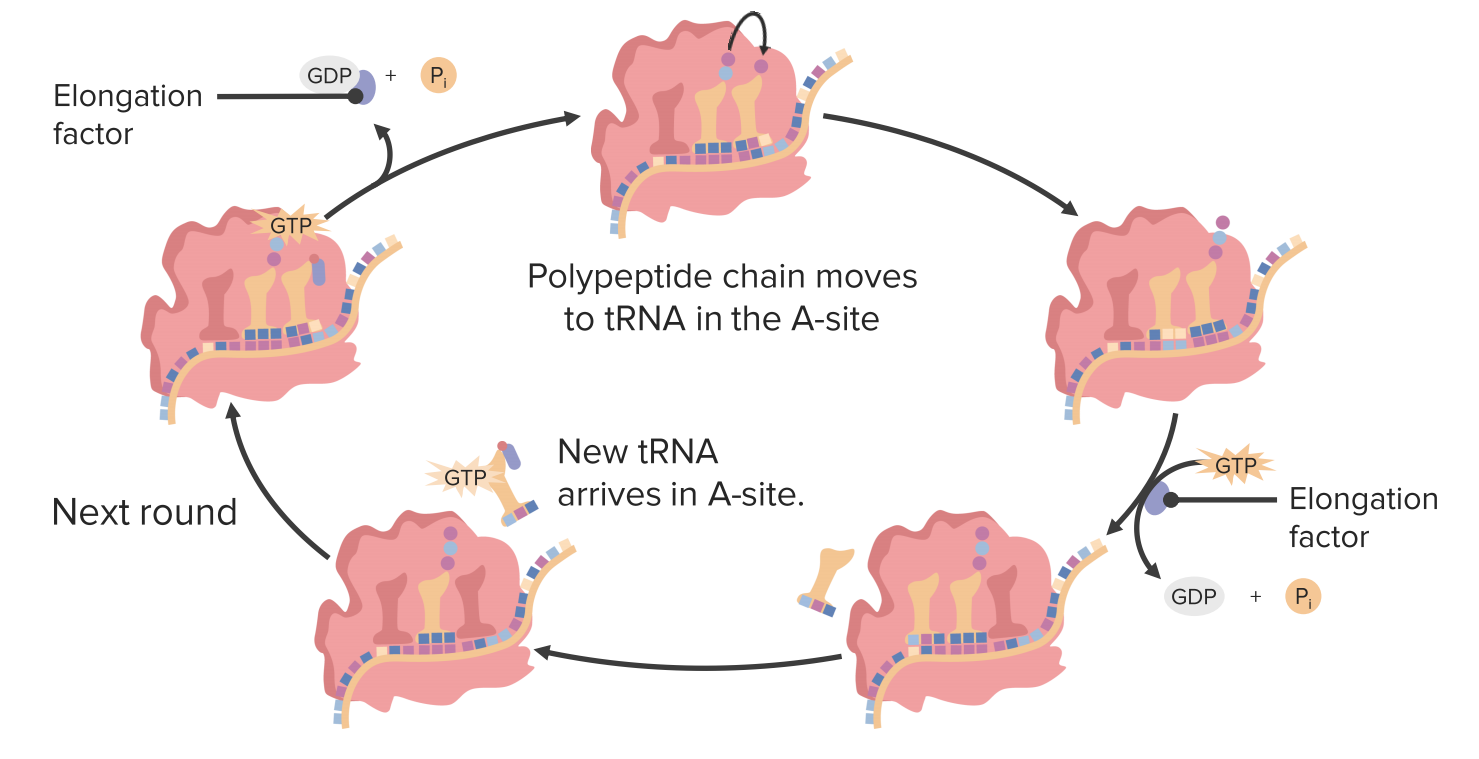
Um RNARNAA polynucleotide consisting essentially of chains with a repeating backbone of phosphate and ribose units to which nitrogenous bases are attached. RNA is unique among biological macromolecules in that it can encode genetic information, serve as an abundant structural component of cells, and also possesses catalytic activity.RNA Types and Structure carregado com aminoácidos (aa-tRNA) liga-se ao local A dentro do ribossoma:
O anticodão tRNAtRNAThe small RNA molecules, 73-80 nucleotides long, that function during translation (translation, genetic) to align amino acids at the ribosomes in a sequence determined by the mRNA (RNA, messenger). There are about 30 different transfer rnas. Each recognizes a specific codon set on the mRNA through its own anticodon and as aminoacyl trnas (RNA, transfer, amino Acyl), each carries a specific amino acid to the ribosome to add to the elongating peptide chains.RNA Types and Structure deve complementar o codão mRNAmRNARNA sequences that serve as templates for protein synthesis. Bacterial mRNAs are generally primary transcripts in that they do not require post-transcriptional processing. Eukaryotic mRNA is synthesized in the nucleus and must be exported to the cytoplasm for translation. Most eukaryotic mRNAs have a sequence of polyadenylic acid at the 3′ end, referred to as the poly(a) tail. The function of this tail is not known for certain, but it may play a role in the export of mature mRNA from the nucleus as well as in helping stabilize some mRNA molecules by retarding their degradation in the cytoplasm.RNA Types and Structure para que a ligação no local A ocorra.
Requer energia de um fator de alongamento (EFEFCardiac Cycle pela sigla em inglês) pela hidrólise de um GTP
A peptidil transferase liga o novo aminoácido à cadeia polipeptídica em crescimento por:
Transferência da cadeia de polipéptidos do tRNA no local P para a extremidade do aminoácido (“topo”) do aminoácido ligado ao tRNAtRNAThe small RNA molecules, 73-80 nucleotides long, that function during translation (translation, genetic) to align amino acids at the ribosomes in a sequence determined by the mRNA (RNA, messenger). There are about 30 different transfer rnas. Each recognizes a specific codon set on the mRNA through its own anticodon and as aminoacyl trnas (RNA, transfer, amino Acyl), each carries a specific amino acid to the ribosome to add to the elongating peptide chains.RNA Types and Structure no local A
Formação catalítica de uma ligação peptídica entre os 2 aminoácidos
O ribossoma desloca-se para o codão seguinte na direção 3′:
O deslocamento requer energia de outro EFEFCardiac Cycle através da hidrólise de um GTP:
EF-G em procariontes
eEF-2 em eucariontes
Este deslocamento muda os tRNAtRNAThe small RNA molecules, 73-80 nucleotides long, that function during translation (translation, genetic) to align amino acids at the ribosomes in a sequence determined by the mRNA (RNA, messenger). There are about 30 different transfer rnas. Each recognizes a specific codon set on the mRNA through its own anticodon and as aminoacyl trnas (RNA, transfer, amino Acyl), each carries a specific amino acid to the ribosome to add to the elongating peptide chains.RNA Types and Structure:
O tRNAtRNAThe small RNA molecules, 73-80 nucleotides long, that function during translation (translation, genetic) to align amino acids at the ribosomes in a sequence determined by the mRNA (RNA, messenger). There are about 30 different transfer rnas. Each recognizes a specific codon set on the mRNA through its own anticodon and as aminoacyl trnas (RNA, transfer, amino Acyl), each carries a specific amino acid to the ribosome to add to the elongating peptide chains.RNA Types and Structure na posição A com a crescente cadeia polipeptídica move-se para a posição P.
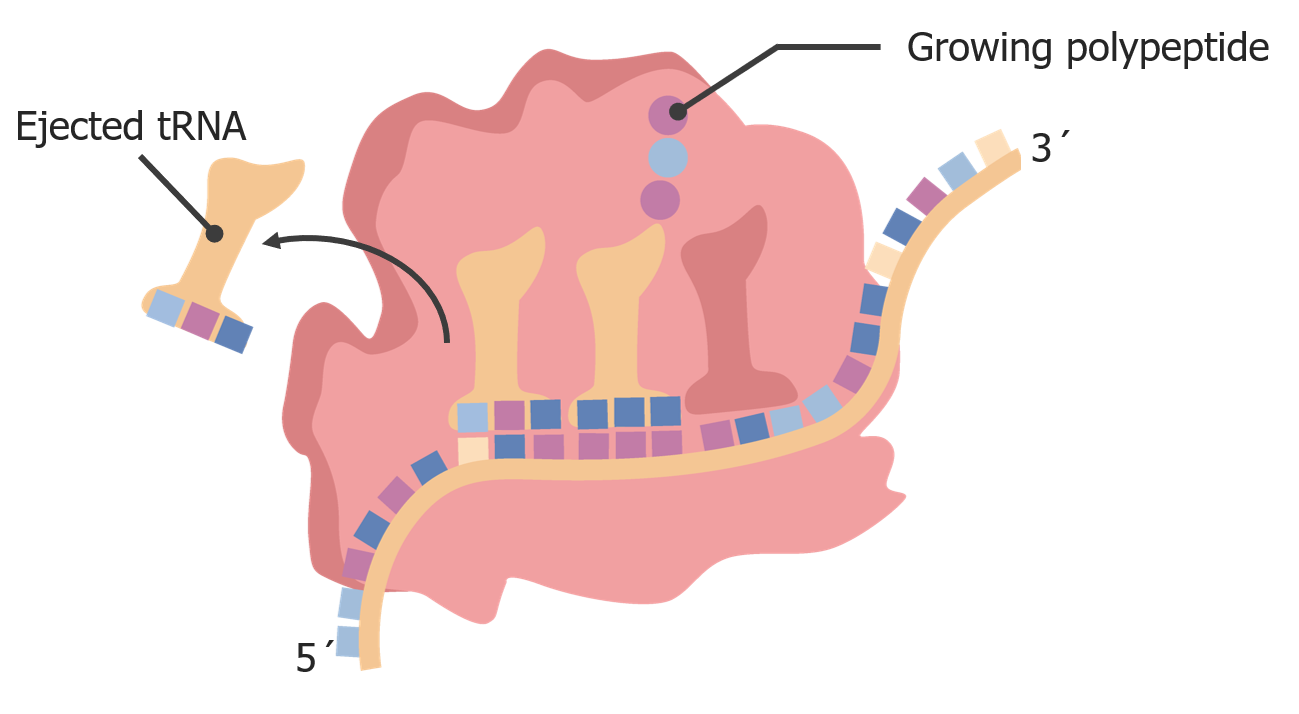
O tRNAtRNAThe small RNA molecules, 73-80 nucleotides long, that function during translation (translation, genetic) to align amino acids at the ribosomes in a sequence determined by the mRNA (RNA, messenger). There are about 30 different transfer rnas. Each recognizes a specific codon set on the mRNA through its own anticodon and as aminoacyl trnas (RNA, transfer, amino Acyl), each carries a specific amino acid to the ribosome to add to the elongating peptide chains.RNA Types and Structure na posição P move-se para a posição E e é expulso do ribossoma.
A posição A está agora aberto para o próximo tRNAtRNAThe small RNA molecules, 73-80 nucleotides long, that function during translation (translation, genetic) to align amino acids at the ribosomes in a sequence determined by the mRNA (RNA, messenger). There are about 30 different transfer rnas. Each recognizes a specific codon set on the mRNA through its own anticodon and as aminoacyl trnas (RNA, transfer, amino Acyl), each carries a specific amino acid to the ribosome to add to the elongating peptide chains.RNA Types and Structure carregado entrar.
Este ciclo é repetido até se encontrar um codão de paragem.
O ciclo de alongamento
Image by Lecturio.
Forma-se uma ligação peptídica dentro do ribossoma.
Image by Lecturio.
Quando o ribossoma se desloca, o tRNA “vazio” move-se para a posição E sendo ejetado do ribossoma.
Image by Lecturio.
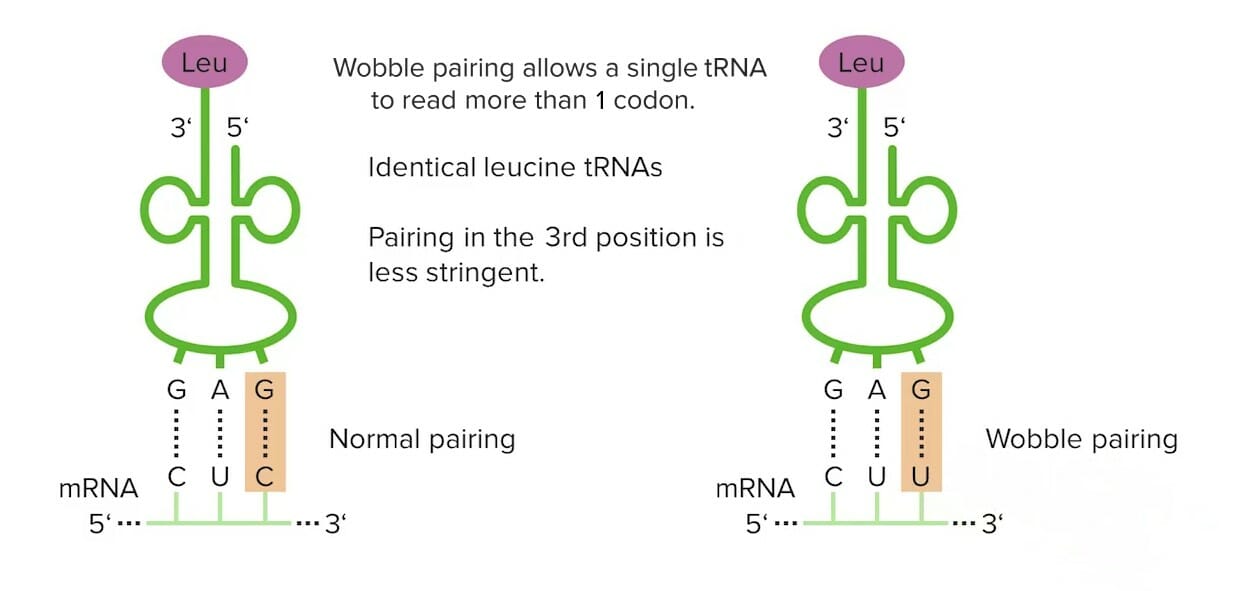
Emparelhamento wobble
As regras de emparelhamento de basesBasesUsually a hydroxide of lithium, sodium, potassium, rubidium or cesium, but also the carbonates of these metals, ammonia, and the amines.Acid-Base Balance não são tão rigorosas na 3ª posição.
Emparelhamento wobble: quando a base na 3.ª posição do codão não coincide com a base na 3.ª posição do anticodão
Muitos aminoácidos têm múltiplas 3.ªˢ basesBasesUsually a hydroxide of lithium, sodium, potassium, rubidium or cesium, but also the carbonates of these metals, ammonia, and the amines.Acid-Base Balance possíveis, onde o emparelhamento oscilante (wobble) não alteraria a estrutura final da proteína.
Se o emparelhamento wobble permitir a inserção de um aminoácido diferente, pode resultar uma proteína mutante.
Emparelhamento wobble
Image by Lecturio.
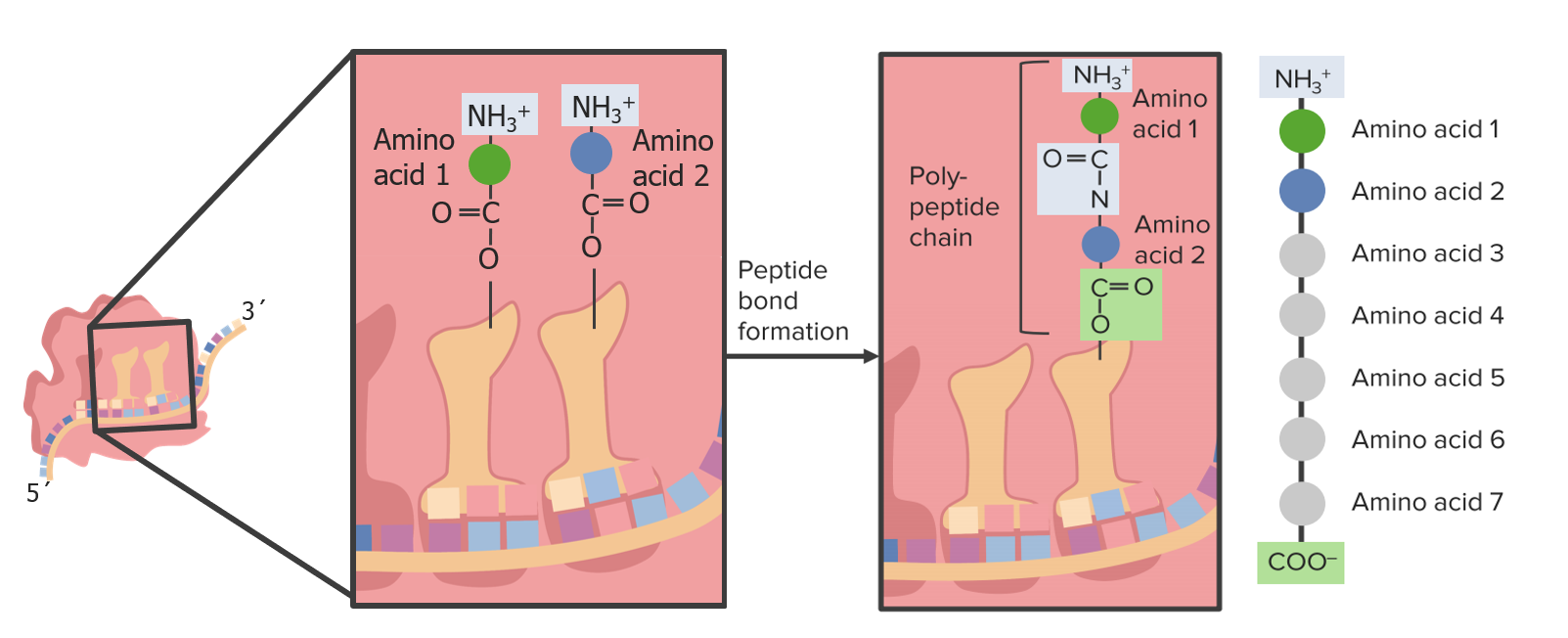
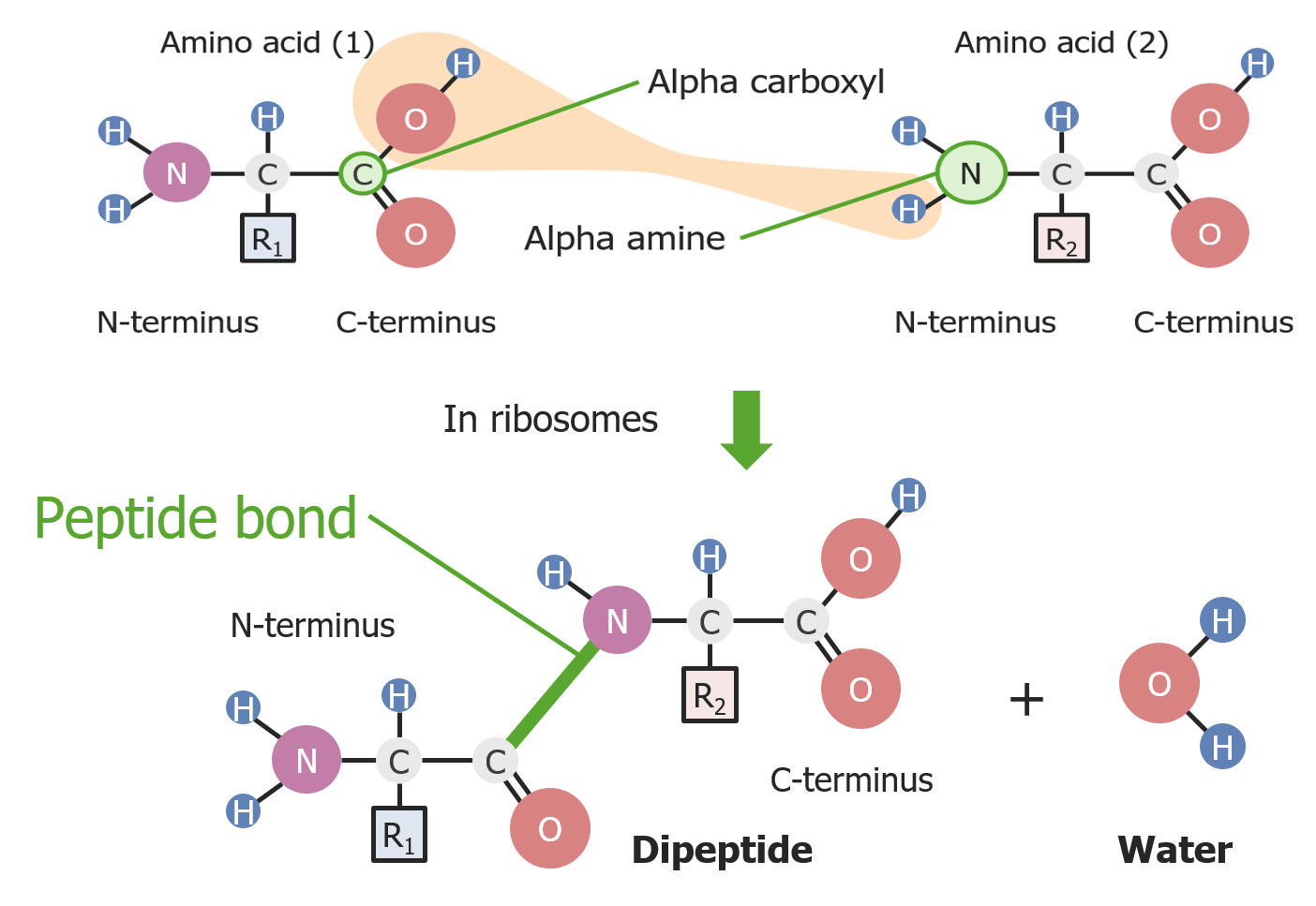
Formação de ligações peptídicas
Catalisado pela peptidil transferase (um rRNArRNAThe most abundant form of RNA. Together with proteins, it forms the ribosomes, playing a structural role and also a role in ribosomal binding of mRNA and tRNAs. Individual chains are conventionally designated by their sedimentation coefficients. In eukaryotes, four large chains exist, synthesized in the nucleolus and constituting about 50% of the ribosome.RNA Types and Structure enzimático dentro de um ribossoma)
Liga o carbono α-carboxílico ao azoto α-amina
Liberta H2O no processo
Formação de uma ligação peptídica entre 2 aminoácidos
Image by Lecturio.
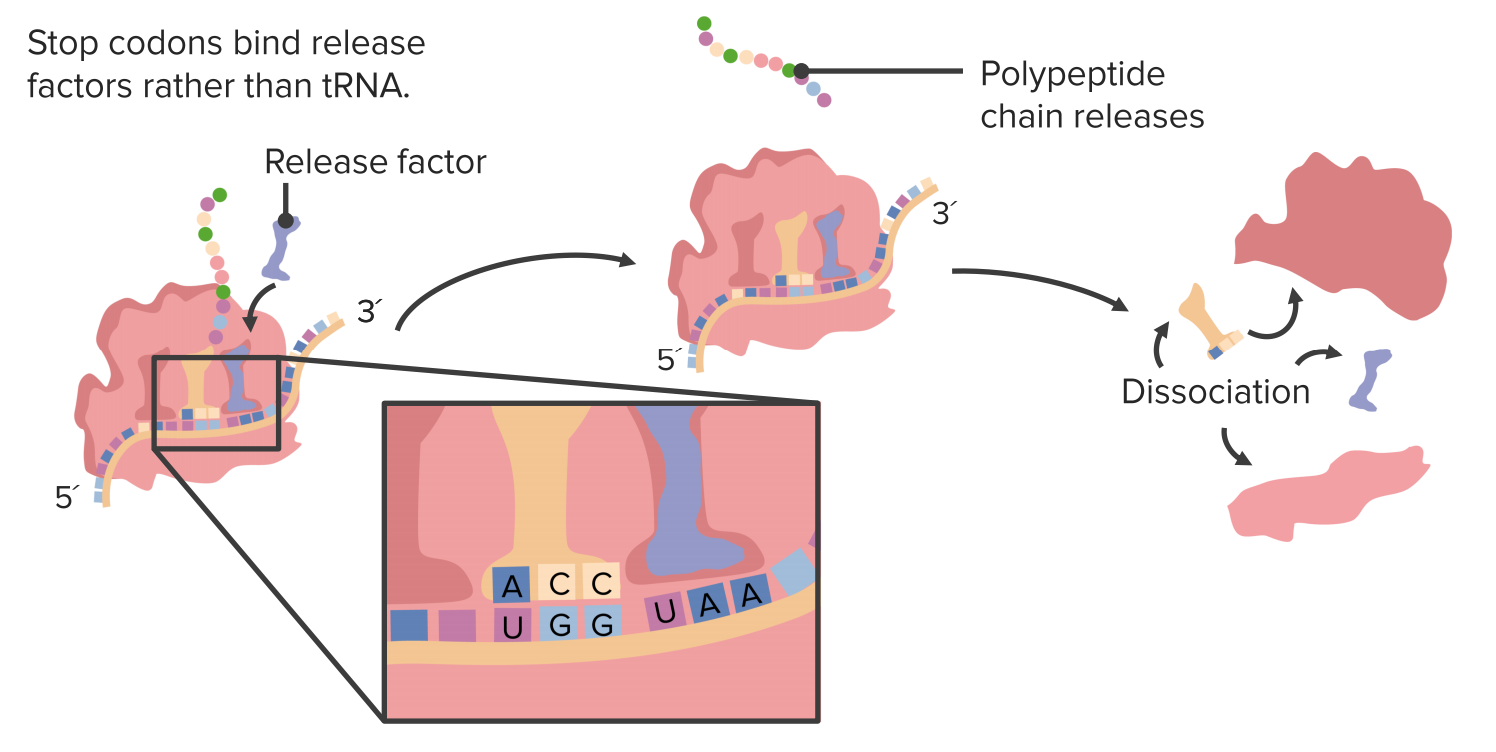
Terminação da tradução
A terminação ocorre quando o ribossoma atinge um codão de paragem.
Os codões de paragem codificam para um fator de libertação(FL) em vez de aminoácidos.
A tradução pode ser regulada no nível de iniciação, do alongamento ou da terminação, principalmente através de “up-regulation” (regulação positiva, a favorecendo a síntese) e “down-regulation” (regulação negativa, contra a síntese) de fatores de iniciação, alongamento e terminação. A tradução é também regulada através RNARNAA polynucleotide consisting essentially of chains with a repeating backbone of phosphate and ribose units to which nitrogenous bases are attached. RNA is unique among biological macromolecules in that it can encode genetic information, serve as an abundant structural component of cells, and also possesses catalytic activity.RNA Types and Structure de interferência, splicing alternativo e edição de RNARNAA polynucleotide consisting essentially of chains with a repeating backbone of phosphate and ribose units to which nitrogenous bases are attached. RNA is unique among biological macromolecules in that it can encode genetic information, serve as an abundant structural component of cells, and also possesses catalytic activity.RNA Types and Structure.
RNARNAA polynucleotide consisting essentially of chains with a repeating backbone of phosphate and ribose units to which nitrogenous bases are attached. RNA is unique among biological macromolecules in that it can encode genetic information, serve as an abundant structural component of cells, and also possesses catalytic activity.RNA Types and Structure de interferência
RNARNAA polynucleotide consisting essentially of chains with a repeating backbone of phosphate and ribose units to which nitrogenous bases are attached. RNA is unique among biological macromolecules in that it can encode genetic information, serve as an abundant structural component of cells, and also possesses catalytic activity.RNA Types and Structure de interferência (RNAi) são pequenas moléculas de RNARNAA polynucleotide consisting essentially of chains with a repeating backbone of phosphate and ribose units to which nitrogenous bases are attached. RNA is unique among biological macromolecules in that it can encode genetic information, serve as an abundant structural component of cells, and also possesses catalytic activity.RNA Types and Structure que causam interferência na tradução, que acabam por inibir a tradução de mRNAmRNARNA sequences that serve as templates for protein synthesis. Bacterial mRNAs are generally primary transcripts in that they do not require post-transcriptional processing. Eukaryotic mRNA is synthesized in the nucleus and must be exported to the cytoplasm for translation. Most eukaryotic mRNAs have a sequence of polyadenylic acid at the 3′ end, referred to as the poly(a) tail. The function of this tail is not known for certain, but it may play a role in the export of mature mRNA from the nucleus as well as in helping stabilize some mRNA molecules by retarding their degradation in the cytoplasm.RNA Types and Structure específicos.
Envolve RNARNAA polynucleotide consisting essentially of chains with a repeating backbone of phosphate and ribose units to which nitrogenous bases are attached. RNA is unique among biological macromolecules in that it can encode genetic information, serve as an abundant structural component of cells, and also possesses catalytic activity.RNA Types and Structure de cadeia dupla e um complexo proteico:
MicroRNA (miRNA): originam-se dentro da célula
RNARNAA polynucleotide consisting essentially of chains with a repeating backbone of phosphate and ribose units to which nitrogenous bases are attached. RNA is unique among biological macromolecules in that it can encode genetic information, serve as an abundant structural component of cells, and also possesses catalytic activity.RNA Types and Structure de silenciamento (siRNA) (ou pequenos RNARNAA polynucleotide consisting essentially of chains with a repeating backbone of phosphate and ribose units to which nitrogenous bases are attached. RNA is unique among biological macromolecules in that it can encode genetic information, serve as an abundant structural component of cells, and also possesses catalytic activity.RNA Types and Structure de interferência): originam-se fora da célula
Podem originar-se a partir de um vírus
Frequentemente usados em biotecnologia
Complexo silenciador induzido por RNARNAA polynucleotide consisting essentially of chains with a repeating backbone of phosphate and ribose units to which nitrogenous bases are attached. RNA is unique among biological macromolecules in that it can encode genetic information, serve as an abundant structural component of cells, and also possesses catalytic activity.RNA Types and Structure (RISC pela sigla em inglês): complexo de proteínas que incorpora um miRNA ou um siRNA e pode inibir a tradução
siRNAs e miRNAs estão envolvidos em:
Degradação seletiva de mRNAmRNARNA sequences that serve as templates for protein synthesis. Bacterial mRNAs are generally primary transcripts in that they do not require post-transcriptional processing. Eukaryotic mRNA is synthesized in the nucleus and must be exported to the cytoplasm for translation. Most eukaryotic mRNAs have a sequence of polyadenylic acid at the 3′ end, referred to as the poly(a) tail. The function of this tail is not known for certain, but it may play a role in the export of mature mRNA from the nucleus as well as in helping stabilize some mRNA molecules by retarding their degradation in the cytoplasm.RNA Types and Structure
Inibição da tradução
Alteração da estrutura da cromatina (mecanismos epigenéticos)
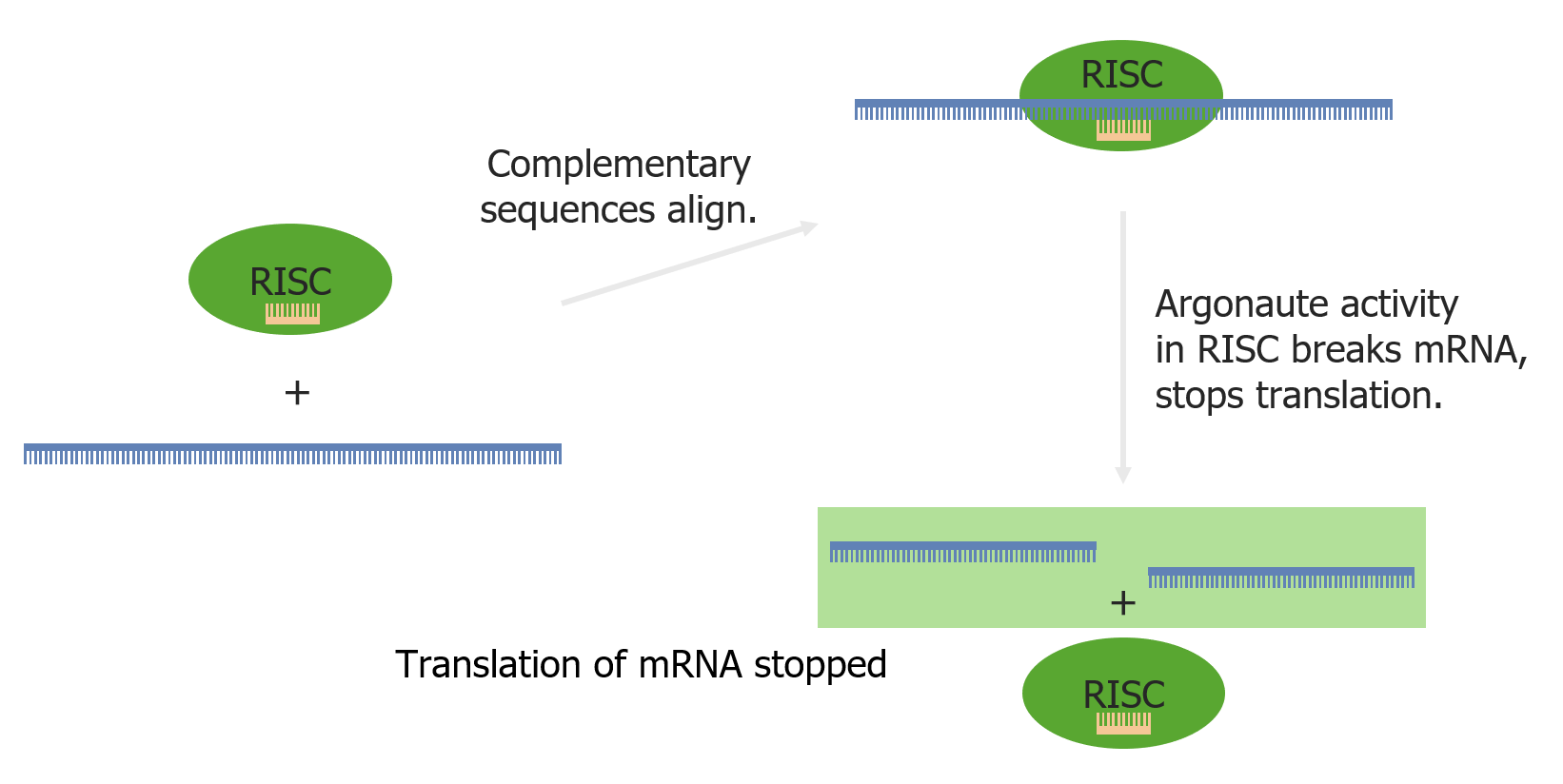
Como funciona o RNAi:
Uma enzima chamada “dicer” divide o RNARNAA polynucleotide consisting essentially of chains with a repeating backbone of phosphate and ribose units to which nitrogenous bases are attached. RNA is unique among biological macromolecules in that it can encode genetic information, serve as an abundant structural component of cells, and also possesses catalytic activity.RNA Types and Structure de cadeia dupla (dsRNA) em cerca de 20 segmentos de pares de base (seja miRNA ou siRNA).
Uma vez cortado, o dsRNA é separado em cadeias simples.
Quando estes segmentos miRNA/siRNA de cadeia única se ligam aos RISC, o RISC ajuda o miRNA/siRNA na ligação e inibição de uma cadeia complementar de mRNAmRNARNA sequences that serve as templates for protein synthesis. Bacterial mRNAs are generally primary transcripts in that they do not require post-transcriptional processing. Eukaryotic mRNA is synthesized in the nucleus and must be exported to the cytoplasm for translation. Most eukaryotic mRNAs have a sequence of polyadenylic acid at the 3′ end, referred to as the poly(a) tail. The function of this tail is not known for certain, but it may play a role in the export of mature mRNA from the nucleus as well as in helping stabilize some mRNA molecules by retarding their degradation in the cytoplasm.RNA Types and Structure.
Uma vez ligado a um mRNAmRNARNA sequences that serve as templates for protein synthesis. Bacterial mRNAs are generally primary transcripts in that they do not require post-transcriptional processing. Eukaryotic mRNA is synthesized in the nucleus and must be exported to the cytoplasm for translation. Most eukaryotic mRNAs have a sequence of polyadenylic acid at the 3′ end, referred to as the poly(a) tail. The function of this tail is not known for certain, but it may play a role in the export of mature mRNA from the nucleus as well as in helping stabilize some mRNA molecules by retarding their degradation in the cytoplasm.RNA Types and Structure, o RISC inibe a tradução por:
Corte de segmentos de mRNAmRNARNA sequences that serve as templates for protein synthesis. Bacterial mRNAs are generally primary transcripts in that they do not require post-transcriptional processing. Eukaryotic mRNA is synthesized in the nucleus and must be exported to the cytoplasm for translation. Most eukaryotic mRNAs have a sequence of polyadenylic acid at the 3′ end, referred to as the poly(a) tail. The function of this tail is not known for certain, but it may play a role in the export of mature mRNA from the nucleus as well as in helping stabilize some mRNA molecules by retarding their degradation in the cytoplasm.RNA Types and Structure com a enzima argonaute(parte do RISC).
Permanecendo ligado ao mRNAmRNARNA sequences that serve as templates for protein synthesis. Bacterial mRNAs are generally primary transcripts in that they do not require post-transcriptional processing. Eukaryotic mRNA is synthesized in the nucleus and must be exported to the cytoplasm for translation. Most eukaryotic mRNAs have a sequence of polyadenylic acid at the 3′ end, referred to as the poly(a) tail. The function of this tail is not known for certain, but it may play a role in the export of mature mRNA from the nucleus as well as in helping stabilize some mRNA molecules by retarding their degradation in the cytoplasm.RNA Types and Structure e bloqueando o ribossoma de completar a tradução.
Objetivos do RNAi:
Proteção contra certos vírus
Regulação da expressão génica
Em biotecnologia: permite aos biólogos moleculares silenciar genes-alvo específicos
Interferência de RNA através do RISC e de um miRNA
Image by Lecturio.
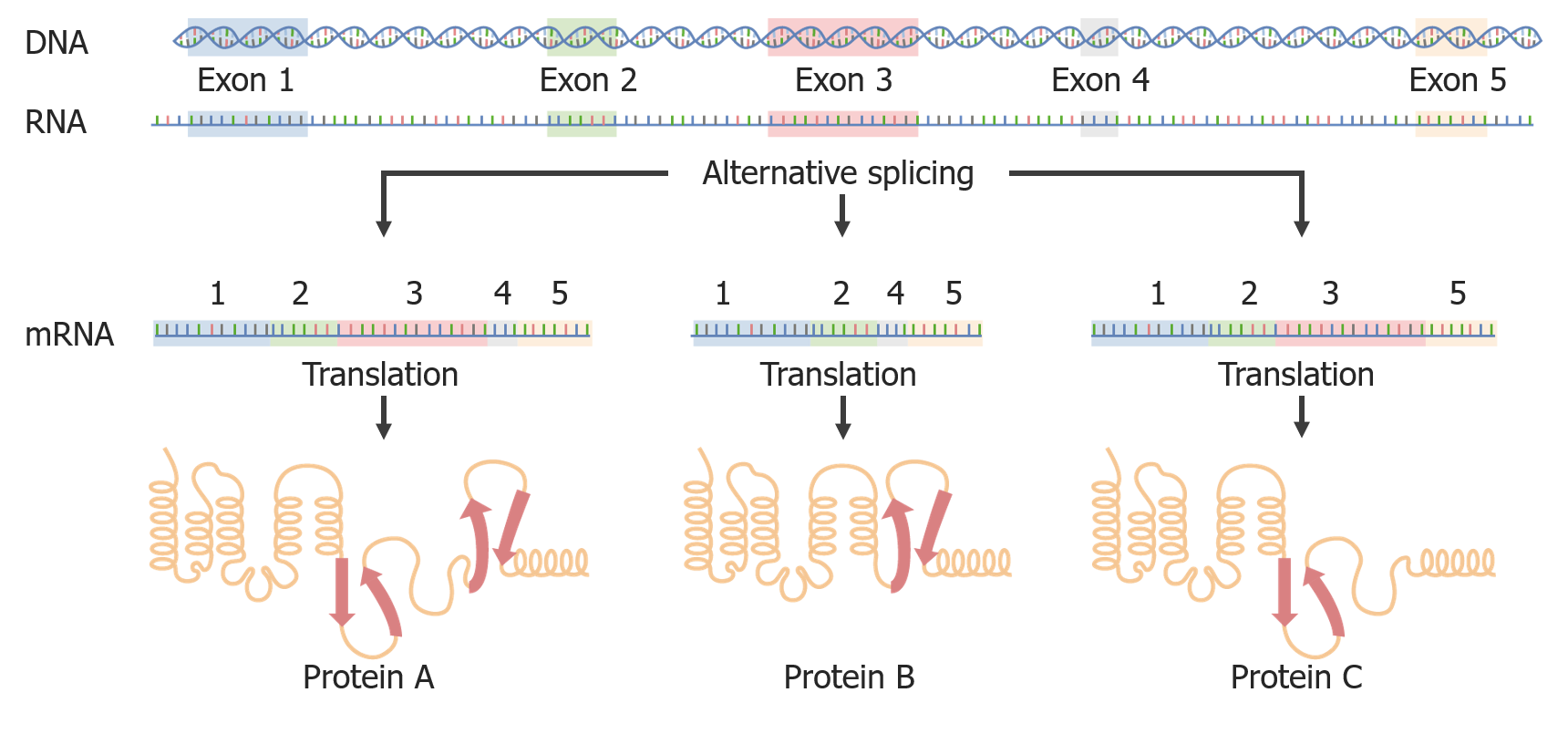
Splicing alternativo
Os intrões não codificantes são cortados por spliceosomas (complexos de ribonucleoproteínas enzimáticas).
Várias proteínas diferentes podem ser feitas a partir de um único geneGeneA category of nucleic acid sequences that function as units of heredity and which code for the basic instructions for the development, reproduction, and maintenance of organisms.Basic Terms of Genetics através de splicing diferencial do mRNAmRNARNA sequences that serve as templates for protein synthesis. Bacterial mRNAs are generally primary transcripts in that they do not require post-transcriptional processing. Eukaryotic mRNA is synthesized in the nucleus and must be exported to the cytoplasm for translation. Most eukaryotic mRNAs have a sequence of polyadenylic acid at the 3′ end, referred to as the poly(a) tail. The function of this tail is not known for certain, but it may play a role in the export of mature mRNA from the nucleus as well as in helping stabilize some mRNA molecules by retarding their degradation in the cytoplasm.RNA Types and Structure.
Splicing alternativo: Através do splicing de várias maneiras, diferentes proteínas podem ser criadas a partir do mesmo mRNA.
Image by Lecturio.
Edição de RNARNAA polynucleotide consisting essentially of chains with a repeating backbone of phosphate and ribose units to which nitrogenous bases are attached. RNA is unique among biological macromolecules in that it can encode genetic information, serve as an abundant structural component of cells, and also possesses catalytic activity.RNA Types and Structure
Os transcritos de mRNAmRNARNA sequences that serve as templates for protein synthesis. Bacterial mRNAs are generally primary transcripts in that they do not require post-transcriptional processing. Eukaryotic mRNA is synthesized in the nucleus and must be exported to the cytoplasm for translation. Most eukaryotic mRNAs have a sequence of polyadenylic acid at the 3′ end, referred to as the poly(a) tail. The function of this tail is not known for certain, but it may play a role in the export of mature mRNA from the nucleus as well as in helping stabilize some mRNA molecules by retarding their degradation in the cytoplasm.RNA Types and Structure podem ser editados por enzimas depois de já terem sido criados.
Exemplos de proteínas cujos mRNAmRNARNA sequences that serve as templates for protein synthesis. Bacterial mRNAs are generally primary transcripts in that they do not require post-transcriptional processing. Eukaryotic mRNA is synthesized in the nucleus and must be exported to the cytoplasm for translation. Most eukaryotic mRNAs have a sequence of polyadenylic acid at the 3′ end, referred to as the poly(a) tail. The function of this tail is not known for certain, but it may play a role in the export of mature mRNA from the nucleus as well as in helping stabilize some mRNA molecules by retarding their degradation in the cytoplasm.RNA Types and Structure sofrem edição:
Macrólidos e cetolidos: um grupo de antibióticos frequentemente usado em infeções respiratórias que funcionam através da inibição da subunidade 50S no ribossoma, bloqueando a síntese de proteínas em bactérias. Macrólidos comuns incluem eritromicina, claritromicina e azitromicina.
Tetraciclinas: um grupo de antibióticos bacteriostáticos de largo espetro que funcionam através da inibição da subunidade 30S no ribossoma, bloqueando a síntese de proteínas em bactérias. Um exemplo comum é a doxiciclina.
Toxina da difteria: a toxina da difteria ribosila o eEF-2, inibindo o alongamento e, consequentemente, a síntese de proteínas, levando à morte celular. As descobertas características da difteria incluem pseudomembranas faríngeas (exsudados de amígdalas cinzentos), faringite severa e uma linfadenopatia “pescoço de touro”. O tratamento é feito principalmente através da imunização passiva com antitoxinas e antibióticos. A prevenção é feita através da vacina contra a difteria toxoide.
Cancro: os miRNA podem atuar como supressores tumorais ou oncogénicos, desregulando a expressão génica.
Referências
Alberts, B., Heald, R., Johnson, A., Morgan, D., Raff, M., Roberts, K., Walter, P., & Wilson, J. (2022). Molecular biology of the cell (7th ed.). W.W. Norton & Company.
Blanchet, S., & Ranjan, N. (2022). Translation phases in eukaryotes. In K.-D. Entian (Ed.), Ribosome biogenesis: Methods and protocols (pp. 217–228). Springer US. https://doi.org/10.1007/978-1-0716-2501-9_13
Famà, V., Rossi, M. A., De Gregorio, L., & Biffo, S. (2025). Coupling mechanisms coordinating mRNA translation with stages of the mRNA lifecycle. RNA Biology, 22(1), 1–12. https://doi.org/10.1080/15476286.2025.2483001
Laham-Karam, N., Pinto, G. P., Poso, A., & Bartos, P. (2020). Transcription and translation inhibitors in cancer treatment. Frontiers in Chemistry, 8, Article 276. https://doi.org/10.3389/fchem.2020.00276
A Lecturio Medical complementa o teu estudo através de métodos de ensino baseados em evidência, vídeos de palestras, perguntas e muito mais – tudo combinado num só lugar e fácil de usar.
User Reviews
Details
×
Obtenha Premium para testar os seus conhecimentos
Lecturio Premium dá-lhe acesso total a todos os conteúdos e características
Obtenha Premium para ver todos os vídeos
Verifique agora o seu e-mail para obter um teste gratuito.
Crie uma conta gratuita para testar os seus conhecimentos
Lecturio Premium dá-lhe acesso total a todos os conteúdos e características - incluindo o Qbank de Lecturio com perguntas actualizadas ao estilo do board-.