



Antibióticos Antitumorais

Os antibióticos antitumorais, também conhecidos como antibióticos antineoplásicos, são o produto de micróbios do solo, bactérias Streptomyces. Os tipos de antibióticos antitumorais usados mais MAIS Androgen Insensitivity Syndrome frequentemente — a bleomicina, a dactinomicina e as antraciclinas — têm um amplo espetro de atividade contra malignidades hematológicas e tumores sólidos. A bleomicina difere do resto dos fármacos devido à sua ação específica no ciclo celular durante a fase G2. Os mecanismos de ação destes fármacos incluem danos no DNA DNA A deoxyribonucleotide polymer that is the primary genetic material of all cells. Eukaryotic and prokaryotic organisms normally contain DNA in a double-stranded state, yet several important biological processes transiently involve single-stranded regions. DNA, which consists of a polysugar-phosphate backbone possessing projections of purines (adenine and guanine) and pyrimidines (thymine and cytosine), forms a double helix that is held together by hydrogen bonds between these purines and pyrimidines (adenine to thymine and guanine to cytosine). DNA Types and Structure por radicais livres, inibição da topoisomerase II Topoisomerase II DNA topoisomerases that catalyze ATP-dependent breakage of both strands of DNA, passage of the unbroken strands through the breaks, and rejoining of the broken strands. These enzymes bring about relaxation of the supercoiled DNA and resolution of a knotted circular DNA duplex. Fluoroquinolones, ligação ao DNA DNA A deoxyribonucleotide polymer that is the primary genetic material of all cells. Eukaryotic and prokaryotic organisms normally contain DNA in a double-stranded state, yet several important biological processes transiently involve single-stranded regions. DNA, which consists of a polysugar-phosphate backbone possessing projections of purines (adenine and guanine) and pyrimidines (thymine and cytosine), forms a double helix that is held together by hydrogen bonds between these purines and pyrimidines (adenine to thymine and guanine to cytosine). DNA Types and Structure por intercalação e alteração da fluidez da membrana celular e do transporte de iões. Os efeitos adversos importantes incluem cardiotoxicidade (aguda e crónica) e mielossupressão.

Last updated: Dec 15, 2025

Editorial responsibility: Stanley Oiseth, Lindsay Jones, Evelin Maza

Descrição Geral

Os antibióticos antitumorais, agentes isolados de estirpes de Streptomyces, são utilizados para o tratamento de cancro devido à sua capacidade de interferir com a síntese de ADN e/ou RNA RNA A polynucleotide consisting essentially of chains with a repeating backbone of phosphate and ribose units to which nitrogenous bases are attached. RNA is unique among biological macromolecules in that it can encode genetic information, serve as an abundant structural component of cells, and also possesses catalytic activity. RNA Types and Structure, levando assim à morte de células cancerígenas. Os efeitos destes fármacos são demasiado tóxicos para serem usados em infeções bacterianas.

Os agentes nesta classe incluem:
  • Específico para o ciclo celular: bleomicina
  • Não específico para o ciclo celular:
    • Dactinomicina
    • Mitomicina
    • Antraciclinas

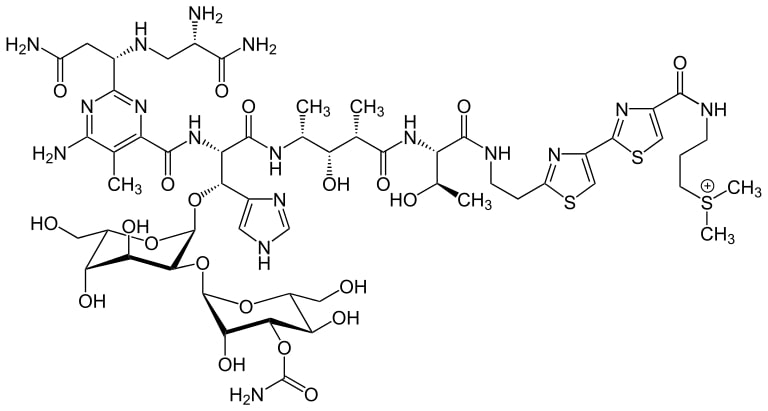
Bleomicina

Descrição

  • Fármaco específico do ciclo celular que atua na fase G2 do ciclo celular
  • Mecanismo de ação:
    • Contém um local de ligação de DNA DNA A deoxyribonucleotide polymer that is the primary genetic material of all cells. Eukaryotic and prokaryotic organisms normally contain DNA in a double-stranded state, yet several important biological processes transiently involve single-stranded regions. DNA, which consists of a polysugar-phosphate backbone possessing projections of purines (adenine and guanine) and pyrimidines (thymine and cytosine), forms a double helix that is held together by hydrogen bonds between these purines and pyrimidines (adenine to thymine and guanine to cytosine). DNA Types and Structure e um local de ligação de ferro → liga-se o DNA DNA A deoxyribonucleotide polymer that is the primary genetic material of all cells. Eukaryotic and prokaryotic organisms normally contain DNA in a double-stranded state, yet several important biological processes transiently involve single-stranded regions. DNA, which consists of a polysugar-phosphate backbone possessing projections of purines (adenine and guanine) and pyrimidines (thymine and cytosine), forms a double helix that is held together by hydrogen bonds between these purines and pyrimidines (adenine to thymine and guanine to cytosine). DNA Types and Structure, formando um complexo (DNA-bleomicina Fe(II))
    • Efeito: Quebras no DNA DNA A deoxyribonucleotide polymer that is the primary genetic material of all cells. Eukaryotic and prokaryotic organisms normally contain DNA in a double-stranded state, yet several important biological processes transiently involve single-stranded regions. DNA, which consists of a polysugar-phosphate backbone possessing projections of purines (adenine and guanine) and pyrimidines (thymine and cytosine), forms a double helix that is held together by hydrogen bonds between these purines and pyrimidines (adenine to thymine and guanine to cytosine). DNA Types and Structure de cadeia dupla e simples
  • Farmacocinética:
    • IV, IM, SC, intrapleural
    • Metabolismo: inativado enzimaticamente pela bleomicina hidrolase (não encontrada em quantidades significativas na pele e nos pulmões)
    • Meia-vida: 2 horas (IV)
    • Excreção: renal
  • Indicações (rotuladas):
    • Linfoma de Hodgkin
    • Cancro da cabeça e do pescoço
    • Cancro do testículo
    • Efusão pleural maligna (agente esclerosante)
Estrutura da bleomicina

Estrutura da bleomicina

Imagem: “Bleomycin A2” by Yikrazuul. Licença: Public Domain
Efeitos adversos

  • Toxicidade pulmonar que se apresenta como pneumonite:
  • Hepatotoxicidade
  • Toxicidade renal
  • Reação idiossincrática (↓ tensão arterial, pieira, febre, calafrios)
  • Dermatológica:
    • Erupções cutâneas
    • Hiperpigmentação
    • Alopecia Alopecia Alopecia is the loss of hair in areas anywhere on the body where hair normally grows. Alopecia may be defined as scarring or non-scarring, localized or diffuse, congenital or acquired, reversible or permanent, or confined to the scalp or universal; however, alopecia is usually classified using the 1st 3 factors. Alopecia

Contraindicações e interações medicamentosas

  • Contraindicações:
    • Hipersensibilidade ao fármaco
    • Gravidez (1.º trimestre)
  • Se houver alterações pulmonares, o tratamento deve ser retido e a relação com a bleomicina deve ser investigada.
  • Ajuste da dose em função renal deficiente
  • Interações medicamentosas (↑ toxicidade pulmonar da bleomicina):
    • Brentuximab
    • Gemcitabina
    • Fatores estimulantes de colónias de granulócitos
    • Oxigénio

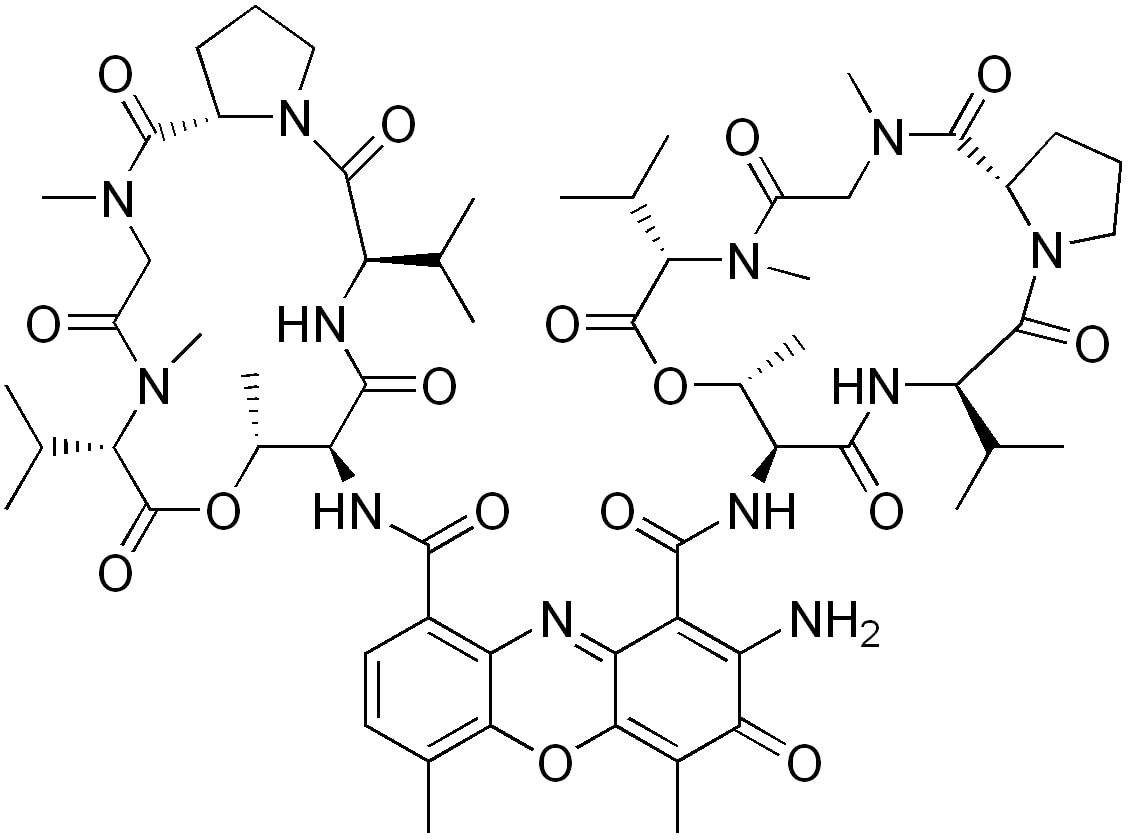
Dactinomicina

Descrição

  • Dactinomicina (actinomicina D)
  • Cromopéptido de Streptomyces
  • Mecanismo de ação:
    • Forma uma ligação com o DNA DNA A deoxyribonucleotide polymer that is the primary genetic material of all cells. Eukaryotic and prokaryotic organisms normally contain DNA in a double-stranded state, yet several important biological processes transiently involve single-stranded regions. DNA, which consists of a polysugar-phosphate backbone possessing projections of purines (adenine and guanine) and pyrimidines (thymine and cytosine), forms a double helix that is held together by hydrogen bonds between these purines and pyrimidines (adenine to thymine and guanine to cytosine). DNA Types and Structure, intercalando-se entre pares de bases Bases Usually a hydroxide of lithium, sodium, potassium, rubidium or cesium, but also the carbonates of these metals, ammonia, and the amines. Acid-Base Balance (citosina e guanina)
    • Evita a atividade da RNA RNA A polynucleotide consisting essentially of chains with a repeating backbone of phosphate and ribose units to which nitrogenous bases are attached. RNA is unique among biological macromolecules in that it can encode genetic information, serve as an abundant structural component of cells, and also possesses catalytic activity. RNA Types and Structure polimerase, bloqueando a transcrição de DNA DNA A deoxyribonucleotide polymer that is the primary genetic material of all cells. Eukaryotic and prokaryotic organisms normally contain DNA in a double-stranded state, yet several important biological processes transiently involve single-stranded regions. DNA, which consists of a polysugar-phosphate backbone possessing projections of purines (adenine and guanine) and pyrimidines (thymine and cytosine), forms a double helix that is held together by hydrogen bonds between these purines and pyrimidines (adenine to thymine and guanine to cytosine). DNA Types and Structure
    • Também produz quebras no DNA DNA A deoxyribonucleotide polymer that is the primary genetic material of all cells. Eukaryotic and prokaryotic organisms normally contain DNA in a double-stranded state, yet several important biological processes transiently involve single-stranded regions. DNA, which consists of a polysugar-phosphate backbone possessing projections of purines (adenine and guanine) and pyrimidines (thymine and cytosine), forms a double helix that is held together by hydrogen bonds between these purines and pyrimidines (adenine to thymine and guanine to cytosine). DNA Types and Structure de cadeia simples
  • Farmacocinética:
    • IV
    • Não atravessa a barreira hematoencefálica
    • Metabolismo residual
    • Meia-vida: 36 horas
    • Excreção: urina e fezes, 30%
  • Indicações (rotuladas):
    • Tumores sólidos
    • Tumor Tumor Inflammation de Wilms
    • Sarcoma de Ewing
    • Neoplasia trofoblástica gestacional
    • Rabdomiossarcoma
Estrutura da dactinomicina

Estrutura da dactinomicina

Imagem: “Actinomycin D” by Edgar181. Licença: Public Domain
Efeitos adversos

  • Mielossupressão
  • Toxicidade mucocutânea (como a síndrome de Stevens-Johnson, necrólise epidérmica tóxica)
  • Hepatotoxicidade ( tal TAL Renal Sodium and Water Regulation como ↑ bilirrubina, enzimas hepáticas)
  • Nefrotoxicidade
  • Toxicidade GI: náuseas, vómitos, diarreia
  • Extravasamento (causa danos locais nos tecidos)
  • Malignidade secundária (como a leucemia)

Contraindicações e interações medicamentosas

  • Evitar vacinas vivas antes e durante o tratamento com dactinomicina.
  • Dactinomicina:
    • ↑ Toxicidade quando combinada com radioterapia
    • ↓ Efeitos das vacinas inativadas e vivas
    • ↑ Efeitos tóxicos das vacinas vivas

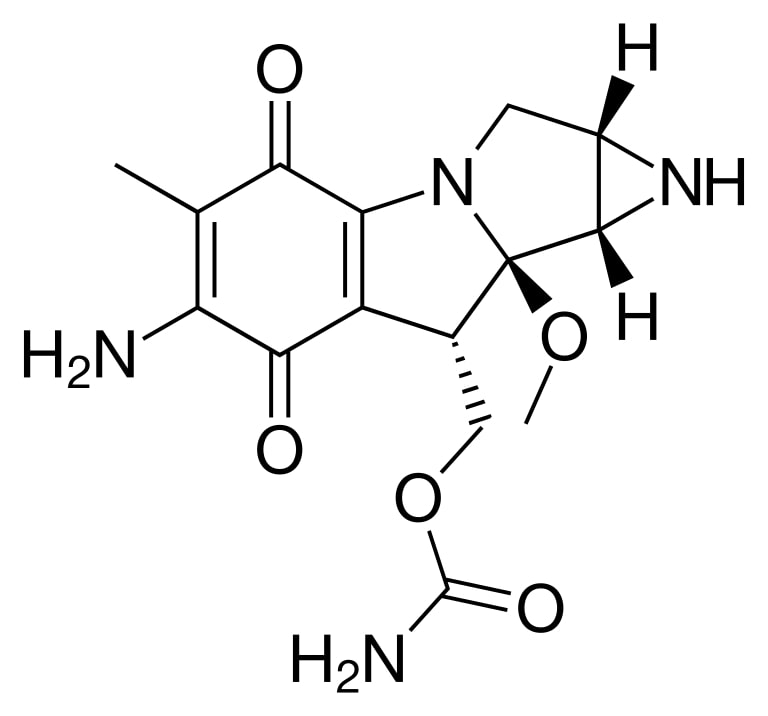
Mitomicina

Descrição

  • Mitomicina: isolada de Streptomyces caespitosus
  • A mitomicina é ativada em mitoseno.
  • Mecanismo de ação:
    • O mitoseno alquila o DNA DNA A deoxyribonucleotide polymer that is the primary genetic material of all cells. Eukaryotic and prokaryotic organisms normally contain DNA in a double-stranded state, yet several important biological processes transiently involve single-stranded regions. DNA, which consists of a polysugar-phosphate backbone possessing projections of purines (adenine and guanine) and pyrimidines (thymine and cytosine), forms a double helix that is held together by hydrogen bonds between these purines and pyrimidines (adenine to thymine and guanine to cytosine). DNA Types and Structure cria ligações cruzadas no DNA DNA A deoxyribonucleotide polymer that is the primary genetic material of all cells. Eukaryotic and prokaryotic organisms normally contain DNA in a double-stranded state, yet several important biological processes transiently involve single-stranded regions. DNA, which consists of a polysugar-phosphate backbone possessing projections of purines (adenine and guanine) and pyrimidines (thymine and cytosine), forms a double helix that is held together by hydrogen bonds between these purines and pyrimidines (adenine to thymine and guanine to cytosine). DNA Types and Structure
    • Previne a síntese de DNA DNA A deoxyribonucleotide polymer that is the primary genetic material of all cells. Eukaryotic and prokaryotic organisms normally contain DNA in a double-stranded state, yet several important biological processes transiently involve single-stranded regions. DNA, which consists of a polysugar-phosphate backbone possessing projections of purines (adenine and guanine) and pyrimidines (thymine and cytosine), forms a double helix that is held together by hydrogen bonds between these purines and pyrimidines (adenine to thymine and guanine to cytosine). DNA Types and Structure e de RNA RNA A polynucleotide consisting essentially of chains with a repeating backbone of phosphate and ribose units to which nitrogenous bases are attached. RNA is unique among biological macromolecules in that it can encode genetic information, serve as an abundant structural component of cells, and also possesses catalytic activity. RNA Types and Structure
  • Farmacocinética:
    • Metabolismo: fígado
    • Meia-vida: < 1 hora
    • Excreção: principalmente nas fezes (alguma parte através de excreção renal)
  • Indicações:
    • Cancro do estômago
    • Cancro do pâncreas
    • “Off-label”: cancro anal, cancro da bexiga, cancro do esófago, cancro do colo do útero, cancro da vulva Vulva The vulva is the external genitalia of the female and includes the mons pubis, labia majora, labia minora, clitoris, vestibule, vestibular bulb, and greater vestibular glands. Vagina, Vulva, and Pelvic Floor: Anatomy
Estrutura da mitomicina

Estrutura da mitomicina

Imagem: “Mitomycin” by Fvasconcellos. Licença: Public Domain
Efeitos adversos

  • Mielossupressão
  • Toxicidade miocárdica (insuficiência cardíaca)
  • Síndrome hemolítica urémica e insuficiência renal
  • Fibrose da bexiga (com administração intravesical)
  • Toxicidade pulmonar
  • Toxicidade GI: náuseas, vómitos, mucosite
  • Extravasamento

Contraindicações e interações medicamentosas

  • Contraindicações:
    • Hipersensibilidade
    • Tendência para hemorragia
    • Interromper a medicação com toxicidade significativa nos órgãos
  • Interações medicamentosas:
    • O tratamento concomitante com alcaloides da vinca pode causar broncoespasmo.
    • ↓ Efeitos das vacinas inativadas e vivas
    • ↑ Efeitos tóxicos das vacinas vivas

Antraciclinas

Descrição

  • As antraciclinas ou antibióticos de antraciclina são derivados de Streptomyces peucetius var. caesius.
  • Agentes quimioterápicos frequentemente usados para diferentes tipos de cancros (cancros hematológicos e tumores sólidos)
  • Mecanismos de ação:
    • Inibem a topoisomerase II Topoisomerase II DNA topoisomerases that catalyze ATP-dependent breakage of both strands of DNA, passage of the unbroken strands through the breaks, and rejoining of the broken strands. These enzymes bring about relaxation of the supercoiled DNA and resolution of a knotted circular DNA duplex. Fluoroquinolones e impedem a reparação do DNA DNA A deoxyribonucleotide polymer that is the primary genetic material of all cells. Eukaryotic and prokaryotic organisms normally contain DNA in a double-stranded state, yet several important biological processes transiently involve single-stranded regions. DNA, which consists of a polysugar-phosphate backbone possessing projections of purines (adenine and guanine) and pyrimidines (thymine and cytosine), forms a double helix that is held together by hydrogen bonds between these purines and pyrimidines (adenine to thymine and guanine to cytosine). DNA Types and Structure
    • Formam radicais livres de oxigénio, que se ligam ao DNA DNA A deoxyribonucleotide polymer that is the primary genetic material of all cells. Eukaryotic and prokaryotic organisms normally contain DNA in a double-stranded state, yet several important biological processes transiently involve single-stranded regions. DNA, which consists of a polysugar-phosphate backbone possessing projections of purines (adenine and guanine) and pyrimidines (thymine and cytosine), forms a double helix that is held together by hydrogen bonds between these purines and pyrimidines (adenine to thymine and guanine to cytosine). DNA Types and Structure de cadeia simples e dupla → causam danos
    • Intercalam com o DNA DNA A deoxyribonucleotide polymer that is the primary genetic material of all cells. Eukaryotic and prokaryotic organisms normally contain DNA in a double-stranded state, yet several important biological processes transiently involve single-stranded regions. DNA, which consists of a polysugar-phosphate backbone possessing projections of purines (adenine and guanine) and pyrimidines (thymine and cytosine), forms a double helix that is held together by hydrogen bonds between these purines and pyrimidines (adenine to thymine and guanine to cytosine). DNA Types and Structure para bloquear a transcrição e a replicação
    • Ligam-se a membranas celulares e alteram o transporte de iões
  • Farmacocinética:
    • IV
    • Metabolismo: fígado por hidrólise do anel de antraciclina
    • Eliminação: principalmente nas fezes através de excreção biliar
  • Indicações:
    • Doxorrubicina:
      • Cancro da mama
      • Cancro do ovário
      • Leucemia linfoblástica aguda (LLA), leucemia mieloide aguda (LMA)
      • Linfoma de Hodgkin, linfoma não Hodgkin
      • Cancro da bexiga
      • Sarcoma ósseo, sarcoma dos tecidos moles Moles Primary Skin Lesions
      • Carcinoma broncogénico
      • Cancro do estômago
      • Neuroblastoma Neuroblastoma Neuroblastoma is a malignancy that arises from the neural crest cell derivatives along the sympathetic chain (neuroblasts) and is most commonly located in the adrenal medulla. The tumor often presents in childhood with a flank mass that crosses the midline. Neuroblastoma
      • Carcinoma da tiróide
      • Tumor Tumor Inflammation de Wilms
    • Daunorrubicina:
      • LLA
      • LMA
    • Idarrubicina: LMA
    • Epirrubicina: cancro da mama
    • Mitoxantrona:
      • Cancro da próstata avançado
      • LMA
      • Esclerose múltipla
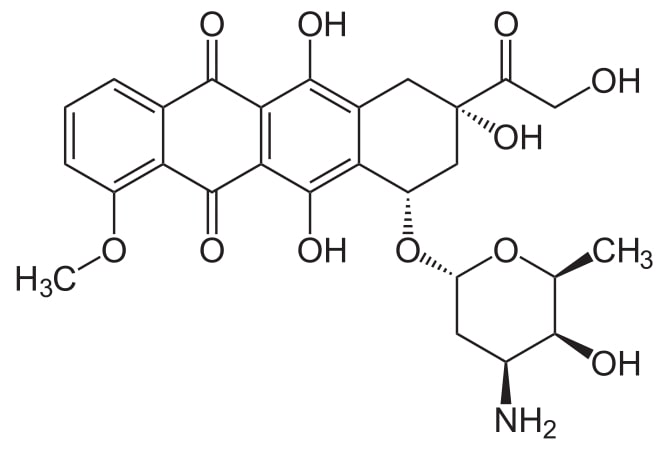
Estrutura da doxorrubicina

Estrutura da doxorrubicina

Imagem: “Doxorubicin2” by NEUROtiker. Licença: Public Domain
Efeitos adversos

  • Cardiotoxicidade:
    • Agudos: Distúrbios no ECG ECG An electrocardiogram (ECG) is a graphic representation of the electrical activity of the heart plotted against time. Adhesive electrodes are affixed to the skin surface allowing measurement of cardiac impulses from many angles. The ECG provides 3-dimensional information about the conduction system of the heart, the myocardium, and other cardiac structures. Electrocardiogram (ECG), pericardite, miocardite, níveis elevados de troponina
    • Crónicos:
      • Cardiomiopatia dilatada (dependente de fose) levando à insuficiência cardíaca
      • Resulta de radicais livres de oxigénio que danificam o miocárdio
      • Dexrazoxano: administrado para prevenir a cardiotoxicidade induzida por antraciclina (cancro da mama metastásico)
    • As formulações lipossomais de antraciclinas têm reduzido a incidência de cardiotoxicidade.
  • Mielossupressão
  • Malignidade secundária
  • Deficiência hepática
  • Extravasamento
  • Dermatite pós-radiação: Pode desenvolver-se eritema e descamação da pele em áreas tratadas com radiação.
  • Síndrome de lise tumoral
  • Mucosite

Contraindicações e interações medicamentosas

  • Contraindicações:
    • Hipersensibilidade ao fármaco
    • Função cardíaca deficiente ou doença cardíaca grave ou arritmia
    • Função hepática deficiente
    • Mielossupressão grave
    • Infeção ativa
  • Interações medicamentosas (particularmente a doxorrubicina):
    • Os seguintes ↑ risco de cardiotoxicidade:
    • ↓ Efeitos das vacinas inativadas e vivas
    • ↑ Efeitos tóxicos das vacinas vivas

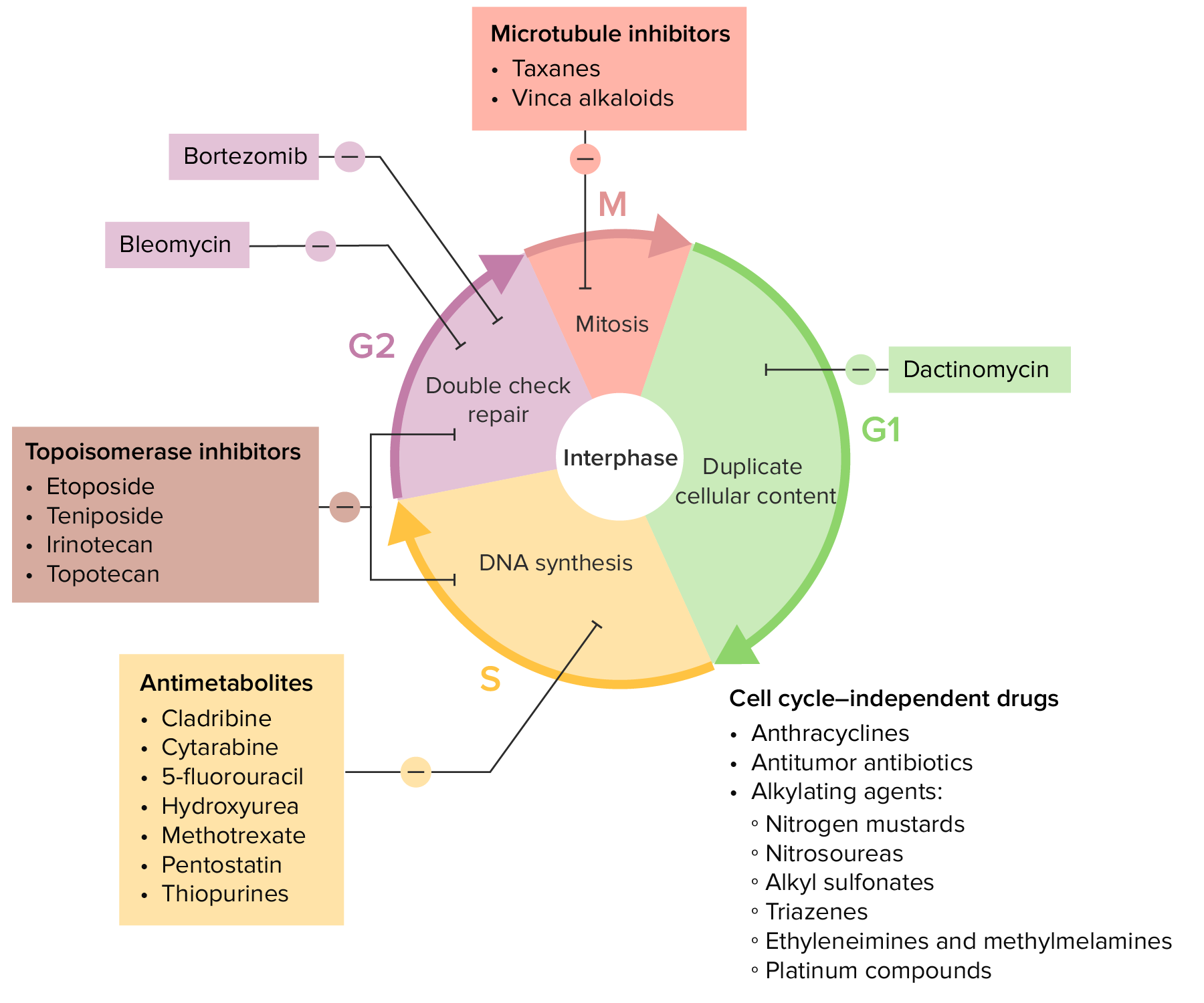
Comparação com outros agentes quimioterápicos

Vários fármacos quimioterápicos e os seus efeitos sobre o ciclo celular

Vários fármacos quimioterápicos e os seus efeitos sobre o ciclo celular

Imagem por Lecturio.
Tabela: Comparação dos fármacos de quimioterapia independentes do ciclo celular
Classe do fármaco Mecanismo
Antibióticos antitumorais:
  • Dactinomicina
  • Mitomicina
Intercalam-se entre bases Bases Usually a hydroxide of lithium, sodium, potassium, rubidium or cesium, but also the carbonates of these metals, ammonia, and the amines. Acid-Base Balance, levando ao bloqueio da síntese de DNA DNA A deoxyribonucleotide polymer that is the primary genetic material of all cells. Eukaryotic and prokaryotic organisms normally contain DNA in a double-stranded state, yet several important biological processes transiently involve single-stranded regions. DNA, which consists of a polysugar-phosphate backbone possessing projections of purines (adenine and guanine) and pyrimidines (thymine and cytosine), forms a double helix that is held together by hydrogen bonds between these purines and pyrimidines (adenine to thymine and guanine to cytosine). DNA Types and Structure ou de RNA RNA A polynucleotide consisting essentially of chains with a repeating backbone of phosphate and ribose units to which nitrogenous bases are attached. RNA is unique among biological macromolecules in that it can encode genetic information, serve as an abundant structural component of cells, and also possesses catalytic activity. RNA Types and Structure e à prevenção da replicação de DNA DNA A deoxyribonucleotide polymer that is the primary genetic material of all cells. Eukaryotic and prokaryotic organisms normally contain DNA in a double-stranded state, yet several important biological processes transiently involve single-stranded regions. DNA, which consists of a polysugar-phosphate backbone possessing projections of purines (adenine and guanine) and pyrimidines (thymine and cytosine), forms a double helix that is held together by hydrogen bonds between these purines and pyrimidines (adenine to thymine and guanine to cytosine). DNA Types and Structure
Antraciclinas
  • Inibição da topoisomerase II Topoisomerase II DNA topoisomerases that catalyze ATP-dependent breakage of both strands of DNA, passage of the unbroken strands through the breaks, and rejoining of the broken strands. These enzymes bring about relaxation of the supercoiled DNA and resolution of a knotted circular DNA duplex. Fluoroquinolones
  • Intercalação no DNA DNA A deoxyribonucleotide polymer that is the primary genetic material of all cells. Eukaryotic and prokaryotic organisms normally contain DNA in a double-stranded state, yet several important biological processes transiently involve single-stranded regions. DNA, which consists of a polysugar-phosphate backbone possessing projections of purines (adenine and guanine) and pyrimidines (thymine and cytosine), forms a double helix that is held together by hydrogen bonds between these purines and pyrimidines (adenine to thymine and guanine to cytosine). DNA Types and Structure, levando à inibição do DNA DNA A deoxyribonucleotide polymer that is the primary genetic material of all cells. Eukaryotic and prokaryotic organisms normally contain DNA in a double-stranded state, yet several important biological processes transiently involve single-stranded regions. DNA, which consists of a polysugar-phosphate backbone possessing projections of purines (adenine and guanine) and pyrimidines (thymine and cytosine), forms a double helix that is held together by hydrogen bonds between these purines and pyrimidines (adenine to thymine and guanine to cytosine). DNA Types and Structure e do RNA RNA A polynucleotide consisting essentially of chains with a repeating backbone of phosphate and ribose units to which nitrogenous bases are attached. RNA is unique among biological macromolecules in that it can encode genetic information, serve as an abundant structural component of cells, and also possesses catalytic activity. RNA Types and Structure
  • Promove a formação de espécies reativas de oxigénio
Agentes alquilantes
  • ↓ Síntese de DNA DNA A deoxyribonucleotide polymer that is the primary genetic material of all cells. Eukaryotic and prokaryotic organisms normally contain DNA in a double-stranded state, yet several important biological processes transiently involve single-stranded regions. DNA, which consists of a polysugar-phosphate backbone possessing projections of purines (adenine and guanine) and pyrimidines (thymine and cytosine), forms a double helix that is held together by hydrogen bonds between these purines and pyrimidines (adenine to thymine and guanine to cytosine). DNA Types and Structure devido à sua alquilação
  • ↓ Replicação de DNA DNA A deoxyribonucleotide polymer that is the primary genetic material of all cells. Eukaryotic and prokaryotic organisms normally contain DNA in a double-stranded state, yet several important biological processes transiently involve single-stranded regions. DNA, which consists of a polysugar-phosphate backbone possessing projections of purines (adenine and guanine) and pyrimidines (thymine and cytosine), forms a double helix that is held together by hydrogen bonds between these purines and pyrimidines (adenine to thymine and guanine to cytosine). DNA Types and Structure, síntese de proteínas
Tabela: Comparação dos fármacos de quimioterapia dependentes do ciclo celular
Classe do fármaco Fase do ciclo celular afetada Mecanismo de ação
Antifolatos Paragem do ciclo celular na fase S Inibem:
  • Dihidrofolato redutase
  • Tiamidilato sintase
Bleomicina Paragem do ciclo celular na fase G2 Ligam-se ao DNA DNA A deoxyribonucleotide polymer that is the primary genetic material of all cells. Eukaryotic and prokaryotic organisms normally contain DNA in a double-stranded state, yet several important biological processes transiently involve single-stranded regions. DNA, which consists of a polysugar-phosphate backbone possessing projections of purines (adenine and guanine) and pyrimidines (thymine and cytosine), forms a double helix that is held together by hydrogen bonds between these purines and pyrimidines (adenine to thymine and guanine to cytosine). DNA Types and Structure, levando a quebras em cadeias duplas e simples
Fluoropirimidinas Paragem do ciclo celular na fase S Inibem a timidilato sintetase
Análogos de desoxicitidina Paragem do ciclo celular na fase S Inibem:
  • DNA DNA A deoxyribonucleotide polymer that is the primary genetic material of all cells. Eukaryotic and prokaryotic organisms normally contain DNA in a double-stranded state, yet several important biological processes transiently involve single-stranded regions. DNA, which consists of a polysugar-phosphate backbone possessing projections of purines (adenine and guanine) and pyrimidines (thymine and cytosine), forms a double helix that is held together by hydrogen bonds between these purines and pyrimidines (adenine to thymine and guanine to cytosine). DNA Types and Structure polimerase
  • Ribonucleótido redutase
Análogos de purina Paragem do ciclo celular na fase S Inibição da síntese de novo de purinas
Inibidores da topoisomerase II Topoisomerase II DNA topoisomerases that catalyze ATP-dependent breakage of both strands of DNA, passage of the unbroken strands through the breaks, and rejoining of the broken strands. These enzymes bring about relaxation of the supercoiled DNA and resolution of a knotted circular DNA duplex. Fluoroquinolones Paragem do ciclo celular nas fases S e G2 Inibem a topoisomerase II Topoisomerase II DNA topoisomerases that catalyze ATP-dependent breakage of both strands of DNA, passage of the unbroken strands through the breaks, and rejoining of the broken strands. These enzymes bring about relaxation of the supercoiled DNA and resolution of a knotted circular DNA duplex. Fluoroquinolones
Taxanos Paragem do ciclo celular na metáfase da fase M Hiperestabilização de microtúbulos
Alcaloides da vinca Paragem do ciclo celular durante a metáfase da fase M Ligam-se à beta-tubulina e previnem a polimerização de microtúbulos

Referências

  1. Chu E. (2021). Cancer chemotherapy. Chapter 54 in Katzung B. G., Vanderah T. W. (Eds.), Basic & Clinical Pharmacology, 15th ed. McGraw-Hill. Retrieved September 22, 2021, from https://accessmedicine.mhmedical.com/content.aspx?bookid=2988&sectionid=250603422
  2. Gao, Y., Shang, Q., Li, W., et al. (2020) Antibiotics for cancer treatment: a double-edged sword. J Cancer 11, pp. 5135–5149. Retrieved September 22, 2021, from doi:10.7150/jca.47470
  3. Hollingshead, L.M., Faulds, D. (1991) Idarubicin: a review of its pharmacodynamic and pharmacokinetic properties, and therapeutic potential in the chemotherapy of cancer. Drugs 42, pp. 690–719. Retrieved September 22, 2021, from doi.org/10.2165/00003495-199142040-00010
  4. Johnson-Arbor, K., Dubey, R. (2021) Doxorubicin. StatPearls. Retrieved September 22, 2021, from https://www.ncbi.nlm.nih.gov/books/NBK459232/
  5. Saleem, T., Kasi, A. (2020) Daunorubicin. StatPearls. Retrieved September 22, 2021, from https://www.ncbi.nlm.nih.gov/books/NBK559073/
  6. Thorn, C. F., Oshiro, C., Marsh, S., et al. (2011) Doxorubicin pathways: pharmacodynamics and adverse effects. Pharmacogenet Genomics 21, pp. 440–446. Retrieved September 22, 2021, from doi.org/10.1097/FPC.0b013e32833ffb56
  7. Bleomycin. (2021). UpToDate. Retrieved September 22, 2021, from https://www.uptodate.com/contents/bleomycin-drug-information
  8. Dactinomycin. (2021). UpToDate. Retrieved September 22, 2021, from https://www.uptodate.com/contents/dactinomycin-drug-information
  9. Epirubicin. (2021). UpToDate. Retrieved September 22, 2021, from https://www.uptodate.com/contents/epirubicin-drug-information
  10. Idarubicin. (2021). UpToDate. Retrieved September 22, 2021, from https://www.uptodate.com/contents/idarubicin-drug-information
  11. Mitomycin. (2021). UpToDate. Retrieved September 22, 2021, from https://www.uptodate.com/contents/mitomycin-intravenous-and-intravesical-systemic-drug-information
  12. Mitoxantrone. (2021). UpToDate. Retrieved September 22, 2021, from https://www.uptodate.com/contents/mitoxantrone-drug-information
  13. Wellstein, A., Giaccone, G., Atkins, M. B., Sausville, E. A. (2017). Cytotoxic drugs. Chapter 66 in Brunton, L. L., Hilal-Dandan, R., Knollmann B. C. (Eds.), Goodman & Gilman’s: The Pharmacological Basis of Therapeutics, 13th ed. McGraw-Hill. Retrieved September 22, 2021, from https://accessmedicine.mhmedical.com/content.aspx?bookid=2189&sectionid=172486857

Crie sua conta gratuita ou faça login para continuar lendo!

Cadastre-se agora e tenha acesso grátis ao Lecturio, com páginas de conceitos, vídeos de medicina e questões para sua educação médica.

Aprende mais com a Lecturio:

Multiple devices displaying human anatomy and health education content.

Complementa o teu estudo da faculdade com o companheiro de estudo tudo-em-um da Lecturio, através de métodos de ensino baseados em evidência.

Estuda onde quiseres

Two iPhones display medical education apps, one showing anatomy, the other Bookmatcher.

A Lecturio Medical complementa o teu estudo através de métodos de ensino baseados em evidência, vídeos de palestras, perguntas e muito mais – tudo combinado num só lugar e fácil de usar.

User Reviews

Have a holly, jolly study session 🎁 Save 50% on all plans now >>

Que tengas una sesión de estudio alegre y navideña 🎁 Ahorra 50% en todos los planes >>

Details