Domina Conceptos Médicos

Estudia para la escuela de medicina y tus examenes con Lecturio.

Virología

Los LOS Neisseria virus Virus Viruses are infectious, obligate intracellular parasites composed of a nucleic acid core surrounded by a protein capsid. Viruses can be either naked (non-enveloped) or enveloped. The classification of viruses is complex and based on many factors, including type and structure of the nucleoid and capsid, the presence of an envelope, the replication cycle, and the host range. Virology son parásitos intracelulares obligados infecciosos compuestos por ácidos nucleicos rodeados por una cápside proteica. Los LOS Neisseria virus Virus Viruses are infectious, obligate intracellular parasites composed of a nucleic acid core surrounded by a protein capsid. Viruses can be either naked (non-enveloped) or enveloped. The classification of viruses is complex and based on many factors, including type and structure of the nucleoid and capsid, the presence of an envelope, the replication cycle, and the host range. Virology pueden ser desnudos (sin envoltura) o con envoltura. La clasificación de los LOS Neisseria virus Virus Viruses are infectious, obligate intracellular parasites composed of a nucleic acid core surrounded by a protein capsid. Viruses can be either naked (non-enveloped) or enveloped. The classification of viruses is complex and based on many factors, including type and structure of the nucleoid and capsid, the presence of an envelope, the replication cycle, and the host range. Virology es compleja y se basa en EN Erythema nodosum is an immune-mediated panniculitis (inflammation of the subcutaneous fat) caused by a type IV (delayed-type) hypersensitivity reaction. It commonly manifests in young women as tender, erythematous nodules on the shins. Erythema Nodosum muchos factores, como el tipo y la estructura del nucleoide y de la cápside, la presencia de una envoltura, el ciclo de replicación y la variedad de hospederos. El ciclo de replicación difiere entre los LOS Neisseria virus Virus Viruses are infectious, obligate intracellular parasites composed of a nucleic acid core surrounded by a protein capsid. Viruses can be either naked (non-enveloped) or enveloped. The classification of viruses is complex and based on many factors, including type and structure of the nucleoid and capsid, the presence of an envelope, the replication cycle, and the host range. Virology que infectan bacterias (bacteriófagos) y los LOS Neisseria virus Virus Viruses are infectious, obligate intracellular parasites composed of a nucleic acid core surrounded by a protein capsid. Viruses can be either naked (non-enveloped) or enveloped. The classification of viruses is complex and based on many factors, including type and structure of the nucleoid and capsid, the presence of an envelope, the replication cycle, and the host range. Virology que infectan células eucariotas. Los LOS Neisseria bacteriófagos tienen un ciclo de replicación lítico o lisogénico, mientras que los LOS Neisseria virus Virus Viruses are infectious, obligate intracellular parasites composed of a nucleic acid core surrounded by a protein capsid. Viruses can be either naked (non-enveloped) or enveloped. The classification of viruses is complex and based on many factors, including type and structure of the nucleoid and capsid, the presence of an envelope, the replication cycle, and the host range. Virology eucariotas tienen un proceso de replicación definido de 6 pasos.

Last updated: Dec 15, 2025

Editorial responsibility: Stanley Oiseth, Lindsay Jones, Evelin Maza

Definición

Los LOS Neisseria virus Virus Viruses are infectious, obligate intracellular parasites composed of a nucleic acid core surrounded by a protein capsid. Viruses can be either naked (non-enveloped) or enveloped. The classification of viruses is complex and based on many factors, including type and structure of the nucleoid and capsid, the presence of an envelope, the replication cycle, and the host range. Virology son parásitos intracelulares obligados, infecciosos, compuestos por ácidos nucleicos (ácido desoxirribonucleico (ADN) o ácido ribonucleico (ARN)) rodeado por una cápsula proteica; a veces, los LOS Neisseria virus Virus Viruses are infectious, obligate intracellular parasites composed of a nucleic acid core surrounded by a protein capsid. Viruses can be either naked (non-enveloped) or enveloped. The classification of viruses is complex and based on many factors, including type and structure of the nucleoid and capsid, the presence of an envelope, the replication cycle, and the host range. Virology también están rodeados por una envoltura derivada de las membranas de la célula huésped.
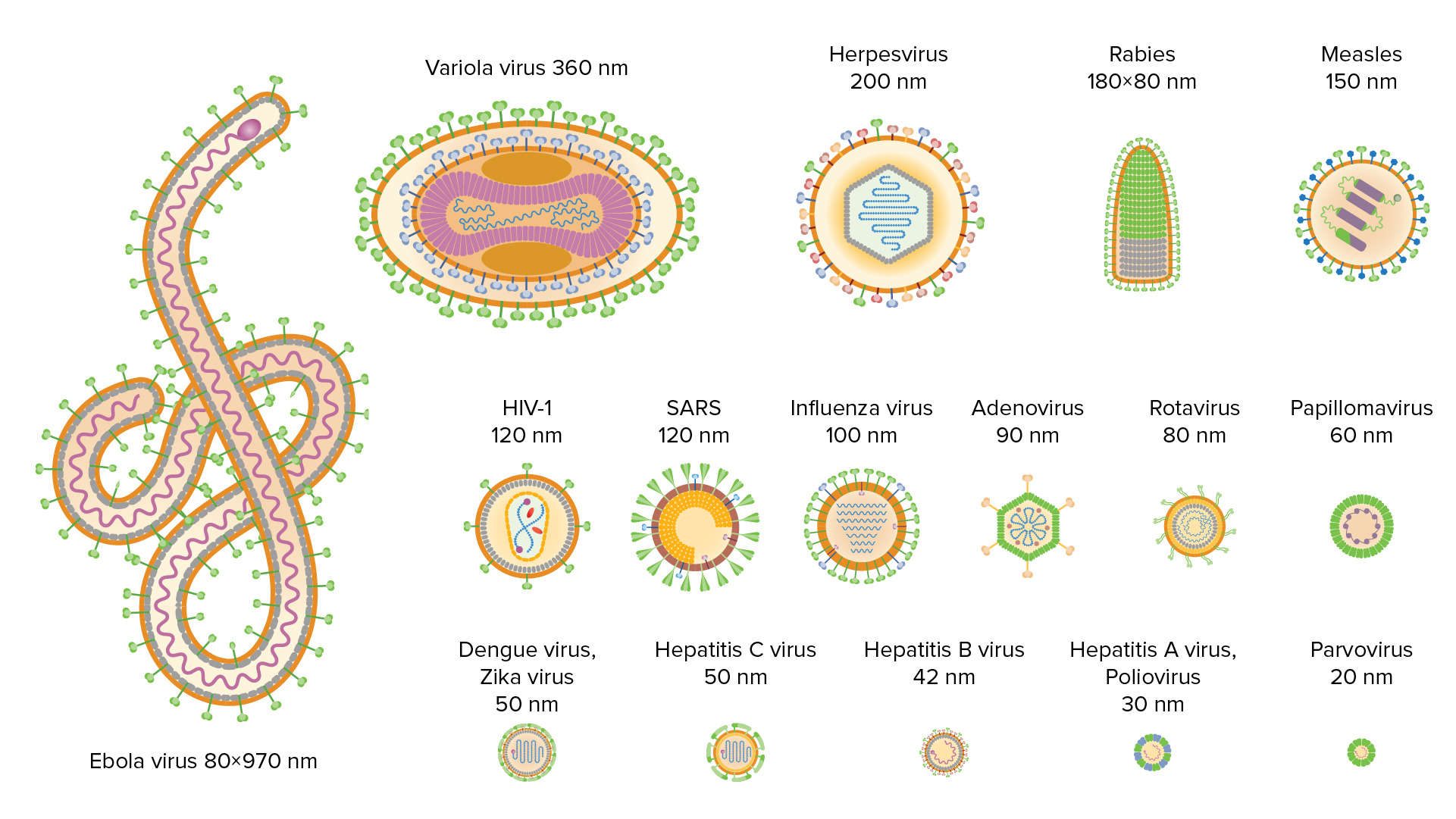
Tipos de virus

Variedad de virus existentes, incluyendo el tamaño y la morfología

Imagen por Lecturio. Licencia: CC BY-NC-SA 4.0

Estructura

La estructura básica consiste en EN Erythema nodosum is an immune-mediated panniculitis (inflammation of the subcutaneous fat) caused by a type IV (delayed-type) hypersensitivity reaction. It commonly manifests in young women as tender, erythematous nodules on the shins. Erythema Nodosum:
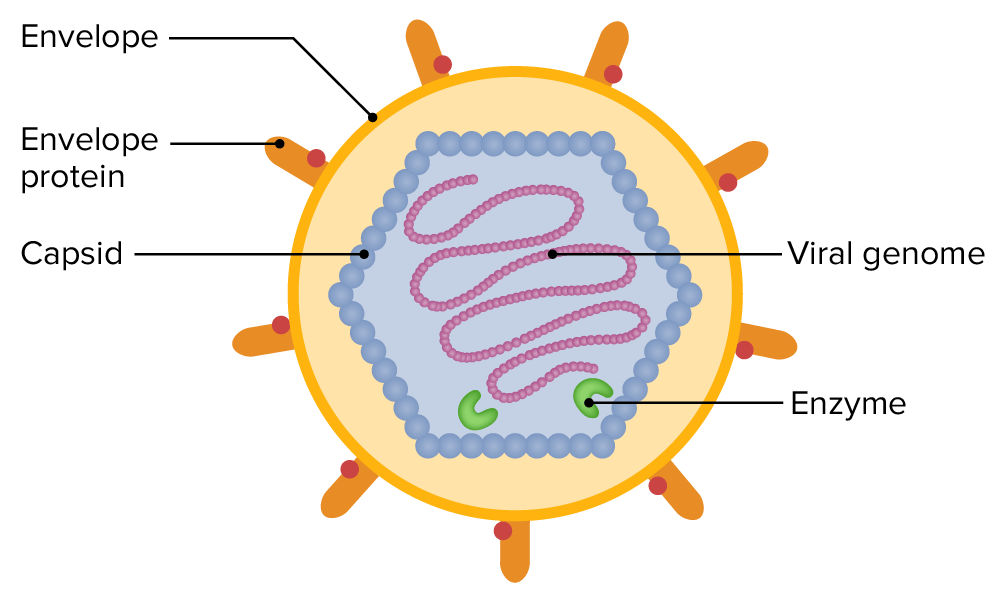
  • La “maquinaria” interna que permite al AL Amyloidosis virus Virus Viruses are infectious, obligate intracellular parasites composed of a nucleic acid core surrounded by a protein capsid. Viruses can be either naked (non-enveloped) or enveloped. The classification of viruses is complex and based on many factors, including type and structure of the nucleoid and capsid, the presence of an envelope, the replication cycle, and the host range. Virology replicarse dentro de las células del huésped
  • Componente estructural externo que permite al AL Amyloidosis virus Virus Viruses are infectious, obligate intracellular parasites composed of a nucleic acid core surrounded by a protein capsid. Viruses can be either naked (non-enveloped) or enveloped. The classification of viruses is complex and based on many factors, including type and structure of the nucleoid and capsid, the presence of an envelope, the replication cycle, and the host range. Virology sobrevivir en EN Erythema nodosum is an immune-mediated panniculitis (inflammation of the subcutaneous fat) caused by a type IV (delayed-type) hypersensitivity reaction. It commonly manifests in young women as tender, erythematous nodules on the shins. Erythema Nodosum el entorno y unirse a las células del huésped
Anatomy of virus

Anatomy of a virus

Image by Lecturio.

Componentes internos

  • Genoma viral (nucleoide): diverso, compuesto por ARN o ADN
  • Enzimas virales: necesarias para la replicación viral dentro de la célula huésped:
    • ARN polimerasa dependiente de ADN
    • ARN polimerasa dependiente de ARN
    • ADN polimerasa dependiente de ARN (transcriptasa inversa)

Componentes exteriores

  • Cápside:
    • Membrana protéica de una o dos capas que rodea el nucleoide
    • Formado por subunidades, conocidas como capsómeros
    • 3 patrones estructurales:
      • Icosahédrico
      • Helicoidal
      • Complejo
  • Envoltura:
    • Puede o no estar presente
    • Rodea la nucleocápside
    • Compuesto por proteínas específicas del virus Virus Viruses are infectious, obligate intracellular parasites composed of a nucleic acid core surrounded by a protein capsid. Viruses can be either naked (non-enveloped) or enveloped. The classification of viruses is complex and based on many factors, including type and structure of the nucleoid and capsid, the presence of an envelope, the replication cycle, and the host range. Virology, lípidos y carbohidratos (derivados de las membranas de la célula huésped)
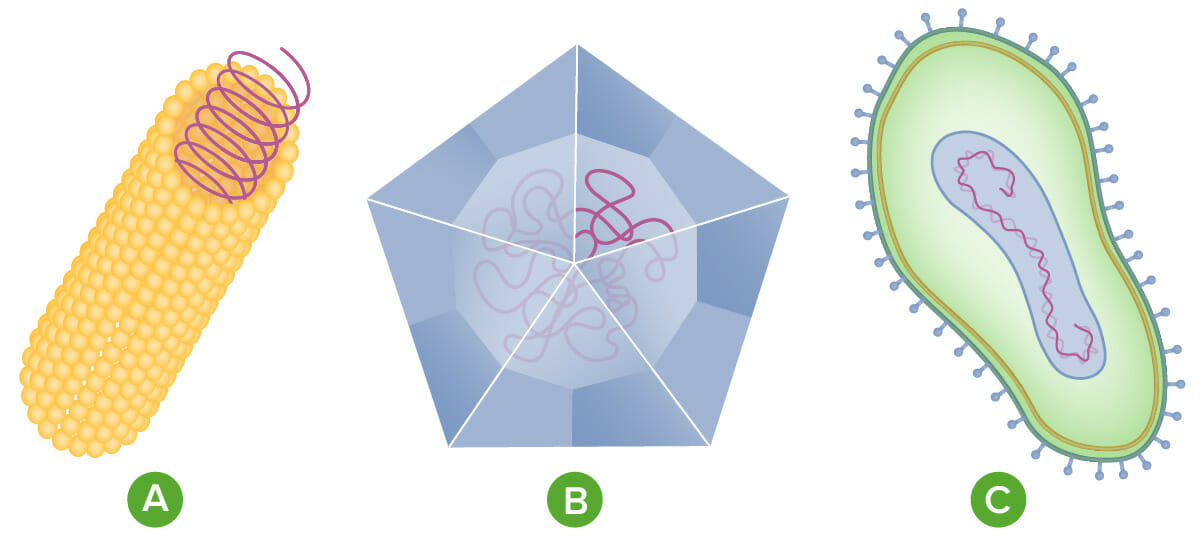
Viral capsid types

La cápside viral puede ser (a) helicoidal, (b) poliédrica, o (c) tener una forma compleja

Imagen por Lecturio.
Clasificación

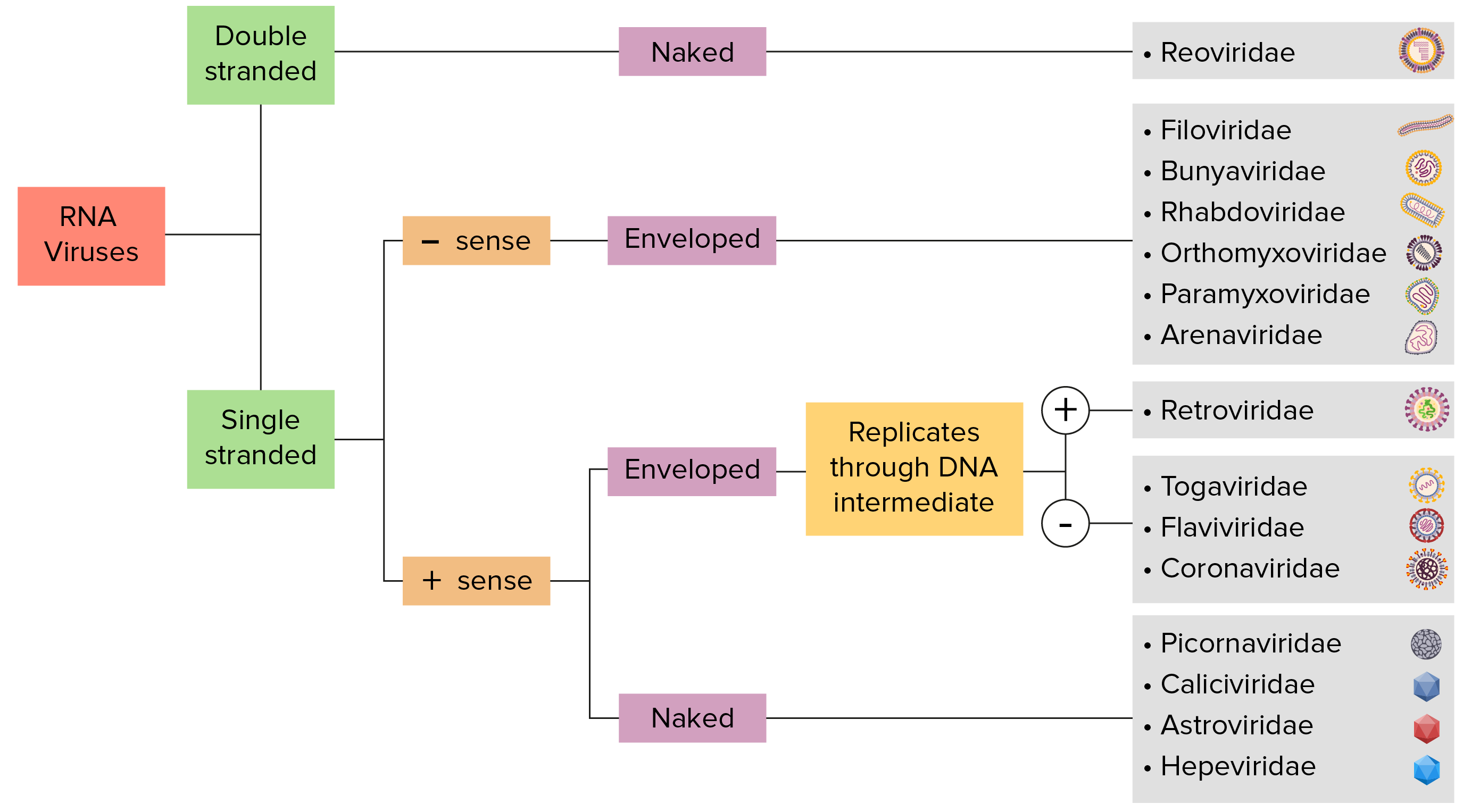
Clasificación del diagrama de flujo de los virus de ARN

Identificación de los virus de ARN:
Los virus pueden clasificarse de muchas maneras. Sin embargo, la mayoría de los virus tienen un genoma formado por ADN o ARN. Los virus con genoma de ARN pueden caracterizarse además, por tener ARN monocatenario o bicatenario. Los virus “envueltos” están cubiertos por una fina capa de membrana celular (normalmente tomada de la célula huésped). Si la capa está ausente, los virus se denominan “desnudos”. Los virus con genomas monocatenarios son positivos si el genoma se emplea directamente como ARN mensajero (ARNm), que se traduce en proteínas. Los virus monocatenarios negativos emplean la ARN polimerasa, una enzima viral, para transcribir su genoma en ARN mensajero.

Imagen por Lecturio. Licencia: CC BY-NC-SA 4.0

Existen múltiples esquemas de categorización para los LOS Neisseria virus Virus Viruses are infectious, obligate intracellular parasites composed of a nucleic acid core surrounded by a protein capsid. Viruses can be either naked (non-enveloped) or enveloped. The classification of viruses is complex and based on many factors, including type and structure of the nucleoid and capsid, the presence of an envelope, the replication cycle, and the host range. Virology, basados en EN Erythema nodosum is an immune-mediated panniculitis (inflammation of the subcutaneous fat) caused by a type IV (delayed-type) hypersensitivity reaction. It commonly manifests in young women as tender, erythematous nodules on the shins. Erythema Nodosum características físicas y estrategias de replicación.

Tabla: Clasificación de los LOS Neisseria virus Virus Viruses are infectious, obligate intracellular parasites composed of a nucleic acid core surrounded by a protein capsid. Viruses can be either naked (non-enveloped) or enveloped. The classification of viruses is complex and based on many factors, including type and structure of the nucleoid and capsid, the presence of an envelope, the replication cycle, and the host range. Virology
Clasificación por: Tipos
Tipo y estructura del nucleoide
  • ADN o ARN:
    • Para los LOS Neisseria virus Virus Viruses are infectious, obligate intracellular parasites composed of a nucleic acid core surrounded by a protein capsid. Viruses can be either naked (non-enveloped) or enveloped. The classification of viruses is complex and based on many factors, including type and structure of the nucleoid and capsid, the presence of an envelope, the replication cycle, and the host range. Virology de ARN:
      • Genoma de cadena simple (ss-RNA) (sentido positivo o negativo)
      • Genoma de doble cadena (ds-ARN)
    • Para los LOS Neisseria virus Virus Viruses are infectious, obligate intracellular parasites composed of a nucleic acid core surrounded by a protein capsid. Viruses can be either naked (non-enveloped) or enveloped. The classification of viruses is complex and based on many factors, including type and structure of the nucleoid and capsid, the presence of an envelope, the replication cycle, and the host range. Virology de ADN: Todos son ds-ADN (excepto los LOS Neisseria Parvoviridae Parvoviridae A family of very small DNA viruses containing a single molecule of single-stranded DNA and consisting of two subfamilies: parvovirinae and densovirinae. They infect both vertebrates and invertebrates. Parvovirus B19).
  • Lineal o circular
  • Segmentado o no segmentado
Estructura de la cápside
  • Icosahédrica
  • Helicoidal
  • Simetría compleja
Presencia de envoltura
  • Desnudo
  • Envuelto
Ciclo de replicación (para los LOS Neisseria bacteriófagos)
  • Lítico
  • Lisogénico o templado
Otro
  • Variedad de huéspedes
  • Características inmunológicas
  • Sensibilidad a determinadas sustancias químicas o propiedades físicas

Related videos

Replicación

Es importante diferenciar entre la replicación de los LOS Neisseria bacteriófagos ( virus Virus Viruses are infectious, obligate intracellular parasites composed of a nucleic acid core surrounded by a protein capsid. Viruses can be either naked (non-enveloped) or enveloped. The classification of viruses is complex and based on many factors, including type and structure of the nucleoid and capsid, the presence of an envelope, the replication cycle, and the host range. Virology que infectan bacterias) y los LOS Neisseria virus Virus Viruses are infectious, obligate intracellular parasites composed of a nucleic acid core surrounded by a protein capsid. Viruses can be either naked (non-enveloped) or enveloped. The classification of viruses is complex and based on many factors, including type and structure of the nucleoid and capsid, the presence of an envelope, the replication cycle, and the host range. Virology eucariotas ( virus Virus Viruses are infectious, obligate intracellular parasites composed of a nucleic acid core surrounded by a protein capsid. Viruses can be either naked (non-enveloped) or enveloped. The classification of viruses is complex and based on many factors, including type and structure of the nucleoid and capsid, the presence of an envelope, the replication cycle, and the host range. Virology que infectan células eucariotas).

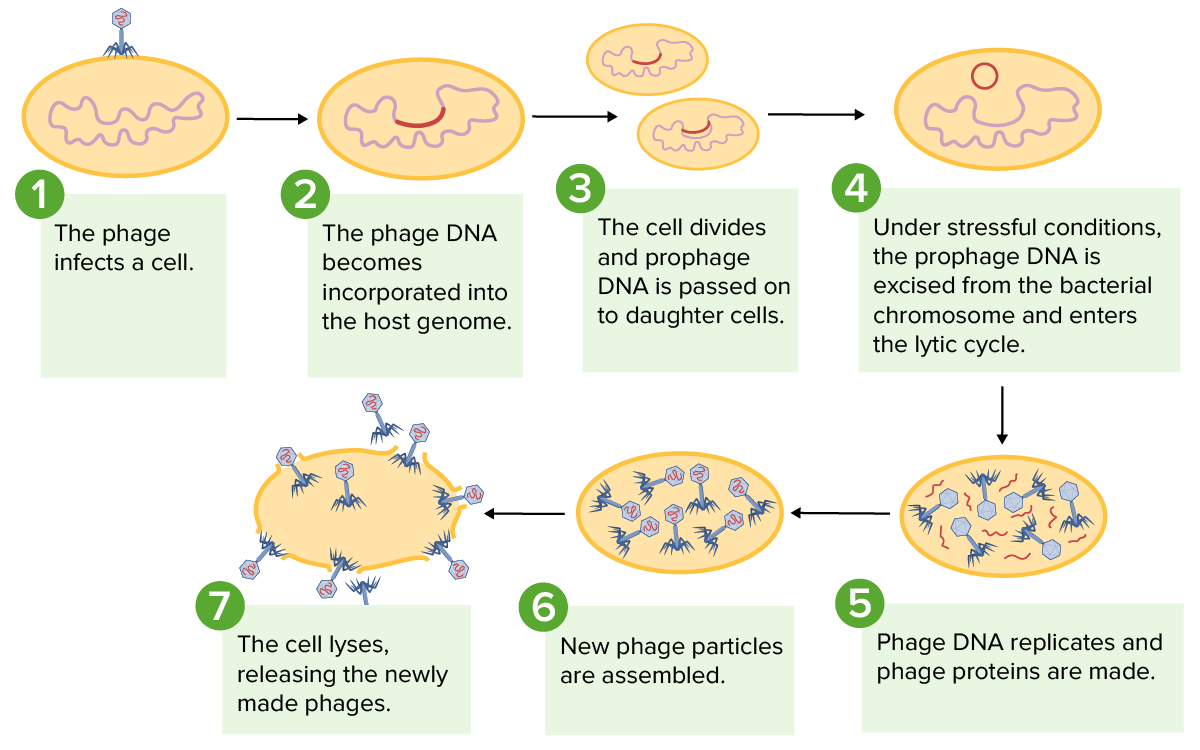
Ciclo de replicación de los LOS Neisseria bacteriófagos

Hay 2 vías de replicación una vez que el virus Virus Viruses are infectious, obligate intracellular parasites composed of a nucleic acid core surrounded by a protein capsid. Viruses can be either naked (non-enveloped) or enveloped. The classification of viruses is complex and based on many factors, including type and structure of the nucleoid and capsid, the presence of an envelope, the replication cycle, and the host range. Virology está dentro de la célula huésped bacteriana:
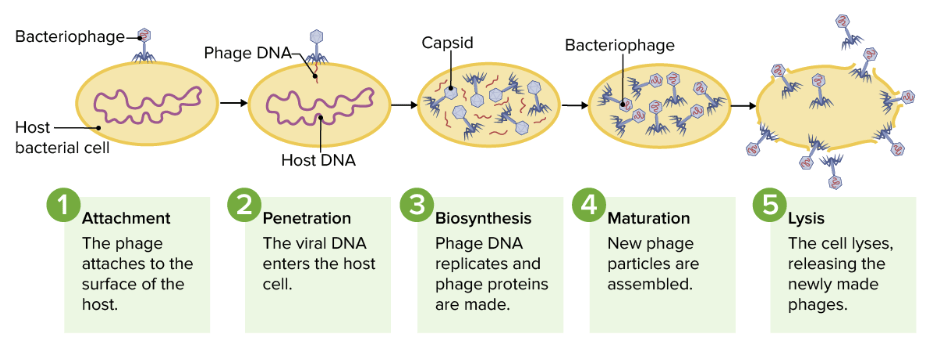
  1. Ciclo lítico:
    • Se produce en EN Erythema nodosum is an immune-mediated panniculitis (inflammation of the subcutaneous fat) caused by a type IV (delayed-type) hypersensitivity reaction. It commonly manifests in young women as tender, erythematous nodules on the shins. Erythema Nodosum condiciones de daño del ADN u otras tensiones
    • El bacteriófago toma el control de la maquinaria de transcripción y traducción de la célula huésped (expresión inmediata y rápida de genes Genes A category of nucleic acid sequences that function as units of heredity and which code for the basic instructions for the development, reproduction, and maintenance of organisms. DNA Types and Structure y proteínas del fago).
    • Provoca la lisis de la célula huésped bacteriana
  2. Ciclo lisogénico o templado:
    • Genomas de bacteriófagos incorporados al AL Amyloidosis genoma del huésped bacteriano
    • El genoma del fago se replica en EN Erythema nodosum is an immune-mediated panniculitis (inflammation of the subcutaneous fat) caused by a type IV (delayed-type) hypersensitivity reaction. It commonly manifests in young women as tender, erythematous nodules on the shins. Erythema Nodosum un estado benigno e inactivo: El genoma del fago puede expresarse cuando la célula bacteriana está estresada (e.g., por falta de nutrientes).

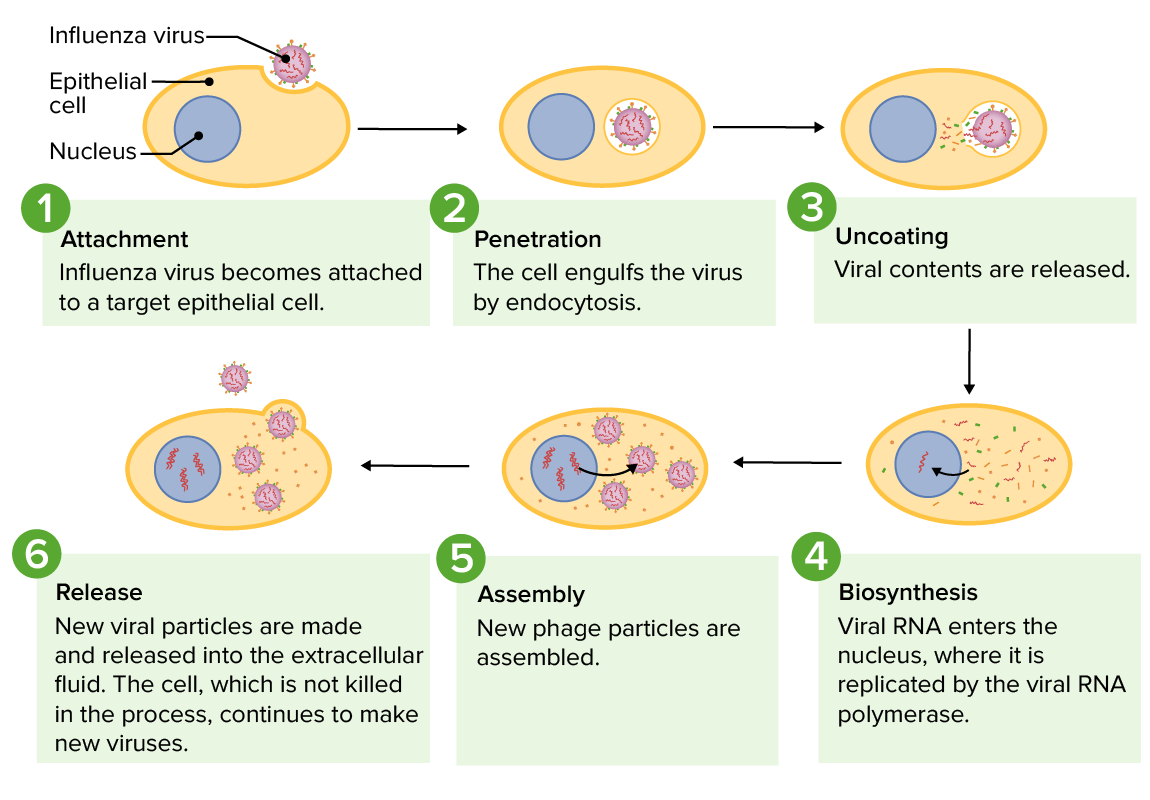
Ciclo de replicación de los LOS Neisseria virus Virus Viruses are infectious, obligate intracellular parasites composed of a nucleic acid core surrounded by a protein capsid. Viruses can be either naked (non-enveloped) or enveloped. The classification of viruses is complex and based on many factors, including type and structure of the nucleoid and capsid, the presence of an envelope, the replication cycle, and the host range. Virology eucariotas

  • Genoma viral es liberado en EN Erythema nodosum is an immune-mediated panniculitis (inflammation of the subcutaneous fat) caused by a type IV (delayed-type) hypersensitivity reaction. It commonly manifests in young women as tender, erythematous nodules on the shins. Erythema Nodosum la célula huésped infectada
  • Pasos de la replicación viral:
    1. Adhesión: Las proteínas víricas especializadas se adhieren a la célula huésped.
    2. Penetración: invasión de la célula huésped
    3. Desenvoltura: cápside desmontada y material genético disponible
    4. Biosíntesis: se sintetizan el ácido nucleico y las proteínas virales
    5. Ensamblaje: los LOS Neisseria viriones se ensamblan dentro de la célula huésped
    6. Liberación: a través de la lisis de la célula huésped (para los LOS Neisseria virus Virus Viruses are infectious, obligate intracellular parasites composed of a nucleic acid core surrounded by a protein capsid. Viruses can be either naked (non-enveloped) or enveloped. The classification of viruses is complex and based on many factors, including type and structure of the nucleoid and capsid, the presence of an envelope, the replication cycle, and the host range. Virology desnudos) o de la yemación de la membrana celular (para los LOS Neisseria virus Virus Viruses are infectious, obligate intracellular parasites composed of a nucleic acid core surrounded by a protein capsid. Viruses can be either naked (non-enveloped) or enveloped. The classification of viruses is complex and based on many factors, including type and structure of the nucleoid and capsid, the presence of an envelope, the replication cycle, and the host range. Virology con envoltura)
  • Todos los LOS Neisseria virus Virus Viruses are infectious, obligate intracellular parasites composed of a nucleic acid core surrounded by a protein capsid. Viruses can be either naked (non-enveloped) or enveloped. The classification of viruses is complex and based on many factors, including type and structure of the nucleoid and capsid, the presence of an envelope, the replication cycle, and the host range. Virology de ADN se replican en EN Erythema nodosum is an immune-mediated panniculitis (inflammation of the subcutaneous fat) caused by a type IV (delayed-type) hypersensitivity reaction. It commonly manifests in young women as tender, erythematous nodules on the shins. Erythema Nodosum el núcleo (excepto el poxvirus).
  • Todos los LOS Neisseria virus Virus Viruses are infectious, obligate intracellular parasites composed of a nucleic acid core surrounded by a protein capsid. Viruses can be either naked (non-enveloped) or enveloped. The classification of viruses is complex and based on many factors, including type and structure of the nucleoid and capsid, the presence of an envelope, the replication cycle, and the host range. Virology de ARN se replican en EN Erythema nodosum is an immune-mediated panniculitis (inflammation of the subcutaneous fat) caused by a type IV (delayed-type) hypersensitivity reaction. It commonly manifests in young women as tender, erythematous nodules on the shins. Erythema Nodosum el citoplasma (excepto los LOS Neisseria de influenza Influenza Influenza viruses are members of the Orthomyxoviridae family and the causative organisms of influenza, a highly contagious febrile respiratory disease. There are 3 primary influenza viruses (A, B, and C) and various subtypes, which are classified based on their virulent surface antigens, hemagglutinin (HA) and neuraminidase (NA). Influenza typically presents with a fever, myalgia, headache, and symptoms of an upper respiratory infection. Influenza Viruses/Influenza, retrovirus y hepatitis D Hepatitis D Inflammation of the liver in humans caused by hepatitis delta virus, a defective RNA virus that can only infect hepatitis B patients. For its viral coating, hepatitis delta virus requires the hepatitis B surface antigens produced by these patients. Hepatitis d can occur either concomitantly with (coinfection) or subsequent to (superinfection) hepatitis B infection. Similar to hepatitis b, it is primarily transmitted by parenteral exposure, such as transfusion of contaminated blood or blood products, but can also be transmitted via sexual or intimate personal contact. Hepatitis D Virus).

Diversificación Genética

Los LOS Neisseria virus Virus Viruses are infectious, obligate intracellular parasites composed of a nucleic acid core surrounded by a protein capsid. Viruses can be either naked (non-enveloped) or enveloped. The classification of viruses is complex and based on many factors, including type and structure of the nucleoid and capsid, the presence of an envelope, the replication cycle, and the host range. Virology han desarrollado muchos procesos para aumentar su diversidad genética:
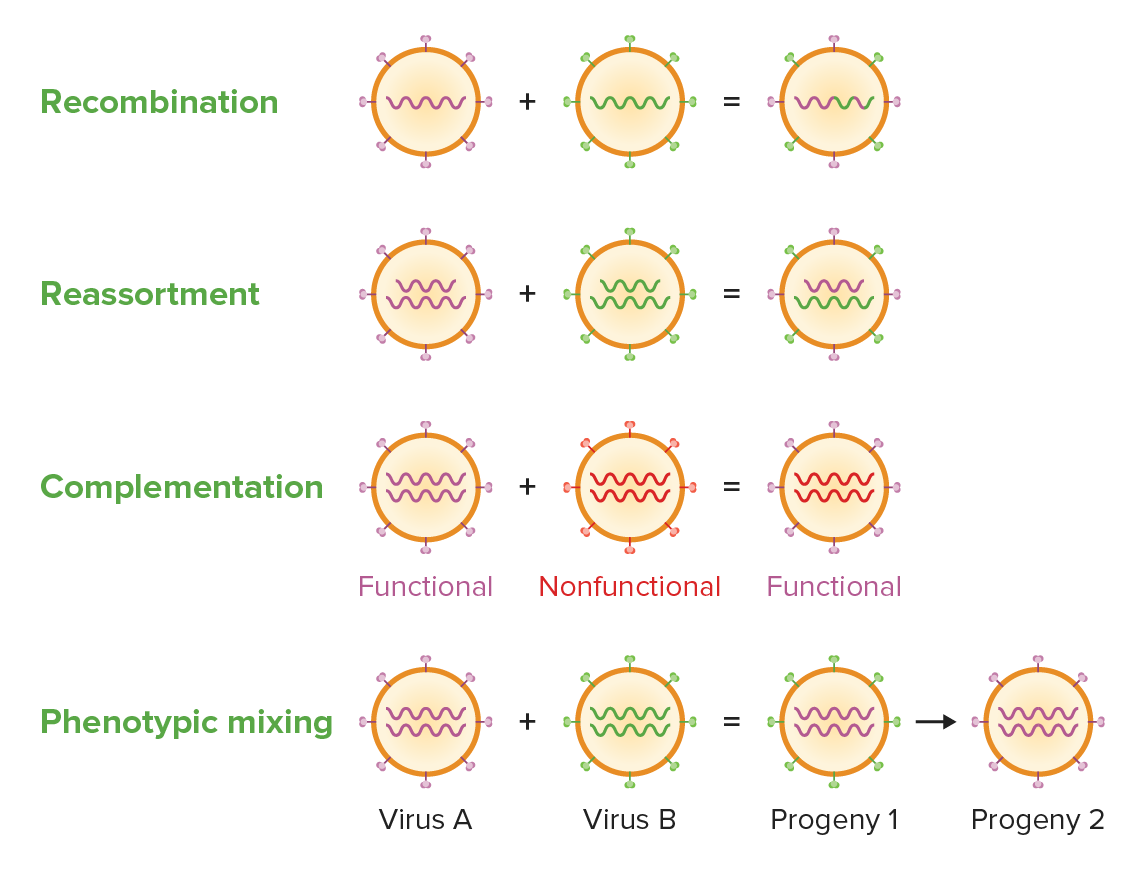
  • Recombinación: intercambio de genes Genes A category of nucleic acid sequences that function as units of heredity and which code for the basic instructions for the development, reproduction, and maintenance of organisms. DNA Types and Structure entre 2 genomas por cruce en EN Erythema nodosum is an immune-mediated panniculitis (inflammation of the subcutaneous fat) caused by a type IV (delayed-type) hypersensitivity reaction. It commonly manifests in young women as tender, erythematous nodules on the shins. Erythema Nodosum regiones homólogas
  • Reordenamiento:
    • Los LOS Neisseria virus Virus Viruses are infectious, obligate intracellular parasites composed of a nucleic acid core surrounded by a protein capsid. Viruses can be either naked (non-enveloped) or enveloped. The classification of viruses is complex and based on many factors, including type and structure of the nucleoid and capsid, the presence of an envelope, the replication cycle, and the host range. Virology con genomas segmentados intercambian material genético.
    • Puede provocar un cambio antigénico (e.g., el virus Virus Viruses are infectious, obligate intracellular parasites composed of a nucleic acid core surrounded by a protein capsid. Viruses can be either naked (non-enveloped) or enveloped. The classification of viruses is complex and based on many factors, including type and structure of the nucleoid and capsid, the presence of an envelope, the replication cycle, and the host range. Virology de la gripe)
  • Complementación:
    • Se produce cuando el virus Virus Viruses are infectious, obligate intracellular parasites composed of a nucleic acid core surrounded by a protein capsid. Viruses can be either naked (non-enveloped) or enveloped. The classification of viruses is complex and based on many factors, including type and structure of the nucleoid and capsid, the presence of an envelope, the replication cycle, and the host range. Virology tiene una mutación que da lugar a una proteína no funcional
    • Un virus Virus Viruses are infectious, obligate intracellular parasites composed of a nucleic acid core surrounded by a protein capsid. Viruses can be either naked (non-enveloped) or enveloped. The classification of viruses is complex and based on many factors, including type and structure of the nucleoid and capsid, the presence of an envelope, the replication cycle, and the host range. Virology no mutado “complementa” a un virus Virus Viruses are infectious, obligate intracellular parasites composed of a nucleic acid core surrounded by a protein capsid. Viruses can be either naked (non-enveloped) or enveloped. The classification of viruses is complex and based on many factors, including type and structure of the nucleoid and capsid, the presence of an envelope, the replication cycle, and the host range. Virology mutado (cuando co-infecta una célula huésped) fabricando una proteína funcional que le sirve a ambos virus Virus Viruses are infectious, obligate intracellular parasites composed of a nucleic acid core surrounded by a protein capsid. Viruses can be either naked (non-enveloped) or enveloped. The classification of viruses is complex and based on many factors, including type and structure of the nucleoid and capsid, the presence of an envelope, the replication cycle, and the host range. Virology (e.g., el virus Virus Viruses are infectious, obligate intracellular parasites composed of a nucleic acid core surrounded by a protein capsid. Viruses can be either naked (non-enveloped) or enveloped. The classification of viruses is complex and based on many factors, including type and structure of the nucleoid and capsid, the presence of an envelope, the replication cycle, and the host range. Virology de la hepatitis D Hepatitis D Inflammation of the liver in humans caused by hepatitis delta virus, a defective RNA virus that can only infect hepatitis B patients. For its viral coating, hepatitis delta virus requires the hepatitis B surface antigens produced by these patients. Hepatitis d can occur either concomitantly with (coinfection) or subsequent to (superinfection) hepatitis B infection. Similar to hepatitis b, it is primarily transmitted by parenteral exposure, such as transfusion of contaminated blood or blood products, but can also be transmitted via sexual or intimate personal contact. Hepatitis D Virus ( HDV HDV Hepatitis D virus (HDV) is a small enveloped, single-stranded RNA virus. Hepatitis D virus is considered a satellite virus, as it requires the presence of hepatitis B virus (HBV) for assembly and secretion. Therefore, in order for an individual to contract hepatitis D, coinfection or superinfection with HBV is required. Hepatitis D Virus, por sus siglas en EN Erythema nodosum is an immune-mediated panniculitis (inflammation of the subcutaneous fat) caused by a type IV (delayed-type) hypersensitivity reaction. It commonly manifests in young women as tender, erythematous nodules on the shins. Erythema Nodosum inglés) requiere del virus Virus Viruses are infectious, obligate intracellular parasites composed of a nucleic acid core surrounded by a protein capsid. Viruses can be either naked (non-enveloped) or enveloped. The classification of viruses is complex and based on many factors, including type and structure of the nucleoid and capsid, the presence of an envelope, the replication cycle, and the host range. Virology de la hepatitis B Hepatitis B Hepatitis B virus (HBV) is a partially double-stranded DNA virus, which belongs to the Orthohepadnavirus genus and the Hepadnaviridae family. Most individuals with acute HBV infection are asymptomatic or have mild, self-limiting symptoms. Chronic infection can be asymptomatic or create hepatic inflammation, leading to liver cirrhosis and hepatocellular carcinoma (HCC). Hepatitis B Virus ( HBV HBV Hepatitis B virus (HBV) is a partially double-stranded DNA virus, which belongs to the Orthohepadnavirus genus and the Hepadnaviridae family. Hepatitis B virus is transmitted by exposure to infectious blood or body fluids. Examples of types of exposure include sexual intercourse, IV drug use, and childbirth. Hepatitis B Virus, por sus siglas en EN Erythema nodosum is an immune-mediated panniculitis (inflammation of the subcutaneous fat) caused by a type IV (delayed-type) hypersensitivity reaction. It commonly manifests in young women as tender, erythematous nodules on the shins. Erythema Nodosum inglés) para suministrar HBsAg (una proteína de envoltura clave para el HDV HDV Hepatitis D virus (HDV) is a small enveloped, single-stranded RNA virus. Hepatitis D virus is considered a satellite virus, as it requires the presence of hepatitis B virus (HBV) for assembly and secretion. Therefore, in order for an individual to contract hepatitis D, coinfection or superinfection with HBV is required. Hepatitis D Virus)).
  • Mezcla fenotípica:
    • Infección simultánea de la célula huésped con 2 virus Virus Viruses are infectious, obligate intracellular parasites composed of a nucleic acid core surrounded by a protein capsid. Viruses can be either naked (non-enveloped) or enveloped. The classification of viruses is complex and based on many factors, including type and structure of the nucleoid and capsid, the presence of an envelope, the replication cycle, and the host range. Virology
    • Suele implicar la mezcla del genoma de 1 virus Virus Viruses are infectious, obligate intracellular parasites composed of a nucleic acid core surrounded by a protein capsid. Viruses can be either naked (non-enveloped) or enveloped. The classification of viruses is complex and based on many factors, including type and structure of the nucleoid and capsid, the presence of an envelope, the replication cycle, and the host range. Virology con las proteínas de superficie del 2do virus Virus Viruses are infectious, obligate intracellular parasites composed of a nucleic acid core surrounded by a protein capsid. Viruses can be either naked (non-enveloped) or enveloped. The classification of viruses is complex and based on many factors, including type and structure of the nucleoid and capsid, the presence of an envelope, the replication cycle, and the host range. Virology
Virus Diversificación genética

Los virus han desarrollado diversas estrategias para aumentar la diversidad genética, entre ellas la recombinación (el intercambio de genes entre 2 cromosomas por cruce en regiones homólogas), el reordenamiento (intercambio de segmentos de cromosomas), la complementación (el intercambio de material genético de un virus funcional con otro no funcional para convertir este último en funcional) y la mezcla fenotípica (mezcla de 2 genomas virales una célula huésped infectada simultáneamente dando lugar a una progenie con genomas mezclados).

Imagen por Lecturio. Licencia: CC BY-NC-SA 4.0

Casos Especiales

Retrovirus

  • Virus Virus Viruses are infectious, obligate intracellular parasites composed of a nucleic acid core surrounded by a protein capsid. Viruses can be either naked (non-enveloped) or enveloped. The classification of viruses is complex and based on many factors, including type and structure of the nucleoid and capsid, the presence of an envelope, the replication cycle, and the host range. Virology de ARN
  • Contienen transcriptasa inversa (ADN polimerasa dependiente de ARN)
  • El retrovirus más destacado es el virus Virus Viruses are infectious, obligate intracellular parasites composed of a nucleic acid core surrounded by a protein capsid. Viruses can be either naked (non-enveloped) or enveloped. The classification of viruses is complex and based on many factors, including type and structure of the nucleoid and capsid, the presence of an envelope, the replication cycle, and the host range. Virology de la inmunodeficiencia humana (VIH).

Priones

  • Técnicamente no son virus Virus Viruses are infectious, obligate intracellular parasites composed of a nucleic acid core surrounded by a protein capsid. Viruses can be either naked (non-enveloped) or enveloped. The classification of viruses is complex and based on many factors, including type and structure of the nucleoid and capsid, the presence of an envelope, the replication cycle, and the host range. Virology
  • Proteínas infecciosas que no contienen un nucleoide
  • Causan encefalopatías espongiformes transmisibles:
    • Enfermedad de Creutzfeldt-Jakob
    • Kuru Kuru A prion disease found exclusively among the fore linguistic group natives of the highlands of new guinea. The illness is primarily restricted to adult females and children of both sexes. It is marked by the subacute onset of tremor and ataxia followed by motor weakness and incontinence. Death occurs within 3-6 months of disease onset. The condition is associated with ritual cannibalism, and has become rare since this practice has been discontinued. Pathologic features include a noninflammatory loss of neurons that is most prominent in the cerebellum, glial proliferation, and amyloid plaques. Transmissible Spongiform Encephalopathies
    • Encefalopatía espongiforme bovina (enfermedad de las “vacas locas”)

Referencias

  1. Parker, N., Schneegurt, M., Thi Tu, A.H., Lister, P., & Forster, B. Microbiology. (2016). Chapter 6.2, The Viral Life Cycle. https://openstax.org/details/books/microbiology
  2. Pellett, P. E., Mitra, S., & Holland, T. C. (2014). Basics of virology. Handbook of clinical neurology123, 45–66. https://doi.org/10.1016/B978-0-444-53488-0.00002-X

¡Crea tu cuenta gratis o inicia una sesión para seguir leyendo!

Regístrate ahora y obtén acceso gratuito a Lecturio con páginas de concepto, videos médicos y cuestionarios para tu educación médica.

User Reviews

Que tengas una sesión de estudio alegre y navideña 🎁 Ahorra 50% en todos los planes >>

Details