
Domina Conceptos Médicos

Estudia para la escuela de medicina y tus examenes con Lecturio.

Taquicardia Ventricular

Una taquicardia ventricular es cualquier ritmo cardíaco más rápido que 100 latidos/min, con 3 o más latidos irregulares seguidos, que surgen distalmente al AL Amyloidosis haz de His. La taquicardia ventricular es la forma más común de taquicardia de complejo ancho, y se asocia con una alta tasa de mortalidad. La taquicardia ventricular suele estar causada por una isquemia miocárdica, una enfermedad estructural, condiciones congénitas o una alteración electrolítica. Las personas pueden presentar dolor Dolor Inflammation torácico, disnea, palpitaciones, síncope e inestabilidad hemodinámica. El diagnóstico se basa en EN Erythema nodosum is an immune-mediated panniculitis (inflammation of the subcutaneous fat) caused by a type IV (delayed-type) hypersensitivity reaction. It commonly manifests in young women as tender, erythematous nodules on the shins. Erythema Nodosum los LOS Neisseria hallazgos característicos del ECG ECG An electrocardiogram (ECG) is a graphic representation of the electrical activity of the heart plotted against time. Adhesive electrodes are affixed to the skin surface allowing measurement of cardiac impulses from many angles. The ECG provides 3-dimensional information about the conduction system of the heart, the myocardium, and other cardiac structures. Electrocardiogram (ECG): complejo QRS ancho, fusión y latidos de captura. El tratamiento puede requerir medicamentos antiarrítmicos o cardioversión eléctrica para evitar complicaciones como la insuficiencia cardíaca, el fallo multiorgánico y el paro cardíaco.

Last updated: Dec 15, 2025

Editorial responsibility: Stanley Oiseth, Lindsay Jones, Evelin Maza

Epidemiología y Etiología

Epidemiología

  • La mitad de la mortalidad cardíaca en EN Erythema nodosum is an immune-mediated panniculitis (inflammation of the subcutaneous fat) caused by a type IV (delayed-type) hypersensitivity reaction. It commonly manifests in young women as tender, erythematous nodules on the shins. Erythema Nodosum Estados Unidos está causada por la taquicardia ventricular.
  • Incidencia ↑ con la edad
  • Es más común en EN Erythema nodosum is an immune-mediated panniculitis (inflammation of the subcutaneous fat) caused by a type IV (delayed-type) hypersensitivity reaction. It commonly manifests in young women as tender, erythematous nodules on the shins. Erythema Nodosum los LOS Neisseria hombres
  • Las torsades de pointes Torsades de pointes A malignant form of polymorphic ventricular tachycardia that is characterized by heart rate between 200 and 250 beats per minute, and QRS complexes with changing amplitude and twisting of the points. The term also describes the syndrome of tachycardia with prolonged ventricular repolarization, long qt intervals exceeding 500 milliseconds or bradycardia. Torsades de pointes may be self-limited or may progress to ventricular fibrillation. Ventricular Tachycardia son más frecuentes en EN Erythema nodosum is an immune-mediated panniculitis (inflammation of the subcutaneous fat) caused by a type IV (delayed-type) hypersensitivity reaction. It commonly manifests in young women as tender, erythematous nodules on the shins. Erythema Nodosum las mujeres

Etiología

  • Enfermedades del corazón:
    • Enfermedad arterial coronaria (la más común), especialmente con un IM previo
    • Aterosclerosis
    • Tabaquismo
    • Diabetes Diabetes Diabetes mellitus (DM) is a metabolic disease characterized by hyperglycemia and dysfunction of the regulation of glucose metabolism by insulin. Type 1 DM is diagnosed mostly in children and young adults as the result of autoimmune destruction of β cells in the pancreas and the resulting lack of insulin. Type 2 DM has a significant association with obesity and is characterized by insulin resistance. Diabetes Mellitus mellitus
  • Enfermedad estructural:
    • Insuficiencia cardíaca
    • Cardiomiopatía
    • Miocarditis
  • Trastornos congénitos:
    • Síndrome de QT largo
    • Síndrome de Wolff-Parkinson-White
  • Desbalance de electrolitos:
    • Hipopotasemia
    • Hipomagnesemia
    • Hipocalcemia
  • Agentes que prolonguen el QT:
    • Antibióticos
      • Macrólidos
      • Fluoroquinolonas
    • Antiarrítmicos
      • Amiodarona
      • Quinidina
      • Intoxicación por digitálicos
    • Antipsicóticos de 1ra generación como el haloperidol Haloperidol A phenyl-piperidinyl-butyrophenone that is used primarily to treat schizophrenia and other psychoses. It is also used in schizoaffective disorder, delusional disorders, ballism, and tourette syndrome (a drug of choice) and occasionally as adjunctive therapy in intellectual disability and the chorea of huntington disease. It is a potent antiemetic and is used in the treatment of intractable hiccups. First-Generation Antipsychotics
    • Antidepresivos tricíclicos
  • Idiopática: taquicardia del tracto de salida del ventrículo derecho

Fisiopatología

  • La taquicardia ventricular se debe a contracciones ectópicas anormales en EN Erythema nodosum is an immune-mediated panniculitis (inflammation of the subcutaneous fat) caused by a type IV (delayed-type) hypersensitivity reaction. It commonly manifests in young women as tender, erythematous nodules on the shins. Erythema Nodosum el ventrículo:
    • Taquicardia ventricular benigna
      • La señal ectópica es regular Regular Insulin y estacionaria.
      • El gasto cardíaco se mantiene.
    • Taquicardia ventricular potencialmente mortal: si la señal ectópica tiene una localización o frecuencia variable Variable Variables represent information about something that can change. The design of the measurement scales, or of the methods for obtaining information, will determine the data gathered and the characteristics of that data. As a result, a variable can be qualitative or quantitative, and may be further classified into subgroups. Types of Variables
  • Formación de cicatrices miocárdicas → ralentiza la conducción de los LOS Neisseria impulsos eléctricos cardíacos
    • Generalmente por daño isquémico
    • El tejido cicatricial no excitable está rodeado de células miocárdicas hiperirritables:
      • Los LOS Neisseria impulsos eléctricos se ralentizan al AL Amyloidosis pasar por la cicatriz.
      • El resto del ventrículo tiene tiempo para repolarizarse.
    • El tejido ventricular restante se despolariza de nuevo cuando el impulso sale de la cicatriz (lo que se conoce como reentrada).
    • Las contracciones ventriculares son rápidas y no están sincronizadas con las aurículas:
      • Si se tolera, la arritmia puede causar una cardiomiopatía con el tiempo.
      • Si no se tolera, puede producirse una descompensación aguda, incluyendo un paro cardíaco.
  • Los LOS Neisseria medicamentos y los LOS Neisseria trastornos genéticos que provocan una repolarización prolongada o retardada pueden dar lugar a postdespolarizaciones tempranas y torsades de pointes Torsades de pointes A malignant form of polymorphic ventricular tachycardia that is characterized by heart rate between 200 and 250 beats per minute, and QRS complexes with changing amplitude and twisting of the points. The term also describes the syndrome of tachycardia with prolonged ventricular repolarization, long qt intervals exceeding 500 milliseconds or bradycardia. Torsades de pointes may be self-limited or may progress to ventricular fibrillation. Ventricular Tachycardia.
  • La taquicardia ventricular monomórfica está causada principalmente por circuitos de reentrada anormales, que conducen a una automaticidad ↑.
  • La taquicardia ventricular polimórfica está causada principalmente por una repolarización ventricular anormal:
    • Anomalías electrolíticas
    • Síndrome de QT largo

Presentación Clínica

Antecedentes familiares

  • Muerte súbita prematura (< 40 años)
  • Síndrome de QT largo
  • Síndrome de QT corto
  • Síndrome de Brugada
  • Displasia arritmogénica del ventrículo derecho
  • Taquicardia ventricular polimórfica catecolaminérgica
  • Miocardiopatía hipertrófica

Síntomas

  • Puede ser asintomático
  • Dolor Dolor Inflammation torácico
  • Hipotensión
  • Síncope
  • Fatiga
  • Confusión
  • Palpitaciones
  • Mareo
  • Disnea
  • Muerte súbita

Examen físico

  • Hipotensión
  • Taquipnea
  • Signos de disminución de la perfusión:
    • Disminución del nivel de conciencia
    • Palidez
    • Diaforesis
    • ↑ Presión venosa yugular
    • S1 S1 Heart Sounds puede variar en EN Erythema nodosum is an immune-mediated panniculitis (inflammation of the subcutaneous fat) caused by a type IV (delayed-type) hypersensitivity reaction. It commonly manifests in young women as tender, erythematous nodules on the shins. Erythema Nodosum intensidad.

Diagnóstico

El diagnóstico se realiza mediante ECG ECG An electrocardiogram (ECG) is a graphic representation of the electrical activity of the heart plotted against time. Adhesive electrodes are affixed to the skin surface allowing measurement of cardiac impulses from many angles. The ECG provides 3-dimensional information about the conduction system of the heart, the myocardium, and other cardiac structures. Electrocardiogram (ECG) o monitorización cardíaca.

Existen 2 tipos principales de taquicardia ventricular:

  1. Monomórfica:
    • Complejos QRS amplios (a menudo > 200 mseg)
    • Morfología QRS uniforme
  2. Polimórfica:
    • Complejos QRS amplios (> 120 mseg)
    • Torsades de pointes Torsades de pointes A malignant form of polymorphic ventricular tachycardia that is characterized by heart rate between 200 and 250 beats per minute, and QRS complexes with changing amplitude and twisting of the points. The term also describes the syndrome of tachycardia with prolonged ventricular repolarization, long qt intervals exceeding 500 milliseconds or bradycardia. Torsades de pointes may be self-limited or may progress to ventricular fibrillation. Ventricular Tachycardia: desviación del eje de los LOS Neisseria complejos QRS alrededor de la línea de base
Taquicardia ventricular

Tira rítmica de taquicardia ventricular que muestra un ritmo regular, de complejo amplio, con una frecuencia superior a 100/min
Este es un ritmo desfibrilable.
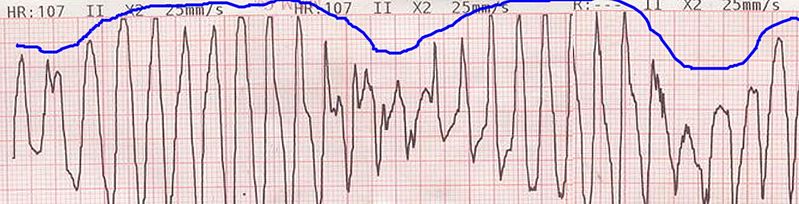
Imagen: “Lead II rhythm ventricular tachycardia Vtach VT” por Glenlarson. Licencia: Dominio Público
Torsades de pointes

Ejemplo de un trazado de ECG que muestra la desviación del eje de los complejos QRS alrededor de la línea de base en las torsades de pointes

Imagen: “Torsade de pointes” por Panthro. Licencia: Dominio Público

Tratamiento

El tratamiento de la taquicardia ventricular se basa en EN Erythema nodosum is an immune-mediated panniculitis (inflammation of the subcutaneous fat) caused by a type IV (delayed-type) hypersensitivity reaction. It commonly manifests in young women as tender, erythematous nodules on the shins. Erythema Nodosum la presencia de pulso y, si lo hay, en EN Erythema nodosum is an immune-mediated panniculitis (inflammation of the subcutaneous fat) caused by a type IV (delayed-type) hypersensitivity reaction. It commonly manifests in young women as tender, erythematous nodules on the shins. Erythema Nodosum sí el individuo está hemodinámicamente estable.
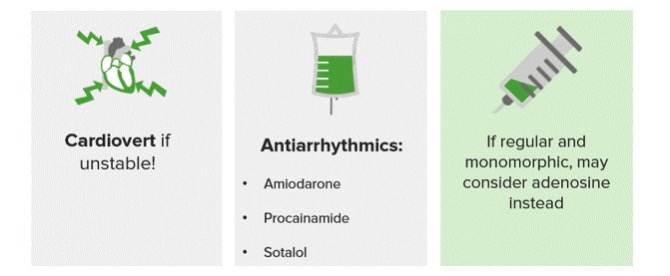
Manejo de la taquicardia ventricular

Tratamiento de la taquicardia ventricular

Imagen por Lecturio.

Para la taquicardia ventricular sin pulso

Siga el algoritmo del paro cardíaco en EN Erythema nodosum is an immune-mediated panniculitis (inflammation of the subcutaneous fat) caused by a type IV (delayed-type) hypersensitivity reaction. It commonly manifests in young women as tender, erythematous nodules on the shins. Erythema Nodosum adultos.

  • RCP para ayudar a mantener el flujo sanguíneo a través del cuerpo
  • Desfibrilación:
    • Suministro de una descarga eléctrica al AL Amyloidosis corazón
    • Puede utilizar un desfibrilador manual o un desfibrilador externo automático
  • Considerar la adición de antiarrítmicos, si es necesario:
    • Amiodarona
    • Lidocaína
  • Acceso intravenoso/intraóseo
  • Vía aérea avanzada
Algoritmo de manejo de la fibrilación ventricular/taquicardia ventricular sin pulso

Algoritmo de tratamiento de la fibrilación ventricular/taquicardia ventricular sin pulso

Imagen por Lecturio.

Para la taquicardia ventricular con pulso

  • Si está hemodinámicamente inestable:
    • El tratamiento de 1ra línea de los LOS Neisseria individuos inestables es la cardioversión de corriente directa sincronizada.
    • Por lo general, comienza en EN Erythema nodosum is an immune-mediated panniculitis (inflammation of the subcutaneous fat) caused by a type IV (delayed-type) hypersensitivity reaction. It commonly manifests in young women as tender, erythematous nodules on the shins. Erythema Nodosum 100 J
  • Si está hemodinámicamente estable:
    • La taquicardia ventricular monomórfica sostenida sin signos de daño de órganos diana debe recibir cardioversión inducida por medicamentos con:
    • La taquicardia ventricular polimórfica debe ser tratada con:
      • Sulfato de magnesio intravenoso
      • Isoproterenol Isoproterenol Isopropyl analog of epinephrine; beta-sympathomimetic that acts on the heart, bronchi, skeletal muscle, alimentary tract, etc. It is used mainly as bronchodilator and heart stimulant. Sympathomimetic Drugs
      • Marcapasos
      • Agente antiarrítmico que no prolongue el intervalo QT (la procainamida y la amiodarona están contraindicadas)
      • Cardioversión sincronizada si la terapia médica no tiene éxito a 50–200 J monofásicos.
      • Corrección de las anomalías electrolíticas
  • Si hay disfunción ventricular izquierda, la cardioversión debe realizarse con amiodarona o lidocaína.
  • Si la taquicardia ventricular es el resultado de la intoxicación por digitálicos, tratar con anticuerpos antidigitálicos y electrocardioversión para lograr un ritmo sinusal normal.
  • La terapia más eficaz a largo plazo para ↓ la mortalidad es un desfibrilador cardioversor implantado.

Evaluación de las causas subyacentes

  • Enzimas cardíacas: ↑ después de un IM
  • Angiografía coronaria para evaluar la isquemia miocárdica
  • Electrolitos
    • Hipopotasemia
    • Hipomagnesemia
    • Hipocalcemia
  • Examen toxicológico en EN Erythema nodosum is an immune-mediated panniculitis (inflammation of the subcutaneous fat) caused by a type IV (delayed-type) hypersensitivity reaction. It commonly manifests in young women as tender, erythematous nodules on the shins. Erythema Nodosum orina para detectar medicamentos o estimulantes que puedan afectar al AL Amyloidosis ritmo cardíaco
  • Ecocardiografía si se sospecha una causa estructural
  • El monitor Holter puede utilizarse para detectar taquicardias ventriculares intermitentes no detectadas por el ECG ECG An electrocardiogram (ECG) is a graphic representation of the electrical activity of the heart plotted against time. Adhesive electrodes are affixed to the skin surface allowing measurement of cardiac impulses from many angles. The ECG provides 3-dimensional information about the conduction system of the heart, the myocardium, and other cardiac structures. Electrocardiogram (ECG) normal.

Diagnóstico Diferencial

  • Hipopotasemia: concentración de potasio en EN Erythema nodosum is an immune-mediated panniculitis (inflammation of the subcutaneous fat) caused by a type IV (delayed-type) hypersensitivity reaction. It commonly manifests in young women as tender, erythematous nodules on the shins. Erythema Nodosum plasma Plasma The residual portion of blood that is left after removal of blood cells by centrifugation without prior blood coagulation. Transfusion Products < 3,5 mEq/L. La hipopotasemia puede deberse a pérdidas renales, pérdidas gastrointestinales, desplazamientos transcelulares o una ingesta dietética deficiente. La hipopotasemia suele ser asintomática si es leve; sin embargo, puede provocar arritmias cardíacas, debilidad muscular, rabdomiólisis, parálisis e insuficiencia respiratoria. El diagnóstico se realiza mediante los LOS Neisseria antecedentes y las pruebas de laboratorio. El tratamiento consiste en EN Erythema nodosum is an immune-mediated panniculitis (inflammation of the subcutaneous fat) caused by a type IV (delayed-type) hypersensitivity reaction. It commonly manifests in young women as tender, erythematous nodules on the shins. Erythema Nodosum corregir el déficit de potasio y tratar la causa subyacente.
  • Enfermedad arterial coronaria: suministro inadecuado de sangre al AL Amyloidosis miocardio, normalmente causado por la aterosclerosis. El miocardio se vuelve isquémico cuando el suministro de oxígeno no satisface la demanda de oxígeno. El diagnóstico se basa en EN Erythema nodosum is an immune-mediated panniculitis (inflammation of the subcutaneous fat) caused by a type IV (delayed-type) hypersensitivity reaction. It commonly manifests in young women as tender, erythematous nodules on the shins. Erythema Nodosum los LOS Neisseria antecedentes y los LOS Neisseria hallazgos del ECG ECG An electrocardiogram (ECG) is a graphic representation of the electrical activity of the heart plotted against time. Adhesive electrodes are affixed to the skin surface allowing measurement of cardiac impulses from many angles. The ECG provides 3-dimensional information about the conduction system of the heart, the myocardium, and other cardiac structures. Electrocardiogram (ECG), las pruebas de esfuerzo cardíaco o el cateterismo cardíaco. El tratamiento se basa principalmente en EN Erythema nodosum is an immune-mediated panniculitis (inflammation of the subcutaneous fat) caused by a type IV (delayed-type) hypersensitivity reaction. It commonly manifests in young women as tender, erythematous nodules on the shins. Erythema Nodosum la reducción de la demanda de oxígeno del corazón y el aumento del suministro de oxígeno.
  • Infarto de miocardio: isquemia de una zona del tejido miocárdico debido a un flujo sanguíneo y una oxigenación insuficientes. La presentación clínica del infarto de miocardio es con dolor Dolor Inflammation torácico. El diagnóstico se basa en EN Erythema nodosum is an immune-mediated panniculitis (inflammation of the subcutaneous fat) caused by a type IV (delayed-type) hypersensitivity reaction. It commonly manifests in young women as tender, erythematous nodules on the shins. Erythema Nodosum los LOS Neisseria antecedentes, los LOS Neisseria cambios en EN Erythema nodosum is an immune-mediated panniculitis (inflammation of the subcutaneous fat) caused by a type IV (delayed-type) hypersensitivity reaction. It commonly manifests in young women as tender, erythematous nodules on the shins. Erythema Nodosum el ECG ECG An electrocardiogram (ECG) is a graphic representation of the electrical activity of the heart plotted against time. Adhesive electrodes are affixed to the skin surface allowing measurement of cardiac impulses from many angles. The ECG provides 3-dimensional information about the conduction system of the heart, the myocardium, and other cardiac structures. Electrocardiogram (ECG), el aumento de las enzimas cardíacas y la evidencia de anomalías en EN Erythema nodosum is an immune-mediated panniculitis (inflammation of the subcutaneous fat) caused by a type IV (delayed-type) hypersensitivity reaction. It commonly manifests in young women as tender, erythematous nodules on the shins. Erythema Nodosum el movimiento de la pared. El tratamiento es con terapia trombolítica más que con intervención percutánea. Todos los LOS Neisseria individuos reciben nitratos, control del dolor Dolor Inflammation, aspirina, anticoagulación y betabloqueadores.
  • Síndrome del QT largo: trastorno de la actividad eléctrica del corazón. El síndrome del QT largo afecta a la repolarización del corazón tras un latido y puede ser congénito o adquirido. El síndrome se caracteriza típicamente por una prolongación del intervalo QT en EN Erythema nodosum is an immune-mediated panniculitis (inflammation of the subcutaneous fat) caused by a type IV (delayed-type) hypersensitivity reaction. It commonly manifests in young women as tender, erythematous nodules on the shins. Erythema Nodosum el ECG ECG An electrocardiogram (ECG) is a graphic representation of the electrical activity of the heart plotted against time. Adhesive electrodes are affixed to the skin surface allowing measurement of cardiac impulses from many angles. The ECG provides 3-dimensional information about the conduction system of the heart, the myocardium, and other cardiac structures. Electrocardiogram (ECG) y por la aparición de síncopes o paros cardíacos.
  • Fibrilación ventricular: tipo de taquiarritmia ventricular (> 300/min) a menudo precedida de fibrilación ventricular. En EN Erythema nodosum is an immune-mediated panniculitis (inflammation of the subcutaneous fat) caused by a type IV (delayed-type) hypersensitivity reaction. It commonly manifests in young women as tender, erythematous nodules on the shins. Erythema Nodosum esta arritmia, el ventrículo late rápida y esporádicamente. La contracción ventricular no está coordinada, lo que provoca una disminución del gasto cardíaco y un colapso hemodinámico inmediato. La fibrilación ventricular suele estar causada por una cardiopatía isquémica subyacente.
  • Paro cardíaco: cese súbito y completo del gasto cardíaco con colapso hemodinámico. Los LOS Neisseria individuos con paro cardíaco se presentan sin pulso, sin respuesta y en EN Erythema nodosum is an immune-mediated panniculitis (inflammation of the subcutaneous fat) caused by a type IV (delayed-type) hypersensitivity reaction. It commonly manifests in young women as tender, erythematous nodules on the shins. Erythema Nodosum estado de apnea. Los LOS Neisseria ritmos asociados al AL Amyloidosis paro cardíaco son la fibrilación/taquicardia ventricular, la asistolia o la actividad eléctrica sin pulso. El tratamiento del paro cardíaco comienza con el soporte vital básico fuera del hospital y el soporte vital cardíaco avanzado cuando se está en EN Erythema nodosum is an immune-mediated panniculitis (inflammation of the subcutaneous fat) caused by a type IV (delayed-type) hypersensitivity reaction. It commonly manifests in young women as tender, erythematous nodules on the shins. Erythema Nodosum el hospital.

Referencias

  1. Kashou, A. H., Noseworthy, P. A., DeSimone, C. V., Deshmukh, A. J., Asirvatham, S. J., May, A. M. (2020). Wide complex tachycardia differentiation: A reappraisal of the state‐of‐the‐art. Journal of the American Heart Association, 9(11).
  2. Al-Khatib et. Al., (2018). 2017 AHA/ACC/HRS guideline for management of patients with ventricular arrhythmias and the prevention of sudden cardiac death. Journal of the American College of Cardiology 72(14).
  3. Link et. Al., (2010). Part 6: Electrical Therapies: Automated External DEFIBRILLATORS, Defibrillation, CARDIOVERSION, and Pacing * 2010 American Heart Association guidelines for cardiopulmonary resuscitation and Emergency CARDIOVASCULAR CARE. Circulation 122(18 Suppl 3).
  4. (1997). A comparison of antiarrhythmic-drug therapy with implantable defibrillators in patients resuscitated from near-fatal ventricular arrhythmias. New England Journal of Medicine 337:1576–1584.
  5. Compton, S. (2017). Ventricular tachycardia treatment & management. Emedicine. Retrieved August 6, 2021, from https://emedicine.medscape.com/article/159075-treatment

¡Crea tu cuenta gratis o inicia una sesión para seguir leyendo!

Regístrate ahora y obtén acceso gratuito a Lecturio con páginas de concepto, videos médicos y cuestionarios para tu educación médica.

User Reviews

Que tengas una sesión de estudio alegre y navideña 🎁 Ahorra 50% en todos los planes >>

Details