Domina Conceptos Médicos

Estudia para la escuela de medicina y tus examenes con Lecturio.

Síndrome de Secreción Inapropiada de la Hormona Antidiurética (SIADH)

El síndrome de secreción inapropiada de hormona antidiurética ( SIADH SIADH Syndrome of inappropriate antidiuretic hormone secretion (SIADH) is a disorder of impaired water excretion due to the inability to suppress the secretion of antidiuretic hormone (ADH). SIADH is characterized by impaired water excretion leading to dilutional hyponatremia, which is mainly asymptomatic but may cause neurologic symptoms. S Syndrome of Inappropriate Antidiuretic Hormone Secretion (SIADH), por sus siglas en EN Erythema nodosum is an immune-mediated panniculitis (inflammation of the subcutaneous fat) caused by a type IV (delayed-type) hypersensitivity reaction. It commonly manifests in young women as tender, erythematous nodules on the shins. Erythema Nodosum inglés) es un trastorno que se caracteriza por la alteración en EN Erythema nodosum is an immune-mediated panniculitis (inflammation of the subcutaneous fat) caused by a type IV (delayed-type) hypersensitivity reaction. It commonly manifests in young women as tender, erythematous nodules on the shins. Erythema Nodosum la excreción de agua debido a la incapacidad de suprimir la secreción de la hormona antidiurética (ADH). La secreción inapropiada de la ADH puede deberse a varias causas, como el aumento de la producción por parte de la hipófisis debido a un traumatismo, una enfermedad o ciertos medicamentos; la secreción ectópica de ADH por cáncer; o causas hereditarias ( SIADH SIADH Syndrome of inappropriate antidiuretic hormone secretion (SIADH) is a disorder of impaired water excretion due to the inability to suppress the secretion of antidiuretic hormone (ADH). SIADH is characterized by impaired water excretion leading to dilutional hyponatremia, which is mainly asymptomatic but may cause neurologic symptoms. S Syndrome of Inappropriate Antidiuretic Hormone Secretion (SIADH) nefrogénica). El síndrome de secreción inapropiada de la hormona antidiurética se caracteriza por una alteración de la excreción de agua que conduce a una hiponatremia dilucional, que es principalmente asintomática, pero puede causar síntomas neurológicos. El síndrome de secreción inapropiada de hormona antidiurética debe sospecharse en EN Erythema nodosum is an immune-mediated panniculitis (inflammation of the subcutaneous fat) caused by a type IV (delayed-type) hypersensitivity reaction. It commonly manifests in young women as tender, erythematous nodules on the shins. Erythema Nodosum cualquier paciente con hiponatremia, hipoosmolaridad y osmolaridad urinaria elevada.

Last updated: Dec 15, 2025
Editorial responsibility: Stanley Oiseth, Lindsay Jones, Evelin Maza

Hormona Antidiurética (ADH)

Origen

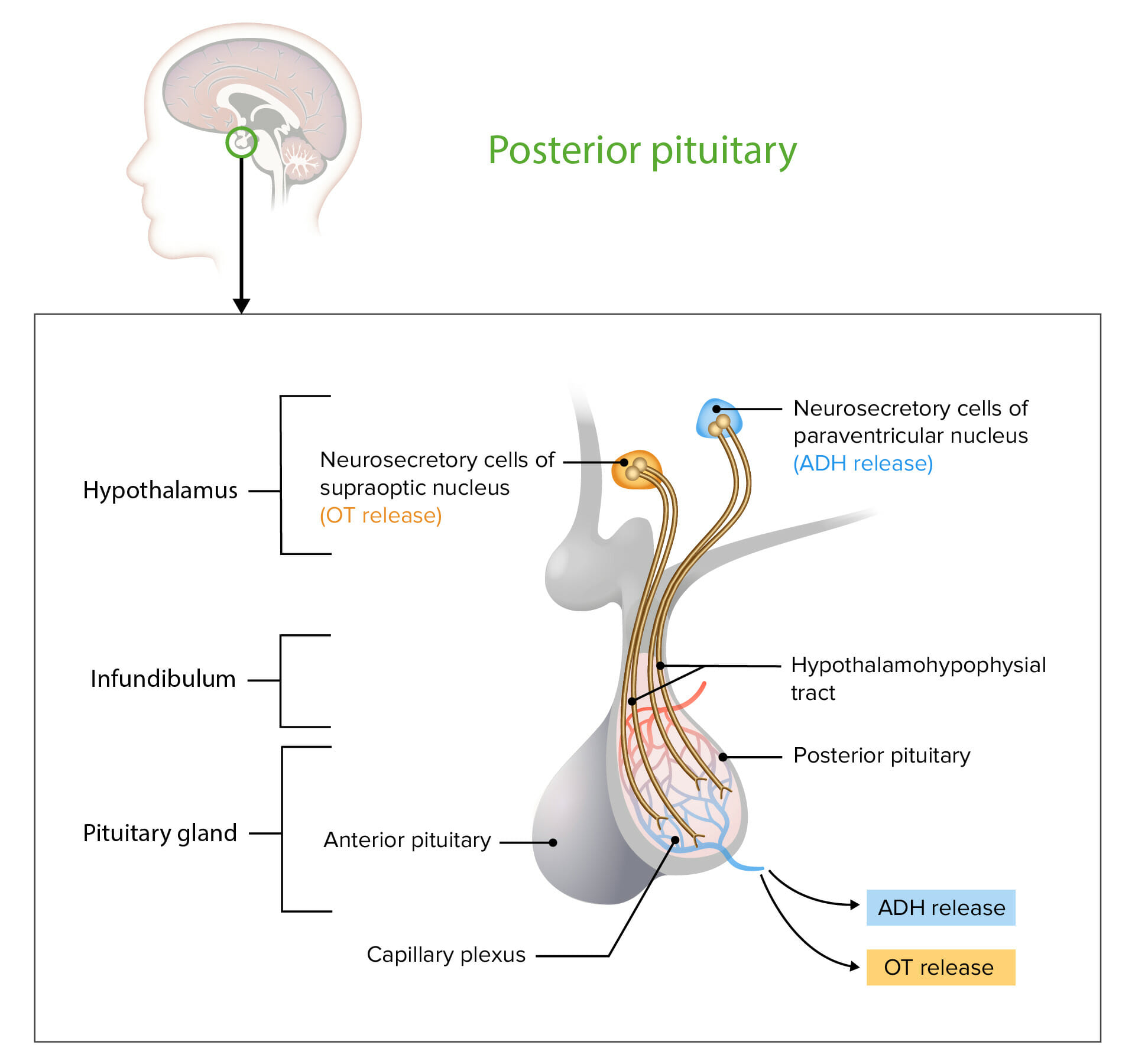
  • Se sintetiza en EN Erythema nodosum is an immune-mediated panniculitis (inflammation of the subcutaneous fat) caused by a type IV (delayed-type) hypersensitivity reaction. It commonly manifests in young women as tender, erythematous nodules on the shins. Erythema Nodosum el hipotálamo:
    • Núcleo supraóptico
    • Núcleo paraventricular
  • Almacenada y secretada por la hipófisis posterior

Secretada en EN Erythema nodosum is an immune-mediated panniculitis (inflammation of the subcutaneous fat) caused by a type IV (delayed-type) hypersensitivity reaction. It commonly manifests in young women as tender, erythematous nodules on the shins. Erythema Nodosum respuesta a

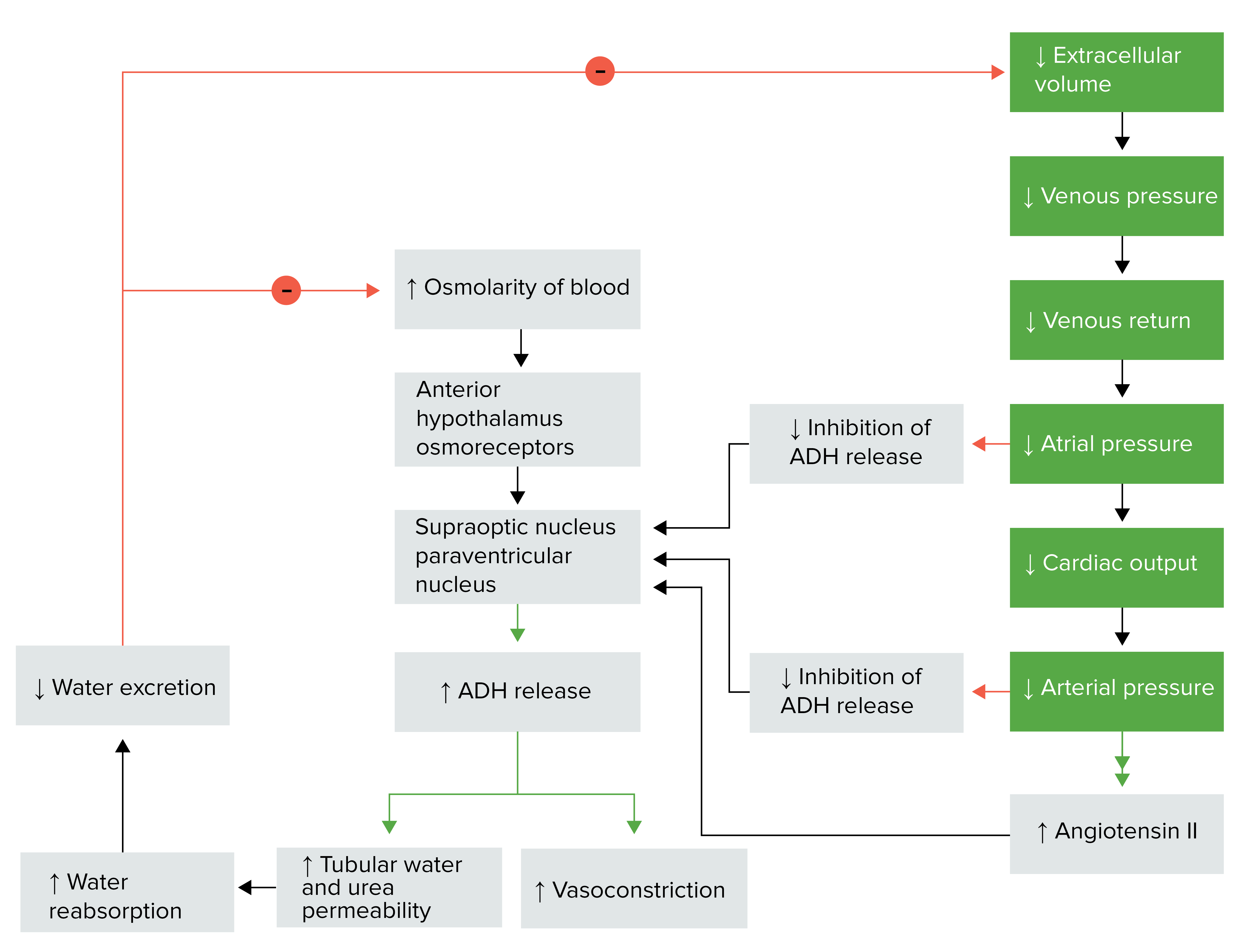
  • Aumento de la osmolaridad sérica:
    • Detectado por los LOS Neisseria osmoreceptores (hipotálamo)
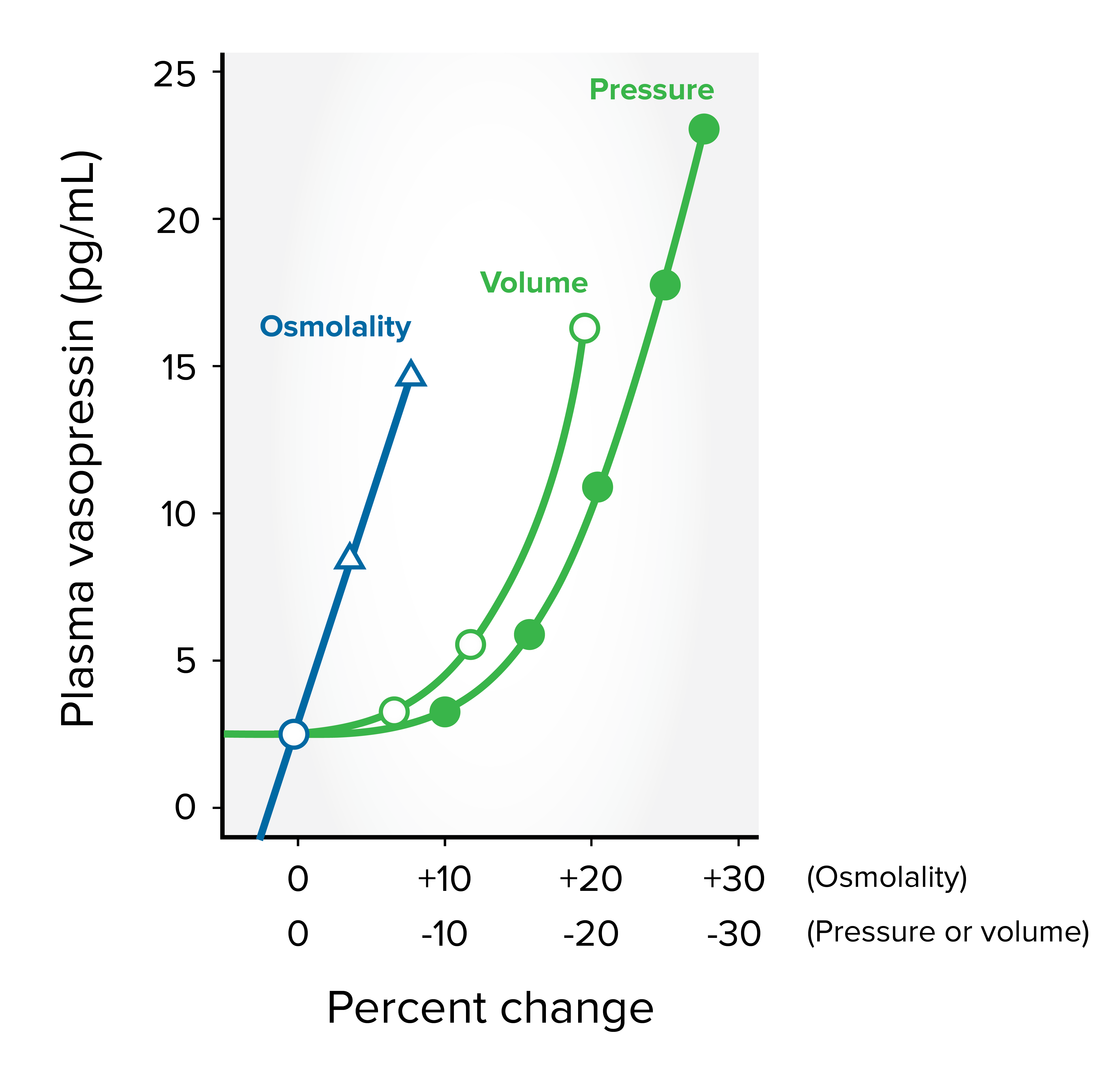
    • La ADH es muy sensible a la osmolaridad, respondiendo a aumentos de tan solo un 1%.
  • Hipovolemia:
    • Detectado por barorreceptores (aurícula izquierda, arteria carótida, arco aórtico)
    • Causado por una disminución del volumen de sangre circulante o una presión sanguínea baja
    • La ADH es menos sensible a la presión y al AL Amyloidosis volumen sanguíneo, requiriendo un cambio 10%–15% para estimular su liberación.

Función

  • Aumenta la absorción de agua libre (a través de los LOS Neisseria receptores V2)
    • ↓ Osmolaridad sérica
    • ↑ Osmolaridad de la orina
    • ↑ Volumen intravascular
  • Vasoconstricción (vía receptores V1)
  • Liberación del factor von Willebrand por parte de las células endoteliales
Regulación de la hormona antidiurética

Regulación de la ADH

Imagen por Lecturio.
Etiología y Fisiopatología

  • SIADH SIADH Syndrome of inappropriate antidiuretic hormone secretion (SIADH) is a disorder of impaired water excretion due to the inability to suppress the secretion of antidiuretic hormone (ADH). SIADH is characterized by impaired water excretion leading to dilutional hyponatremia, which is mainly asymptomatic but may cause neurologic symptoms. S Syndrome of Inappropriate Antidiuretic Hormone Secretion (SIADH) adquirido: producción continua de ADH sin un control adecuado del mecanismo de retroalimentación
  • SIADH SIADH Syndrome of inappropriate antidiuretic hormone secretion (SIADH) is a disorder of impaired water excretion due to the inability to suppress the secretion of antidiuretic hormone (ADH). SIADH is characterized by impaired water excretion leading to dilutional hyponatremia, which is mainly asymptomatic but may cause neurologic symptoms. S Syndrome of Inappropriate Antidiuretic Hormone Secretion (SIADH) hereditario:
    • Una mutación afecta al AL Amyloidosis gen del receptor Receptor Receptors are proteins located either on the surface of or within a cell that can bind to signaling molecules known as ligands (e.g., hormones) and cause some type of response within the cell. Receptors renal V2
    • También llamado síndrome nefrogénico de antidiuresis inapropiada
  • Ambos tipos ocasionan la absorción de agua libre → hiponatremia dilucional → edema Edema Edema is a condition in which excess serous fluid accumulates in the body cavity or interstitial space of connective tissues. Edema is a symptom observed in several medical conditions. It can be categorized into 2 types, namely, peripheral (in the extremities) and internal (in an organ or body cavity). Edema cerebral y síntomas neurológicos
Tabla: Causas del SIADH SIADH Syndrome of inappropriate antidiuretic hormone secretion (SIADH) is a disorder of impaired water excretion due to the inability to suppress the secretion of antidiuretic hormone (ADH). SIADH is characterized by impaired water excretion leading to dilutional hyponatremia, which is mainly asymptomatic but may cause neurologic symptoms. S Syndrome of Inappropriate Antidiuretic Hormone Secretion (SIADH) adquirido
Causas principales Ejemplos
Causas del sistema nervioso central
  • Accidente cerebrovascular
  • Hemorragia subaracnoidea
  • Infección:
    • Meningitis Meningitis Meningitis is inflammation of the meninges, the protective membranes of the brain, and spinal cord. The causes of meningitis are varied, with the most common being bacterial or viral infection. The classic presentation of meningitis is a triad of fever, altered mental status, and nuchal rigidity. Meningitis
    • Encefalitis
  • Trauma
Neoplasias
  • Cáncer de pulmón de células pequeñas
  • Cánceres de cabeza y cuello
Causas pulmonares
  • Neumonía
  • Tuberculosis Tuberculosis Tuberculosis (TB) is an infectious disease caused by Mycobacterium tuberculosis complex bacteria. The bacteria usually attack the lungs but can also damage other parts of the body. Approximately 30% of people around the world are infected with this pathogen, with the majority harboring a latent infection. Tuberculosis spreads through the air when a person with active pulmonary infection coughs or sneezes. Tuberculosis
  • Atelectasias
Medicamentos
  • Clorpropamida
  • Carbamazepina, oxcarbazepina
  • ISRS
  • Vincristina, vinblastina, vinorelbina, cisplatino
  • IMAO
  • Haloperidol Haloperidol A phenyl-piperidinyl-butyrophenone that is used primarily to treat schizophrenia and other psychoses. It is also used in schizoaffective disorder, delusional disorders, ballism, and tourette syndrome (a drug of choice) and occasionally as adjunctive therapy in intellectual disability and the chorea of huntington disease. It is a potent antiemetic and is used in the treatment of intractable hiccups. First-Generation Antipsychotics
Cirugía
  • Se produce en EN Erythema nodosum is an immune-mediated panniculitis (inflammation of the subcutaneous fat) caused by a type IV (delayed-type) hypersensitivity reaction. It commonly manifests in young women as tender, erythematous nodules on the shins. Erythema Nodosum las cirugías de las regiones abdominal y torácica
  • El mecanismo de liberación está mediado por los LOS Neisseria aferentes del dolor Dolor Inflammation.
ISRS: inhibidor selectivo de la recaptura de serotonina
IMAO: inhibidor de la monoaminooxidasa

Presentación Clínica

  • Los LOS Neisseria pacientes suelen ser euvolémicos.
  • Las manifestaciones en EN Erythema nodosum is an immune-mediated panniculitis (inflammation of the subcutaneous fat) caused by a type IV (delayed-type) hypersensitivity reaction. It commonly manifests in young women as tender, erythematous nodules on the shins. Erythema Nodosum el paciente dependen de:
    • La rapidez y la gravedad de la hiponatremia (aguda y crónica)
    • El grado de edema Edema Edema is a condition in which excess serous fluid accumulates in the body cavity or interstitial space of connective tissues. Edema is a symptom observed in several medical conditions. It can be categorized into 2 types, namely, peripheral (in the extremities) and internal (in an organ or body cavity). Edema cerebral
  • Hiponatremia aguda:
    • El edema Edema Edema is a condition in which excess serous fluid accumulates in the body cavity or interstitial space of connective tissues. Edema is a symptom observed in several medical conditions. It can be categorized into 2 types, namely, peripheral (in the extremities) and internal (in an organ or body cavity). Edema cerebral es el principal problema.
    • Los LOS Neisseria síntomas son principalmente neurológicos e incluyen:
      • Náuseas
      • Vómitos
      • Convulsiones
      • Herniación del tallo cerebral
      • Coma Coma Coma is defined as a deep state of unarousable unresponsiveness, characterized by a score of 3 points on the GCS. A comatose state can be caused by a multitude of conditions, making the precise epidemiology and prognosis of coma difficult to determine. Coma
      • Muerte
    • El movimiento de agua hacia las células estimulará la secreción adicional de ADH.
    • Una complicación importante es la insuficiencia respiratoria hipoxémica.
  • Hiponatremia crónica:
    • Las células se adaptan al AL Amyloidosis cambio osmótico/hiponatremia dilucional perdiendo osmolitos orgánicos (inositol, betaína, glutamato); por lo tanto, el edema Edema Edema is a condition in which excess serous fluid accumulates in the body cavity or interstitial space of connective tissues. Edema is a symptom observed in several medical conditions. It can be categorized into 2 types, namely, peripheral (in the extremities) and internal (in an organ or body cavity). Edema cerebral se reducirá.
    • Los LOS Neisseria síntomas son sutiles, incluyendo:
      • Marcha anormal
      • Confusión
      • Alteraciones cognitivas

Diagnóstico

  • Resultados de laboratorio:
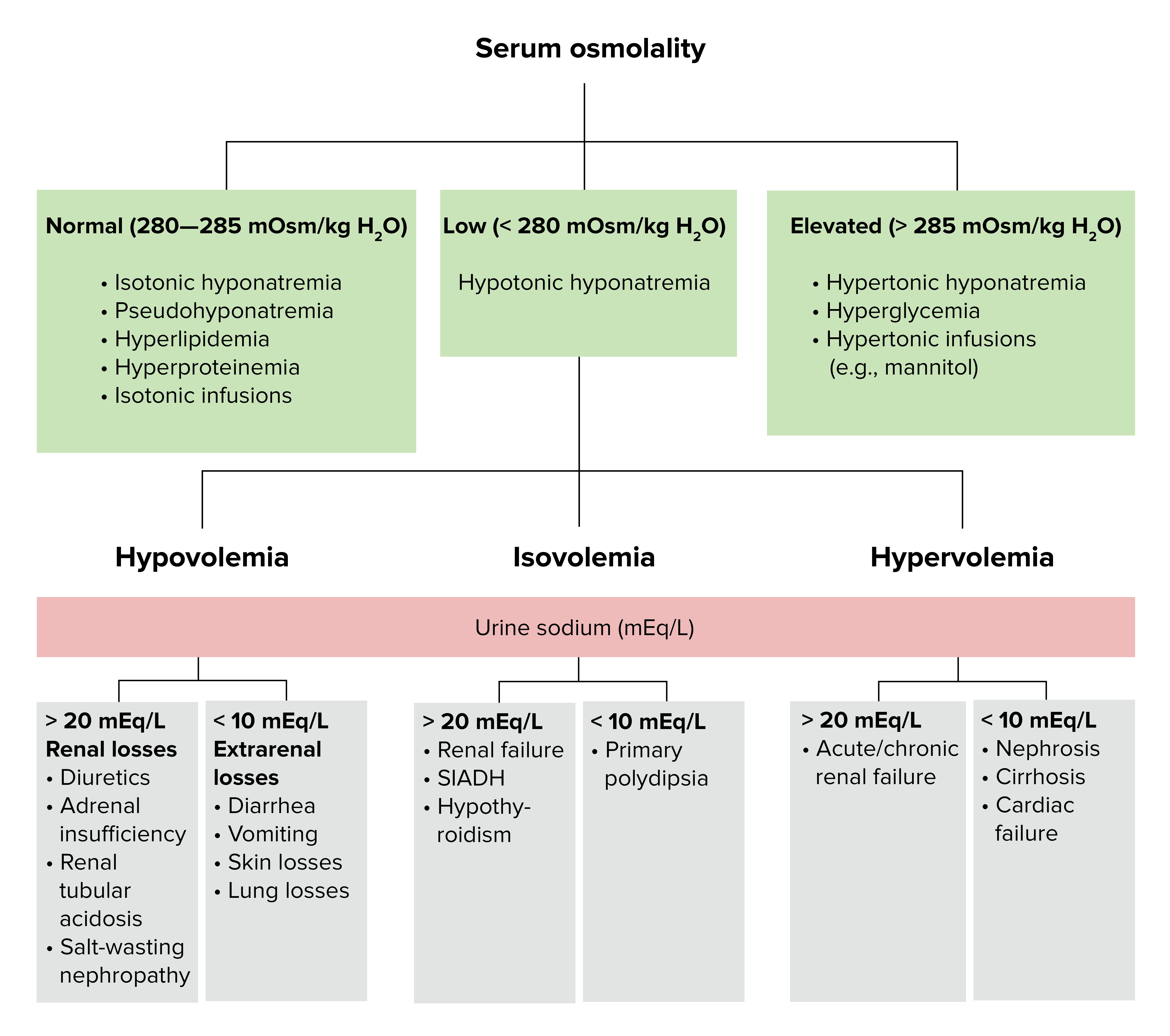
    • Sodio sérico < 135 mEq/L
    • Osmolaridad sérica < 280 mOsm/kg
    • Sodio en EN Erythema nodosum is an immune-mediated panniculitis (inflammation of the subcutaneous fat) caused by a type IV (delayed-type) hypersensitivity reaction. It commonly manifests in young women as tender, erythematous nodules on the shins. Erythema Nodosum orina > 20-40 mEq/L (a menos que se siga una dieta baja en EN Erythema nodosum is an immune-mediated panniculitis (inflammation of the subcutaneous fat) caused by a type IV (delayed-type) hypersensitivity reaction. It commonly manifests in young women as tender, erythematous nodules on the shins. Erythema Nodosum sodio)
    • Brecha aniónica disminuida
    • Osmolaridad de la orina > 100 mOsm/kg
  • Deben realizarse más pruebas para encontrar la causa subyacente según los LOS Neisseria antecedentes:
    • Los LOS Neisseria pacientes con antecedentes de tabaquismo de larga duración y pérdida de peso requieren una radiografía de tórax y/o una tomografía computarizada (TC) para descartar un posible cáncer de pulmón.
    • Niveles de creatinina para evaluar la función renal
Algoritmo de diagnóstico de las alteraciones de la volemia y del sodio

Algoritmo de diagnóstico de las alteraciones de la volemia y del sodio

Imagen por Lecturio.

Tratamiento

  • La causa subyacente debe ser tratada si es posible.
  • Los LOS Neisseria niveles bajos de sodio (hiponatremia) deben ser corregidos:
    • La corrección debe hacerse gradualmente (< 8 mEq/L en EN Erythema nodosum is an immune-mediated panniculitis (inflammation of the subcutaneous fat) caused by a type IV (delayed-type) hypersensitivity reaction. It commonly manifests in young women as tender, erythematous nodules on the shins. Erythema Nodosum 24 horas) para prevenir el síndrome de desmielinización osmótica.
    • Una corrección rápida provocará un síndrome de desmielinización osmótica (disfagia, disartria, diplopía, ataxia Ataxia Impairment of the ability to perform smoothly coordinated voluntary movements. This condition may affect the limbs, trunk, eyes, pharynx, larynx, and other structures. Ataxia may result from impaired sensory or motor function. Sensory ataxia may result from posterior column injury or peripheral nerve diseases. Motor ataxia may be associated with cerebellar diseases; cerebral cortex diseases; thalamic diseases; basal ganglia diseases; injury to the red nucleus; and other conditions. Ataxia-telangiectasia, mutismo, síndrome de enclaustramiento).
    • Síntomas agudos y graves (por ejemplo, convulsiones):
      • Solución salina hipertónica
    • Síntomas leves:
      • Restricción de fluidos
      • Tabletas de sal
  • Pueden utilizarse medicamentos complementarios:
    • Furosemida
    • Antagonistas de la vasopresina (conivaptán, tolvaptán)
    • Demeclociclina

Diagnóstico Diferencial

El diagnóstico diferencial del SIADH SIADH Syndrome of inappropriate antidiuretic hormone secretion (SIADH) is a disorder of impaired water excretion due to the inability to suppress the secretion of antidiuretic hormone (ADH). SIADH is characterized by impaired water excretion leading to dilutional hyponatremia, which is mainly asymptomatic but may cause neurologic symptoms. S Syndrome of Inappropriate Antidiuretic Hormone Secretion (SIADH) incluye otras condiciones hiponatrémicas:

  • Hiponatremia: una baja concentración de sodio en EN Erythema nodosum is an immune-mediated panniculitis (inflammation of the subcutaneous fat) caused by a type IV (delayed-type) hypersensitivity reaction. It commonly manifests in young women as tender, erythematous nodules on the shins. Erythema Nodosum la sangre. Generalmente se define como una concentración de sodio < 135 mEq/L, siendo la hiponatremia grave < 120 mEq/L. Los LOS Neisseria trastornos que causan hiponatremia pueden dividirse en EN Erythema nodosum is an immune-mediated panniculitis (inflammation of the subcutaneous fat) caused by a type IV (delayed-type) hypersensitivity reaction. It commonly manifests in young women as tender, erythematous nodules on the shins. Erythema Nodosum:
    • Trastornos que provocan una alteración de la excreción de agua en EN Erythema nodosum is an immune-mediated panniculitis (inflammation of the subcutaneous fat) caused by a type IV (delayed-type) hypersensitivity reaction. It commonly manifests in young women as tender, erythematous nodules on the shins. Erythema Nodosum la orina:
      • Pérdidas gastrointestinales (vómitos, diarrea)
      • Pérdidas renales (terapia diurética, insuficiencia suprarrenal)
      • Trastornos con edema Edema Edema is a condition in which excess serous fluid accumulates in the body cavity or interstitial space of connective tissues. Edema is a symptom observed in several medical conditions. It can be categorized into 2 types, namely, peripheral (in the extremities) and internal (in an organ or body cavity). Edema (insuficiencia cardíaca crónica, cirrosis, síndrome nefrótico)
      • Insuficiencia renal (insuficiencia renal aguda y enfermedad renal crónica)
      • Otras causas de exceso de ADH (deficiencia de cortisol Cortisol Glucocorticoids, hipotiroidismo, administración de derivados de ADH)
    • Trastornos en EN Erythema nodosum is an immune-mediated panniculitis (inflammation of the subcutaneous fat) caused by a type IV (delayed-type) hypersensitivity reaction. It commonly manifests in young women as tender, erythematous nodules on the shins. Erythema Nodosum los LOS Neisseria que el manejo renal del agua es normal:
      • Polidipsia primaria
      • Perdedor cerebral de sal
  • Pérdida cerebral de sal: Pérdida renal de Na+ con una enfermedad intracraneal, que conduce a una hiponatremia y a una disminución del volumen de líquido extracelular. Los LOS Neisseria pacientes con contracción de volumen y SIADH SIADH Syndrome of inappropriate antidiuretic hormone secretion (SIADH) is a disorder of impaired water excretion due to the inability to suppress the secretion of antidiuretic hormone (ADH). SIADH is characterized by impaired water excretion leading to dilutional hyponatremia, which is mainly asymptomatic but may cause neurologic symptoms. S Syndrome of Inappropriate Antidiuretic Hormone Secretion (SIADH) serán euvolémicos. El tratamiento es de reposición de sal y volumen.
  • Insuficiencia suprarrenal (enfermedad de Addison): insuficiencia de glucocorticoides y mineralocorticoides debido a la destrucción o disfunción de toda la corteza suprarrenal. El cortisol Cortisol Glucocorticoids tiene un efecto de retroalimentación negativa sobre la ADH y la hormona adrenocorticotrópica (ACTH, por sus siglas en EN Erythema nodosum is an immune-mediated panniculitis (inflammation of the subcutaneous fat) caused by a type IV (delayed-type) hypersensitivity reaction. It commonly manifests in young women as tender, erythematous nodules on the shins. Erythema Nodosum inglés). La ausencia de cortisol Cortisol Glucocorticoids elimina así este efecto inhibidor, aumentando la liberación de ADH.
  • Polidipsia psicógena: aumento de la ingesta de agua atribuido a un defecto del mecanismo de la sed, sobre todo en EN Erythema nodosum is an immune-mediated panniculitis (inflammation of the subcutaneous fat) caused by a type IV (delayed-type) hypersensitivity reaction. It commonly manifests in young women as tender, erythematous nodules on the shins. Erythema Nodosum pacientes con psicosis.
  • Hiponatremia hipervolémica: déficit de la excreción de agua libre lo que provoca una retención de agua inadecuada en EN Erythema nodosum is an immune-mediated panniculitis (inflammation of the subcutaneous fat) caused by a type IV (delayed-type) hypersensitivity reaction. It commonly manifests in young women as tender, erythematous nodules on the shins. Erythema Nodosum relación con la concentración de sodio. Este desequilibrio osmótico da lugar a un volumen extracelular elevado y a una hiponatremia por dilución. Se puede observar en EN Erythema nodosum is an immune-mediated panniculitis (inflammation of the subcutaneous fat) caused by a type IV (delayed-type) hypersensitivity reaction. It commonly manifests in young women as tender, erythematous nodules on the shins. Erythema Nodosum casos de insuficiencia cardíaca crónica, cirrosis y síndrome nefrótico. Fácil de diagnosticar basándose en EN Erythema nodosum is an immune-mediated panniculitis (inflammation of the subcutaneous fat) caused by a type IV (delayed-type) hypersensitivity reaction. It commonly manifests in young women as tender, erythematous nodules on the shins. Erythema Nodosum los LOS Neisseria síntomas significativos y los LOS Neisseria valores de laboratorio de la enfermedad subyacente.

Referencias

  1. Jameson, J.L., et al. (Ed.). (2015). Harrison’s Principles of Internal Medicine (20th ed., pp. 299–303, 610, & 2281).
  2. Sterns, R.H., Emmett, M., & Forman, J.P. (2024). Pathophysiology and etiology of the syndrome of inappropriate antidiuretic hormone secretion (SIADH). UpToDate. Retrieved July 22, 2025, from https://www.uptodate.com/contents/pathophysiology-and-etiology-of-the-syndrome-of-inappropriate-antidiuretic-hormone-secretion-siadh
  3. Thomas, C.P., Lederer, E., Batuman, V., & Fraer, M. (2023). Syndrome of Inappropriate Antidiuretic Hormone Secretion (SIADH). Retrieved July 22, 2025, from https://emedicine.medscape.com/article/246650-overview
  4. Verbalis, J.G., et al. (Ed.) (2013). Diagnosis, evaluation, and treatment of hyponatremia: expert panel recommendations. Am J Med. 126(10 Suppl 1), S1-42. https://doi.org/10.1016/j.amjmed.2013.07.006

¡Crea tu cuenta gratis o inicia una sesión para seguir leyendo!

Regístrate ahora y obtén acceso gratuito a Lecturio con páginas de concepto, videos médicos y cuestionarios para tu educación médica.

User Reviews

Que tengas una sesión de estudio alegre y navideña 🎁 Ahorra 50% en todos los planes >>

Details