Domina Conceptos Médicos

Estudia para la escuela de medicina y tus examenes con Lecturio.

Segundos Mensajeros

Las vías de señalización son sistemas complejos en EN Erythema nodosum is an immune-mediated panniculitis (inflammation of the subcutaneous fat) caused by a type IV (delayed-type) hypersensitivity reaction. It commonly manifests in young women as tender, erythematous nodules on the shins. Erythema Nodosum los LOS Neisseria que una sola señal extracelular puede provocar múltiples eventos intracelulares, algunos de los LOS Neisseria cuales también pueden desencadenarse por otras vías de señalización o pueden desencadenar ellos mismos otros eventos intracelulares. “Segundo mensajero” es un término utilizado para referirse a un grupo diverso de pequeñas moléculas o iones que transmiten la señal extracelular iniciada por un ligando que se une a un receptor Receptor Receptors are proteins located either on the surface of or within a cell that can bind to signaling molecules known as ligands (e.g., hormones) and cause some type of response within the cell. Receptors de la superficie celular a proteínas efectoras dentro de la célula. En EN Erythema nodosum is an immune-mediated panniculitis (inflammation of the subcutaneous fat) caused by a type IV (delayed-type) hypersensitivity reaction. It commonly manifests in young women as tender, erythematous nodules on the shins. Erythema Nodosum estado de reposo, existen pequeñas cantidades de segundos mensajeros en EN Erythema nodosum is an immune-mediated panniculitis (inflammation of the subcutaneous fat) caused by a type IV (delayed-type) hypersensitivity reaction. It commonly manifests in young women as tender, erythematous nodules on the shins. Erythema Nodosum una célula; sin embargo, su producción puede aumentar rápidamente una vez que se ha HA Hemolytic anemia (HA) is the term given to a large group of anemias that are caused by the premature destruction/hemolysis of circulating red blood cells (RBCs). Hemolysis can occur within (intravascular hemolysis) or outside the blood vessels (extravascular hemolysis). Hemolytic Anemia recibido una señal. Una vez liberados en EN Erythema nodosum is an immune-mediated panniculitis (inflammation of the subcutaneous fat) caused by a type IV (delayed-type) hypersensitivity reaction. It commonly manifests in young women as tender, erythematous nodules on the shins. Erythema Nodosum el interior de la célula, los LOS Neisseria segundos mensajeros se unen a sus proteínas objetivo y alteran sus propiedades (actividad, localización, disponibilidad de sitios de reacción, estabilidad, etc ETC The electron transport chain (ETC) sends electrons through a series of proteins, which generate an electrochemical proton gradient that produces energy in the form of adenosine triphosphate (ATP). Electron Transport Chain (ETC).), provocando un cambio en EN Erythema nodosum is an immune-mediated panniculitis (inflammation of the subcutaneous fat) caused by a type IV (delayed-type) hypersensitivity reaction. It commonly manifests in young women as tender, erythematous nodules on the shins. Erythema Nodosum la homeostasis Homeostasis The processes whereby the internal environment of an organism tends to remain balanced and stable. Cell Injury and Death de la célula y transmitiendo así el mensaje.

Last updated: Apr 25, 2025

Editorial responsibility: Stanley Oiseth, Lindsay Jones, Evelin Maza

Descripción General de los Segundos Mensajeros

Los LOS Neisseria segundos mensajeros son moléculas de señalización intracelular liberadas por la célula en EN Erythema nodosum is an immune-mediated panniculitis (inflammation of the subcutaneous fat) caused by a type IV (delayed-type) hypersensitivity reaction. It commonly manifests in young women as tender, erythematous nodules on the shins. Erythema Nodosum respuesta a los LOS Neisseria primeros mensajeros, que son moléculas de señalización extracelular.
  • Primeros mensajeros (ligandos):
    • Factores extracelulares
    • Hormonas
    • Neurotransmisores
    • Epinefrina
    • Hormona del crecimiento
    • Serotonina
  • Categorías de segundos mensajeros y sus funciones específicas:
    • Nucleótidos cíclicos y otras moléculas solubles: señal dentro del citosol.
      • Monofosfato de adenosina cíclico ( cAMP cAMP An adenine nucleotide containing one phosphate group which is esterified to both the 3′- and 5′-positions of the sugar moiety. It is a second messenger and a key intracellular regulator, functioning as a mediator of activity for a number of hormones, including epinephrine, glucagon, and acth. Phosphodiesterase Inhibitors, por sus siglas en EN Erythema nodosum is an immune-mediated panniculitis (inflammation of the subcutaneous fat) caused by a type IV (delayed-type) hypersensitivity reaction. It commonly manifests in young women as tender, erythematous nodules on the shins. Erythema Nodosum inglés)
      • Monofosfato de guanosina cíclico ( cGMP cGMP Guanosine cyclic 3. Phosphodiesterase Inhibitors, por sus siglas en EN Erythema nodosum is an immune-mediated panniculitis (inflammation of the subcutaneous fat) caused by a type IV (delayed-type) hypersensitivity reaction. It commonly manifests in young women as tender, erythematous nodules on the shins. Erythema Nodosum inglés)
    • Mensajeros lipídicos: se originan dentro de las membranas celulares.
      • Diacilglicerol ( DAG DAG Second Messengers)
      • Trifosfato de inositol (IP3)
      • Fosfatidilinositol (3,4,5)-trifosfato (PIP3)
    • Iones: señal dentro y entre compartimentos celulares
      • Calcio ( Ca CA Condylomata acuminata are a clinical manifestation of genital HPV infection. Condylomata acuminata are described as raised, pearly, flesh-colored, papular, cauliflower-like lesions seen in the anogenital region that may cause itching, pain, or bleeding. Condylomata Acuminata (Genital Warts))
      • Mg
    • Gases y radicales libres: pueden enviar señales a través de la célula e incluso a las células vecinas
      • NO
      • CO
      • Sulfuro de hidrógeno (H2S)
  • Los LOS Neisseria segundos mensajeros pueden desencadenar múltiples funciones, que incluyen:
    • Proliferación
    • Diferenciación
    • Migración
    • Supervivencia
    • Apoptosis Apoptosis A regulated cell death mechanism characterized by distinctive morphologic changes in the nucleus and cytoplasm, including the endonucleolytic cleavage of genomic DNA, at regularly spaced, internucleosomal sites, I.e., DNA fragmentation. It is genetically-programmed and serves as a balance to mitosis in regulating the size of animal tissues and in mediating pathologic processes associated with tumor growth. Ischemic Cell Damage
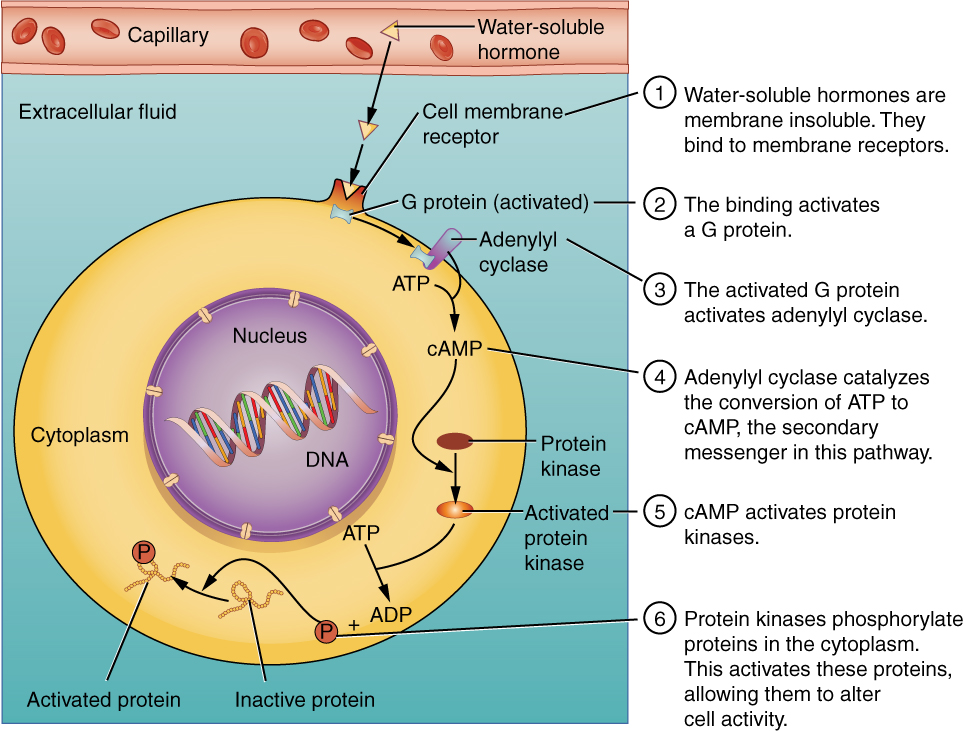
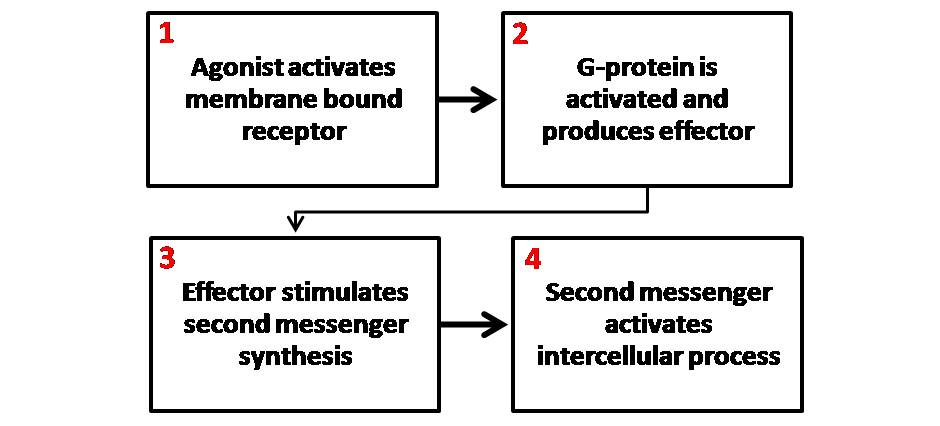
El mecanismo del segundo mensajero

Esquema general del mecanismo del segundo mensajero

Imagen: “Second Messenger Mechanism” por Lunska. Licencia: Dominio Público

Nucleótidos Cíclicos

Monofosfato de adenosina cíclico

  • Propiedades generales:
    • Segundo mensajero común visto en EN Erythema nodosum is an immune-mediated panniculitis (inflammation of the subcutaneous fat) caused by a type IV (delayed-type) hypersensitivity reaction. It commonly manifests in young women as tender, erythematous nodules on the shins. Erythema Nodosum la respuesta de “lucha o huida”, así como en EN Erythema nodosum is an immune-mediated panniculitis (inflammation of the subcutaneous fat) caused by a type IV (delayed-type) hypersensitivity reaction. It commonly manifests in young women as tender, erythematous nodules on the shins. Erythema Nodosum muchas otras vías metabólicas
    • Derivado del trifosfato de adenosina (ATP)
  • Síntesis en EN Erythema nodosum is an immune-mediated panniculitis (inflammation of the subcutaneous fat) caused by a type IV (delayed-type) hypersensitivity reaction. It commonly manifests in young women as tender, erythematous nodules on the shins. Erythema Nodosum respuesta al AL Amyloidosis primer mensajero:
    • Los LOS Neisseria primeros mensajeros (e.g., epinefrina) se unen a los LOS Neisseria receptores extracelulares
    • Provocan la activación intracelular de las subunidades de la proteína G del receptor Receptor Receptors are proteins located either on the surface of or within a cell that can bind to signaling molecules known as ligands (e.g., hormones) and cause some type of response within the cell. Receptors
    • La proteína G activa la adenilil ciclasa
    • La adenilil ciclasa cataliza la conversión de ATP a cAMP cAMP An adenine nucleotide containing one phosphate group which is esterified to both the 3′- and 5′-positions of the sugar moiety. It is a second messenger and a key intracellular regulator, functioning as a mediator of activity for a number of hormones, including epinephrine, glucagon, and acth. Phosphodiesterase Inhibitors
    • Los LOS Neisseria niveles intracelulares de cAMP cAMP An adenine nucleotide containing one phosphate group which is esterified to both the 3′- and 5′-positions of the sugar moiety. It is a second messenger and a key intracellular regulator, functioning as a mediator of activity for a number of hormones, including epinephrine, glucagon, and acth. Phosphodiesterase Inhibitors aumentan
  • Actividad del segundo mensajero:
    • cAMP cAMP An adenine nucleotide containing one phosphate group which is esterified to both the 3′- and 5′-positions of the sugar moiety. It is a second messenger and a key intracellular regulator, functioning as a mediator of activity for a number of hormones, including epinephrine, glucagon, and acth. Phosphodiesterase Inhibitors tiene como objetivo la proteína quinasa A (PKA)
    • 2 moléculas de AMPc se unen a PKA → la activan
    • PKA fosforila residuos de serina o treonina en EN Erythema nodosum is an immune-mediated panniculitis (inflammation of the subcutaneous fat) caused by a type IV (delayed-type) hypersensitivity reaction. It commonly manifests in young women as tender, erythematous nodules on the shins. Erythema Nodosum proteínas objetivo
    • La fosforilación afecta la actividad de múltiples grupos de proteínas, particularmente aquellas que regulan el metabolismo de azúcares, glucógeno y lípidos
    • La concentración intracelular de cAMP cAMP An adenine nucleotide containing one phosphate group which is esterified to both the 3′- and 5′-positions of the sugar moiety. It is a second messenger and a key intracellular regulator, functioning as a mediator of activity for a number of hormones, including epinephrine, glucagon, and acth. Phosphodiesterase Inhibitors determina la fracción de PKA en EN Erythema nodosum is an immune-mediated panniculitis (inflammation of the subcutaneous fat) caused by a type IV (delayed-type) hypersensitivity reaction. It commonly manifests in young women as tender, erythematous nodules on the shins. Erythema Nodosum su forma activa y, por lo tanto, la velocidad a la que fosforila sus sustratos
  • Ejemplos:
    • Vía de la epinefrina:
      • La epinefrina se une al AL Amyloidosis receptor Receptor Receptors are proteins located either on the surface of or within a cell that can bind to signaling molecules known as ligands (e.g., hormones) and cause some type of response within the cell. Receptors beta-adrenérgico de una célula muscular.
      • Activación de proteína G → aumento de los LOS Neisseria niveles de cAMP cAMP An adenine nucleotide containing one phosphate group which is esterified to both the 3′- and 5′-positions of the sugar moiety. It is a second messenger and a key intracellular regulator, functioning as a mediator of activity for a number of hormones, including epinephrine, glucagon, and acth. Phosphodiesterase Inhibitors
      • La activación de PKA conduce a la activación de la glucógeno fosforilasa
      • Aumento de la descomposición del glucógeno para una respuesta de lucha o huida
    • La vía del glucagón sigue un mecanismo similar.

Monofosfato de guanosina cíclico

  • Síntesis en EN Erythema nodosum is an immune-mediated panniculitis (inflammation of the subcutaneous fat) caused by a type IV (delayed-type) hypersensitivity reaction. It commonly manifests in young women as tender, erythematous nodules on the shins. Erythema Nodosum respuesta al AL Amyloidosis primer mensajero:
    • La activación de la guanilil ciclasa (GA) convierte el trifosfato de guanosina (GTP) en EN Erythema nodosum is an immune-mediated panniculitis (inflammation of the subcutaneous fat) caused by a type IV (delayed-type) hypersensitivity reaction. It commonly manifests in young women as tender, erythematous nodules on the shins. Erythema Nodosum cGMP cGMP Guanosine cyclic 3. Phosphodiesterase Inhibitors
    • La activación de GA puede ser desencadenada por:
      • Hormonas peptídicas impermeables a la membrana que se unen a receptores de membrana extracelulares
      • NO penetrando a través de la membrana plasmática, activando GA que se encuentra en EN Erythema nodosum is an immune-mediated panniculitis (inflammation of the subcutaneous fat) caused by a type IV (delayed-type) hypersensitivity reaction. It commonly manifests in young women as tender, erythematous nodules on the shins. Erythema Nodosum el citoplasma
  • Actividad del segundo mensajero:
    • Aumento de los LOS Neisseria niveles de cGMP cGMP Guanosine cyclic 3. Phosphodiesterase Inhibitors → aumento de la actividad de la proteína quinasa dependiente de cGMP cGMP Guanosine cyclic 3. Phosphodiesterase Inhibitors (PKG)
    • PKG fosforila proteínas que regulan:
      • Conductancia del canal de iones
      • Glucogenólisis
      • Apoptosis Apoptosis A regulated cell death mechanism characterized by distinctive morphologic changes in the nucleus and cytoplasm, including the endonucleolytic cleavage of genomic DNA, at regularly spaced, internucleosomal sites, I.e., DNA fragmentation. It is genetically-programmed and serves as a balance to mitosis in regulating the size of animal tissues and in mediating pathologic processes associated with tumor growth. Ischemic Cell Damage celular
  • Ejemplos: cGMP cGMP Guanosine cyclic 3. Phosphodiesterase Inhibitors funciona como una señal para:
    • Relajar el músculo liso de los LOS Neisseria vasos sanguíneos → vasodilatación y aumento del flujo sanguíneo
    • Regular Regular Insulin los LOS Neisseria canales de Na en EN Erythema nodosum is an immune-mediated panniculitis (inflammation of the subcutaneous fat) caused by a type IV (delayed-type) hypersensitivity reaction. It commonly manifests in young women as tender, erythematous nodules on the shins. Erythema Nodosum el ojo, controlando la fototransducción y la transmisión de imágenes al AL Amyloidosis cerebro
Second messengers

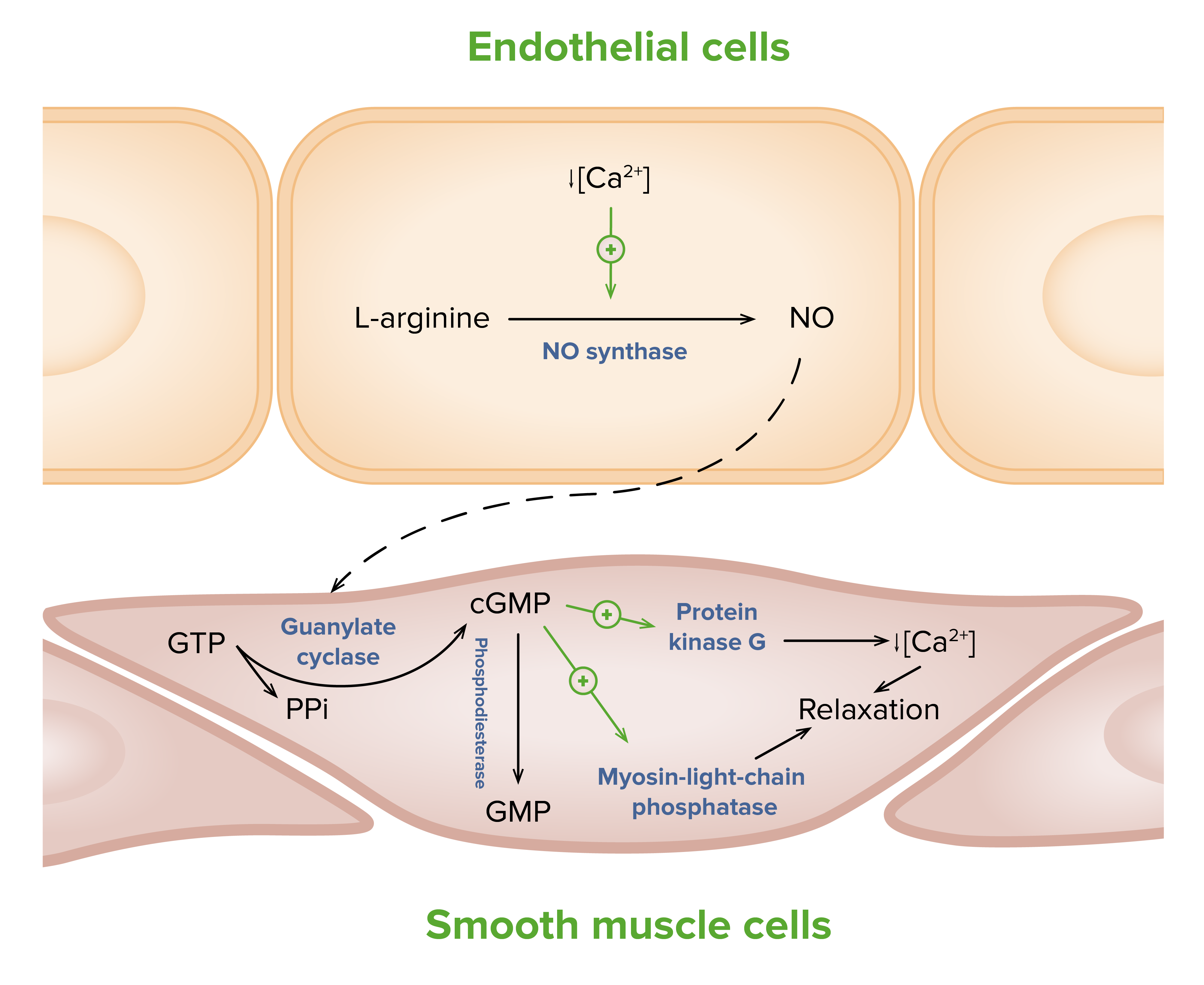
Señalización del óxido nítrico en las células musculares lisas a través de la vía del GMPc
GMP: guanosina monofosfato
GTP: guanosina trifosfato
PPi: pirofosfato inorgánico

Imagen por Lecturio.

Lípidos

Los LOS Neisseria lípidos presentes en EN Erythema nodosum is an immune-mediated panniculitis (inflammation of the subcutaneous fat) caused by a type IV (delayed-type) hypersensitivity reaction. It commonly manifests in young women as tender, erythematous nodules on the shins. Erythema Nodosum la membrana plasmática, como el fosfatidilinositol 4,5-bisfosfato (PIP2), a menudo son modificados y se utilizan como segundos mensajeros. La unión de los LOS Neisseria primeros mensajeros a los LOS Neisseria receptores puede activar enzimas modificadoras de lípidos. Esto conduce a la hidrolización de cadenas de acilo específicas o grupos de cabeza polar en EN Erythema nodosum is an immune-mediated panniculitis (inflammation of the subcutaneous fat) caused by a type IV (delayed-type) hypersensitivity reaction. It commonly manifests in young women as tender, erythematous nodules on the shins. Erythema Nodosum grupos lipídicos específicos, lo que les permite funcionar como segundos mensajeros.
Diacilglicerol e inositol trifosfato

  • Síntesis en EN Erythema nodosum is an immune-mediated panniculitis (inflammation of the subcutaneous fat) caused by a type IV (delayed-type) hypersensitivity reaction. It commonly manifests in young women as tender, erythematous nodules on the shins. Erythema Nodosum respuesta al AL Amyloidosis primer mensajero:
    • La unión de ligandos a un receptor Receptor Receptors are proteins located either on the surface of or within a cell that can bind to signaling molecules known as ligands (e.g., hormones) and cause some type of response within the cell. Receptors acoplado a proteína G (e.g., histamina) o un receptor Receptor Receptors are proteins located either on the surface of or within a cell that can bind to signaling molecules known as ligands (e.g., hormones) and cause some type of response within the cell. Receptors de tirosina cinasa (RTK) (e.g., hormona del crecimiento) activa la fosfolipasa C (PLC)
    • PLC escinde PIP2, creando 2 segundos mensajeros: DAG DAG Second Messengers e IP3
  • Actividad del segundo mensajero:
    • Cascada de IP3 IP3 Intracellular messenger formed by the action of phospholipase C on phosphatidylinositol 4, 5-bisphosphate, which is one of the phospholipids that make up the cell membrane. Inositol 1, 4, 5-trisphosphate is released into the cytoplasm where it releases calcium ions from internal stores within the cell’s endoplasmic reticulum. These calcium ions stimulate the activity of B kinase or calmodulin. Second Messengers → liberación de Ca2+ del retículo endoplásmico/sarcoplásmico → contracción muscular o liberación de hormonas (según el tipo de célula)
    • La cascada DAG DAG Second Messengers trabaja con el Ca2+ liberado de la vía IP3 para activar la proteína quinasa C → fosforilación de otras proteínas
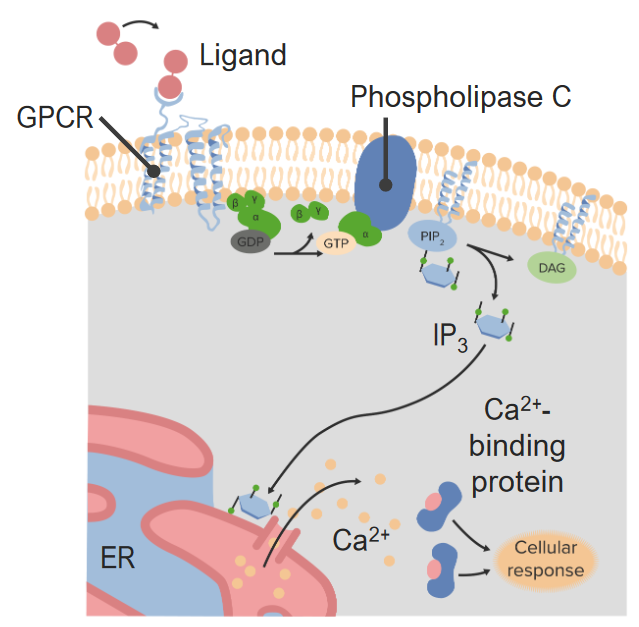
Receptor acoplado a proteína G (GPCR)

El receptor acoplado a proteína G (GPCR) activa la fosfolipasa C, que convierte PIP2 en IP3 y DAG. IP3 promueve la liberación de las reservas de calcio en la célula.
GDP: difosfato de guanosina
GTP: trifosfato de guanosina

Imagen por Lecturio.

Fosfatidilinositol (3,4,5)-trifosfato

  • Síntesis en EN Erythema nodosum is an immune-mediated panniculitis (inflammation of the subcutaneous fat) caused by a type IV (delayed-type) hypersensitivity reaction. It commonly manifests in young women as tender, erythematous nodules on the shins. Erythema Nodosum respuesta al AL Amyloidosis primer mensajero:
    • El factor de crecimiento (primer mensajero) se une a los LOS Neisseria receptores de tirosina cinasa
    • La tirosina quinasa activa la fosfoinositida 3-quinasa (PI3K)
    • Induce la fosforilación de PIP2 en EN Erythema nodosum is an immune-mediated panniculitis (inflammation of the subcutaneous fat) caused by a type IV (delayed-type) hypersensitivity reaction. It commonly manifests in young women as tender, erythematous nodules on the shins. Erythema Nodosum el 3′ para producir PIP3, un segundo mensajero
  • Actividad del segundo mensajero:
    • PIP3 tiene como objetivo la quinasa Akt prosupervivencia en EN Erythema nodosum is an immune-mediated panniculitis (inflammation of the subcutaneous fat) caused by a type IV (delayed-type) hypersensitivity reaction. It commonly manifests in young women as tender, erythematous nodules on the shins. Erythema Nodosum el citosol celular
    • Una vez unida, Akt se mueve a la membrana plasmática, donde participa en EN Erythema nodosum is an immune-mediated panniculitis (inflammation of the subcutaneous fat) caused by a type IV (delayed-type) hypersensitivity reaction. It commonly manifests in young women as tender, erythematous nodules on the shins. Erythema Nodosum una vía de señal compleja que promueve la supervivencia y el crecimiento celular

Iones

  • Descripción general:
    • Los LOS Neisseria iones y los LOS Neisseria gradientes de iones tienen funciones de señalización complejas dentro de las células (e.g., propagación del potencial de acción y cofactores de señal)
    • Ca CA Condylomata acuminata are a clinical manifestation of genital HPV infection. Condylomata acuminata are described as raised, pearly, flesh-colored, papular, cauliflower-like lesions seen in the anogenital region that may cause itching, pain, or bleeding. Condylomata Acuminata (Genital Warts) y Mg también pueden funcionar como segundos mensajeros intracelulares
    • Pueden liberarse de los LOS Neisseria depósitos intracelulares o importarse a la célula desde el espacio extracelular
  • Ca CA Condylomata acuminata are a clinical manifestation of genital HPV infection. Condylomata acuminata are described as raised, pearly, flesh-colored, papular, cauliflower-like lesions seen in the anogenital region that may cause itching, pain, or bleeding. Condylomata Acuminata (Genital Warts):
    • En EN Erythema nodosum is an immune-mediated panniculitis (inflammation of the subcutaneous fat) caused by a type IV (delayed-type) hypersensitivity reaction. It commonly manifests in young women as tender, erythematous nodules on the shins. Erythema Nodosum respuesta a señales, como IP3, los LOS Neisseria niveles de Ca CA Condylomata acuminata are a clinical manifestation of genital HPV infection. Condylomata acuminata are described as raised, pearly, flesh-colored, papular, cauliflower-like lesions seen in the anogenital region that may cause itching, pain, or bleeding. Condylomata Acuminata (Genital Warts) intracelular pueden aumentar drásticamente y actuar como un segundo mensajero:
      • Los LOS Neisseria iones individuales se unen directamente a las proteínas, lo que afecta su actividad
      • Los LOS Neisseria cambios en EN Erythema nodosum is an immune-mediated panniculitis (inflammation of the subcutaneous fat) caused by a type IV (delayed-type) hypersensitivity reaction. It commonly manifests in young women as tender, erythematous nodules on the shins. Erythema Nodosum los LOS Neisseria niveles generales de concentración de Ca CA Condylomata acuminata are a clinical manifestation of genital HPV infection. Condylomata acuminata are described as raised, pearly, flesh-colored, papular, cauliflower-like lesions seen in the anogenital region that may cause itching, pain, or bleeding. Condylomata Acuminata (Genital Warts) activan las proteínas sensoras de calcio que tienen efectos posteriores
    • Los LOS Neisseria niveles intracelulares de Ca CA Condylomata acuminata are a clinical manifestation of genital HPV infection. Condylomata acuminata are described as raised, pearly, flesh-colored, papular, cauliflower-like lesions seen in the anogenital region that may cause itching, pain, or bleeding. Condylomata Acuminata (Genital Warts) están estrictamente regulados.
      • Las bombas y los LOS Neisseria canales funcionan para almacenar Ca CA Condylomata acuminata are a clinical manifestation of genital HPV infection. Condylomata acuminata are described as raised, pearly, flesh-colored, papular, cauliflower-like lesions seen in the anogenital region that may cause itching, pain, or bleeding. Condylomata Acuminata (Genital Warts) en EN Erythema nodosum is an immune-mediated panniculitis (inflammation of the subcutaneous fat) caused by a type IV (delayed-type) hypersensitivity reaction. It commonly manifests in young women as tender, erythematous nodules on the shins. Erythema Nodosum el RE o eliminarlo de la célula
      • Una proteína amortiguadora como la parvalbúmina puede absorber el exceso de calcio
    • Terminación de la señal: las bombas y los LOS Neisseria canales eliminan Ca CA Condylomata acuminata are a clinical manifestation of genital HPV infection. Condylomata acuminata are described as raised, pearly, flesh-colored, papular, cauliflower-like lesions seen in the anogenital region that may cause itching, pain, or bleeding. Condylomata Acuminata (Genital Warts) activamente de la célula y lo transportan al AL Amyloidosis RE o al AL Amyloidosis exterior de la célula.
  • Mg:
    • Funciona como un segundo mensajero de manera similar al AL Amyloidosis calcio
    • Puede contribuir aún más a la señalización al AL Amyloidosis antagonizar la actividad de señalización de Ca CA Condylomata acuminata are a clinical manifestation of genital HPV infection. Condylomata acuminata are described as raised, pearly, flesh-colored, papular, cauliflower-like lesions seen in the anogenital region that may cause itching, pain, or bleeding. Condylomata Acuminata (Genital Warts) (el Mg reduce los LOS Neisseria niveles de Ca CA Condylomata acuminata are a clinical manifestation of genital HPV infection. Condylomata acuminata are described as raised, pearly, flesh-colored, papular, cauliflower-like lesions seen in the anogenital region that may cause itching, pain, or bleeding. Condylomata Acuminata (Genital Warts) al AL Amyloidosis inhibir su transporte al AL Amyloidosis citosol)

Referencias

  1. Alberts, B., Heald, R., Johnson, A., Morgan, D., Raff, M., Roberts, K., Walter, P., & Wilson, J. (2022). Molecular biology of the cell (7th ed.). W.W. Norton & Company.
  2. Bernheim, A., Millman, A., Ofir, G., Bondy-Denomy, J., & Sorek, R. (2024). The immune modules conserved across the tree of life: Towards a definition of ancestral immunity. PLOS Biology, 22(7), e3002717. https://doi.org/10.1371/journal.pbio.3002717
  3. Bock, A., Irannejad, R., & Scott, J. D. (2024). cAMP signaling: A remarkably regional affair. Trends in Biochemical Sciences, 49(4), 305-317. https://doi.org/10.1016/j.tibs.2024.01.004
  4. Lim, W. A., & Mayer, B. J. (2024). Cell signaling: Principles and mechanisms (2nd ed.). CRC Press. https://doi.org/10.1201/9780429298844
  5. Ma, X., Wu, X., Wang, Y., & Wu, Y. (2024). Second messenger 2’3′-cyclic GMP-AMP (2’3′-cGAMP): The cell autonomous and non-autonomous roles in cancer progression. Acta Pharmacologica Sinica, 45(5), 890–899. https://doi.org/10.1038/s41401-023-01210-7
  6. Stella, G., & Marraffini, L. (2024). Type III CRISPR-Cas: Beyond the Cas10 effector complex. Trends in Biochemical Sciences, 49(1), 28–37. https://doi.org/10.1016/j.tibs.2023.10.006

¡Crea tu cuenta gratis o inicia una sesión para seguir leyendo!

Regístrate ahora y obtén acceso gratuito a Lecturio con páginas de concepto, videos médicos y cuestionarios para tu educación médica.

User Reviews

Que tengas una sesión de estudio alegre y navideña 🎁 Ahorra 50% en todos los planes >>

Details