Domina Conceptos Médicos

Estudia para la escuela de medicina y tus examenes con Lecturio.

Retinopatía Hipertensiva

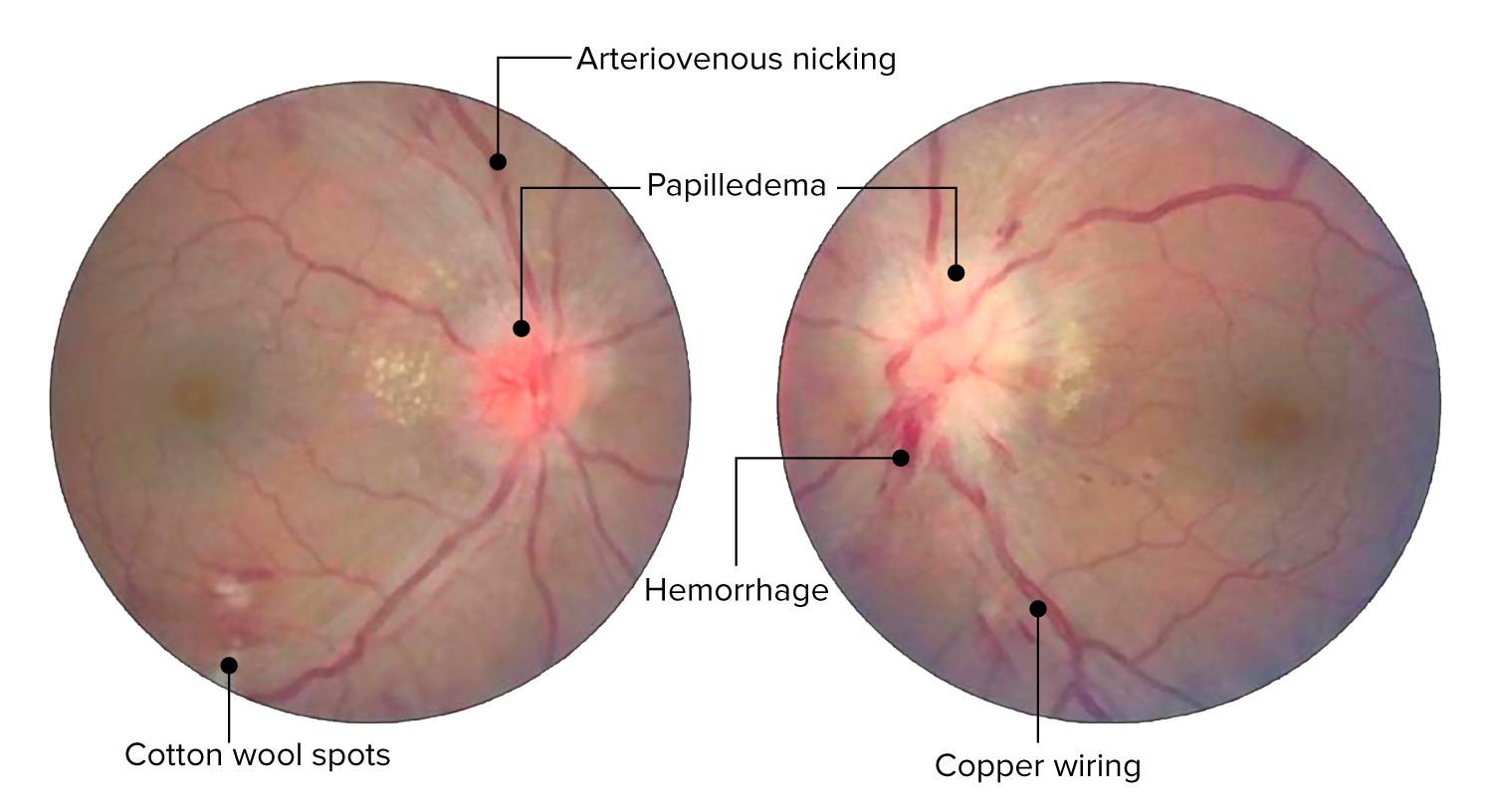
La hipertensión tiene muchos efectos adversos en EN Erythema nodosum is an immune-mediated panniculitis (inflammation of the subcutaneous fat) caused by a type IV (delayed-type) hypersensitivity reaction. It commonly manifests in young women as tender, erythematous nodules on the shins. Erythema Nodosum el ojo, de los LOS Neisseria cuales la retinopatía es la presentación más común. La retinopatía hipertensiva consiste en EN Erythema nodosum is an immune-mediated panniculitis (inflammation of the subcutaneous fat) caused by a type IV (delayed-type) hypersensitivity reaction. It commonly manifests in young women as tender, erythematous nodules on the shins. Erythema Nodosum alteraciones vasculares de la retina Retina The ten-layered nervous tissue membrane of the eye. It is continuous with the optic nerve and receives images of external objects and transmits visual impulses to the brain. Its outer surface is in contact with the choroid and the inner surface with the vitreous body. The outermost layer is pigmented, whereas the inner nine layers are transparent. Eye: Anatomy que se desarrollan como efecto directo de una presión arterial elevada. En EN Erythema nodosum is an immune-mediated panniculitis (inflammation of the subcutaneous fat) caused by a type IV (delayed-type) hypersensitivity reaction. It commonly manifests in young women as tender, erythematous nodules on the shins. Erythema Nodosum los LOS Neisseria aumentos agudos de la presión arterial, la autorregulación da lugar a una contracción de las arteriolas de la retina Retina The ten-layered nervous tissue membrane of the eye. It is continuous with the optic nerve and receives images of external objects and transmits visual impulses to the brain. Its outer surface is in contact with the choroid and the inner surface with the vitreous body. The outermost layer is pigmented, whereas the inner nine layers are transparent. Eye: Anatomy. En EN Erythema nodosum is an immune-mediated panniculitis (inflammation of the subcutaneous fat) caused by a type IV (delayed-type) hypersensitivity reaction. It commonly manifests in young women as tender, erythematous nodules on the shins. Erythema Nodosum la hipertensión crónica, los LOS Neisseria cambios estructurales consistentes con la arteriosclerosis afectan la vasculatura de la retina Retina The ten-layered nervous tissue membrane of the eye. It is continuous with the optic nerve and receives images of external objects and transmits visual impulses to the brain. Its outer surface is in contact with the choroid and the inner surface with the vitreous body. The outermost layer is pigmented, whereas the inner nine layers are transparent. Eye: Anatomy. Se produce un daño en EN Erythema nodosum is an immune-mediated panniculitis (inflammation of the subcutaneous fat) caused by a type IV (delayed-type) hypersensitivity reaction. It commonly manifests in young women as tender, erythematous nodules on the shins. Erythema Nodosum la pared endotelial y aparecen diversos signos como hemorragias, manchas algodonosas y exudados. En EN Erythema nodosum is an immune-mediated panniculitis (inflammation of the subcutaneous fat) caused by a type IV (delayed-type) hypersensitivity reaction. It commonly manifests in young women as tender, erythematous nodules on the shins. Erythema Nodosum los LOS Neisseria casos graves de hipertensión no controlada, se observa un papiledema. El tratamiento se centra en EN Erythema nodosum is an immune-mediated panniculitis (inflammation of the subcutaneous fat) caused by a type IV (delayed-type) hypersensitivity reaction. It commonly manifests in young women as tender, erythematous nodules on the shins. Erythema Nodosum el control de la hipertensión. Los LOS Neisseria pacientes con retinopatía hipertensiva grave tienen un mayor riesgo de sufrir una enfermedad arterial coronaria y un accidente cerebrovascular; por lo tanto, la detección y el tratamiento de la hipertensión subyacente son importantes.

Last updated: Dec 15, 2025

Editorial responsibility: Stanley Oiseth, Lindsay Jones, Evelin Maza

Descripción General

Definición

Retinopatía hipertensiva:

  • Se caracteriza por cambios microvasculares en EN Erythema nodosum is an immune-mediated panniculitis (inflammation of the subcutaneous fat) caused by a type IV (delayed-type) hypersensitivity reaction. It commonly manifests in young women as tender, erythematous nodules on the shins. Erythema Nodosum la retina Retina The ten-layered nervous tissue membrane of the eye. It is continuous with the optic nerve and receives images of external objects and transmits visual impulses to the brain. Its outer surface is in contact with the choroid and the inner surface with the vitreous body. The outermost layer is pigmented, whereas the inner nine layers are transparent. Eye: Anatomy y daños por hipertensión
  • Surge de un aumento agudo de la presión arterial y/o de una hipertensión crónica

Hipertensión:

Categoría de presión arterial Presión arterial sistólica Presión arterial diastólica
Presión arterial elevada 120-129 mm Hg Y <80 mm Hg
Hipertensión en EN Erythema nodosum is an immune-mediated panniculitis (inflammation of the subcutaneous fat) caused by a type IV (delayed-type) hypersensitivity reaction. It commonly manifests in young women as tender, erythematous nodules on the shins. Erythema Nodosum fase 1 130-139 mm Hg O 80-89 mm Hg
Hipertensión en EN Erythema nodosum is an immune-mediated panniculitis (inflammation of the subcutaneous fat) caused by a type IV (delayed-type) hypersensitivity reaction. It commonly manifests in young women as tender, erythematous nodules on the shins. Erythema Nodosum fase 2 ≥ 140 mm Hg O ≥ 90 mm Hg

Epidemiología

  • En EN Erythema nodosum is an immune-mediated panniculitis (inflammation of the subcutaneous fat) caused by a type IV (delayed-type) hypersensitivity reaction. It commonly manifests in young women as tender, erythematous nodules on the shins. Erythema Nodosum Estados Unidos:
    • La hipertensión afecta a un-tercio de los LOS Neisseria adultos.
    • La prevalencia de la retinopatía hipertensiva abarca un 2%-17% en EN Erythema nodosum is an immune-mediated panniculitis (inflammation of the subcutaneous fat) caused by a type IV (delayed-type) hypersensitivity reaction. It commonly manifests in young women as tender, erythematous nodules on the shins. Erythema Nodosum pacientes no diabéticos.
  • Menores de 45 años: hombres > mujeres
  • Mayores de 65 años: mujeres > hombres
  • Mayor prevalencia en EN Erythema nodosum is an immune-mediated panniculitis (inflammation of the subcutaneous fat) caused by a type IV (delayed-type) hypersensitivity reaction. It commonly manifests in young women as tender, erythematous nodules on the shins. Erythema Nodosum afroamericanos y personas de descendencia china
  • Se asocia con un mayor riesgo de accidente cerebrovascular y enfermedad arterial coronaria

Fisiopatología

Fase vasoconstrictora

  • La autorregulación local responde a los LOS Neisseria aumentos agudos de la presión arterial.
  • Elevación de la presión arterial → aumento de la presión intraluminal
  • Se produce un vasoespasmo y una vasoconstricción para reducir el flujo (vasoconstricción arteriolar retiniana generalizada).
  • En EN Erythema nodosum is an immune-mediated panniculitis (inflammation of the subcutaneous fat) caused by a type IV (delayed-type) hypersensitivity reaction. It commonly manifests in young women as tender, erythematous nodules on the shins. Erythema Nodosum los LOS Neisseria vasos arterioscleróticos: Algunos segmentos no pueden aumentar el tono vascular, por lo que se produce una constricción segmentaria (vasoconstricción arteriolar focal).

Fase esclerótica

  • La hipertensión crónica provoca cambios estructurales en EN Erythema nodosum is an immune-mediated panniculitis (inflammation of the subcutaneous fat) caused by a type IV (delayed-type) hypersensitivity reaction. It commonly manifests in young women as tender, erythematous nodules on the shins. Erythema Nodosum la pared del vaso:
    • Engrosamiento de la íntima
    • Hiperplasia de la media
    • Degeneración hialina de la pared arteriolar
  • Cambios:
    • Vasoconstricción arteriolar severa
    • Reflejo luminoso arteriolar acentuado de la pared vascular opacificada (cableado de plata y cobre)
    • Una arteriola gruesa cruza, comprime y estrecha una vénula (muesca arteriovenosa).

Fase exudativa

  • Las fases no son necesariamente secuenciales.
  • Los LOS Neisseria cambios exudativos pueden producirse de forma aguda sin que se produzca la fase esclerótica (que es el resultado de una presión arterial elevada de manera crónica).
  • Los LOS Neisseria cambios incluyen:
    • La hipertensión no controlada altera la barrera hematorretiniana y provoca daños en EN Erythema nodosum is an immune-mediated panniculitis (inflammation of the subcutaneous fat) caused by a type IV (delayed-type) hypersensitivity reaction. It commonly manifests in young women as tender, erythematous nodules on the shins. Erythema Nodosum la pared endotelial y necrosis Necrosis The death of cells in an organ or tissue due to disease, injury or failure of the blood supply. Ischemic Cell Damage del músculo liso.
    • La sangre y los LOS Neisseria productos plasmáticos se filtran a la pared del vaso, obliterando el lumen vascular.
  • Los LOS Neisseria hallazgos incluyen:
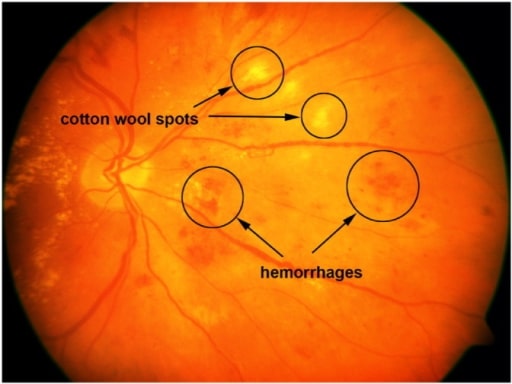
    • Sangrado de los LOS Neisseria vasos en EN Erythema nodosum is an immune-mediated panniculitis (inflammation of the subcutaneous fat) caused by a type IV (delayed-type) hypersensitivity reaction. It commonly manifests in young women as tender, erythematous nodules on the shins. Erythema Nodosum las fibras nerviosas superficiales (hemorragias en EN Erythema nodosum is an immune-mediated panniculitis (inflammation of the subcutaneous fat) caused by a type IV (delayed-type) hypersensitivity reaction. It commonly manifests in young women as tender, erythematous nodules on the shins. Erythema Nodosum forma de llama)
    • Sangrado hacia la capa interna de la retina Retina The ten-layered nervous tissue membrane of the eye. It is continuous with the optic nerve and receives images of external objects and transmits visual impulses to the brain. Its outer surface is in contact with the choroid and the inner surface with the vitreous body. The outermost layer is pigmented, whereas the inner nine layers are transparent. Eye: Anatomy (hemorragias puntiformes)
    • Isquemia retiniana → microinfartos de fibras nerviosas, que se ven como opacificación esponjosa (manchas algodonosas)
    • Fuga y acumulación de residuos lipídicos en EN Erythema nodosum is an immune-mediated panniculitis (inflammation of the subcutaneous fat) caused by a type IV (delayed-type) hypersensitivity reaction. It commonly manifests in young women as tender, erythematous nodules on the shins. Erythema Nodosum la zona (exudados duros)
    • Debilidad de la pared del vaso (microaneurismas)

Hipertensión maligna

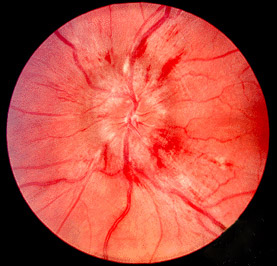
  • Presión arterial muy elevada → aumento de la presión intracraneal → inflamación del disco óptico (papiledema)
  • Los LOS Neisseria cambios coroidales (coroidopatía) se producen por una mala perfusión:
    • Atrofia del epitelio pigmentario de la retina Retina The ten-layered nervous tissue membrane of the eye. It is continuous with the optic nerve and receives images of external objects and transmits visual impulses to the brain. Its outer surface is in contact with the choroid and the inner surface with the vitreous body. The outermost layer is pigmented, whereas the inner nine layers are transparent. Eye: Anatomy suprayacente: forma lesiones pigmentarias con halo blanco (manchas de Elschnig)
    • Isquemia coroidea que se manifiesta como lesiones lineales hiperpigmentadas (estrías de Siegrist)
    • Desprendimientos del epitelio pigmentario de la retina Retina The ten-layered nervous tissue membrane of the eye. It is continuous with the optic nerve and receives images of external objects and transmits visual impulses to the brain. Its outer surface is in contact with the choroid and the inner surface with the vitreous body. The outermost layer is pigmented, whereas the inner nine layers are transparent. Eye: Anatomy

Presentación Clínica y Diagnóstico

Presentación clínica

  • La mayoría de los LOS Neisseria pacientes son asintomáticos.
  • Posible: cefalea y disminución de la visión o visión borrosa
  • Raramente causa pérdida de visión, pero puede ocurrir con atrofia óptica secundaria o desprendimiento de retina Retina The ten-layered nervous tissue membrane of the eye. It is continuous with the optic nerve and receives images of external objects and transmits visual impulses to the brain. Its outer surface is in contact with the choroid and the inner surface with the vitreous body. The outermost layer is pigmented, whereas the inner nine layers are transparent. Eye: Anatomy

Diagnóstico

  • El diagnóstico se basa en EN Erythema nodosum is an immune-mediated panniculitis (inflammation of the subcutaneous fat) caused by a type IV (delayed-type) hypersensitivity reaction. It commonly manifests in young women as tender, erythematous nodules on the shins. Erythema Nodosum un examen fondoscópico con dilatación.
  • Clasificaciones de los LOS Neisseria hallazgos del examen:
    • Clasificación de Keith-Wagener-Barker de la retinopatía hipertensiva: clasificación basada en EN Erythema nodosum is an immune-mediated panniculitis (inflammation of the subcutaneous fat) caused by a type IV (delayed-type) hypersensitivity reaction. It commonly manifests in young women as tender, erythematous nodules on the shins. Erythema Nodosum la gravedad de los LOS Neisseria hallazgos retinianos
    • Clasificación de Mitchell-Wong: clasificación basada en EN Erythema nodosum is an immune-mediated panniculitis (inflammation of the subcutaneous fat) caused by a type IV (delayed-type) hypersensitivity reaction. It commonly manifests in young women as tender, erythematous nodules on the shins. Erythema Nodosum la gravedad y correlacionada con los LOS Neisseria cambios fisiopatológicos
Tabla: Clasificación de Keith-Wagener-Barker de la retinopatía hipertensiva
Grado I Vasoconstricción leve o moderada de las arteriolas de la retina Retina The ten-layered nervous tissue membrane of the eye. It is continuous with the optic nerve and receives images of external objects and transmits visual impulses to the brain. Its outer surface is in contact with the choroid and the inner surface with the vitreous body. The outermost layer is pigmented, whereas the inner nine layers are transparent. Eye: Anatomy, con una relación arteriovenosa de ≥ 1:2
Grado II Vasoconstricción moderada a grave de las arteriolas de la retina Retina The ten-layered nervous tissue membrane of the eye. It is continuous with the optic nerve and receives images of external objects and transmits visual impulses to the brain. Its outer surface is in contact with the choroid and the inner surface with the vitreous body. The outermost layer is pigmented, whereas the inner nine layers are transparent. Eye: Anatomy con una relación arteriovenosa <1:2 o muesca arteriovenosa
Grado III Exudados blandos o hemorragias en EN Erythema nodosum is an immune-mediated panniculitis (inflammation of the subcutaneous fat) caused by a type IV (delayed-type) hypersensitivity reaction. It commonly manifests in young women as tender, erythematous nodules on the shins. Erythema Nodosum forma de llama
Grado IV Edema Edema Edema is a condition in which excess serous fluid accumulates in the body cavity or interstitial space of connective tissues. Edema is a symptom observed in several medical conditions. It can be categorized into 2 types, namely, peripheral (in the extremities) and internal (in an organ or body cavity). Edema óptico bilateral
Tabla: Clasificación de Mitchell-Wong de la retinopatía hipertensiva
Grado de retinopatía Hallazgos en EN Erythema nodosum is an immune-mediated panniculitis (inflammation of the subcutaneous fat) caused by a type IV (delayed-type) hypersensitivity reaction. It commonly manifests in young women as tender, erythematous nodules on the shins. Erythema Nodosum la retina Retina The ten-layered nervous tissue membrane of the eye. It is continuous with the optic nerve and receives images of external objects and transmits visual impulses to the brain. Its outer surface is in contact with the choroid and the inner surface with the vitreous body. The outermost layer is pigmented, whereas the inner nine layers are transparent. Eye: Anatomy Riesgos sistémicos
Ninguno No hay signos detectables Ninguno
Leve
  • Vasoconstricción arteriolar generalizada
  • Vasoconstricción arteriolar focal
  • Muesca arteriovenosa
  • Cableado de cobre o plata
Asociación moderada con el riesgo de accidente cerebrovascular clínico, accidente cerebrovascular subclínico, enfermedad coronaria y mortalidad
Moderado
  • Hemorragia retiniana en EN Erythema nodosum is an immune-mediated panniculitis (inflammation of the subcutaneous fat) caused by a type IV (delayed-type) hypersensitivity reaction. It commonly manifests in young women as tender, erythematous nodules on the shins. Erythema Nodosum forma de llamas, puntos o manchas
  • Microaneurismas, manchas algodonosas o exudados duros
Fuerte asociación con el riesgo de accidente cerebrovascular clínico, accidente cerebrovascular subclínico, deterioro cognitivo, enfermedad coronaria y mortalidad
Maligno Signos de retinopatía moderada más inflamación del disco óptico Fuerte asociación con la mortalidad

Pronóstico y Tratamiento

  • Algunas alteraciones de la retina Retina The ten-layered nervous tissue membrane of the eye. It is continuous with the optic nerve and receives images of external objects and transmits visual impulses to the brain. Its outer surface is in contact with the choroid and the inner surface with the vitreous body. The outermost layer is pigmented, whereas the inner nine layers are transparent. Eye: Anatomy en EN Erythema nodosum is an immune-mediated panniculitis (inflammation of the subcutaneous fat) caused by a type IV (delayed-type) hypersensitivity reaction. It commonly manifests in young women as tender, erythematous nodules on the shins. Erythema Nodosum la hipertensión maligna mejoran con el control de la presión arterial.
  • Si no se trata, la tasa de mortalidad en EN Erythema nodosum is an immune-mediated panniculitis (inflammation of the subcutaneous fat) caused by a type IV (delayed-type) hypersensitivity reaction. It commonly manifests in young women as tender, erythematous nodules on the shins. Erythema Nodosum la hipertensión maligna es del 90%.
  • El tratamiento incluye:
    • Modificaciones del estilo de vida (e.g., dieta baja en EN Erythema nodosum is an immune-mediated panniculitis (inflammation of the subcutaneous fat) caused by a type IV (delayed-type) hypersensitivity reaction. It commonly manifests in young women as tender, erythematous nodules on the shins. Erythema Nodosum sal, pérdida de peso y ejercicio regular Regular Insulin)
    • Dejar de fumar
    • Medicamentos antihipertensivos
    • El objetivo de la presión arterial viene determinado por otros factores de riesgo: enfermedades cardio y cerebrovasculares, enfermedades renales y diabetes Diabetes Diabetes mellitus (DM) is a metabolic disease characterized by hyperglycemia and dysfunction of the regulation of glucose metabolism by insulin. Type 1 DM is diagnosed mostly in children and young adults as the result of autoimmune destruction of β cells in the pancreas and the resulting lack of insulin. Type 2 DM has a significant association with obesity and is characterized by insulin resistance. Diabetes Mellitus.
Mejora de las emergencias hipertensivas

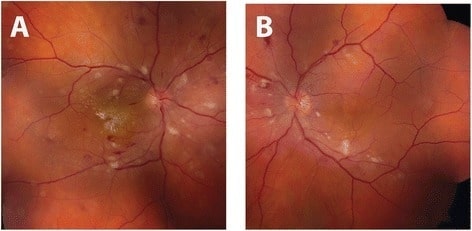
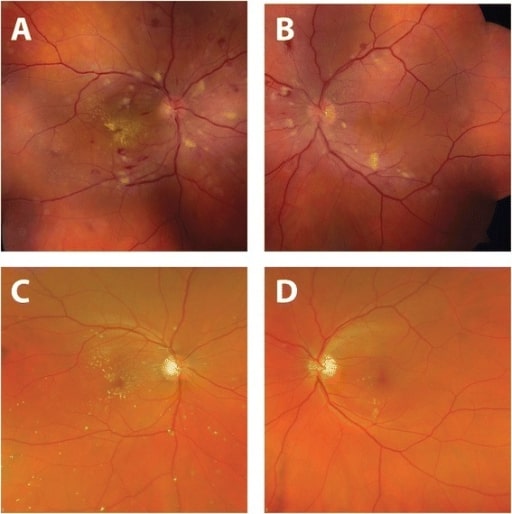
Mejora del aspecto del fondo de ojo tras el tratamiento de la hipertensión.

Fotografías del fondo de ojo tomadas en el momento de la presentación (A, B): Se observan vasoconstricciones arteriolares, hemorragias retinianas, manchas algodonosas y exudados duros (a la derecha).
Cuatro meses después del diagnóstico y tratamiento de la hipertensión sistémica (C, D): La normalización de la presión arterial dio lugar a la resolución de las hemorragias retinianas y las manchas algodonosas.
Hay una mejora de intervalo en los exudados duros en el ojo derecho con una estrella macular residual.

Imagen: “Improvement in fundus appearance after treatment” por the Department of Ophthalmology and Visual Sciences, University of Michigan, 500 S State St, Ann Arbor, MI 48109 USA. Licencia: CC BY 4.0.
Diagnóstico Diferencial

  • Catarata: es una disminución de la visión debida a la opacidad del cristalino, que se presenta sin dolor Dolor Inflammation, con visión borrosa y problemas de destellos de luz. Las cataratas son la principal causa de ceguera en EN Erythema nodosum is an immune-mediated panniculitis (inflammation of the subcutaneous fat) caused by a type IV (delayed-type) hypersensitivity reaction. It commonly manifests in young women as tender, erythematous nodules on the shins. Erythema Nodosum todo el mundo y pueden aparecer a cualquier edad, pero la mayoría de los LOS Neisseria casos afectan a los LOS Neisseria mayores de 60 años.
  • Retinopatía diabética: es una alteración visual debida al AL Amyloidosis daño microvascular de los LOS Neisseria órganos diana de la diabetes Diabetes Diabetes mellitus (DM) is a metabolic disease characterized by hyperglycemia and dysfunction of the regulation of glucose metabolism by insulin. Type 1 DM is diagnosed mostly in children and young adults as the result of autoimmune destruction of β cells in the pancreas and the resulting lack of insulin. Type 2 DM has a significant association with obesity and is characterized by insulin resistance. Diabetes Mellitus mellitus. La retinopatía diabética se clasifica en EN Erythema nodosum is an immune-mediated panniculitis (inflammation of the subcutaneous fat) caused by a type IV (delayed-type) hypersensitivity reaction. It commonly manifests in young women as tender, erythematous nodules on the shins. Erythema Nodosum retinopatía no proliferativa y proliferativa. La retinopatía no proliferativa se caracteriza por microaneurismas, hemorragias intrarretinianas, exudados y edema Edema Edema is a condition in which excess serous fluid accumulates in the body cavity or interstitial space of connective tissues. Edema is a symptom observed in several medical conditions. It can be categorized into 2 types, namely, peripheral (in the extremities) and internal (in an organ or body cavity). Edema macular. El tipo proliferativo es la presencia de neovascularización de la retina Retina The ten-layered nervous tissue membrane of the eye. It is continuous with the optic nerve and receives images of external objects and transmits visual impulses to the brain. Its outer surface is in contact with the choroid and the inner surface with the vitreous body. The outermost layer is pigmented, whereas the inner nine layers are transparent. Eye: Anatomy o del disco óptico. Los LOS Neisseria pacientes son inicialmente asintomáticos, pero en EN Erythema nodosum is an immune-mediated panniculitis (inflammation of the subcutaneous fat) caused by a type IV (delayed-type) hypersensitivity reaction. It commonly manifests in young women as tender, erythematous nodules on the shins. Erythema Nodosum las etapas tardías presentan una visión disminuida o fluctuante, posiblemente con partículas flotantes.
  • Desprendimiento de retina Retina The ten-layered nervous tissue membrane of the eye. It is continuous with the optic nerve and receives images of external objects and transmits visual impulses to the brain. Its outer surface is in contact with the choroid and the inner surface with the vitreous body. The outermost layer is pigmented, whereas the inner nine layers are transparent. Eye: Anatomy: es la separación de la retina Retina The ten-layered nervous tissue membrane of the eye. It is continuous with the optic nerve and receives images of external objects and transmits visual impulses to the brain. Its outer surface is in contact with the choroid and the inner surface with the vitreous body. The outermost layer is pigmented, whereas the inner nine layers are transparent. Eye: Anatomy del epitelio pigmentario de la retina Retina The ten-layered nervous tissue membrane of the eye. It is continuous with the optic nerve and receives images of external objects and transmits visual impulses to the brain. Its outer surface is in contact with the choroid and the inner surface with the vitreous body. The outermost layer is pigmented, whereas the inner nine layers are transparent. Eye: Anatomy, lo cual provoca un rápido daño de los LOS Neisseria fotorreceptores. Los LOS Neisseria síntomas incluyen cambios indoloros en EN Erythema nodosum is an immune-mediated panniculitis (inflammation of the subcutaneous fat) caused by a type IV (delayed-type) hypersensitivity reaction. It commonly manifests in young women as tender, erythematous nodules on the shins. Erythema Nodosum la visión, como destellos repentinos de luz, partículas flotantes, empeoramiento de la visión periférica o presencia de una sombra en EN Erythema nodosum is an immune-mediated panniculitis (inflammation of the subcutaneous fat) caused by a type IV (delayed-type) hypersensitivity reaction. It commonly manifests in young women as tender, erythematous nodules on the shins. Erythema Nodosum el campo de visión. La visión se describe como irregular o en EN Erythema nodosum is an immune-mediated panniculitis (inflammation of the subcutaneous fat) caused by a type IV (delayed-type) hypersensitivity reaction. It commonly manifests in young women as tender, erythematous nodules on the shins. Erythema Nodosum forma de cortina. El desprendimiento de retina Retina The ten-layered nervous tissue membrane of the eye. It is continuous with the optic nerve and receives images of external objects and transmits visual impulses to the brain. Its outer surface is in contact with the choroid and the inner surface with the vitreous body. The outermost layer is pigmented, whereas the inner nine layers are transparent. Eye: Anatomy es una emergencia que requiere cirugía correctiva.
  • Oclusión de la arteria central de la retina Retina The ten-layered nervous tissue membrane of the eye. It is continuous with the optic nerve and receives images of external objects and transmits visual impulses to the brain. Its outer surface is in contact with the choroid and the inner surface with the vitreous body. The outermost layer is pigmented, whereas the inner nine layers are transparent. Eye: Anatomy: es la oclusión de la arteria central de la retina Retina The ten-layered nervous tissue membrane of the eye. It is continuous with the optic nerve and receives images of external objects and transmits visual impulses to the brain. Its outer surface is in contact with the choroid and the inner surface with the vitreous body. The outermost layer is pigmented, whereas the inner nine layers are transparent. Eye: Anatomy, el principal suministro de sangre del nervio óptico, por un émbolo o un ateroma. Los LOS Neisseria pacientes suelen presentar una pérdida visual repentina, indolora y monocular. Los LOS Neisseria hallazgos fundoscópicos incluyen el blanqueamiento de la retina Retina The ten-layered nervous tissue membrane of the eye. It is continuous with the optic nerve and receives images of external objects and transmits visual impulses to the brain. Its outer surface is in contact with the choroid and the inner surface with the vitreous body. The outermost layer is pigmented, whereas the inner nine layers are transparent. Eye: Anatomy con una mancha “rojo cereza”. La oclusión de la arteria central de la retina Retina The ten-layered nervous tissue membrane of the eye. It is continuous with the optic nerve and receives images of external objects and transmits visual impulses to the brain. Its outer surface is in contact with the choroid and the inner surface with the vitreous body. The outermost layer is pigmented, whereas the inner nine layers are transparent. Eye: Anatomy es una emergencia médica y la recuperación visual depende de la evaluación y el tratamiento inmediatos.
  • Oclusión de la vena central de la retina Retina The ten-layered nervous tissue membrane of the eye. It is continuous with the optic nerve and receives images of external objects and transmits visual impulses to the brain. Its outer surface is in contact with the choroid and the inner surface with the vitreous body. The outermost layer is pigmented, whereas the inner nine layers are transparent. Eye: Anatomy: es la oclusión de la vena central de la retina Retina The ten-layered nervous tissue membrane of the eye. It is continuous with the optic nerve and receives images of external objects and transmits visual impulses to the brain. Its outer surface is in contact with the choroid and the inner surface with the vitreous body. The outermost layer is pigmented, whereas the inner nine layers are transparent. Eye: Anatomy principalmente por formación de trombos. Los LOS Neisseria pacientes suelen presentar una pérdida de visión monocular, repentina e indolora. El examen fundoscópico revela venas tortuosas dilatadas, hemorragias intrarretinianas y manchas algodonosas que a menudo se describen con un aspecto de “sangre y trueno”. El manejo requiere una referencia urgente a oftalmología.

Referencias

  1. Lloyd-Jones, D. M., Morris, P. B., Ballantyne, C. M., Birtcher, K. K., Daly, D. D., Jr, DePalma, S. M., Minissian, M. B., Orringer, C. E., & Smith, S. C., Jr (2017). 2017 Focused Update of the 2016 ACC Expert Consensus Decision Pathway on the Role of Non-Statin Therapies for LDL-Cholesterol Lowering in the Management of Atherosclerotic Cardiovascular Disease Risk: A Report of the American College of Cardiology Task Force on Expert Consensus Decision Pathways. Journal of the American College of Cardiology70(14), 1785–1822. https://doi.org/10.1016/j.jacc.2017.07.745
  2. Basile, J., et al. (2024). Overview of Hypertension in adults. UpToDate. Retrieved on August 2, 2025, from https://www.uptodate.com/contents/overview-of-hypertension-in-adults?search=overview
  3. Elliott, W., et al. (2024). Moderate to severe hypertensive retinopathy and hypertensive encephalopathy in adults. UpToDate. Retrieved on August 2, 2025, from https://www.uptodate.com/contents/moderate-to-severe-hypertensive-retinopathy-and-hypertensive-encephalopathy-in-adults
  4. Grosso, A., Veglio, F., Porta, M., Grignolo, F. M., & Wong, T. Y. (2005). Hypertensive retinopathy revisited: some answers, more questions. The British journal of ophthalmology89(12), 1646–1654. https://doi.org/10.1136/bjo.2005.072546
  5. Harjasouliha, A., Raiji, V., & Gonzalez, J. (2017) Review of hypertensive retinopathy. Elsevier. Retrieved on August 2, 2025, from https://www.sciencedirect.com/science/article/abs/pii/S0011502916300839?via%3Dihub
  6. Henderson, A., et al. (2011). Hypertension-related eye abnormalities and the risk of stroke. Rev Neurol Dis, 8(1-2): 1–9. https://www.ncbi.nlm.nih.gov/pmc/articles/PMC3448945/
  7. Modi, P., & Arsiwalla, T. (2023). Hypertensive retinopathy. StatPearls. Retrieved on August 2, 2025, from https://www.ncbi.nlm.nih.gov/books/NBK525980/
  8. Oh, K., Moinfar, N., & Roy, H. (2024). Ophthalmologic Manifestations of Hypertension. Medscape. Retrieved on August 2, 2025, from https://emedicine.medscape.com/article/1201779-overview
  9. Townsend, R. Bakris, G., Kunins, L., & Forman, J. (2024). Ocular effects of hypertension. UpToDate. Retrieved on August 2, 2025, from https://www.uptodate.com/contents/ocular-effects-of-hypertension

¡Crea tu cuenta gratis o inicia una sesión para seguir leyendo!

Regístrate ahora y obtén acceso gratuito a Lecturio con páginas de concepto, videos médicos y cuestionarios para tu educación médica.

User Reviews

Que tengas una sesión de estudio alegre y navideña 🎁 Ahorra 50% en todos los planes >>

Details