
En EN Erythema nodosum is an immune-mediated panniculitis (inflammation of the subcutaneous fat) caused by a type IV (delayed-type) hypersensitivity reaction. It commonly manifests in young women as tender, erythematous nodules on the shins. Erythema Nodosum el cerebro humano, la información se transmite en EN Erythema nodosum is an immune-mediated panniculitis (inflammation of the subcutaneous fat) caused by a type IV (delayed-type) hypersensitivity reaction. It commonly manifests in young women as tender, erythematous nodules on the shins. Erythema Nodosum forma de impulsos bioeléctricos y moléculas de señalización química. Estas moléculas, llamadas neurotransmisores, son proteínas que las neuronas utilizan para emitir una señal específica. Las señales son captadas en EN Erythema nodosum is an immune-mediated panniculitis (inflammation of the subcutaneous fat) caused by a type IV (delayed-type) hypersensitivity reaction. It commonly manifests in young women as tender, erythematous nodules on the shins. Erythema Nodosum la membrana plasmática de las neuronas adyacentes por los LOS Neisseria receptores, que son complejos de subunidades de proteínas responsables de detectar estímulos relevantes y poner en EN Erythema nodosum is an immune-mediated panniculitis (inflammation of the subcutaneous fat) caused by a type IV (delayed-type) hypersensitivity reaction. It commonly manifests in young women as tender, erythematous nodules on the shins. Erythema Nodosum marcha la maquinaria celular necesaria para producir la respuesta deseada.
Last updated: Dec 15, 2025
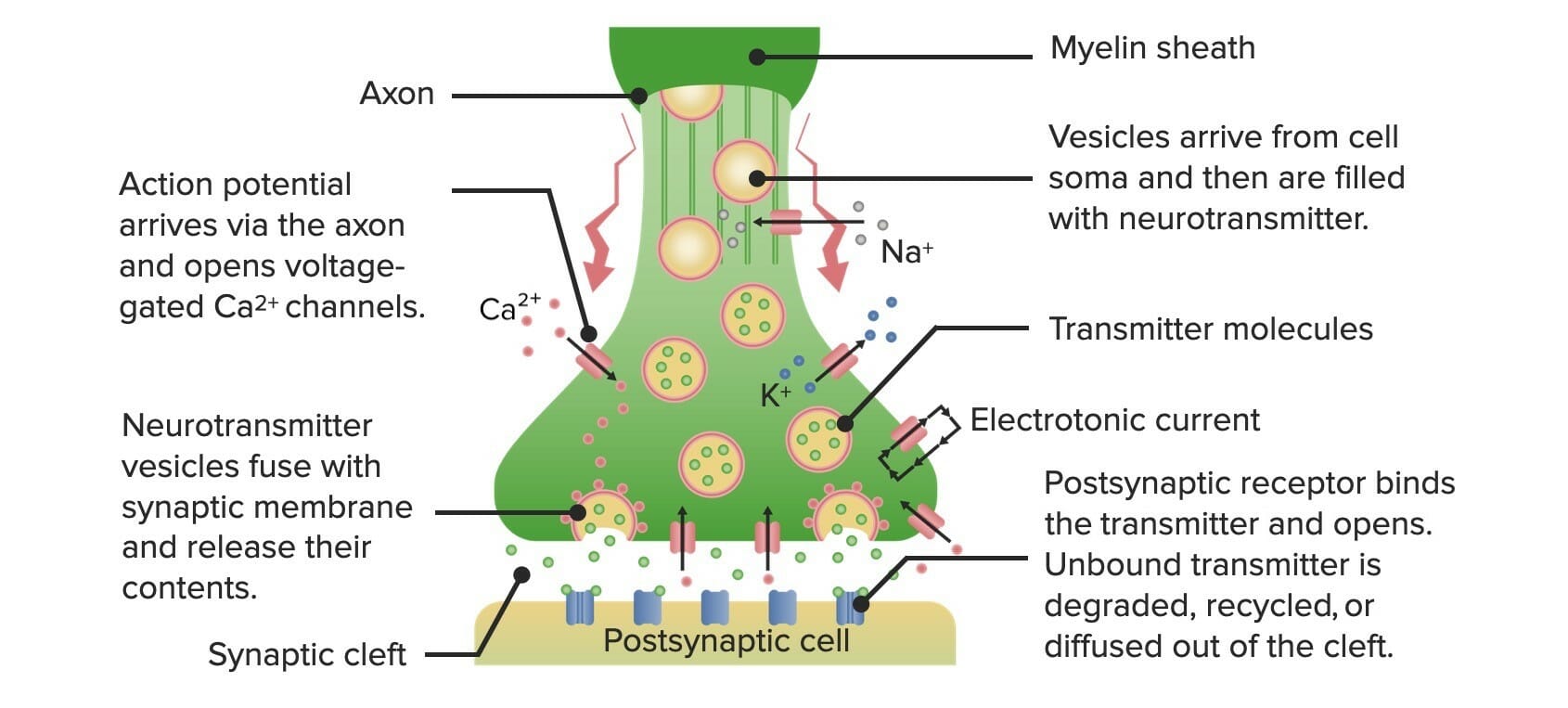
Diagrama que muestra el proceso de neurotransmisión
Imagen por Lecturio.Se han identificado más de 500 neurotransmisores únicos en EN Erythema nodosum is an immune-mediated panniculitis (inflammation of the subcutaneous fat) caused by a type IV (delayed-type) hypersensitivity reaction. It commonly manifests in young women as tender, erythematous nodules on the shins. Erythema Nodosum humanos.
| Ruta | Origen de la neurona | Ubicación de proyección de neuronas | Funciones |
|---|---|---|---|
| Mesolímbica | Área tegmental ventral |
|
|
| Mesocortical | Área tegmental ventral | Corteza prefrontal |
|
| Nigroestriatal | Sustancia negra | Cuerpo estriado | Control locomotor |
| Tuberoinfundibular | Núcleo arqueado | Hipófisis | Inhibe la secreción de prolactina |
| Neurotransmisor | Efecto | Sitio de síntesis |
|---|---|---|
| Dopamina | Excitatorio e inhibitorio | SNC: sustancia negra, área tegmental ventral y otros |
| Norepinefrina | Excitatorio | SNC: locus Locus Specific regions that are mapped within a genome. Genetic loci are usually identified with a shorthand notation that indicates the chromosome number and the position of a specific band along the P or Q arm of the chromosome where they are found. For example the locus 6p21 is found within band 21 of the P-arm of chromosome 6. Many well known genetic loci are also known by common names that are associated with a genetic function or hereditary disease. Basic Terms of Genetics coeruleus, sistema nervioso simpático y médula suprarrenal |
| Epinefrina | Excitatorio | Médula suprarrenal |
| Serotonina |
|
SNC: núcleos del rafe y células enterocromafines |
| Histamina | Excitatorio e inhibitorio |
|
| Acetilcolina | Excitatorio (generalmente) | Uniones neuromusculares, sinapsis presimpáticas y sinapsis simpáticas preganglionares |
| Glutamato |
|
SNC: casi todas las partes del sistema nervioso |
| GABA GABA The most common inhibitory neurotransmitter in the central nervous system. Receptors and Neurotransmitters of the CNS |
|
SNC |
| Glicina | Inhibitorio | SNC: médula espinal, tronco encefálico y retina Retina The ten-layered nervous tissue membrane of the eye. It is continuous with the optic nerve and receives images of external objects and transmits visual impulses to the brain. Its outer surface is in contact with the choroid and the inner surface with the vitreous body. The outermost layer is pigmented, whereas the inner nine layers are transparent. Eye: Anatomy |
| Encefalinas | Inhibitorio ( dolor Dolor Inflammation) | SNC |
| Endorfinas | Inhibitorio | SNC y periférico |
| Neurocininas | Tracto gastrointestinal: modula la motilidad, la secreción de líquidos y electrolitos | Neuronas entéricas intrínsecas y fibras nerviosas aferentes primarias extrínsecas |
| Receptor Receptor Receptors are proteins located either on the surface of or within a cell that can bind to signaling molecules known as ligands (e.g., hormones) and cause some type of response within the cell. Receptors | Localización | Efector de señalización (del enlace 5-HT 5-HT A biochemical messenger and regulator, synthesized from the essential amino acid l-tryptophan. In humans it is found primarily in the central nervous system, gastrointestinal tract, and blood platelets. Serotonin mediates several important physiological functions including neurotransmission, gastrointestinal motility, hemostasis, and cardiovascular integrity. Receptors and Neurotransmitters of the CNS) | Mensajeros secundarios | Función |
|---|---|---|---|---|
| 5-HT 5-HT A biochemical messenger and regulator, synthesized from the essential amino acid l-tryptophan. In humans it is found primarily in the central nervous system, gastrointestinal tract, and blood platelets. Serotonin mediates several important physiological functions including neurotransmission, gastrointestinal motility, hemostasis, and cardiovascular integrity. Receptors and Neurotransmitters of the CNS1A |
|
Inhibe la adenilil ciclasa | ↓ cAMP cAMP An adenine nucleotide containing one phosphate group which is esterified to both the 3′- and 5′-positions of the sugar moiety. It is a second messenger and a key intracellular regulator, functioning as a mediator of activity for a number of hormones, including epinephrine, glucagon, and acth. Phosphodiesterase Inhibitors |
|
| 5-HT 5-HT A biochemical messenger and regulator, synthesized from the essential amino acid l-tryptophan. In humans it is found primarily in the central nervous system, gastrointestinal tract, and blood platelets. Serotonin mediates several important physiological functions including neurotransmission, gastrointestinal motility, hemostasis, and cardiovascular integrity. Receptors and Neurotransmitters of the CNS2A |
|
Activa fosfolipasa C | ↑ Inositol trisfosfato3, diacilglicerol, Ca CA Condylomata acuminata are a clinical manifestation of genital HPV infection. Condylomata acuminata are described as raised, pearly, flesh-colored, papular, cauliflower-like lesions seen in the anogenital region that may cause itching, pain, or bleeding. Condylomata Acuminata (Genital Warts)2+ |
|
| 5-HT 5-HT A biochemical messenger and regulator, synthesized from the essential amino acid l-tryptophan. In humans it is found primarily in the central nervous system, gastrointestinal tract, and blood platelets. Serotonin mediates several important physiological functions including neurotransmission, gastrointestinal motility, hemostasis, and cardiovascular integrity. Receptors and Neurotransmitters of the CNS2C |
|
|
↑ Inositol trisfosfato3, diacilglicerol, Ca CA Condylomata acuminata are a clinical manifestation of genital HPV infection. Condylomata acuminata are described as raised, pearly, flesh-colored, papular, cauliflower-like lesions seen in the anogenital region that may cause itching, pain, or bleeding. Condylomata Acuminata (Genital Warts)2+ | Apetito |
| 5-HT 5-HT A biochemical messenger and regulator, synthesized from the essential amino acid l-tryptophan. In humans it is found primarily in the central nervous system, gastrointestinal tract, and blood platelets. Serotonin mediates several important physiological functions including neurotransmission, gastrointestinal motility, hemostasis, and cardiovascular integrity. Receptors and Neurotransmitters of the CNS3 |
|
Canal iónico activado por ligando → entrada de Na+, Ca CA Condylomata acuminata are a clinical manifestation of genital HPV infection. Condylomata acuminata are described as raised, pearly, flesh-colored, papular, cauliflower-like lesions seen in the anogenital region that may cause itching, pain, or bleeding. Condylomata Acuminata (Genital Warts)2+ | — |
|
| Receptor Receptor Receptors are proteins located either on the surface of or within a cell that can bind to signaling molecules known as ligands (e.g., hormones) and cause some type of response within the cell. Receptors | Localización | Efector de señalización (de la unión de dopamina) | Implicación en EN Erythema nodosum is an immune-mediated panniculitis (inflammation of the subcutaneous fat) caused by a type IV (delayed-type) hypersensitivity reaction. It commonly manifests in young women as tender, erythematous nodules on the shins. Erythema Nodosum la vía dopaminérgica | Función |
|---|---|---|---|---|
| D1 |
|
Activa adenilil ciclasa | Mesocortical | |
| D1 |
|
Activa AC | Periférico |
|
| D2 |
|
Inhibe la adenilil ciclasa |
|
|
| D2 |
|
Inhibe la adenilil ciclasa | Periférico | |
| D3 |
|
Inhibe la adenilil ciclasa | Mesolímbico | |
| D3 | Riñones | Inhibe la adenilil ciclasa | Periférico | ↓ Secreción de renina |
| Receptor Receptor Receptors are proteins located either on the surface of or within a cell that can bind to signaling molecules known as ligands (e.g., hormones) and cause some type of response within the cell. Receptors | Localización | Efector de señalización (agonismo del glutamato) | Mensajeros secundarios | Función | |
|---|---|---|---|---|---|
| Agonismo | Antagonismo | ||||
| Ácido α-amino-3-hidroxi-5-metil-4-isoxazolpropiónico | SNC | Ionotrópico → entrada de Na+ → potencial postsináptico excitatorio → expulsa Mg2+ del receptor Receptor Receptors are proteins located either on the surface of or within a cell that can bind to signaling molecules known as ligands (e.g., hormones) and cause some type of response within the cell. Receptors N-metil-D-aspartato | — | Potencial postsináptico excitatorio rápido | Bloque de conducción |
| N-metil-D-aspartato |
|
Ionotrópico → potencial postsináptico excitatorio de ácido α-amino-3-hidroxi-5-metil-4-isoxazolpropiónico → Mg2+ es expulsado → entrada de Ca CA Condylomata acuminata are a clinical manifestation of genital HPV infection. Condylomata acuminata are described as raised, pearly, flesh-colored, papular, cauliflower-like lesions seen in the anogenital region that may cause itching, pain, or bleeding. Condylomata Acuminata (Genital Warts)2+ → mayor despolarización | — |
|
|
| Receptor Receptor Receptors are proteins located either on the surface of or within a cell that can bind to signaling molecules known as ligands (e.g., hormones) and cause some type of response within the cell. Receptors metabotrópico de glutamato grupo I | Autorreceptores en EN Erythema nodosum is an immune-mediated panniculitis (inflammation of the subcutaneous fat) caused by a type IV (delayed-type) hypersensitivity reaction. It commonly manifests in young women as tender, erythematous nodules on the shins. Erythema Nodosum neuronas glutamatérgicas | Activa fosfolipasa C | ↑ Inositol trisfosfato3, diacilglicerol, Ca CA Condylomata acuminata are a clinical manifestation of genital HPV infection. Condylomata acuminata are described as raised, pearly, flesh-colored, papular, cauliflower-like lesions seen in the anogenital region that may cause itching, pain, or bleeding. Condylomata Acuminata (Genital Warts)2+ | Importancia clínica desconocida | |
| Receptores metabotrópicos de glutamato grupo II | Inhibe la adenilil ciclasa | ↓ cAMP cAMP An adenine nucleotide containing one phosphate group which is esterified to both the 3′- and 5′-positions of the sugar moiety. It is a second messenger and a key intracellular regulator, functioning as a mediator of activity for a number of hormones, including epinephrine, glucagon, and acth. Phosphodiesterase Inhibitors | |||
| Receptor Receptor Receptors are proteins located either on the surface of or within a cell that can bind to signaling molecules known as ligands (e.g., hormones) and cause some type of response within the cell. Receptors metabotrópico de glutamato grupo III | Inhibe la adenilil ciclasa | ↓ cAMP cAMP An adenine nucleotide containing one phosphate group which is esterified to both the 3′- and 5′-positions of the sugar moiety. It is a second messenger and a key intracellular regulator, functioning as a mediator of activity for a number of hormones, including epinephrine, glucagon, and acth. Phosphodiesterase Inhibitors | |||