
Domina Conceptos Médicos

Estudia para la escuela de medicina y tus examenes con Lecturio.

Obesidad

La obesidad es una afección asociada al AL Amyloidosis exceso de peso corporal, concretamente a la deposición de un exceso de tejido adiposo. La obesidad se considera una epidemia mundial. Las principales influencias provienen de la dieta occidental y el estilo de vida sedentario, pero los LOS Neisseria mecanismos exactos probablemente incluyen una mezcla de factores genéticos y ambientales. Varias afecciones están asociadas a la obesidad, incluyendo diabetes Diabetes Diabetes mellitus (DM) is a metabolic disease characterized by hyperglycemia and dysfunction of the regulation of glucose metabolism by insulin. Type 1 DM is diagnosed mostly in children and young adults as the result of autoimmune destruction of β cells in the pancreas and the resulting lack of insulin. Type 2 DM has a significant association with obesity and is characterized by insulin resistance. Diabetes Mellitus, hipertensión y enfermedades cardíacas, las cuales contribuyen a generar importantes costos para los LOS Neisseria sistemas de salud. El diagnóstico suele basarse en EN Erythema nodosum is an immune-mediated panniculitis (inflammation of the subcutaneous fat) caused by a type IV (delayed-type) hypersensitivity reaction. It commonly manifests in young women as tender, erythematous nodules on the shins. Erythema Nodosum la medición del IMC, donde la obesidad se define como IMC > 30. El tratamiento incluye cambios en EN Erythema nodosum is an immune-mediated panniculitis (inflammation of the subcutaneous fat) caused by a type IV (delayed-type) hypersensitivity reaction. It commonly manifests in young women as tender, erythematous nodules on the shins. Erythema Nodosum el estilo de vida, medicamentos o, en EN Erythema nodosum is an immune-mediated panniculitis (inflammation of the subcutaneous fat) caused by a type IV (delayed-type) hypersensitivity reaction. It commonly manifests in young women as tender, erythematous nodules on the shins. Erythema Nodosum casos severos, cirugía bariátrica.

Last updated: Dec 15, 2025

Editorial responsibility: Stanley Oiseth, Lindsay Jones, Evelin Maza

Descripción General

Definición

La obesidad es una afección asociada con el exceso de peso corporal, específicamente con el depósito excesivo de tejido adiposo.
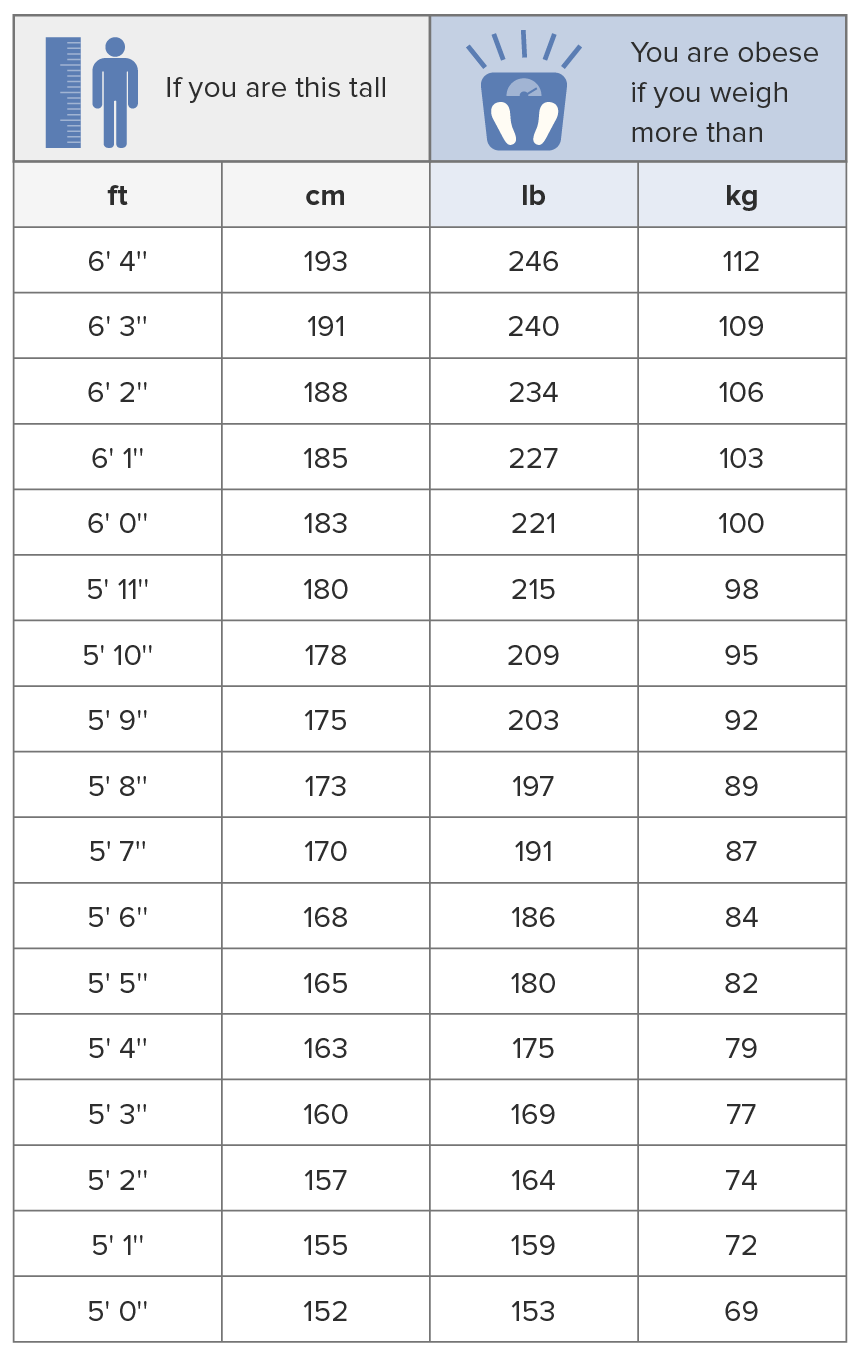
Medidas de obesidad

  • La obesidad puede definirse con precisión mediante el IMC o el porcentaje de grasa corporal.
  • El perímetro de la cintura es una medida de la obesidad abdominal y se asocia a un mayor riesgo cardiovascular.
  • El IMC se calcula como peso (kg)/talla² (m²).
  • Clasificación del IMC:
    • Bajo peso < 18,5
    • Peso normal: 18,5–24,9
    • Sobrepeso: 25–29,9
    • Obesidad: 30–39,9
    • Obesidad de clase III > 40
  • Porcentaje de grasa corporal = 1,2(IMC) + 0,23(edad) – 10,8(sexo) – 5,4:
    • Normal:
      • Hombres (sexo = 1): 15–20%
      • Mujeres (sexo = 0): 25–30%
    • Obesidad:
      • Hombres: > 25 %
      • Mujeres: > 33%
  • Circunferencia de la cintura que indica un mayor riesgo cardíaco:
    • Hombres: > 102 cm (40 pulgadas)
    • Mujeres: > 88 cm (34,5 pulgadas)
Cálculo del índice de masa corporal

Tabla del índice de masa corporal

Imagen por Lecturio.

Epidemiología

  • Un tercio o más adultos en EN Erythema nodosum is an immune-mediated panniculitis (inflammation of the subcutaneous fat) caused by a type IV (delayed-type) hypersensitivity reaction. It commonly manifests in young women as tender, erythematous nodules on the shins. Erythema Nodosum Estados Unidos sufren de obesidad.
  • La prevalencia parece estar en EN Erythema nodosum is an immune-mediated panniculitis (inflammation of the subcutaneous fat) caused by a type IV (delayed-type) hypersensitivity reaction. It commonly manifests in young women as tender, erythematous nodules on the shins. Erythema Nodosum constante aumento y muestra una prevalencia ligeramente mayor en EN Erythema nodosum is an immune-mediated panniculitis (inflammation of the subcutaneous fat) caused by a type IV (delayed-type) hypersensitivity reaction. It commonly manifests in young women as tender, erythematous nodules on the shins. Erythema Nodosum las mujeres en EN Erythema nodosum is an immune-mediated panniculitis (inflammation of the subcutaneous fat) caused by a type IV (delayed-type) hypersensitivity reaction. It commonly manifests in young women as tender, erythematous nodules on the shins. Erythema Nodosum comparación con los LOS Neisseria hombres.
  • Hubo un aumento en EN Erythema nodosum is an immune-mediated panniculitis (inflammation of the subcutaneous fat) caused by a type IV (delayed-type) hypersensitivity reaction. It commonly manifests in young women as tender, erythematous nodules on the shins. Erythema Nodosum la prevalencia de la obesidad del 19,4% en EN Erythema nodosum is an immune-mediated panniculitis (inflammation of the subcutaneous fat) caused by a type IV (delayed-type) hypersensitivity reaction. It commonly manifests in young women as tender, erythematous nodules on the shins. Erythema Nodosum 1997 al AL Amyloidosis 31,4% en EN Erythema nodosum is an immune-mediated panniculitis (inflammation of the subcutaneous fat) caused by a type IV (delayed-type) hypersensitivity reaction. It commonly manifests in young women as tender, erythematous nodules on the shins. Erythema Nodosum 2017.
  • Alrededor del 17% de los LOS Neisseria niños y adolescentes están afectados.
  • En EN Erythema nodosum is an immune-mediated panniculitis (inflammation of the subcutaneous fat) caused by a type IV (delayed-type) hypersensitivity reaction. It commonly manifests in young women as tender, erythematous nodules on the shins. Erythema Nodosum 2015, aproximadamente 108 millones de niños y 604 millones de adultos en EN Erythema nodosum is an immune-mediated panniculitis (inflammation of the subcutaneous fat) caused by a type IV (delayed-type) hypersensitivity reaction. It commonly manifests in young women as tender, erythematous nodules on the shins. Erythema Nodosum todo el mundo eran obesos.

Etiología

Se cree que la naturaleza de la obesidad es multifactorial. El sedentarismo y el aumento de la ingesta de calorías parecen ser las causas más comunes.

Las causas pueden clasificarse además por:

  • Factores dietéticos:
    • Comer en EN Erythema nodosum is an immune-mediated panniculitis (inflammation of the subcutaneous fat) caused by a type IV (delayed-type) hypersensitivity reaction. It commonly manifests in young women as tender, erythematous nodules on the shins. Erythema Nodosum exceso
    • Dietas ricas en EN Erythema nodosum is an immune-mediated panniculitis (inflammation of the subcutaneous fat) caused by a type IV (delayed-type) hypersensitivity reaction. It commonly manifests in young women as tender, erythematous nodules on the shins. Erythema Nodosum grasas
  • Factores sociales/conductuales:
    • Factores socioeconómicos
    • Factores psicológicos
    • Alimentación nocturna
    • Atracones
  • Estilo de vida sedentaria:
    • Pobre actividad física
    • Trabajos sedentarios
    • Inactividad debido a cirugía
    • Discapacidad
    • Envejecimiento
  • Iatrogénico:
    • Debido a ciertos medicamentos
    • Cirugía hipotalámica
  • Condiciones genéticas
  • Trastornos neuroendocrinos subyacentes:
    • Síndrome de Cushing
    • Hipotiroidismo
    • Deficiencia de la hormona del crecimiento
    • Hipogonadismo

Los LOS Neisseria medicamentos asociados con el aumento de peso incluyen:

  • Esteroides: prednisona
  • Medicamentos para la diabetes Diabetes Diabetes mellitus (DM) is a metabolic disease characterized by hyperglycemia and dysfunction of the regulation of glucose metabolism by insulin. Type 1 DM is diagnosed mostly in children and young adults as the result of autoimmune destruction of β cells in the pancreas and the resulting lack of insulin. Type 2 DM has a significant association with obesity and is characterized by insulin resistance. Diabetes Mellitus:
    • Insulina
    • Sulfonilureas
    • Tiazolidinedionas
  • Antipsicóticos:
    • Risperidona
    • Quetiapina
    • Olanzapina)
  • Antidepresivos:
    • Paroxetina
    • Citalopram Citalopram A furancarbonitrile that is one of the serotonin uptake inhibitors used as an antidepressant. The drug is also effective in reducing ethanol uptake in alcoholics and is used in depressed patients who also suffer from tardive dyskinesia in preference to tricyclic antidepressants, which aggravate dyskinesia. Serotonin Reuptake Inhibitors and Similar Antidepressants
    • Amitriptilina
    • Mirtazapina
  • Estabilizadores del estado de ánimo/agentes neurológicos:
    • Carbamazepina
    • Valproato
    • Litio
    • Gabapentina
  • Agentes hormonales/progestinas: medroxiprogesterona
  • Betabloqueadores: propranolol Propranolol A widely used non-cardioselective beta-adrenergic antagonist. Propranolol has been used for myocardial infarction; arrhythmia; angina pectoris; hypertension; hyperthyroidism; migraine; pheochromocytoma; and anxiety but adverse effects instigate replacement by newer drugs. Antiadrenergic Drugs
  • Alfabloqueadores: terazosina

Fisiopatología y Morbilidad Relacionada con la Obesidad

Fisiopatología

  • La obesidad puede ser hipertrófica (aumento del tamaño de los LOS Neisseria adipocitos) o hipercelular (aumento del número de células):
    • La variante hipertrófica es típica de la obesidad androide (abdominal).
    • La variante hipercelular se asocia con frecuencia a la obesidad infantil y muy severa.
  • Varias hormonas intervienen en EN Erythema nodosum is an immune-mediated panniculitis (inflammation of the subcutaneous fat) caused by a type IV (delayed-type) hypersensitivity reaction. It commonly manifests in young women as tender, erythematous nodules on the shins. Erythema Nodosum la regulación del apetito, la saciedad, el metabolismo y la distribución de las grasas.
  • Las hormonas orexigénicas que participan en EN Erythema nodosum is an immune-mediated panniculitis (inflammation of the subcutaneous fat) caused by a type IV (delayed-type) hypersensitivity reaction. It commonly manifests in young women as tender, erythematous nodules on the shins. Erythema Nodosum la estimulación del apetito:
    • Grelina
    • Endocannabinoide
    • Neuropéptido Y
  • Las hormonas anorexígenas que participan en EN Erythema nodosum is an immune-mediated panniculitis (inflammation of the subcutaneous fat) caused by a type IV (delayed-type) hypersensitivity reaction. It commonly manifests in young women as tender, erythematous nodules on the shins. Erythema Nodosum la supresión del apetito son:
    • Leptina
    • GLP-1 GLP-1 A peptide of 36 or 37 amino acids that is derived from proglucagon and mainly produced by the intestinal l cells. Glp-1(1-37 or 1-36) is further n-terminally truncated resulting in glp-1(7-37) or glp-1-(7-36) which can be amidated. These glp-1 peptides are known to enhance glucose-dependent insulin release, suppress glucagon release and gastric emptying, lower blood glucose, and reduce food intake. Insulinomas
    • Péptido YY.
  • Las dos hormonas que probablemente desempeñan el mayor papel en EN Erythema nodosum is an immune-mediated panniculitis (inflammation of the subcutaneous fat) caused by a type IV (delayed-type) hypersensitivity reaction. It commonly manifests in young women as tender, erythematous nodules on the shins. Erythema Nodosum la regulación del apetito y el peso corporal son la grelina y la leptina:
    • Grelina:
      • Se produce principalmente en EN Erythema nodosum is an immune-mediated panniculitis (inflammation of the subcutaneous fat) caused by a type IV (delayed-type) hypersensitivity reaction. It commonly manifests in young women as tender, erythematous nodules on the shins. Erythema Nodosum el estómago.
      • Envía señales al AL Amyloidosis núcleo lateral del hipotálamo (centro del hambre) para ↑ el apetito y estimular el hambre.
      • Niveles ↑ durante la inanición/ayuno y la privación de sueño
      • Niveles ↓ después de la ingesta de alimentos
    • Leptina:
      • Producida principalmente por el tejido adiposo
      • Envía señales al AL Amyloidosis núcleo ventromedial del hipotálamo (centro de saciedad) para disminuir el apetito.
      • Se opone a la grelina enviando señales para la sensación de saciedad al AL Amyloidosis hipotálamo.
      • Niveles ↑ con la ingesta de alimentos y con ↑ en EN Erythema nodosum is an immune-mediated panniculitis (inflammation of the subcutaneous fat) caused by a type IV (delayed-type) hypersensitivity reaction. It commonly manifests in young women as tender, erythematous nodules on the shins. Erythema Nodosum el peso y la grasa corporal debido al AL Amyloidosis aumento de la resistencia a la leptina
      • Niveles ↓ con inanición, privación de sueño y ejercicio

Morbilidad asociada a la obesidad

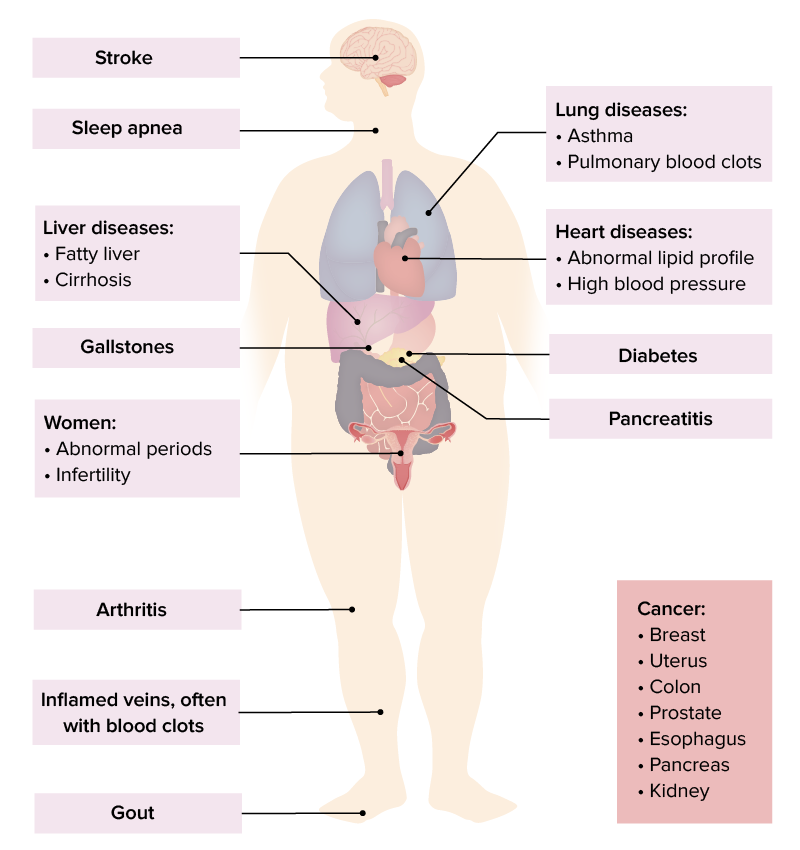
La obesidad está asociada a un aumento de la mortalidad y tiene un impacto negativo en EN Erythema nodosum is an immune-mediated panniculitis (inflammation of the subcutaneous fat) caused by a type IV (delayed-type) hypersensitivity reaction. It commonly manifests in young women as tender, erythematous nodules on the shins. Erythema Nodosum casi todos los LOS Neisseria sistemas de órganos. La obesidad abdominal se asocia específicamente con un mayor riesgo cardiovascular.

Los LOS Neisseria efectos que se observan comúnmente son:
  • Cardiovasculares:
    • Enfermedad arterial coronaria
    • Hipertensión
    • Cardiomiopatía
    • Hipertrofia ventricular
    • Insuficiencia cardíaca
    • Venas varicosas (várices)
    • Trombosis venosa profunda (TVP)
  • Respiratorios:
    • Apnea obstructiva del sueño
    • Asma ASMA Autoimmune Hepatitis
    • Infecciones respiratorias
    • Síndrome de hipoventilación por obesidad
  • Neurológicos:
    • Mayor riesgo de accidente cerebrovascular hemorrágico e isquémico en EN Erythema nodosum is an immune-mediated panniculitis (inflammation of the subcutaneous fat) caused by a type IV (delayed-type) hypersensitivity reaction. It commonly manifests in young women as tender, erythematous nodules on the shins. Erythema Nodosum los LOS Neisseria hombres
    • Meralgia parestésica (compresión del nervio cutáneo lateral del muslo)
  • Genitourinarios/reproductivos:
    • Síndrome de ovario poliquístico (SOP)
    • Bebés macrosómicos y posterior distocia pélvica
    • Incontinencia de esfuerzo
  • Dermatológicos:
    • Mayor riesgo de infección y celulitis debido a la mala circulación
    • Acantosis nigricans secundaria a cambios metabólicos
  • Endocrinos/metabólicos:
    • Diabetes Diabetes Diabetes mellitus (DM) is a metabolic disease characterized by hyperglycemia and dysfunction of the regulation of glucose metabolism by insulin. Type 1 DM is diagnosed mostly in children and young adults as the result of autoimmune destruction of β cells in the pancreas and the resulting lack of insulin. Type 2 DM has a significant association with obesity and is characterized by insulin resistance. Diabetes Mellitus mellitus tipo 2
    • Síndrome metabólico
    • Dislipidemia
    • Hipercolesterolemia
  • Gastrointestinales:
    • Enfermedad de la vesícula biliar
    • ERGE
  • Músculo-esqueléticos: osteoartrosis ( OA OA Osteoarthritis (OA) is the most common form of arthritis, and is due to cartilage destruction and changes of the subchondral bone. The risk of developing this disorder increases with age, obesity, and repetitive joint use or trauma. Patients develop gradual joint pain, stiffness lasting < 30 minutes, and decreased range of motion. Osteoarthritis) de rodilla
  • Hematológicos/oncológicos:
    • Linfadenopatías
    • ↑ Riesgo de cáncer de pulmón, páncreas, renal y gástrico en EN Erythema nodosum is an immune-mediated panniculitis (inflammation of the subcutaneous fat) caused by a type IV (delayed-type) hypersensitivity reaction. It commonly manifests in young women as tender, erythematous nodules on the shins. Erythema Nodosum ambos sexos
    • ↑ Riesgo de cáncer de endometrio, ovario y mama en EN Erythema nodosum is an immune-mediated panniculitis (inflammation of the subcutaneous fat) caused by a type IV (delayed-type) hypersensitivity reaction. It commonly manifests in young women as tender, erythematous nodules on the shins. Erythema Nodosum las mujeres
    • ↑ Riesgo de cáncer de próstata, colon Colon The large intestines constitute the last portion of the digestive system. The large intestine consists of the cecum, appendix, colon (with ascending, transverse, descending, and sigmoid segments), rectum, and anal canal. The primary function of the colon is to remove water and compact the stool prior to expulsion from the body via the rectum and anal canal. Colon, Cecum, and Appendix: Anatomy y recto en EN Erythema nodosum is an immune-mediated panniculitis (inflammation of the subcutaneous fat) caused by a type IV (delayed-type) hypersensitivity reaction. It commonly manifests in young women as tender, erythematous nodules on the shins. Erythema Nodosum los LOS Neisseria hombres
Complications of obesity

Una muestra de las complicaciones de la obesidad

Imagen por Lecturio.
Diagnóstico

Antecedentes

  • Identifique los LOS Neisseria factores que contribuyen a la obesidad:
    • Estilo de vida (ocupación, ejercicio)
    • Dieta/ingesta calórica
    • Duración de un problema/edad de inicio
    • Intentos anteriores de pérdida de peso
    • Dejar de fumar (puede estimular el aumento de la ingesta calórica)
    • Antecedentes familiares
  • Descarte causas secundarias:
    • Medicamentos (e.g., esteroides, antipsicóticos)
    • Patologías:
      • Hipotiroidismo
      • Síndrome de Cushing

Examen físico

  • Los LOS Neisseria individuos deben ser examinados para obtener medidas del IMC.
  • Hay algunas advertencias en EN Erythema nodosum is an immune-mediated panniculitis (inflammation of the subcutaneous fat) caused by a type IV (delayed-type) hypersensitivity reaction. It commonly manifests in young women as tender, erythematous nodules on the shins. Erythema Nodosum el uso del IMC:
    • El IMC no tiene en EN Erythema nodosum is an immune-mediated panniculitis (inflammation of the subcutaneous fat) caused by a type IV (delayed-type) hypersensitivity reaction. It commonly manifests in young women as tender, erythematous nodules on the shins. Erythema Nodosum cuenta el porcentaje de peso que es músculo frente a la grasa, y puede sobrestimar la adiposidad en EN Erythema nodosum is an immune-mediated panniculitis (inflammation of the subcutaneous fat) caused by a type IV (delayed-type) hypersensitivity reaction. It commonly manifests in young women as tender, erythematous nodules on the shins. Erythema Nodosum individuos musculosos (i.e., atletas, fisicoculturistas).
    • El IMC puede subestimar la adiposidad en EN Erythema nodosum is an immune-mediated panniculitis (inflammation of the subcutaneous fat) caused by a type IV (delayed-type) hypersensitivity reaction. It commonly manifests in young women as tender, erythematous nodules on the shins. Erythema Nodosum individuos, como los LOS Neisseria ancianos, que pueden haber perdido masa muscular como consecuencia del envejecimiento.
    • El IMC no tiene en EN Erythema nodosum is an immune-mediated panniculitis (inflammation of the subcutaneous fat) caused by a type IV (delayed-type) hypersensitivity reaction. It commonly manifests in young women as tender, erythematous nodules on the shins. Erythema Nodosum cuenta la distribución de la grasa corporal, como la obesidad abdominal, que es un factor de riesgo en EN Erythema nodosum is an immune-mediated panniculitis (inflammation of the subcutaneous fat) caused by a type IV (delayed-type) hypersensitivity reaction. It commonly manifests in young women as tender, erythematous nodules on the shins. Erythema Nodosum sí mismo.
  • El porcentaje de grasa corporal puede ser una herramienta más precisa para evaluar a los LOS Neisseria individuos musculosos.
  • El perímetro de la cintura debe medirse en EN Erythema nodosum is an immune-mediated panniculitis (inflammation of the subcutaneous fat) caused by a type IV (delayed-type) hypersensitivity reaction. It commonly manifests in young women as tender, erythematous nodules on the shins. Erythema Nodosum individuos con un IMC que oscile entre 25–35 para evaluar la adiposidad abdominal.
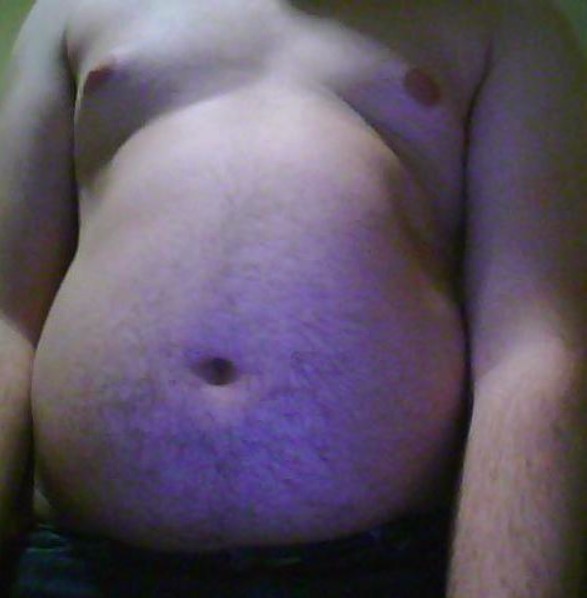
Vientre de un adolescente obeso

Obesidad abdominal

Imagen: “Belly of an obese teenage boy” por OctoMocto. Licencia: Dominio Público

Análisis de laboratorio

  • Glucosa en EN Erythema nodosum is an immune-mediated panniculitis (inflammation of the subcutaneous fat) caused by a type IV (delayed-type) hypersensitivity reaction. It commonly manifests in young women as tender, erythematous nodules on the shins. Erythema Nodosum ayunas y/o HbA1c HbA1c Products of non-enzymatic reactions between glucose and hemoglobin a, occurring as a minor fraction of the hemoglobin components of human erythrocytes. Hemoglobin a1c is hemoglobin a with glucose covalently bound to the terminal valine of the beta chain. Glycated hemoglobin a is used as an index of the average blood sugar level over a lifetime of erythrocytes. Diabetes Mellitus
  • Hormona estimulante de la tiroides (TSH, por sus siglas en EN Erythema nodosum is an immune-mediated panniculitis (inflammation of the subcutaneous fat) caused by a type IV (delayed-type) hypersensitivity reaction. It commonly manifests in young women as tender, erythematous nodules on the shins. Erythema Nodosum inglés)
  • Enzimas hepáticas
  • Lípidos en EN Erythema nodosum is an immune-mediated panniculitis (inflammation of the subcutaneous fat) caused by a type IV (delayed-type) hypersensitivity reaction. It commonly manifests in young women as tender, erythematous nodules on the shins. Erythema Nodosum ayunas
  • Colesterol
  • Deben realizarse más pruebas si los LOS Neisseria antecedentes, los LOS Neisseria hallazgos del examen físico o los LOS Neisseria análisis iniciales hacen sospechar de causas secundarias:

Tratamiento

Objetivos del tratamiento

  • Prevenir, tratar o revertir la morbilidad relacionada con la obesidad
  • La pérdida del 5%–7% del peso corporal se asocia a la reducción del riesgo de diabetes Diabetes Diabetes mellitus (DM) is a metabolic disease characterized by hyperglycemia and dysfunction of the regulation of glucose metabolism by insulin. Type 1 DM is diagnosed mostly in children and young adults as the result of autoimmune destruction of β cells in the pancreas and the resulting lack of insulin. Type 2 DM has a significant association with obesity and is characterized by insulin resistance. Diabetes Mellitus, hipertensión y dislipidemia.
  • En EN Erythema nodosum is an immune-mediated panniculitis (inflammation of the subcutaneous fat) caused by a type IV (delayed-type) hypersensitivity reaction. It commonly manifests in young women as tender, erythematous nodules on the shins. Erythema Nodosum individuos con un IMC > 30, la pérdida de peso de aproximadamente 11,3 kg (25 libras) se asocia con un menor riesgo de enfermedades cardiovasculares, cáncer y mortalidad general.

Modificaciones del estilo de vida/comportamiento

  • Primer paso en EN Erythema nodosum is an immune-mediated panniculitis (inflammation of the subcutaneous fat) caused by a type IV (delayed-type) hypersensitivity reaction. It commonly manifests in young women as tender, erythematous nodules on the shins. Erythema Nodosum el tratamiento de la obesidad
  • Cambios en EN Erythema nodosum is an immune-mediated panniculitis (inflammation of the subcutaneous fat) caused by a type IV (delayed-type) hypersensitivity reaction. It commonly manifests in young women as tender, erythematous nodules on the shins. Erythema Nodosum la dieta:
    • Disminución de la ingesta calórica en EN Erythema nodosum is an immune-mediated panniculitis (inflammation of the subcutaneous fat) caused by a type IV (delayed-type) hypersensitivity reaction. It commonly manifests in young women as tender, erythematous nodules on the shins. Erythema Nodosum relación con el gasto calórico
    • Ingesta calórica recomendada para la pérdida de peso 800–1200 kcal/día
    • El tipo específico de dieta no es tan importante, pero se deben recomendar opciones alimentarias más saludables en EN Erythema nodosum is an immune-mediated panniculitis (inflammation of the subcutaneous fat) caused by a type IV (delayed-type) hypersensitivity reaction. It commonly manifests in young women as tender, erythematous nodules on the shins. Erythema Nodosum general.
  • Aumentar la actividad física/ejercicio
  • Terapia/modificación del comportamiento:
    • Se recomienda ayudar a los LOS Neisseria pacientes a realizar cambios a largo plazo.
    • Animar a los LOS Neisseria pacientes a modificar y controlar la ingesta de alimentos y la actividad física y aumentar la consciencia de los LOS Neisseria factores desencadenantes que estimulan la alimentación
    • Crear objetivos realistas a corto plazo para cambiar el comportamiento de los LOS Neisseria pacientes y desarrollar un plan para lograr los LOS Neisseria objetivos
  • Educación del paciente:
    • Educar al AL Amyloidosis paciente sobre los LOS Neisseria riesgos y beneficios asociados a su peso y hábitos de vida
    • Aconsejar a los LOS Neisseria pacientes sobre hábitos de nutrición más saludables y opciones de actividad física

Medicamentos

Los LOS Neisseria medicamentos para bajar de peso se reservan para los LOS Neisseria pacientes con estas características:

  • No han conseguido perder > 5% del peso corporal total en EN Erythema nodosum is an immune-mediated panniculitis (inflammation of the subcutaneous fat) caused by a type IV (delayed-type) hypersensitivity reaction. It commonly manifests in young women as tender, erythematous nodules on the shins. Erythema Nodosum un plazo de 3–6 meses tras modificar únicamente el estilo de vida Y tienen
  • IMC ≥ 27 con comorbilidades
  • IMC de 30 con o sin comorbilidades

Consideraciones y resultados:

  • El uso de medicamentos para la pérdida de peso suele dar lugar a una pérdida de peso de 4%–8% del peso corporal durante un período de 6–12 meses.
  • La combinación de cambios en EN Erythema nodosum is an immune-mediated panniculitis (inflammation of the subcutaneous fat) caused by a type IV (delayed-type) hypersensitivity reaction. It commonly manifests in young women as tender, erythematous nodules on the shins. Erythema Nodosum el estilo de vida/conducta con medicamentos para perder peso da como resultado una mayor pérdida de peso que con los LOS Neisseria medicamentos solos.
  • La elección del agente contra la obesidad se basa en EN Erythema nodosum is an immune-mediated panniculitis (inflammation of the subcutaneous fat) caused by a type IV (delayed-type) hypersensitivity reaction. It commonly manifests in young women as tender, erythematous nodules on the shins. Erythema Nodosum las comorbilidades y las contraindicaciones relativas relevantes para el paciente.
  • La pérdida de peso, la presión arterial y la frecuencia cardíaca del paciente deben ser vigiladas estrechamente mientras dure el tratamiento médico.
  • La interrupción del medicamento para adelgazar se ha HA Hemolytic anemia (HA) is the term given to a large group of anemias that are caused by the premature destruction/hemolysis of circulating red blood cells (RBCs). Hemolysis can occur within (intravascular hemolysis) or outside the blood vessels (extravascular hemolysis). Hemolytic Anemia asociado a la recuperación de peso.

Duración:

  • Si el paciente no pierde 4%–5% de su peso corporal inicial a las 12 semanas con la dosis máxima tolerada, el medicamento debe titularse y suspenderse.
  • Se puede considerar la continuación del medicamento para adelgazar a largo plazo si:
    • El medicamento ha HA Hemolytic anemia (HA) is the term given to a large group of anemias that are caused by the premature destruction/hemolysis of circulating red blood cells (RBCs). Hemolysis can occur within (intravascular hemolysis) or outside the blood vessels (extravascular hemolysis). Hemolytic Anemia sido bien tolerado.
    • Se ha HA Hemolytic anemia (HA) is the term given to a large group of anemias that are caused by the premature destruction/hemolysis of circulating red blood cells (RBCs). Hemolysis can occur within (intravascular hemolysis) or outside the blood vessels (extravascular hemolysis). Hemolytic Anemia producido una reducción de peso de al AL Amyloidosis menos 5% respecto al AL Amyloidosis inicio y ha HA Hemolytic anemia (HA) is the term given to a large group of anemias that are caused by the premature destruction/hemolysis of circulating red blood cells (RBCs). Hemolysis can occur within (intravascular hemolysis) or outside the blood vessels (extravascular hemolysis). Hemolytic Anemia durado 6 meses después de comenzar con el medicamento.
  • Los LOS Neisseria siguientes medicamentos están aprobados para su uso a corto plazo (<12 semanas):
    • Sustancias controladas con efectos similares a los LOS Neisseria de las anfetaminas y con potencial de abuso:
      • Fentermina
      • Benzfetamina
      • Dietilpropión
      • Fendimetrazina
    • Los LOS Neisseria siguientes medicamentos están aprobados para su uso a largo plazo en EN Erythema nodosum is an immune-mediated panniculitis (inflammation of the subcutaneous fat) caused by a type IV (delayed-type) hypersensitivity reaction. It commonly manifests in young women as tender, erythematous nodules on the shins. Erythema Nodosum el control de la pérdida de peso:
      • Agonistas del péptido similar al AL Amyloidosis glucagón tipo 1 ( GLP-1 GLP-1 A peptide of 36 or 37 amino acids that is derived from proglucagon and mainly produced by the intestinal l cells. Glp-1(1-37 or 1-36) is further n-terminally truncated resulting in glp-1(7-37) or glp-1-(7-36) which can be amidated. These glp-1 peptides are known to enhance glucose-dependent insulin release, suppress glucagon release and gastric emptying, lower blood glucose, and reduce food intake. Insulinomas) (también aprobado para tratar la diabetes Diabetes Diabetes mellitus (DM) is a metabolic disease characterized by hyperglycemia and dysfunction of the regulation of glucose metabolism by insulin. Type 1 DM is diagnosed mostly in children and young adults as the result of autoimmune destruction of β cells in the pancreas and the resulting lack of insulin. Type 2 DM has a significant association with obesity and is characterized by insulin resistance. Diabetes Mellitus de tipo 2 con diferentes nombres comerciales): semaglutida o liraglutida
      • Orlistat
      • Fentermina-topiramato
      • Naltrexona-bupropión
    • La setmelanotida está aprobada para las causas genéticas de la obesidad, entre ellas:
      • Deficiencia de proopiomelanocortina (POMC)
      • Deficiencia de proproteína convertasa subtilisina/kexina tipo 1 (PCSK1)
      • Deficiencia del receptor Receptor Receptors are proteins located either on the surface of or within a cell that can bind to signaling molecules known as ligands (e.g., hormones) and cause some type of response within the cell. Receptors de leptina (LEPR)

También pueden ser necesarios medicamentos para controlar comorbilidades como la hipertensión, la diabetes Diabetes Diabetes mellitus (DM) is a metabolic disease characterized by hyperglycemia and dysfunction of the regulation of glucose metabolism by insulin. Type 1 DM is diagnosed mostly in children and young adults as the result of autoimmune destruction of β cells in the pancreas and the resulting lack of insulin. Type 2 DM has a significant association with obesity and is characterized by insulin resistance. Diabetes Mellitus, la hiperlipidemia y la depresión:

  • Si es posible, evite los LOS Neisseria medicamentos asociados al AL Amyloidosis aumento de peso.
  • Seleccione los LOS Neisseria medicamentos que también puedan dar como resultado una pérdida de peso.
  • Ejemplos de medicamentos que pueden ayudar a perder peso:
    • Metformina o semaglutida (Ozempic) utilizados en EN Erythema nodosum is an immune-mediated panniculitis (inflammation of the subcutaneous fat) caused by a type IV (delayed-type) hypersensitivity reaction. It commonly manifests in young women as tender, erythematous nodules on the shins. Erythema Nodosum el tratamiento de la diabetes Diabetes Diabetes mellitus (DM) is a metabolic disease characterized by hyperglycemia and dysfunction of the regulation of glucose metabolism by insulin. Type 1 DM is diagnosed mostly in children and young adults as the result of autoimmune destruction of β cells in the pancreas and the resulting lack of insulin. Type 2 DM has a significant association with obesity and is characterized by insulin resistance. Diabetes Mellitus
    • Fluoxetina (Prozac) utilizada en EN Erythema nodosum is an immune-mediated panniculitis (inflammation of the subcutaneous fat) caused by a type IV (delayed-type) hypersensitivity reaction. It commonly manifests in young women as tender, erythematous nodules on the shins. Erythema Nodosum el tratamiento de trastornos psiquiátricos

Cirugía bariátrica

  • Se puede observar una pérdida de peso de hasta el 40% del peso inicial a los LOS Neisseria 12–18 meses de la intervención.
  • Indicaciones:
    • IMC > 40 kg/m2
    • IMC > 35 kg/m2 con comorbilidades (hipertensión, diabetes Diabetes Diabetes mellitus (DM) is a metabolic disease characterized by hyperglycemia and dysfunction of the regulation of glucose metabolism by insulin. Type 1 DM is diagnosed mostly in children and young adults as the result of autoimmune destruction of β cells in the pancreas and the resulting lack of insulin. Type 2 DM has a significant association with obesity and is characterized by insulin resistance. Diabetes Mellitus grave, apnea del sueño, OA OA Osteoarthritis (OA) is the most common form of arthritis, and is due to cartilage destruction and changes of the subchondral bone. The risk of developing this disorder increases with age, obesity, and repetitive joint use or trauma. Patients develop gradual joint pain, stiffness lasting < 30 minutes, and decreased range of motion. Osteoarthritis)
    • IMC > 30 kg/m2 con diabetes Diabetes Diabetes mellitus (DM) is a metabolic disease characterized by hyperglycemia and dysfunction of the regulation of glucose metabolism by insulin. Type 1 DM is diagnosed mostly in children and young adults as the result of autoimmune destruction of β cells in the pancreas and the resulting lack of insulin. Type 2 DM has a significant association with obesity and is characterized by insulin resistance. Diabetes Mellitus de tipo 2, refractaria a las medidas de tratamiento o síndrome metabólico
    • Fracaso de los LOS Neisseria intentos conservadores de pérdida de peso
  • Se recomienda un examen psicológico antes de someterse a una intervención quirúrgica.
  • El mejor medio para curar las complicaciones relacionadas con la obesidad (hipertensión, diabetes Diabetes Diabetes mellitus (DM) is a metabolic disease characterized by hyperglycemia and dysfunction of the regulation of glucose metabolism by insulin. Type 1 DM is diagnosed mostly in children and young adults as the result of autoimmune destruction of β cells in the pancreas and the resulting lack of insulin. Type 2 DM has a significant association with obesity and is characterized by insulin resistance. Diabetes Mellitus)
  • Opciones quirúrgicas:
    • Gastrectomía en EN Erythema nodosum is an immune-mediated panniculitis (inflammation of the subcutaneous fat) caused by a type IV (delayed-type) hypersensitivity reaction. It commonly manifests in young women as tender, erythematous nodules on the shins. Erythema Nodosum manga
    • Bypass gástrico en EN Erythema nodosum is an immune-mediated panniculitis (inflammation of the subcutaneous fat) caused by a type IV (delayed-type) hypersensitivity reaction. It commonly manifests in young women as tender, erythematous nodules on the shins. Erythema Nodosum Y de Roux
    • Banda gástrica laparoscópica
    • Balón intragástrico
  • Se puede observar una pérdida de peso de hasta el 40% del peso inicial a los LOS Neisseria 12-18 meses de la intervención.

Relevancia Clínica

Causas secundarias de obesidad

  • Hipotiroidismo: Condición causada por la deficiencia de T3 T3 A T3 thyroid hormone normally synthesized and secreted by the thyroid gland in much smaller quantities than thyroxine (T4). Most T3 is derived from peripheral monodeiodination of T4 at the 5′ position of the outer ring of the iodothyronine nucleus. The hormone finally delivered and used by the tissues is mainly t3. Thyroid Hormones y T4 T4 The major hormone derived from the thyroid gland. Thyroxine is synthesized via the iodination of tyrosines (monoiodotyrosine) and the coupling of iodotyrosines (diiodotyrosine) in the thyroglobulin. Thyroxine is released from thyroglobulin by proteolysis and secreted into the blood. Thyroxine is peripherally deiodinated to form triiodothyronine which exerts a broad spectrum of stimulatory effects on cell metabolism. Thyroid Hormones. Las características clínicas del hipotiroidismo reflejan los LOS Neisseria efectos de la disminución de la tasa metabólica e incluyen fatiga, bradicardia, intolerancia al AL Amyloidosis frío y aumento de peso. El diagnóstico se basa en EN Erythema nodosum is an immune-mediated panniculitis (inflammation of the subcutaneous fat) caused by a type IV (delayed-type) hypersensitivity reaction. It commonly manifests in young women as tender, erythematous nodules on the shins. Erythema Nodosum las pruebas de la función tiroidea. Se observa una elevación de la hormona estimulante de la tiroides y una disminución de la tiroxina libre ( T4 T4 The major hormone derived from the thyroid gland. Thyroxine is synthesized via the iodination of tyrosines (monoiodotyrosine) and the coupling of iodotyrosines (diiodotyrosine) in the thyroglobulin. Thyroxine is released from thyroglobulin by proteolysis and secreted into the blood. Thyroxine is peripherally deiodinated to form triiodothyronine which exerts a broad spectrum of stimulatory effects on cell metabolism. Thyroid Hormones). El tratamiento es con T4 T4 The major hormone derived from the thyroid gland. Thyroxine is synthesized via the iodination of tyrosines (monoiodotyrosine) and the coupling of iodotyrosines (diiodotyrosine) in the thyroglobulin. Thyroxine is released from thyroglobulin by proteolysis and secreted into the blood. Thyroxine is peripherally deiodinated to form triiodothyronine which exerts a broad spectrum of stimulatory effects on cell metabolism. Thyroid Hormones sintética.
  • Síndrome de Cushing: Trastorno que se produce por hipercortisolismo. El síndrome de Cushing puede ser el resultado del uso excesivo de corticosteroides o de algo en EN Erythema nodosum is an immune-mediated panniculitis (inflammation of the subcutaneous fat) caused by a type IV (delayed-type) hypersensitivity reaction. It commonly manifests in young women as tender, erythematous nodules on the shins. Erythema Nodosum el cuerpo que produce un exceso de cortisol Cortisol Glucocorticoids. Las características clínicas incluyen obesidad central, cara de luna redonda, joroba de tejido graso en EN Erythema nodosum is an immune-mediated panniculitis (inflammation of the subcutaneous fat) caused by a type IV (delayed-type) hypersensitivity reaction. It commonly manifests in young women as tender, erythematous nodules on the shins. Erythema Nodosum la parte superior de la espalda/cuello, estrías abdominales y fácil aparición de hematomas. El síndrome de Cushing se asocia con la hipertensión y la hiperglucemia. El diagnóstico se basa en EN Erythema nodosum is an immune-mediated panniculitis (inflammation of the subcutaneous fat) caused by a type IV (delayed-type) hypersensitivity reaction. It commonly manifests in young women as tender, erythematous nodules on the shins. Erythema Nodosum la medición de los LOS Neisseria niveles de cortisol Cortisol Glucocorticoids. El tratamiento depende de la causa del nivel excesivo de cortisol Cortisol Glucocorticoids.
  • Síndrome de Prader-Willi: Un raro trastorno genético del neurodesarrollo. El síndrome de Prader-Willi se asocia a hipotonía, baja estatura, discapacidad intelectual y obesidad. Se ha HA Hemolytic anemia (HA) is the term given to a large group of anemias that are caused by the premature destruction/hemolysis of circulating red blood cells (RBCs). Hemolysis can occur within (intravascular hemolysis) or outside the blood vessels (extravascular hemolysis). Hemolytic Anemia planteado la hipótesis de que los LOS Neisseria niveles extremadamente altos de grelina en EN Erythema nodosum is an immune-mediated panniculitis (inflammation of the subcutaneous fat) caused by a type IV (delayed-type) hypersensitivity reaction. It commonly manifests in young women as tender, erythematous nodules on the shins. Erythema Nodosum los LOS Neisseria pacientes son los LOS Neisseria responsables de la obesidad, la hiperfagia y el apetito voraz. Las pruebas genéticas confirman el diagnóstico. Un enfoque de tratamiento multidisciplinar incluye el control del peso, una serie de terapias (i.e., física, lingüística, conductual) y tratamientos específicos para la enfermedad.

Trastornos relacionados con la obesidad

  • SOP: Un trastorno endocrino común que afecta a las mujeres en EN Erythema nodosum is an immune-mediated panniculitis (inflammation of the subcutaneous fat) caused by a type IV (delayed-type) hypersensitivity reaction. It commonly manifests in young women as tender, erythematous nodules on the shins. Erythema Nodosum edad reproductiva. El síndrome de ovario poliquístico se caracteriza por el hiperandrogenismo, los LOS Neisseria ciclos menstruales irregulares y la disfunción metabólica, y se sabe que aumenta el riesgo de infertilidad y de enfermedades cardiovasculares. La etiología es incierta, pero se cree que la genética y el exceso de niveles hormonales desempeñan un papel en EN Erythema nodosum is an immune-mediated panniculitis (inflammation of the subcutaneous fat) caused by a type IV (delayed-type) hypersensitivity reaction. It commonly manifests in young women as tender, erythematous nodules on the shins. Erythema Nodosum su fisiopatología. El diagnóstico se basa en EN Erythema nodosum is an immune-mediated panniculitis (inflammation of the subcutaneous fat) caused by a type IV (delayed-type) hypersensitivity reaction. It commonly manifests in young women as tender, erythematous nodules on the shins. Erythema Nodosum la exclusión. El tratamiento incluye el intento de restaurar la ovulación normal mediante la pérdida de peso, las píldoras anticonceptivas orales, y terapias de fertilidad.
  • Síndrome metabólico: Grupo de trastornos que incluyen la hipertensión, el deterioro de los LOS Neisseria niveles de glucosa en EN Erythema nodosum is an immune-mediated panniculitis (inflammation of the subcutaneous fat) caused by a type IV (delayed-type) hypersensitivity reaction. It commonly manifests in young women as tender, erythematous nodules on the shins. Erythema Nodosum ayunas, la dislipidemia y un perímetro de cintura aumentado. Los LOS Neisseria pacientes suelen tener sobrepeso con una distribución predominante de la grasa central (abdominal). El diagnóstico se realiza basándose en EN Erythema nodosum is an immune-mediated panniculitis (inflammation of the subcutaneous fat) caused by a type IV (delayed-type) hypersensitivity reaction. It commonly manifests in young women as tender, erythematous nodules on the shins. Erythema Nodosum la presencia de las condiciones anteriores tras el examen y los LOS Neisseria análisis de sangre. La gestión implica cambios en EN Erythema nodosum is an immune-mediated panniculitis (inflammation of the subcutaneous fat) caused by a type IV (delayed-type) hypersensitivity reaction. It commonly manifests in young women as tender, erythematous nodules on the shins. Erythema Nodosum el estilo de vida y medicamentos para controlar los LOS Neisseria problemas de salud asociados.
  • Diabetes Diabetes Diabetes mellitus (DM) is a metabolic disease characterized by hyperglycemia and dysfunction of the regulation of glucose metabolism by insulin. Type 1 DM is diagnosed mostly in children and young adults as the result of autoimmune destruction of β cells in the pancreas and the resulting lack of insulin. Type 2 DM has a significant association with obesity and is characterized by insulin resistance. Diabetes Mellitus mellitus de tipo 2: Trastorno metabólico caracterizado por una hiperglucemia crónica con un elevado nivel de azúcar en EN Erythema nodosum is an immune-mediated panniculitis (inflammation of the subcutaneous fat) caused by a type IV (delayed-type) hypersensitivity reaction. It commonly manifests in young women as tender, erythematous nodules on the shins. Erythema Nodosum la orina. La diabetes Diabetes Diabetes mellitus (DM) is a metabolic disease characterized by hyperglycemia and dysfunction of the regulation of glucose metabolism by insulin. Type 1 DM is diagnosed mostly in children and young adults as the result of autoimmune destruction of β cells in the pancreas and the resulting lack of insulin. Type 2 DM has a significant association with obesity and is characterized by insulin resistance. Diabetes Mellitus mellitus de tipo 2 es el resultado de la resistencia a la insulina en EN Erythema nodosum is an immune-mediated panniculitis (inflammation of the subcutaneous fat) caused by a type IV (delayed-type) hypersensitivity reaction. It commonly manifests in young women as tender, erythematous nodules on the shins. Erythema Nodosum los LOS Neisseria tejidos y/o la incapacidad del páncreas para sintetizar la insulina adecuada. Los LOS Neisseria síntomas incluyen aumento de la sed, micción frecuente, aumento del hambre, fatiga y parestesias. Los LOS Neisseria análisis de sangre se utilizan para confirmar el diagnóstico. El manejo implica cambios en EN Erythema nodosum is an immune-mediated panniculitis (inflammation of the subcutaneous fat) caused by a type IV (delayed-type) hypersensitivity reaction. It commonly manifests in young women as tender, erythematous nodules on the shins. Erythema Nodosum el estilo de vida y medicamentos.
  • Apnea obstructiva del sueño: Enfermedad caracterizada por una apnea episódica o cese de la respiración durante el sueño, en EN Erythema nodosum is an immune-mediated panniculitis (inflammation of the subcutaneous fat) caused by a type IV (delayed-type) hypersensitivity reaction. It commonly manifests in young women as tender, erythematous nodules on the shins. Erythema Nodosum la que el periodo de apnea dura > 10 segundos. La apnea obstructiva del sueño es el resultado de un colapso parcial o total de las vías respiratorias superiores y se asocia con ronquidos, inquietud, dolor Dolor Inflammation de cabeza durante el día y somnolencia. Un estudio del sueño sirve para confirmar el diagnóstico. El tratamiento implica la pérdida de peso y el uso de dispositivos, como una de la presión positiva continua en EN Erythema nodosum is an immune-mediated panniculitis (inflammation of the subcutaneous fat) caused by a type IV (delayed-type) hypersensitivity reaction. It commonly manifests in young women as tender, erythematous nodules on the shins. Erythema Nodosum la vía aérea ( CPAP CPAP A technique of respiratory therapy, in either spontaneously breathing or mechanically ventilated patients, in which airway pressure is maintained above atmospheric pressure throughout the respiratory cycle by pressurization of the ventilatory circuit. Noninvasive Ventilation, por sus siglas en EN Erythema nodosum is an immune-mediated panniculitis (inflammation of the subcutaneous fat) caused by a type IV (delayed-type) hypersensitivity reaction. It commonly manifests in young women as tender, erythematous nodules on the shins. Erythema Nodosum inglés), que ayuda a mantener las vías respiratorias abiertas.
  • Meralgia parestésica: Enfermedad causada por la compresión del nervio cutáneo femoral lateral, que suministra sensibilidad a la parte superior del muslo lateral. La meralgia parestésica se caracteriza por el hormigueo, el entumecimiento y el dolor Dolor Inflammation urente en EN Erythema nodosum is an immune-mediated panniculitis (inflammation of the subcutaneous fat) caused by a type IV (delayed-type) hypersensitivity reaction. It commonly manifests in young women as tender, erythematous nodules on the shins. Erythema Nodosum la parte externa de la parte lateral superior del muslo y es frecuente en EN Erythema nodosum is an immune-mediated panniculitis (inflammation of the subcutaneous fat) caused by a type IV (delayed-type) hypersensitivity reaction. It commonly manifests in young women as tender, erythematous nodules on the shins. Erythema Nodosum personas con un IMC elevado. El diagnóstico se basa en EN Erythema nodosum is an immune-mediated panniculitis (inflammation of the subcutaneous fat) caused by a type IV (delayed-type) hypersensitivity reaction. It commonly manifests in young women as tender, erythematous nodules on the shins. Erythema Nodosum los LOS Neisseria antecedentes y el examen, aunque pueden realizarse pruebas para descartar otras afecciones. El tratamiento consiste en EN Erythema nodosum is an immune-mediated panniculitis (inflammation of the subcutaneous fat) caused by a type IV (delayed-type) hypersensitivity reaction. It commonly manifests in young women as tender, erythematous nodules on the shins. Erythema Nodosum la pérdida de peso, la terapia farmacológica, las inyecciones de esteroides y, en EN Erythema nodosum is an immune-mediated panniculitis (inflammation of the subcutaneous fat) caused by a type IV (delayed-type) hypersensitivity reaction. It commonly manifests in young women as tender, erythematous nodules on the shins. Erythema Nodosum casos raros, la descompresión quirúrgica.

Referencias

  1. Cleveland Clinic. (2025). Class III obesity (formerly known as morbid obesity). https://my.clevelandclinic.org/health/diseases/21989-class-iii-obesity-formerly-known-as-morbid-obesity
  2. First aid step 1, 327, 365, 486
  3. Perreault, L. (2025). Obesity in adults: Prevalence, screening, and evaluation. UpToDate. Retrieved April 8, 2025, from https://www.uptodate.com/contents/obesity-in-adults-prevalence-screening-and-evaluation
  4. Perreault, L. (2025). Obesity in adults: Drug therapy. UpToDate. Retrieved April 8, 2025, from https://www.uptodate.com/contents/obesity-in-adults-drug-therapy
  5. Perreault, L., Apovian, C. (2025). Obesity in adults: Overview of management. UpToDate. Retrieved April 8, 2025, from https://www.uptodate.com/contents/obesity-in-adults-overview-of-management
  6. Lim, R.B. (2025). Bariatric procedures for the management of severe obesity: Descriptions. UpToDate. Retrieved April 8, 2025, from https://www.uptodate.com/contents/bariatric-procedures-for-the-management-of-severe-obesity-descriptions
  7. Ellsmere, J. C. (2023, July 18). Bariatric operations: Late complications with subacute presentations. In D. Jones & W. Chen (Eds.), UpToDate. Retrieved April 8, 2025, from https://www.uptodate.com/contents/bariatric-operations-late-complications-with-subacute-presentations
  8. Le, T., Dehlendorf, C., Mendoza, M., Ohata, C. (2008). First aid for the family medicine boards. McGraw-Hill. 
  9. Perreault, L., Rosenbaum, M. (2025). Obesity: Genetic contribution and pathophysiology. UpToDate. Retrieved April 8, 2025, from https://www.uptodate.com/contents/obesity-genetic-contribution-and-pathophysiology
  10. Klok, M.D., Jakobsdottir, S., Drent, M. L. (2006). The role of leptin and ghrelin in the regulation of food intake and body weight in humans: A review. Obesity Reviews. https://doi.org/10.1111/j.1467-789X.2006.00270.x

¡Crea tu cuenta gratis o inicia una sesión para seguir leyendo!

Regístrate ahora y obtén acceso gratuito a Lecturio con páginas de concepto, videos médicos y cuestionarios para tu educación médica.

User Reviews

Que tengas una sesión de estudio alegre y navideña 🎁 Ahorra 50% en todos los planes >>

Details